

Railway PSU Stocks List 2026: Complete Guide to IRFC, RVNL, IRCTC & Every Listed Railway PSU in India
Published: July 2026 | Category: Share Market | Reading Time: ~15 min
Indian Railways just received its largest-ever budget — ₹2.93 lakh crore in FY 2026–27, a 5.4% jump over the previous year. Seven high-speed rail corridors are being planned from scratch. Kavach safety technology is rolling out across 18,000 km of high-density track. And yet, if you search for a proper Railway PSU stocks list that actually tells you what each company does, how it makes money, and what the risks are — most pages give you a generic table and nothing else.
This guide is different. We’ve broken down every major Railway PSU stock listed on NSE and BSE — their business model, latest financials, government backing, growth triggers, and the honest risks. Whether you’re a first-time investor or someone building a long-term infrastructure portfolio, this is the most complete Railway PSU reference you’ll find for 2026.
Before you invest, use MoneyOra’s free Stock Return Calculator to model what historical railway stock returns might look like in your portfolio over time.
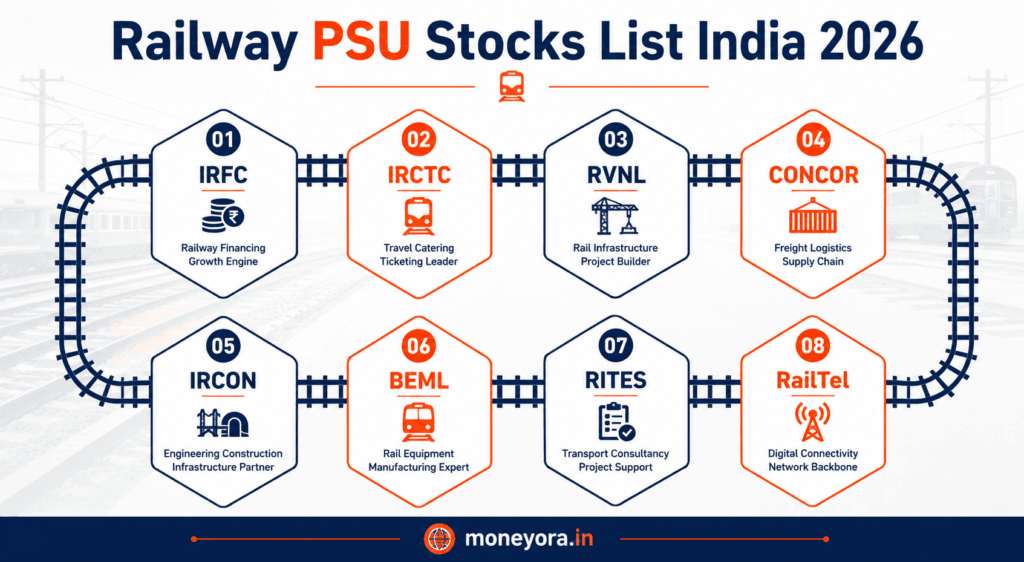
- There are 8 core Railway PSU stocks listed on Indian exchanges: IRFC, RVNL, IRCTC, IRCON, RITES, BEML, CONCOR, and RailTel.
- Budget 2026–27 allocated ₹2.93 lakh crore to Indian Railways — highest ever — with ₹52,108 crore for rolling stock alone.
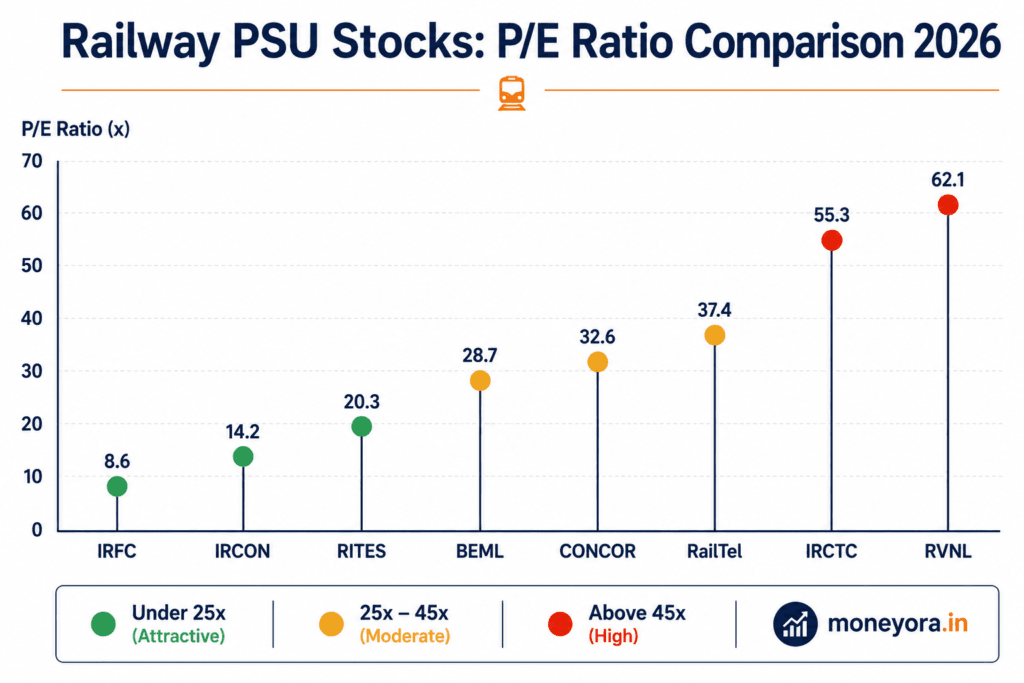
- IRFC is the largest by market cap (~₹1.24 lakh crore), but trades at a modest ~17.7x P/E after falling 58% from its 2024 peak.
- RVNL has the biggest order book (4.8x revenue coverage) but still carries an elevated ~59x P/E despite recent profit declines.
- Railway PSU stocks fell 40–55% from 2024 highs. Current prices may offer value — but execution risk and high valuations on some names deserve caution.
- No single “best” railway PSU stock exists. Your choice should match your risk profile, time horizon, and return expectations.
Disclaimer: This article is for educational and informational purposes only. It is not investment advice or a recommendation to buy/sell any security. Investments in the stock market are subject to market risks. Please consult a SEBI-registered investment adviser before making any investment decisions. Past performance is not a guarantee of future returns.
What Are Railway PSU Stocks?
India’s railway system is the fourth-largest in the world. The government doesn’t run it through one company — it runs it through a web of specialized PSUs, each with a specific role. When you buy a Railway PSU stock, you’re buying into one piece of that ecosystem.
The key distinction: PSU vs private railway stocks. Companies like Titagarh Rail Systems and Jupiter Wagons are private manufacturers operating in the same sector. PSUs, on the other hand, carry an implicit government guarantee — they get orders first, and rarely face existential business risk. That’s the trade-off. Lower risk, but often lower capital efficiency too.
To understand how stock returns compound over time, try MoneyOra’s CAGR Calculator — it helps you calculate what a given return rate means over 5, 10, or 20 years.
Complete Railway PSU Stocks List 2026 — All Listed Companies
Here is every major Railway PSU stock listed on NSE/BSE, sorted by market capitalization. Data is approximate and based on publicly available information through mid-2026.
| Company | NSE Symbol | Category | Approx. Market Cap | P/E Ratio (FY25) | Navratna Status |
|---|---|---|---|---|---|
| IRFC (Indian Railway Finance Corp.) | IRFC | Financing | ~₹1.24 lakh cr. | ~17.7x | Yes (Navaratna, 2025) |
| IRCTC (Indian Railway Catering & Tourism) | IRCTC | Ticketing / Tourism | ~₹54,000 cr. | ~50–55x | Yes (Miniratna-I) |
| RVNL (Rail Vikas Nigam) | RVNL | Infrastructure EPC | ~₹48,000–66,000 cr. | ~59x | Yes (Miniratna-I) |
| CONCOR (Container Corp. of India) | CONCOR | Logistics / Freight | ~₹40,000–45,000 cr. | ~35–40x | Yes (Navratna) |
| IRCON (IRCON International) | IRCON | Construction EPC | ~₹18,000–22,000 cr. | ~20x | Yes (Miniratna-I) |
| BEML (Bharat Earth Movers) | BEML | Rolling Stock / Equipment | ~₹13,000–17,000 cr. | ~28–32x | Yes (Miniratna-II) |
| RITES (RITES Ltd.) | RITES | Consulting / Exports | ~₹14,000–18,000 cr. | ~22–26x | Yes (Miniratna-I) |
| RailTel Corporation | RAILTEL | Telecom / IT | ~₹9,000–12,000 cr. | ~30–35x | Yes (Miniratna-I) |
Note: Market caps fluctuate daily. Always verify current prices on NSE India or BSE India before making any decisions.
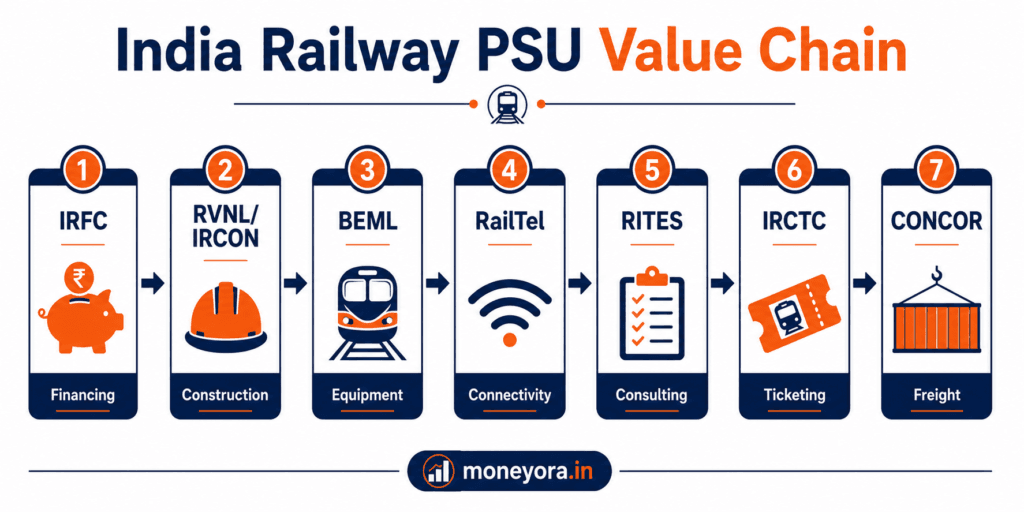
These companies cover the full railway value chain. Think of it as a pipeline: IRFC provides the money → RVNL and IRCON build the tracks → BEML and RITES supply equipment and consulting → RailTel connects it all digitally → IRCTC sells the tickets → CONCOR moves the freight. Each has a distinct risk-reward profile.
Deep Dive: Each Railway PSU Stock Explained
1. IRFC — Indian Railway Finance Corporation
IRFC is the dedicated financing arm of Indian Railways. It raises low-cost funds from the bond market — backed by its AAA credit rating — and on-lends them to the Ministry of Railways for rolling stock (locomotives, coaches, wagons) and infrastructure. It earns a small but stable spread on the difference between its borrowing cost and lending rate.
In March 2025, IRFC was elevated to Navaratna PSU status — a significant recognition of its financial scale and strategic importance. Its FY25 revenue stood at ₹27,285 crore with net profit of ₹7,009 crore.
| Metric | Value (FY25 / Mid-2026) |
|---|---|
| Revenue (FY25) | ₹27,285 crore |
| Net Profit (FY25) | ₹7,009 crore |
| P/E Ratio | ~17.7x |
| Approximate Stock Price (June 2026) | ₹94–95 (52-week range: ₹87–₹149) |
| Dividend Yield | ~2.6% |
| PSU Status | Navaratna (elevated March 2025) |
| Credit Rating | AAA (domestic) |
Who should consider it: Investors looking for quasi-bond stability with equity upside. IRFC functions almost like an infrastructure bond — predictable income, sovereign-backed borrower (Indian Railways is its only client), and consistent dividend payments. The stock fell ~58% from its 2024 high of ₹229, which is why it now trades at a historically modest P/E.
Use MoneyOra’s Dividend Calculator to model how IRFC’s dividend income could compound over 10+ years in your portfolio.
2. IRCTC — Indian Railway Catering & Tourism Corporation
IRCTC is one of the few pure monopoly businesses in India’s listed universe. It controls 100% of online rail ticket bookings in India — no competitor can legally sell e-tickets for Indian Railways. It also runs catering on select trains, premium tourist train services, hotel bookings, and travel packages.
Every time you book a train ticket online, IRCTC earns a convenience fee. The platform handles hundreds of millions of transactions a year. That kind of captive traffic is almost impossible to replicate — and it’s reflected in the premium valuation of 50–55x earnings.
| Metric | Value |
|---|---|
| Business Moat | Legal monopoly on e-ticketing |
| P/E Ratio | ~50–55x (FY25) |
| Revenue Segments | Ticketing, Catering, Tourism, Rail Neer (Water) |
| Return on Equity | High (asset-light model) |
| Dividend History | Consistent annual dividends |
Who should consider it: Investors wanting quality over cheap valuation. IRCTC doesn’t need government contracts for project execution — it generates cash every single day from ticket convenience fees. The premium is real. Whether the valuation is justified at 50x+ depends on your growth expectations for Indian rail passenger traffic.
3. RVNL — Rail Vikas Nigam Limited
RVNL is the government’s primary execution engine for railway infrastructure. Track doubling, new line construction, gauge conversions, bridge construction, metro projects, station redevelopments — RVNL handles it all. Incorporated in 2003, it operates as a project management and EPC (Engineering, Procurement, Construction) company, outsourcing most physical work to contractors while retaining project oversight.
RVNL’s order book is massive — approximately 4.8x its annual revenue, providing strong multi-year revenue visibility. But FY25 was a tough year: full-year net profit fell to ₹1,281 crore from ₹1,550 crore in FY24. Revenue also declined from ₹21,878 crore to ₹19,923 crore. The execution challenges are real.
| Metric | Value (FY25) |
|---|---|
| Net Profit | ₹1,281 crore (down from ₹1,550 cr. in FY24) |
| Revenue | ₹19,923 crore (down from ₹21,878 cr. in FY24) |
| Order Book Coverage | ~4.8x revenue (one of the highest in the sector) |
| P/E Ratio | ~59x (elevated despite earnings dip) |
| Dividend (FY25) | ₹1.72 per share (final dividend) |
| Stock Price (June 2026) | ~₹234 (52-week range: ₹227–₹443) |
Who should consider it: Investors who believe in India’s railway capex story over 3–5 years and are comfortable with execution risk. RVNL won’t disappear — it’s a government company with guaranteed order flow. But earnings can be lumpy, margins can get squeezed, and the P/E of ~59x leaves little room for earnings disappointment.
4. IRCON International
IRCON is an engineering and construction PSU that builds railways, highways, bridges, and airports — both in India and internationally. It has completed projects in 26 countries including Sri Lanka, Malaysia, Nepal, Mozambique, and Algeria. Its international diversification is a key differentiator from pure domestic players.
IRCON’s order book provides about 2.7x revenue coverage — moderate compared to RVNL but still healthy. Its P/E of ~20x is among the more attractive in the Railway PSU space.
| Metric | Value |
|---|---|
| Order Book Coverage | ~2.7x revenue |
| P/E Ratio | ~20x |
| International Operations | 26+ countries |
| Revenue Mix | Railways + Highways + International Projects |
| Dividend Track Record | Consistent dividend payer |
Who should consider it: Investors who want EPC exposure at a less stretched valuation than RVNL. IRCON’s international revenue base adds an element of geographic diversification that purely domestic rail PSUs don’t offer. The stock tends to be less volatile than pure-play rail infrastructure names.
5. RITES Limited
RITES is an asset-light consulting and engineering services company. It earns fees for project management, design, quality assurance, and rolling stock inspection — for Indian Railways, state governments, and international clients. It also exports railway equipment (mainly locomotive components and rolling stock) to African, Asian, and Southeast Asian markets.
RITES received a massive order win in July 2026, sparking a 14% single-day rally. Its order book coverage of ~3.8x revenue is strong. Because RITES is asset-light, its return on equity is high and capex requirements are minimal.
| Metric | Value |
|---|---|
| Business Model | Asset-light: consulting + inspection + exports |
| Order Book Coverage | ~3.8x revenue |
| P/E Range | ~22–26x |
| Return on Equity | High (no heavy asset base) |
| Export Revenue | Meaningful international client base in Africa + Asia |
Who should consider it: Conservative investors who want railway exposure without betting on construction execution. RITES earns fees — it’s paid for expertise, not project completion milestones. Motilal Oswal and other brokerages have highlighted RITES as a preferred PSU pick for risk-averse investors.
6. BEML Limited
BEML manufactures heavy engineering products — metro rail cars, train coaches, mining equipment, and defence equipment. It’s a key supplier of rolling stock to Indian Railways and metro rail projects across India. BEML also benefits from India’s growing metro rail network in 25+ cities.
BEML has a zero debt-equity ratio — a significant strength in a capital-intensive sector. Its EPS and book value are among the highest in the Railway PSU group.
| Metric | Value |
|---|---|
| Debt-Equity Ratio | Zero (debt-free) |
| Product Mix | Metro cars, coaches, mining, defence |
| Key Opportunity | Metro expansion in 25+ Indian cities |
| Dividend History | Consistent payer |
| 1-Year Return (30-day) | +5% (as of July 2026) |
Who should consider it: Investors who want manufacturing exposure within the railway theme. BEML benefits from both railway and metro rail expansion, plus a defence revenue stream. The debt-free balance sheet is a real strength for a manufacturing-heavy company.
7. CONCOR — Container Corporation of India
CONCOR is India’s largest multimodal logistics operator, moving containerized cargo by rail across its 85+ inland container depots. It holds roughly 10% of the containerized logistics market share. As a Navratna PSU under the Ministry of Railways, CONCOR directly benefits from the Dedicated Freight Corridor (DFC) expansion.
The Budget 2026–27 announced a new DFC connecting Dankuni (West Bengal) to Surat (Gujarat) — a direct trigger for CONCOR’s long-term freight volumes. The July 2026 rally saw CONCOR post strong buying interest alongside other railway PSUs.
| Metric | Value |
|---|---|
| PSU Category | Navratna |
| Depot Network | 85+ Inland Container Depots |
| Market Share | ~10% (containerized rail logistics) |
| Key Trigger | Dankuni–Surat DFC expansion (Budget 2026-27) |
| Market Cap (approx.) | ~₹40,000–₹45,000 crore |
Who should consider it: Investors with a logistics/freight thesis. If you believe India’s cargo volumes will grow with better rail infrastructure, CONCOR is the most direct listed play. It’s less dependent on budget capex announcements compared to infrastructure EPC PSUs.
8. RailTel Corporation of India
RailTel builds and operates a nationwide broadband, telecom, and VPN network using optical fiber laid along railway tracks — covering over 60,000 route km. It provides Wi-Fi at railway stations, MPLS VPN services to enterprises, and IT/data centre solutions. In Q4 FY26, RailTel’s net profit jumped 35.7% YoY to ₹143.52 crore, and revenue rose 27.6% YoY.
| Metric | Value (Q4 FY26) |
|---|---|
| Net Profit (Q4 FY26) | ₹143.52 crore (+35.7% YoY) |
| Revenue (Q4 FY26) | ₹1,668.86 crore (+27.6% YoY) |
| Network | 60,000+ km optical fiber (alongside rail tracks) |
| Services | Broadband, MPLS VPN, Data Centres, Station Wi-Fi |
| Stock Price (June 2026) | ~₹307.65 |
Who should consider it: Investors who want a telecom/IT angle on the railway theme. RailTel’s fiber network is hard to replicate — it runs alongside thousands of km of rail tracks. As data demand grows across government and enterprise clients, RailTel’s infrastructure becomes more valuable.
Budget 2026–27: What It Means for Railway PSU Stocks
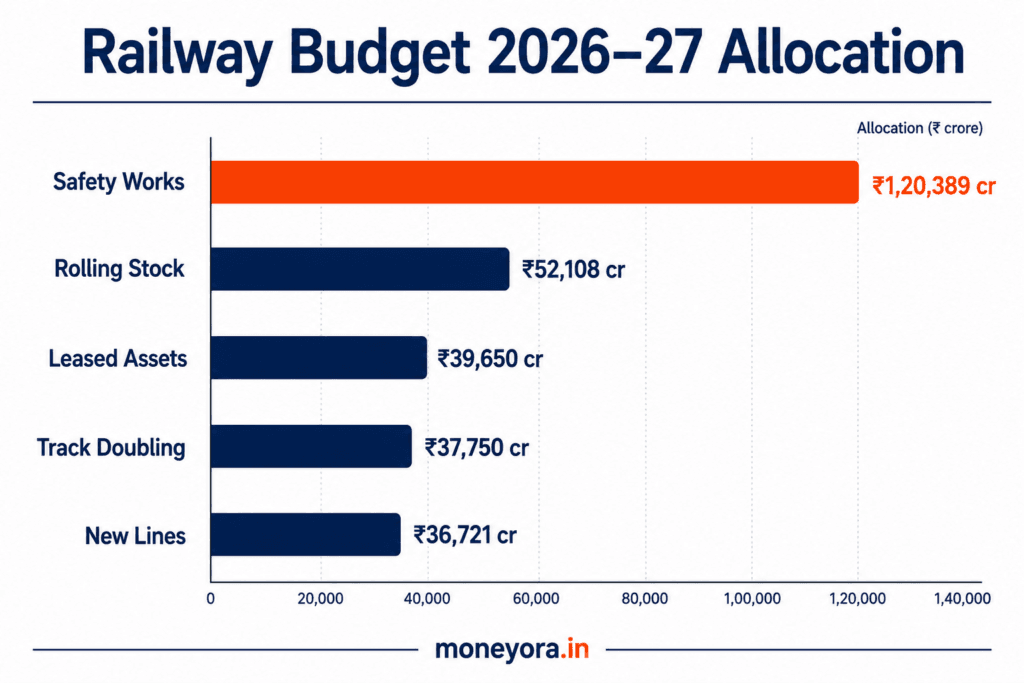
The Union Budget 2026–27 was a landmark moment for the sector. Finance Minister Nirmala Sitharaman announced a total allocation of ₹2.93 lakh crore for Indian Railways — a 5.4% increase over the previous year’s ₹2.78 lakh crore, and the highest railway budget in India’s history.
| Budget Head | FY27 Allocation | Change vs FY26 |
|---|---|---|
| New Rail Lines | ₹36,721 crore | +19.9% |
| Track Doubling | ₹37,750 crore | +30.1% |
| Rolling Stock | ₹52,108 crore | +4.2% |
| Signalling & Telecom | ₹7,500 crore | +15.4% |
| Electrification | ₹5,000 crore | +11.1% |
| Safety-Related Works | ₹1,20,389 crore | Major emphasis |
| Leased Assets (Capital) | ₹39,650 crore | +40.8% |
Beyond the numbers, the Budget announced seven new high-speed rail corridors as “growth connectors”: Mumbai–Pune, Pune–Hyderabad, Hyderabad–Bengaluru, Hyderabad–Chennai, Chennai–Bengaluru, Delhi–Varanasi, and Varanasi–Siliguri — covering approximately 4,000 km. A new Dedicated Freight Corridor connecting Dankuni to Surat was also proposed.
MoneyOra Analysis: Who Benefits Most from Budget 2026–27?
Track Doubling (+30.1% allocation) → Direct benefit to RVNL and IRCON. Track doubling is their bread and butter.
Rolling Stock (+4.2% allocation) → Benefits BEML (coach manufacturing) and IRFC (financing the rolling stock purchases).
Signalling & Telecom (+15.4% allocation, Kavach rollout) → Benefits RailTel (connectivity infrastructure) and niche ancillary players like Kernex Microsystems.
Leased Assets Capital Payments (+40.8%) → This directly flows to IRFC — larger lease payments mean higher IRFC revenue.
High-Speed Corridors (7 new) → Long-term play for construction EPC companies (RVNL, IRCON) and equipment suppliers (BEML). These won’t show up in earnings for 3–5 years.
Dedicated Freight Corridor expansion → Direct long-term trigger for CONCOR’s freight volume growth.
What Most Railway PSU Articles Get Wrong
Most lists you’ll find online give you a table and call it done. They don’t tell you the three things that actually matter for investors in 2026. Here they are.
1. The 40–55% Correction Is Real — and It Changes the Math
In 2024, many Railway PSU stocks had become investor darlings. IRFC touched ₹229. RVNL was above ₹400. The froth was real — a Kotak Institutional Equities report specifically flagged a “large disconnect” between fundamentals and valuations at the peak.
By early 2026, most Railway PSU stocks had corrected 40–55% from those highs. This correction happened because: earnings growth disappointed, quarterly results were mixed, and the broader PSU re-rating cycle reversed. The good news? For long-term investors, corrections create entry opportunities. The bad news? Some stocks are still expensive on a P/E basis even after the fall (RVNL at 59x being the clearest example).
Don’t anchor on a stock’s 52-week high. IRFC at ₹95 after falling from ₹229 might look like a bargain — but you need to verify whether current earnings justify the price, not whether the stock is “50% cheaper than it was.”
2. Order Book ≠ Revenue (The Execution Gap)
RVNL has a massive order book. But RVNL’s FY25 revenue actually declined year-on-year. This is the execution gap — the time between winning orders and recognizing revenue is long in infrastructure EPC. Project delays, contractor issues, land acquisition problems, and government approvals all create friction.
A fat order book is a necessary condition for future growth. It’s not sufficient. Before investing in RVNL or IRCON, look at order book-to-billing ratios over multiple years — not just the headline order wins.
3. Not All Railway PSUs Are Equally “Government-Safe”
Investors sometimes assume that being a PSU means zero business risk. That’s wrong. IRFC has very low business risk — it has one client (Indian Railways) and earns a spread with a AAA-rated balance sheet. But RVNL operates in a competitive EPC environment where project execution quality determines margins. RITES competes for international contracts. CONCOR faces competition from private container operators. The PSU label doesn’t erase operating risk.
How to Evaluate Railway PSU Stocks Before Investing
If you’re looking at Railway PSU stocks seriously, here’s a practical decision framework — built for Indian retail investors.
Step 1: Match the Company’s Role to Your Investment Thesis
- Believe in railway financing growth? → IRFC
- Believe in infrastructure execution? → RVNL, IRCON
- Believe in travel demand / ticketing? → IRCTC
- Believe in freight corridor growth? → CONCOR
- Want asset-light exposure with high ROE? → RITES
- Want digital/telecom railway play? → RailTel
- Want manufacturing with no debt? → BEML
Step 2: Check These 5 Financial Parameters
- P/E Ratio vs. Earnings Growth Rate: A P/E of 59x (RVNL) is only justified if earnings grow at 25%+ consistently. Has that happened? Check the last 4 quarters.
- Order Book-to-Revenue Ratio: For EPC companies (RVNL, IRCON), look for coverage above 2.5x — it means at least 2.5 years of revenue are already locked in.
- Debt Levels: Infrastructure companies often carry debt. BEML’s zero-debt status is a meaningful differentiator. IRFC’s debt is structural (it borrows to lend) — normal for an NBFC.
- Return on Equity (ROE): RITES and IRCTC have high ROE because they’re asset-light. BEML’s ROE is lower but supported by a clean balance sheet. Compare within the correct peer group.
- Dividend Consistency: For long-term holding, dividend track record matters. IRFC, RITES, IRCON, and CONCOR are consistent dividend payers.
Step 3: Use Portfolio Tools to Understand Position Sizing
Before buying any railway PSU stock, decide how much of your portfolio it should represent. A simple rule for Indian retail investors: no single stock — PSU or otherwise — should exceed 5–10% of your total equity portfolio without a very clear reason.
Use MoneyOra’s Position Size Calculator to calculate the right number of shares based on your total capital and risk tolerance. Pair it with the Stop Loss Calculator to protect against downside.
Railway PSU Stocks Comparison: Who Is Best for Which Investor?
| Investor Type | Best Fit | Why | Watch Out For |
|---|---|---|---|
| Conservative / Income | IRFC | AAA-rated, Navaratna status, ~2.6% dividend yield, quasi-bond nature | Spread compression if rates rise, single-client concentration |
| Quality Growth | IRCTC | Monopoly ticketing franchise, high ROE, consistent cash flows | Expensive at 50–55x P/E; any fee-cap policy risk |
| High Beta / Capex Story | RVNL | Largest order book (4.8x), direct infra play, government pipeline | Earnings declined in FY25; P/E still 59x; execution risk |
| Balanced EPC Exposure | IRCON | Moderate P/E (~20x), international diversification, consistent dividend | Moderate order book; lower growth profile than RVNL |
| Conservative Sector Exposure | RITES | Asset-light, high ROE, consulting model, export revenue | Smaller company; stock can be illiquid at peaks |
| Manufacturing + Diversification | BEML | Zero debt, metro + railway + defence exposure, consistent dividend | Revenue lumpy based on tender wins; lower margins |
| Logistics / Freight Thesis | CONCOR | Navratna, DFC beneficiary, 85+ depot network, market leader | Faces privatization risk / disinvestment speculation historically |
| Digital / Telecom Angle | RailTel | Q4 FY26 profit up 35.7% YoY; hard-to-replicate fiber network | Smaller company; dependent on government IT contracts |
Risks to Consider Before Investing in Railway PSU Stocks
Long-Term Drivers of the Railway Sector in India (2026–2030)
The near-term numbers matter — but Railway PSU stocks are really long-duration bets on India’s infrastructure transformation. Here’s what will drive the sector over the next 5 years.
1. Kavach Safety Technology Rollout
Kavach Version 4.0 is being deployed across 1,452 km of key routes, with plans to cover 18,000 km of high-density tracks. Every km of Kavach installation is a procurement order for signalling equipment and telecom infrastructure — benefiting RailTel, BEML, and ancillary suppliers.
2. Vande Bharat Train Expansion
The Vande Bharat program — 400+ train sets ordered domestically — is a multi-year rolling stock procurement cycle. BEML is a key supplier. The Vande Bharat Sleeper variant adds a premium travel option that can grow IRCTC’s average revenue per ticket.
3. Metro Rail Expansion Across 25+ Cities
India’s metro rail network is expanding across Bangalore, Pune, Ahmedabad, Surat, Nagpur, Bhopal, and smaller tier-2 cities. BEML manufactures metro cars. RITES provides consultancy for metro projects. RailTel builds the telecom backbone.
4. Amrit Bharat Station Scheme (ABSS)
1,337 stations are being redeveloped under ABSS — creating multi-year construction and renovation contracts. This benefits RVNL and IRCON directly.
5. Dedicated Freight Corridors (DFC)
With 3,300 km of DFC already operational, and the new Dankuni–Surat corridor in Budget 2026–27, freight efficiency will improve dramatically. Lower logistics costs mean more demand for rail freight — a long-term volume growth story for CONCOR.
Calculate Your Potential Returns from Railway PSU Investments
Before committing capital, run the math. Indian investors often skip this step — and then get surprised when returns disappoint or come later than expected.
Here’s a simple example. Suppose you invest ₹1,00,000 in a Railway PSU basket and target a 12% CAGR over 10 years:
- After 5 years: ~₹1,76,234
- After 10 years: ~₹3,10,585
- After 15 years: ~₹5,47,357
That’s the power of compounding at 12% annually. But what if returns come in at 8%? Or 15%? The difference is massive over long holding periods — and you should model all three scenarios.
Use MoneyOra’s free CAGR Calculator to run these scenarios yourself. If you’re planning a systematic investment into railway PSU ETFs or stocks via SIP, the SIP Calculator shows how monthly investments accumulate over time. For lumpsum investments, the Lumpsum Calculator gives you an instant projection.
Use the free Stock Return Calculator, CAGR Calculator, and Lumpsum Calculator on MoneyOra.in — all free, no login required.
Use the free calculator now on MoneyOra.in
Railway PSU Stocks in 2026
The Railway PSU stocks list in India covers eight fundamentally different businesses tied to one mega-theme: India’s railway modernization. Budget 2026–27’s record ₹2.93 lakh crore allocation, seven new high-speed corridors, Kavach safety rollout, and the new Dankuni–Surat DFC corridor are not short-term news — they represent a decade-long infrastructure buildout.
That’s the opportunity. But the risks are real too. Stocks fell 40–55% from 2024 peaks. Some remain expensive even after the correction. Execution is uneven. Policy risk is always present with PSUs.
The right approach isn’t to chase the “best” Railway PSU stock — it’s to understand what each company does, match it to your risk profile, check current valuations against earnings reality, and invest with a 5+ year horizon.
Action items before you invest:
- Use the MoneyOra Stock Return Calculator to model historical return scenarios.
- Use the CAGR Calculator to understand what different growth rates mean for your wealth.
- Use the Position Size Calculator to calibrate how much of your portfolio to allocate.
- Verify current prices, P/E ratios, and financials on NSE India before acting.
- Consult a SEBI-registered financial advisor for personalized investment recommendations.
Railway PSU stocks aren’t a get-rich-quick trade. At their best, they’re a patient, well-researched bet on India’s infrastructure future. And for that bet, knowledge is your first advantage.
MoneyOra’s free financial calculators help you model returns, compare scenarios, and invest smarter.
Use the free calculator now on MoneyOra.in
Research Sources Used
- NSE India — Stock data and company information
- BSE India — Financial filings and market data
- Angel One — Union Budget 2026-27 Railway Allocation
- Business Standard — Railway Capex FY27
- Company Annual Reports and BSE Filings (IRFC FY25, RVNL FY25, RailTel Q4 FY26)
Frequently Asked Questions: Railway PSU Stocks
Which is the best Railway PSU stock to buy in 2026?
There’s no single “best” — it depends on your risk profile. For conservative investors seeking dividend income and low risk, IRFC is often cited due to its AAA credit rating and Navaratna status. For growth-oriented investors comfortable with valuation risk, RVNL’s massive order book (4.8x revenue coverage) makes it a high-beta option. For quality at a premium, IRCTC offers a monopoly ticketing franchise — at a price of 50–55x earnings. Match the company to your goal, not the market noise.
What is the Railway PSU stocks list on NSE India?
The primary Railway PSU stocks listed on NSE are: IRFC (financing), IRCTC (ticketing/tourism), RVNL (infrastructure EPC), CONCOR (freight logistics), IRCON (construction EPC), BEML (rolling stock manufacturing), RITES (consulting/exports), and RailTel (telecom/IT). All are government-controlled companies under or linked to the Ministry of Railways. Private manufacturers Titagarh Rail Systems and Jupiter Wagons are separate — they’re not PSUs.
Did Railway PSU stocks fall in 2024–25? Why?
Yes. Most Railway PSU stocks fell 40–55% from their 2024 peaks by early 2026. Three main reasons: quarterly earnings disappointed relative to stretched expectations, budget allocations underwhelmed investor estimates in some quarters, and the broader PSU re-rating cycle reversed as global risk appetite shifted. A Kotak Institutional Equities report specifically flagged a “large disconnect” between PSU railway stock valuations and their underlying fundamentals at the 2024 peak.
Is IRFC a safe investment?
IRFC is among the lower-risk Railway PSU stocks — but “safe” is relative. It carries an AAA domestic credit rating, has Navaratna PSU status (elevated in March 2025), and earns income from one sovereign-backed client (Indian Railways). Its FY25 net profit was ₹7,009 crore on revenue of ₹27,285 crore. Risks include interest rate movements compressing its spread, and any restructuring of its funding relationship with the Ministry of Railways. It’s conservative equity, not a fixed deposit.
How does the Union Budget affect Railway PSU stocks?
Railway capex directly flows to these companies as revenue. A higher railway budget — Budget 2026–27 allocated ₹2.93 lakh crore, the highest ever — means more projects for RVNL and IRCON, more rolling stock purchases financed by IRFC, more equipment orders for BEML, and more IT/connectivity contracts for RailTel. However, the stock market typically prices in budget expectations before the actual announcement, so the immediate market reaction can be muted even after a positive budget.
What is RVNL’s order book size in 2026?
RVNL’s order book provides approximately 4.8x annual revenue coverage — one of the highest among Railway PSU stocks. This means several years of project backlog are already locked in. However, RVNL’s FY25 full-year revenue and profit both declined year-on-year, highlighting that a large order book doesn’t automatically translate to smooth revenue recognition. Investors should watch quarterly execution data, not just order win announcements.
Are Railway PSU stocks good for long-term investment?
Railway PSU stocks are a long-duration bet on India’s infrastructure transformation through 2030 and beyond. Structural drivers — record capex, high-speed corridor development, Kavach safety rollout, Vande Bharat expansion, and freight corridor growth — are real and multi-year in nature. The challenge is valuation: even after corrections, some stocks remain expensive. Long-term investors should focus on entry price discipline, diversify across 2–3 different Railway PSU business models, and use tools like MoneyOra’s CAGR Calculator to stress-test return scenarios before committing capital.
What is the difference between RVNL and IRCON?
Both are railway infrastructure EPC companies, but with key differences. RVNL is a pure-play domestic railway execution company — almost all projects are Indian Railways assignments. IRCON is more diversified: it works on highways, bridges, airports, and has executed projects in 26 countries internationally. RVNL has a larger order book (4.8x vs IRCON’s 2.7x). IRCON trades at a lower P/E (~20x vs RVNL’s ~59x). For investors wanting EPC exposure at a less stretched valuation, IRCON is often the more conservative choice.


Pingback: EPF Passbook Not Showing Contribution: 9 Urgent Reasons
Pingback: What Is a CKYC Number? Urgent 2026 Guide to Find Yours Fast
Pingback: PAN Aadhaar Link Status Check 2026: Urgent Penalty Alert
Pingback: Gold Price Today India: Record Highs-Should Buy or Wait 2026
Pingback: Adani Power Stock Split: Ratio, Date, History & Investor Guide 2026