

SWP for Demat Mutual Funds: New SEBI Rules, Timeline and How It Works (2026)
If you hold mutual fund units in a demat account through Zerodha, Groww, or any other broker, there is a problem you have probably already discovered: you cannot set up a Systematic Withdrawal Plan (SWP) on those units. Every month, you have to manually log in and redeem units yourself. There is no automation.
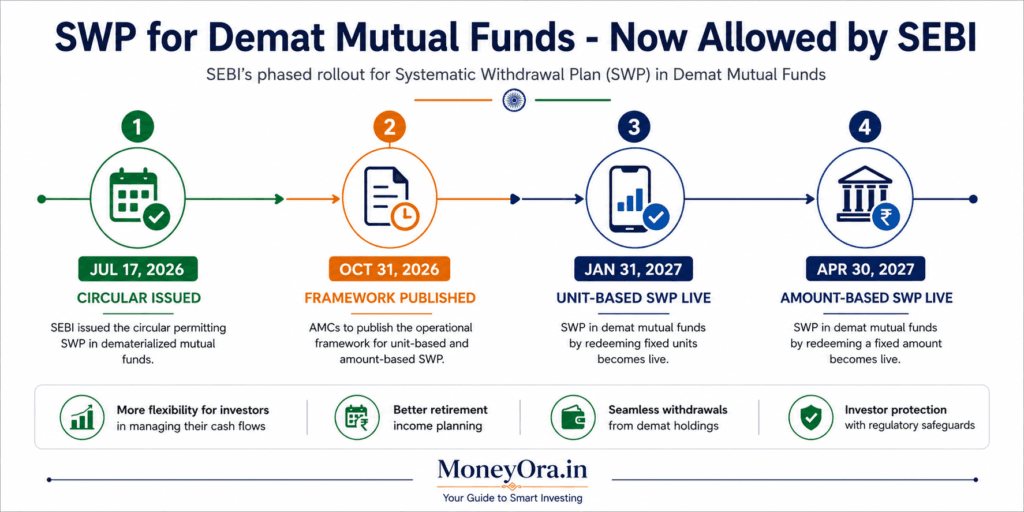
SEBI announced on July 17, 2026 that this is finally changing. The regulator has extended the SWP standing instruction facility to mutual fund units held in demat form, through a two-phase rollout. Unit-based SWP goes live by January 2027, and amount-based SWP by April 2027.
This article covers what the rule change means, how the two phases differ, what you should do in the meantime, and why this matters more than most investors realize.
For a quick refresher on how SWP works in general, start with MoneyOra’s SWP calculator and then come back here for the demat-specific update.
- SEBI’s July 17, 2026 circular allows SWP standing instructions for demat-held mutual fund units for the first time
- Phase I covers unit-based SWP by January 31, 2027. Phase II covers amount-based SWP by April 30, 2027
- NSDL and CDSL are the nodal agencies. They must publish a joint operational framework by October 31, 2026
- Until then, demat investors cannot set up automated SWP; manual monthly redemption remains the only option
- The change was triggered by Groww’s 2025 migration of millions of investors from SoA to demat, which broke their SWP access
- SWP from demat units carries the same capital gains tax treatment as SWP from SoA units
- The SEBI circular is SEBI Circular No. HO/47/14/13(2)2026-MRD-POD2/I/16590/2026
Why Could You Not Set Up SWP on Demat Mutual Fund Units Before?
This is the question nobody is answering properly. Understanding the root cause helps you understand why the fix is taking until 2027.
When you hold mutual fund units in a Statement of Account (SoA) folio, the SWP instruction lives with the AMC or its RTA (CAMS or KFintech). The instruction simply says “Every month on the 5th, redeem 100 units from Folio XYZ12345.” The RTA processes it, the AMC redeems units, and the money hits your bank account. Simple, direct pipeline.
When you hold the same mutual fund units in a demat account, the units are recorded in the depository ledger (NSDL or CDSL). Your broker (Zerodha, Groww, etc.) is the Depository Participant (DP). The AMC and RTA are still involved for NAV calculation and payment, but the units themselves live in a different system.
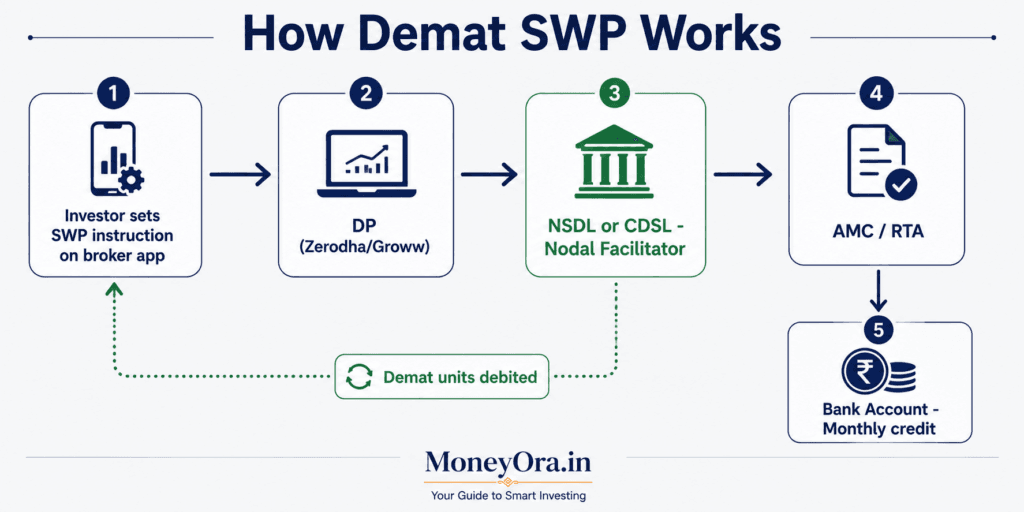
The SWP standing instruction was never built to talk to the depository ledger. There was no protocol for a depository to receive an instruction from an investor, trigger the redemption at the AMC end, debit units from the demat account, and credit the payout to the bank account. The plumbing simply did not exist.
The growing shift to demat holdings had left investors without access to automated SWP and STP facilities. SEBI’s July 2026 circular builds that plumbing. The depositories become the connective layer between the investor’s instruction and the AMC’s execution.
The Groww Problem That Triggered This Fix
Online MF distributors are increasingly moving investors from the SoA mode to demat holdings. Groww, the country’s largest mutual fund distributor, announced the transition last year.
This created a specific problem for a large number of Indian investors. Many of them had been running SWPs on their mutual fund portfolios for years. The SWP was set up in the SoA system. When Groww moved their units to demat, the SWP instructions tied to the old SoA folios broke or became inaccessible.
Following representations from Depositories, recommendations of a SEBI-constituted Working Group, and recommendations of SEBI’s Secondary Market Advisory Committee, SEBI has now decided to extend this facility to demat-held units, in the interest of ease of doing business.
If you are a Groww investor who lost SWP access, you now have a timeline for when it comes back. January 2027 for unit-based, April 2027 for amount-based. Until then, see the interim workaround section below.
SEBI’s Two-Phase SWP Rollout: What Each Phase Means
The facility will roll out in two phases, distinguished by whether the standing instruction is based on a fixed number of units or a fixed payout amount.
Phase I: Unit-Based SWP and STP (By January 31, 2027)
This is the simpler mechanism. You tell the system: “Every month, redeem 200 units from my demat account holding in XYZ Flexi Cap Fund.”
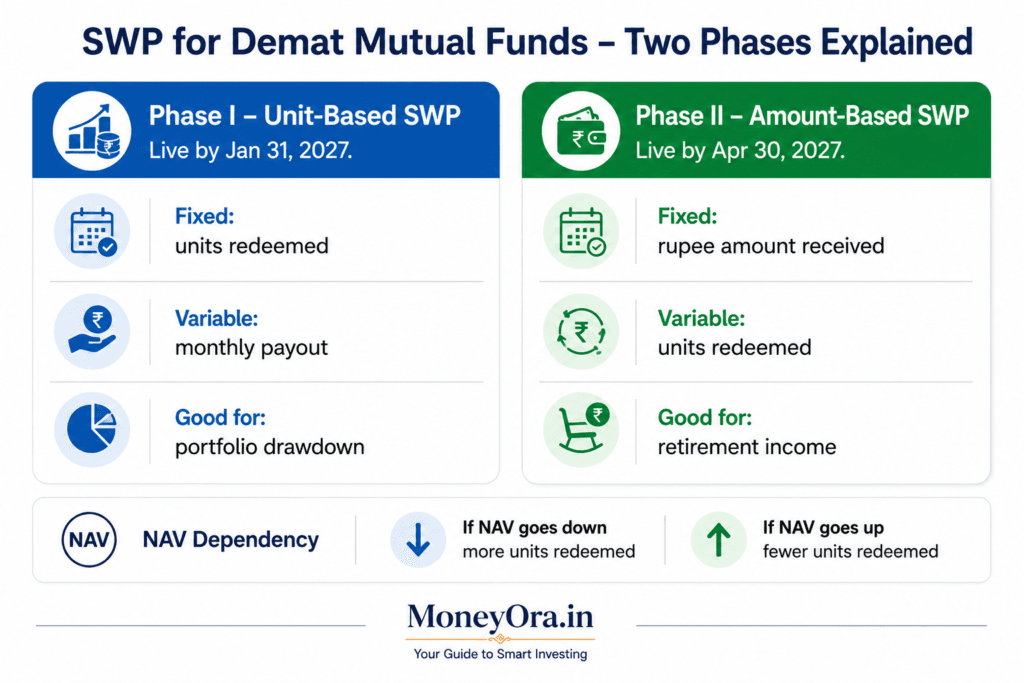
The number of units is fixed. The rupee amount you receive will vary because it depends on the NAV on the redemption date. If NAV is Rs 80 on month one, you get Rs 16,000. If NAV rises to Rs 90 by month three, you get Rs 18,000.
This is operationally simpler to build because no real-time NAV calculation is needed at the point of instruction creation. The system just needs to know: fund name, unit count, frequency, bank account. Straightforward.
Who is unit-based SWP good for?
Investors who want to draw down their portfolio in a disciplined way without worrying about how much they receive each month. It works well for wealth drawdown but not as a reliable monthly income replacement.
Phase II: Amount-Based SWP and STP (By April 30, 2027)
This is what most retirees and regular-income investors actually need. You tell the system: “Every month, redeem whatever units are needed to pay me Rs 30,000 from my demat holding in XYZ Balanced Advantage Fund.”
Standing instructions for a fixed amount required as pay-out at a specified frequency, or for purchasing units of another scheme of the same Mutual Fund.
This requires real-time NAV-linked calculation at redemption time. If NAV is Rs 100 and you need Rs 30,000, the system redeems 300 units. If NAV drops to Rs 80 next month, it redeems 375 units to still deliver Rs 30,000. More complex to build, which is why it comes three months after Phase I.
Who is amount-based SWP essential for?
Anyone using SWP as a pension substitute. Fixed monthly income to cover rent, groceries, or EMIs. This is the version that matters most for retirees.
Side-by-Side Comparison
| Feature | Phase I: Unit-Based | Phase II: Amount-Based |
|---|---|---|
| What is fixed | Number of units redeemed | Rupee amount received |
| What varies | Monthly payout amount | Number of units redeemed |
| Live by | January 31, 2027 | April 30, 2027 |
| Suitable for | Portfolio drawdown, wealth management | Monthly income, retirement planning |
| NAV dependency | NAV determines payout | NAV determines units redeemed |
| Complexity | Lower | Higher |
The October 2026 Framework: What It Means and Why It Matters
SEBI has directed depositories to act as nodal facilitators and publish a standard framework by October 2026.
This October 2026 milestone is not getting enough attention. Before January 2027, NSDL and CDSL must jointly publish a detailed operational framework explaining exactly how the system works. This framework will cover:
- How investors register a SWP standing instruction through their broker platform
- How the instruction flows from the DP to the depository to the AMC or RTA
- Turnaround times for execution
- How rejections and failures are handled
- How disputes are resolved between investor, DP, depository, and AMC
- What happens if a scheme is merged or the fund house changes its RTA
Until this framework is published, nobody knows the exact operational steps. Groww, Zerodha, and other platforms cannot build the investor-facing interface until they know what the underlying standard looks like.
Watch for the NSDL and CDSL websites in October 2026 for the published framework. Once it is out, your broker will build the standing instruction feature on their app, and you will be able to set up your demat SWP from the platform’s UI.
What Is STP and Why Does This Circular Cover It Too?
A Systematic Transfer Plan (STP) enables periodic transfer of investment from one scheme to another scheme of the same Mutual Fund via redemption and subscription.
STP is commonly used for two purposes. First, parking a lumpsum in a liquid or money market fund and then systematically moving it into an equity fund over 6-12 months, which reduces timing risk. Second, moving profits from an equity fund to a debt fund during accumulation.
Like SWP, STP also did not work for demat-held units until this circular. The same two-phase fix applies.
Phase I covers unit-based STP (transfer a fixed number of units from Fund A to Fund B monthly). Phase II covers amount-based STP (transfer a fixed rupee amount from Fund A to Fund B monthly).
For investors who prefer the lumpsum-to-STP strategy for new money, this is an important unlock. You can now hold the liquid fund units in demat and still run the systematic transfer to your equity fund, once the Phase I infrastructure is live.
What Should Demat Mutual Fund Investors Do Right Now?
The honest answer is: wait and stay informed. The feature is not live yet. Here is the practical action plan by timeline.
Now (August-September 2026):
- Confirm with your broker (Groww, Zerodha, HDFC Sec, Upstox, etc.) that your mutual fund units are in demat form. Ask them to confirm the folio or DP account where units are held.
- If you need monthly income from your portfolio right now and your units are in demat, set up a manual monthly redemption calendar reminder. It is inconvenient, but it is the only option until January 2027.
- If your units are still in SoA form and your SWP is running, do not migrate to demat yet. Wait until your broker confirms SWP support is live post-January 2027 before switching.
October 2026:
- Watch for NSDL and CDSL’s joint operational framework publication. This tells you exactly how the SWP instruction will work.
- Your broker’s app may start showing a “SWP setup” feature under demat mutual funds around this time, in preparation for the January go-live.
January 2027:
- Unit-based SWP for demat mutual funds goes live. Log in to your broker app and set up the standing instruction.
- If you need amount-based SWP, continue with manual redemptions until April 2027.
April 2027:
- Amount-based SWP goes live. This is the one most retirees need. Set it up once and collect your monthly income automatically.
The Tax Angle: What Changes for SWP in Demat?
Nothing changes on tax treatment. This is worth being clear about because some investors assume demat format comes with different tax rules.
Each redemption under an SWP is a separate taxable event. The capital gains calculation depends on:
- Whether the units are equity-oriented or debt-oriented
- How long the units have been held before each redemption
- The cost of acquisition of the units being redeemed (FIFO method: first-in, first-out)
For equity mutual funds held more than 12 months, long-term capital gains (LTCG) above Rs 1.25 lakh per year are taxed at 12.5%. Short-term (held under 12 months) taxed at 20%.
For debt mutual funds (purchased after April 1, 2023), gains are added to income and taxed at your slab rate regardless of holding period.
Demat format does not change any of this. The same FIFO rule applies. The same holding period thresholds apply. The only practical difference: your broker’s demat system generates the capital gains statement automatically, which makes ITR filing slightly easier since all transactions are consolidated in one place.
Use MoneyOra’s CAGR calculator to understand the compounded growth on units you are about to redeem, and the SIP calculator to model what your remaining corpus will look like after SWP drawdowns.
What Rs 50 Lakh Looks Like as a Monthly SWP
Here is a worked example to make this concrete.
An investor retires in January 2027 with Rs 50 lakh in a balanced advantage mutual fund, held in demat form. They want monthly income of Rs 25,000.
Amount-based SWP (Phase II, from April 2027):
- Monthly withdrawal: Rs 25,000
- Annual withdrawal: Rs 3 lakh
- Withdrawal rate: 6% of corpus
- If the fund earns 10% CAGR annually, the corpus grows despite withdrawals
- After 10 years at 10% growth and 6% annual withdrawal: corpus is approximately Rs 75-80 lakh (corpus actually grows)
- After 10 years at 8% growth and 6% withdrawal: corpus is approximately Rs 55-60 lakh (slow growth)
- After 10 years at 5% growth and 6% withdrawal: corpus shrinks to approximately Rs 35-38 lakh (erosion begins)
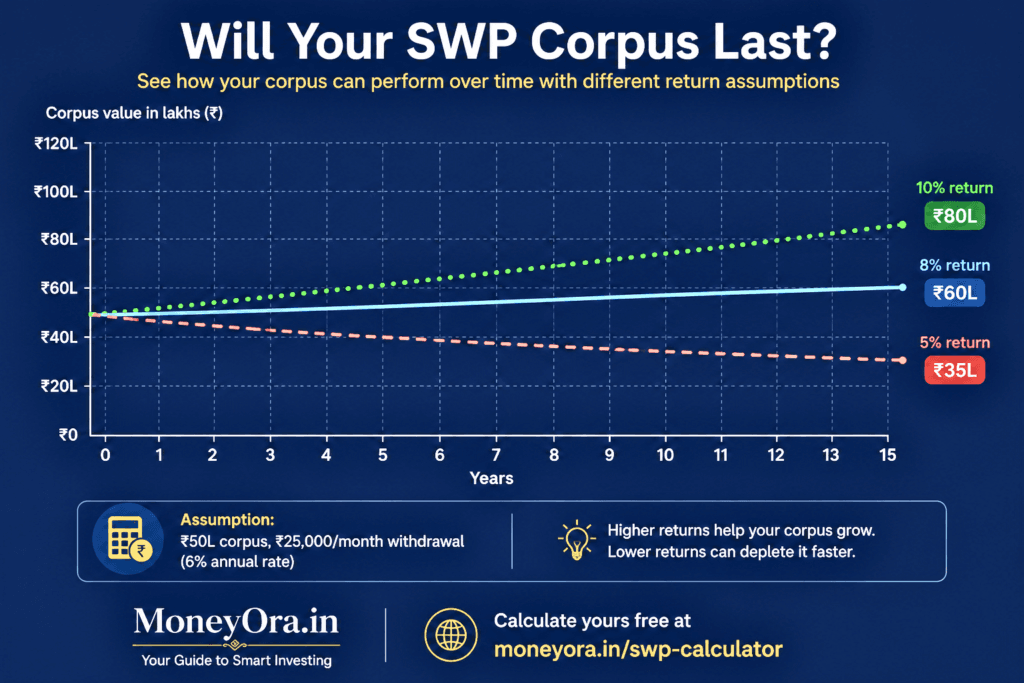
The key insight: SWP sustainability depends on the gap between the fund’s return and your withdrawal rate. A 25,000/month withdrawal on a 50L corpus is 6% annualized. Any fund returning above 6% sustainably means your corpus grows. Below 6% means it shrinks.
For a unit-based SWP (Phase I), the math works differently. If the investor redeems 100 units at Rs 250 NAV in month one (Rs 25,000), but NAV rises to Rs 280 by month four, the same 100 units now yield Rs 28,000. This means monthly income is not fixed, which makes budgeting harder for retirees.
Amount-based SWP (Phase II, April 2027) is what retirees need. Unit-based SWP (Phase I, January 2027) works better for portfolio drawdown investors who want flexibility.
Use MoneyOra’s SWP calculator and lumpsum calculator to model your specific numbers.
SWP in Demat vs SWP in SoA: Key Differences for Investors
Both types of investors will eventually have the same SWP functionality. But there are some practical differences to know.
| Dimension | SWP in SoA (existing) | SWP in Demat (from Jan 2027) |
|---|---|---|
| Setup | Through AMC website, CAMS, KFintech | Through broker app (Zerodha, Groww, etc.) |
| Standing instruction held by | AMC or RTA | Depository (NSDL or CDSL) via DP |
| Redemption trigger | RTA triggers directly | Depository triggers RTA |
| Capital gains statement | From AMC or CAMS | From broker or CDSL/NSDL |
| Nomination and transmission | Through AMC or RTA | Through DP |
| Consolidation | Multiple AMC portals | Single demat account view |
| Availability today | Yes, fully live | Not yet; Phase I Jan 2027 |
The consolidation advantage is real. Investors who hold 10 different mutual fund schemes in demat see all holdings in one demat account statement and eventually one SWP view. In SoA format, 10 schemes across 4 AMCs means 4 separate logins and 4 separate SWP setups.
This is the long-term benefit that makes demat mutual fund holding genuinely attractive, and why the SWP fix was urgent for the industry.
1. The January and April 2027 dates are implementation deadlines for depositories, not guaranteed product launch dates Depositories are directed to implement by these dates. If there are system readiness issues or the October framework is delayed, the investor-facing feature at the broker level could slip. Watch your broker’s communication in Q4 2026.
2. You cannot set up demat SWP today, even if your broker’s app has a placeholder Some broker apps may show an SWP option for demat units that does not actually work yet. Until the depository infrastructure is live (post-January 2027 for Phase I), any standing instruction created may not execute correctly. Confirm with your broker before relying on it. If you face issues, raise a complaint on the SEBI SCORES portal.
3. Moving from SoA to demat breaks your existing SWP If you migrate your mutual fund units from SoA to demat and your SWP was registered in the SoA system, that SWP stops. You cannot transfer the standing instruction. You will need to set it up again once the demat SWP goes live. In the meantime, monthly income stops unless you redeem manually.
4. Tax reporting changes slightly In SoA, your AMC or RTA issues a capital gains statement. In demat, your DP or broker issues the statement. Both are equally valid for ITR filing, but make sure you are collecting the right document from the right source. You can verify your fund house’s RTA details on the AMFI website. Do not file ITR using SoA statements if your units are now in demat.
5. AMC scheme mergers or RTA changes during the transition If a mutual fund scheme merges or changes its RTA between now and the Phase I go-live, there may be short-term disruptions to the SWP standing instruction. Monitor AMC communications for any such changes.
If you currently hold demat mutual fund units and need monthly income:
- Confirm units are in demat by checking your broker’s holdings page
- Set up monthly calendar reminders to manually redeem the required units until January 2027
- Keep a note of the number of units you need to redeem each month for tax records
If you are planning to start SWP from January 2027:
- Confirm with your broker (Groww, Zerodha, etc.) that they will support unit-based SWP for demat from January 31, 2027
- Check NSDL and CDSL websites in October 2026 for the published operational framework
- Decide if you need amount-based SWP (April 2027) and plan accordingly
If you are still on SoA and your SWP is running fine:
- Do not migrate to demat until January 2027 at the earliest
- After January 2027, migrate only if your broker confirms SWP is live for your fund schemes
- Use MoneyOra’s SWP calculator to verify your withdrawal rate is sustainable before and after any migration
For retirement planning using SWP:
- Model your corpus and monthly need using MoneyOra’s SWP calculator
- Understand that unit-based SWP (Phase I) gives variable income; amount-based (Phase II) gives fixed income
- Plan around the April 2027 date if fixed monthly income is your goal
MoneyOra Tools
Plan your SWP and mutual fund strategy with these free calculators:
- SWP Calculator – Calculate monthly withdrawal amounts and corpus sustainability
- SIP Calculator – Build your mutual fund corpus to fund future SWP
- Lumpsum Calculator – Model one-time investments before switching to SWP
- CAGR Calculator – Understand how your fund has compounded historically
- Dividend Calculator – Compare dividend option vs growth option + SWP
- PPF Calculator – Plan safe parallel income alongside your SWP
- EPF Calculator – Understand your EPF corpus alongside retirement SWP planning
- Mutual Fund Nomination Deadline Guide – Set up nomination before your SWP begins
- Transmission of Shares Guide – Ensure your demat holdings are protected for nominees
SWP for demat mutual funds has been a missing piece for years. Millions of investors who moved to demat via Groww, Zerodha, or any other broker-dealer platform discovered they could not automate their withdrawals, and had to redeem manually every single month.
SEBI’s July 2026 circular fixes this, with two phases: unit-based by January 2027, amount-based by April 2027. It is not immediate, but the fix is confirmed and the timeline is clear.
If you need monthly income from your demat mutual fund holdings right now, manual redemption is still the bridge solution. Set a calendar reminder for the last working day of each month, redeem the required units, and document the transactions carefully for capital gains records.
Once January 2027 arrives, check your broker app. The standing instruction feature should be available. Use MoneyOra’s free SWP calculator to decide the right withdrawal amount for your corpus before you set it up.
Disclaimer: This article is for educational purposes only and does not constitute investment or financial advice. Mutual fund investments are subject to market risks. Tax rules may change. Verify SEBI circular details at SEBI’s official website before acting.
Source: SEBI Circular No. HO/47/14/13(2)2026-MRD-POD2/I/16590/2026, dated July 17, 2026. Available at sebi.gov.in under Legal Framework, Circulars, July 2026.
Frequently Asked Questions
Q1. What is SWP for demat mutual funds?
SWP for demat mutual funds is a Systematic Withdrawal Plan set up as a standing instruction for mutual fund units held in demat form. Before SEBI’s July 17, 2026 circular, this facility did not exist. Investors with demat-held mutual fund units could not automate monthly withdrawals and had to redeem units manually each time. The new SEBI framework introduces this facility in two phases: unit-based SWP by January 31, 2027 and amount-based SWP by April 30, 2027.
Q2. When will SWP be available for demat mutual funds?
SEBI’s circular is effective immediately from July 17, 2026, but the investor-facing facility will be available in phases. NSDL and CDSL must publish a joint operational framework by October 31, 2026. Unit-based SWP (withdraw a fixed number of units monthly) goes live by January 31, 2027. Amount-based SWP (withdraw a fixed rupee amount monthly) goes live by April 30, 2027. Your broker’s app will add this feature as the depository infrastructure goes live.
Q3. What is the difference between unit-based and amount-based SWP in demat mutual funds?
Unit-based SWP redeems a fixed number of units every month, so the rupee payout varies based on NAV. If you set “redeem 100 units monthly” and NAV rises, you get more rupees; if NAV falls, you get fewer. Amount-based SWP redeems however many units are needed to deliver a fixed rupee amount monthly. If you set “pay me Rs 30,000 monthly,” the system calculates and redeems the right number of units at the current NAV. Amount-based is more predictable for budgeting and is what most retirees need.
Q4. Why did demat mutual funds not support SWP before July 2026?
When mutual fund units are in demat form, they are recorded in the depository ledger (NSDL or CDSL) rather than the AMC’s RTA system. The SWP standing instruction system was built only to work with SoA folios managed by RTAs like CAMS and KFintech. There was no protocol for a depository to receive an investor’s SWP instruction, trigger the AMC redemption, debit units from the demat ledger, and credit the payout to the bank account. SEBI’s July 2026 circular builds this missing infrastructure, with depositories as the nodal facilitator.
Q5. Can I set up SWP on demat mutual funds right now in August 2026?
No. The operational framework needs to be published by NSDL and CDSL by October 2026, and Phase I only goes live by January 31, 2027. Until then, investors with demat-held mutual fund units cannot automate SWP. Manual monthly redemptions through your broker app remain the only option for now.
Q6. If I move my mutual fund units to demat, will my existing SWP continue?
No. If you migrate units from SoA to demat, the SWP instruction registered with the AMC or RTA in the SoA system is tied to the old folio and will not transfer. Your monthly SWP stops. You will need to wait until January 2027 (unit-based) or April 2027 (amount-based) to set up a new standing instruction in the demat system. If monthly income is critical, do not migrate to demat until you confirm with your broker that the SWP feature is fully live.
Q7. Does demat SWP affect tax treatment of withdrawals?
No. Each redemption under a demat SWP carries the same capital gains tax rules as SoA SWP. For equity mutual funds held more than 12 months, LTCG above Rs 1.25 lakh per year is taxed at 12.5%. For short-term (under 12 months), the rate is 20%. For debt mutual funds bought after April 1, 2023, gains are added to income and taxed at your applicable slab rate. The demat format does not change any of these rules. What changes is where your capital gains statement comes from: the depository or your broker, instead of the AMC or RTA.
Q8. What role do NSDL and CDSL play in demat SWP?
NSDL and CDSL are the nodal facilitators for this entire framework under SEBI’s July 2026 circular. They sit between the investor’s standing instruction and the AMC’s redemption system. Their responsibilities include jointly publishing the operational framework by October 31, 2026; amending their bye-laws to accommodate SWP instructions; making system changes to receive, process, and relay standing instructions; and disseminating the framework to all DPs, RTAs, and AMCs. Without NSDL and CDSL building this infrastructure, brokers like Zerodha and Groww cannot offer the SWP feature.
Q9. Is STP also covered under the new SEBI demat rule?
Yes. The SEBI circular covers both SWP and STP. A Systematic Transfer Plan moves investment from one mutual fund scheme to another within the same AMC. Like SWP, STP was not available for demat-held units before this circular. Phase I (by January 31, 2027) covers unit-based STP, where a fixed number of units are transferred from Fund A to Fund B monthly. Phase II (by April 30, 2027) covers amount-based STP, where a fixed rupee amount is moved between schemes monthly. Both SWP and STP in demat follow the same two-phase timeline.
Q10. Which SEBI circular introduced SWP for demat mutual funds?
SEBI Circular No. HO/47/14/13(2)2026-MRD-POD2/I/16590/2026, dated July 17, 2026, titled “Extending facility of creating standing instructions for Systematic Withdrawal Plan (SWP) / Systematic Transfer Plan (STP) for Mutual Fund units held in demat form.” It was issued by Sanjay Singh Bhati, General Manager, SEBI Market Regulation Department. The circular is available at SEBI’s official website under Legal Framework, Circulars, July 2026.


Pingback: Mutual Fund After Death Nominee Claim Process India 2026
Pingback: What Happens to Mutual Fund if AMC Shuts Down? Best Explain