

SEBI Mutual Fund Nomination Deadline: New Rules Effective September 1, 2026
If you have a mutual fund folio or a demat account and most Indian investors have both there’s a deadline you need to know about right now. SEBI’s new nomination framework kicks in on September 1, 2026, and it changes more than just the deadline. The entire process has been overhauled.
Here’s the short version: from September 1, new single-holder accounts must have a nominee or a formal opt-out on record. No witness is needed anymore for physical nominations. You can name up to 3 nominees. And the old messy paperwork process has been replaced with one clean standardized form.
This is the most significant update to nomination rules for Indian investors in two decades. All 18 previous SEBI circulars on this topic – dating back to 2002 – are superseded by the new circular issued on May 29, 2026 (Circular No. SEBI/HO/OIAE/OIAE_IAD-3/P/CIR/2026/12676).
Here’s everything you need to know before the deadline.
For related reading on what happens when a nominee actually has to claim your investments, check MoneyOra’s guide on transmission of shares – the process your nominees will follow when they need to access your portfolio.

- SEBI’s new mutual fund nomination deadline is September 1, 2026
- From that date, all new single-holder demat accounts and MF folios must have a nominee OR a formal opt-out declaration
- No witness is needed for physical nominations (wet signature only) – a major simplification
- Up to 3 nominees allowed per account, down from 10 under the January 2025 rules
- Only 2 fields are mandatory: nominee’s name and relationship with the investor
- Existing accounts are not frozen but will receive bi-annual reminders and daily pop-ups until a nominee is added
- Even if you opted out earlier, you will still receive pop-up nudges on every first daily login
- 18 old SEBI circulars are now superseded – one unified framework applies
Why Did SEBI Issue Yet Another Nomination Circular?
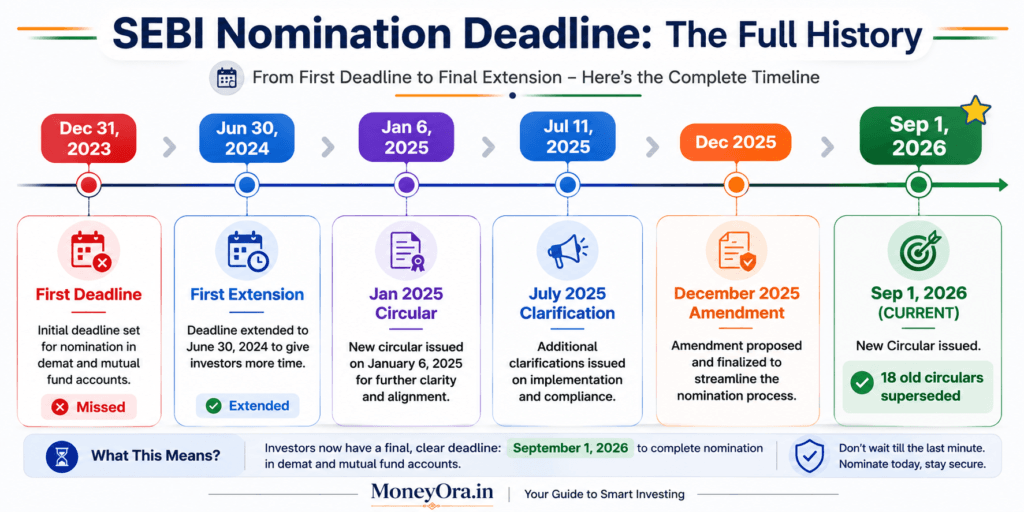
This is a fair question. SEBI has extended and revised the nomination deadline multiple times:
| Deadline | What Happened |
|---|---|
| December 31, 2023 | Original deadline – extended due to low compliance |
| June 30, 2024 | Extended again after industry representations |
| March 1, 2025 | January 10, 2025 circular effective – new revamped framework |
| July 30, 2025 | Further clarifications issued |
| December 11, 2025 | Additional amendment circular |
| September 1, 2026 | Current deadline – new comprehensive circular |
The reason for so many extensions: the January 2025 framework created operational headaches for AMCs, DPs, and RTAs. Witness requirements were complex. Online validation methods were unclear. Forms were not standardized across brokers. Different entities were following different procedures.
The May 29, 2026 circular is SEBI’s clean-slate response. It supersedes all 18 previous circulars, introduces unified Annexure-A and Annexure-B forms, removes the witness requirement, and sets clear rules for every scenario. September 1, 2026 is when it all goes live.
This matters because India has a serious unclaimed financial assets problem. The IEPF Authority holds billions of rupees in unclaimed shares and mutual fund units – most of them because the original investor died without a nominee, leaving heirs scrambling for succession certificates and court orders. Better nomination compliance prevents this.
If you want to see the original SEBI circular, it’s available at SEBI’s official website.
What the September 1, 2026 Deadline Means for You
There are three groups of investors, and the rules are different for each.
Group 1: Opening a new demat account or MF folio from September 1, 2026
Nomination is now mandatory. You cannot leave the field blank. You must either:
- Provide nominee details using the standardized Annexure-A form, OR
- Formally opt-out using the Annexure-B declaration form
Skipping the nomination section entirely is no longer an option. Your account or folio will not be processed without one of these two steps being completed.
Group 2: Existing investor with no nominee on record
Your existing account is not frozen and will not be restricted. But from September 1, your broker, AMC, or RTA must:
- Send you an SMS and email reminder twice a year (bi-annually)
- Show you a nomination-related pop-up on the first login of each day on their web and mobile platforms
These nudges do not stop if you opt-out. Under Para 10.2 of the circular, the exemption from pop-ups and reminders applies only to investors who have actually provided a nomination – not to those who have formally opted out. If you want the pop-ups to stop, you need to add a nominee.
Group 3: Existing investor who already has a nominee
Nothing urgent to do. Your existing nomination remains valid. The old witness signature requirement no longer applies going forward – but your past nominations with witness signatures are still fully valid. Your statement of account will now show either your nominee’s name or a Yes/No indicator (you can specify which you prefer).
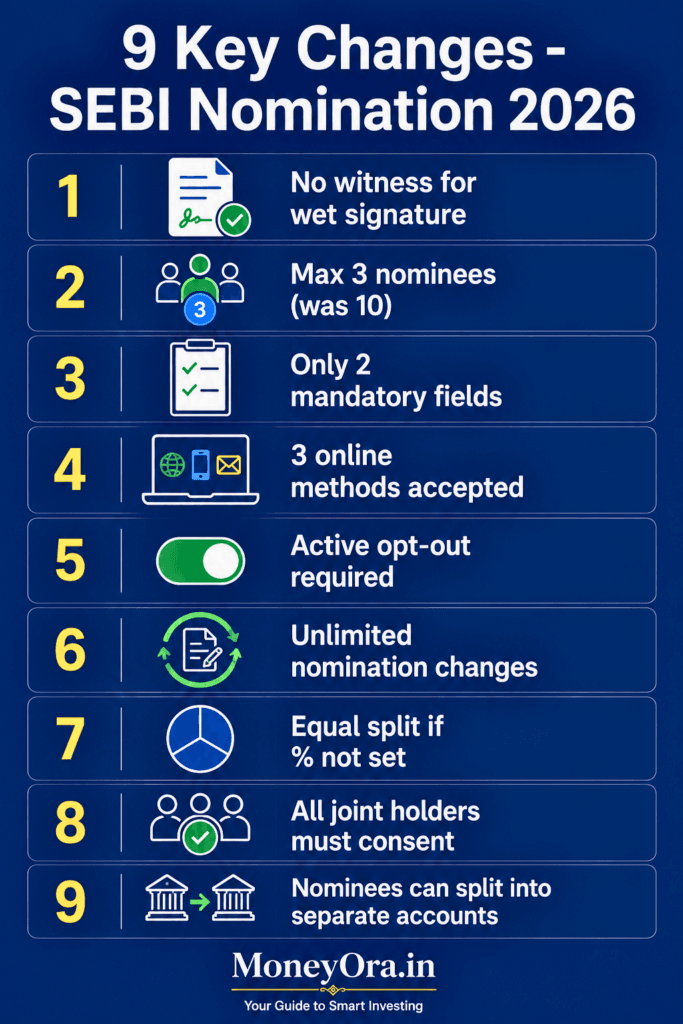
The 9 Key Changes Under the New SEBI Nomination Framework
1. No witness required for physical nominations
This is the biggest practical change for most investors, especially older ones who found the witness requirement cumbersome. Under the old rules, any physical nomination form needed a witness’s signature and address.
From September 1, if you sign the Annexure-A form with your own wet (ink) signature, no witness is needed. A witness is only required if you use a thumb impression instead of a signature, and in that case two witnesses are needed.
2. Maximum 3 nominees (previously up to 10)
The January 2025 circular had expanded the nominee count to up to 10. The new circular brings it back to a maximum of 3 nominees per account or folio. The rationale is simplicity and reduced complexity at the transmission stage.
3. Only 2 mandatory fields in the nomination form
Earlier forms asked for extensive nominee details – PAN, Aadhaar, mobile number, email, address, and more. The new Annexure-A reduces mandatory information to just two items:
- Name of the nominee
- Relationship with the investor
- Date of birth (only if the nominee is a minor – a third mandatory field in that specific case)
Everything else – mobile number, email, KYC identifier, percentage share, guardian details – is explicitly optional. This removes a major friction point.
4. Three valid methods for online nomination
For investors who prefer to nominate online, three authentication methods are now accepted:
- Digital Signature Certificate (DSC)
- Aadhaar e-sign or any e-sign under the IT Act, 2000
- Two-Factor Authentication (2FA) with OTP sent to both registered mobile number AND email address
All three give the nomination the same legal standing as a physical form.
5. Opt-out requires an active declaration – not silence
If you genuinely do not want to nominate anyone, you must say so actively by completing Annexure-B. The form explicitly tells you what you’re agreeing to: that without a nominee, your legal heirs will need legal or court-issued documents, and prolonged non-claim means assets may go to IEPF.
Online opt-out requires clicking “agree” after the full Annexure-B message is displayed – you cannot opt out passively or by skipping the step.
6. Unlimited changes to nominations
You can update, change, or cancel your nomination any number of times using Annexure-A and Annexure-B forms. There is no limit. Your broker, AMC, or RTA must acknowledge each change in writing (email or SMS confirmation).
7. Equal split for multiple nominees if no percentage specified
If you add 2 or 3 nominees but don’t specify the percentage each should receive, assets are split equally. If there’s an odd lot that can’t be divided equally, the full odd lot goes to the first nominee named in the form. To avoid ambiguity, specifying percentages explicitly is a good idea – though it remains optional.
8. Joint accounts: all holders must consent
For jointly held demat accounts or MF folios, any change to nominations requires the consent of all joint holders – regardless of the mode of operations. Even if your account is “either or survivor” where one person can transact independently, adding or changing a nominee still needs all account holders to agree.
Nomination is optional for joint accounts (not mandatory), but if you choose to nominate, all joint holders must sign off.
9. Nominee options after the investor’s death
When an investor dies, the nominees (if there are multiple) now have a choice: they can either continue sharing the same account or folio for their respective portions, or they can open separate individual accounts for their individual shares. This flexibility was not explicitly available under earlier circulars.
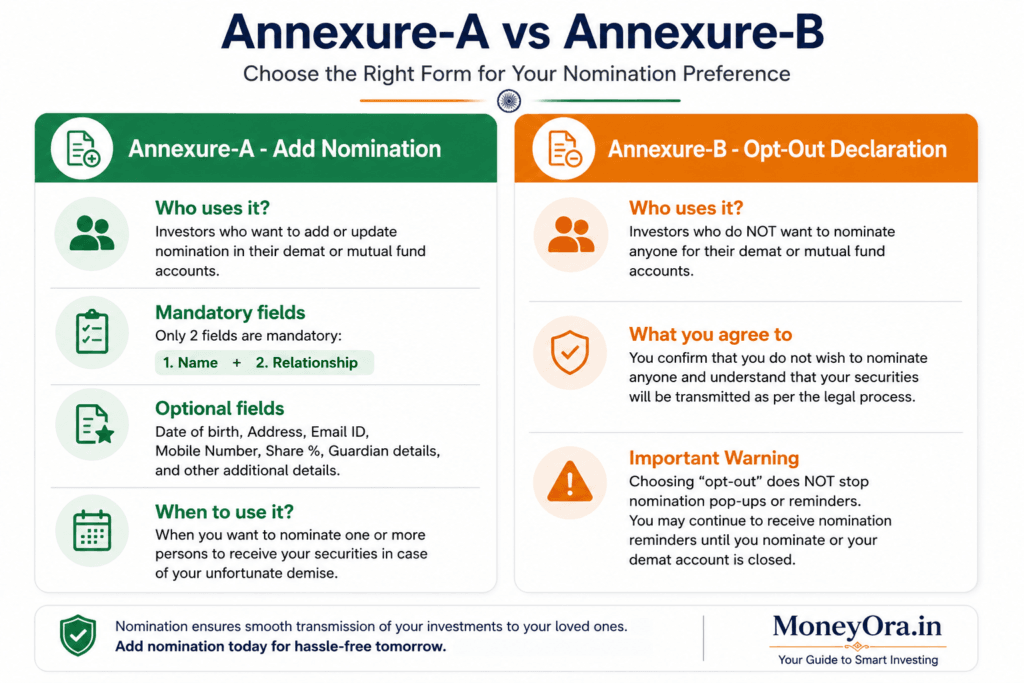
What Happens If You Don’t Add a Nominee?
A lot of investors ask this. The short answer is: your existing accounts won’t be frozen, but there are real consequences.
During your lifetime: You’ll receive bi-annual SMS/email nudges and daily first-login pop-ups from your broker and AMC platforms. These are mandated under the new circular and will continue until you add a nominee.
After your death – without a nominee: Your legal heirs will need to submit a Legal Heir Certificate or Succession Certificate, an indemnity bond, affidavit-cum-NOC from other heirs, and potentially a court order. This process takes 1-3 months minimum and can stretch much longer for large portfolios.
If nobody claims the investments: After 7 consecutive years of unclaimed dividends or payouts, both dividends and fund units transfer to IEPF. Recovering them then requires filing Form IEPF-5, which adds 2-4 months to the process.
A real example of the cost: Take an investor who started an SIP of Rs 5,000 per month in 2006 and continued for 20 years. By 2026, assuming a 12% CAGR, that portfolio is worth approximately Rs 49 lakh. If that investor dies without a nominee, their spouse or children will spend 6-12 months navigating legal paperwork to access this amount. During that time, the portfolio may continue to grow or decline – but the family has no control.
To understand what your own SIP portfolio might be worth, use MoneyOra’s SIP calculator and lumpsum calculator to run your own numbers.
MoneyOra Analysis: The Real Cost of Not Having a Nominee
Most guides tell you to add a nominee as a compliance step. Here’s the actual financial argument.
India has over Rs 5 lakh crore worth of unclaimed financial assets according to various RBI and SEBI estimates. A significant portion of this is mutual fund units and shares held by deceased investors whose families couldn’t navigate the documentation process.
The IEPF holds a growing pool of unclaimed assets. Once transferred there, recovery is possible but the process adds 2-4 months and requires active effort from legal heirs who may not know the account existed.
The cost of a nominee: zero rupees, 5 minutes on your broker’s app.
The cost of not having one: months of legal delay, potential court fees for a Succession Certificate (which range from Rs 3,000 to Rs 15,000+ depending on the court and state), lawyer fees if needed, and the emotional burden on grieving family members dealing with bureaucracy at the worst possible time.
For large mutual fund portfolios, also consider the tax angle. Inherited mutual fund units do not trigger capital gains at the time of transmission. When the heir sells, gains are calculated from the original investor’s purchase date and cost. For funds bought 15-20 years ago, the LTCG tax benefit can be significant. A nominee makes it far more likely the heir can access and manage the portfolio in time to make good decisions.
Use MoneyOra’s CAGR calculator to see how much a long-running SIP has compounded, and the dividend calculator to understand dividend income that would be at risk without proper nomination.
How to Add a Nominee to Your Mutual Fund Folio – Step by Step
The process varies slightly by platform but follows the same framework under the new SEBI rules.
Online (through your broker or AMC platform):
- Log in to your broker’s app or AMC website (Zerodha, Groww, HDFC Securities, ICICI Direct, CAMS, KFintech portal, etc.)
- Go to “Account Settings” or “Profile” and look for “Nomination” or “Nominee Management”
- Select “Add / Update Nominee”
- Fill Annexure-A (now standardized across all platforms under the new rules):
- Nominee’s full name (mandatory)
- Relationship with you (mandatory)
- Date of birth if the nominee is a minor (mandatory)
- Percentage share if adding multiple nominees (optional but recommended)
- Nominee’s mobile, email, Aadhaar last 4 digits (optional)
- Authenticate using DSC, Aadhaar e-sign, or 2FA (OTP to your registered mobile + email)
- Submit – you will receive a confirmation acknowledgement immediately
Offline / Physical:
- Download Annexure-A from your broker’s or AMC’s website
- Fill it with the above details
- Sign with wet (ink) signature – no witness required
- Submit at your broker branch or send by registered post to the AMC’s RTA
For joint accounts: all account holders must sign the Annexure-A form.
If you have mutual fund folios with multiple AMCs, you need to update nomination separately with each AMC (or through their respective RTAs like CAMS and KFintech). One nomination on your Zerodha demat account does not automatically apply to your Groww or CAMS folio.
Nominee vs Legal Heir: What Most Investors Get Wrong
This is worth clarifying because it confuses a lot of people.
A nominee is not automatically the permanent legal owner of the mutual fund units after you die. Under Indian personal law (Hindu Succession Act, Muslim Personal Law, Indian Succession Act), your legal heirs have a right to inherit your assets.
A nominee receives the assets as a trustee or custodian on behalf of the legal heirs. In practice, this means:
- The nominee can quickly claim the assets without going through a court process
- But other legal heirs (spouse, children) can subsequently ask the nominee to redistribute according to succession law
- For small amounts, this is rarely contested
- For large portfolios, legal heirs sometimes dispute with nominees
The practical upside of having a nominee is clear: someone can access the assets quickly without legal paperwork. The question of who ultimately owns what can be sorted out among family members later. Without a nominee, nobody can access the portfolio quickly everyone has to wait for the legal process to complete.
If your nominee is someone other than your primary legal heir (for example, a nominee who is a sibling when you have a spouse and children), consider writing a Will that clarifies your intentions. A Will does not replace a nominee for the purposes of quick transmission both serve different functions.
For understanding what nominees go through to claim mutual fund units after a death, MoneyOra’s transmission of shares guide covers the full process including IEPF recovery.
Special Cases: Minor Nominees, NRI Investors, Joint Accounts
Minor nominees
If you want to nominate a minor child, their date of birth is mandatory in Annexure-A. You should also name a guardian who will manage the units until the child turns 18. While guardian details are technically optional under the new rules, omitting them creates practical issues – who does the AMC contact in the event of your death? Provide them.
When the minor turns 18, they can directly claim the mutual fund units as an adult by submitting identity proof and an updated KYC to the AMC.
NRI investors
NRI investors holding mutual fund units in India must also comply with the September 1 deadline. The Annexure-A and Annexure-B forms apply equally to NRIs. For nominee details, foreign addresses are accepted. Foreign phone numbers and email IDs are accepted in the optional fields.
If you are an NRI holding units through an NRE or NRO account, your nomination applies to those specific folios. Ensure the nominee’s bank details are captured separately at the AMC or RTA level for smooth payout.
Joint account holders
Nomination is not mandatory for jointly held folios or demat accounts. The survivorship rule applies automatically – on the death of one joint holder, the assets pass to the surviving holders without fresh KYC.
But if you do want to name a nominee for a joint account (for example, to cover what happens if all joint holders die), all joint holders must give consent. Even on a single-holder transaction mandate, all holders must sign the Annexure-A for any nomination change.
1. Platform inconsistencies during the transition
Until all AMCs, DPs, and RTAs upgrade their systems before September 1, you may find that some platforms still show old nomination forms or old processes. If that happens, ask specifically for the “new Annexure-A format under SEBI circular dated May 29, 2026.” If the platform can’t accommodate, report to SEBI SCORES portal.
2. Thinking your demat nomination covers your MF folios
It does not. Your Zerodha demat account nomination covers your stocks held in demat form. Your direct mutual fund folios at each AMC need separate nomination updates. These are separate systems.
3. Opt-out does not stop nudges If
you genuinely do not want to nominate anyone (single person, no family), the Annexure-B opt-out is the right route. But under Para 10.2 of the circular, DPs and RTAs must continue sending bi-annual reminders and daily pop-ups even to opt-outs. The only way to stop nudges is to add a nominee.
4. The 3-nominee limit applies going forward
If you had set up more than 3 nominees under the January 2025 framework, check with your DP or AMC how they are handling the transition to the 3-nominee limit.
5. Percentage allocation matters more with 3 nominees
With up to 10 nominees previously allowed, percentage allocation was often left unspecified. With 3 nominees, it’s more important to specify percentages to avoid the odd-lot default rule (first nominee gets the entire odd lot).
Your Action Checklist Before September 1, 2026
If you have a mutual fund folio:
- Log in to each AMC portal or CAMS/KFintech platform
- Check if nomination is already on record
- If yes: verify nominee details are current and no update needed
- If no: complete Annexure-A nomination form (2 mandatory fields + optional extras)
- If you don’t want to nominate anyone: complete Annexure-B formally
If you have a demat account:
- Log in to your broker (Zerodha, Groww, HDFC Sec, etc.)
- Check nominee status under Profile/Account settings
- Add or update using the new Annexure-A format
- Ensure nominee details match legal documents (name spelling especially)
If you have joint accounts:
- Decide with co-holders whether you want to add a nominee
- If yes: all holders must sign the form together
If you want to nominate a minor:
- Include date of birth and guardian details in Annexure-A
General:
- Make sure your nominees know they are nominees
- Share your folio numbers and broker login details in a secure place
- Consider writing a Will to clarify distribution wishes beyond the nominee arrangement
MoneyOra Tools
Once you’ve sorted your nominations, use these to plan your mutual fund investments better:
- SIP Calculator – See what your monthly SIP will be worth over time
- Lumpsum Calculator – Model one-time investments in mutual funds
- SWP Calculator – Plan systematic withdrawals in retirement
- CAGR Calculator – Check the real compounded growth of your portfolio
- Dividend Calculator – Estimate dividend income from equity holdings
- Transmission of Shares Guide – What happens when a nominee has to claim your investments
- PPF Calculator – For parallel safe-investment planning alongside mutual funds
- EPF Calculator – Plan your provident fund alongside market investments
The SEBI mutual fund nomination deadline of September 1, 2026 is not just compliance paperwork. It’s about making sure the money you’ve built over years actually reaches the people you intend it for without putting them through months of legal procedures at the worst possible time.
The new rules are genuinely better. No witness needed. Two fields mandatory. Up to 3 nominees. Online in under 5 minutes on most major platforms. SEBI has cleared a real hurdle here.
If you haven’t added a nominee yet, do it this week. If you already have one, check that their name is spelled correctly and the relationship is accurate. Five minutes now saves your family months of paperwork later.
Use the free SIP calculator on MoneyOra to calculate what your portfolio will be worth and make sure someone you trust can access it.
Disclaimer: This article is for educational purposes only and does not constitute legal or financial advice. Nomination rules may vary based on specific circumstances. Consult a qualified financial advisor or legal professional for personalized guidance.
Sources: SEBI Circular No. SEBI/HO/OIAE/OIAE_IAD-3/P/CIR/2026/12676 dated May 29, 2026; SEBI Act, 1992, Section 11(1); IEPF Authority guidelines, Ministry of Corporate Affairs.
Frequently Asked Questions
Q1. What is the current SEBI mutual fund nomination deadline?
The current SEBI mutual fund nomination deadline is September 1, 2026. This is set under SEBI Circular No. SEBI/HO/OIAE/OIAE_IAD-3/P/CIR/2026/12676 issued on May 29, 2026. From this date, all new single-holder mutual fund folios and demat accounts must either have a nominee registered or a formal opt-out declaration on record. Existing accounts are not frozen but will receive bi-annual reminders and daily pop-up notifications.
Q2. Will my existing mutual fund account be frozen if I miss the September 1, 2026 deadline?
No. Existing accounts and folios will not be frozen or restricted. The September 1, 2026 deadline applies to new single-holder accounts opened from that date onwards. For existing accounts, the consequence of not having a nomination is receiving bi-annual SMS/email reminders and daily first-login pop-ups on your broker and AMC platforms. These nudges do not stop even if you formally opt out via Annexure-B.
Q3. Do I need a witness to add a nominee in a mutual fund from September 2026?
No. One of the biggest changes under SEBI’s May 2026 circular is the removal of the witness requirement for physical nominations. If you sign the Annexure-A form with your own wet (ink) signature, no witness is needed. A witness (two witnesses) is only required if you use a thumb impression instead of a signature.
Q4. How many nominees can I add in a mutual fund in 2026?
Under the new SEBI rules effective September 1, 2026, you can add up to 3 nominees per mutual fund folio. This is a reduction from the 10-nominee limit under the January 2025 rules. The three nominees can each have a different percentage allocation; if no percentage is specified, assets are divided equally and any odd lot goes to the first nominee.
Q5. Is nomination mandatory for all mutual fund accounts?
From September 1, 2026, nomination is mandatory for all new single-holder mutual fund folios. You cannot leave the nomination field blank – you must either complete the nomination (Annexure-A) or formally opt out (Annexure-B). For jointly held folios, nomination is optional. For existing accounts, there is no mandatory requirement, but nudges will be sent to those without nominations.
Q6. Can I add a nominee online for my mutual fund?
Yes. SEBI’s new rules explicitly support online nomination through three methods: Digital Signature Certificate (DSC); Aadhaar-based e-sign or any e-sign under the IT Act 2000; or Two-Factor Authentication (2FA) using OTP sent to your registered mobile number AND email address. All three are valid for nomination submission. Most major platforms like Zerodha, Groww, HDFC Securities, CAMS, and KFintech will support these methods.
Q7. What information is mandatory when nominating someone in a mutual fund?
Only two fields are mandatory: the nominee’s name and their relationship with you. If the nominee is a minor, their date of birth is also mandatory. Everything else – mobile number, email, Aadhaar, percentage share, guardian details – is optional. This is a significant simplification from previous forms that required extensive nominee identification details.
Q8. What happens to my mutual fund units if I die without a nominee?
Without a nominee, your legal heirs (spouse, children, parents) can still claim your mutual fund units but they need to follow a more complex process. They must submit a Legal Heir Certificate or Succession Certificate, an indemnity bond, affidavit-cum-NOC from other heirs, and KYC documents to the AMC or RTA. This process takes 1-3 months minimum. If no claim is made for 7 consecutive years after unclaimed payouts or dividends, the units may be transferred to IEPF.
Q9. Does a nominee in a mutual fund automatically own the units after I die?
Not in the legal sense. A nominee receives the mutual fund units as a trustee or custodian on behalf of the legal heirs. The nominee can claim and access the units quickly – without going through a court process. But the legal heirs (under Hindu Succession Act, Muslim Personal Law, or Indian Succession Act) retain their right to the assets. For undisputed families, the nominee claim is usually the quickest route to accessing the portfolio.
Q10. I opted out of nomination earlier. Do I need to do anything before September 1, 2026?
If you previously filed a formal opt-out declaration, that decision is still recorded. However, under the new circular’s Para 10.2, even formal opt-outs will continue to receive bi-annual reminders and daily first-login pop-ups. The exemption from nudges applies only to investors who have provided a nomination – not to those who have opted out. If you want to stop the reminders, you need to add a nominee using Annexure-A.


Pingback: SWP for Demat Mutual Funds: New SEBI Rules 2026 Best Guide
Pingback: Mutual Fund After Death Nominee Claim Process India 2026
Pingback: What Happens to Mutual Fund if AMC Shuts Down? Best Explain
Pingback: How to Find Unclaimed Money in India ( Best 4 Portals, 2026)