
Open ten different EPF Calculator results for the same person and you’ll often get ten different retirement corpus figures. Not because the maths is broken — the formula is standard and well understood — but because almost everyone feeds it the wrong numbers without realising it. “check if your 8.25% EPF interest has been credited yet”
That gap matters more than it sounds. A 2026 Edelweiss Wealth survey on retirement readiness found that 61% of urban salaried Indians overestimate their retirement corpus by more than 15%, and the single biggest reason is bad calculator inputs, not bad luck or bad markets. People type their CTC where Basic + DA should go. They assume 0% salary growth over 30 years. And almost nobody has factored in what changed under India’s new Labour Codes in late 2025 — a rule that’s quietly reshaping the EPF wage base for millions of employees in 2026.
This piece is not another “what is EPF” explainer. It’s a fix-it guide. Seven specific input mistakes, what each one actually costs you in rupees, and a corrected walkthrough you can run yourself on MoneyOra’s EPF Calculator in the next five minutes.
- Entering your full CTC instead of Basic + DA into an EPF Calculator can overstate or understate your projected corpus by ₹15–40 lakh over a 30-year career.
- India’s new Labour Codes (effective November 21, 2025) force basic pay to at least 50% of CTC for most employees — directly raising the EPF wage base, though EPF-specific transitional provisions run until November 2026.
- Only 3.67% of the employer’s 12% goes into your EPF balance. The remaining 8.33% funds EPS pension — a separate, non-withdrawable benefit most calculators handle correctly, but most users misread.
- A flat 0% salary increment assumption is the single most common EPF Calculator error — and it can understate a 30-year corpus by more than 60%.
- EPF interest has moved between 8.10% and 8.65% over the last eight years. Running only one rate assumption gives a false sense of precision.
Once your EPF Calculator inputs are corrected, the natural next step is making sure the balance you’ve built survives every job change intact. How to Transfer EPF When Changing Jobs walks through the full step-by-step EPFO portal process — including the January 2025 rule that eliminated employer approval for most accounts.
What is EPF (Employee Provident Fund)?
The Employees’ Provident Fund is a mandatory retirement savings scheme governed by the Employees’ Provident Funds and Miscellaneous Provisions Act, 1952. It is managed by the Employees’ Provident Fund Organisation (EPFO), one of the world’s largest social security organisations by membership.
Here’s the basic structure. Every month, 12% of your basic salary plus Dearness Allowance (DA) is deducted and deposited into your EPF account. Your employer matches this with another 12%. financial planning meaning for salaried employees That means 24% of your basic salary goes toward your retirement fund every single month — though the employer’s 12% is split between EPF and EPS (we’ll come to that shortly).
EPF is mandatory for:
- All organisations with 20 or more employees
- Employees earning a basic salary up to Rs 15,000/month (mandatory coverage)
- Employees earning above Rs 15,000 can be covered voluntarily by employer agreement
According to Wikipedia’s article on EPFO, the organisation manages a corpus of tens of lakhs of crore rupees and covers over 7 crore active members — making it one of the largest provident fund organisations in the world. Every employee in the formal sector builds their retirement corpus through this scheme, whether they actively think about it or not. What is EPFO 3.0 and how does it change PF access?
What makes EPF calculator stand out from other savings schemes is the combination of guaranteed returns (no market risk), tax-free compounding (up to defined limits), and the employer contribution — which is essentially free money added to your retirement account every month.
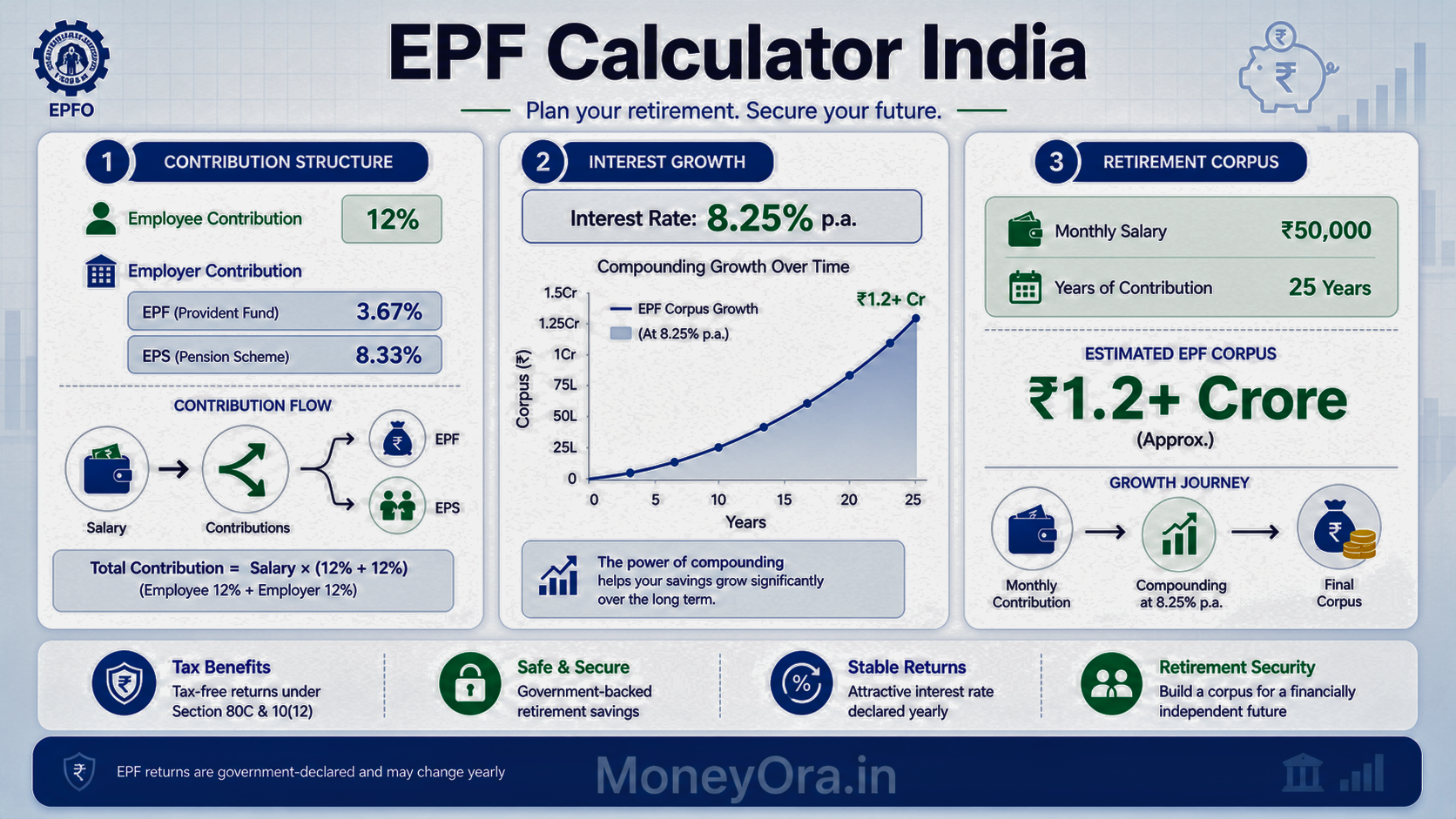
“EPF calculator combines steady contributions with compounding interest, making it one of the most powerful long-term retirement tools in India.”
How the EPF calculator works
The EPF calculator takes five inputs and gives you one very useful output: how much money you’ll have in your PF account when you retire.
What you enter in the EPF calculator
- Basic monthly salary + DA — the base on which EPF is calculated (not the total CTC)
- Your current age — to determine how many years of service remain until retirement at 58
- Your EPF contribution % — typically 12%, but can be higher if you’re contributing to VPF
- Annual salary increment % — accounts for salary growth over your career (typically 5-10%)
- EPF interest rate — 8.25% for FY 2025-26 (pre-filled in most calculators)
What the EPF calculator shows you
- Total employee contribution over career
- Total employer contribution to EPF (3.67% portion only — EPS is separate)
- Total interest earned on the accumulated balance
- Final EPF corpus at retirement age (58)
One important clarification: the EPF calculator shows the EPF corpus only — not the EPS pension amount. EPS gives you a monthly pension after retirement, not a lump sum. The EPF portion is what you can withdraw as a lump sum when you retire or become unemployed for 2+ months.
Use MoneyOra’s EPF calculator online right now — it’s free, takes under a minute, and shows a year-by-year projection of your PF balance growth.
EPF calculation formula with worked example
Let’s walk through the full EPF calculation step by step. This is exactly what the PF calculator does automatically.
EPF contribution formula
Employee EPF contribution = 12% × (Basic Salary + DA)
Employer EPF contribution = 3.67% × (Basic Salary + DA)
Employer EPS contribution = 8.33% × (Basic Salary + DA) — capped at Rs 1,250/month
Total monthly EPF deposit = Employee (12%) + Employer EPF (3.67%)
Monthly interest = Running EPF balance × (8.25% ÷ 12)
Worked example — Basic salary Rs 30,000/month
Step 1: Monthly contributions
- Employee contribution: 12% × Rs 30,000 = Rs 3,600
- Employer EPF contribution: 3.67% × Rs 30,000 = Rs 1,101
- Employer EPS contribution: 8.33% × Rs 15,000 (wage ceiling) = Rs 1,250 (not part of EPF corpus)
- Total monthly EPF deposit: Rs 3,600 + Rs 1,101 = Rs 4,701
Step 2: First-year interest (simplified)
- Month 1: Deposit Rs 4,701. No interest (joining month)
- Month 2: Balance Rs 9,402 × 0.6875% (monthly rate) = Rs 64.64 interest
- This continues each month — rising balance earns more interest every month
- All monthly interest accrues but is credited to account at year-end (March 31)
Step 3: 30-year projection (10% annual salary increment, 8.25% interest)
| Year | Monthly Basic Salary | Monthly EPF Deposit | EPF Balance (approx.) |
|---|---|---|---|
| Year 1 | Rs 30,000 | Rs 4,701 | Rs 58,000 |
| Year 5 | Rs 43,923 | Rs 6,883 | Rs 5.2 lakh |
| Year 10 | Rs 70,781 | Rs 11,092 | Rs 17.8 lakh |
| Year 20 | Rs 1,83,724 | Rs 28,783 | Rs 95 lakh |
| Year 30 | Rs 4,76,988 | Rs 74,761 | Rs 3.2 crore+ |
That Rs 3.2 crore figure for a person who started at Rs 30,000 basic salary with 10% annual increments shows the power of EPF compounding over 30 years. The interest-on-interest effect is enormous by year 20 onwards.
Run your own exact numbers using MoneyOra’s PF calculator. You can also use the CAGR calculator to check what compounded annual growth rate 8.25% produces over your specific career tenure — the result is usually more impressive than people expect.
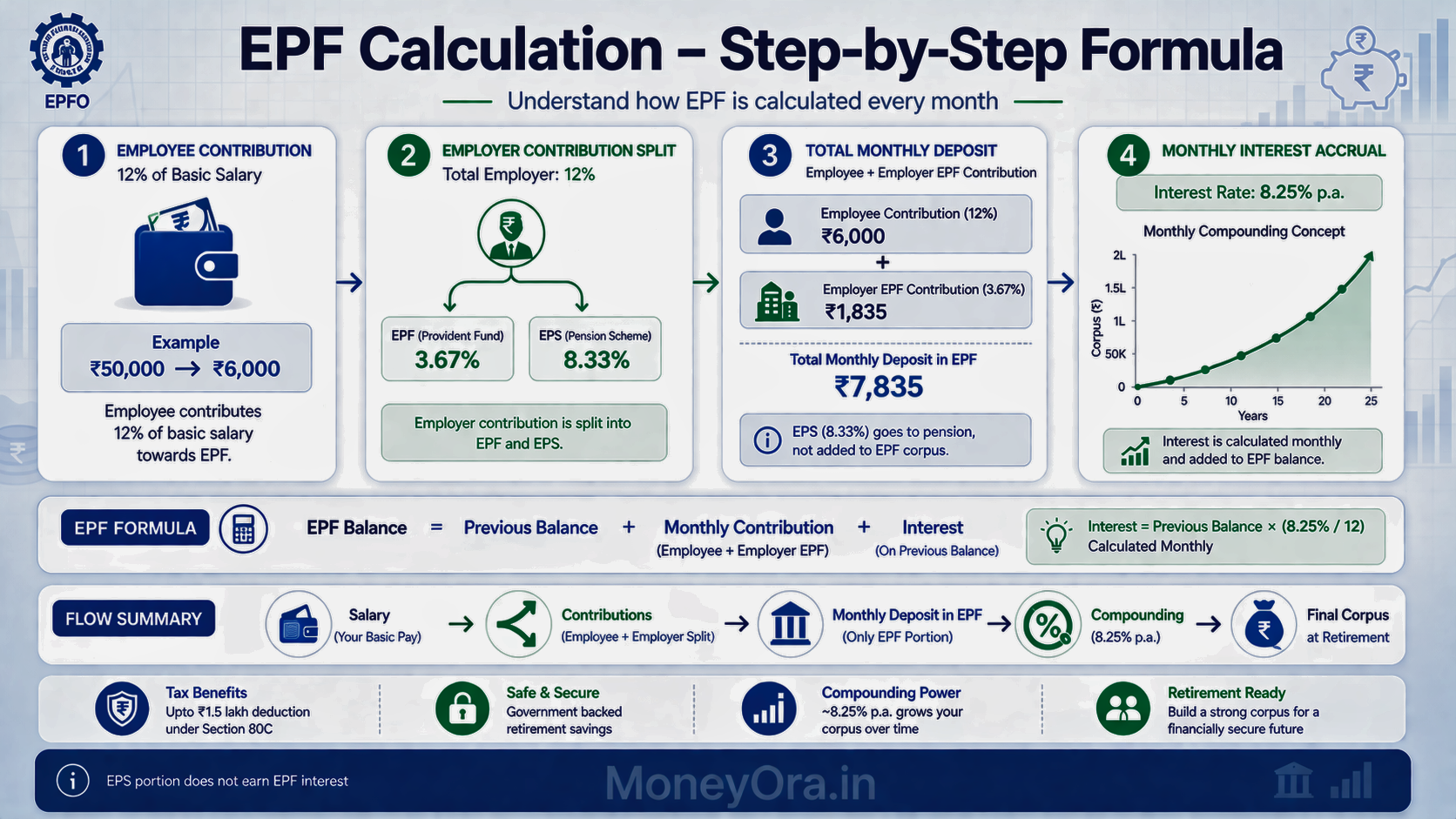
“Understanding the EPF contribution split and compounding formula helps you estimate your real retirement corpus more accurately.”
EPF interest rate 2025-26 — 8.25% explained
The EPF interest rate for FY 2025-26 is 8.25% per annum — unchanged from FY 2024-25. This rate was confirmed by EPFO’s Central Board of Trustees in consultation with the Ministry of Finance.
How EPF interest is calculated
Interest is calculated monthly but credited annually. This is a common source of confusion.
Every month, EPFO calculates interest on the closing balance at 0.6875% (8.25% ÷ 12). This monthly interest accrues but does not appear in your passbook immediately. At the end of the financial year (March 31), all accumulated monthly interest is credited to your account in one go. In practice, the credit usually shows up in the EPFO passbook between July and September.
This monthly calculation actually benefits you. Interest is computed on the month-end balance — so as your balance grows each month from new contributions, the interest base expands. It’s effectively monthly compounding with annual crediting.
EPF interest rate history
| Financial Year | EPF Interest Rate |
|---|---|
| FY 2025-26 | 8.25% |
| FY 2024-25 | 8.25% |
| FY 2023-24 | 8.25% |
| FY 2022-23 | 8.15% |
| FY 2021-22 | 8.10% |
| FY 2020-21 | 8.50% |
| FY 2019-20 | 8.50% |
| FY 2018-19 | 8.65% |
Even in years when bank FD rates dropped to 5–6%, EPF held at 8.10–8.50%. That consistency is one of EPF’s most underappreciated features. For a comparison, check MoneyOra’s FD calculator — most bank FDs for equivalent durations offer significantly lower net returns especially after tax.
The official EPF interest rate announcements are published on the EPFO’s official website at epfindia.gov.in. Check there after each financial year’s announcement for the latest confirmed rate before updating your EPF calculator inputs.
EPF vs EPS — what goes where in your account
This is the most misunderstood part of PF. Many employees assume their employer’s full 12% goes into EPF. It doesn’t. Here’s exactly how the employer’s 12% is split.
Employer’s 12% contribution breakdown
- 3.67% → goes into your EPF account (the lump-sum withdrawable amount)
- 8.33% → goes into EPS (Employee Pension Scheme), capped at Rs 1,250/month
- 0.50% → goes to EDLI (Employees’ Deposit Linked Insurance — life insurance)
- 0.50% → goes to EPFO administration charges
The EPS component funds your monthly pension after retirement — but it is not part of the lump-sum EPF corpus that the EPF calculator projects. It’s a separate benefit entirely.
What this means in rupees
For a basic salary of Rs 30,000/month:
- Employee contribution to EPF: Rs 3,600
- Employer contribution to EPF: Rs 1,101 (3.67%)
- Employer contribution to EPS: Rs 1,250 (8.33% of Rs 15,000 ceiling — not Rs 30,000)
- Monthly EPF deposit (what earns 8.25% interest): Rs 3,600 + Rs 1,101 = Rs 4,701
The EPF wage ceiling for EPS is Rs 15,000. Even if your basic salary is Rs 1 lakh, the maximum EPS contribution is 8.33% of Rs 15,000 = Rs 1,250. Anything above Rs 15,000 in your employer’s contribution gets routed to EPF instead. This benefits higher-salary employees — a larger proportion of their employer’s 12% goes to EPF (lump sum) rather than EPS (pension). If you’re early in your career and weighing EPF against other retirement instruments, EPF vs PPF vs NPS for Freshers lays out which one to prioritise first — and why the answer almost always starts with EPF before the others.
VPF calculator — contributing more than 12%
The Voluntary Provident Fund (VPF) allows you to contribute more than the mandatory 12% to your PF account. VPF earns the exact same 8.25% interest as EPF and is treated identically for tax purposes.
Why VPF makes sense
At 8.25% guaranteed return with tax-free compounding (up to Rs 2.5 lakh annual contribution), VPF competes favourably against most debt instruments. There are very few investments that offer government-guaranteed 8.25% returns with zero market risk — and VPF is one of them.
VPF contribution example
Employee with Rs 50,000 basic salary:
- Mandatory EPF: 12% × Rs 50,000 = Rs 6,000/month = Rs 72,000/year
- VPF extra contribution: 10% × Rs 50,000 = Rs 5,000/month = Rs 60,000/year
- Total annual PF contribution: Rs 72,000 + Rs 60,000 = Rs 1,32,000/year — fully within the Rs 2.5 lakh tax-free limit
- All interest earned remains tax-free
VPF limit for tax-free interest
If your total employee PF contribution (EPF + VPF) exceeds Rs 2.5 lakh per year, interest on the excess becomes taxable as income from other sources. TDS applies at your slab rate. Most salaried employees stay well below this threshold — only those with very high salaries or large VPF top-ups cross it.
To see how VPF compares to other tax-saving instruments: the PPF calculator shows returns on Public Provident Fund (7.1% currently, also tax-free up to Rs 1.5L/year), and the NPS calculator shows National Pension System projections. Each has a different risk-return-tax profile — worth comparing before deciding where to put extra retirement savings.
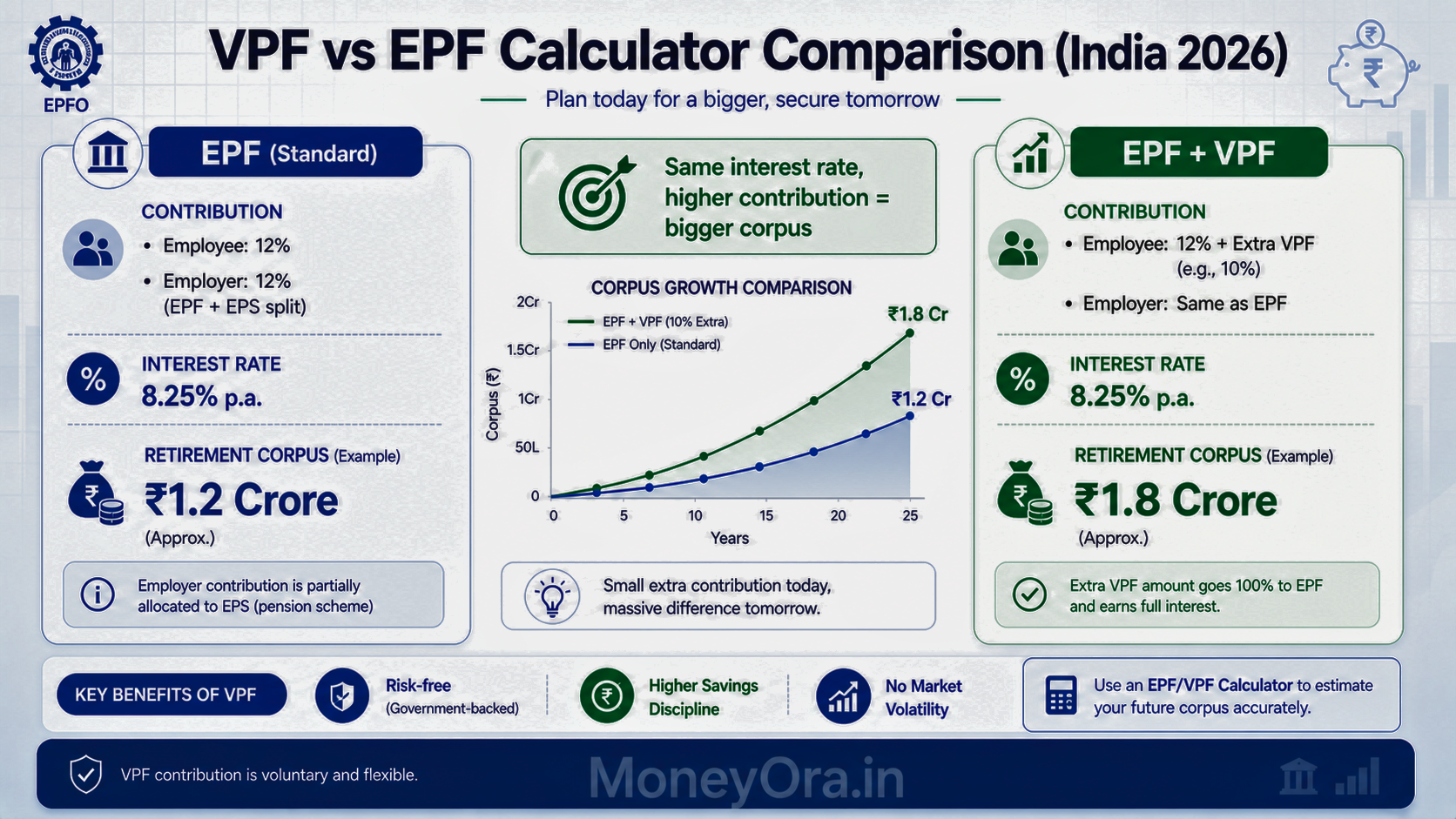
“VPF allows you to increase your EPF contributions at the same interest rate, significantly boosting your retirement corpus without additional risk.”
EPF withdrawal rules — when and how much
EPF is designed as a long-term retirement instrument. But EPFO does allow withdrawals in specific situations — both partial and full.
Full EPF withdrawal
You can withdraw your full EPF balance (employee contribution + employer EPF contribution + interest) in two situations:
- At retirement — when you reach age 58
- After 2 consecutive months of unemployment — regardless of age
| Purpose | Minimum service required | Maximum withdrawal amount |
|---|---|---|
| Medical emergency (self or family) | No minimum | 6 months basic salary or employee’s share + interest (lower of two) |
| Marriage (self, sibling, children) | 7 years | 50% of employee’s EPF share |
| Education (post-10th) | 7 years | 50% of employee’s EPF share |
| Home loan repayment | 5 years | 90% of total EPF balance |
| House purchase / construction | 5 years | 24 months basic salary + DA or total EPF (lower) |
| House renovation | 5 years (can apply twice) | 12 months basic salary or employee’s EPF share (lower) |
| Natural calamity / disaster | No minimum | Up to 3 months basic salary |
As of 2025, EPFO 3.0 is introducing PF-linked ATM cards that allow instant partial withdrawals (up to 50-75% of balance) for approved purposes without filing a claim form — making EPF more accessible during emergencies. This is still being rolled out but represents a significant upgrade to the withdrawal system.
If you’re considering using EPF for home loan repayment, pair this with MoneyOra’s home loan EMI calculator to see how a lump-sum EPF contribution toward principal affects your remaining loan term and total interest paid.
EPF tax rules — what’s exempt and what’s not
EPF is often called an EEE (Exempt-Exempt-Exempt) instrument, but that description has changed in recent years. Here’s the accurate tax picture.
Tax on EPF contribution (at investment stage)
Employee contributions to EPF qualify for deduction under Section 80C, up to Rs 1.5 lakh per year. This reduces your taxable income — so if you’re in the 30% slab, the Rs 1.5L 80C deduction saves Rs 45,000 in tax.
Tax on EPF interest (while accumulating)
This changed in Budget 2021. From FY 2021-22 onwards:
- Interest on EPF contributions up to Rs 2.5 lakh/year remains tax-free
- Interest on contributions above Rs 2.5 lakh/year is taxable at slab rate
- For employees without employer contribution (VPF only): tax-free limit is Rs 5 lakh/year
The Rs 2.5 lakh limit is only an issue for high earners. At Rs 30,000 basic salary, your annual EPF contribution is Rs 43,200 — well below the threshold. You’d need a basic salary above Rs 1.74 lakh/month before crossing the Rs 2.5 lakh annual limit.
Tax on EPF withdrawal
- If you’ve completed 5 continuous years of service: EPF withdrawal is fully tax-free
- If you withdraw before 5 years of service: TDS at 10% (PAN furnished) or 34.608% (no PAN) applies
- Employer’s contribution is added to income and taxed if withdrawn before 5 years
- At retirement (after 5 years): full withdrawal is tax-free — this is the EEE benefit that still stands
For most salaried employees who stay in the formal sector for 5+ years, EPF remains essentially EEE — contribution deducted from tax, accumulation tax-free, withdrawal tax-free. The only caveat is the Rs 2.5 lakh limit on tax-free interest for very high earners.
The Income Tax India portal has the latest rules on Section 80C deductions and EPF taxation — worth checking each budget year as rules can change.
How to check EPF balance — EPFO portal and UMANG
Your EPF balance is accessible through multiple channels. Here are all the ways to check it.
1. EPFO Member Portal (most detailed)
Go to epfindia.gov.in → Member e-Sewa → Passbook. Log in with your UAN and password. The passbook shows month-by-month contributions from employee and employer, plus annual interest credits. This is the most detailed view — useful for spotting missed contributions.
2. UMANG App
Download UMANG (Unified Mobile Application for New-age Governance) from the App Store or Play Store. Navigate to EPFO → Employee Centric Services → View Passbook. Same passbook data as the web portal, accessible on mobile.
3. Missed call (quickest)
Give a missed call to 9966044425 from your registered mobile number. EPFO sends an SMS with your current balance within seconds. This works only if your UAN is activated and mobile number is registered.
4. SMS
Send EPFOHO UAN ENG to 7738299899 from your registered mobile. You receive your EPF balance and last contribution details as an SMS.
5. Employer portal / Salary slip
Many employers now show EPF contributions on the monthly salary slip. The employee and employer contributions for each month are visible there. For full balance including interest, use the EPFO portal.
One thing to watch for: if your passbook shows a month where employer contribution is missing, contact your HR department immediately. Delayed or missed employer contributions cost you interest for that month and may indicate compliance issues at the company level.
What happens to EPF when you change jobs
Job changes are where most EPF planning errors happen. Here’s what you should and should not do.
Transfer EPF — don’t withdraw it
When you change jobs, transfer your EPF balance to your new employer’s account using Form 13 on the EPFO member portal. Your UAN stays the same across all jobs — only the PF account number changes. The UAN links all accounts under one umbrella.
Why transferring is important: every EPF account that’s left idle at an old employer stops receiving contributions. After 36 months of no contributions, the account becomes inoperative. Inoperative accounts still earn interest for 3 years post-inactivity, but then interest stops. Multiple idle PF accounts from multiple jobs are a common and costly mistake.
Never withdraw EPF on job change (unless absolutely necessary)
This is the single biggest EPF mistake Indian employees make. Withdrawing EPF at each job change breaks the compounding chain and triggers TDS. Here’s why it hurts so much:
Rs 5 lakh in EPF withdrawn at age 30, instead of being left to compound at 8.25% for 28 more years, would have grown to approximately Rs 43 lakh by retirement. That one premature withdrawal costs Rs 38 lakh in future retirement corpus.
The transfer process through the EPFO portal takes 10–15 days and is done entirely online — there’s no reason to withdraw just for the sake of convenience.
TDS rules on withdrawal before 5 years
If you’ve been employed for less than 5 continuous years (including service at previous employer if EPF was transferred) and withdraw:
- TDS at 10% if PAN is furnished
- TDS at 34.608% if PAN is not furnished
- Employer’s contribution becomes taxable income
- Previously claimed 80C deductions are reversed
The 5-year count includes all service periods where EPF was transferred — it’s continuous employment in the EPF system, not just one employer.
EPF vs PPF vs NPS — which is better for retirement?
This is one of the most searched retirement planning questions in India. The honest answer is: all three work together, not as alternatives. But let’s compare them directly.
| Feature | EPF | PPF | NPS |
|---|---|---|---|
| Current interest / return | 8.25% (FY 2025-26) | 7.1% (Q1 FY 2025-26) | 10-12% (market-linked, not guaranteed) |
| Return type | Guaranteed by govt | Guaranteed by govt | Market-linked (equity + debt mix) |
| Who can invest | Salaried employees (formal sector) | Anyone (including self-employed) | Anyone (Indian citizen, 18-70) |
| Annual investment limit | No upper limit (12% mandatory, VPF unlimited) | Rs 500 to Rs 1.5 lakh/year | No upper limit (tax benefit capped at Rs 2L) |
| Lock-in period | Until retirement / job exit conditions | 15 years (partial from year 7) | Until age 60 (partial exits allowed) |
| Withdrawal at maturity | 100% lump sum (tax-free after 5 years) | 100% lump sum (tax-free) | 60% lump sum + 40% mandatory annuity |
| Tax on interest | Tax-free up to Rs 2.5L/year contribution | Fully tax-free | Corpus growth: not taxed annually |
| 80C benefit | Yes (employee contribution) | Yes (up to Rs 1.5L) | 80CCD(1): Rs 1.5L + 80CCD(1B): Rs 50K extra |
| Employer contribution | Yes — 3.67% EPF + 8.33% EPS | No | Yes (10% of basic for central govt) |
| Partial withdrawal | Yes (specific purposes) | Yes (from year 7, limited) | Yes (after 3 years, specific purposes) |
Use MoneyOra’s PPF calculator and NPS calculator alongside the EPF calculator to model your total retirement corpus from all three sources. Most salaried employees end up with EPF as the mandatory foundation, PPF as a voluntary tax-free supplement, and NPS for additional equity exposure in retirement savings.
Pro tips to maximise your EPF corpus
- Use the EPF calculator with your actual basic salary (not CTC) and include a realistic salary increment rate. Most people underestimate their salary growth — even 8% annual increment makes a large difference over 25-30 years.
- Add VPF if you’re in the 30% tax bracket and have maxed out Section 80C with other instruments. VPF at 8.25% tax-free beats most debt mutual funds and corporate FDs on a post-tax basis at higher income levels.
- Never withdraw EPF for a car loan, personal loan, or non-emergency use. The opportunity cost is massive — money withdrawn at 35 costs you 23+ years of compounding at 8.25%.
- Check that your employer’s EPF contributions are deposited on time. EPFO mandates contributions by the 15th of the following month. Consistent delays by employers are a compliance violation you can report to EPFO.
- Transfer EPF immediately when changing jobs — don’t wait months. Idle accounts lose contributions (from the new employer) and can become complicated to consolidate later.
- Compare your EPF projection against expenses using MoneyOra’s tools. The SWP calculator can show you what monthly income your EPF lump sum generates if invested in a mutual fund post-retirement. The lumpsum calculator shows what EPF corpus grows to if reinvested.
- Use the EPF withdrawal provisions strategically — the home loan repayment provision (up to 90% after 5 years) is genuinely useful and avoids taking a separate personal loan at higher interest. Compare with MoneyOra’s personal loan EMI calculator to see the interest cost difference before deciding.
- Review your retirement plan annually. Run the EPF calculator each April with your updated salary, then check if the projected corpus is sufficient against expected retirement expenses. If not, adjust VPF contribution or SIP amount accordingly.
Why Most EPF Calculator Results Are Quietly Wrong
Quick answer: An EPF Calculator is only as accurate as its five inputs — Basic + DA, current age, contribution rate, salary increment, and interest rate. Get any one of these wrong and the formula still runs perfectly, producing a confident, precise-looking number that’s nowhere close to reality.
That’s the trap. A calculator never tells you your inputs are wrong. It just multiplies them forward for 25–30 years and hands you a clean rupee figure. People trust that number because it looks calculated, not guessed. In reality, a single wrong input compounds for three decades right alongside your real contributions.
The seven mistakes below come from the same pattern: a small misunderstanding at data-entry time, magnified by decades of compounding. Each one is fixable in under a minute once you know what to look for.
Mistake 1 — Entering CTC Instead of Basic + DA
This is the single most common EPF Calculator mistake, and it produces wildly different results depending on which direction you get it wrong.
EPF is calculated only on Basic Salary + Dearness Allowance — never on your full CTC. CTC includes HRA, special allowances, employer PF, gratuity provision, and other components that never touch the EPF formula. If your offer letter says ₹12 lakh CTC and you type ₹1,00,000/month straight into the monthly salary field, your EPF Calculator output is fiction.
| Input Used | Monthly Figure Entered | Monthly EPF Deposit (Employee + Employer EPF) | 30-Year Corpus (8.25%, 8% increment) |
|---|---|---|---|
| Wrong: Full CTC ÷ 12 | ₹1,00,000 | ₹15,670 | ~₹3.6 crore (overstated) |
| Correct: Basic + DA only | ₹45,000 | ₹7,051 | ~₹1.62 crore (actual) |
That’s roughly a ₹2 crore gap, purely from one wrong field. Most offer letters and salary slips list Basic separately — check yours before you touch the EPF Calculator. If your slip only shows CTC, ask HR for the Basic + DA breakup, or estimate it at 40–50% of CTC as a rough starting point (more on why 50% specifically matters in Mistake 4).
Mistake 2 — Forgetting the EPS 8.33% Carve-Out
People assume their employer’s full 12% lands in their EPF account, ready to compound alongside their own contribution. It doesn’t. Of the employer’s 12%, only 3.67% goes into EPF. The other 8.33% routes to EPS (Employee Pension Scheme) — capped at ₹1,250/month — which builds a separate monthly pension entitlement, not a lump sum.
This isn’t a flaw in the EPF Calculator — a correctly built one already accounts for this split. The mistake happens when people manually estimate their corpus (“12% + 12% = 24% of salary compounding”) instead of trusting the calculator’s actual math, or when they use a calculator that incorrectly lets the full 12% employer share flow into EPF.
| Assumption | Effective Monthly EPF Rate | 30-Year Corpus Impact |
|---|---|---|
| Wrong: Full 24% (12% + 12%) compounds into EPF | 24% | Overstated by ~35% |
| Correct: 12% employee + 3.67% employer to EPF | 15.67% | Accurate |
The 8.33% EPS portion isn’t lost money — it funds your pension after age 58, provided you’ve completed 10 years of eligible service. But it’s a different benefit, paid out differently, and a properly built EPF Calculator like MoneyOra’s keeps it separate from the lump-sum projection on purpose.
Mistake 3 — Using 0% or Unrealistic Salary Increment
This is the quietest mistake of all because it doesn’t feel like a mistake — it feels conservative. People leave the salary increment field at 0%, thinking they’re being cautious. They’re actually throwing away the majority of their projected corpus.
Indian salaries, even modest ones, tend to grow 5–10% annually across a career through appraisals and job changes combined. An EPF Calculator run with 0% increment assumes your salary on day one of your career equals your salary on the day you retire — which almost never happens.
| Annual Increment Assumed | Year-30 Basic Salary | EPF Corpus at Retirement |
|---|---|---|
| 0% (flat) | ₹30,000 | ~₹78 lakh |
| 5% (conservative) | ₹1,29,658 | ~₹1.71 crore |
| 10% (typical career growth) | ₹4,76,988 | ~₹3.2 crore+ |
The gap between 0% and 10% increment isn’t a rounding error — it’s a 4× difference in projected corpus. The honest middle ground for most salaried employees is 6–8%, adjusted down if you work in a sector with historically slower wage growth, or up if you expect aggressive job-hopping early in your career.
Mistake 4 — Ignoring the 2026 Wage Code 50% Rule
This is the mistake almost nobody outside payroll departments knows about yet, and it’s the most consequential change to EPF Calculator inputs in years.
India’s new Labour Codes came into effect on November 21, 2025, consolidating 29 older labour laws. One provision under the Code on Wages, 2019, redefines “wages” so that Basic + DA + retaining allowance must equal at least 50% of total CTC. Previously, many employers structured salaries with Basic at just 30–40% of CTC, keeping EPF contributions artificially low by loading compensation into HRA and special allowances instead.
Under the new rule, if your Basic + DA falls below that 50% threshold, the excess allowance gets “deemed” back into wages for EPF and gratuity calculation purposes — even if your payslip still shows it as a separate line item.
There’s an important nuance the headlines often skip: EPF-specific pension provisions under the Social Security Code carry a one-year transition period running until November 2026, and the Finance Ministry’s 2026 clarifications confirmed that PF contributions above the existing ₹15,000 statutory wage ceiling remain voluntary for many establishments. In practice, this means the broader wage definition is already reshaping gratuity, ESI, and bonus calculations faster than it’s reshaping EPF for every employer — rollout is uneven and depends on your specific company’s compliance timeline.
The practical takeaway: don’t treat your current Basic + DA as fixed for the next 30 years in your EPF Calculator projection. If your company hasn’t restructured salaries yet, budget for a possible Basic increase sometime in 2026, which raises both your EPF contribution and your projected corpus — alongside a modest dip in monthly take-home pay as the trade-off.
Mistake 5 — Assuming 8.25% Is Locked Forever
The EPF interest rate is reviewed annually by EPFO’s Central Board of Trustees in consultation with the Finance Ministry. It is not contractually fixed for your entire career, even though most EPF Calculator tools — including MoneyOra’s — pre-fill the current confirmed rate as a sensible default.
| Financial Year | Rate |
|---|---|
| FY 2025-26 | 8.25% |
| FY 2024-25 | 8.25% |
| FY 2023-24 | 8.25% |
| FY 2022-23 | 8.15% |
| FY 2021-22 | 8.10% |
| FY 2020-21 | 8.50% |
| FY 2019-20 | 8.50% |
| FY 2018-19 | 8.65% |
That’s a range of 0.55 percentage points over eight years — not dramatic, but not nothing either when compounded over 30. The fix isn’t complicated: run your EPF Calculator twice, once at the current 8.25% and once at a more conservative 7.5–7.75%, and treat the gap between the two outputs as your margin of uncertainty rather than betting your retirement plan on a single precise-looking number.
Mistake 6 — Not Modelling Job-Change Gaps and Withdrawals
A standard EPF Calculator assumes one continuous, uninterrupted contribution stream from your current age to retirement. Real careers don’t work that way. People take career breaks, switch jobs with gaps between roles, and — far too often — withdraw their EPF balance instead of transferring it.
None of this shows up in a default calculator run, which is exactly why the gap between projected and actual corpus tends to widen over a real career.
| Scenario | Balance at Withdrawal (Age 30) | What It Would Have Been at 58 |
|---|---|---|
| Withdrawn instead of transferred | ₹5,00,000 | ₹0 (spent) |
| Transferred and left to compound | ₹5,00,000 | ~₹43 lakh |
That ₹5 lakh withdrawn at 30 instead of transferred costs roughly ₹38 lakh in foregone retirement corpus by 58, purely from lost compounding at 8.25% over 28 years. If you’ve changed jobs before, the honest way to use an EPF Calculator is to run it in segments — one projection per continuous employment stretch — rather than assuming one unbroken 30-year line.
Also model career gaps realistically. A 1–2 year break for further studies, caregiving, or a job search resets nothing structurally (EPF keeps compounding even with zero new contributions, as long as you don’t withdraw), but it does mean fewer years of fresh contributions — which a single static calculator run won’t show unless you adjust the contribution years manually.
Mistake 7 — Leaving VPF Out of the Calculation Entirely
The seventh mistake isn’t an error in the inputs you do enter — it’s an opportunity most people never enter at all. Voluntary Provident Fund (VPF) lets you contribute above the mandatory 12%, at the same 8.25% government-guaranteed rate, with identical tax treatment.
Most EPF Calculator runs stop at the mandatory 12% because that’s the default. But for anyone in the 30% tax bracket who’s already maxed Section 80C elsewhere, VPF is one of the few instruments offering a guaranteed, tax-free 8.25% — a rate that’s genuinely difficult to beat without taking on market risk.
| Contribution Structure | Monthly Employee Contribution | Projected 25-Year Corpus |
|---|---|---|
| Mandatory 12% EPF only | ₹6,000 | ~₹1.3 crore |
| 12% EPF + 10% VPF | ₹11,000 | ~₹2.4 crore |
This isn’t right for everyone — VPF locks up liquidity the same way mandatory EPF does. But leaving it out of your EPF Calculator exploration entirely means you may never realise it was an option worth modelling against your other 80C choices, including PPF and ELSS.
A Corrected EPF Calculator Walkthrough, Start to Finish
Here’s how to run the numbers properly, using a real profile: 27-year-old, Basic + DA of ₹38,000/month, current EPF balance of ₹3.2 lakh from a previous job (already transferred, not withdrawn).
- Confirm Basic + DA, not CTC. Check the salary slip line item directly — don’t estimate from the offer letter’s CTC figure.
- Check whether your company has completed Wage Code restructuring. If Basic is currently below 50% of CTC and your employer hasn’t restructured yet, note that this figure may rise during 2026 — run a second scenario at the higher Basic to see the range.
- Set increment realistically. 7% is a reasonable default for most private-sector careers; adjust based on your industry and role.
- Run the rate at 8.25% and again at 7.5% to see the range rather than a single point estimate.
- Add existing balance. Don’t start the projection from zero if you already have a transferred EPF balance — that ₹3.2 lakh keeps compounding from today.
- Decide on VPF separately if you’re maximising tax efficiency, and run a second scenario with it added.
Run all of this directly on MoneyOra’s EPF Calculator — it already handles the EPF/EPS split correctly and shows year-by-year growth, so the only inputs you need to get right are the five covered above.
The Wage Code Is the Real 2026 EPF Story
Most coverage of EPF in 2026 is still focused on EPFO 3.0’s digital features — UPI withdrawal, ATM-linked partial claims, faster settlement. Those matter operationally. But the wage code’s 50% rule is the bigger story for anyone actually trying to project a retirement number, because it changes the input itself, not just the withdrawal process.
Here’s the part that gets lost in most coverage: this is genuinely a mixed outcome, not a clean win or loss. A higher mandated Basic means higher EPF contributions and a larger guaranteed retirement corpus — that’s the upside, and for long-tenure employees it’s a meaningful one. But because total CTC typically stays fixed during restructuring, the increase usually comes out of flexible allowances, which can mean a modest dip in monthly take-home pay, particularly noticeable for employees whose Basic was previously set well below the new 50% threshold.
For an EPF Calculator user specifically, the practical implication is this: your current Basic + DA figure may not be your Basic + DA figure in twelve months. If your employer restructures mid-year, your monthly EPF contribution jumps mid-stream — which a single static calculator run, done once and forgotten, will never capture. The honest approach is treating your EPF Calculator output as a living number you revisit at least once a year, not a one-time forecast you check off a list.
There’s also a tenure asymmetry worth flagging. Long-tenured employees benefit clearly — a bigger Basic compounds into both a bigger EPF corpus and bigger gratuity. Frequent job-changers see a thinner version of the upside, since gratuity in particular rewards years of continuous service that job-hoppers by definition don’t accumulate. If you’re early-career and weighing job-hopping against staying put, the wage code modestly tilts the maths toward staying — not dramatically, but it’s a real factor that didn’t exist before November 2025.
Risks and Assumptions to Keep in Mind
- Rate risk: EPF’s 8.25% rate is reviewed annually and has moved within a 0.55-point band over the past eight years. Treat any single-rate projection as an estimate, not a guarantee.
- Wage code rollout risk: Implementation varies by employer and state as of mid-2026. Some companies have restructured salaries to the 50% Basic threshold; others are still in transition. Confirm your own company’s status with HR rather than assuming a uniform national timeline.
- Increment risk: Salary growth is never perfectly linear. A flat increment assumption smooths over real-world volatility — promotions, stagnant years, job changes — that genuinely affects the final number.
- Withdrawal risk: The single largest deviation between projected and actual EPF corpus, in practice, comes from premature withdrawals at job changes rather than from interest rate movements.
- EPS exclusion: Remember that EPF Calculator outputs do not include your EPS pension entitlement. That’s a separate monthly benefit, calculated differently, requiring 10 years of eligible service.
MoneyOra Tools
- EPF Calculator — Run your corrected EPF retirement corpus projection
- NPS Calculator — Compare EPF against National Pension System projections
- PPF Calculator — Model Public Provident Fund returns at 7.1%
- CAGR Calculator — Check the compound annual growth rate your EPF balance is actually earning
- SIP Calculator — See how a parallel mutual fund SIP supplements EPF over 20–30 years
- FD Calculator — Compare EPF’s post-tax return against bank fixed deposits
- RD Calculator — Model recurring deposit growth alongside EPF
- SWP Calculator — Plan monthly income from your EPF lump sum after retirement
- Lumpsum Calculator — See what your EPF corpus grows to if reinvested at retirement
- EMI Calculator — Check loan commitments before deciding to increase VPF
- Home Loan EMI Calculator — Compare EPF-funded prepayment against continued EMI
- Personal Loan EMI Calculator — Compare the cost of a personal loan against EPF partial withdrawal
- Car Loan EMI Calculator — Plan a car purchase without disturbing your EPF corpus
- IFSC Code Finder — Verify bank details when linking your account to EPFO for withdrawal or transfer
- Bank Details Finder — Quick bank verification tool for EPFO KYC updates
MoneyOra Articles
- How to Transfer EPF When Changing Jobs — The full step-by-step process for preserving your compounding
- EPF vs PPF vs NPS for Freshers — Which retirement instrument to prioritise when starting out
- Common Financial Mistakes Freshers Make — Including the most expensive EPF mistakes early in a career
- EPFO 3.0 Complete Guide — How the new digital EPF system changes withdrawal and access
- ₹25,000 Salary Investment Plan — How EPF fits into a starter salary investment plan
- ₹100/Day Investment Plan — Pairing small daily SIPs with your EPF base
- Financial Planning Meaning for Salaried Employees — How EPF fits into a complete financial plan
What’s the most common mistake people make with an EPF Calculator?
Entering full CTC instead of Basic + DA. EPF is calculated only on Basic Salary plus Dearness Allowance — never on HRA, special allowances, or any other CTC component. This single input error can overstate or understate a 30-year EPF Calculator projection by ₹15–40 lakh, depending on how your salary is structured.
Why does my EPF Calculator result not match what I expected?
Usually one of five things: you entered CTC instead of Basic + DA, you assumed the full employer 12% goes to EPF (only 3.67% does — the rest funds EPS pension), you set salary increment to 0% instead of a realistic 6–8%, you didn’t account for an EPF withdrawal at a previous job change, or you’re not factoring in that India’s 2026 wage code may raise your Basic + DA during the year.
How does the 2026 Wage Code change my EPF Calculator inputs?
India’s new Labour Codes, effective November 21, 2025, require Basic + DA to equal at least 50% of total CTC for most employees. If your company hasn’t yet restructured salaries to meet this threshold, your Basic + DA figure may rise during 2026, which directly increases your EPF contribution and projected corpus. EPF-specific pension provisions carry a transition period running until November 2026, so rollout timing varies by employer — confirm your company’s status with HR before assuming your current Basic is fixed for the long term.
Should I use 8.25% or a lower rate in my EPF Calculator?
8.25% is the confirmed rate for FY 2025-26, and it’s a reasonable default since most EPF calculators pre-fill it. But the rate has moved between 8.10% and 8.65% over the past eight years and is reviewed annually by EPFO. Running your EPF Calculator twice — once at 8.25% and once at a more conservative 7.5% — gives you a realistic range rather than a single, falsely precise number.
Does the EPF Calculator include my EPS pension?
No, and this trips up a lot of people. An EPF Calculator projects only the lump-sum EPF corpus — built from your 12% employee contribution plus the employer’s 3.67% EPF share. The employer’s remaining 8.33% funds EPS (Employee Pension Scheme), which pays a separate monthly pension after retirement, calculated under entirely different rules, requiring 10 years of eligible service. The EPF Calculator output and your eventual EPS pension are two different benefits.
How much does an EPF withdrawal at a job change actually cost in lost corpus?
A withdrawal of ₹5 lakh at age 30, left to compound at 8.25% until retirement at 58 instead, would have grown to roughly ₹43 lakh — meaning the withdrawal effectively costs about ₹38 lakh in foregone retirement wealth. The fix is straightforward: always transfer your EPF balance to your new employer’s account using Form 13 rather than withdrawing it, even though withdrawal feels more convenient in the moment.
Should I include VPF in my EPF Calculator projection?
If you’re in a higher tax bracket and have already maximised other Section 80C instruments, running a second EPF Calculator scenario with Voluntary Provident Fund (VPF) added is worth doing. VPF earns the same 8.25% government-guaranteed, tax-free rate as mandatory EPF, with no separate account needed. On a ₹50,000 basic salary, adding 10% VPF on top of mandatory EPF can roughly double the 25-year projected corpus, though it does increase the portion of your salary that’s locked up until retirement.
What salary increment percentage should I use in an EPF Calculator?
6–8% annual increment is a reasonable default for most private-sector careers in India, based on typical appraisal cycles plus periodic job changes. Using 0% — which many people choose thinking it’s the conservative option — actually understates a 30-year EPF corpus by more than 60% compared to a realistic 8–10% increment assumption, since it ignores the compounding effect of a rising contribution base over a career.
Is my current Basic + DA figure going to change because of the wage code?
Possibly, depending on your employer’s restructuring timeline. If your Basic + DA currently sits below 50% of your total CTC, the new wage code requires it to rise to that threshold, which most companies achieve by reducing flexible allowances while keeping total CTC unchanged. Implementation has been uneven through 2026 — some employers restructured immediately after the November 2025 effective date, others are still transitioning. Check with your HR or payroll team for your specific company’s status rather than assuming a fixed national timeline.
Frequently Asked Questions About EPF Calculator
An EPF calculator estimates your PF balance.
It shows total retirement corpus.
You enter salary, age, and contribution.
It includes employee and employer share.
It also adds interest over time.
The EPF interest rate is 8.25% per year.
It is set by EPFO.
Monthly rate is 0.6875%.
Interest is credited yearly.
Credit date is March 31.
Employee contributes 12% of Basic + DA.
Employer contributes 12% total.
3.67% goes to EPF.
8.33% goes to EPS.
EPS is capped at ₹1,250/month.
Interest is calculated monthly.
It is credited annually.
Employer contributes 12% of Basic + DA.
Only 3.67% goes to EPF.
Remaining 8.33% goes to EPS.
EPS has ₹1,250 monthly cap.
EPS is separate from EPF corpus.
Yes, partial withdrawals are allowed.
Medical emergencies have no minimum service.
Marriage or education needs 7 years service.
Home-related withdrawals need 5 years.
Full withdrawal allowed after unemployment.
Also allowed at retirement age.
EPF interest is mostly tax-free.
Limit is ₹2.5 lakh yearly contribution.
Above this, interest becomes taxable.
Tax applies as per slab rate.
Most salaried employees stay below limit.
VPF is voluntary contribution.
It is above mandatory 12% EPF.
It earns same 8.25% interest.
Tax rules are same as EPF.
Higher contributions may become taxable.
EPF builds a lump sum corpus.
EPS provides monthly pension.
EPS is funded by employer contribution.
It is not part of EPF balance.
It is separate retirement benefit.
Use EPFO website for detailed info.
Use UMANG app for mobile access.
Missed call gives instant balance.
SMS also provides details.
Transfer EPF to new employer.
Use Form 13 online.
Your UAN remains same.
Avoid withdrawing PF.
Withdrawal breaks compounding.
It reduces long-term corpus.