
Loan EMI
Calculator
Monthly instalments for any currency — Home, Car, Personal & Education loans.
| Year | Principal | Interest | Total | Balance |
|---|
EMI Calculator India 2026 – Free Online Loan EMI Calculator (Instant Results)
Most people I know who’ve taken a loan in India did the same thing: they asked a relative what the EMI would be, got a rough number, and trusted it. Then the first statement arrived and the number was different. Sometimes higher. Often confusing.
That’s the thing about loans — the math is simple but the implications aren’t, and nobody walks you through them before you sign. “share market today — understand market trends before using loans to invest”
The EMI Calculator India on Moneyora does that. Enter your loan amount, interest rate, and tenure. It returns your exact monthly payment, total interest, and a month-by-month breakdown of where every rupee goes. Free. No account needed. Takes about four seconds.
RBI data from 2024 shows total personal loan outstanding in India crossed ₹50 lakh crore. Every borrower behind that number pays a monthly instalment. Most never calculated what they’d actually pay in total before they agreed to it.
This guide covers all of it — the formula, real numbers, bank comparisons, tax angles, and the mistakes that cost people quietly over years. Use these calculators to estimate repayment costs and understand how credit card interest charges affect your finances.
What is an EMI?
EMI stands for Equated Monthly Installment. It’s the fixed amount you pay every month until a loan is fully repaid.
Walk into SBI, borrow ₹5 lakh. They don’t expect a lump sum next month. Instead, they divide the repayment into equal monthly chunks across your agreed tenure. Each chunk is an EMI.
Two things make up every EMI:
- Principal — the actual loan amount you’re chipping away at
- Interest — what the bank charges for lending you the money
Here’s what most people don’t realize: in the early months, most of your EMI is interest, not principal. Only later — sometimes much later — does the balance shift. This process is called amortization, and it’s the reason a 20-year home loan can end up costing nearly twice the original amount.
Running the numbers on a loan EMI calculator before signing is the only way to see this clearly.
“stock average calculator” in a section about managing finances alongside equity investments.
How EMI Actually Works
Take a simple example:
- You borrow ₹3,00,000 from HDFC Bank
- Rate: 14% per annum
- Tenure: 3 years (36 months)
The bank runs the standard formula, tells you your monthly payment, and you pay that same amount every month for 36 months. Done. “loan against Netweb Technologies India shares — EMI planning”
What changes month to month is the split inside each payment. Early on, more goes to interest. Later, more clears principal. The total you pay each month never changes — but what that money is doing changes constantly.
The loan EMI calculator on Moneyora shows you exactly how that split looks, month by month, before you take the loan.
The EMI Formula (P, R, N) — Explained Simply
Every bank in India — and every calculator including Moneyora’s — uses this formula:
EMI = [P × R × (1+R)^N] / [(1+R)^N – 1]| Variable | What it means |
|---|---|
| P | Principal — the loan amount in rupees |
| R | Monthly interest rate = Annual rate ÷ 12 ÷ 100 |
| N | Loan tenure in months |
Working through an example:
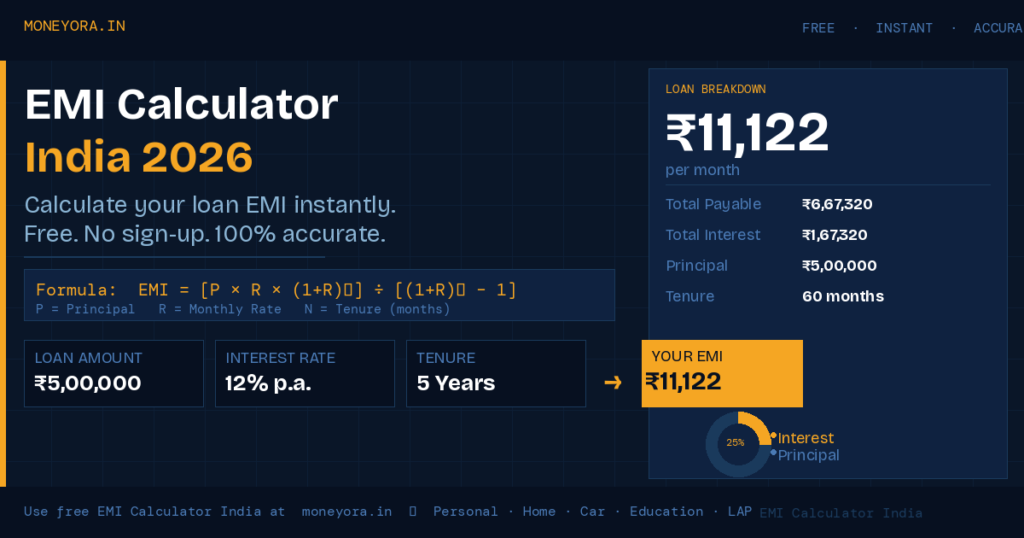
- P = ₹5,00,000
- Annual rate = 12%, so R = 0.01
- N = 60 months (5 years)
EMI = [5,00,000 × 0.01 × (1.01)^60] / [(1.01)^60 – 1]
    = [5,00,000 × 0.01 × 1.8167] / [0.8167]
    = ₹11,122 per month
Nobody should do this by hand when the free EMI calculator on Moneyora runs it in a second. But understanding the variables — P, R, N — matters, because those are exactly the three levers you can pull to reduce what you pay.
How to Use Moneyora’s EMI Calculator
Four steps:
- Enter your loan amount (e.g., ₹5,00,000)
- Enter the annual interest rate (e.g., 12%)
- Choose tenure — years or months, whichever is easier
- Hit Calculate
You get back:
- Monthly EMI
- Total interest over the full loan term
- Total amount repaid (principal + interest combined)
- A complete amortization schedule, month by month
No login. No fees.
Real Example — ₹5 Lakh Loan, Calculated
Rahul is a software engineer in Pune. He wants a ₹5,00,000 personal loan from ICICI Bank for his wedding. Before walking into the branch, he runs the numbers.
His loan details:
| Parameter | Value |
|---|---|
| Loan Amount | ₹5,00,000 |
| Interest Rate | 13% per annum |
| Tenure | 3 Years (36 months) |
The math:
- R = 13 ÷ 12 ÷ 100 = 0.01083
- EMI comes out to ₹16,861/month
What he’ll actually pay:
| Amount | |
|---|---|
| Monthly EMI × 36 | ₹6,06,996 |
| Total Interest | ₹1,06,996 |
| Original Principal | ₹5,00,000 |
Over a lakh in interest on a ₹5 lakh loan over 3 years. That’s the real cost of borrowing, and it’s not hidden — it’s just rarely surfaced before you sign.
Rahul earns ₹60,000/month. His EMI of ₹16,861 is 28% of take-home pay — within the safe 30–35% range most advisors recommend. Loan approved, finances intact.
He knew all of this before entering the bank.
EMI Amortization Table
Here’s how Rahul’s ₹5,00,000 loan at 13% breaks down month by month:
| Month | EMI (₹) | Interest Paid (₹) | Principal Paid (₹) | Balance (₹) |
|---|---|---|---|---|
| 1 | 16,861 | 5,417 | 11,444 | 4,88,556 |
| 6 | 16,861 | 4,813 | 12,048 | 4,33,028 |
| 12 | 16,861 | 4,143 | 12,718 | 3,69,834 |
| 18 | 16,861 | 3,428 | 13,433 | 3,00,862 |
| 24 | 16,861 | 2,662 | 14,199 | 2,25,485 |
| 30 | 16,861 | 1,843 | 15,018 | 1,42,981 |
| 36 | 16,861 | 182 | 16,679 | 0 |
Month 1: ₹5,417 in interest, ₹11,444 toward principal. By Month 36, it flips entirely. That’s amortization — and it’s why the first few years of any loan are the most expensive, even when the EMI feels manageable.
Moneyora’s loan repayment calculator generates this full table for any loan, instantly.
All EMI Calculator Types on Moneyora
Home Loan EMI Calculator India
Home loans run from ₹20 lakh to ₹2 crore, often for 15–30 years. A 0.5% rate difference on a 20-year loan can mean ₹3–5 lakh in savings — or extra cost. Always compare.
Example: ₹30,00,000 at 8.5% for 20 years → EMI: ₹26,035/month
Car Loan EMI Calculator India
Car loans are stricter — missed payments can lead to repossession faster than most people expect. Know your monthly number before the dealership quotes you one.
Example: ₹8,00,000 at 9.5% for 5 years → EMI: ₹16,766/month
Personal Loan EMI Calculator India
Personal loans carry higher interest rates because they’re unsecured. Useful when you need money fast, but the cost of borrowing adds up quickly.
Example: ₹3,00,000 at 14% for 2 years → EMI: ₹14,424/month
Education Loan EMI Calculator India
Education loans usually include a moratorium period — no repayment while you’re studying. Repayments start after graduation or employment. Use the calculator to plan your first paycheck properly.
Loan Against Property EMI Calculator India
Secured loans, lower rates, longer tenures. Common among business owners and self-employed borrowers. Worth calculating carefully since the stakes — your property — are higher.
EMI Calculator with Down Payment
Planning to pay a portion upfront? Enter the financed amount (purchase price minus down payment) as your principal. A larger down payment means a smaller loan and lower total interest. This calculator lets you test different down payment scenarios side by side.
EMI Calculator in Months
Some people find it easier to think in months rather than years — especially for shorter loans. Moneyora’s EMI calculator accepts tenure in months directly, no conversion needed.
Bank Interest Rate Comparison — 2026
Rates as of early 2026. Always confirm directly with the bank before applying — rates change.
| Bank | Personal Loan | Home Loan | Car Loan | Processing Fee |
|---|---|---|---|---|
| SBI | 11.15%–14.30% | 8.50%–9.65% | 8.75%–9.75% | 0–1% |
| HDFC Bank | 10.85%–21.00% | 8.75%–9.65% | 9.00%–10.50% | Up to 2.50% |
| ICICI Bank | 10.85%–19.00% | 8.75%–9.80% | 9.00%–10.75% | Up to 2% |
| Axis Bank | 11.25%–22.00% | 8.75%–9.65% | 9.25%–10.50% | Up to 2% |
| Kotak Mahindra | 10.99%–24.00% | 8.75%–9.60% | 7.70%–12.00% | Up to 3% |
| Bank of Baroda | 10.90%–18.25% | 8.40%–9.65% | 8.70%–10.50% | 0.25%–1% |
A 1% lower rate on a ₹20 lakh home loan over 20 years saves over ₹2.5 lakh in total interest. That’s a number worth spending 10 minutes comparing.
Use these for quick comparisons:
Comparison: Top Banks & Their Loan Interest Rates
(Rates as of early 2026 — always verify directly with the bank before applying)
| Bank | Personal Loan Rate | Home Loan Rate | Car Loan Rate | Processing Fee |
|---|---|---|---|---|
| SBI | 11.15% – 14.30% | 8.50% – 9.65% | 8.75% – 9.75% | 0–1% |
| HDFC Bank | 10.85% – 21.00% | 8.75% – 9.65% | 9.00% – 10.50% | Up to 2.50% |
| ICICI Bank | 10.85% – 19.00% | 8.75% – 9.80% | 9.00% – 10.75% | Up to 2% |
| Axis Bank | 11.25% – 22.00% | 8.75% – 9.65% | 9.25% – 10.50% | Up to 2% |
| Kotak Mahindra | 10.99% – 24.00% | 8.75% – 9.60% | 7.70% – 12.00% | Up to 3% |
| Bank of Baroda | 10.90% – 18.25% | 8.40% – 9.65% | 8.70% – 10.50% | 0.25%–1% |
Pro Tip: Even a 1% lower interest rate on a ₹20 lakh home loan over 20 years can save you over ₹2.5 lakh in total interest. Always use the EMI Calculator India to compare before choosing.
What Actually Changes Your EMI
Three variables. Only three.
1. Loan Amount (Principal) Higher principal = higher EMI and more total interest. Borrow the minimum you actually need.
2. Rate of Interest The rate of interest is the most negotiable factor — if your CIBIL score is strong. Even 0.5% less on a large loan is significant over 10–20 years.
3. Tenure Longer tenure = lower EMI, but much more interest paid total. Shorter tenure = higher EMI, but you clear the loan faster and cheaper.
Most people stretch the tenure to make the EMI feel manageable. That’s understandable. But plugging different tenure options into a reducing EMI calculator side by side shows you the actual cost of that decision — in rupees.
Who Needs an EMI Calculator
Honestly, anyone taking any loan. But a few groups particularly:
- Salaried employees checking whether a new EMI keeps them within safe income ratios
- First-time borrowers who’ve never seen an amortization table before
- Business owners matching loan repayments against monthly cash flow
- Students and parents planning education loan repayments before the moratorium ends
- Home buyers comparing multiple bank quotes before choosing
- Self-employed professionals with irregular monthly income who need to stress-test affordability
Mistakes That Cost People Money
Picking a long tenure without running the numbers first. A 20-year home loan versus a 15-year one on ₹30 lakh can cost ₹8–10 lakh extra in interest. The shorter tenure’s higher EMI often hurts less than people expect. Check it first with the online loan calculator.
Ignoring processing fees. Banks charge 1–3% upfront. On a ₹10 lakh loan, that’s up to ₹30,000 before repayment even starts. It counts.
EMI above 50% of income. Most banks won’t approve it anyway, but some do. If your debt-to-income ratio is that high, any income disruption creates a crisis.
Not reading the prepayment clause. Some lenders charge 2–4% to exit early. On a large loan, that penalty can eat up the savings from prepaying. Know this before you sign, not after you have the money to pay it off.
Looking only at the monthly EMI. The EMI is one number. The total interest over the full tenure is the number that matters. Always look at both on the EMI calculation tool.
How to Pay Less Interest Over Time
Keep EMI within 30–35% of take-home salary. This is the standard cutoff most financial planners use, and it exists because life — not just loan repayments — costs money.
Make at least one prepayment a year if you can. A single extra EMI annually, applied to principal, can shave months off the tenure without affecting your monthly budget.
Take a shorter tenure when the EMI is manageable. You pay more each month, but you pay far less total. Run both options in the EMI calculator and look at total interest, not just the EMI figure.
Negotiate your interest rate. If your CIBIL score is above 750, most banks have room to move — typically 0.25–0.50%. Ask. The worst outcome is that they say no.
Floating rate loans can work in your favour when interest rates are declining. If the RBI cuts the repo rate, your EMI drops automatically. Fixed rates give certainty. Floating rates give upside. Pick based on where rates seem to be heading.
Avoid stacking multiple small loans. Each one carries its own rate and pressure on your monthly budget. Consolidating makes the math cleaner and often cheaper.
Tax Benefits on Loan EMIs
Home Loan
- Section 24(b): Up to ₹2,00,000 deduction on interest paid per year for self-occupied property
- Section 80C: Up to ₹1,50,000 deduction on principal repayment per year
- Section 80EEA: Additional ₹1,50,000 interest deduction for first-time buyers in affordable housing
Education Loan
- Section 80E: Full interest deduction for up to 8 years, with no upper limit. Most people don’t claim this. Virtually nobody who’s eligible should miss it.
Personal and Car Loans
No tax benefit for personal expenses. If the loan funds a business purpose, the interest is deductible as a business expense — but document it properly.
For your specific situation, check the Income Tax Department’s guidance on Section 80C and Section 24 or talk to a CA.
EMI and Your CIBIL Score
Your CIBIL score determines what interest rate you’re offered, whether a loan is approved, and sometimes even the maximum amount you can borrow.
| CIBIL Score | What it means | Loan Approval |
|---|---|---|
| 750+ | Excellent | Very likely |
| 700–749 | Good | Likely |
| 650–699 | Fair | Possible, at higher rates |
| Below 650 | Poor | Often rejected |
What EMI behaviour does to your score:
- Consistent on-time payments raise your score over time
- A single missed EMI can drop your score 50–100 points and stays on your report
- Multiple active loans increase credit utilization — which can pull the score down if income ratios are tight
- Closing a loan cleanly registers as positive credit behaviour
The simplest thing you can do: set up an auto-debit mandate for EMI payments. Takes five minutes at the bank, prevents the kind of “I just forgot” slip that follows you on your CIBIL report for years.
For more on how CIBIL scoring works, the TransUnion CIBIL website has the full breakdown.
Conclusion
I’ve seen people take loans they could afford and still end up financially stressed — because they were focused on the monthly EMI and never looked at the total interest they’d pay over years.
The numbers aren’t complicated. But you have to look at them.
Before you sign a loan document, spend four minutes with the EMI Calculator India on Moneyora. Check your monthly payment. Check your total interest. Check what percentage of your income is going to EMIs.
If the numbers look fine, go ahead. If they don’t, you’ve just saved yourself from a bad decision — for free.
Related Calculators on Moneyora
FAQ — Questions People Actually Ask
The EMI formula is:
EMI = [P × R × (1+R)^N] / [(1+R)^N – 1].
P is the loan principal.
R is the monthly interest rate.
This is calculated as annual rate ÷ 12 ÷ 100.
N is the tenure in months.
You don’t need to calculate this manually.
MoneyOra's EMI calculator gives instant results.
It also shows the full amortization breakdown.
At 2% per month (24% annually) for ₹2,00,000.
For 12 months, EMI is around ₹18,871/month.
Total interest is roughly ₹26,452.
This is a very high interest rate.
It is common in informal lending.
It is not typical for regulated banks.
Compare rates using the personal loan EMI calculator.
Fastest options in India include personal loan apps.
Apps like KreditBee, MoneyTap, and PaySense disburse quickly.
A credit card cash advance is instant.
However, it comes with high interest.
A salary advance from your employer has no interest.
A gold loan is another fast option.
Banks like SBI or lenders like Muthoot Finance process it quickly.
Before choosing, check repayment using the EMI calculator.
Yes, it is accurate.
MoneyOra's EMI calculator uses the standard formula.
This is the same formula used by banks and NBFCs.
The results match official amortization schedules.
It is completely free to use.
No account is required.
You can verify results with your bank’s loan offer letter.
At 13% for 3 years, EMI is ₹16,861/month.
At 12% for 5 years, EMI is ₹11,122/month.
Lower EMI means longer tenure.
Longer tenure increases total interest.
Use the EMI Calculator India to compare options.
The EMI is ₹26,035/month.
Total interest is around ₹32.5 lakh.
This is higher than the loan amount.
This is normal for long-tenure loans.
Compare different tenures before choosing.
Use the Home Loan EMI Calculator.
Financial planners recommend 30–35%.
This is based on your net monthly income.
Banks may approve up to 50%.
But higher EMI can be risky.
Lower ratios allow savings and emergency funds.
You will be charged a late payment fee.
This is usually ₹500–₹1,000 or more.
Your CIBIL score will be affected.
It may drop by 50–100 points.
Interest continues to accumulate.
Repeated defaults may lead to legal action.
Set up auto-debit to avoid this risk.
For fixed-rate loans, EMI does not change.
It stays constant throughout the tenure.
For floating-rate loans, EMI may change.
This happens when RBI repo rate changes.
Some banks adjust tenure instead of EMI.
Always check your loan agreement.
Yes, most banks allow prepayment.
There may be a penalty on fixed-rate loans.
This is usually 2–4% of outstanding amount.
Floating-rate home loans have no penalty.
This is as per RBI rules.
Always calculate savings before prepaying.