
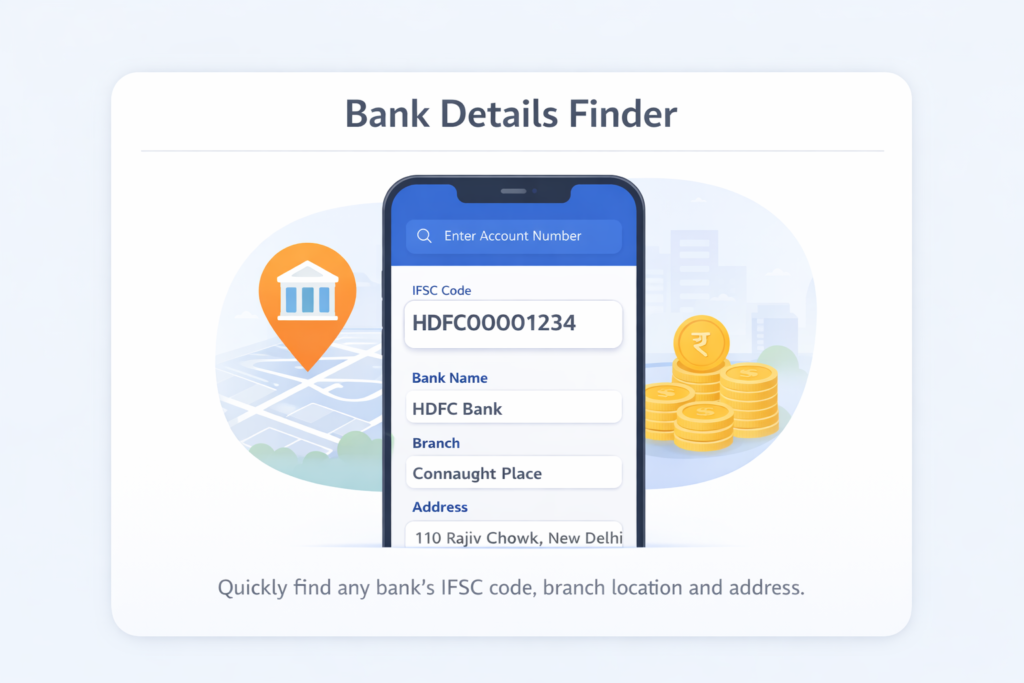
7 Powerful Ways to Find Bank Details in India – Instant IFSC, MICR & Branch Finder (2026 Guide)
Finding accurate bank information is extremely important in today’s digital banking ecosystem. A small mistake in bank details can delay payments, cause transaction failures, or even lead to refund issues.
This is where a Bank Details Finder becomes a powerful tool.
A Bank Details Finder helps you quickly verify important banking information such as IFSC code, MICR code, branch name, bank address, and other details required for secure online transfers.
Whether you are sending money via NEFT, setting up UPI, receiving salary payments, or applying for a loan, verifying bank details beforehand can save you from major financial inconvenience.
This guide explains how to find bank details instantly in India and how to avoid common mistakes while making transactions.
Why Bank Details Matter More Than You Think
Many people assume bank details are simple.
But even one incorrect digit can create serious transaction problems.
For example:
• Salary payments may get delayed
• NEFT or RTGS transfers may fail
• Income tax refunds may not process
• EMI auto-debit may bounce
• Loan disbursement may get delayed
These issues are very common in India because users often copy bank details from outdated sources.
According to guidelines published by the Reserve Bank of India, IFSC codes may change when:
Bank branches merge
Banks undergo restructuring
Branches relocate
This is why verifying bank information before sending money is extremely important.
What Is a Bank Details Finder?
A Bank Details Finder is an online tool that helps users instantly search and verify bank branch information.
It works like a digital bank directory that allows users to find important banking data within seconds.
Using a bank details finder, you can search for:
• Bank Name
• Branch Name
• IFSC Code
• MICR Code
• Branch Address
• District and State
• Bank Type (Public / Private / Cooperative)
Most reliable tools use data sourced from official banking records and regulatory directories.
Who Should Use a Bank Details Finder?
Almost everyone who performs digital banking transactions can benefit from using this tool.
Here are some common users.
Salaried Employees
Employees usually share their bank details with employers for salary credit.
Before submitting bank details, it is always recommended to verify the IFSC code and branch information to avoid salary delays.
Business Owners & Freelancers
Freelancers and business owners frequently receive payments from clients.
Incorrect bank details can lead to:
• Failed client transfers
• Payment delays
• Accounting errors
Using a bank details finder ensures invoices contain the correct banking information.
Students
Students often receive:
• Scholarships
• Education refunds
• Internship stipends
Incorrect bank information can delay these payments.
Loan Applicants
Banks require correct IFSC and branch details to process:
• Loan disbursement
• EMI auto debit setup
If the branch details are incorrect, EMI mandates may fail.
Government Scheme Beneficiaries
Many government benefits use Direct Benefit Transfer systems.
Examples include:
• PMAY subsidy
• LPG subsidy
• Scholarship payments
These transfers require accurate bank branch verification.
Accountants & CA Professionals
Chartered accountants and finance professionals often verify bank details for multiple clients.
A bank details finder simplifies bulk verification work.
Types of Bank Details You Can Find
When you use a bank details finder, you can access multiple types of banking information.
IFSC Code
IFSC stands for Indian Financial System Code.
It is a unique code assigned to every bank branch in India.
Example:
SBIN0000456
Breakdown of the code:
First 4 letters → Bank name
5th character → Always zero
Last 6 digits → Branch code
IFSC codes are required for:
• NEFT transfers
• RTGS transactions
• IMPS payments
• UPI bank linking
• Salary credit
• Loan disbursement
MICR Code
MICR stands for Magnetic Ink Character Recognition.
This code is used mainly for cheque processing.
Example MICR:
400002345
While MICR codes are less important for online banking today, they are still required for cheque clearance.
Bank Branch Details
A bank details finder also provides full branch information.
This may include:
• Branch address
• District
• State
• Contact number
• Branch category
These details help users verify the exact bank location.
Step-by-Step: How to Use Bank Details Finder on Moneyora
Using the Moneyora Bank Details Finder is extremely simple.
You can search bank information in multiple ways.
Method 1: Search by IFSC Code
This is the fastest method.
Steps:
Enter the IFSC code
Click search
View bank and branch details instantly
The result will show:
• Bank name
• Branch name
• Address
• MICR code
Method 2: Search by Bank & Branch
If you do not know the IFSC code, you can search manually.
Steps:
Select bank name
Choose state
Select district
Select branch name
You will instantly see the IFSC and MICR code.
Method 3: Search by City
This method is useful when you only know:
• Bank name
• City name
The tool will show a list of all bank branches available in that city.
Real Life Example (Indian Scenario)
Consider a real-life situation.
Ramesh from Pune wanted to transfer ₹1,25,000 to a builder using NEFT.
He entered:
Correct account number
But an outdated IFSC code from an old cheque book.
Result:
The transaction failed.
The refund took four working days.
If Ramesh had verified the branch details using a bank details finder, the problem could have been avoided.
Bank Details Finder vs Bank Website
Many people wonder whether they should use a bank website or a bank details finder.
Here is a quick comparison.
Feature | Bank Website | Bank Details Finder
Speed | Slow | Instant
Multiple Banks | No | Yes
Mobile Friendly | Limited | Fully optimized
Search Experience | Average | Very easy
Data Access | Single bank only | All banks
Bank websites only provide details for their own branches.
A bank details finder allows you to search across multiple banks instantly.
RBI Guidelines You Should Know
The **Reserve Bank of India recommends verifying IFSC codes before making high-value transfers.
Important points:
• IFSC codes may change due to bank mergers
• Old IFSC codes may work temporarily but later fail
• Always confirm branch details before large payments
For transactions above ₹50,000, verifying bank information is highly recommended.
Common Mistakes to Avoid
Many people unknowingly make mistakes when sharing bank details.
Avoid these errors.
 Using IFSC codes from old cheque books Copying bank details from WhatsApp messages Assuming IFSC codes never change Confusing cooperative banks with commercial banks Not verifying branch location
These mistakes can cause failed transactions and unnecessary delays.
Pro Tips (Moneyora Expert Advice)
Here are some expert tips for safe banking transactions.
 Always verify IFSC before sending large payments Save verified bank details for regular use Businesses should maintain a master bank sheet Avoid screenshots of bank details found on social media Use official banking directories when possible
How Bank Details Affect Your Transactions
Incorrect bank information can affect different types of financial transactions.
NEFT / RTGS
If the IFSC code is incorrect, the transaction may get rejected or delayed.
UPI
UPI linking requires the correct IFSC code during bank verification.
UPI infrastructure in India is managed by the **National Payments Corporation of India.
EMI & Auto-Debit
Wrong bank branch information can cause EMI mandates to fail.
This may result in penalty charges.
Does Bank Details Affect Your CIBIL Score?
Indirectly, yes.
If your EMI auto-debit fails due to incorrect bank details, it may lead to:
• Missed payment
• Late fee
• Negative credit report entry
Even one missed EMI can reduce your credit score by 50–70 points.
Tax & Refund Implications
Incorrect bank details can delay important financial refunds such as:
• Income tax refund
• GST refund
• Government subsidy payments
Before submitting your ITR or GST return, verify your bank branch details carefully.
People Also Ask (Voice Search Friendly)
What is the easiest way to find IFSC code?
Can IFSC code change?
How to find bank branch by IFSC?
Is MICR still required?
Can I verify bank details online safely?
Which website provides correct IFSC code?
Is RBI IFSC list publicly available?
What happens if IFSC code is wrong?
Conclusion: Verify Once, Transact Stress-Free
In today’s digital banking world, verifying bank details before making transactions is extremely important.
A simple mistake in IFSC code or branch information can delay payments, create financial stress, and even affect credit records.
Using a reliable Bank Details Finder helps ensure that your transactions are safe and accurate.
Before making any important payment, salary transfer, or loan transaction, always verify bank details once.
This small step can save you from major problems later.
Call To Action
 Search Your Bank Details Instantly on Moneyora
Find accurate:
IFSC Code MICR Code Bank Branch Address Bank Name
Fast • Accurate • RBI Verified • Completely Free