
Find Your Bank’s Details Easily
Use our tool to quickly find the Bank Details you need. Just enter your IFSC Code and get all the details you require in seconds.
IFSC Code Finder
Enter any IFSC code to get complete bank branch details — address, MICR, district and more.
IFSC Code Finder 2026: Search Any Bank Branch Code Free in Seconds
You’re about to transfer money. You have the account number. You need the IFSC code — and you need to be sure it’s correct. Getting it wrong means the transaction fails, gets delayed, or in rare cases goes somewhere it shouldn’t. “your CKYC number speeds up new bank account opening too”
MoneyOra’s IFSC Code Finder solves this in under 10 seconds. Enter any 11-character IFSC code and instantly get the bank name, branch name, full address, MICR code, district, and state all verified against RBI data. No login, no subscription, no ads. “which banks offer the best home loan rates for your CIBIL score”
This page explains exactly how the IFSC code finder works, what details it shows you, which banks it covers, and why verifying before you transfer is worth those extra 10 seconds. You can also use the Bank Details Finder to search by bank name and branch instead of by IFSC code. “verify account details to avoid failed-transfer bank charges”
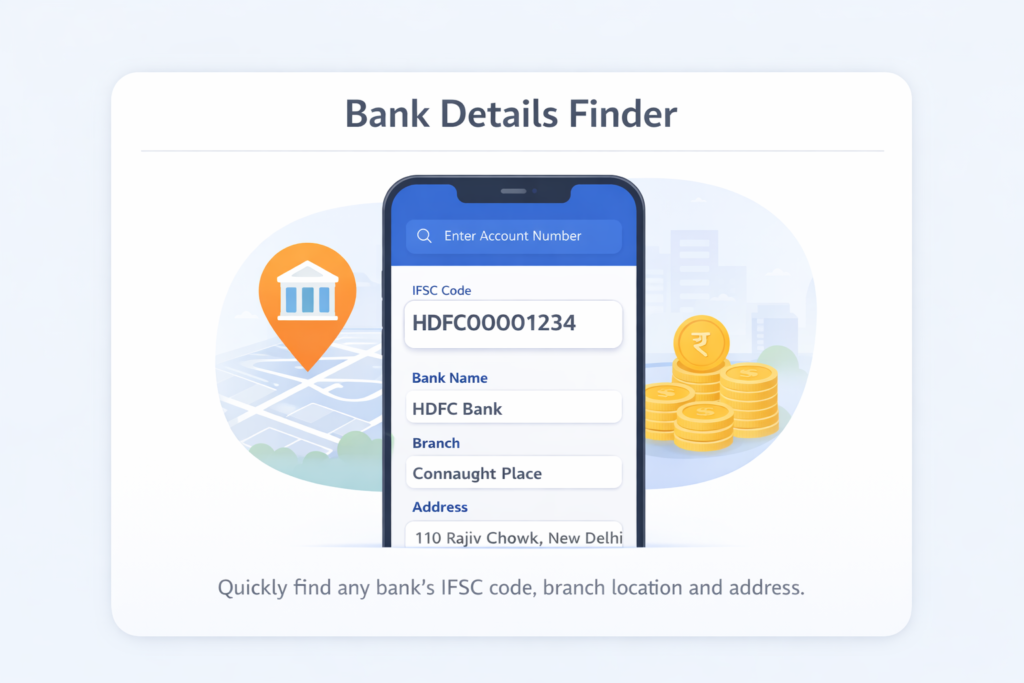
What Is an IFSC Code Finder?
An IFSC code finder is an online lookup tool that takes an 11-character IFSC code as input and returns the complete details of that bank branch — name, address, MICR code, and location. Think of it as a reverse phone directory, but for bank branches.
Every bank branch in India that participates in electronic fund transfers — NEFT, RTGS, or IMPS — has been assigned a unique IFSC code by the Reserve Bank of India (RBI). There are over 1 lakh such branches across more than 200 banks. Searching manually through RBI records takes time. An IFSC finder does it in one click.
According to Wikipedia, the IFSC system covers all bank branches in India’s three main payment rails: NEFT, RTGS, and IMPS. Each branch’s code is permanent unless the branch closes, relocates, or its bank merges with another.
Why Not Just Search Google for the IFSC Code?
You can — but you risk getting outdated results. After bank mergers (like the 2019–2020 public sector bank consolidations), many IFSC codes changed. Outdated pages and forums often still show old codes. A verified IFSC finder pulls from current RBI data, which is the only source that’s guaranteed accurate. After verifying payment details, learn how to avoid hidden credit card charges that banks may not clearly explain.
How to Use MoneyOra’s IFSC Code Finder — Step by Step
The tool is designed to take zero learning time. Here’s what to do:
Step 1: Open the Tool
Go to MoneyOra’s IFSC Code Finder. The search box is the first thing on the page — no scrolling needed.
Step 2: Enter the IFSC Code
Type or paste the 11-character IFSC code in the input field. For example: HDFC0001234 or SBIN0011569. The tool auto-formats it to uppercase, so don’t worry about case sensitivity.
Step 3: Click “Find Bank Details”
Hit the search button. Results appear instantly — no page reload, no waiting.
Step 4: Verify the Details
The result card shows the bank name, branch name, full address, MICR code, district, and state. Cross-check the bank name and branch location against what the recipient told you. If both match, you’re good to proceed with the transfer.
Don’t Have the IFSC Code? Search by Bank and Branch
If you don’t have the IFSC code and want to find it by selecting the bank name, state, and branch, use MoneyOra’s Bank Details Finder instead. It works in reverse — you select the bank, then drill down to the branch.
What Details Does the IFSC Code Finder Show?
Once you enter a valid IFSC code, here’s exactly what you get back:
| Detail | Example | Why It Matters |
|---|---|---|
| Bank Name | HDFC Bank | Confirms you have the right bank |
| Branch Name | Saket Branch | Verifies the branch matches recipient’s details |
| Branch Address | Shop No. 12, Press Enclave Road, Saket, New Delhi | Useful if you need to visit the branch |
| MICR Code | 110240043 | Needed for cheque-based clearing and ECS mandates |
| District | South West Delhi | Confirms geographic location |
| State | Delhi | Useful for verifying state-level bank operations |
The MICR code is especially useful if you’re setting up an ECS (Electronic Clearing System) mandate for SIP investments, loan EMIs, or insurance premium auto-debits. The MICR code identifies the branch for cheque-based clearing, while the IFSC handles online transfers. Speaking of which — use MoneyOra’s SIP Calculator to calculate how much your SIP can grow, and the EMI Calculator to plan your loan repayments.
Understanding the IFSC Code Format — What Each Part Means
The IFSC code isn’t random. Every character has a specific meaning. Once you know the format, you can decode any IFSC code yourself — and spot obvious errors before they reach the bank.
| Position | Characters | What It Represents | Example |
|---|---|---|---|
| 1st to 4th | 4 alphabets | Bank code (short form of bank name, set by RBI) | HDFC = HDFC Bank, SBIN = State Bank of India |
| 5th | Always 0 (zero) | Reserved for future RBI use — always zero in all codes | 0 |
| 6th to 11th | 6 alphanumeric characters | Branch-specific code — unique to that one branch | 000043 = HDFC Saket, New Delhi |
Bank Codes for Major Indian Banks
| Bank Name | 4-Letter Bank Code |
|---|---|
| State Bank of India | SBIN |
| HDFC Bank | HDFC |
| ICICI Bank | ICIC |
| Axis Bank | UTIB |
| Punjab National Bank | PUNB |
| Bank of Baroda | BARB |
| Canara Bank | CNRB |
| Kotak Mahindra Bank | KKBK |
| Union Bank of India | UBIN |
| Bank of India | BKID |
| IndusInd Bank | INDB |
| Yes Bank | YESB |
| Federal Bank | FDRL |
| IDFC FIRST Bank | IDFB |
| Central Bank of India | CBIN |
| Indian Bank | IDIB |
| RBL Bank | RATN |
| South Indian Bank | SIBL |
Spot check: if an IFSC code someone gives you starts with “SBIN” but they claim it’s an HDFC Bank account, something is wrong. The 4-letter bank code is the quickest error check you can do before running the full lookup.
Which Banks Are Covered by MoneyOra’s IFSC Code Finder?
MoneyOra’s IFSC finder covers 200+ banks and 1 lakh+ branches across India. This includes:
Public Sector Banks
State Bank of India, Punjab National Bank, Bank of Baroda, Canara Bank, Union Bank of India, Bank of India, Indian Bank, Central Bank of India, UCO Bank, Indian Overseas Bank, Punjab & Sind Bank, Bank of Maharashtra — all branches covered.
Private Sector Banks
HDFC Bank, ICICI Bank, Axis Bank, Kotak Mahindra Bank, IndusInd Bank, Yes Bank, Federal Bank, IDFC FIRST Bank, RBL Bank, South Indian Bank, Bandhan Bank, Karnataka Bank, Karur Vysya Bank, City Union Bank, Dhanlaxmi Bank, Tamilnad Mercantile Bank, and more.
Small Finance Banks
AU Small Finance Bank, Equitas Small Finance Bank, Ujjivan Small Finance Bank, Jana Small Finance Bank, ESAF Small Finance Bank, Suryoday Small Finance Bank, Utkarsh Small Finance Bank, and others registered with RBI.
Payment Banks
Paytm Payments Bank, Airtel Payments Bank, India Post Payments Bank, Fino Payments Bank — all included.
Regional Rural Banks (RRBs) and Co-operative Banks
Regional Rural Banks and major Urban Co-operative Banks that participate in the NEFT/RTGS/IMPS network are also included in the database.
Foreign Banks Operating in India
Citibank India, HSBC India, Deutsche Bank India, Standard Chartered India, DBS Bank India, and other foreign banks licensed by RBI with Indian branches.
When Should You Use an IFSC Code Finder?
Most people only think about IFSC verification after something goes wrong. Here are the situations where checking first is worth it:
Before Your First Transfer to Someone New
When adding a new beneficiary to your bank account, you need their IFSC code. Before you type it in and wait out the 4–24 hour beneficiary activation window, verify the code matches the bank and branch they told you. A mismatch at this stage means starting over.
When the Recipient’s Bank Recently Went Through a Merger
India saw a major wave of public sector bank mergers between 2019 and 2020. Allahabad Bank merged into Indian Bank. Oriental Bank of Commerce and United Bank of India merged into Punjab National Bank. Syndicate Bank into Canara Bank. Andhra Bank and Corporation Bank into Union Bank of India. Dena Bank and Vijaya Bank into Bank of Baroda. If your beneficiary’s passbook or cheque is from before 2021, the IFSC code on it may no longer be active.
Before Setting Up EMI Auto-Debit or SIP Mandate
When you submit a NACH (National Automated Clearing House) mandate for loan EMI deductions or SIP auto-investments, the bank verifies your IFSC and MICR before activating it. A wrong IFSC means the mandate activation fails and your SIP misses its first instalment. Use our Home Loan EMI Calculator or Personal Loan EMI Calculator to plan your repayments — and verify your IFSC before setting up the mandate.
When Receiving Salary or Government Payments
HR departments, government portals (like PM Kisan, scholarship databases, or pension disbursement systems) require your bank’s IFSC to credit payments. An incorrect IFSC means your salary or benefit doesn’t get credited. Look up and confirm before submitting.
Before Large RTGS Transfers
RTGS is used for high-value transfers of ₹2 lakh and above. There’s no “undo” once an RTGS transaction is processed. Verify the IFSC, then do the transfer. Those 10 seconds are worth it for ₹5 lakh or ₹50 lakh.
IFSC Code vs MICR Code — What’s the Difference and When Do You Need Each?
Both codes appear on your cheque, and both identify your bank branch — but for different systems. Here’s the quick version:
| Feature | IFSC Code | MICR Code |
|---|---|---|
| Full Form | Indian Financial System Code | Magnetic Ink Character Recognition |
| Length & Format | 11 characters (letters + numbers) | 9 digits (numbers only) |
| Used In | NEFT, RTGS, IMPS — all online transfers | Cheque clearing, ECS mandates |
| Where to Find It | Top-left of cheque, passbook first page, bank website | Bottom of cheque leaf (printed in magnetic ink) |
| Structure | 4 letters (bank) + 0 + 6 alphanumeric (branch) | 3 digits (city) + 3 digits (bank) + 3 digits (branch) |
| Assigned by | RBI | RBI |
The MICR code structure tells you something useful: the first three digits are the city code. So 110 is Delhi, 400 is Mumbai, 600 is Chennai, 700 is Kolkata, 560 is Bengaluru. This is how cheque processing machines sort and route cheques by city before clearing them.
MoneyOra’s IFSC Code Finder shows both the IFSC and MICR code in one result — so you don’t need to look them up separately.
NEFT, RTGS, and IMPS — All Three Need Your IFSC Code
Every inter-bank fund transfer in India routes through one of three systems, and all three require a valid IFSC code for the destination branch. Here’s when to use which:
NEFT (National Electronic Funds Transfer)
Best for routine transfers of any amount. NEFT processes in batches — the RBI settles them every 30 minutes. Since January 2020, the RBI has made NEFT available 24×7, including weekends and holidays. Online NEFT transfers are free at virtually all major banks. If you’re transferring ₹500 or ₹5 crore and you’re not in a hurry, NEFT works perfectly. You’ll still need the recipient’s IFSC code to initiate it.
RTGS (Real-Time Gross Settlement)
Best for high-value, time-sensitive transfers. The minimum amount is ₹2 lakh — no exceptions. RTGS settles each transaction individually in real time (within 30 minutes at most). As of December 2020, RTGS also operates 24×7 per RBI guidelines. Free for online transfers. If you’re paying for a property, making a business payment, or settling a large invoice, RTGS is the right choice. Entering the wrong IFSC code on an RTGS transfer of ₹10 lakh is a very stressful situation — always verify first.
IMPS (Immediate Payment Service)
Best for instant transfers up to ₹5 lakh. IMPS is managed by NPCI and settles in real time, 24×7 including all holidays. Unlike NEFT, there’s no batch window — the money moves the moment you confirm. IMPS charges vary by bank, typically ₹2.50 to ₹25 plus 18% GST depending on the transfer amount. Small but worth knowing. All IMPS transfers also need the recipient’s IFSC code.
A quick side note: UPI payments work differently — they use Virtual Payment Addresses (VPAs) or mobile numbers and don’t require the IFSC code from the sender’s side. But UPI settles through IMPS infrastructure, so IFSC codes are still involved at the back end.
Planning a loan? Use our Car Loan EMI Calculator to see your monthly payments, or the FD Calculator to plan fixed deposits. For mutual fund investors, the Lumpsum Calculator and CAGR Calculator help you understand returns.
Fund Transfer Limits and Charges in 2026 — Quick Reference
These figures are based on RBI and NPCI guidelines for FY 2025-26:
| Method | Minimum | Maximum | Settlement | Online Charges | Availability |
|---|---|---|---|---|---|
| NEFT | ₹1 | No cap (bank daily limit applies) | Batch, every 30 min | Free | 24×7, 365 days |
| RTGS | ₹2,00,000 | No cap (bank daily limit applies) | Real-time, individual | Free | 24×7, 365 days |
| IMPS | ₹1 | ₹5,00,000 (bank-specific) | Instant, real-time | ₹2.50–₹25 + 18% GST | 24×7, 365 days |
Note: Branch-based NEFT and RTGS transfers still carry nominal charges (₹2–₹50 + GST depending on amount and bank). The free-of-charge rule applies to transfers initiated through internet banking or mobile banking apps. Always check your bank’s fee schedule for the most current rates.
Mistakes People Make with IFSC Codes — and How to Avoid Them
Entering an IFSC Code Manually Without Verifying
IFSC codes are 11 characters. Typing even one wrong digit — or confusing the letter “O” with zero “0” — sends your verification to a completely different branch or triggers an outright error. Always paste from a verified source, or check it first in the IFSC finder. MoneyOra’s IFSC Finder confirms the bank and branch immediately, before you proceed.
Using the IFSC from a Passbook Issued Before 2021
The 2019–2020 public sector bank mergers changed the IFSC codes of hundreds of branches. If your beneficiary’s passbook or cheque predates the merger of their bank (Allahabad Bank, OBC, Andhra Bank, Syndicate Bank, Dena Bank, Vijaya Bank, Corporation Bank, United Bank), verify their current code before sending money. The old codes may still work during transition periods — but eventually they stop, and failed transactions become your problem.
Assuming the IFSC Is the Same as the Branch Code
The IFSC code is not the same as the 6-character branch code. The branch code is only the last 6 characters of the IFSC. For a transfer to work, you need the complete 11-character IFSC, not just the branch code.
Using One Branch’s IFSC for a Different Branch of the Same Bank
Every branch has its own unique IFSC. HDFC’s Connaught Place branch and HDFC’s Lajpat Nagar branch are the same bank — but different IFSC codes. If your beneficiary has their account at a specific branch, you need that specific branch’s code.
Ignoring the 5th Character
The 5th character is always zero (0), not the letter “O”. In certain fonts, they look identical. If you’re copying an IFSC code from a printed document and it doesn’t work, check whether the 5th character was scanned or read as the letter O instead of the digit 0.
Trying to Send Below ₹2 Lakh via RTGS
RTGS requires a minimum transaction of ₹2 lakh. If you initiate an RTGS of ₹1,50,000, the bank system rejects it automatically. Use NEFT or IMPS for smaller amounts.
Pro Tips for Faster, Safer Bank Transfers
Verify Before Every New Beneficiary Addition
Banks have a cooling period — typically 4 to 24 hours — after you add a new beneficiary before the first transfer goes through. If you add someone with a wrong IFSC and only discover the error after the waiting period, you’ll need to delete and re-add them. That’s another 4–24 hours lost. Verify the IFSC before adding the beneficiary, not after.
Do a ₹1 Test Transfer for Large Payments
Before sending ₹5 lakh to a new account, send ₹1 first. Ask the recipient to confirm it reached them. Takes 2 minutes and gives you complete certainty. IMPS is best for this — it’s instant.
Screenshot the IFSC Finder Result Before Big Transfers
When making an RTGS transfer, take a screenshot of the IFSC finder result showing the bank name and branch. If there’s ever a dispute, you have a record that you verified the details before initiating.
Use the MICR Code for Cheque-Based Mandates
When filling out a NACH/ECS mandate form for auto-debit (EMI or SIP), you need the MICR code — not the IFSC. MoneyOra’s IFSC finder shows both. Get them both in one lookup, fill the form correctly, and avoid mandate activation failures.
Bookmark This Tool
You’ll use an IFSC finder more often than you expect — salary setups, scholarship applications, government benefit enrollment, adding new payees. Keep MoneyOra’s IFSC Code Finder bookmarked. It takes one click when you need it.
Plan the Financial Side Too
Once your transfers are set up correctly, use MoneyOra’s calculators to make them count. The PPF Calculator and NPS Calculator help with long-term savings planning. The RD Calculator shows recurring deposit returns. The EPF Calculator helps salaried employees track their PF corpus. For stock market investors, try the Stock Return Calculator, Stop Loss Calculator, and Position Size Calculator.
Conclusion
Verifying an IFSC code takes about 10 seconds. Recovering from a failed transfer — especially a large RTGS payment — can take days. That ratio makes the IFSC finder one of those small tools that quietly saves a lot of trouble.
MoneyOra’s IFSC Code Finder covers 200+ banks and 1 lakh+ branches across India. It’s free, fast, and requires no login. Enter any IFSC code and instantly verify the bank name, branch, address, and MICR code before you initiate any transfer.
And while you’re here — MoneyOra has a full suite of free financial calculators to help you plan better:
- Loan planning: EMI Calculator, Home Loan EMI, Car Loan EMI, Personal Loan EMI
- Investments: SIP, Lumpsum, FD, RD, SWP, CAGR
- Retirement: PPF, NPS, EPF
- Stock market: Brokerage, Margin, Stock Average, P/E Ratio, Dividend, Option Price, Stop Loss, Position Size
No sign-up needed. Bookmark MoneyOra — one tab for everything you need in personal finance.
Frequently Asked Questions About IFSC Code Finder
An IFSC code finder is an online tool.
It shows bank and branch details instantly.
Enter the 11-character IFSC code.
It returns bank name, branch, and address.
Also shows MICR, district, and state.
Helps verify details before transfer.
Yes, it is completely free.
No login or registration required.
No subscription charges.
Unlimited lookups available.
Works 24x7.
Data is sourced from RBI.
Updated periodically.
Includes mergers and new branches.
Cross-check for large transfers is recommended.
Yes, you can search by bank details.
Select bank, state, district, and branch.
It shows IFSC and MICR codes.
Also shows full branch address.
Most branches have IFSC codes.
Applicable for NEFT, RTGS, and IMPS.
Covers over 1 lakh branches.
Some small co-operative branches may not have IFSC.
Yes, IFSC codes may change.
Updates happen within 12–24 months.
Old codes work temporarily.
Eventually they are deactivated.
Always verify before transfer.
The tool shows "not found" message.
This means code is incorrect or outdated.
It may belong to closed or merged branch.
Use correct IFSC before transferring.
Yes, same IFSC works for all systems.
No need for different codes.
It identifies branch universally.
IFSC finder uses 11-character code.
Used for online transfers.
MICR finder uses 9-digit code.
Used for cheque processing.
Both identify bank branch.
Yes, RTGS is available 24x7.
Works all days including holidays.
Minimum transfer amount is ₹2 lakh.
Online transfers are mostly free.