
SIP & Lumpsum
Calculator
Estimate wealth creation from systematic & one-time investments — with year-by-year projections.
| Year | Invested | Returns | Corpus | CAGR |
|---|
Lumpsum Calculator: How It Works – Formula and Tax Rules for Indian Investors
A lumpsum calculator answers a question Indian investors ask all the time: if I invest a fixed amount today in a fund and leave it alone how much will it be worth in ten or twenty years? The tool uses compound interest on your principal adds your chosen return rate and shows the estimated amount you will have after a period. What it cannot do is guess what the market will do or consider the ups and downs that might happen along the way.
The lumpsum calculator is very helpful for people who have gotten some money like a bonus, money from selling a house or an inheritance and want to see how much a single investment in equity mutual funds could grow before they decide to go ahead. For people who want to invest every month the SIP calculator is the right choice. If someone wants to mix a one-time investment with ones the step-up SIP calculator is the tool that handles that.
This guide explains the compound interest formula that the lumpsum calculator uses three real situations in Indian rupees the tax rules in the Income Tax Act for the financial years 2025-26 and 2026-27 things that other guides leave out and four common errors that lower what investors actually end up with. All the numbers in this guide come from data that’s available to the public, from NSE India, SEBI, and the Income Tax India portal.
What the lumpsum calculator Why it matters
A lumpsum investment means putting a single amount into a mutual fund scheme on one day instead of spreading it out over months. The lumpsum calculator shows how that amount grows over time when compound interest works on it without interruption based on the period you choose.
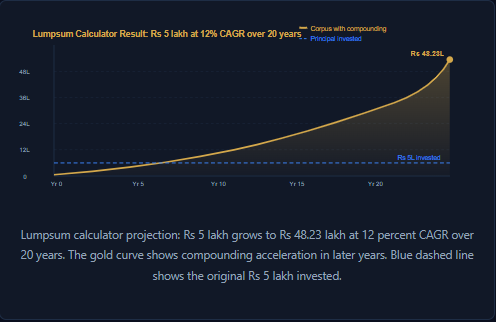
The reason lumpsum investments are strong is simple: every rupee starts growing from the first day. In a SIP the money you add in month 24 only has a years to grow.. With a lumpsum all the money begins compounding right away. Over periods this difference makes a big impact. For example at a 12 percent CAGR Rs 5 lakh invested as a lumpsum today becomes Rs 48.23 lakh in 20 years.. If you invest Rs 5 lakh through a 60-month SIP of Rs 8,333 each month the total grows to only Rs 7.59 lakh. That’s because each monthly amount has time to grow.
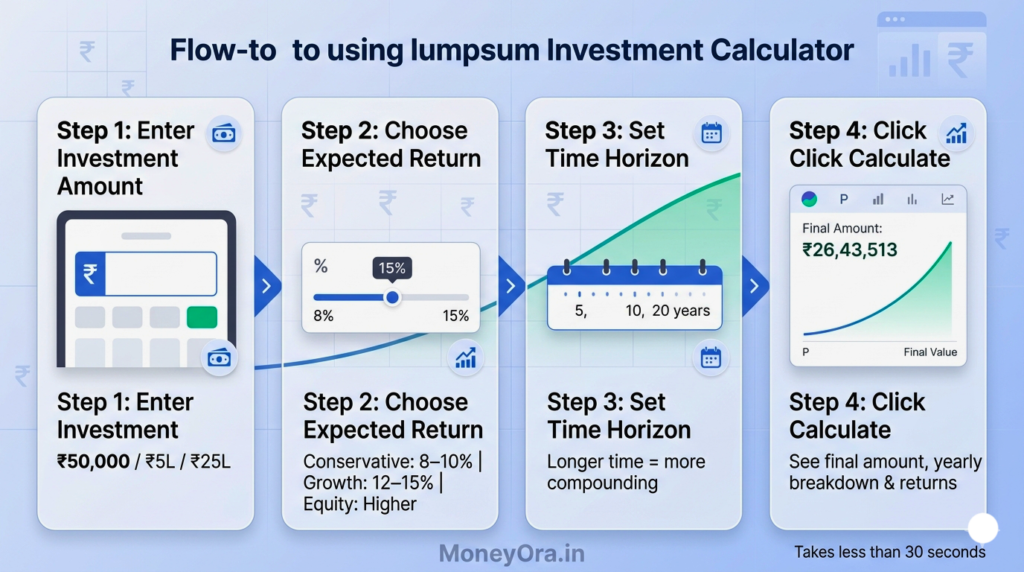
The lumpsum calculator, on MoneyOra works with all equity and debt mutual fund types registered with AMFI,. This includes cap, mid-cap small-cap, flexi-cap, ELSS, index funds and hybrid funds. Just enter the amount the expected annual return rate and how long you plan to invest. The calculator then gives you the estimated maturity amount and total wealth gain instantly.
The lumpsum calculator formula with a worked example in INR
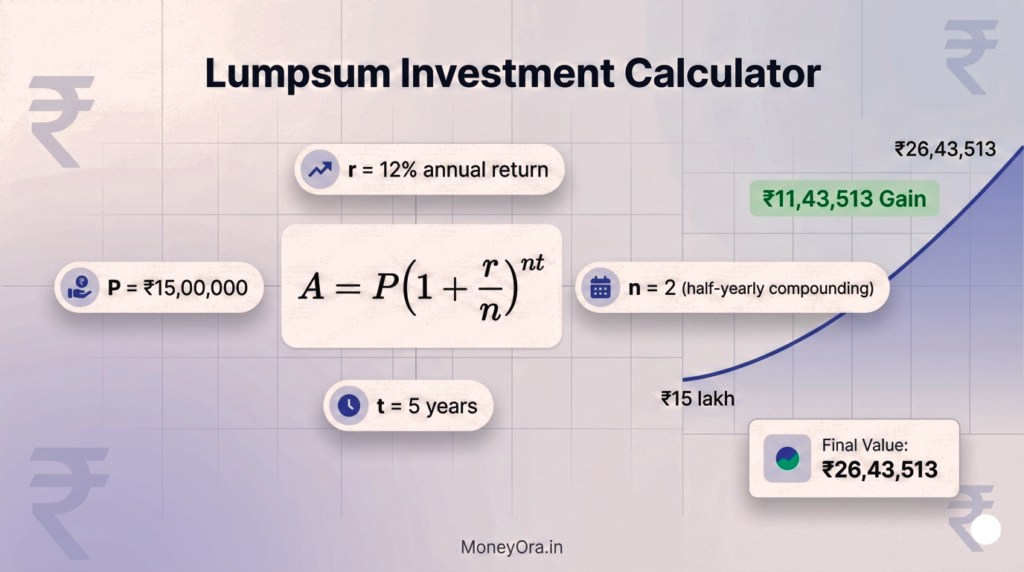
The lumpsum calculator uses the compound interest formula. Most mutual funds compound returns on an annual basis. For long-term planning annual compounding is the assumption used across the industry and in every public lumpsum calculator tool.
Lumpsum Calculator Formula
A = P x (1 + r)^t
A = Maturity amount (what you receive at the end)
P = Principal invested as a lumpsum in rupees
r = Expected return rate as a decimal (12% = 0.12)
t = Investment tenure in years
^ = Raised to the power of (exponent)
This formula assumes the return compounds once per year. If a fund compounds quarterly the formula becomes A = P x (1 + r/4)^(4 x t). The annual assumption is standard for planning purposes and what the lumpsum calculator on this page uses.
Worked example: Rs 10 lakh lumpsum in 50 index fund for 15 years
Inputs: P = Rs 10,00,000. Annual return r = 0.12 (12 percent). Tenure t = 15 years.
Step-by-step calculation
A = 10,00,000 x (1 + 0.12)^15
(1.12)^15 = 5.4736
A = 10,00,000 x 5.4736 = Rs 54,73,566
Principal invested: Rs 10,00,000
Total wealth gained: Rs 44,73,566
Absolute return: 447 percent over 15 years
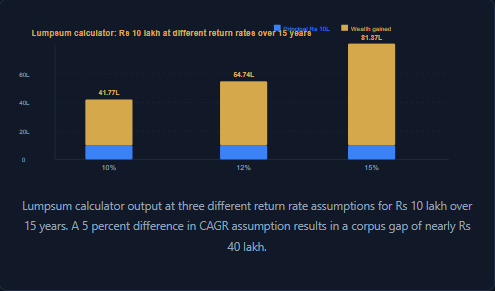
That’s Rs 44.73 lakh earned on a Rs 10 lakh one-time investment without touching the corpus. At 10 percent the same investment produces Rs 41.77 lakh. At 15 percent it produces Rs 81.37 lakh. The return rate assumption is the sensitive variable in the lumpsum calculator. A 3 percent difference in assumed CAGR over 15 years creates a gap of over Rs 30 lakh, on a Rs 10 lakh principal.

Practical scenarios and comparison tables
Scenario A: Short-term vs long-term lumpsum investment
The lumpsum calculator reveals something most investors underestimate: compounding is not linear. The first five years of a lumpsum investment at 12 percent turn Rs 10 lakh into Rs 17.62 lakh. The next five years turn Rs 17.62 lakh into Rs 31.06 lakh. The five years after that turn Rs 31.06 lakh into Rs 54.74 lakh. The absolute gain in years 11 to 15 alone exceeds the entire corpus at year 5. This is why short-term lumpsum investing rarely justifies the risk.
Rs 10 lakh lumpsum at 12% CAGR across different tenures
| Tenure | Maturity amount | Wealth gained | Absolute return |
|---|---|---|---|
| 3 years | Rs 14.05 lakh | Rs 4.05 lakh | 40.5% |
| 5 years | Rs 17.62 lakh | Rs 7.62 lakh | 76.2% |
| 10 years | Rs 31.06 lakh | Rs 21.06 lakh | 210.6% |
| 15 years | Rs 54.74 lakh | Rs 44.74 lakh | 447.4% |
| 20 years | Rs 96.46 lakh | Rs 86.46 lakh | 864.6% |
Estimated at 12 percent CAGR using the lumpsum calculator formula. Pre-tax figures. LTCG applies on redemption.
Scenario B: Lumpsum vs SIP for the same total investment
This is the content gap most competing pages miss entirely. When you have a large amount to invest, lumpsum and SIP are not equivalent. The lumpsum calculator and the SIP calculator together let you compare them directly.
Rs 12 lakh total investment at 12% CAGR over 10 years
| Comparison point | Lumpsum (Rs 12L on day 1) | SIP (Rs 10K per month) |
|---|---|---|
| Total invested | Rs 12 lakh | Rs 12 lakh |
| Maturity corpus | Rs 37.27 lakh | Rs 23.23 lakh |
| Wealth gained | Rs 25.27 lakh | Rs 11.23 lakh |
| Market risk at entry | High (all in on day 1) | Low (averaged over 10 yrs) |
| Best suited when | Markets at low valuation | Markets at high valuation |
Lumpsum maturity uses A = 12,00,000 x (1.12)^10 = Rs 37.27 lakh. SIP maturity uses the standard annuity formula. Both pre-tax.
Lumpsum wins the corpus race by a wide margin when markets go up continuously. But that assumption of continuous upward movement is exactly where the risk lies. If you invest your Rs 12 lakh lumpsum one month before a 30 percent correction, your starting corpus drops to Rs 8.4 lakh and the lumpsum calculator output shifts dramatically. The right answer for most investors is not all-or-nothing. Three to six tranches over three months captures much of the lumpsum advantage while reducing single-entry-point risk.
Scenario C: Inflation-adjusted real return from lumpsum investment
The lumpsum calculator shows a nominal corpus. The purchasing power of that corpus depends on inflation over your investment tenure. At 6 percent average inflation over 15 years, every Rs 1 of corpus in 2041 is worth only Rs 0.42 in today’s money. Factoring this in changes how you set your target corpus.
Rs 10 lakh lumpsum at 12% CAGR over 15 years: inflation-adjusted real value
| Inflation rate | Nominal corpus | Real corpus (today’s Rs) | Effective real CAGR |
|---|---|---|---|
| 4% per year | Rs 54.74 lakh | Rs 30.38 lakh | ~7.7% |
| 6% per year | Rs 54.74 lakh | Rs 22.83 lakh | ~5.7% |
| 8% per year | Rs 54.74 lakh | Rs 17.27 lakh | ~3.7% |
Real corpus = Nominal corpus divided by (1 + inflation)^years. Illustrative only. Use the lumpsum calculator with your own tenure and rate inputs.
At 6 percent inflation your lumpsum investment at 12 percent CAGR gives you a real CAGR of about 5.7 percent after inflation. Still better than a savings account at 3 to 4 percent nominal. But the point of using the lumpsum calculator for goal-based planning is to set a corpus target that is inflation-adjusted, not just the headline nominal number the tool displays.
Taxation and legal implications for lumpsum investors in India
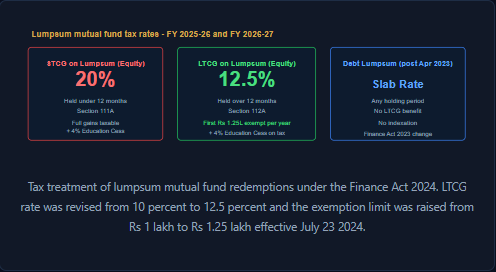
Tax is the single biggest gap between what the lumpsum calculator projects and what you actually receive on redemption. The numbers below apply for both FY 2025-26 and FY 2026-27 under the Finance Act 2024 per the India Budget portal.
Equity mutual fund lumpsum taxation
| Holding period | Tax type | Rate | Exemption | Section |
|---|---|---|---|---|
| Under 12 months | STCG | 20% flat | None | 111A |
| Over 12 months | LTCG | 12.5% | Rs 1.25L per year | 112A |
Add 4 percent Education Cess on the computed tax in both cases. Surcharge applies for income above Rs 50 lakh.
Worked tax example on a redemption
You invested Rs 10 lakh as a lumpsum in an equity fund 18 months ago. Today the total amount is Rs 13.5 lakh. Your long-term capital gain is Rs 3.5 lakh.
Rs 1.25 lakh is exempt under Section 112A. Taxable LTCG is Rs 3.5 lakh minus Rs 1.25 lakh which’s Rs 2.25 lakh. Tax at 12.5 percent is Rs 28,125. Education Cess at 4 percent on Rs 28,125 is Rs 1,125. Total tax amount is Rs 29,250. You get Rs 13,50,000 minus Rs 29,250 which’s Rs 13,20,750.
If you had held the lumpsum for only 10 months and sold at the same Rs 13.5 lakh short-term capital gain at 20 percent on the full Rs 3.5 lakh gain gives a tax of Rs 70,000 plus cess of Rs 2,800. Total is Rs 72,800. The difference between 10-month and 18-month holding on this lumpsum is Rs 43,550 in tax. That is the cost of not waiting past the 12-month period.
Debt mutual fund lumpsum taxation
All debt fund lumpsum investments made after April 1 2023 are taxed at your income tax slab rate regardless of how you held them. There is no long-term capital gain benefit and no indexation. Before using the lumpsum calculator to plan a debt fund investment compare the after-tax yield against a bank FD using the FD calculator or against PPF using the PPF calculator on MoneyOra. For investors in the 30 percent tax bracket debt funds bought after April 2023 are rarely more tax-efficient than a FD.
LTCG tax harvesting on investments
The Rs 1.25 lakh long-term capital gain exemption resets every April 1. If your lumpsum investment has long-term gains you can sell up to Rs 1.25 lakh of gain before March 31. Immediately invest the money again. This resets your cost basis without causing any tax. Doing this every year from the year onward this method removes LTCG tax on a large part of a long-term lumpsum amount. It is legal, easy and mostly not used by investors. The Income Tax e-filing portal asks you to report capital gains in Schedule CG of your ITR even when they’re within the exempt amount.
ELSS lumpsum note: ELSS funds have a 3-year lock-in for each investment date. Gains after the lock-in period are taxed as long-term capital gains at 12.5 percent above Rs 1.25 lakh under Section 112A. The lumpsum investment also qualifies for Rs 1.5 lakh deduction per year under Section 80C in the tax regime, per the Finance Act gazette. ELSS is the lumpsum investment that offers a tax deduction when you start and also has equity-linked growth.
Common mistakes to avoid with lumpsum investing
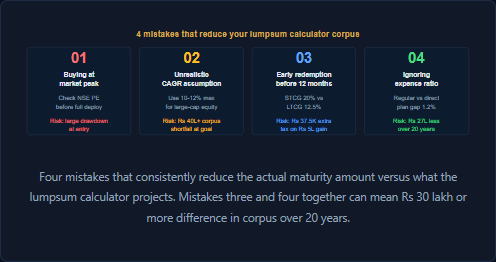
Investing the lumpsum at a market peak
The lumpsum calculator assumes that the CAGR remains steady for the whole time you invest. Real markets do not behave that way. If you put a lumpsum into the market when the Nifty PE ratio is above 24 or 25 history shows that you will often have to wait through a big drop before the returns start to level out. The lumpsum calculator does not show you what the market is worth today. The NSE India website shows the Nifty PE ratio. If you are putting an amount into the market and the PE ratio is historically high spreading the entry over three or four months with a SIP cuts the concentration risk a lot and you do not lose much of the corpus by the end.
Using an unrealistic CAGR in the lumpsum calculator
Typing 18 or 20 percent into the lumpsum calculator to get a corpus figure that justifies an investment decision is the most common planning error. The AMFI website shows the returns for all registered funds. 50 Index funds have averaged 12 to 13 percent CAGR over rolling 15‑year periods according to NSE data. Small‑cap funds have given returns in recent cycles but they also have 50 to 60 percent drawdowns in bad years. For a 15‑plus year lumpsum in an equity fund plan with 10 to 12 percent. At 18 percent the lumpsum calculator shows a corpus that could be Rs 40 to 60 lakh higher than what 12 percent delivers over 15 years on a Rs 10 lakh principal. Building your retirement plan around that number is planning for an outcome that the market has no obligation to deliver.
Redeeming before the 12‑month mark to avoid STCG
Many first‑time lumpsum investors redeem when their fund is up 15 to 20 percent without checking the holding period. If the lumpsum was invested than 12 months ago the entire gain is taxed as STCG at 20 percent. Waiting a few more weeks past the 12‑month anniversary reduces the rate to 12.5 percent LTCG on gains above Rs 1.25 lakh. On a Rs 5 lakh gain the difference is Rs 37,500 in tax saved by waiting. Check the investment date in your fund house statement or through CAMS or CDSL before placing any redemption order on an investment.
Ignoring the expense ratio when entering the return rate
The lumpsum calculator takes a return rate you enter and compounds it. What it does not do is automatically subtract the fund’s expense ratio. A regular plan fund with a 1.7 percent expense ratio and a direct plan fund with a 0.5 percent expense ratio are not equivalent. If you enter 12 percent into the lumpsum calculator the direct plan fund delivers close to that. The regular plan fund delivers to 10.3 percent after the extra 1.2 percent recurring cost. On a Rs 10 lakh lumpsum over 20 years the difference between 10.3 percent and 12 percent CAGR is Rs 96.46 lakh versus Rs 69.31 lakh. That is Rs 27 lakh lost to distributor commission over 20 years. Always use plans for long‑term lumpsum investments and enter the fund’s actual direct‑plan expense ratio to set a realistic return assumption, in the lumpsum calculator.
These are the questions Indian investors ask most often before using the lumpsum calculator for the first time.
What formula does a lumpsum calculator use to estimate returns?
The lumpsum calculator uses the compound interest formula: A = P x (1 + r)^t. A is the maturity amount, P is the principal, r is the annual return rate as a decimal, and t is the tenure in years. For quarterly compounding the formula becomes A = P x (1 + r/4)^(4 x t). Most lumpsum calculator tools for mutual funds use annual compounding as the standard assumption.
Is lumpsum investment taxed differently from SIP in India?
The tax rates are identical. Both lumpsum and SIP redemptions from equity funds attract LTCG at 12.5 percent above Rs 1.25 lakh if held over 12 months (Section 112A) and STCG at 20 percent if held under 12 months (Section 111A). The practical difference is that a lumpsum has one purchase date so the entire investment clears the 12-month mark together, while each SIP instalment has its own clock and its own tax calculation on redemption.
What return rate should I enter in a lumpsum calculator for Indian equity funds?
For large-cap and index funds, 10 to 12 percent CAGR is a reasonable planning assumption based on Nifty 50 historical returns. For mid-cap funds, 12 to 14 percent reflects long-term category averages with significantly higher volatility. Never use rates above 15 percent for any lumpsum calculator projection you plan financially around. The AMFI website shows rolling return data for each fund category which is a useful reference before deciding what rate to enter.
Is lumpsum or SIP better for mutual fund investment in India?
Lumpsum wins on total corpus if markets trend upward throughout the tenure, which they have historically done over 10 to 15 year periods. SIP wins on risk management when markets are at elevated valuations because it averages your entry price. For most retail investors who cannot reliably time market cycles, splitting a large lumpsum amount into three to four tranches over three months reduces single-date entry risk while retaining most of the corpus advantage. Use both the lumpsum calculator and the SIP calculator on MoneyOra to compare projected outcomes before deciding.
Frequently Asked Questions
A lumpsum investment calculator estimates how much your one-time investment will grow over time.
It uses your expected annual return rate and time period.
Use the formula A = P(1 + r/n)nt.
P is your investment.
r is the annual return rate.
n is how often it compounds.
t is the number of years.
Our calculator does this instantly.
Yes. Lumpsum works well for long-term goals of 10+ years.
Compound growth gets more time to work.
For shorter periods, SIP may be safer.
It spreads market risk over time.
Check your chosen fund or investment's past 5-year or 10-year performance.
Conservative: 6–8%.
Balanced: 10–12%.
Growth: 12–18%.
Past performance does not guarantee future returns.
Yes. You can add lump sums periodically.
You can also start a SIP alongside it.
Many investors combine both strategies.
Check annually to ensure your investment is on track.
Market fluctuations happen monthly.
Annual reviews give you a clearer picture.
They also help you avoid reacting to short-term noise.
Our basic calculator shows nominal returns.
For inflation-adjusted returns, subtract India's inflation rate from your expected return rate.
Inflation is typically around 5–6%.
The calculator shows mathematical projections.
A financial advisor considers your full financial situation.
They also consider taxes, risk tolerance, and life goals.
Use both.
Use the calculator for estimates.
Use an advisor for a personalized strategy.
That depends on your emergency fund.
Keep 6–12 months of expenses aside first.
It also depends on your immediate needs and risk tolerance.
Never invest money you may need within 2–3 years.
Do not invest borrowed money.
It is as accurate as the inputs you provide.
If you enter realistic return rates and time horizons, yes.
If you assume 25% returns, the math will work.
But the prediction may not match reality.