Stock Return Calculator
Calculate a shareholding’s gain or loss including dividends and entered costs.
By Mukesh Rajbhar. Calculation methodology prepared 23 November 2026. Educational estimates.
Stock Return Calculator inputs
On this page
What the stock return calculator measures
A share return includes more than the difference between two quoted prices. Dividends add cash and transaction costs reduce it. This tool treats the costs as one entered total and measures the result against the purchase value, making the denominator easy to check.
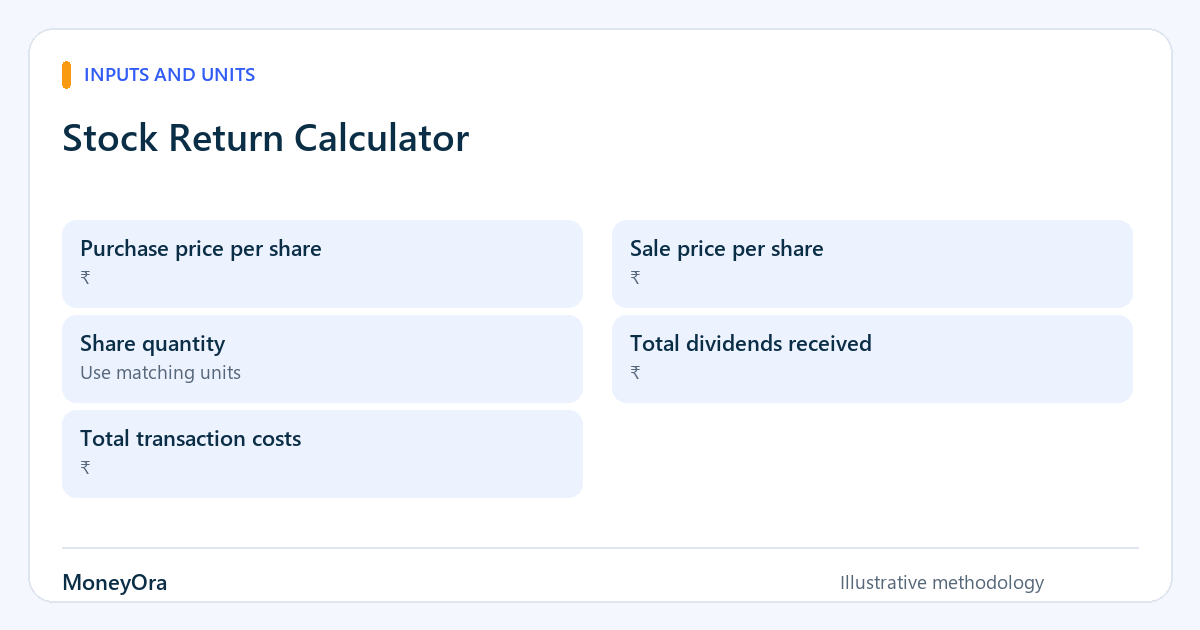
Understand the inputs
Purchase price per share
Use the execution price paid for one share. Enter a rupee amount using digits, without a currency symbol or comma. The result uses Indian number grouping, while the calculation retains precision until it is displayed.
Sale price per share
Use the sale price or a hypothetical future price. Enter a rupee amount using digits, without a currency symbol or comma. The result uses Indian number grouping, while the calculation retains precision until it is displayed.
Share quantity
Keep the same share count for the purchase and sale in this model. Keep the unit consistent with the label and your source record. A per-unit price and the value of the full holding must remain separate to avoid multiplying the quantity twice.
Total dividends received
Enter cash received across the whole holding, not dividend per share. Enter a rupee amount using digits, without a currency symbol or comma. The result uses Indian number grouping, while the calculation retains precision until it is displayed.
Total transaction costs
Include costs from both purchase and sale. Capital gains tax is excluded. Enter a rupee amount using digits, without a currency symbol or comma. The result uses Indian number grouping, while the calculation retains precision until it is displayed.
How to use the stock return calculator
Enter purchase and sale prices per share and the quantity sold. Add dividends and transaction costs as totals for the whole position, rather than per-share amounts. Calculate, then compare a scenario with the same prices but different costs. Use the same share basis for both prices if a corporate action occurred, and retain the transaction dates separately because this tool reports a period return, not CAGR.
Stock Return Calculator formula
Net gain = (sale price - purchase price) × quantity + total dividends - total costs. Return = net gain / purchase value × 100.
Calculations retain precision until display. Currency amounts are rounded to two decimal places. Displayed percentages and quantities may use more decimal places. A lender or provider can round each payment separately, so its statement can differ from this estimate.
Stock Return Calculator example
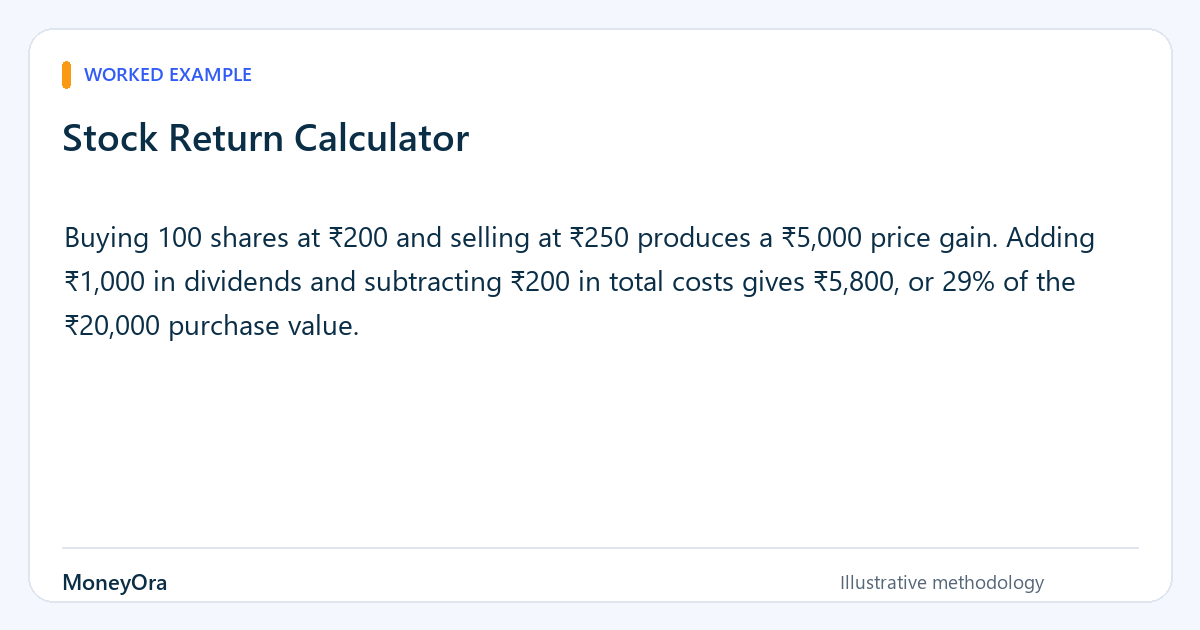
Buying 100 shares at ₹200 and selling at ₹250 produces a ₹5,000 price gain. Adding ₹1,000 in dividends and subtracting ₹200 in total costs gives ₹5,800, or 29% of the ₹20,000 purchase value.
How to read the result
Net gain combines the price difference, total dividends and entered transaction costs. The displayed return divides that gain by purchase value under the stated convention. Dividends must not be multiplied by the share quantity again after being entered as a total. The percentage covers the whole holding interval; it is not an annualised rate or an estimate of the tax due on the transaction.
A useful comparison
Keep cash dividends and transaction costs as totals for the whole position. The purchase and sale fields are prices for one share, while quantity scales those prices into trade values. Mixing total and per-share units can multiply a dividend or fee incorrectly.
The displayed return uses the purchase value as its denominator. Charges reduce the net gain, but they do not change that stated denominator. A return based on all initial cash outlays would use a different convention. Record which one you use when comparing another worksheet.
This result is a holding-period percentage. It does not annualise a gain or account for when dividends arrived. Reinvested distributions, partial sales and multiple purchase dates require a fuller cash flow ledger to measure actual investment performance.
Assumptions and limits
The percentage is a total holding period return, not an annualised rate. Corporate actions, partial sales and reinvested dividends need more detailed records. Taxes on a sale are excluded and can depend on transaction type and holding period.

Stock Return Calculator FAQs
Can I use a current price before selling?
Yes, as an unrealised scenario. Enter the current price and label it as such. Your eventual sale can execute at a different price, and the costs or tax may change the amount received.
Are my calculator inputs stored?
Ordinary numeric inputs are calculated in your browser. This calculator does not save those entries to browser storage or send them with a calculation request. A separate reference-rate request contacts a data provider through the server. Read the Privacy Policy for hosting and provider details.
What should I check if a result looks different from my statement?
Check purchase price per share, sale price per share, share quantity, then compare the exact calculation convention stated above. A different period, unit, rounding rule or excluded charge can change the result. Send the page URL and a reproducible numerical example to support@moneyora.in if the arithmetic still appears wrong.
Sources and corrections
Use the linked primary source to verify product terms and current rules. The source explains the underlying subject; it does not certify this calculator. Report a calculation problem with the inputs and expected result so the example can be checked.
Revision prepared 24 November 2026: input and result guidance updated; formula and worked example retained.
Related share market tools
Share Market
Stock Average Calculator
Calculate the weighted average purchase price for two share purchases.
PE Ratio Calculator
Compare a company’s share price with its earnings per share.
Dividend Yield Calculator
Estimate dividend yield and annual dividend income for a shareholding.
Margin Calculator
Estimate an illustrative margin amount from notional exposure and an entered margin percentage.
Position Size Calculator
Work out whole-share position size from a cash risk budget and stop distance.
Brokerage Calculator
Estimate trading costs using a broker rate, an order cap and separately entered statutory charges.
Stop Loss Calculator
Calculate a stop price and planned cash loss for a long or short trade.
Option Price Calculator
Estimate a European option value with the Black-Scholes model and a dividend yield input.
No matching tool. Try a shorter search or choose another category.