Option Price Calculator
Estimate a European option value with the Black-Scholes model and a dividend yield input.
By Mukesh Rajbhar. Calculation methodology prepared 23 November 2026. Educational estimates.
Option Price Calculator inputs
On this page
What the option price calculator measures
The theoretical price depends heavily on volatility and time to expiry. A quoted option premium also reflects the market’s supply, demand and implied assumptions. This calculator treats volatility as an input and supports continuous dividend yield, so the assumptions are visible.
Understand the inputs
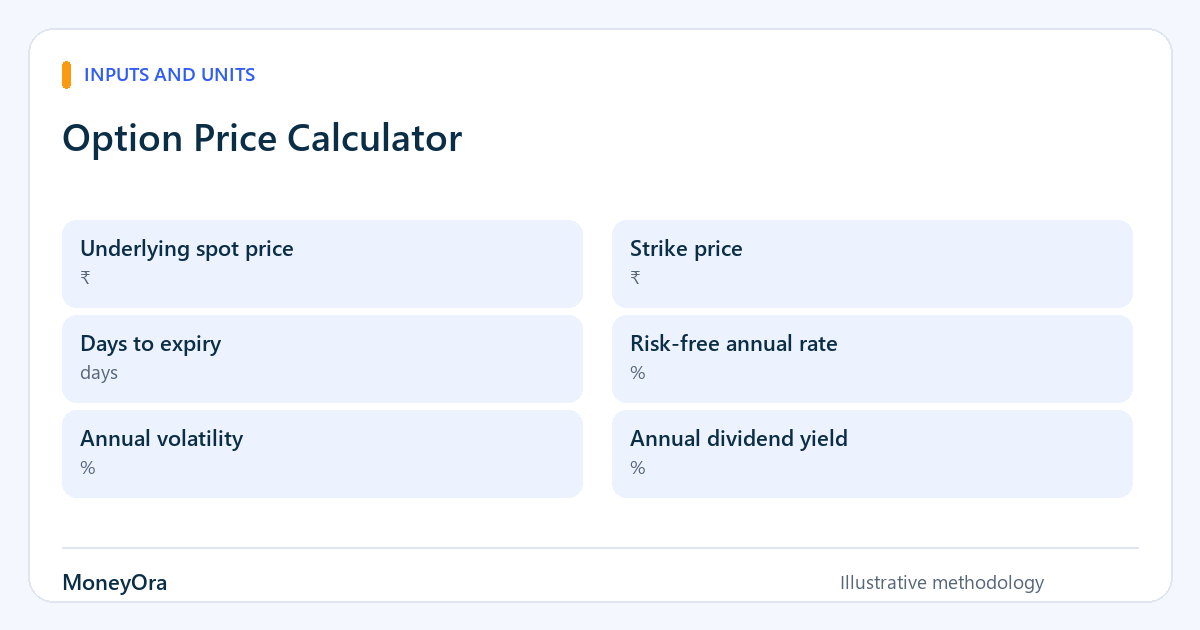
Underlying spot price
Use the current or scenario underlying price. Enter a rupee amount using digits, without a currency symbol or comma. The result uses Indian number grouping, while the calculation retains precision until it is displayed.
Strike price
Enter the contract’s exercise price per underlying unit. Enter a rupee amount using digits, without a currency symbol or comma. The result uses Indian number grouping, while the calculation retains precision until it is displayed.
Days to expiry
Calendar days are divided by 365 to obtain model years. Use a whole number for this period. The tool does not infer opening dates, holiday adjustments or partial periods from the duration alone.
Risk-free annual rate
Use a continuously compounded annual percentage for the model. Type the percentage itself, such as 8 for eight percent. Keep the quoted period consistent with the label; a monthly percentage and an annual percentage are different inputs.
Annual volatility
Enter annualised volatility, not daily price movement. Type the percentage itself, such as 8 for eight percent. Keep the quoted period consistent with the label; a monthly percentage and an annual percentage are different inputs.
Annual dividend yield
This is a continuous dividend yield assumption. Type the percentage itself, such as 8 for eight percent. Keep the quoted period consistent with the label; a monthly percentage and an annual percentage are different inputs.
Option type
The model supports European calls and puts. The choice changes how the calculation treats the inputs. Keep this setting unchanged when comparing two amounts, then change it separately to see the effect of the convention.
How to use the option price calculator
Enter underlying price, strike and calendar days to expiry. Add annual risk-free rate, annual volatility and dividend-yield assumptions, then choose call or put. Use percentages in the labelled percentage fields. Calculate the theoretical premium and change volatility alone to inspect its effect. Check the contract's exercise style, settlement and units separately before comparing this per-option model price with an exchange quotation.
Option Price Calculator formula
Call = S × exp(-qT) × N(d1) - K × exp(-rT) × N(d2). Put follows the corresponding Black-Scholes expression. T = calendar days / 365.
Calculations retain precision until display. Currency amounts are rounded to two decimal places. Displayed percentages and quantities may use more decimal places. A lender or provider can round each payment separately, so its statement can differ from this estimate.
Option Price Calculator example
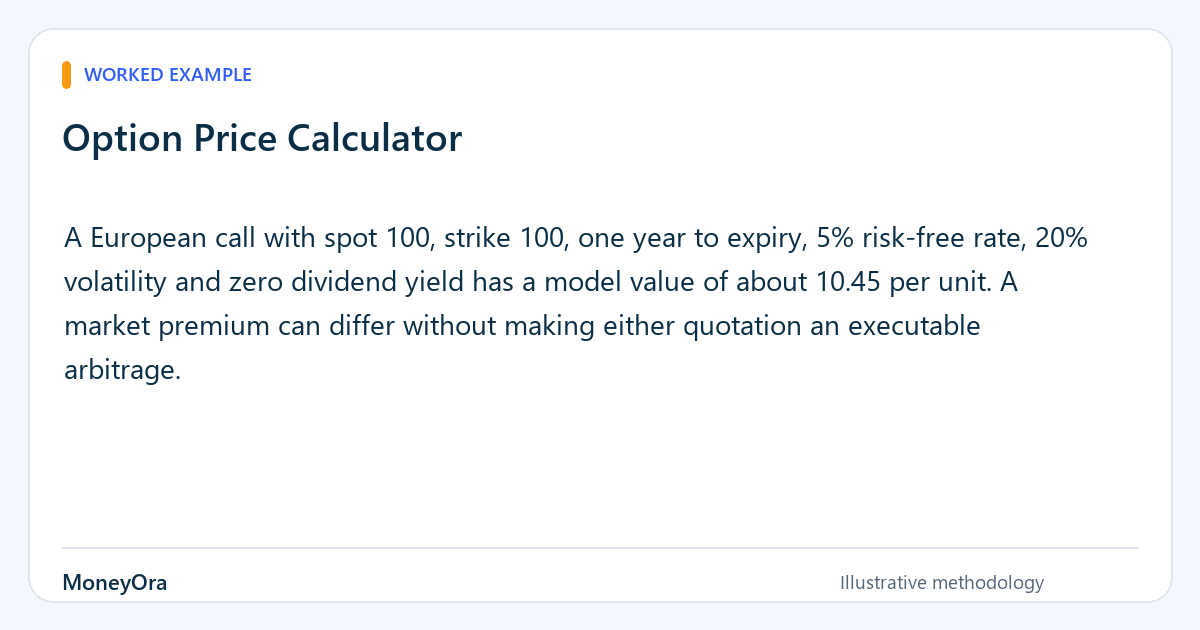
A European call with spot 100, strike 100, one year to expiry, 5% risk-free rate, 20% volatility and zero dividend yield has a model value of about 10.45 per unit. A market premium can differ without making either quotation an executable arbitrage.
How to read the result
The premium is a Black-Scholes theoretical value for the entered assumptions, not an executable bid or ask. Volatility is an input here, not an implied-volatility estimate solved from a traded premium. Calendar days are converted using a 365-day year. A mismatch with the market can reflect assumptions, exercise features, spreads or liquidity. The tool does not calculate a broker's margin requirement or recommend an options trade.
A useful comparison
Use volatility and dividend yield consistently with an annual time scale. The model converts calendar days into years and treats the entered rates as constant over that period. A short time to expiry can make the output sensitive to small changes in inputs and the exact remaining time.
This is a European-style pricing model with a continuous dividend-yield assumption. It does not capture early exercise, discrete dividend jumps, changing volatility smiles or illiquid quotes. The result is for one underlying unit under the model. Apply a contract multiplier separately when considering a full lot's theoretical value. A model price is not an available bid or ask.
Assumptions and limits
Black-Scholes assumes a European exercise style, constant volatility and frictionless trading. It can be a poor fit for jumps, early exercise or discrete dividends. The value is per underlying unit and must be multiplied by the contract lot size.
Option Price Calculator FAQs
Is theoretical option value a buy or sell recommendation?
No. It is a model result. Small changes in implied volatility, dividends and execution costs can change the interpretation. Options can lose their entire premium and some strategies can lose more.
Are my calculator inputs stored?
Ordinary numeric inputs are calculated in your browser. This calculator does not save those entries to browser storage or send them with a calculation request. A separate reference-rate request contacts a data provider through the server. Read the Privacy Policy for hosting and provider details.
What should I check if a result looks different from my statement?
Check underlying spot price, strike price, days to expiry, then compare the exact calculation convention stated above. A different period, unit, rounding rule or excluded charge can change the result. Send the page URL and a reproducible numerical example to support@moneyora.in if the arithmetic still appears wrong.
Sources and corrections
Use the linked primary source to verify product terms and current rules. The source explains the underlying subject; it does not certify this calculator. Report a calculation problem with the inputs and expected result so the example can be checked.
Revision prepared 24 November 2026: input and result guidance updated; formula and worked example retained.
Related share market tools
Share Market
Stock Average Calculator
Calculate the weighted average purchase price for two share purchases.
PE Ratio Calculator
Compare a company’s share price with its earnings per share.
Dividend Yield Calculator
Estimate dividend yield and annual dividend income for a shareholding.
Stock Return Calculator
Calculate a shareholding’s gain or loss including dividends and entered costs.
Margin Calculator
Estimate an illustrative margin amount from notional exposure and an entered margin percentage.
Position Size Calculator
Work out whole-share position size from a cash risk budget and stop distance.
Brokerage Calculator
Estimate trading costs using a broker rate, an order cap and separately entered statutory charges.
Stop Loss Calculator
Calculate a stop price and planned cash loss for a long or short trade.
No matching tool. Try a shorter search or choose another category.