
How to Find Unclaimed Money in India: 4 Official Portals to Claim Your Share of 1 Lakh Crore
- Over 1 lakh crore of unclaimed money in India is sitting across 4 asset types: bank deposits, EPF accounts, insurance policies and shares
- The RBI UDGAM portal holds 67,003 crore in unclaimed bank deposits as of July 2025. SBI alone accounts for 19,329 crore
- 25,000 crore in unclaimed insurance policies sits with IRDAI’s Bima Bharosa portal
- 9,330 crore in inactive EPF accounts tracked by EPFO as of July 2026
- 5,685 crore in unclaimed shares and dividends sits with IEPF under the Companies Act 2013
- Every step in how to find unclaimed money in India is free, every claim process is official, and there is no time limit on how long you can wait to claim
Knowing how to find unclaimed money in India could be one of the most useful 30-minute exercises you do this year. The numbers are amazing. As of 2025 and 2026 than 1 lakh crore rupees is sitting uncollected across bank accounts EPF funds, insurance policies and company shares. This is not money. It belongs to people and their families. It is sitting in government and regulatory accounts waiting to be claimed.
The reason most of this money in India stays unclaimed is simple. People do not know about the portals.. They think the process is hard.. They forget that a parent opened a fixed deposit 15 years ago and never told anyone. Or an employer provident fund account from a job held in 2008 is still sitting with a balance nobody has checked.
This guide gives you the details of how to find unclaimed money in India using all four official portals. It covers UDGAM for bank deposits EPFO for PF accounts IRDAIs Bima Bharosa for insurance policies and IEPF for shares and dividends. Each section has the 2025-26 data, a step-by-step claim process and specific things other guides miss completely.
Before you search any of these portals it helps to have your financial picture organised. The financial planning guide on MoneyOra explains how to map all your assets in one place, which also makes it easier to find what might be unclaimed, in your name or your familys name.
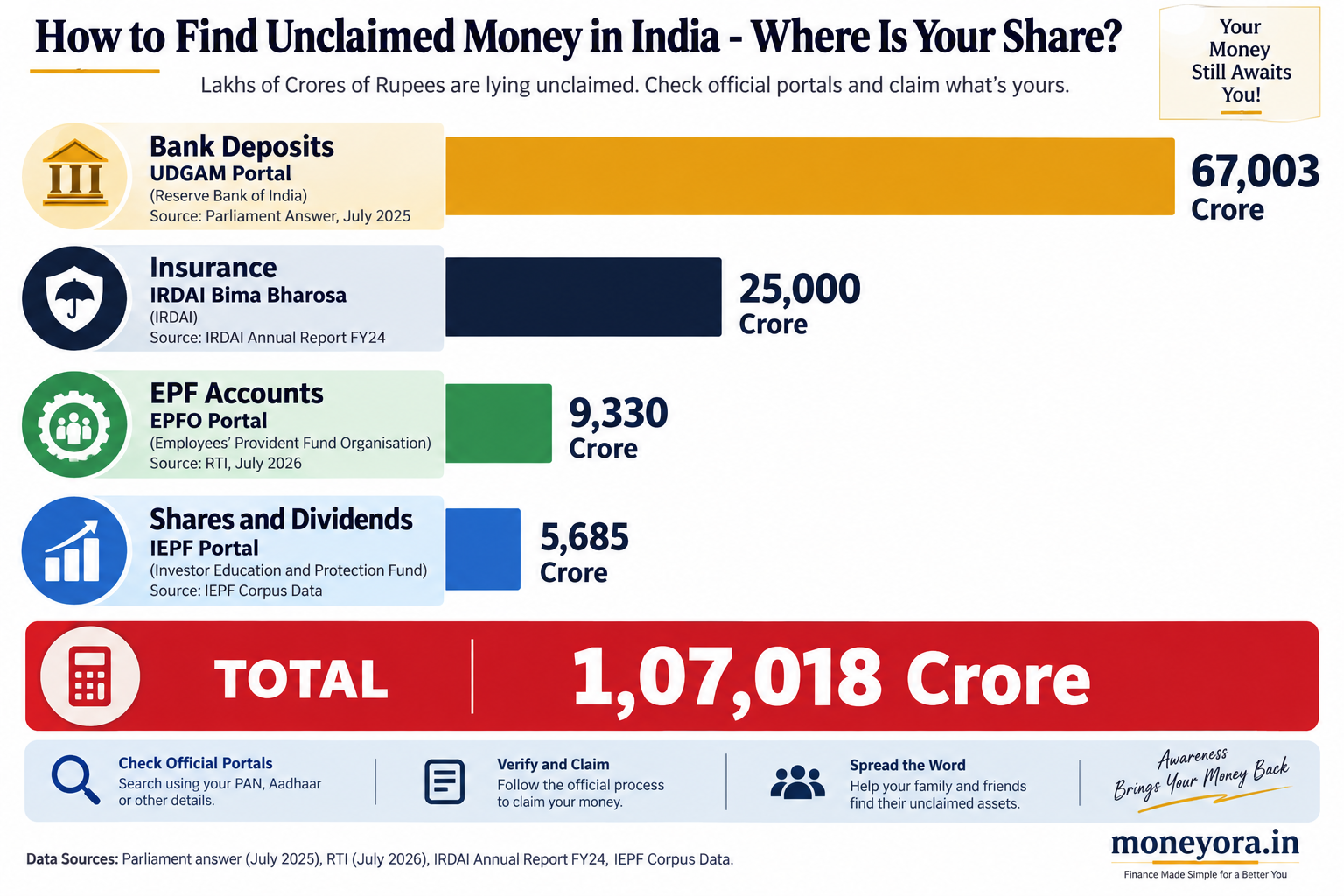
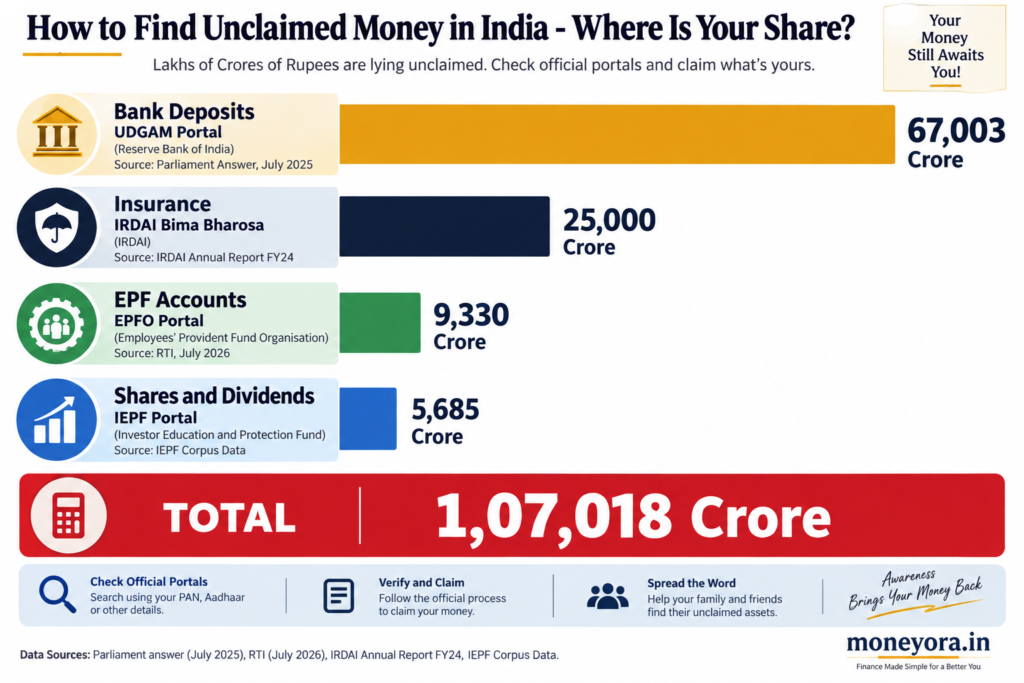
Over 1 lakh crore in unclaimed money in India is spread across 4 official portals. UDGAM holds 67,003 crore, IRDAI Bima Bharosa holds 25,000 crore, EPFO holds 9,330 crore, and IEPF holds 5,685 crore.
The 1 Lakh Crore Problem: How to Find Unclaimed Money in India That Nobody Claims
The scale of unclaimed money in India is not a minor statistic A Parliament answer tabled on July 28, 2025 revealed that 67,003 crore in bank deposits had been transferred to the RBI’s Depositor Education and Awareness Fund after sitting unclaimed for 10 or more years How to find unclaimed money in India in the banking system is now simpler than ever because of this centralised parliament-tracked database This is just the banking number Add 25,000 crore from insurance policies tracked by IRDAI, 9,330 crore in inactive EPF accounts per RTI data from July 2026, and 5,685 crore in unclaimed shares and dividends held by the Investor Education and Protection Fund, and the total crosses 1 lakh crore rupees.
How to find unclaimed money in India starts with understanding how it gets lost in the first place The most common reasons follow a predictable pattern An account holder dies without informing their family about the account Someone changes jobs and forgets an old employer’s PF account A fixed deposit opened decades ago matures and the person has since moved cities A life insurance policy bought in the 1990s never communicated its maturity to the nominee Shares received as part of a corporate bonus or rights issue sit in a demat account nobody knew existed.
All of this money is recoverable None of these portals charges a fee to search None of them has a time limit after which a claim is rejected The only requirement is documentation proving identity and your relationship to the original account holder.
This guide explains how to find unclaimed money in India across all four categories Check each one Your family may have more sitting in official accounts than you realise.
Portal 1: UDGAM for Unclaimed Bank Deposits (RBI)
If you are trying how to find unclaimed money in India that might be in bank accounts UDGAM is the place you should start. UDGAM stands for Unclaimed Deposits Gateway to Access Information. The Reserve Bank of India launched this centralized portal in August 2023. It gives people one place to search for unclaimed bank deposits across many banks at once. This saves time compared to checking each bank’s website one by one.
How Much Is in UDGAM
A Parliament answer from July 28 2025 said that the total amount of bank deposits in India is 67,003 crore. Among banks SBI has the largest share with 19,329 crore. Punjab National Bank holds 6,539 crore. Canara Bank has 4,558 crore. Bank of Baroda has 4,285 crore. These are bank accounts where no transaction has happened for ten years. Also the depositor did not reply to any communication, from the bank. The money stays in the RBIs Depositor Education and Awareness Fund. It earns interest at the savings bank rate.
How to Search UDGAM
The best way how to find unclaimed money in India through banks begins with UDGAM. Visit udgam.rbi.org.in To register you need a number and an OTP. After registration you can search using your name, PAN number or Aadhaar number. You can check all participating banks together. Choose a specific bank. The portal now includes all public sector banks and a growing list of sector banks. When you search the results will show if any unclaimed deposits match what you entered.
How to Claim from UDGAM After Finding Your Unclaimed Money
Once UDGAM shows a match, the claim does not go through the portal itself. UDGAM directs you to the specific bank branch that holds the account. You visit that branch with your identity proof, account details from the search result, and if you are a nominee or legal heir, the relevant supporting documents. Banks must process unclaimed deposit claims within 15 working days per RBI guidelines issued in May 2024. The interest on the DEA Fund amount is paid along with the principal when the claim is settled.
What UDGAM Does Not Cover
UDGAM covers bank deposits: savings accounts, fixed deposits, recurring deposits, and current accounts. It does not cover mutual funds, trading accounts, insurance policies, or PF accounts. For those you need the other three portals covered in this guide. Also note that UDGAM does not yet include cooperative banks or small finance banks in most searches. If you had accounts with a cooperative bank that has since merged or closed, contact the bank directly or the relevant state cooperative registrar.
For people who want to understand how unclaimed deposits interact with their overall savings strategy, the FD versus Liquid Fund comparison on MoneyOra explains how different deposit types accumulate interest and what happens to them when left dormant.
Portal 2: EPFO for Inactive and Unclaimed PF Accounts
The second way how to find unclaimed money in India is through provident fund accounts. The Employees Provident Fund Organisation or EPFO holds 9,330 crore rupees in EPF accounts according to RTI data gathered in July 2026. These accounts have had no contributions for 36 months in a row. Have no withdrawal or transfer requests. The money keeps earning interest at the EPF rate, which for the year 2024-25 was 8.25 percent per year. This is one of the results for unclaimed money in India because the EPF pool grows each year even when the accounts are idle.
Who Has Unclaimed PF Money
The common reasons that lead to unclaimed PF balances are job changes where the employee did not transfer or withdraw the old PF account jobs before the Universal Account Number system started in 2014 when old accounts were not linked to UAN, deaths where the nominee was unaware of the account and short‑term jobs in the organized sector where PF contributions were made automatically.
How to Find Your Unclaimed PF Using EPFO
The main way how to find unclaimed money in India with EPFO is to use your UAN number. If you know your UAN log in to the EPFO Member Portal Look at the Passbook section. This section shows all PF accounts that are linked to your UAN including accounts from previous employers. If you do not know your UAN you can search by PAN number or by the establishment code of your employer on the EPFO portal.
For accounts that were created before UAN linkage EPFO has a section, on its portal named Inoperative Account Helpdesk. You can visit epfigms.gov.in File a grievance if your old account does not appear in your UAN‑linked passbook.
How to Claim Unclaimed EPF
Withdrawal from an unclaimed EPF account follows the same process as standard EPF withdrawal. Submit Form 19 for final settlement or Form 31 for partial withdrawal using the EPFO member portal. If the account is inoperative and more than 3 years old, you still get the accumulated balance plus interest at the current EPF rate. The EPFO processes claims online within 20 working days for complete applications. Nominees of deceased members can claim using Form 20.
Tax on Unclaimed EPF Withdrawals
If you have completed 5 years of continuous service across all your EPF-contributing employers combined, the final withdrawal is tax-free. If you withdraw before 5 years of total qualifying service, the amount is taxable in your hands and TDS applies at 10 percent if the withdrawal exceeds 50,000 rupees. For unclaimed accounts from jobs held 10 or more years ago, most claimants will have exceeded the 5-year threshold through combined service periods. Confirm your qualifying service calculation before withdrawing to avoid unnecessary tax outflow.
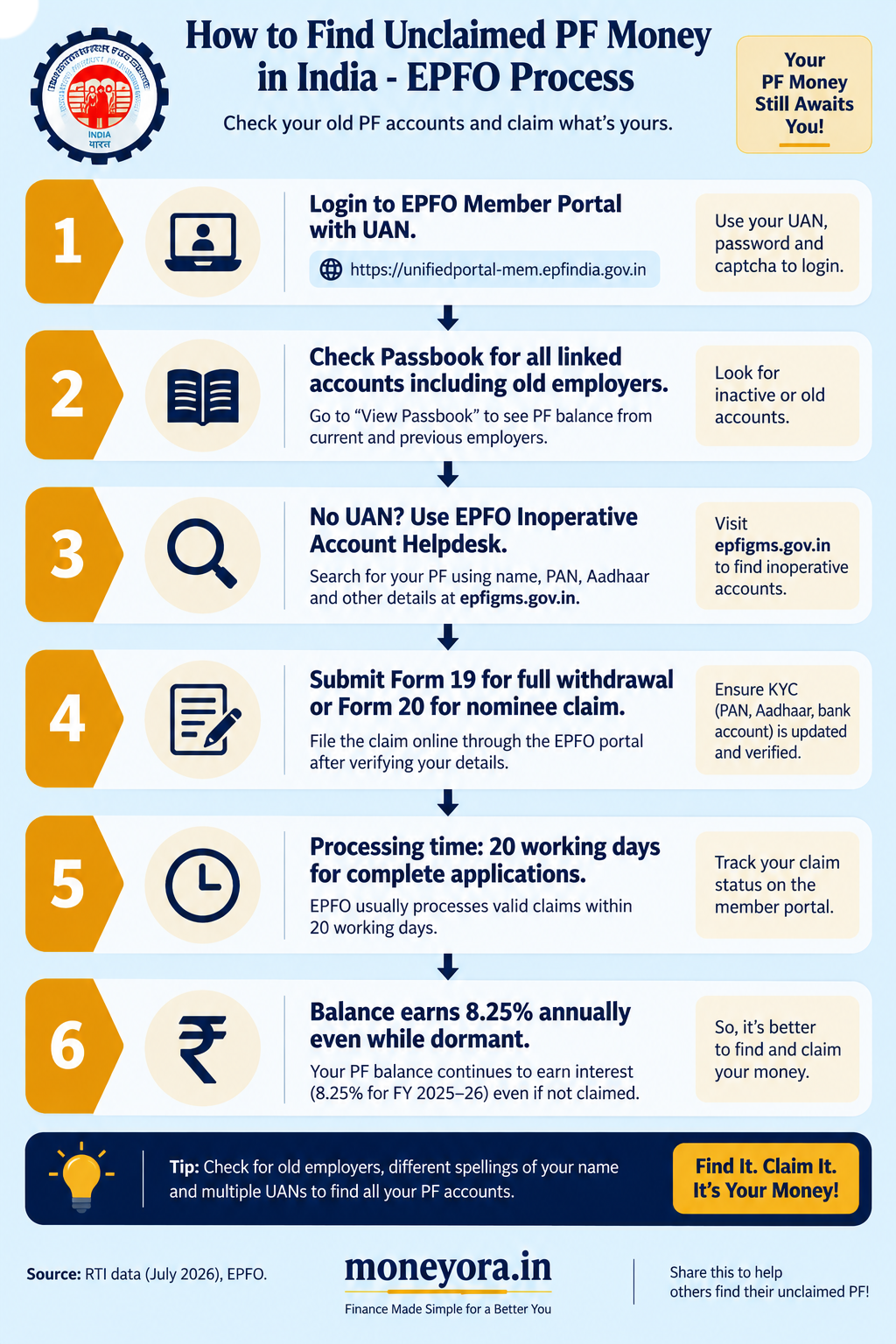
Step-by-step EPFO claim flow for inactive PF accounts. The EPFO holds 9,330 crore in dormant accounts earning 8.25 percent annually while the rightful owners remain unaware.
Portal 3: Bima Bharosa for Unclaimed Insurance Money (IRDAI)
Many people miss the insurance side of how to find unclaimed money in India . Indias insurance regulator IRDAI keeps a database called Bima Bharosa. This database lets policyholders and beneficiaries look for insurance amounts. According to the IRDAI Annual Report for FY 2023‑24 the unclaimed insurance money in India was than 25,000 crore across life and general insurance companies. This is the largest pool of unclaimed money in India after bank deposits.
Why Insurance Money Is Part of the Unclaimed Money in India Problem
Insurance policies can stay unclaimed for reasons. A policyholder may. The nominee may not know the policy existed. A maturity date may. The policyholder may not file a claim either because they forgot or because the insurance company did not communicate. A surrendered policy may have a value that the policyholder never collected. A group insurance policy from an employer might never be transferred to the individuals name after they left that job. Health insurance cashback bonuses that accumulated over years without a claim may never be requested.
How to Search Bima Bharosa
If you are unsure how to find unclaimed money in India from insurance policies this portal is the answer. The IRDAI Bima Bharosa portal can be found at bimabharosa.irdai.gov.in. You can search using your name, date of birth PAN or the policy number if you know it. The search covers all life insurance and general insurance companies that take part in the portal. LIC, HDFC Life, ICICI Prudential Life and all other major insurers have uploaded their unclaimed amounts databases to Bima Bharosa.
How to Claim from Bima Bharosa
Bima Bharosa shows you which insurer holds the amount. Then you contact that insurer directly with a claim form, identity proof. If you are a nominee the death certificate and nominee proof. IRDAI regulations require insurers to settle unclaimed amount claims within thirty days after receiving documentation. If an insurer does not settle within thirty days they must pay interest at six percent per annum for the delayed period. You can bring delayed claims to the IRDAI Grievance Cell at igms.irda.gov.in.
The SEBI nomination deadline article on MoneyOra explains why keeping nominee details updated across all products can reduce the risk of your own holdings becoming part of India’s unclaimed money problem, in the future.
Portal 4: IEPF for Unclaimed Shares and Dividends
The Investor Education and Protection Fund Authority under Section 124 of the Companies Act 2013 holds unclaimed shares and dividends. The current IEPF corpus stands at 5,685 crore and growing. Any dividend that remains unclaimed for 7 consecutive years is transferred to IEPF. The corresponding shares from whose dividends were repeatedly unclaimed are also transferred to IEPF after 7 years of consecutive unclaimed dividends on those shares.
Who Has Unclaimed Shares and Dividends as Part of India’s Unclaimed Money Total
Two groups of people have money sitting in IEPF. First, investors who held physical share certificates from companies they invested in during the 1980s and 1990s and never dematerialised those shares. The company continued declaring dividends, the warrants went to the old address, nobody collected them for 7 years, and both the dividends and the shares transferred to IEPF. Second, nominees and legal heirs of deceased investors who never tracked down the deceased’s share portfolio.
How to Find Unclaimed Shares and Dividends on IEPF
The IEPF authority maintains a searchable database at iepf.gov.in. Under the Investor Services section there is a link to search unclaimed dividends and shares by company name or investor name. You can also search on the individual company’s website under their Investor Relations section, which is mandatory for listed companies to maintain. Many registrars and transfer agents like KFin Technologies and Link Intime India also let you search by PAN or name across their client company universe.
How to Claim from IEPF
The IEPF step in how to find unclaimed money in India is the most document-intensive but often the most financially valuable. Claiming from IEPF requires filing Form IEPF-5 on the MCA21 portal at mca.gov.in. The form requires your Aadhaar, PAN, bank account details, and details of the specific shares and dividends you are claiming. After submitting IEPF-5 online, take a printout of the acknowledgment and the Indemnity Bond, sign them, and send the physical documents to the company’s nodal officer along with attested identity proofs. The company verifies the claim and forwards a verification report to the IEPF authority. The IEPF authority then refunds the amount to your Aadhaar-linked bank account and transfers the shares to your demat account. The full process typically takes 60 to 90 days from document submission.
Key Point on IEPF Share Returns
This is why how to find unclaimed money in India through IEPF specifically can be extremely valuable. When IEPF returns your shares, they are returned at their current market value in the form of the actual shares in your demat account. If you owned 100 shares of a blue-chip company that transferred to IEPF 10 years ago and the share price has grown since, you receive the current 100 shares at today’s market value. This is why how to find unclaimed money in India specifically related to IEPF can sometimes be very lucrative for heirs of investors who held high-growth stocks.
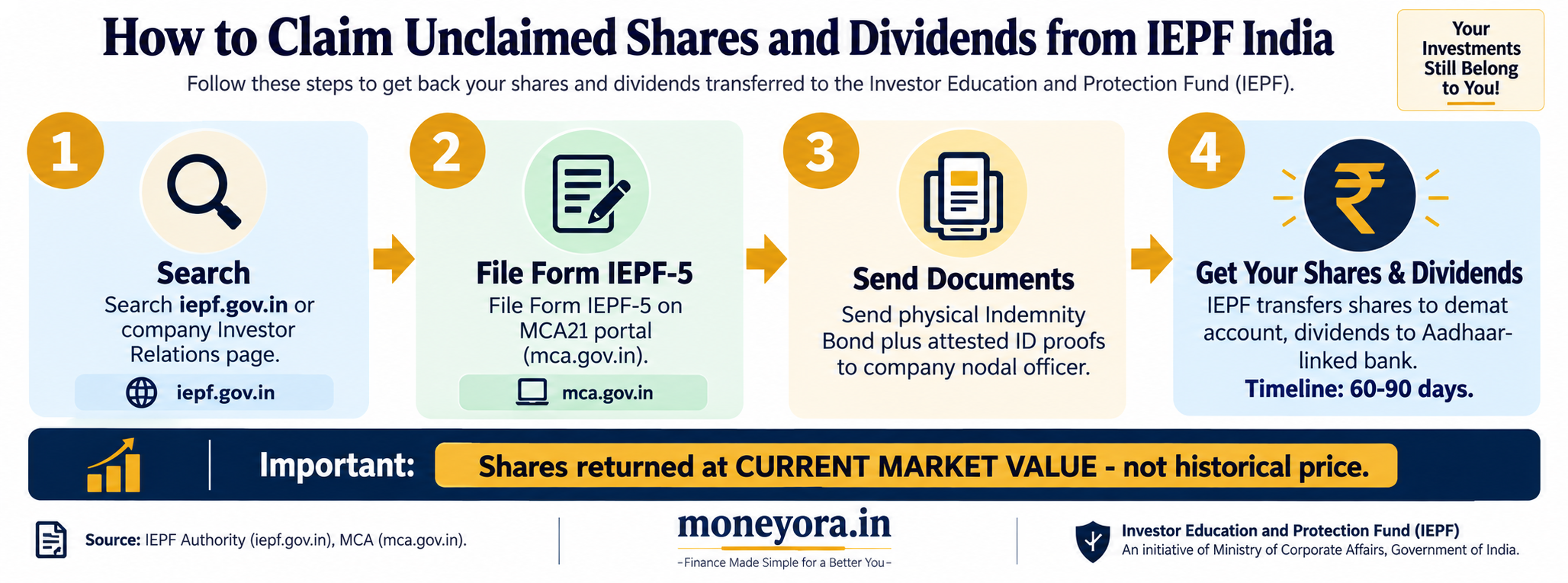
Claiming unclaimed shares from IEPF can be significantly valuable if the shares belonged to high-growth companies. The IEPF corpus holds 5,685 crore in unclaimed shares and dividends transferred under the Companies Act 2013.
The 4-Phase Master Checklist for Claiming Everything at Once
If you want to understand how to find unclaimed money in India efficiently across all four portals in one sitting, use this checklist. Running all four searches in sequence takes about 2 hours with documents ready. Anyone who has completed this full process reports it as the most rewarding exercise in personal finance. The preparation phase takes longer but only needs to happen once.
Phase 1: Gather Your Documents
- PAN card of the original account holder
- Aadhaar number linked to your current mobile
- Old passbooks, insurance policy documents, or share certificates if available
- Death certificate and succession certificate if claiming as a nominee or legal heir
- Bank account details for refund credit and Aadhaar-linked account confirmation
- Demat account details for IEPF share claims
Phase 2: Run All 4 Searches
- Search UDGAM at udgam.rbi.org.in using name and PAN
- Log in to EPFO portal using UAN or search via Inoperative Account Helpdesk
- Search Bima Bharosa at bimabharosa.irdai.gov.in using name and date of birth
- Search IEPF at iepf.gov.in using name and PAN
Phase 3: File Claims in Priority Order
- EPFO first: entirely online, 20-day processing, money credited directly to your bank
- UDGAM second: visit bank branch, 15-day processing per RBI guideline
- Bima Bharosa third: contact insurer directly, 30-day regulatory requirement
- IEPF last: most document-intensive, 60 to 90 days, worth doing for share holdings
Phase 4: Track and Follow Up
- Keep acknowledgment numbers from all portal applications
- If no response within the prescribed timeline, file a complaint at the respective regulator’s grievance portal
- EPFO grievance: epfigms.gov.in
- Banking grievance: bankingombudsman.rbi.org.in
- Insurance grievance: igms.irda.gov.in
- IEPF grievance: mca.gov.in under Investor Services
Investors who complete this exercise and recover money should then plan what to do with it. The SIP versus FD comparison on MoneyOra is a useful starting point for deciding how to deploy a recovered lump sum for long-term growth.
What Every Other Article Misses About Unclaimed Money in India
Every competitor article on how to find unclaimed money in India covers either UDGAM alone or lists the four portals without explaining what actually distinguishes a successful claim from a rejected one. This section covers what those articles skip.
Gap 1: Searching in Your Parents’ Names Is Usually More Valuable
Most people reading a guide on how to find unclaimed money in India assume they are searching for their own money. In practice, the largest amounts sit in the accounts of people who are now elderly or deceased. Your parents’ generation bought insurance policies, opened fixed deposits, and received bonus shares in the 1980s and 1990s in contexts where digital records did not exist and nominees were not formally registered. Run every portal search in your parents’ names, your grandparents’ names if applicable, and your spouse’s family names. The result often surprises people. A 25-year-old life insurance policy with a 1 lakh face value has grown to a much larger maturity amount at an insurer you may never have heard of under your parent’s maiden name or an old address.
Gap 2: The Interest on Unclaimed Money Continues Growing
Most guides on how to find unclaimed money in India do not mention this: unclaimed bank deposits in the DEA Fund earn simple interest at the savings bank rate (currently 3.5 percent per annum at most public sector banks) from the date of transfer to RBI. EPF dormant accounts earn the full EPF interest rate, which was 8.25 percent for FY 2024-25. Insurance unclaimed amounts earn a regulatory minimum rate. IEPF shares earn market appreciation. The longer unclaimed money sits, the more it has grown. There is genuinely no financial penalty for claiming late other than the years of higher returns you could have had if deployed differently.
Gap 3: Legal Heirs Need a Succession Certificate for Large Claims
One major step that how to find unclaimed money in India guides consistently skip is the Succession Certificate requirement. For amounts above a certain threshold, typically 1 lakh rupees for bank deposits, banks and insurers require a succession certificate issued by a civil court, not just a death certificate and self-declaration. This is a legal document that takes 2 to 6 months to obtain through the court process. If you know you are a legal heir to a substantial unclaimed amount, start the succession certificate process before filing your portal claim, so the documentation is ready when the claim is processed. Some states have simplified this through district courts for smaller amounts. Check with your specific bank or insurer about their threshold before investing time in the court process.
Gap 4: Old PPF Accounts at Post Offices Are Also Unclaimed
UDGAM and EPFO cover bank‑linked instruments and employer PF accounts respectively. However millions of Indians opened Public Provident Fund accounts at post offices in the 1980s and 1990s. These accounts matured after 15 years. Could be extended in 5‑year blocks. Many of these accounts were. Then forgotten. This gap appears in every guide that explains how to find money in India. The post office PPF network is not listed in UDGAM, many unclaimed money in India may remain hidden. To trace a post office PPF account visit the post office where the account was opened with the passbook if you have one or file an RTI with India Post to locate accounts under your name and PAN. The Department of Posts has a RTI portal at pgportal.gov.in.
Gap 5: Cooperative Bank Deposits Are Not in UDGAM
Another gap in guides that explain how to find unclaimed money in India is cooperative bank deposits. Urban cooperative banks and state cooperative banks are regulated separately from banks by the Reserve Bank of India and state governments. Their deposits do not currently feed into the UDGAM system. If you had a cooperative bank account or your family had one you need to contact that cooperative bank directly. For banks that have been placed under moratorium or merged by the RBI contact the RBI’s Financial Intelligence Unit or the acquiring bank to claim accounts. This gap affects depositors in Maharashtra, Gujarat and Karnataka where cooperative banking was historically widespread.
6: The 1 Lakh Crore Total Understates the Real Number
The figures used throughout this guide that explains how to find unclaimed money in India come from official sources such as Parliament, RTI, IRDAI annual reports and IEPF records. However they do not include post office savings, cooperative bank deposits, state government‑run small savings schemes NPS accounts with changed contact details or inactive demat accounts. The real total of money in India is almost certainly larger than 1 lakh crore. The formal portals give you the starting point. For anything outside those portals direct contact, with the institution or a formal RTI filing is the next step.
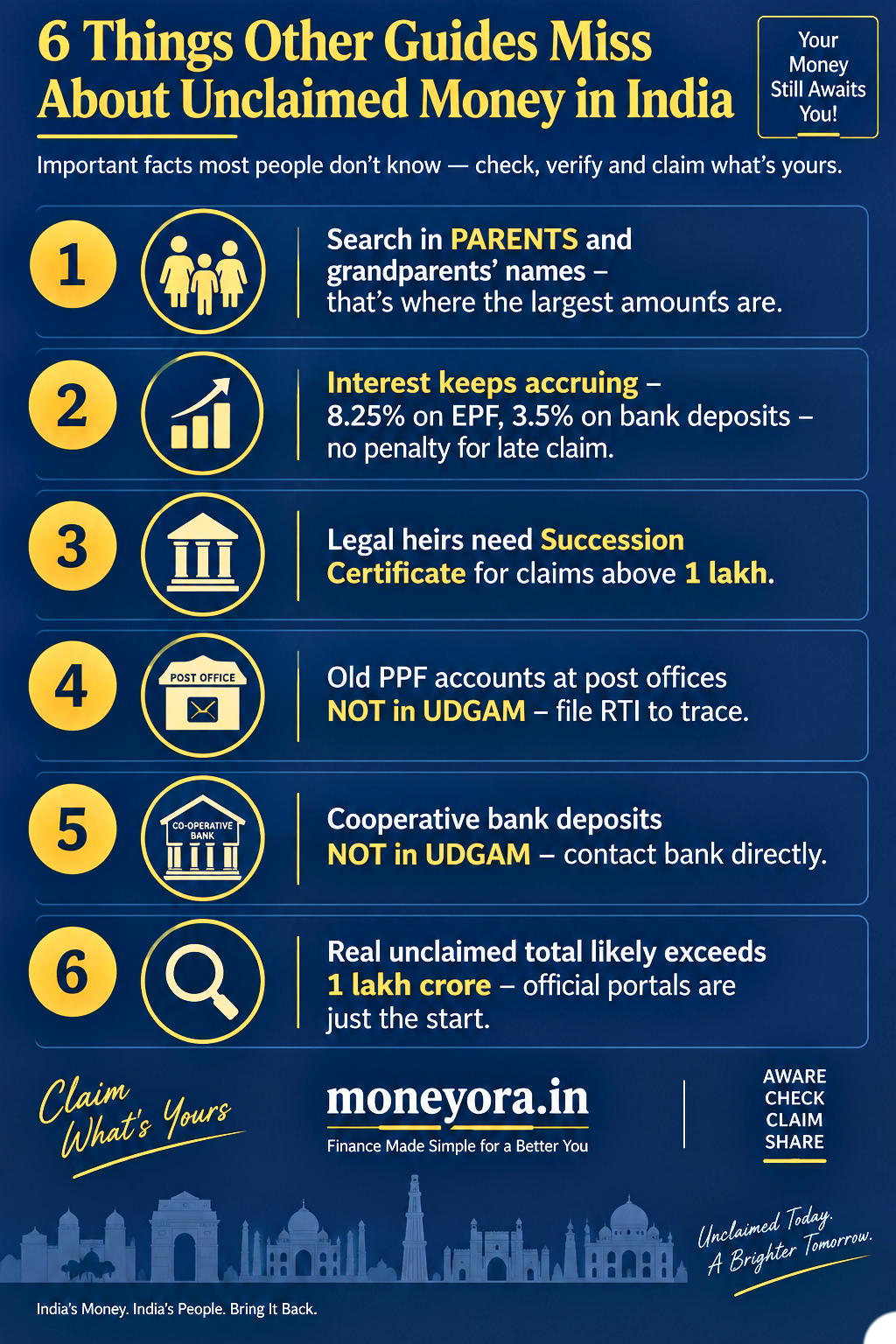
Six gaps in every other guide on how to find unclaimed money in India, including searching in parent names, old PPF accounts at post offices, cooperative bank deposits not in UDGAM, and succession certificate requirements for large claims.
Start Searching Today: How to Find Unclaimed Money in India in Under 2 Hours
Knowing how to find money in India is genuinely useful knowledge that most people acquire too late. The money is there. The portals are free. The claim process is official and documented. The only thing stopping people from checking is not knowing where to look.
The four-step approach to how to find money in India takes under 2 hours. Run this process every years because balances in old accounts continue to accumulate. Do four searches this week. UDGAM for bank deposits EPFO for PF accounts Bima Bharosa for insurance IEPF for shares. Run each search in your name your spouses name and your parents names. Take note of any matches. Begin the appropriate claim process.
If your exercise in how to find money in India yields a meaningful recovery the EPF vs PPF vs NPS comparison on MoneyOra and the SIP versus FD guide can help you decide where to deploy the recovered corpus for the best long-term return.
Use the calculators at MoneyOra.in to model what your recovered funds can grow into over the next 10 to 20 years.
Disclaimer: This article is for purposes only. Figures cited are from Parliament answers RTI filings and regulatory annual reports through 2025-26 and may have changed since publication. Verify figures and processes directly, at the official portal websites before filing any claim. This article does not constitute legal advice.
FAQ: How do I find unclaimed money in India
How do I find unclaimed money in India for free?
The most important thing about how to find unclaimed money in India is that the entire process is free. All four official portals are entirely free to search and free to claim through. UDGAM at udgam.rbi.org.in requires only a mobile OTP registration. The EPFO portal at unifiedportal-mem.epfindia.gov.in needs your UAN. Bima Bharosa at bimabharosa.irdai.gov.in requires your name and date of birth. IEPF at iepf.gov.in searches by name and PAN. There is no charge at any stage of the search or the claim filing. Never pay any third party claiming to help you claim unclaimed money – the process requires no agent and no fee.
How much unclaimed money is there in India in total?
The total scale of how to find unclaimed money in India is larger than most people realise. Based on official data from Parliament answers, RTI filings, and regulatory annual reports through 2025-26, the combined total exceeds 1 lakh crore rupees. Bank deposits account for 67,003 crore per the Parliament answer of July 28 2025. Insurance unclaimed amounts exceed 25,000 crore per IRDAI Annual Report FY 2023-24. EPF inactive accounts hold 9,330 crore per RTI data of July 2026. IEPF holds 5,685 crore in shares and dividends. These are the formally tracked and searchable amounts. Cooperative banks, post office schemes, and NPS accounts with outdated contacts add further uncounted amounts.
What is the UDGAM portal and who can use it?
UDGAM stands for Unclaimed Deposits Gateway to Access inforMation. It is the most direct answer to how to find unclaimed money in India in the banking system. The RBI launched it in August 2023 as a centralised search portal for unclaimed bank deposits across multiple banks simultaneously. Any Indian resident can use it by registering with a mobile number and OTP at udgam.rbi.org.in. Searches can be run by name, PAN, or Aadhaar. The portal covers all public sector banks and major private banks. After a match is found, the actual claim is processed at the specific bank branch holding the account, not through the portal itself.
Can I claim unclaimed money on behalf of a deceased parent?
Yes. You can claim unclaimed money in India as a nominee or legal heir after a parent’s death. You will need the original account holder’s death certificate, your own identity proof, and proof of your relationship to the deceased. For bank deposits and insurance amounts above approximately 1 lakh rupees, most institutions also require a Succession Certificate from a civil court, which takes 2 to 6 months to obtain. For EPF accounts, nominees can use Form 20 for death claims. For IEPF shares, the Form IEPF-5 process applies with additional heir-specific documentation.
Is there a time limit to claim unclaimed money in India?
No. None of the four major portals – UDGAM, EPFO, Bima Bharosa, or IEPF – has a time limit after which a claim is permanently rejected. Bank deposits in the DEA Fund continue earning interest at the savings bank rate. EPF dormant accounts continue earning at the annual EPF rate. IEPF holds shares indefinitely and returns them at current market value. The only practical consequence of delayed claiming is that you miss years of return that would have been available if the money had been actively invested.
How do I find unclaimed EPF money from an old job?
The EPFO portal is the tool for how to find unclaimed money in India that belongs to your provident fund accounts. Log in to the EPFO Member Portal at unifiedportal-mem.epfindia.gov.in using your UAN and password. Under the Passbook section, all EPF accounts linked to your UAN appear including previous employers. If the old account is not linked to your current UAN, use the EPFO Inoperative Account Helpdesk at epfigms.gov.in to trace it using your name, date of birth, and PAN. Once found, transfer it to your current active PF account using Form 13 online, or withdraw it directly using Form 19 if you have left all employment in the organised sector.
How do I claim unclaimed shares from IEPF?
For the shares and dividends component of how to find unclaimed money in India, the process starts at iepf.gov.in. Search iepf.gov.in to confirm your shares and dividends are in the IEPF corpus. Then file Form IEPF-5 on the MCA21 portal at mca.gov.in. Print the acknowledgment and the Indemnity Bond, sign them, and courier the physical documents to the nodal officer of the specific company whose shares are being claimed. The company verifies your claim and forwards a verification report to IEPF. The IEPF authority then credits the dividend amount to your Aadhaar-linked bank account and transfers the shares to your demat account. This process takes 60 to 90 days from the date of physical document submission.
What happens to unclaimed insurance money in India?
Understanding how to find unclaimed money in India from insurance requires knowing where it goes when unclaimed. Insurance companies are required by IRDAI regulations to transfer unclaimed amounts to a segregated fund after a defined period and report them to the IRDAI Bima Bharosa database. The money earns a minimum interest rate while held there. You or your nominees can claim it at any time by identifying the policy through Bima Bharosa at bimabharosa.irdai.gov.in and contacting the insurer directly. The insurer must settle the claim within 30 days of complete documentation. Delayed settlement beyond 30 days attracts interest at 6 percent per annum payable by the insurer to you.
Which bank has the highest unclaimed deposits in India?
Knowing which institutions hold the most is useful context for how to find unclaimed money in India efficiently. Based on the Parliament answer of July 28 2025, State Bank of India holds the largest amount of unclaimed deposits at 19,329 crore. Punjab National Bank holds 6,539 crore. Canara Bank holds 4,558 crore and Bank of Baroda holds 4,285 crore. All of these amounts are searchable through the UDGAM portal at udgam.rbi.org.in. The high SBI figure reflects SBI’s dominant share of India’s total bank account base, particularly in rural and semi-urban areas where account holders are older and communication about dormant accounts is less reliable.