

Credit Card EMI vs Personal Loan: Real Effective Rate + Hidden Charges Guide
You need Rs 1.5 lakh. Your phone just died or the AC gave out or there is a medical bill sitting on the table. The bank app shows two buttons. You can convert to credit card EMI in 30 seconds or apply for a personal loan. The EMI button is faster. But is the credit card EMI vs personal loan cost gap small enough to ignore?
It isn’t. On Rs 3 lakh over 3 years the personal loan saves Rs 82,836 in interest compared to a standard credit card EMI according to SmartEMI research from April 2026. That is money leaving your account quietly every month while you assume both options cost roughly the same.
This guide does the math on credit card EMI vs personal loan using real 2026 rates from HDFC Bank, ICICI Bank, SBI and Bajaj Finserv. You will get a full effective rate calculator, a breakdown of every hidden charge including the GST trap inside no-cost EMI, and a scenario guide that tells you when each option actually wins.
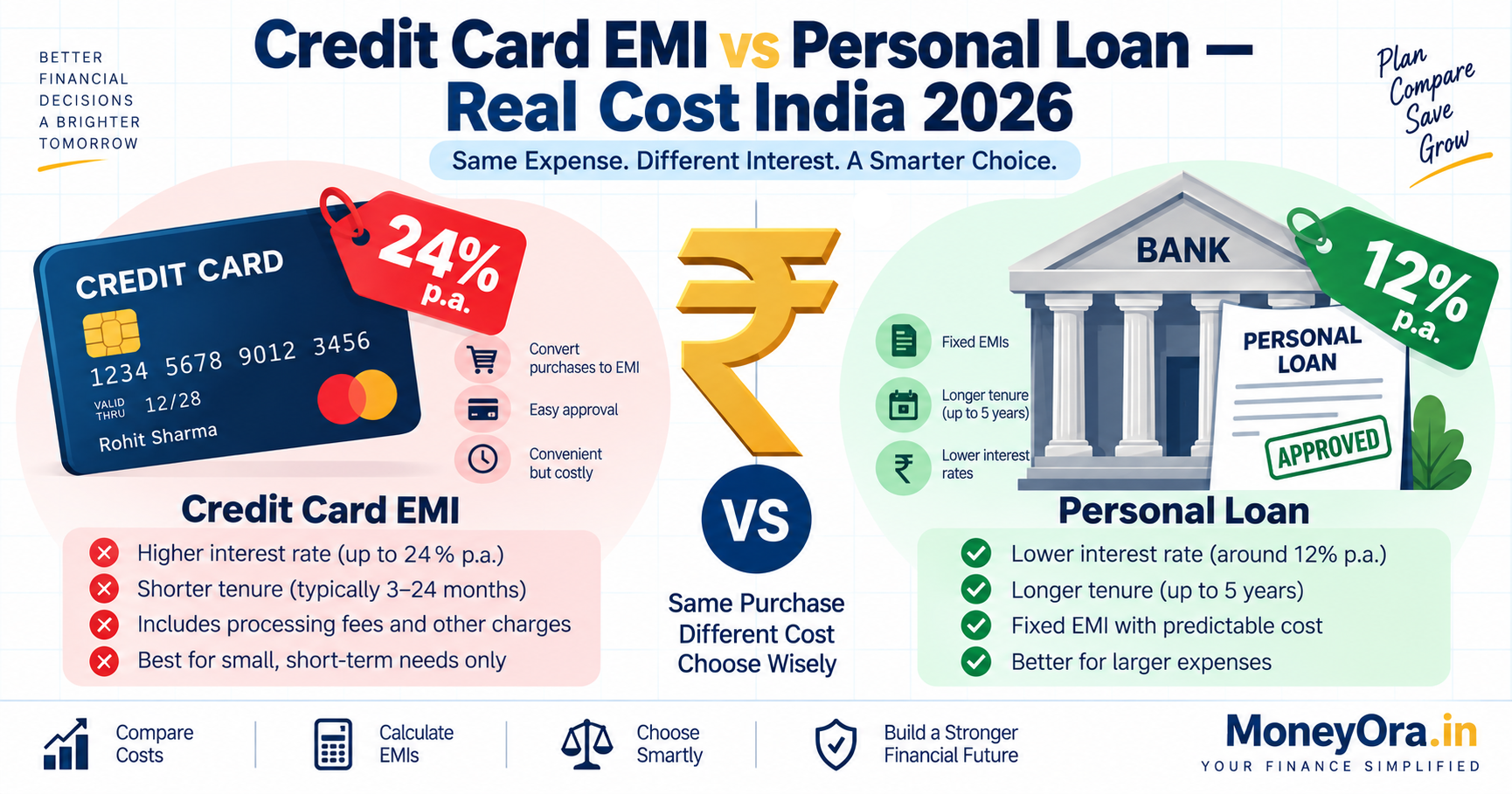
- Personal loans cost 10 to 16% p.a. in India 2026. Credit card EMI costs 18 to 36% p.a. That is not a small gap.
- No-cost EMI is not free. Banks charge 18% GST on the interest component plus a processing fee of Rs 99 to Rs 499.
- Credit card EMI blocks your full card limit and raises credit utilization. Both hurt your CIBIL score.
- RBI’s January 2026 rule bans foreclosure fees on floating-rate personal loans. The personal loan now has no exit penalty in most cases.
- Credit card EMI wins only for small amounts below Rs 30,000 repaid in 3 months or less. Genuine zero-cost deals during major sales.
What Is the Real Rate Difference Between Credit Card EMI vs Personal Loan?
The headline rates can be misleading When you compare credit card EMI vs personal loan on paper the numbers may appear similar However the effective annual rate that includes processing fees and GST tells a story about credit card EMI and personal loan.
Personal loan interest rates at Indian banks in 2026 range from 10% to 16% per year for salaried employees with a CIBIL score above 750. HDFC Bank offers rates from 10.75% to 14.5%. Sbi Personal Loan starts at 11.05%. Adding a processing fee of up to Rs 6,500 plus GST on the loan amount raises the rate by 0.3 to 0.6 percentage points on a 3‑year loan still staying below 17% for a good credit profile.
Credit card EMI works in a way Most bank-to-bank conversions quote credit card EMI at 12% to 18% per year on the face value However that interest is calculated on a reducing balance. You also pay 18% GST on every rupee of that interest. If you do the math for a Rs 1 lakh purchase over 12 months at 15% interest the monthly EMI is Rs 9,026. The total interest paid is Rs 8,310 and the GST on that interest adds Rs 1,496. The effective annualized cost, for credit card EMI is 18.2%, not 15%.
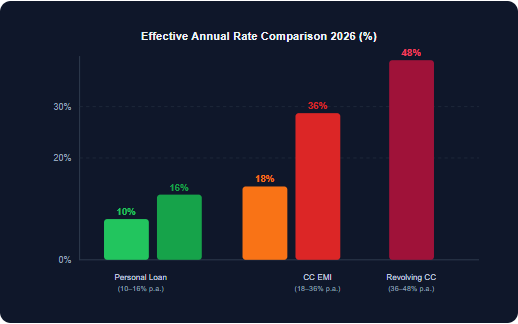
The gap gets wider if your card issuer also charges an EMI conversion fee of Rs 199 to Rs 499 plus GST. That is the number most people miss when they compare credit card EMI vs personal loan at the checkout screen.
For more on how banks structure loan costs see MoneyOra’s guide to personal loan eligibility and charges in India.
The No-Cost EMI Trap and What Banks Do Not Say at Checkout
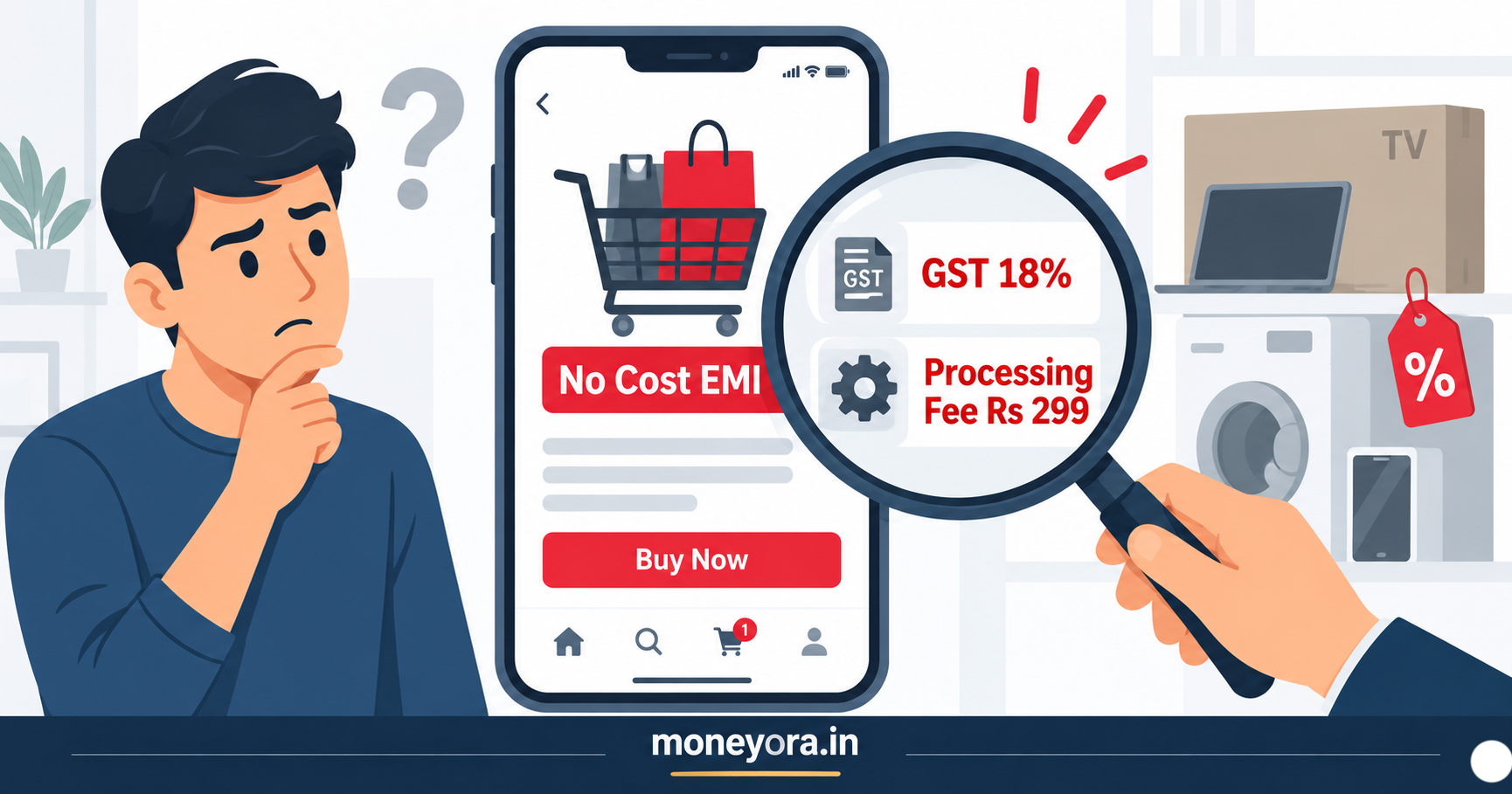
No-cost EMI is the misunderstood product in Indian consumer finance right now. When you choose it at checkout on Amazon or Flipkart during a sale you think you are paying zero interest You are not. Here is exactly what happens.
The bank still charges its interest rate usually 12 to 18% per year. The merchant covers that interest by giving you a discount to the interest amount. Far so good Three costs still come out of your pocket.
First is 18% GST on the interest part The bank handles the interest internally Gst applies to it even if the merchant paid it On a Rs 60,000 laptop with a 6-month no-cost EMI the GST alone adds about Rs 454 according to CardTrail research from March 2026. On a Rs 1.5 lakh phone the number goes up to Rs 1,000 to Rs 1,500.
Second is the processing fee. HDFC Bank and ICICI Bank usually charge Rs 199 to Rs 299 plus 18% GST for each EMI conversion. SBI sometimes doesn’t charge this on Amazon purchases Not always On a Rs 3 lakh TV this fee with GST adds another Rs 350 to Rs 530.
Third and this is the part that really gets people angry when they find out the discount used to cover your interest is often a discount you could have had. Many merchants offer a cash or debit card discount. When you go for no-cost EMI that discount disappears into the merchant-bank deal. You pay the price in EMIs instead of paying 5 to 10% less right away.
Traditional personal loan interest is free from GST Credit card EMI interest is not. That one difference can add Rs 1,500 to Rs 3,000 to a sized purchase. The checkout screen never tells you about it. This is one of the credit card charges banks don’t tell you about until you read the print.
From July 2026 RBIs new reporting rules mean missed EMI payments now show on your CIBIL report within 7 days of 30. If you are looking at credit card EMI vs personal loan and thinking about the card option make sure your payment habits are good. One mistake shows up quickly now.
Original Data Insight On a Rs 3 lakh loan over 3 years a personal loan at 12% per year saves Rs 82,836 in interest compared to a credit card EMI at 24% per year (SmartEMI, April 2026). Add GST on EMI interest and a processing fee. The total saving from choosing the personal loan option is more than Rs 85,000, on the same amount.
Credit Card EMI vs Personal Loan Real Numbers for Rs 50,000 and Rs 2,00,000
Abstract rate comparisons only go far. Here is the credit card EMI vs loan cost laid out in rupees for two common loan amounts Indian salaried employees actually borrow.
Scenario A for Rs 50,000 over 12 months
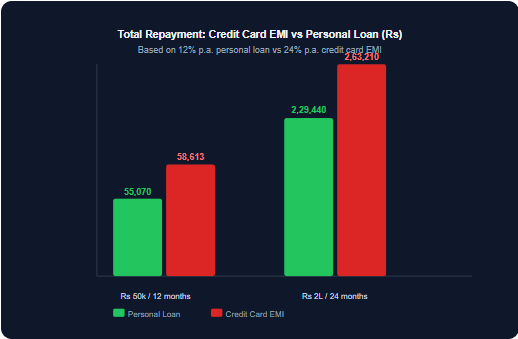
At a loan rate of 12% p.a. The EMI is Rs 4,442 and total interest paid over 12 months is Rs 3,300. Processing fee of Rs 1,500 plus GST adds Rs 1,770. Total repayment is Rs 55,070.
At a credit card EMI rate of 24% p.a. The EMI is Rs 4,754 and total interest is Rs 7,050. GST on interest at 18% adds Rs 1,269. Processing fee of Rs 249 plus GST adds Rs 294. Total repayment is Rs 58,613.
The difference is Rs 3,543. Not life-. Not trivial either. That is more than a months SIP contribution for salaried employees.
Scenario B for Rs 2,00,000 over 24 months
Personal loan at 12% p.a. The EMI is Rs 9,413 and total interest paid is Rs 25,900. Processing fee Rs 3,000. Gst Rs 540. Total repayment is Rs 2,29,440.
Credit card EMI at 24% p.a. Carries an EMI of Rs 10,557 and total interest paid is Rs 53,360. GST on interest adds Rs 9,605. Processing fee Rs 249. Gst Rs 45. Total repayment is Rs 2,63,210.
The difference is Rs 33,770. That is an amount. Enough to fund an equity SIP for 3 years at Rs 1,000 per month. When you are comparing credit card EMI vs loan on larger amounts the personal loan wins, by a very wide margin.
If you are planning a larger purchase and want to calculate your exact eligibility first check MoneyOra’s loan eligibility by salary calculator to see how much you can comfortably borrow before committing to either route.
How Does Credit Card EMI vs Personal Loan Affect Your CIBIL Score?
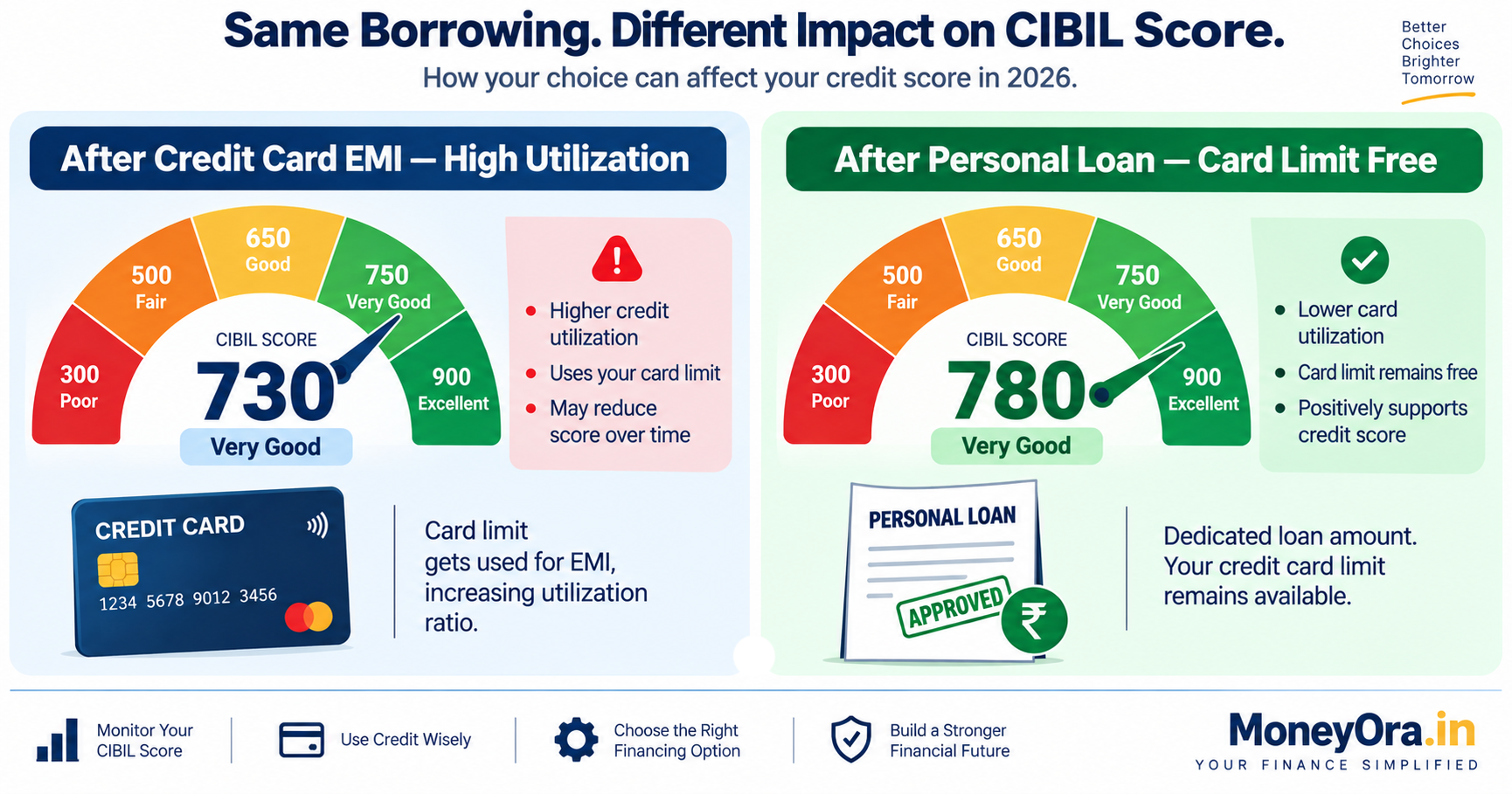
This is the part of the credit card EMI vs personal loan debate that most comparison articles skip. The CIBIL score impact is different for the two products and that difference matters if you plan to borrow again in the next 12 to 24 months.
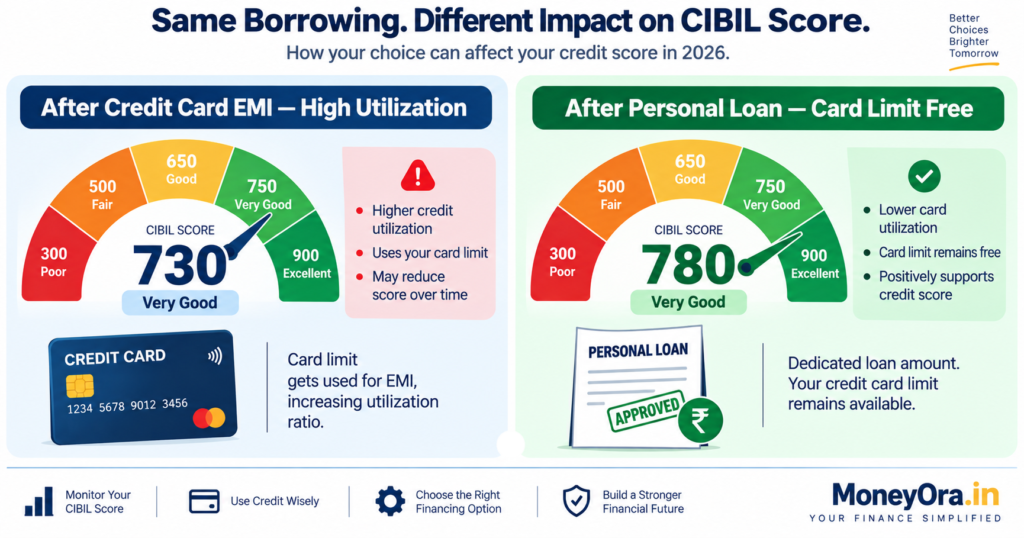
When you convert a purchase to credit card EMI your bank blocks the full purchase amount from your credit limit for the entire EMI tenure even though you repay in slices. If your card limit is Rs 2 lakh and you put a Rs 1.2 lakh washing machine on 12-month EMI your available limit drops to Rs 80,000 immediately. Your credit utilization ratio, the share of your total limit in use, jumps to 60%. CIBIL and other credit bureaus flag any utilization above 30% as a risk signal. This can pull your score down by 20 to 40 points.
A personal loan appears on your credit report as a separate installment account. Your credit card limit stays completely untouched. Your utilization ratio remains low. The personal loan does add to your total debt load but lenders view installment debt and revolving debt differently. A well-managed personal loan with on-time payments often improves your credit mix score over time.
From July 2026 RBI requires banks to report credit data weekly instead of every 15 to 30 days. One missed credit card EMI payment now appears on your CIBIL score within 7 days. For anyone planning a home loan or car loan in the next year this timeline shift makes EMI repayment discipline much more critical than it was before.
Hidden Charges Breakdown What You Actually Pay in Each Option
When you put every charge side by side the comparison between Credit Card EMI vs Personal Loan becomes much clearer. This is the view for the year 2026.
Personal Loan Charges
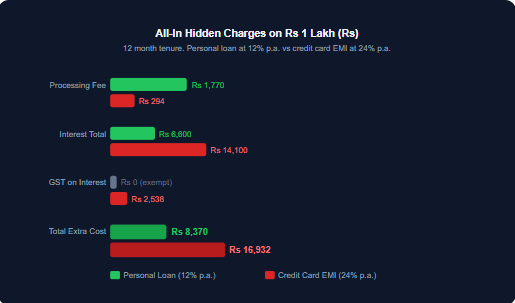
Processing fee at HDFC Bank can reach up to Rs 6,500 plus GST. ICICI Bank can charge up to 2% of the loan amount. Bajaj Finserv can charge up to 3.93%, which on a Rs 4 lakh loan means Rs 4,000 to Rs 15,720. 18% GST. SBI Personal Loan charges 1.5% of the loan amount with a minimum of Rs 1,000, plus GST.
Foreclosure charges have changed as of January 2026. The Reserve Bank of India of India has banned foreclosure fees on floating-rate Personal Loans. Fixed-rate Personal Loans may still have a prepayment penalty of 2 to 4% depending on the lender. Always read the loan agreement before signing.
Late payment penalty for Personal Loan is from Rs 500 to Rs 1,500. An extra 2 to 4% interest on the overdue amount depending on the bank. This is similar to Credit Card EMI fees so it does not set Personal Loan apart.
Credit Card EMI Charges
Interest rate on Credit Card EMI ranges from 12% to 36% per year depending on the bank and card. Most mid‑tier cards charge 18% to 24% per year for EMI.
GST on interest is a 18% on every rupee of interest charged even within no‑cost EMI deals. There is no charge on Personal Loan.
Processing or conversion fee at banks is between Rs 99 and Rs 499 plus 18% GST. HDFC and ICICI usually charge between Rs 199 and Rs 299 plus GST. Some banks waive this fee during sale events.
Foreclosure charge on Credit Card EMI is usually 2% to 5% of the principal plus 18% GST. ICICI and Axis Bank waive this fee only if you cancel within 15 days of conversion. Therefore Credit Card EMI is harder to exit than a floating‑rate Personal Loan as of January 2026.
Loss of reward points is real. Most banks do not award reward points on EMI transactions. On a Rs 1 lakh purchase you could lose 1,000 to 2,000 points depending on your card.
For a view of charges that quietly erode your finances read MoneyOras guide on hidden bank charges costing Indians Rs 2,000 a year.
When Does Credit Card EMI Actually Beat a Personal Loan?
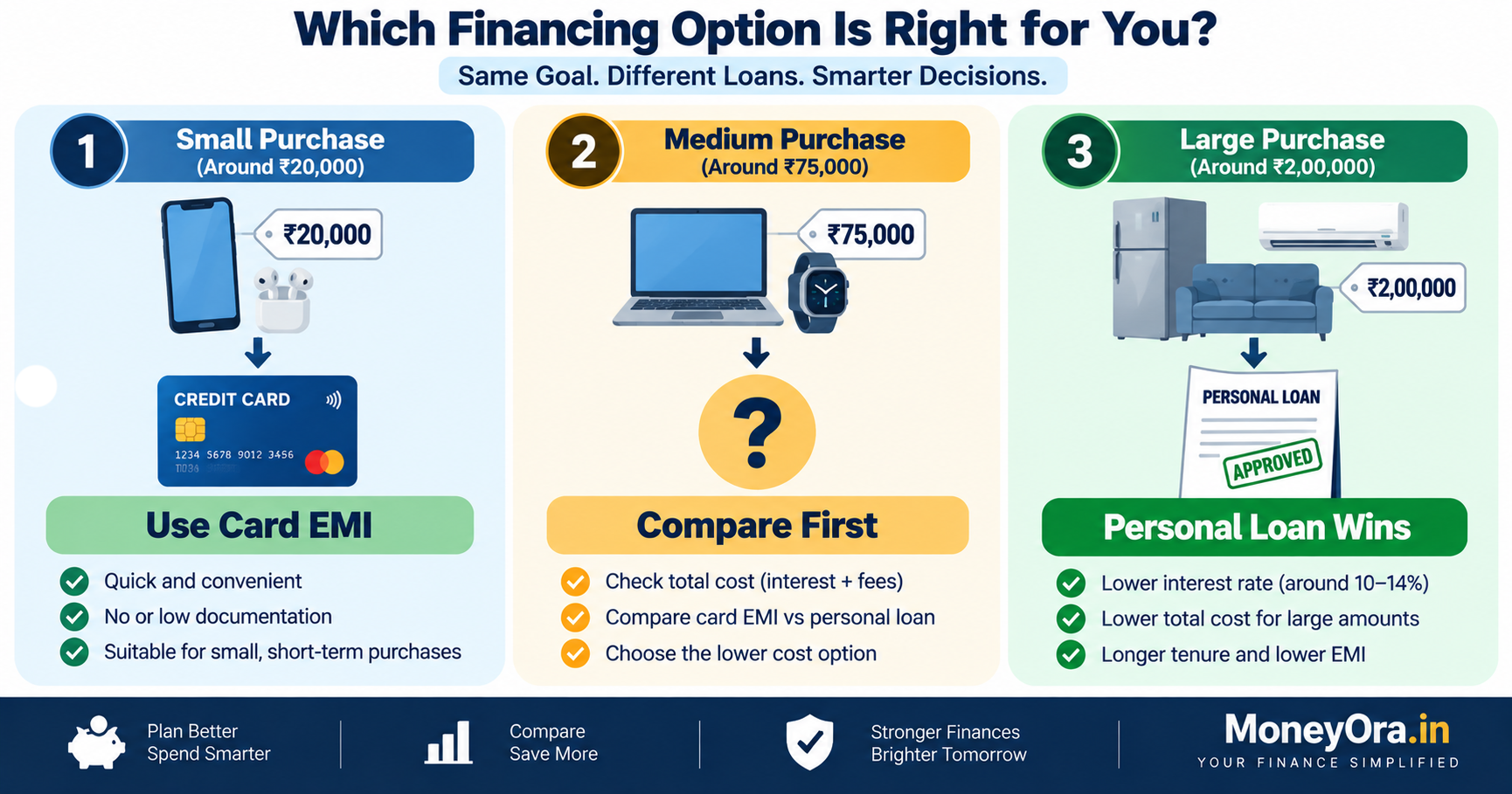
This question has an answer and the answer is narrower than card issuers would like you to believe. There are three situations where the credit card EMI vs personal loan math tips toward the card.
Situation 1 Small amount and short tenure
For a Rs 20,000 to Rs 30,000 purchase repaid in 3 months even a 24% annual rate means Rs 900 to Rs 1,350 in total interest. Add GST and a processing fee and the in cost might be Rs 1,200 to Rs 1,700. Compare that with a loan where the processing fee alone often starts at Rs 1,000 to Rs 1,500 before any interest. On short-term small borrowings the credit card EMI can cost less in total even with its higher rate.
Situation 2 no-cost EMI during major sale events
During Amazon Great Indian Festival or Flipkart Big Billion Days banks sometimes waive the processing fee entirely. If the product has no cash discount available meaning the EMI price and the outright price are identical. The only real cost is the 18% GST on the interest component. On a Rs 40,000 purchase over 3 months that might be Rs 270 to Rs 300. In this scenario the no-cost EMI can be nearly as cheap as paying upfront.
Situation 3 Speed is -negotiable
Personal loans at good terms still take 24 to 48 hours for disbursal at most banks even for pre-approved offers. Credit card EMI activates in 30 seconds. For a medical emergency where every hour matters and the amount is under Rs 1 lakh the speed premium may be worth the cost difference.. For anything that can wait even one working day this advantage disappears.
Outside these three situations the credit card EMI vs personal loan comparison goes to the personal loan almost every time. Keep in mind that credit card EMI also requires you to have the purchase amount available as credit limit. It is not truly accessible, for everyone. The personal loan is a disbursement of funds.
Effective Rate Calculator How to Work Out the True Cost Yourself
You don’t need a finance degree to figure out whether credit card EMI vs personal loan is cheaper for your specific situation. Here is the formula to calculate the effective annual rate on any EMI offer.
Step 1 is to find the total repayment amount. Multiply the EMI by the number of months. For a Rs 1 lakh purchase at Rs 9,026 per month over 12 months the total repayment is Rs 1,08,312.
Step 2 is to add all upfront charges. Processing fee plus GST. If you are comparing credit card EMI vs personal loan include the GST on interest in the credit card column.
Step 3 is to subtract the principal. Rs 1,08,312 minus Rs 1,00,000 equals Rs 8,312 in interest plus fees for the personal loan at 15% p.a. over 12 months.
Step 4 is to divide by the principal and multiply by 100 to get the approximate effective annual cost. Rs 8,312 divided by Rs 1,00,000 equals 8.3%. Because the principal reduces each month and you are comparing over 12 months the annualized effective rate is higher. Use the doubling formula. Multiply by 2 and you get roughly 16.6% effective annual rate. This is a useful approximation for comparing credit card EMI vs personal loan options.
For credit card EMI at 24% p.a. the same Rs 1 lakh over 12 months gives total repayment of Rs 1,14,100. Add Rs 2,538 in GST on interest and Rs 294 processing fee and you are at Rs 1,16,932, an effective cost of roughly 33.9% annualised. The gap against a 15% personal loan is almost 17 percentage points on an effective basis.
Use MoneyOra’s free personal loan EMI calculator to model your exact monthly payment at current rates before committing to either option. The numbers take about 30 seconds to run and will make the credit card EMI vs personal loan decision very clear for your specific amount and tenure.
Scenario Guide Which Option Wins for Each Situation in 2026?
Rather than a general recommendation here is the situation-by-situation verdict on credit card EMI vs personal loan for the most common scenarios Indian salaried employees face.
Buying a smartphone for Rs 80,000 on 9-month EMI
Personal loan wins. At 12% the total interest is Rs 4,700 and processing fee with GST is Rs 1,770. Total extra cost comes to Rs 6,470. Credit card EMI at 24% carries Rs 9,100 in interest plus Rs 1,638 GST on interest plus Rs 294 processing fee. Total extra cost comes to Rs 11,032. Verdict is clear. Choose the personal loan and save Rs 4,562.
Medical emergency of Rs 30,000 needed in 2 hours repaid over 3 months
Credit card EMI may win on convenience. The personal loan cannot disburse that fast for most borrowers. Credit card EMI at 24% over 3 months on Rs 30,000 costs roughly Rs 910 in total interest and GST. That is the speed premium. If the emergency can wait until the next morning a personal loan pre-approval is almost certainly cheaper.
Laptop for Rs 60,000 during Amazon sale with no cash discount available
No-cost EMI may be acceptable here. If the bank waives the processing fee and no upfront discount exists the only real cost is GST on interest, approximately Rs 450 to Rs 600 over 6 months. That is cheaper than a personal loan’s processing fee on a small amount.
Home appliance purchase of Rs 1.5 lakh over 18 months
Personal loan wins decisively. The credit card EMI vs personal loan cost difference on this scenario exceeds Rs 15,000 to Rs 20,000 all-in. Use the personal loan. Also consider that 18 months of blocked credit card limit will hurt your utilization ratio and CIBIL score throughout the period.
Debt consolidation of existing credit card outstanding Rs 2.5 lakh
Personal loan wins. If you are already sitting on revolving credit card debt at 36 to 48% p.a. converting it to a personal loan at 12 to 16% p.a. is one of the highest-return financial moves available to you. This is a well-established use case for personal loans in India and the math is unambiguous. See MoneyOra’s related discussion on debt vs savings trade-offs for Indian households.
Risks to Consider Before You Decide
The credit card EMI vs personal loan decision is simply about rates. Both products carry risks that matter more in 2026 than they did before the RBI’s updated credit reporting rules.
With credit card EMI the biggest risk is the debt trap that forms when you have multiple active EMIs running simultaneously alongside your regular card spend. Your card limit shrinks with each EMI conversion. At some point available limit runs so low that you start using another card for daily expenses. The utilization problem compounds. Lenders see this pattern and it can block your ability to get a personal loan at a good rate if you need one later.
With personal loans the risk is over-borrowing. A personal loan disburses a lump sum. Some borrowers take a Rs 5 lakh personal loan when they only needed Rs 1.5 lakh because the approval came for a larger amount. The leftover cash gets spent. You are now paying interest on money you did not need to borrow.
Both products share the missed-payment risk. From July 2026 a single missed payment hits your CIBIL file within 7 days. If you know your income is irregular or your job has uncertainty in the next 6 to 12 months the credit card EMI vs personal loan question should probably come after a more basic question first. Should you borrow at all right now?
Foreclosure flexibility is also worth thinking about. Since January 2026 you can prepay a floating-rate personal loan with no exit penalty. Credit card EMI foreclosure still attracts 2 to 5% charges at most banks unless you exit within 15 days. If there is any chance you will get a bonus or windfall and want to close the loan early the personal loan is the more flexible product.
The Bottom Line on Credit Card EMI vs Personal Loan
After running the numbers the credit card EMI vs personal loan comparison has a fairly clear answer for most situations. If you are borrowing more than Rs 50,000 or repaying over more than 6 months a personal loan will almost always cost less once you account for the effective rate after GST and processing fees on both sides.
The no-cost EMI offer that looks so attractive at checkout is not free. It is a cost-shifting arrangement that leaves you with GST on interest and a processing fee regardless of what the screen says. The credit card EMI vs personal loan gap on a Rs 2 lakh purchase over 2 years can exceed Rs 33,000 all-in. That is not a rounding error.
Credit card EMI has a legitimate role for small emergency purchases where speed matters or for genuine sale-day no-cost deals where all charges have been verified and no cash discount exists. Outside that narrow window the personal loan wins on cost and CIBIL score impact. Since January 2026 it also wins on exit flexibility.
The single most useful thing you can do before choosing between credit card EMI vs personal loan is to calculate the effective annual rate on the credit card EMI offer, including GST on interest and the processing fee, and compare it directly against what a personal loan would cost you from your bank. That one calculation settles the credit card EMI vs personal loan question for your specific situation faster than any general advice can.
Use the free EMI calculator now on MoneyOra.in to model both options in under 2 minutes. Check your personal loan eligibility and EMI before you commit to a credit card EMI. You may qualify for a personal loan rate that saves you several thousand rupees on the same purchase. Use the free calculator now on MoneyOra.in →
Frequently Asked Questions About Credit Card EMI vs Personal Loan
Is credit card EMI cheaper than a loan in India?
No. Usually a personal loan costs less. Personal loans have interest between 10 and 16 percent a year. Credit card EMI usually has interest between 18 and 36 percent a year. If you borrow Rs 3 lakh for 3 years a personal loan can save about Rs 82,836 in interest according to SmartEMI data from April 2026. When you add the GST on credit card EMI interest the difference becomes even larger.
What are the hidden charges inside credit card EMI?
Three fees are hidden in most credit card EMI offers. First there is 18 percent GST on the interest part. This GST is added for no‑cost EMI and you cannot get it back. Second many banks such as HDFC and ICICI charge a processing fee between Rs 99 and Rs 499. 18 Percent GST on that fee. Third you lose any cash discount that you would have gotten if you paid the amount at once instead of picking an EMI plan.
Is no-cost EMI really free?
No. A no‑cost EMI is not truly free. The bank still charges interest inside. Then takes a cut from the merchant. The 18 percent GST on that interest is added to your bill. Most banks also add a processing fee between Rs 99 and Rs 299. For a Rs 60,000 laptop paid over 6 months the real extra cost of an EMI is between Rs 500 and Rs 800 even though the screen shows no interest.
When does credit card EMI make sense than a personal loan?
Credit card EMI is a choice in three cases. First when you buy something under Rs 30,000 and can pay it back in 3 months or less the ease of using the card may be worth the higher cost. Second when a no‑cost EMI is offered during big sales and you do not lose a cash discount or a processing fee. Third, when you need money fast and cannot wait 24 hours for a loan approval.
Does credit card EMI affect CIBIL score?
Yes. Turning a purchase into a credit card EMI uses up the amount of your credit limit and pushes your credit utilization higher. CIBIL warns when utilization goes above 30 percent and this can drop your score by 20 to 40 points. With a loan the loan shows as its own installment account and your card limit stays the same. Starting July 2026 if you miss an EMI payment the missed payment appears on your CIBIL file in 7 days because of RBI’s new weekly reporting rules.
What is the personal loan interest rate in India in 2026?
Personal loan interest rates in India in 2026 go from 10 percent to 24 percent a year based on your credit score and the lender you choose. If your CIBIL score is above 750 you usually find rates between 10.5 and 13 percent at the banks. Processing fees are, from Rs 1,000 to 3 percent of the loan amount plus GST. Since January 2026 the RBI has banned foreclosure fees on floating‑rate loans.


Pingback: NSE IPO 2026: Issue Price, Dates, Lot Size, Investment Amount and How to Apply