
Gift Tax India 2026: Is Your Diwali Gift Taxable? (7 Scenarios)
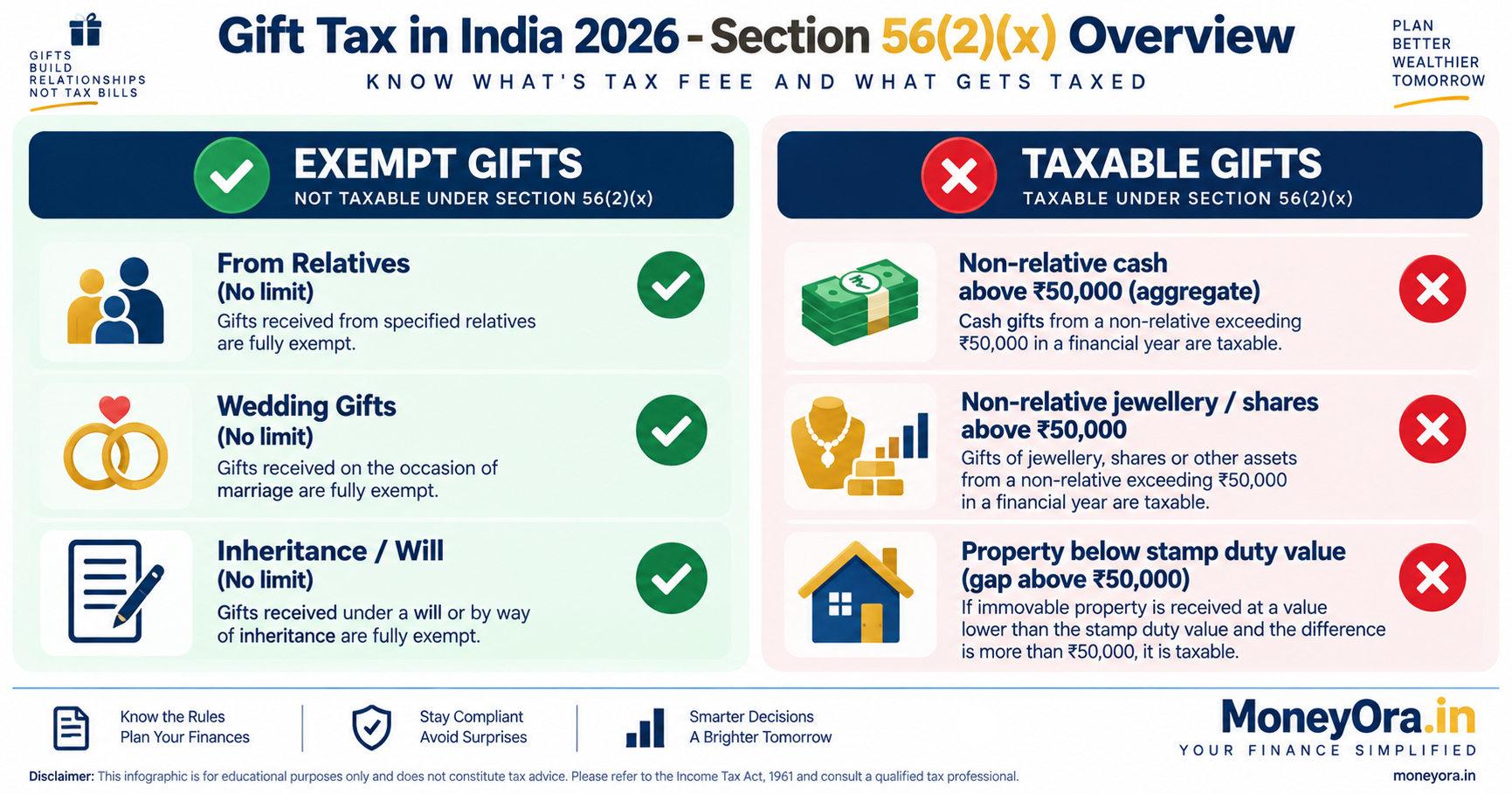
- Gift tax in India 2026 follows Section 56(2)(x) of the Income Tax Act. Gift tax in India no longer has its separate act since 1998.
- If a non‑relative gives you a gift that’s more than Rs 50,000 in a year gift tax in India will take the full amount at your income slab rate.
- Gifts from relatives such as parents, spouse, siblings, children are always exempt from gift tax in India no matter how much.
- Wedding gifts are fully exempt from gift tax in India no matter the amount or who gives them.
- A big change from April 1 2026: the limit for non‑cash gifts from an employer in gift tax in India rises from Rs 5,000 to Rs 15,000 each year under the Income Tax Rules 2026.
- Taxable gifts must appear on Schedule OS in the ITR‑2. Itr‑3 form for gift tax in India.
Every October as Diwali gets closer companies hand out gift hampers and family members send cash. Many people take these gifts without thinking about gift tax in India. Then in March people scramble to figure out how to declare a Rs 60,000 gift from a colleague or gold jewellery a friend gave at a wedding. This guide explains those issues in words updated for gift tax in India 2026 rules.
Here is the short answer before we go deeper. Gift tax in India is no longer a law. The Gift Tax Act of 1958 was ended in October 1998. The rules that now apply are inside the Income Tax Act in Section 56(2)(x). They tax gifts that a person receives. Whether a Diwali gift in India gets taxed depends on three factors who gave it how much it was and what form it was, in.
How Gift Tax in India 2026 Actually Works
Under Section 56(2)(x) of the Income Tax Act a gift received by an individual or HUF can be treated as income from sources. The recipient pays the tax not the giver. The government introduced this provision in 2004 (. Strengthened it significantly in 2017) because the abolition of the standalone Gift Tax Act had opened a loophole where large sums moved between parties tax-free under the label of gifts.
Three categories of assets are covered by these gift tax rules, in India. First is money meaning cash, cheque, bank transfers and digital payments. Second is property, which includes shares, securities, jewellery, archaeological collections, paintings, drawings, sculptures and works of art. Third is immovable property meaning land and buildings. Each category has its valuation method and threshold test.
The Rs 50000 Aggregate Trap Most People Get Wrong
The most misunderstood aspect of gift taxation in India is that Rs 50000 is a flip point, not a deduction. If you receive Rs 20000 in October from one friend and Rs 35000 from another friend in December, your total non-relative gifts in that financial year are Rs 55000. The entire Rs 55000 becomes taxable. Not just the Rs 5000 excess. The full amount.
This aggregate rule applies only to gifts from non-relatives. Gifts from specified relatives are exempt with no cap at all, no matter how large. So the question you need to answer first is always whether the person giving you the gift qualifies as a relative under the Income Tax Act.
Who Counts as a Relative Under Section 56(2)(x)
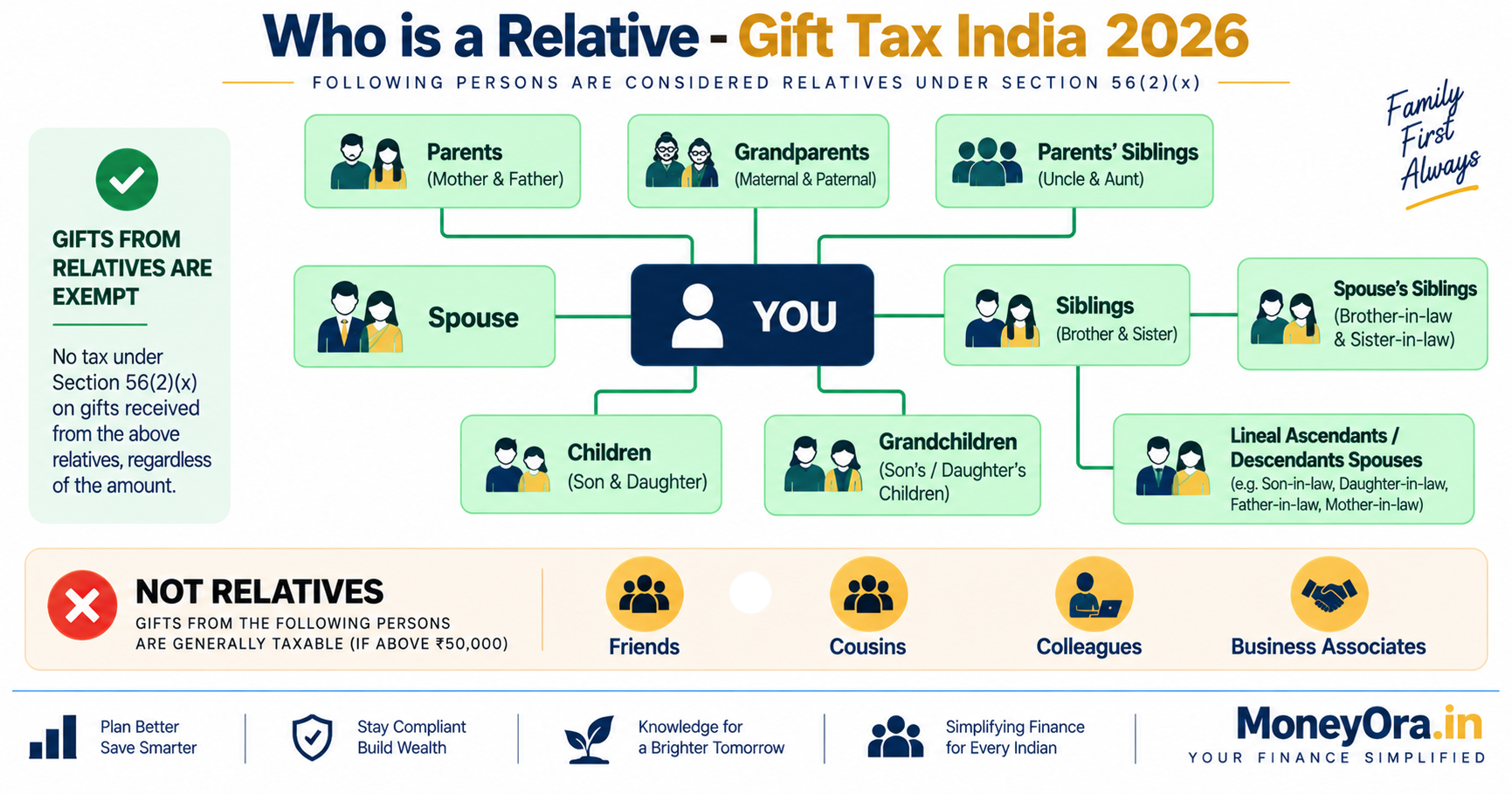
The Income Tax Act uses a precise legal definition of relative under Section 56(2)(x). Gifts from the following persons are always tax-free regardless of amount.
- Your spouse
- Your brother or sister
- Your spouse’s brother or sister
- Brother or sister of either of your parents
- Any lineal ascendant or descendant (so parents, grandparents, great-grandparents, and children, grandchildren)
- Lineal ascendant or descendant of your spouse
- Spouse of any of the above persons
- In the case of an HUF, any member of the HUF
Notice who is missing from this list. Friends, colleagues, cousins, uncles and aunts who are not your parent’s siblings, and business associates are not relatives under this definition. A gift from your cousin can become taxable if it pushes the total above Rs 50000 for the year.
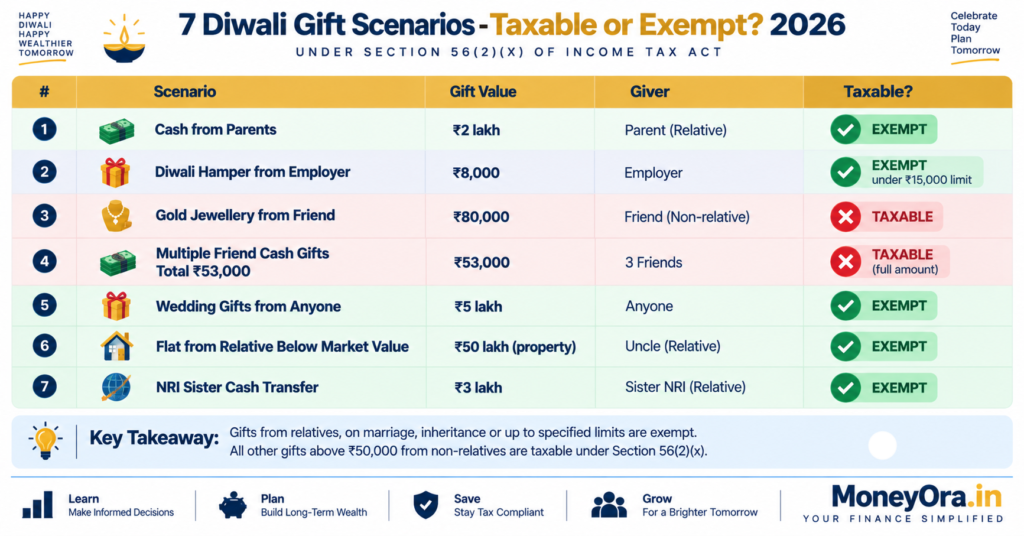
7 Scenarios: Is Your Diwali Gift Taxable in 2026?
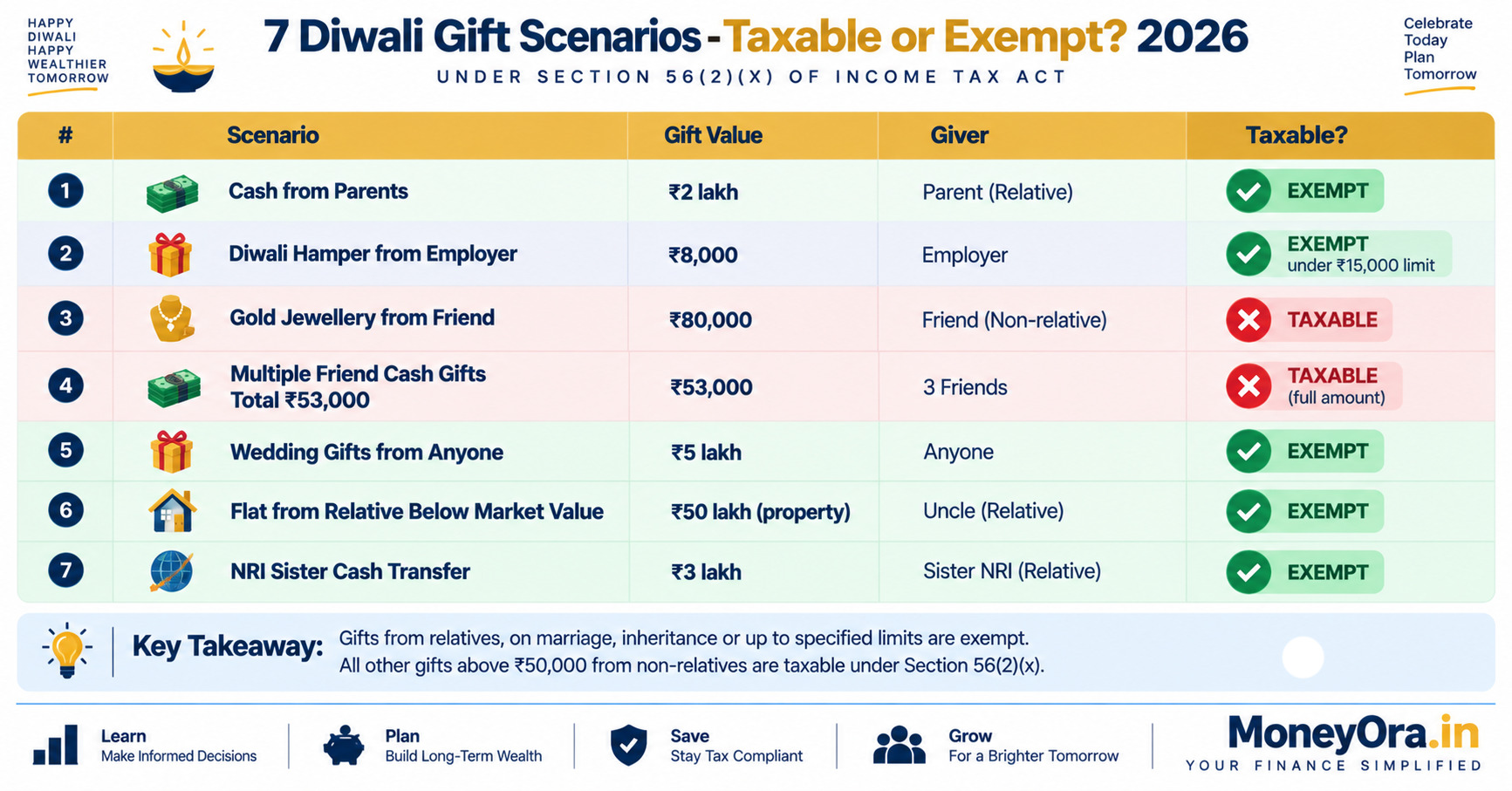
Let us walk through seven situations people face during Diwali season. Each one tests a part of how gift taxation works in India in 2026.
Scenario 1: Cash Gift from Parents on Diwali
Your father transfers Rs 2 lakh to your account on Diwali as a gift. Is it taxable?
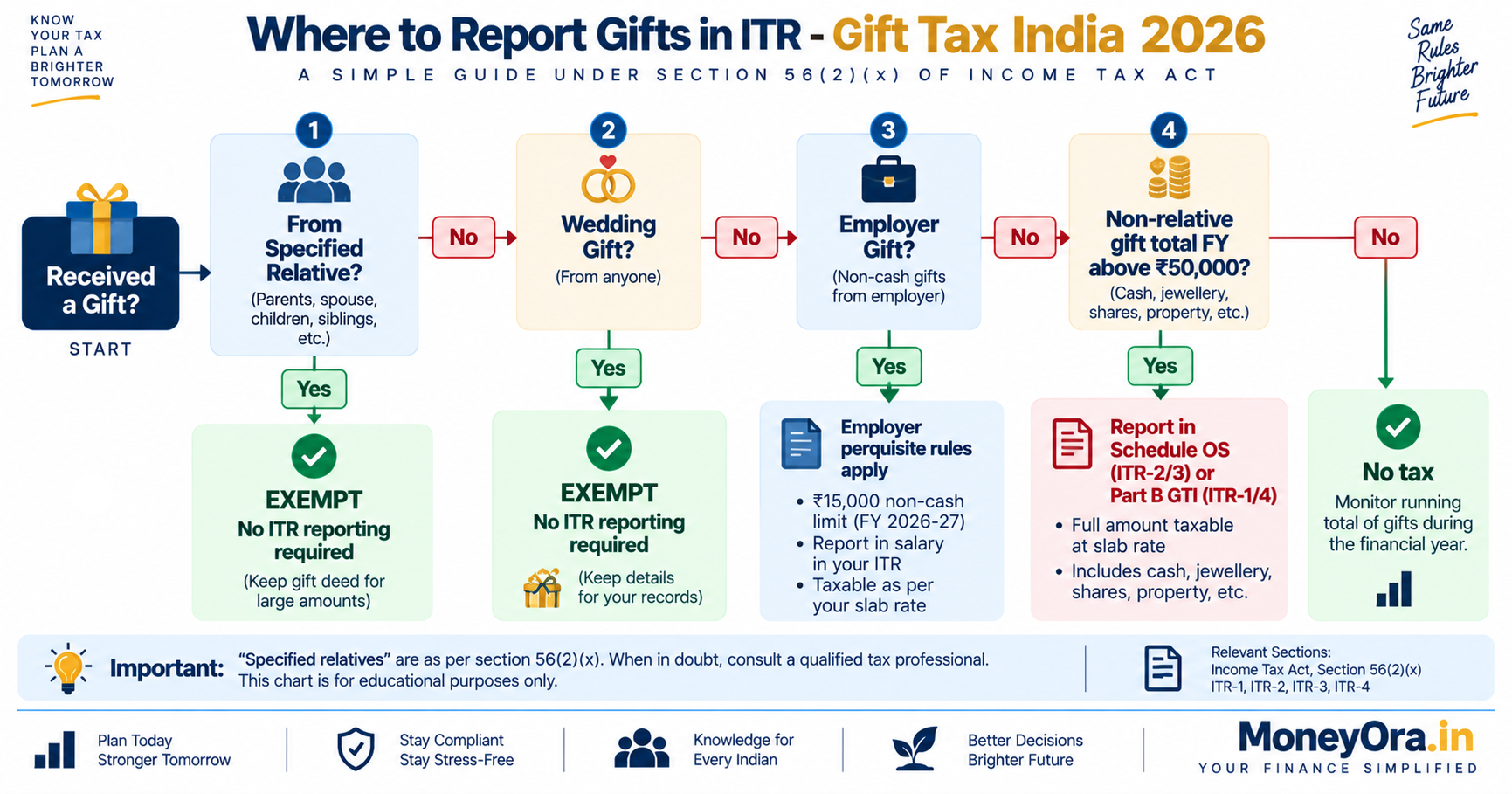
No it is not taxable. Parents are considered relatives under Section 56(2)(x) of the Income Tax Act. Gifts from parents are fully tax-free no matter how large the amount. You can receive Rs 50 lakh from your parents. Still pay no gift tax in 2026 There is one thing to remember documentation. If the amount is large keep a signed gift deed or a written note. The Annual Information Statement (AIS) will show this money entering your account. The tax department may ask about it later so you should be ready with proof.
Scenario 2: Diwali Hamper from Your Employer Worth Rs 8000
Your company gives every employee a hamper worth Rs 8000 in October 2026. Is this taxable?
Yes this is where the new gift tax rules in India 2026 make a difference. The tax-free limit for -cash gifts from employers. Including hampers, vouchers and tokens. Has increased. Previously the limit was Rs 5000 per year From April 1 2026 this limit has been raised to Rs 15000 per financial year. So for the year 2026-27 the first Rs 15000 in non-cash gifts from your employer is fully tax-free.
In this case the hamper is worth Rs 8000. It is below the Rs 15000 limit. If your employer does not give you any non-cash gifts during the year this hamper is tax-free If the total value of all non-cash gifts from your employer exceeds Rs 15000 in the year then the entire amount above Rs 15000 becomes taxable. It will be added to your salary as a perquisite.
One thing many people get wrong: cash bonus gifts from employers are not the same. These are fully taxable as salary income under Section 17(1). There is no Rs 15000 exemption for cash. Only non-cash gifts. Like hampers, vouchers or tokens. Get the exemption.
Scenario 3: Gold Jewellery from a Friend on Diwali
A friend gives you gold jewellery Rs 80000 on Diwali. You have not received any gifts from non-relatives this year. Is this taxable?
Yes this gift is taxable. Gold jewellery is a listed property and the gift tax rules apply. Your friend is not a relative. The fair market value of the jewellery is Rs 80000. This is more than the Rs 50000 threshold. So the entire Rs 80000 is taxable as income from sources. It will be added to your income. Taxed at your applicable slab rate.
For example if your tax rate is 20% you will have to pay Rs 16000 in income tax on this gift. You will also have to pay cess. This is why it is important to know who is giving you gifts and what kind of gifts they are. Gifts from non-relatives, above Rs 5000 are not tax-free.
Scenario 4: Multiple Cash Gifts from Different Friends
Three different friends give you cash gifts during season. Rs 20000 from one Rs 15000 from another Rs 18000 from a third. Total Rs 53000. Taxable?
Yes. This is exactly the aggregate trap. Each individual gift looks small and well under Rs 50000 The law looks at the total from all non‑relatives in the financial year. Rs 53000 exceeds Rs 50000. The entire Rs 53000 is taxable at your slab rate, not the Rs 3000 excess.
This is why keeping a running tally of gifts received from non‑relatives during the year is important for anyone who receives festival gifts regularly.
Scenario 5: Wedding Gift from Anyone Including Strangers
You get married in November 2026. Receive Rs 5 lakh in cash and jewellery as wedding gifts. Some come from relatives some from colleagues some from family friends you barely know. Any of it taxable?
None of it is taxable. The Income Tax Act specifically exempts gifts received on the occasion of your marriage regardless of the value or the identity of the giver. This exemption has no ceiling and no relative requirement. A stranger can give you Rs 10 lakh at your wedding. It remains tax‑free in your hands.
The key word is occasion. The exemption covers gifts received on the occasion of marriage meaning around the time of the wedding event itself. Gifts received months later would not automatically qualify.
Scenario 6: Flat Transferred by Relative Below Market Value
Your uncle transfers a flat to you for Rs 20 lakh. The stamp duty value of the property is Rs 50 lakh. Your uncle is not in the relative list (he is your fathers brother not your parent). Is the difference taxable?
This is one of the gift tax in India 2026. For property received without adequate consideration (below market value) the provision in Section 56(2)(x) applies a two‑step test. The difference between stamp duty value and actual consideration must exceed Rs 50000. In this case Rs 50 lakh minus Rs 20 lakh equals Rs 30 lakh, which obviously exceeds Rs 50000. Second stamp duty value must exceed 110% of the purchase price.
In your scenario uncle is the parents brother which makes him your relative under the definition above. So this transfer is actually exempt If it had been a business associate or a distant acquaintance the Rs 30 lakh difference would be added to your income from other sources and taxed at your slab rate.
This is the scenario most competitor articles completely miss. Property gift taxation is a calculation from cash gift taxation. Valuation matters and using stamp duty value (not market value or the actual transfer price) is what the law prescribes.
Scenario 7: Gift from NRI Relative Living Abroad
Your sister living in Canada transfers Rs 3 lakh to your bank account as a Diwali gift. Taxable?
Your sister is a relative. The gift is fully exempt from income tax in India regardless of her status. NRI status does not change the exemption. FEMA (Foreign Exchange Management Act) governs the remittance side. Gift tax in India 2026 under Section 56(2)(x) looks only at the relationship between donor and recipient, for the relative exemption test.
The New Employer Gift Rule That Most Sites Still Get
Many websites, such as Business Standard, ClearTax and Bajaj Finserv still say that the limit for an employer gift is Rs 5000. That figure is old. Under the Income Tax Rules 2026 which start on 1 April 2026 for the year 2026‑27 the limit has tripled to Rs 15000.
KPMG’s analysis of the Income Tax Rules 2026 shows that the value of any gift, voucher or token from an employer is treated as zero if the total value in the tax year does not exceed Rs 15000. This rule works for both the old and the new tax regimes so it is one of the perquisite changes that helps every employee no matter which regime they choose.
The structure of the gift matters. Nexdigm’s detailed review confirms that the change from Rs 5000 to Rs 15000 applies to all gifts, vouchers and tokens. Your employer can give you a voucher, a birthday gift card and a performance recognition token during the year. Long as the total stays within Rs 15000 all of it is tax‑free. Once the total goes over Rs 15000 the excess is treated as a perquisite added to your salary and taxed. The employer must record this in Form 130 the TDS certificate that replaces Form 16.
Cash gifts from employers no matter how they are named are still 100 % taxable as salary. A Rs 2000 cash Diwali bonus is fully taxable. A Rs 14000 gift voucher is not. That is why structuring employee gifts correctly is so important.
If your company’s HR team is still using the Rs 5000 rule they are following outdated rules that ended on 1 April 2026. The new Rs 15000 limit applies from FY 2026‑27 onward. For FY 2025‑26, which ended on 31 March 2026 the Rs 5000 limit was still, in effect.
The Clubbing Provision That Applies Even to Exempt Gifts
Here is something most gift tax articles in India skip entirely. Receiving an exempt gift from a relative does not automatically mean the income from that gifted money is also tax-free. Section 64 of the Income Tax Act introduces what is called clubbing of income.
If you gift money to your spouse, the income your spouse earns by investing that money gets added back to your income and taxed in your hands. The gift itself was tax-free. The return on the gifted amount is not. This applies to gifts to minor children as well. Income earned on assets transferred to a minor child is clubbed with the income of the parent who transferred them (the higher-earning parent).
So if your husband gives you Rs 10 lakh in cash on Diwali as a gift, that transfer is fully exempt because he is a specified relative under Section 56(2)(x). But if you invest that Rs 10 lakh in a fixed deposit earning Rs 70000 per year, that Rs 70000 interest gets added to your husband’s taxable income, not yours. Clubbing does not apply to gifts made for adequate consideration or in connection with a separation agreement, but it does apply to most direct spousal and minor-child transfers.
Planning a large gift to your spouse for tax reasons? Our FD calculator can help you model returns on fixed deposits, and understanding the clubbing impact up front will save you an uncomfortable surprise at filing time.
Movable Property: The 7 Categories the Tax Department Watches
Not all non-cash, non-property gifts are taxable under Section 56(2)(x). The law specifically lists seven categories of movable property where gift taxation applies. If a gift does not fall into these categories, it generally does not attract tax even from a non-relative.
The seven categories are shares and securities, jewellery, archaeological collections, drawings, paintings, sculptures, and any work of art. A television set or smartphone gifted by a friend on Diwali does not fall into any of these seven categories and is therefore not taxable under Section 56(2)(x), regardless of its value. This is a genuine gap in competitor content and something most taxpayers do not know.
However cash and cheque gifts from non-relatives are always in scope because money is a separate category with no exclusion list. The movable property carve-out applies only to specific asset classes, not to all physical goods.
Property Gifts: Valuation Rules and the 110 Percent Test
When someone transfers immovable property to you at a price below its stamp duty value gift tax in India 2026 may apply to the difference. The rule covers two situations. First property received without any consideration at all. Second property received for inadequate consideration where you paid less than the stamp duty value.
For property received without consideration the taxable amount is the full stamp duty value if it exceeds Rs 50000. For property received below stamp duty value there is a tolerance threshold. If stamp duty value does not exceed 110% of the actual purchase price no tax arises. Only when stamp duty value is more than 110% of what you paid is the difference treated as income from other sources.
This tolerance band exists because stamp duty valuations are sometimes higher than actual transaction values due to government circle rates, and the law does not want to penalize every minor discrepancy. But a significantly underpriced transfer to a non-relative will trigger gift tax in India 2026 on the difference.
Thinking about property investment alongside gift planning? Our EMI calculator can help you model loan costs if you plan to purchase property rather than receive it as a gift.
How to Report Gift Tax in India 2026 in Your ITR
Taxable gifts go into Schedule OS (Income from Other Sources) when you file ITR-2, ITR-3, ITR-5, or ITR-6. If you file ITR-1 or ITR-4, taxable gifts are disclosed under Part B in the Gross Total Income section. The amount is then taxed at your applicable slab rate, exactly like any other income.
A significant change in AY 2026-27 filings is worth knowing. As FreeFincal first reported in June 2026, the exempt income schedule (Schedule EI) in the ITR now operates with predefined dropdown categories and no free-text narration field. Taxpayers who previously disclosed exempt relative gifts voluntarily under the Others category in Schedule EI no longer have a straightforward way to do so. This change was visible in the ITR-2 validation rules released in May 2026 and applies across all ITR forms.
This does not change the tax treatment of relative gifts which remain fully exempt. But it does mean you cannot easily document them in the return itself the way you could before. For large gifts from relatives that show up as significant credits in your bank account keeping a proper gift deed and a written acknowledgment is now more important than ever because reconciling your AIS will require supporting documents if queried.
For employer gifts, the perquisite value (anything above Rs 15000 from FY 2026-27) is included in your Form 130 under salary. You do not report it separately as other income. Your employer handles the TDS calculation and you simply receive the correct figures in your salary TDS certificate.
Documentation You Need to Avoid Tax Notices
The Income Tax Department tracks high-value transactions through your Annual Information Statement. Large bank credits, property registrations, and even significant cash deposits get flagged and compared against your filed return. Without documentation, a large gift from a relative can look like unexplained income.
For cash gifts from relatives a simple gift deed signed by both parties specifying the relationship the amount and the date is sufficient. For large amounts having the transfer go through banking channels rather than cash is strongly recommended. Bank-to-bank transfers create a paper trail that is much easier to explain during any future inquiry.
For wedding gifts, maintaining a basic register noting the giver, their relationship, and the approximate value is good practice for significant amounts. You do not need to report wedding gifts in your ITR since they are exempt, but a register helps if a query arises.
For movable property gifts like jewellery from non-relatives, getting a proper valuation from a registered valuer on or near the date of the gift helps establish the fair market value that would be used for tax calculation.
What the AIS Will Show and How to Match It
Your Annual Information Statement for FY 2026-27 will capture significant cash deposits, bank transfers, and property registrations linked to your PAN. If a relative transferred Rs 5 lakh to your account during Diwali, that credit will appear in your AIS. If you do not reconcile it properly in your return, you may receive a notice asking you to explain the credit.
The right approach is to keep the gift deed ready and, if queried, respond through the e-filing portal with the documentation showing the donor’s relationship to you and the exempt nature of the gift. The ITR itself now has limited space to proactively disclose this, but the response process for AIS mismatches is straightforward if your documentation is in order.
Planning to invest gifted funds? Our SIP calculator can show you how a lump sum received as a gift might grow in a mutual fund over time. And our PPF calculator is worth checking if you are thinking about parking a parent’s gift in a long-term government scheme.
Inheritance and Will-Based Transfers: Always Exempt
Gifts received through a will or through inheritance are fully exempt from gift tax in India 2026 with no upper limit. This exemption applies regardless of the relationship between the deceased and the recipient and regardless of the asset type. So property, jewellery, cash, or shares received as inheritance do not trigger any gift tax liability.
However, when you subsequently sell an inherited asset, capital gains tax applies at that point. The cost of acquisition for capital gains purposes is the original cost paid by the previous owner (or the fair market value as of April 1, 2001, whichever is higher for assets acquired before that date). Selling an inherited flat is not tax-free. The gain from the sale is taxable. Only the inheritance itself is gift-tax-free.
HUF Gifts and Special Cases
Hindu Undivided Families (HUFs) as entities are also covered by Section 56(2)(x). An HUF can receive gifts from its members (who are treated as relatives of the HUF under the definition), and such gifts are exempt. Gifts received by an HUF from non-members are subject to the same Rs 50000 aggregate test as for individuals.
Gifts made from an HUF to its members are also generally not taxable in the member’s hands since members qualify as relatives. This makes HUF structures relevant for gift planning in family-owned businesses, though the anti-avoidance provisions mean structuring purely for tax savings without genuine family business intent can attract scrutiny.
The 3 Decisions That Determine Your Gift Tax Liability
Before you accept any significant gift run through these three checks to understand your gift tax in India 2026 position.
First is the giver a specified relative? If yes the gift is fully exempt with no further questions needed and documentation is your only concern for large amounts.
Second if the giver is not a relative what is the running total of all non-relative gifts received in this financial year? If your total so far including this new gift will stay below Rs 50000 you are still in the clear. The moment it crosses Rs 50000 the entire accumulated amount from non-relatives in that year becomes taxable.
Third what form does the gift take? Cash and seven categories of movable property are in scope. A consumer gadget gifted by a friend is not one of the seven listed categories and generally is not taxable as a gift. Wedding gifts are unconditionally exempt regardless of form. Employer gifts have their own separate Rs 15000 non-cash limit.
Understanding these three filters will handle 95% of the situations most people encounter around taxable gifts in India. The remaining 5% involves property gifts below market value, NRI transfers, HUF structures, and large jewellery gifts, all of which benefit from consulting a qualified CA before the transfer takes place rather than after.
Common Mistakes to Avoid When Filing Gifts in ITR 2026
One mistake is treating Rs 50000 as a deduction. It is a threshold. Cross it. The full amount is taxable not just the portion above Rs 50000. This misunderstanding is worth repeating because it is genuinely the expensive error people make around gift taxation in India.
Another mistake is confusing wedding gifts for the bride and groom with gifts given at a wedding reception to parties. The exemption applies to the person being married not to guests who happen to receive gifts at someone Wedding event.
A third mistake is assuming employer cash bonuses are covered by the Rs 15000 limit. They are not. The Rs 15000 exemption covers non-cash gifts, vouchers and tokens. A Diwali cash envelope from your employer is fully taxable as salary from the rupee.
Finally many people still cite the old Rs 5000 employer gift limit. That limit is gone from FY 2026-27 onwards. The new Rs 15000 limit applies from April 1 2026. If you are reading this before planning gift strategies for employees or before accepting a gift from your employer use Rs 15000 as your threshold not Rs 5000.
Calculating your tax liability after including a taxable gift? Our income tax calculator lets you add income from sources and see the precise tax impact at your slab rate.
Gift tax in India 2026 catches people off guard primarily because the rules are scattered across two sections of the Income Tax Act with treatment, for different asset types donor relationships and occasions. Knowing the picture before the festival season starts is genuinely the most tax-efficient gift you can give yourself.
Use the calculators on MoneyOra.in to model your investment and tax scenarios after accounting for any gifts you plan to give or receive this Diwali.
Use the free calculators now on MoneyOra.in
Related MoneyOra Tools and Guides
- SIP Calculator to grow a lump sum gift through monthly mutual fund investments
- FD Calculator to calculate returns if you park a cash gift in a fixed deposit
- PPF Calculator to plan long-term wealth from a parent’s gift using PPF
- EMI Calculator to model home loan costs if gifted money supplements a property purchase