
Health Insurance Waiting Period India 2026: 4 Types and 5 Ways to Reduce
- Health insurance waiting period India 2026 rules are governed by the IRDAI (Insurance Products) Regulations 2024 and the IRDAI Master Circular dated May 29 2024.
- IRDAI capped the PED waiting period at a maximum of 36 months (3 years) from April 1 2024. No insurer can go higher.
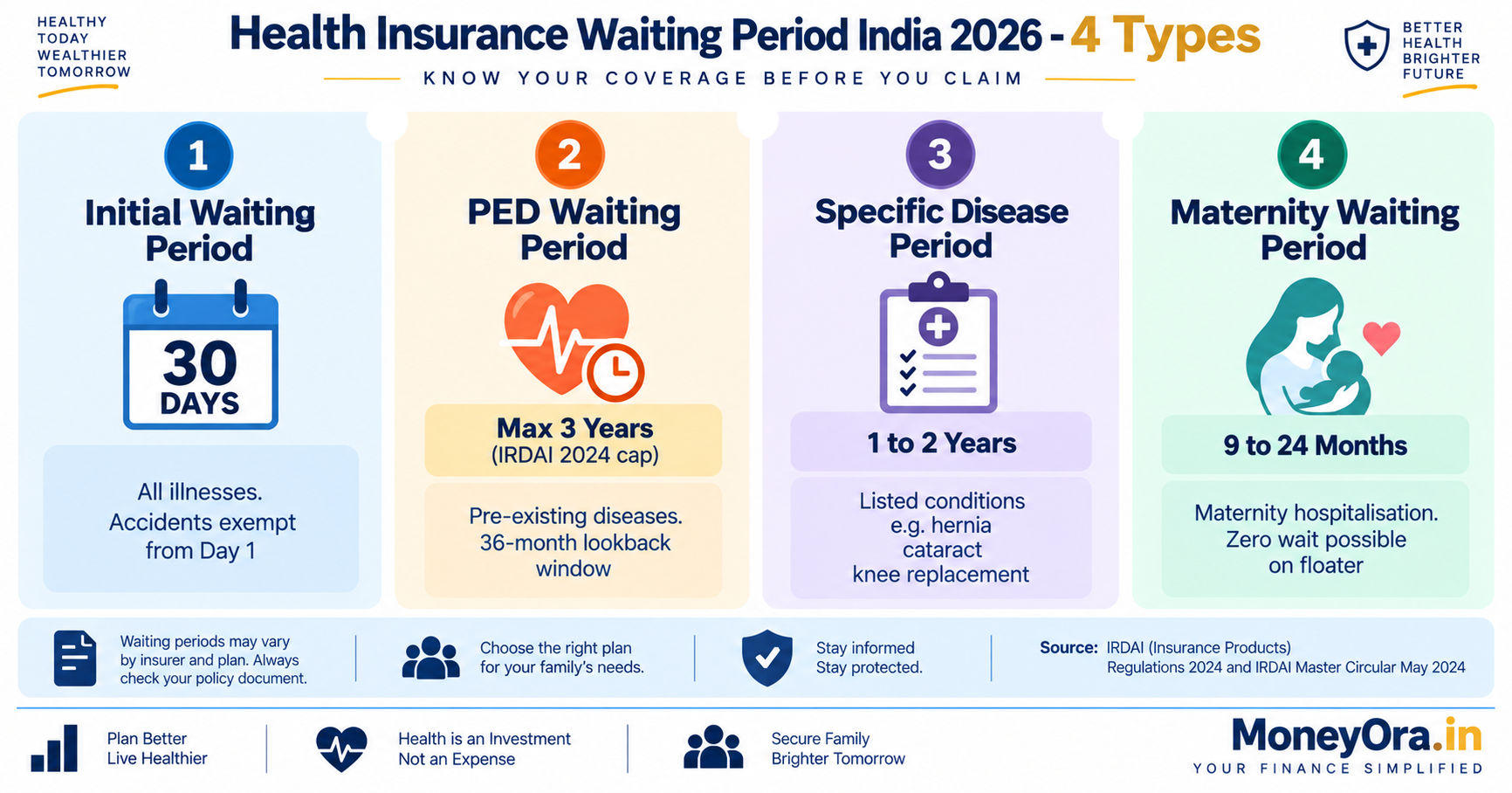
- There are 4 types of waiting periods in Indian health insurance and each works differently.
- Accidents are covered from Day 1 under all policies regardless of any waiting period.
- Portability lets you carry forward waiting period credit when you switch insurers.
- Leaving a job triggers a 30-day window to port your group coverage to individual. Missing it resets everything to zero.
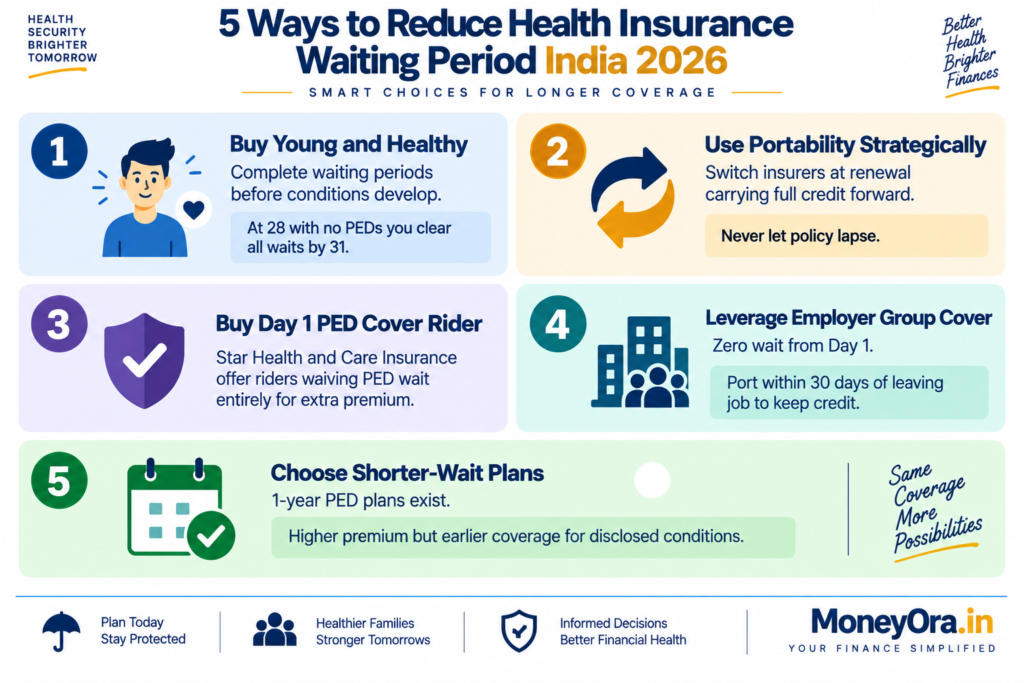
- 5 proven ways to reduce waiting periods include porting, buying early, Day 1 PED riders, group coverage, and choosing shorter-wait plans.
Most people research premium costs and sum insured when buying health insurance. Very few read the waiting period clauses until a claim gets rejected. That rejection letter arriving at the worst possible time is how most Indians learn that their policy did not cover them the way they thought it did. This guide covers the complete picture of health insurance waiting period India 2026 rules, updated for IRDAI’s April 2024 and May 2024 regulatory changes that most insurer websites still have not reflected accurately.
The short version first. Every health insurance policy in India imposes waiting periods before certain conditions are covered. These are not hidden clauses. They are disclosed in the policy document. But the rules governing them changed significantly in 2024 and understanding what changed and what it means for your policy right now is the entire point of this article.
What Is a Waiting Period in Health Insurance
A waiting period in health insurance is the span of time after your policy starts during which the insurer will not pay claims for specific conditions or procedures. You pay premiums during this time. You are technically insured Certain illnesses are not payable yet. The policy document specifies which conditions are affected. For how long.
This is different from an exclusion. An excluded condition is never covered regardless of how you hold the policy. A waiting period condition becomes covered once the clock runs out provided you have renewed continuously without any break in coverage. Letting a policy lapse beyond the grace period can reset waiting periods. Cost you years of accumulated credit.
These waiting period rules draw from two regulatory documents. The first is the IRDAI (Insurance Products) Regulations 2024 effective April 1 2024. The second is the IRDAI Master Circular, on Health Insurance Business (Reference No. IRDAI/HLT/CIR/MISC/77/05/2024) published May 29 2024. Together they replaced 55 circulars and set the current framework every insurer must follow.
The 4 Types of Health Insurance Waiting Period in India 2026
Understanding the health insurance waiting period in India 2026 means learning four separate clocks. Each clock ticks for conditions and lasts for different lengths of time.
Type 1: The Initial Waiting Period (30 Days)
Every new health insurance policy has a health insurance waiting period of 30 days that starts on the day the policy begins. During that health insurance waiting period you cannot claim for any hospitalisation that’s due to an illness. This rule applies even if you have no pre‑existing conditions and if you are buying health insurance for the time at age 25 and you are in perfect health.
The single exception to this 30‑day health insurance waiting period is accidents. If you are hospitalised because of an accident on Day 3 of your policy the insurer must pay. This is not a grace from the insurer. It is a rule set by the IRDAI that applies to every health insurance policy in India without any exception.
People often confuse the initial health insurance waiting period with the grace period. These are completely different. The grace period, which is usually 15 to 30 days, after your premium date is the window to renew your existing policy without losing coverage continuity. The initial health insurance waiting period applies at the very start of a brand new policy.
Type 2: The PreExisting Disease (PED) Waiting Period
This is the health insurance waiting period India 2026 that causes the confusion and the most claim rejections. A pre-Existing Disease is any condition that was diagnosed, treated or for which you received advice within 36 months before the date your policy started. Hypertension, diabetes, thyroid disorders, asthma, high cholesterol and obesity-related conditions commonly fall here.
Under the IRDAI (Insurance Products) Regulations 2024 from April 1 2024 the maximum PED waiting period any insurer can impose is 36 months or 3 years. Before this regulation some insurers were setting PED waiting periods of 48 months or 4 years. That is no longer permitted.
This regulatory cap is one of the important changes in recent Indian health insurance history and most competitor articles on this topic have not updated their content to reflect it. If you are reading an article that says “PED waiting period can be 2 to 4 years” without noting that the IRDAI has now capped the maximum at 3 years from April 2024 that article is working from rules. As BusinessToday reported in April 2024, the 3-year cap applies to both renewing policies.
Some insurers have gone below the 3-year cap. SBI Super Health Platinum runs a 2-year PED wait on some variants. A handful of plans offer 1-year PED periods. The 3-year limit is the ceiling not a standard. Always check your policy document rather than assuming the maximum applies.
One more point that no competitor article makes clearly. The PED definition itself changed in the 2024 regulations. Under the framework a condition you received advice about within 48 months before buying the policy was classified as a PED. The new framework reduced that lookback window, from 48 to 36 months. So a condition treated than 36 months before your policy start date is no longer considered pre-existing under IRDAIs current definition.
Type 3: The Specific Disease Waiting Period
This type of health insurance waiting period in India 2026 confuses people the most because it applies to conditions you did not have when you bought the policy. Even if you were perfectly healthy at policy inception certain named conditions carry a waiting period regardless of your health history.
The reason is actuarial. These are growing often predictable conditions that are not emergencies and that people might delay buying insurance for specifically in anticipation of needing them soon. Insurers protect against this buying behaviour by attaching specific waiting periods to listed conditions.
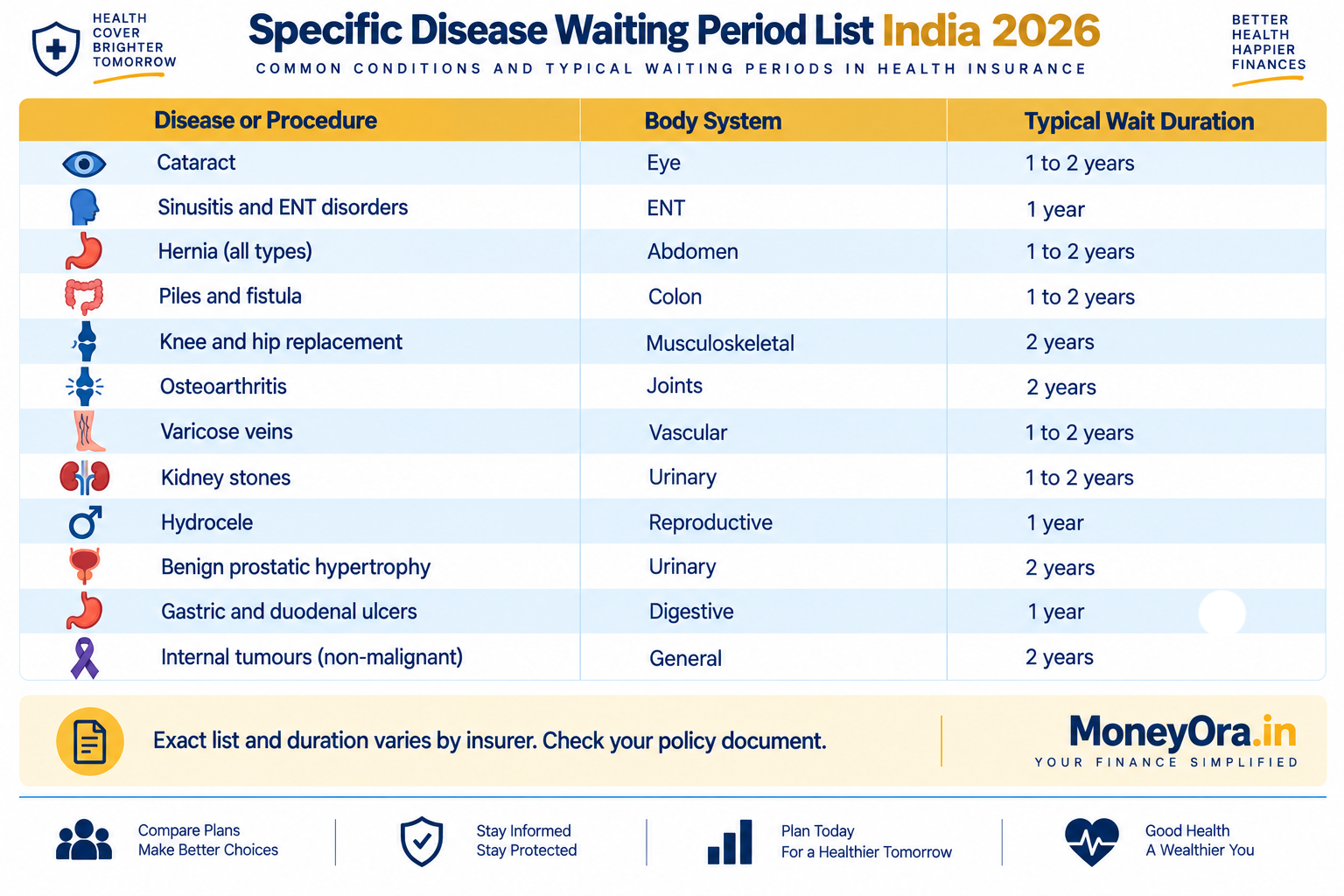
The specific disease waiting period typically runs from 1 to 2 years though it can extend to 3 years for some conditions and some insurers. Under IRDAIs Master Circular the maximum allowed is 36 months. As confirmed by the the IRDAI’s own health department guidance, this period covers specified diseases and treatments contracted during the policy period except those arising due to an accident.
Here is the complete list of conditions typically covered by the disease waiting period in Indian health insurance. No competitor article publishes this list in full. It is exactly what most readers need to check before buying.
- Cataract and other eye procedures (glaucoma treatment, retinal disorders in some plans)
- Hernia (all types including umbilical, hiatal and ventral)
- Piles (haemorrhoids) and related anorectal conditions such as fistula-in-ano and fissure
- Sinusitis and related ENT disorders including tonsillitis, adenoidectomy and tympanoplasty
- Knee replacement and joint replacement surgery including hip replacement
- Osteoarthritis and musculoskeletal degenerative conditions
- Varicose veins
- Kidney stones (urolithiasis)
- Hydrocele
- Benign hypertrophy
- Gastric and duodenal ulcers
- Internal tumours, cysts and polyps (unless malignant)
- Hysterectomy, for fibromyoma or menorrhagia (unless malignant)
- Gout and rheumatism
If a condition appears on both the disease list and your PED list (say you had kidney stones treated within 36 months before buying the policy) the longer of the two waiting periods applies. This is the rule that catches people out often.
Type 4: The Maternity Waiting Period
Maternity benefits in health insurance usually have a waiting period. This waiting period is often between nine months and two years from the start of the policy. Many standard individual health plans set a maternity waiting period of twenty‑four months. Therefore a couple who purchases health insurance after deciding to become pregnant might discover that maternity hospitalisation is not covered during the first two years.
A product feature that many independent guides overlook is that some insurers, such as Niva Bupa and Aditya Birla Health Insurance give zero or reduced maternity waiting periods. This happens when both spouses are covered under a floater policy from day one of the policy. This feature is a rider or design choice, not a rule and it differs from plan to plan. If maternity coverage is important it is wise to ask about this feature when comparing family floater plans.
Under the 2026 rules the maternity waiting period framework also includes coverage, for babies. Most policies that offer maternity benefits automatically cover the newborn from day one of birth. Some plans also cover vaccinations long as the mother’s policy has finished its maternity waiting period.
The Employer Group Insurance Gap That Can Cost You Dearly
This is the single most financially dangerous transition in Indian health insurance and it receives barely a paragraph in competitor articles. Understanding it completely is worth more than understanding every other aspect of health insurance waiting period India 2026 rules combined, because it affects every salaried employee who has ever relied on employer coverage.
When your employer provides group health insurance, you are covered from Day 1 with zero waiting period. Pre-existing diseases are covered immediately. The 30-day initial waiting period does not apply. Specific disease waiting periods do not apply. You walk in on your first day of employment and if you need hospitalisation that evening for a condition you have had for years, it is covered.
This is genuinely excellent coverage. The problem is what happens when you leave the job.
Group insurance coverage ends when your employment ends. The moment you resign, retire, or are made redundant, your group policy stops. If you then purchase an individual health insurance policy, you are treated as a new policyholder. A fresh 30-day initial waiting period starts. A fresh PED waiting period of up to 3 years starts for every condition you disclose. A fresh specific disease waiting period starts for every condition on the list.
Years of protected coverage disappear overnight.
IRDAI has created one mechanism to soften this transition. Under current regulations, individual health insurers must accept a group policyholder who applies for individual coverage within 30 days of leaving their employer, and they must give credit for the waiting period served under the group policy. Miss that 30-day window and this protection is gone. You cannot claim it later. The clock resets and the waiting period starts from scratch on the day you buy your individual policy.
If you are planning to leave a job, buy your individual health policy before your last working day or within that 30-day window. This is one of the most actionable pieces of advice in this entire guide and it is not prominent in any competitor article.
How Health Insurance Portability Lets You Keep Your Waiting Period Credit
Health insurance portability lets you keep your waiting period credit when you switch insurers. This means you do not have to start over with waiting periods when you move from one insurer to another. The waiting period credit is the important benefit that follows you when you port your policy.
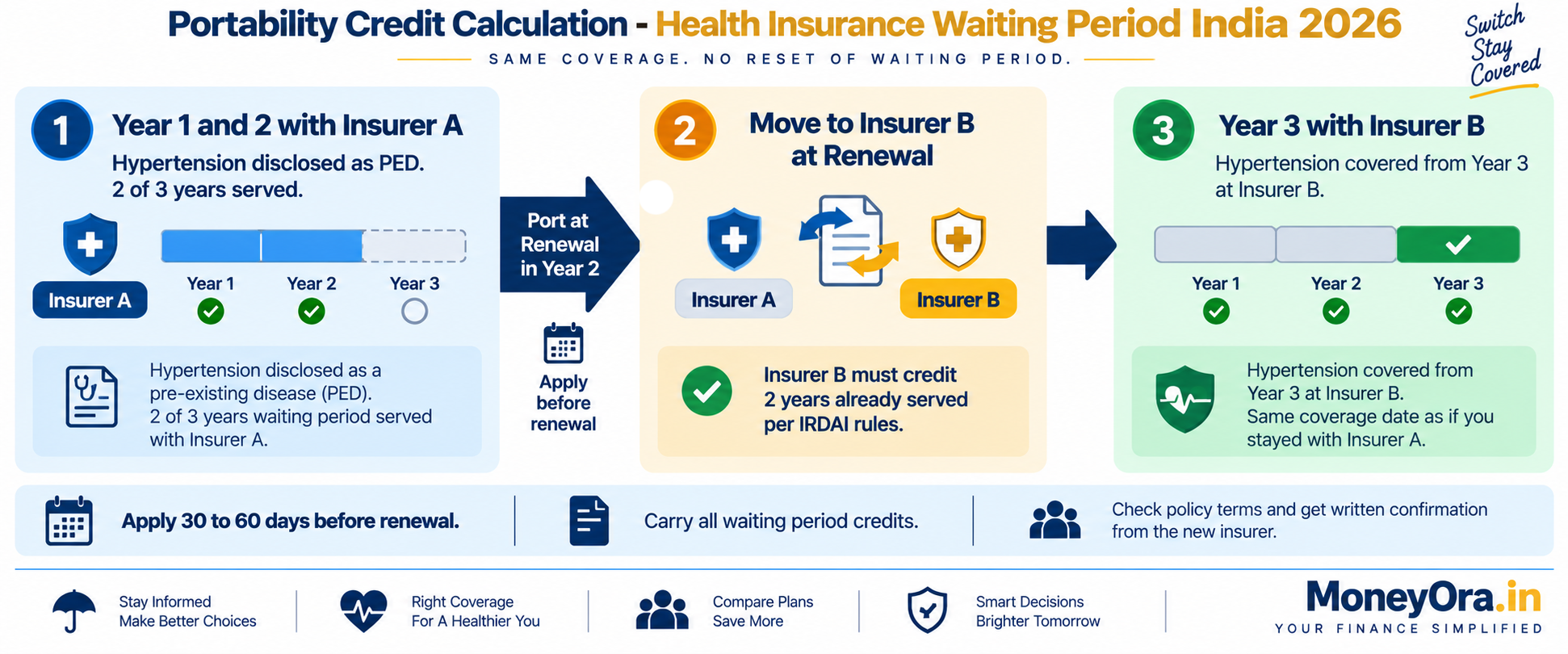
Here is how the calculation works in practice. There is no example in any independent article that shows this clearly so here’s one.
Suppose you bought a health insurance policy from Insurer A in September 2023. That policy has a 3-year – existing disease (PED) waiting period for hypertension. By September 2025 you have completed 2 years of that waiting period. You decide to port your policy to Insurer B at renewal in September 2025. Insurer B must give you credit for the 2 years you already served. You only need 1 year of PED waiting period with Insurer B before your hypertension is covered. Your coverage for hypertension begins in September 2026. This is exactly when it would have started if you had stayed with Insurer A.
This rule is confirmed by Ditto Insurance’s IRDAI portability guide, It follows the Master Circular on Protection of Policyholders Interests 2024. The waiting period credit applies to the pre-existing disease waiting period the disease waiting period the initial 30-day waiting period and the moratorium period. The no-claim bonus also carries forward when you port.
The timeline for portability is strict. You must apply to port between 30 and 60 days before your policy’s renewal date. Your old insurer must send your policy. Claim history through the Insurance Information Bureau (IIB) portal, within 7 working days. The new insurer has 15 days to review all documents and make a decision. Starting the process 45 days before renewal gives you time to meet both deadlines.
One important rule: If your old insurer delays sharing your data your coverage continues without interruption. The Insurance Regulatory and Development Authority of India (IRDAI) rules protect you. You cannot lose coverage because of an administrative delay that is not your fault.
The Moratorium Period: Your Long-Term Protection Against Claim Denial
Along with the waiting period rules IRDAI added another protection named the Moratorium Period. According to the 2024 regulations if you have kept health insurance without interruption for 60 months that is five years an insurer is not allowed to refuse a claim by saying you did not disclose a condition when you first enrolled except if the claim’s based on proven fraud.
This change shortens the 96‑month or eight‑year Moratorium Period. The shorter period works well for policyholders. After five years of coverage even if you renew or move to another insurer you have almost complete protection, against rejections that are based on non‑disclosure.
The Moratorium Period credit also continues when you transfer coverage. If you have had insurance for four years with Insurer A and then move to Insurer B you need one more year with Insurer B to reach the five‑year Moratorium Period threshold.
5 Ways to Reduce Your Health Insurance Waiting Period in India 2026
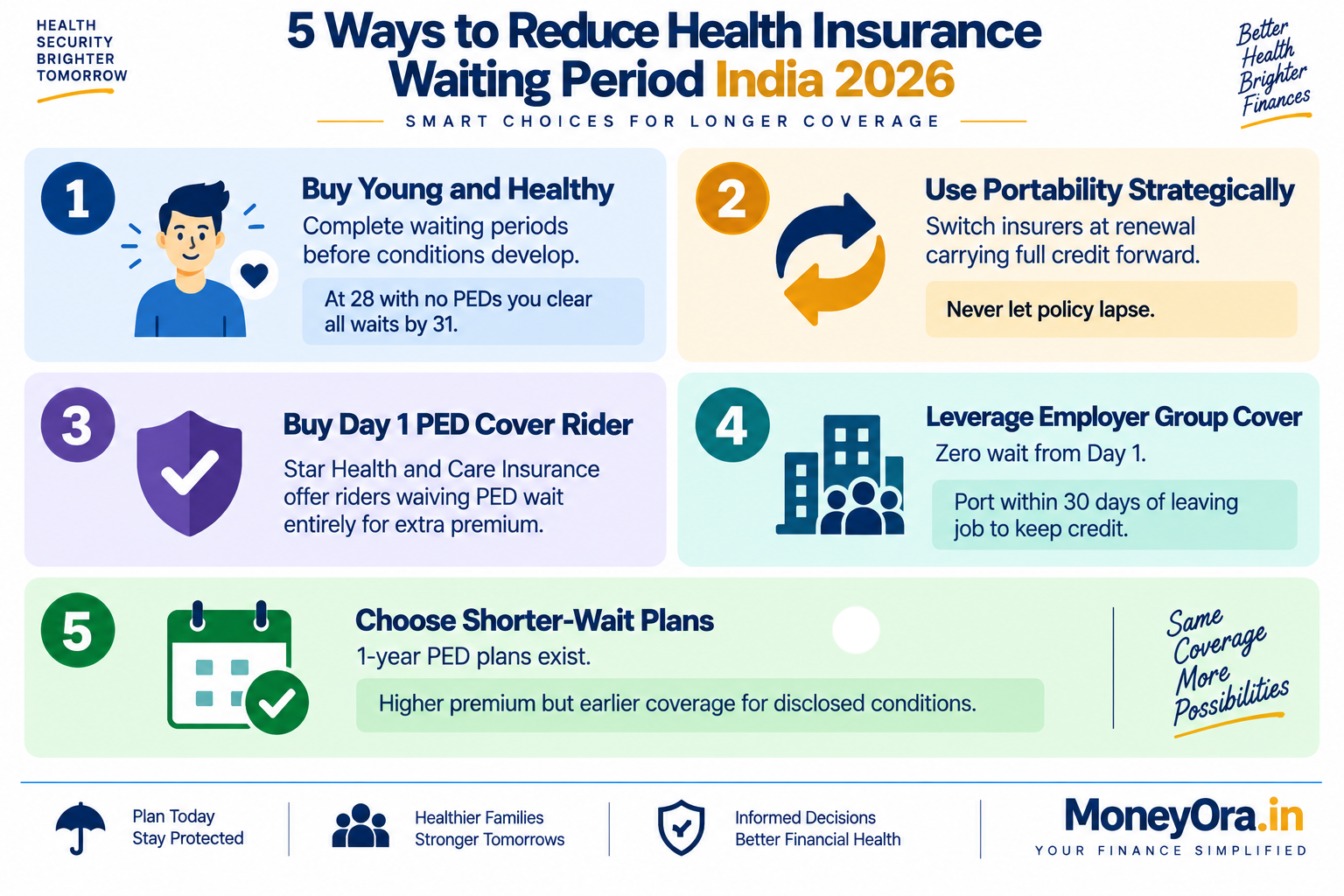
Knowing that you have a health insurance waiting period India 2026’s useful. Knowing how to reduce your health insurance waiting period is what actually protects your finances. These five approaches are based on IRDAI rules and real product features.
1: Buy Health Insurance Early as Possible
This sounds obvious but the math behind it is important. A 28‑year‑old with no health conditions who buys a policy today will finish the 3‑year PED waiting period by age 31. If that same person delays buying until age 35 when they may have developed hypertension or early‑stage diabetes they start the 3‑year wait at 35. Are not covered for those conditions until 38. Buying healthy means finishing waiting periods for conditions you do not yet have so that by the time you develop them the waiting period is already behind you.
The same logic applies to sum insured. Increasing sum insured later in life sometimes triggers a waiting period on the incremental amount. Buying cover early avoids this complication.
2: Use Health Insurance Portability
If your current insurer offers inadequate benefits portability allows you to upgrade without restarting your health insurance waiting period clock. Port at renewal carry your accumulated credit forward. Gain access to better plans, higher sum insured or more extensive coverage. As covered in the portability section the credit transfers for PED waiting, specific disease waiting, initial waiting and moratorium period.
The key is continuity. Never let your policy lapse. A single break, beyond the grace period can reset your health insurance waiting period credit to zero. Undo years of accumulated protection.
3: Buy a Day 1 PED Cover Rider
Some insurers offer riders or add-ons that waive the PED waiting period entirely in exchange for a higher premium. Star Health Insurance and Care Insurance (formerly Religare Health) are among the insurers that have offered such riders in recent years. These are sometimes called Instant Cover or PED Day 1 Cover add-ons.
The financial case for buying one depends on the cost of the rider versus the probability of needing care for your PED during the waiting period and the cost of that care. For someone with well-managed diabetes or hypertension who is unlikely to need hospitalisation in the next 1 to 2 years, the rider premium may not be worthwhile. For someone with a condition that is unstable or that recently required hospitalisation, paying the extra premium for Day 1 cover is likely worth calculating carefully.
Our FD calculator can help you model what the rider premium paid over 3 years costs versus keeping that amount invested and self-insuring the gap. Running those numbers before deciding is useful.
4: Leverage Employer Group Coverage Intelligently
The zero-waiting-period benefit of employer group insurance is genuinely valuable. Use it actively rather than treating it as a passive backstop. If your group policy provides Rs 5 lakh coverage and you also hold an individual policy, schedule elective procedures requiring hospitalisation for conditions on the specific disease waiting period list while those conditions are fully covered under your group policy.
The critical planning action is the 30-day transition window covered earlier. Before leaving any employer, buy your individual policy or arrange portability within 30 days to carry your waiting period credit across. Most financial planners do not emphasise this and most employees discover the rule only after the window has closed and the restart penalty has already hit.
5: Choose Plans with Shorter Built-In Waiting Periods
Not all plans impose the maximum waiting periods allowed by IRDAI. Some plans are structured with shorter PED waits (1 to 2 years instead of 3), shorter specific disease waiting periods, or waived initial waiting periods under certain conditions. These plans typically carry slightly higher base premiums to compensate for the shorter exclusion windows.
When comparing plans, look specifically at the PED waiting period, the specific disease waiting period duration, and the maternity waiting period if applicable. The premium difference between a 3-year PED plan and a 1-year PED plan of similar coverage may be justified if you are buying later in life or already have managed conditions that you are disclosing at inception.
Our SIP calculator can show you the opportunity cost of paying extra premium over 5 years for a shorter-wait plan versus the cost of delayed coverage if a PED claim arises during a standard 3-year wait. The numbers often make the decision clearer than instinct does.
What Changes for Your Existing Policy After April 2024
If you bought a health insurance policy before April 1 2024 with a 4-year PED waiting period the good news from IRDAI’s 2024 regulations is that the 3-year cap applies to your policy as well on renewal. You do not need to buy a new policy to benefit from the updated rules.
At your next renewal after April 1 2024, your policy terms automatically align with the new maximum of 36 months. If you had a 4-year PED clause and have already served 3 years you are already covered from your next renewal. If you served only 2 years under the old 4-year clause the clock does not become 3 years retroactively. The regulation caps the maximum going forward. Work through your renewal date and check your updated policy schedule to confirm the new terms.
The moratorium period has also changed for existing policyholders. If you have been continuously insured for 5 years or more as of today you are already past the new moratorium threshold and your insurer cannot deny claims based on non-disclosure (except fraud) regardless of when the regulation changed.
What Counts as a Pre-Existing Disease Under 2024 Rules
The 2024 regulations changed the PED definition meaningfully and this is a gap in almost every competitor article on this topic. Under the old framework, a condition diagnosed, treated, or for which you received advice within 48 months before buying insurance was classified as a pre-existing disease. The new framework reduced that lookback window to 36 months.
In practical terms, this means a condition you were treated for 40 months before buying your policy is no longer classified as a PED. It may still face a specific disease waiting period if it appears on the list, but the longer PED waiting period does not apply. For someone who had a kidney stone procedure 37 months ago and is now buying a policy, that historical treatment is no longer a pre-existing disease under current IRDAI rules.
This is worth checking for your own health history when buying a new policy or when renewing. Conditions that previously required disclosure as PEDs may no longer qualify under the updated 36-month lookback window.
How the Accident Exception Works in Practice
Every health insurance policy in India has to cover hospitalisation right from Day 1. That is not a feature of the product. That requirement comes from an IRDAI mandate written in the Master Circular on Health Insurance Business dated May 29 2024. Cited in product guidelines. Accident coverage has no waiting period no 30‑day period no PED period, no specific disease period.
What does this mean in practice? If you buy a policy today and slip on the stairs tomorrow needing surgery the insurer must pay. If you have diabetes and a diabetic foot condition needs emergency surgery after a cut the accident component will be covered from Day 1 even though diabetes is a PED.
The area that creates disputes is the line, between an accident and a sudden condition. A first‑time heart attack is not called an accident even though it happens suddenly and without warning. If you have a history of hypertension or other cardiac risk factors and buy a policy today a heart attack that occurs during the PED waiting period will probably be seen as coming from your pre‑existing condition not as an accident. Know this distinction before you assume that emergency hospitalisation will be automatically covered.
Questions People Ask About Health Insurance Waiting Period India 2026
Based on current Google search data, these are the questions most frequently asked about health insurance waiting period rules in India right now. Each is answered directly because the article structure here intentionally avoids the FAQ format that clusters answers at the bottom where most readers never scroll.
People ask whether changing jobs resets the health insurance waiting period. The answer is yes if you do not act within the 30-day group-to-individual porting window covered above. Your employer’s group insurance and any new employer’s group insurance are separate policies. Between jobs, if you buy an individual policy without using the 30-day credit transfer window the PED clock starts fresh.
People ask whether they must disclose all conditions when buying health insurance. Yes. Non-disclosure of a condition that you know about is grounds for claim rejection and potentially policy cancellation. After the 5-year moratorium period the insurer cannot deny claims based on non-disclosure (except fraud) but getting to that 5-year threshold requires the policy not be voided for fraudulent non-disclosure before then.
People ask whether premium goes up after the waiting period ends. No. Completing a waiting period does not trigger a premium increase. However if you file claims your no-claim bonus is affected and renewal premiums across the industry do typically increase with age regardless of claims.
People ask whether they can claim for maternity if they got pregnant before buying insurance. Maternity waiting periods mean that hospitalisation for a pregnancy that began before the waiting period ended is not covered. Some plans do cover pregnancies that start after policy inception even if the delivery happens before 9 or 12 months of coverage, but this is plan-specific and requires careful reading of the policy document.
People ask what happens if they are hospitalised during the specific disease waiting period for a condition that then turns out to be malignant. Most policies treat malignant tumours separately from benign conditions even if they involve the same organ. A tumour that turns out to be cancerous is typically covered under the general cancer coverage provisions rather than the benign-tumour specific disease waiting period. However, this depends entirely on the specific policy wording and should be confirmed with your insurer in writing before a claim situation arises.
Reading Your Policy Document Before You Need It
Health insurance policy documents in India can be very long. They often have 60 to 90 pages. Most people never read them fully There is one part that matters the most. The waiting period schedule. This section is usually found within the 15 pages under Definitions or General Conditions. It tells you how you need to wait before certain illnesses are covered.
Look closely at three things when you review any policy you own or are thinking of buying. First check the waiting period for PreExisting Diseases also known as PED. As per the rules from IRDAI after April 2024 this waiting period should not go beyond 36 months. If your policy was issued before April 2024. Still shows a 48-month waiting period contact your insurer. Ask whether the new rule applies at your renewal. This could save you time and money later.
Second look at the list of diseases covered. Not all insurers use the list. Some conditions may appear on one policy but not another. Make sure the list matches what you expect. Pay attention to both the exclusions and the inclusions.
Third if maternity coverage is important to you check the maternity waiting period carefully. Look for any rules like zero-wait maternity benefits tied to floater policies. These provisions can make a difference especially if you’re planning a family.
If anything about the waiting period sounds unclear don’t guess. Ask your insurer for written confirmation. Get it in writing. This will help you avoid surprises when you file a claim. A policyholder who understands their document is protected. One who doesn’t might face denials.
Are you thinking about how health insurance premiums fit into your financial plan? Our SIP calculator can help you see what happens if you set aside the premium amount over time. This way you can compare coverage options with long-term wealth building goals. If you’re considering a health insurance purchase along with other financial plans like a home loan our EMI calculator helps you check if paying for a top-up health plan fits your monthly budget.
The bigger picture about health insurance waiting periods in India in 2026 is positive. In years IRDAI has made the rules much more consumer-friendly than they were in the decade before. The cap, on PED waiting periods now stands at 36 months. Moratorium periods have been reduced. Portability rights have expanded, including a 30-day window to switch from group insurance to plans Insurers must cover accidents from Day 1.
All these changes help policyholders.. Only if you know them. Understanding your policy document gives you protection. Don’t wait until a claim comes up to find out what’s missing.
Related MoneyOra Tools and Guides
- SIP Calculator to model wealth building alongside your insurance premium commitments
- FD Calculator to compare rider premium cost versus self-insuring the PED gap
- EMI Calculator to see how a top-up health plan premium fits alongside loan repayments
- PPF Calculator to plan long-term tax-saving investments that build a health emergency corpus