

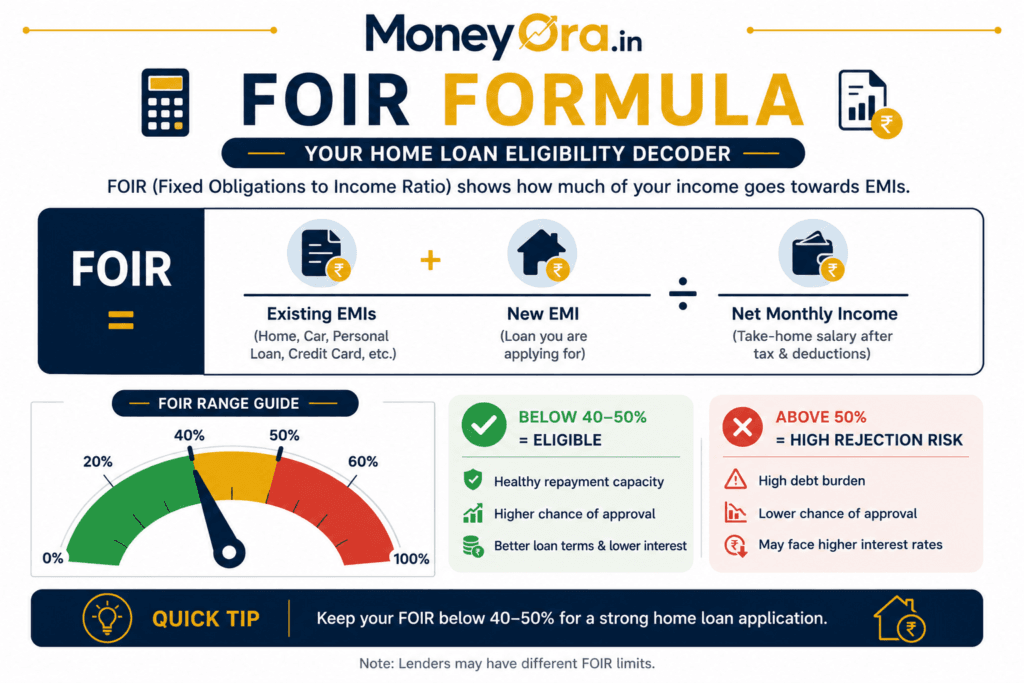
You’ve found a personal loan at 10.5% interest, but the bank sanctions only ₹2.8 lakh when you needed ₹5 lakh. Or you get a rejection email with no clear reason. Or you apply to three banks at once and find your CIBIL score has dropped 25 points without getting a single approval.
All three of these situations come down to the same problem — not understanding how personal loan eligibility is actually calculated before applying. Most people assume their salary alone determines the loan amount. Banks are running four independent checks simultaneously, and failing even one of them limits or kills your application.
This guide breaks down exactly how personal loan eligibility works in India in 2026 — the formulas banks actually use, salary-wise amounts, bank-wise comparisons, employer category impact, and seven specific actions you can take right now to improve your eligibility before the next application. Use MoneyOra’s Personal Loan EMI Calculator alongside this guide to cross-check the EMI for any loan amount before you commit.
Personal Loan Eligibility 2026
- Personal loan eligibility depends on four simultaneous checks: FOIR, salary multiplier cap, CIBIL score, and employer category. Pass all four to get the best amount and rate.
- FOIR (Fixed Obligation to Income Ratio) must stay below 50% for most lenders after adding the new EMI. Even a 750+ CIBIL score won’t save you if FOIR exceeds this threshold.
- Salary multipliers in India range from 10× to 24× net monthly income in 2026, depending on your employer category and income band.
- Personal loan rates range from 8.75% to 29.95% p.a. in mid-2026. On a ₹3 lakh loan over 3 years, that gap means ₹41,856 in interest vs over ₹1.3 lakh — for the same loan amount.
- Every ₹1,000 reduction in existing EMIs increases eligibility by ₹20,000+. Clearing a small loan before applying is one of the fastest eligibility boosters available.
What Personal Loan Eligibility Actually Means
Personal loan eligibility is the maximum loan amount a bank will sanction based on your income, existing EMIs, CIBIL score, employer profile, age, and repayment capacity. It determines both how much you can borrow and the interest rate you’ll be offered.
That definition sounds simple. The reality is more nuanced. Your personal loan eligibility isn’t a single number — it’s the lower of two separate calculations the bank runs simultaneously:
- FOIR-based eligibility — How much EMI can you handle given your income and existing obligations?
- Multiplier-based eligibility — What is the maximum loan a bank will give as a multiple of your monthly income?
Whichever number is lower becomes your sanctioned amount. You could have a salary that qualifies for ₹8 lakh under the multiplier method but only ₹4.5 lakh under FOIR if you already carry significant EMIs. The bank takes ₹4.5 lakh. “compare borrowing against your PF withdrawal for urgent needs”
How Banks Calculate Personal Loan Eligibility — The FOIR + Multiplier Formula
Most loan applications are assessed using two methods simultaneously. Here’s exactly how each works.
Method 1 — FOIR (Fixed Obligation to Income Ratio)
FOIR is the percentage of your net monthly income already committed to fixed obligations — existing loan EMIs, credit card minimum dues, and sometimes rent.
Most banks approve personal loans only when post-loan FOIR stays at or below 50% for incomes up to ₹50,000/month. FOIR threshold rises to 55–65% for higher income brackets.
Worked example — Rahul, Pune, 2026:
- Net monthly salary: ₹55,000
- Existing home loan EMI: ₹12,000
- Car loan EMI: ₹5,500
- Credit card minimum due: ₹2,500
- Current FOIR: (₹20,000 ÷ ₹55,000) × 100 = 36.4%
- Bank’s FOIR ceiling: 50% → Maximum allowable EMI = ₹27,500
- Available EMI headroom for new loan: ₹27,500 − ₹20,000 = ₹7,500
- At 12% interest over 5 years: ₹7,500/month supports approximately ₹3.3 lakh loan
Method 2 — Salary Multiplier Method
Banks also apply a maximum cap expressed as a multiple of your net monthly income. This acts as an absolute ceiling regardless of your FOIR.
| Employer Category | Multiplier Range | Example: ₹50,000 Salary |
|---|---|---|
| Government / PSU employees | 18×–24× | ₹9–12 lakh |
| MNC / Listed Fortune-500 company | 15×–20× | ₹7.5–10 lakh |
| Cat-A private employer (large listed) | 12×–18× | ₹6–9 lakh |
| Cat-B / Mid-size private employer | 10×–14× | ₹5–7 lakh |
| Cat-C / Unlisted / Small employer | 8×–12× | ₹4–6 lakh |
The personal loan eligibility amount is the lower of the FOIR-based calculation and the multiplier-based cap. This is the number banks offer you — and understanding both methods tells you which one is limiting you and how to fix it.
Verify the monthly EMI impact of any sanctioned amount using MoneyOra’s EMI Calculator before accepting a loan offer.
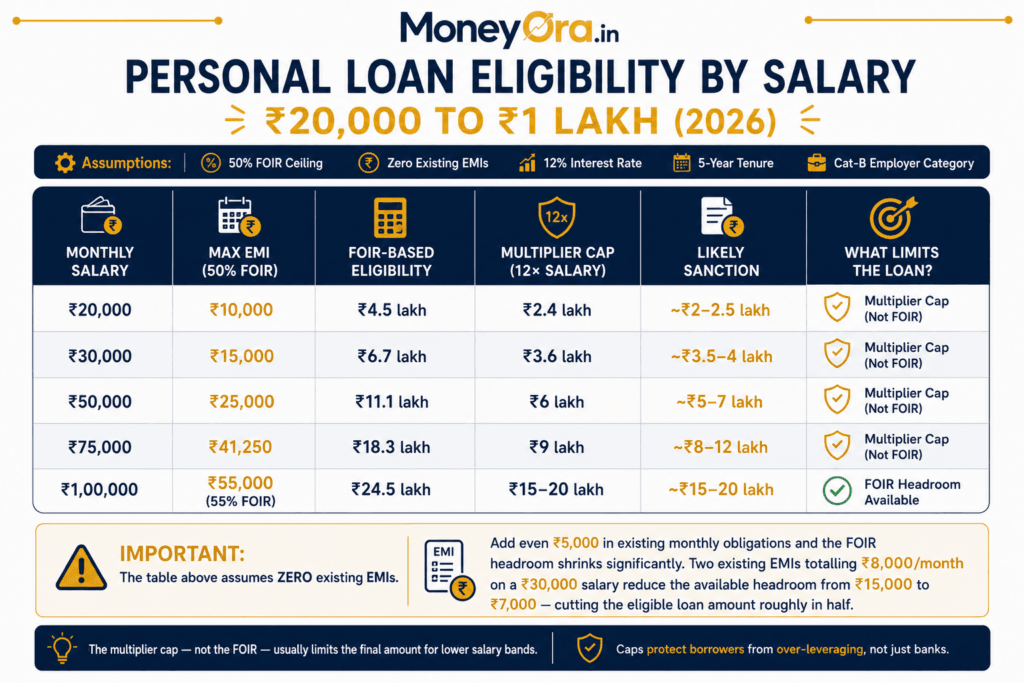
Personal Loan Eligibility by Salary — ₹20,000 to ₹1 Lakh (2026)
Here’s what the personal loan eligibility calculation actually produces across the most common salary brackets in India. Assumptions: 50% FOIR ceiling, zero existing EMIs, 12% interest rate, 5-year tenure, Cat-B employer category unless stated.
| Monthly Salary | Max EMI (50% FOIR) | FOIR-Based Eligibility | Multiplier Cap (12×) | Likely Sanction |
|---|---|---|---|---|
| ₹20,000 | ₹10,000 | ₹4.5 lakh | ₹2.4 lakh | ~₹2–2.5 lakh |
| ₹30,000 | ₹15,000 | ₹6.7 lakh | ₹3.6 lakh | ~₹3.5–4 lakh |
| ₹50,000 | ₹25,000 | ₹11.1 lakh | ₹6 lakh | ~₹5–7 lakh |
| ₹75,000 | ₹41,250 | ₹18.3 lakh | ₹9 lakh | ~₹8–12 lakh |
| ₹1,00,000 | ₹55,000 (55% FOIR) | ₹24.5 lakh | ₹15–20 lakh | ~₹15–20 lakh |
Notice how the multiplier cap — not the FOIR — usually limits the final amount for lower salary bands. For ₹20,000 salary, you could technically handle ₹4.5 lakh by FOIR alone, but no bank gives 20× your salary unsecured. The caps exist to protect borrowers from over-leveraging, not just to limit banks’ exposure.
5 Factors That Determine Your Personal Loan Eligibility
Factor 1 — Net Monthly Income (and what counts as income)
Banks use net take-home salary — not gross CTC. But not all salary components count equally toward personal loan eligibility:
- Fully counted: Basic salary, HRA (at most banks), fixed monthly allowances appearing on every payslip
- Partially counted: Variable pay (most lenders take 50% of previous year’s average), LTA (usually excluded as it’s infrequent)
- Excluded: Annual bonuses, incentives, reimbursements, and non-cash benefits
Factor 2 — CIBIL Score
The minimum CIBIL score threshold for personal loan eligibility varies by lender:
- SBI, government banks: 650–700+
- ICICI, HDFC, Axis: 720–750+
- Kotak Mahindra: 685+
- IDFC First: 710+ (salaried), 760+ (self-employed)
- NBFCs / fintech lenders: 600–650+, but rates are significantly higher
A 750+ CIBIL score doesn’t just increase approval odds — it unlocks better rates and higher multipliers. Two borrowers at the same salary but different CIBIL scores can be offered materially different loan amounts.
Factor 3 — Existing EMI Burden (FOIR calculation driver)
This is the single most underestimated factor. Most people know their salary. Few know their current FOIR. Before applying, add up every monthly obligation: home loan EMI, car loan EMI, personal loan EMIs, credit card minimum dues, and BNPL repayments. A 2026 RBI digital lending advisory flagged no-cost EMI purchases as a common hidden FOIR inflater — buying appliances on no-cost EMI before a loan application can silently push FOIR past the bank’s threshold.
Factor 4 — Age and Job Stability
Minimum age: 21 years. Maximum age at loan maturity: 60 years (some lenders allow 65). A 58-year-old can only take a 2-year loan maximum — which limits the eligible amount because the shorter tenure pushes up the required monthly EMI. Job stability also matters: most lenders require a minimum 1 year with current employer. Frequent job changes in the 12 months before application signal instability.
Factor 5 — Residential Status
Owning your residence gives a modest eligibility boost — it signals lower disposable income commitment and generally higher financial stability. Living in a rented home doesn’t disqualify you, but some lenders include rent payments in their FOIR calculation, which reduces the available headroom.
Employer Category — The Factor Nobody Warns You About in Personal Loan Eligibility
This is the part of personal loan eligibility that surprises most borrowers. Banks maintain internal employer lists, classifying them into tiers — typically Category A, B, and C. The classification is based on the employer’s financial stability, public profile, regulatory status, and historical loan repayment data from existing employees.
| Category | Employer Examples | Max Multiplier | Interest Rate Impact |
|---|---|---|---|
| Cat A+ | Central/State Govt, RBI, PSUs, listed MNCs | 20×–24× | Lowest rates available |
| Cat A | Large listed companies, banks, top IT firms | 15×–18× | Prime rates |
| Cat B | Mid-size private limited companies, startups with VC funding | 10×–14× | Standard rates |
| Cat C | Unlisted, small, or unverifiable employer | 8×–10× | Higher rates, stricter documentation |
Here’s the practical implication. Two people earning ₹60,000/month — one working at a listed IT firm (Cat A) and one at a small private firm (Cat C) — could be offered ₹9 lakh vs ₹5 lakh at very different interest rates. Same salary, same CIBIL score, dramatically different personal loan eligibility outcomes.
If your employer is Cat C or isn’t on the bank’s approved list at all, consider digital lenders and NBFCs that use different classification frameworks — they assess based on company size, incorporation status, and sector rather than a pre-approved list. Also explore MoneyOra’s Bank Calculators Hub to compare offers across lender types.
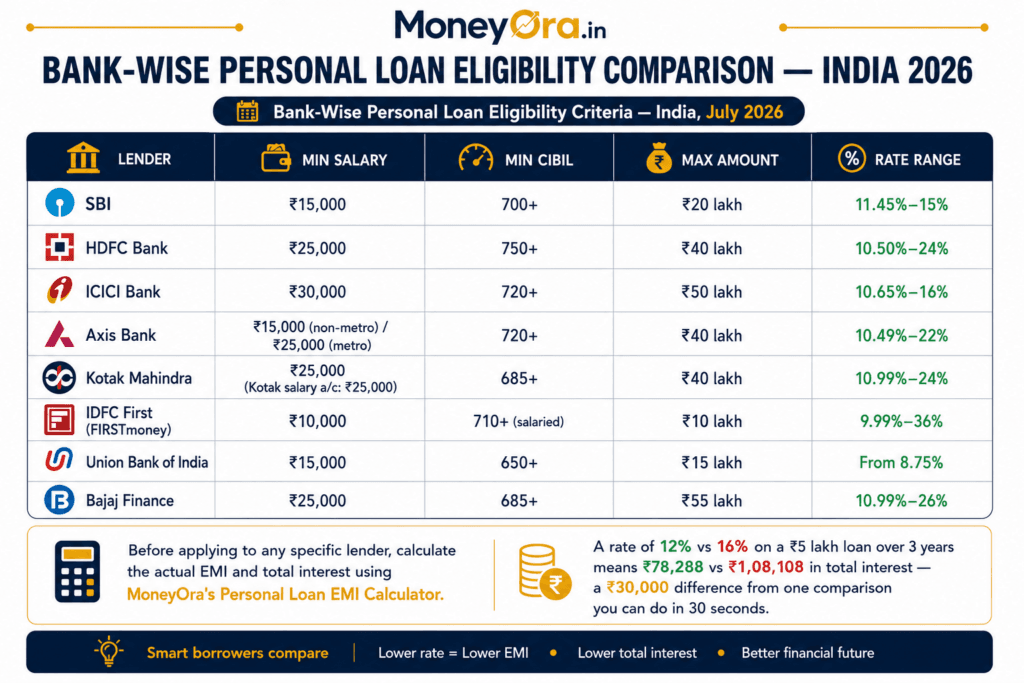
Bank-Wise Personal Loan Eligibility Comparison — India 2026
| Lender | Min Salary | Min CIBIL | Max Amount | Rate Range |
|---|---|---|---|---|
| SBI | ₹15,000 | 700+ | ₹20 lakh | 11.45%–15% |
| HDFC Bank | ₹25,000 | 750+ | ₹40 lakh | 10.50%–24% |
| ICICI Bank | ₹30,000 | 720+ | ₹50 lakh | 10.65%–16% |
| Axis Bank | ₹15,000 (non-metro) / ₹25,000 (metro) | 720+ | ₹40 lakh | 10.49%–22% |
| Kotak Mahindra | ₹25,000 (Kotak salary a/c: ₹25,000) | 685+ | ₹40 lakh | 10.99%–24% |
| IDFC First (FIRSTmoney) | ₹10,000 | 710+ (salaried) | ₹10 lakh | 9.99%–36% |
| Union Bank of India | ₹15,000 | 650+ | ₹15 lakh | From 8.75% |
| Bajaj Finance | ₹25,000 | 685+ | ₹55 lakh | 10.99%–26% |
Before applying to any specific lender, calculate the actual EMI and total interest using MoneyOra’s Personal Loan EMI Calculator. A rate of 12% vs 16% on a ₹5 lakh loan over 3 years means ₹78,288 vs ₹1,08,108 in total interest — a ₹30,000 difference from one comparison you can do in 30 seconds.
Personal Loan Eligibility for Self-Employed — 2026 Rules
Self-employed personal loan eligibility follows different rules. Without a fixed salary, lenders need alternative income proof and require higher stability signals.
What lenders assess for self-employed applicants
- Business vintage: Minimum 2–3 years in the same business (varies by lender)
- ITR proof: 2–3 years of Income Tax Returns — most lenders now require 3 years as of 2026
- Bank statements: 6–12 months showing consistent credit turnover
- GST registration: Increasingly required for business income verification
- CIBIL score: Minimum 750–760 at most private banks (stricter than salaried requirement)
Self-employed personal loan eligibility — worked example
Kavya runs a digital marketing consultancy in Hyderabad with ₹80,000/month average income shown in last 2 ITRs. Bank assessment:
- Usable income (50% of declared, conservative lender): ₹40,000
- FOIR ceiling (50%): ₹20,000 max EMI
- At 14% interest, 5 years: ₹20,000/month EMI supports ~₹8.3 lakh loan
- CIBIL score 760+, business vintage 4 years → eligible for ₹7–8 lakh
Self-employed borrowers are also offered NBFCs as alternatives when bank personal loan eligibility thresholds are too strict. NBFCs tend to be more flexible on documentation but compensate with higher interest rates — sometimes 4–8% above equivalent bank rates.
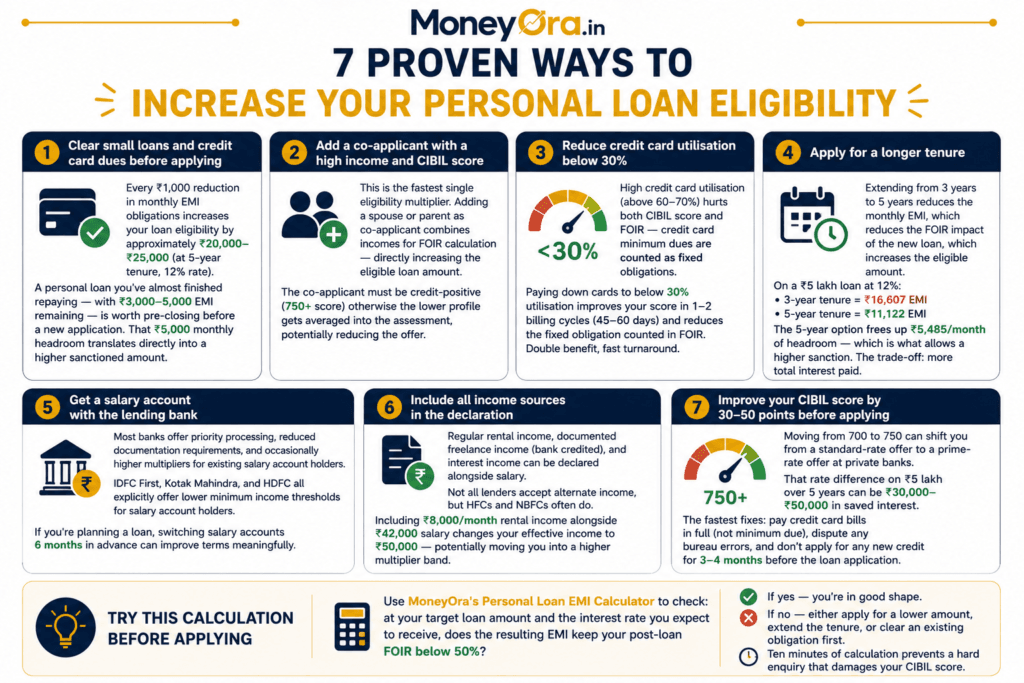
7 Proven Ways to Increase Your Personal Loan Eligibility
1. Clear small loans and credit card dues before applying
Every ₹1,000 reduction in monthly EMI obligations increases your loan eligibility by approximately ₹20,000–25,000 (at 5-year tenure, 12% rate). A personal loan you’ve almost finished repaying — with ₹3,000–5,000 EMI remaining — is worth pre-closing before a new application. That ₹5,000 monthly headroom translates directly into a higher sanctioned amount.
2. Add a co-applicant with a high income and CIBIL score
This is the fastest single eligibility multiplier. Adding a spouse or parent as co-applicant combines incomes for FOIR calculation — directly increasing the eligible loan amount. The co-applicant must be credit-positive (750+ score) otherwise the lower profile gets averaged into the assessment, potentially reducing the offer.
3. Reduce credit card utilisation below 30%
High credit card utilisation (above 60–70%) hurts both CIBIL score and FOIR — credit card minimum dues are counted as fixed obligations. Paying down cards to below 30% utilisation improves your score in 1–2 billing cycles (45–60 days) and reduces the fixed obligation counted in FOIR. Double benefit, fast turnaround.
4. Apply for a longer tenure
Extending from 3 years to 5 years reduces the monthly EMI, which reduces the FOIR impact of the new loan, which increases the eligible amount. On a ₹5 lakh loan at 12%: 3-year tenure = ₹16,607 EMI vs 5-year = ₹11,122 EMI. The 5-year option frees up ₹5,485/month of headroom — which is what allows a higher sanction. The trade-off: more total interest paid.
5. Get a salary account with the lending bank
Most banks offer priority processing, reduced documentation requirements, and occasionally higher multipliers for existing salary account holders. IDFC First, Kotak Mahindra, and HDFC all explicitly offer lower minimum income thresholds for salary account holders. If you’re planning a loan, switching salary accounts 6 months in advance can improve terms meaningfully.
6. Include all income sources in the declaration
Regular rental income, documented freelance income (bank credited), and interest income can be declared alongside salary. Not all lenders accept alternate income, but HFCs and NBFCs often do. Including ₹8,000/month rental income alongside ₹42,000 salary changes your effective income to ₹50,000 — potentially moving you into a higher multiplier band.
7. Improve your CIBIL score by 30–50 points before applying
Moving from 700 to 750 can shift you from a standard-rate offer to a prime-rate offer at private banks. That rate difference on ₹5 lakh over 5 years can be ₹30,000–50,000 in saved interest. The fastest fixes: pay credit card bills in full (not minimum due), dispute any bureau errors, and don’t apply for any new credit for 3–4 months before the loan application.
Use MoneyOra’s Personal Loan EMI Calculator to check: at your target loan amount and the interest rate you expect to receive, does the resulting EMI keep your post-loan FOIR below 50%? If yes — you’re in good shape. If no — either apply for a lower amount, extend the tenure, or clear an existing obligation first. Ten minutes of calculation prevents a hard enquiry that damages your CIBIL score.
8 Mistakes That Silently Destroy Personal Loan Eligibility
Mistake 1 — Applying to multiple lenders at once
Every formal application triggers a hard enquiry on your CIBIL report. Three applications in 30 days = three hard enquiries = 15–30 point score drop. Each subsequent lender sees someone who’s been rejected elsewhere. Apply to one lender, get the offer, then decide whether to compare. Don’t “shop” by applying everywhere simultaneously.
Mistake 2 — Including variable pay in your income estimate
Many borrowers mention their gross CTC including bonuses when estimating eligibility. Banks use only consistent monthly components. If your ₹90,000 CTC includes a ₹25,000 variable bonus component, your effective salary for FOIR calculation is closer to ₹50,000–55,000. Overestimating leads to applications that fail at the final stage after a hard enquiry has already been recorded.
Mistake 3 — Ignoring BNPL purchases and no-cost EMI
Bought a phone on 12-month no-cost EMI? Subscribed to a gadget on BNPL? These appear as fixed obligations on your CIBIL report and eat into FOIR. A borrower with ₹6,000/month in no-cost EMIs for appliances purchases may not realise they’ve already consumed 20% of FOIR headroom on debts that feel like they’re “free.” Check your credit report before applying.
Mistake 4 — Applying just after a job change
Most lenders require minimum 1 year at current employer for personal loan eligibility. Switching jobs and immediately applying combines two problems: short tenure at current employer and a hard enquiry at a bad time. If you’ve just changed jobs, wait 6–12 months before a loan application.
Mistake 5 — Taking a top-up personal loan to increase amount
If a bank sanctions ₹3 lakh instead of the ₹5 lakh you needed, taking the ₹3 lakh and immediately applying elsewhere for an additional ₹2 lakh is the worst approach. The ₹3 lakh loan now appears in your CIBIL report as an active obligation — reducing FOIR headroom — and the new application triggers another hard enquiry. Wait until you fully understand why the initial amount was limited and fix that before applying.
Mistake 6 — Settling a previous loan instead of repaying in full
“Settled” on a CIBIL report is a permanent red flag for lenders. It means the borrower paid less than the full outstanding amount. This status stays for 7 years. Any lender running personal loan eligibility checks will see it and either reject the application or significantly increase the offered rate.
Mistake 7 — Not reading the processing fee in the interest rate comparison
A 10.5% personal loan with 3% processing fee on ₹5 lakh is ₹15,000 upfront. A 12% loan with 0.5% processing fee costs ₹2,500 upfront. Over a 3-year tenure, the “cheaper” 10.5% loan may actually cost more when you add the processing fee to total interest. Always calculate the total cost (EMIs × months + processing fee + GST) rather than comparing rates in isolation.
Mistake 8 — Not checking pre-approved offers first
Many banks extend pre-approved personal loan offers to existing customers based on internal data — salary account holders, credit card users, loan repayment history. These offers typically don’t require a hard enquiry and sometimes come at better rates than cold applications. Always check for pre-approved offers with your current bank before triggering any hard enquiry elsewhere.
Personal Loan Eligibility in India’s 2026 Lending Landscape
The gap between what borrowers think determines their personal loan eligibility and what actually does has never been wider than in 2026. This isn’t because banks have become more opaque — it’s because the product has gotten genuinely more complex.
Three trends define the 2026 lending environment:
1. FOIR tightening by income band.
Banks are now differentiating FOIR ceilings by income. Borrowers earning under ₹50,000/month face a 50% FOIR cap at most private banks. The ₹50,000–₹1,00,000 bracket gets 55%. Those above ₹1 lakh/month can sometimes stretch to 60–65%. This graduated approach means the same FOIR percentage means different things to different borrowers — and using a flat 50% assumption for eligibility estimation is now increasingly inaccurate for higher-income applicants.
2. BNPL and no-cost EMI are the hidden FOIR killers.
The explosion of BNPL apps and no-cost EMI financing has created a generation of borrowers with FOIR problems they don’t know about. Every phone on EMI, every kitchen appliance on zero-cost financing, every subscription split into 6 payments — it’s all on the credit report. Many first-time personal loan applicants discover during a lender’s assessment that 20–30% of their income is already committed to obligations they think of as “free.”
3. The rate spread is enormous — and the spread is mostly about eligibility quality.
Union Bank is offering from 8.75% in mid-2026. KreditBee’s upper end is near 30%. That spread doesn’t exist because different lenders have different cost structures. It exists because different borrowers present different risk profiles — and lenders price that risk into the rate. The same borrower can get materially different rates by choosing the right lender for their profile. A government employee with 720 CIBIL is a prime borrower at SBI and an average one at HDFC. An IT professional with 780 CIBIL and 3-year employment gets near-best rates everywhere. Understanding your profile type — not just your salary — is how you find the right lender first, rather than applying everywhere and damaging your score in the process.
The MoneyOra take: Check FOIR before applying. Fix any easy-to-fix FOIR issues (clear small EMIs, pay down credit cards) before submitting. Identify your employer category and target lenders that treat that category as prime. And use a calculator — not a general sense of your income — to model the actual eligible amount and EMI before any hard enquiry goes through.
Once you’ve checked your personal loan eligibility and understand your FOIR, the next step is understanding exactly how EMI payments will affect your monthly cash flow. Our Personal Loan EMI Calculator breaks down principal vs interest by month so you see exactly where every rupee goes.
If you’re comparing personal loan vs credit card debt consolidation, the Financial Planning Meaning guide explains the full sequencing — when borrowing is the right decision and when it isn’t.
Borrowers worried about applying with a lower CIBIL score will find the Emergency Fund guide useful — sometimes the better path is building a liquid buffer rather than borrowing at a high rate.
For salaried employees in the ₹25,000 bracket wondering whether a personal loan fits their financial plan, the ₹25,000 Salary Investment Plan gives a complete picture of how EMI commitments interact with savings goals.
Risks Before You Borrow — What Personal Loan Eligibility Doesn’t Tell You
- Eligibility ≠ affordability. Being eligible for ₹8 lakh doesn’t mean ₹8 lakh is the right amount. Use 30–35% of net income as a sensible EMI ceiling for financial stability — even if the bank allows 50%.
- Rate changes on floating personal loans. A growing number of digital lenders and NBFCs offer floating-rate personal loans. If the RBI raises rates in 2027–2028, your EMI could rise without warning on a floating product. Fix-rate vs floating is a decision that should happen before you sign, not after.
- Prepayment charges. Many lenders charge 2–5% of outstanding principal for early repayment within the first 12–24 months. If you’re planning to clear the loan early from a bonus, verify the prepayment fee before choosing a lender — it can significantly affect the actual total cost comparison.
- Processing fee + GST. Processing fees of 1–3% are standard, but they’re charged upfront and subject to 18% GST. A ₹5 lakh loan with 2% processing fee = ₹10,000 + ₹1,800 GST = ₹11,800 before the first EMI. Factor this into the actual cost of borrowing.
- Co-applicant risk. Adding a co-applicant increases eligibility — but if you default, the co-applicant’s CIBIL score suffers equally. Don’t add a co-applicant without fully explaining this consequence to them.
Personal Loan Eligibility — Know Before You Apply
A lot of people treat a personal loan application like a form-fill exercise. Enter name, salary, submit. If the bank says yes — great. If not — try somewhere else.
That approach is expensive. Every unnecessary application costs you CIBIL score points and potentially locks you into a higher rate. The ten minutes you spend calculating FOIR, checking your credit report, and identifying your employer category are worth more than any comparison website.
Calculate your FOIR today. If your existing obligations already consume 35–40% of income, you have limited headroom but still have eligibility — just at a lower amount than you might want. Clear even one small loan and you may unlock the amount you actually need. Know your employer category and target the right lender for your profile.
Personal loan eligibility isn’t a gatekeeping exercise — it’s a matching problem. The right lender for your profile exists. Finding that lender before applying, rather than after three rejected applications, is what separates informed borrowers from the majority.
Calculate Your Personal Loan EMI Before You Apply
EMI • Home Loan • Car Loan • FD • SIP — all free, no login required.
Use the free calculator now on MoneyOra.in →Related MoneyOra Tools
- Personal Loan EMI Calculator — Check monthly EMI and total interest at any rate and tenure
- EMI Calculator — Calculate FOIR impact from any loan across all your obligations
- Home Loan EMI Calculator — Model home loan EMI impact on FOIR before a personal loan
- Car Loan EMI Calculator — Check how a car loan affects your personal loan eligibility headroom
- FD Calculator — Compare cost of borrowing vs earning on an FD before taking a loan
- SIP Calculator — See what the same EMI amount builds as a monthly SIP investment instead
- CAGR Calculator — Understand the real annualised cost of borrowing on your personal loan
- Lumpsum Calculator — Project what a personal loan prepayment saves in interest
- Bank Calculators Hub — All savings, deposit, and loan calculators in one place
- Financial Calculator India — Complete MoneyOra calculator directory
Related MoneyOra Articles
- Financial Planning Meaning — Where personal loans fit in a complete financial plan
- Emergency Fund India — Build a liquid safety net instead of borrowing at high rates
- 50 Financial Terms Explained — FOIR, CIBIL, EMI, LTV, APR and all other loan terms decoded
- Hidden Bank Charges — Processing fees, GST, prepayment penalties — the true loan cost
- ₹25,000 Salary Investment Plan — How EMI commitments affect savings on a starter salary
- Financial Mistakes Freshers Make — Including the personal loan traps that catch first-time borrowers
- ₹100/Day Investment Plan — What skipping an unnecessary loan and investing instead builds
Frequently Asked Questions — Personal Loan Eligibility
How is personal loan eligibility calculated in India?
Personal loan eligibility in India is calculated using two simultaneous methods. The FOIR method determines how much EMI you can afford given your income and existing obligations — typically capped at 50% of net monthly income. The multiplier method caps the loan at 10×–24× net monthly salary based on your employer category. Banks approve whichever amount is lower. CIBIL score, age, employer type, and residential status are additional filters that can limit or enhance the final offer.
What is the minimum salary required for a personal loan in India 2026?
Minimum salary requirements vary by lender and city. IDFC First’s FIRSTmoney product accepts from ₹10,000/month. SBI requires ₹15,000/month minimum. Axis Bank requires ₹15,000 in non-metro cities and ₹25,000 in metros. HDFC and ICICI Banks require ₹25,000–₹30,000. NBFCs and fintech lenders are generally more flexible on minimum income but compensate with higher interest rates.
What CIBIL score do I need for personal loan eligibility?
Most private banks (HDFC, ICICI, Axis) require 720–750+ CIBIL for standard personal loan eligibility. SBI and government banks are more flexible at 650–700+. IDFC First requires 710+ for salaried and 760+ for self-employed. Kotak Mahindra accepts 685+. Fintech lenders and NBFCs can work with 600–650+ but at significantly higher rates. A 750+ score is where you unlock the best rates and highest eligible amounts.
How does FOIR affect personal loan eligibility?
FOIR (Fixed Obligation to Income Ratio) is the percentage of your monthly income already committed to existing EMIs and fixed dues. Banks require that the new personal loan EMI doesn’t push FOIR above 50% for incomes under ₹50,000/month (55–65% for higher incomes). A FOIR already at 45% means only 5% more of income is available for a new EMI — which significantly limits the eligible loan amount even if your salary and CIBIL are strong.
Can I get a personal loan with no CIBIL history?
Yes, but with limitations. NH (No History) or NA (Not Applicable) CIBIL status makes it harder to assess risk. PSU banks typically decline. Some NBFCs and fintech lenders like IDFC First will consider income stability, bank statement history, and employer category instead. Expect lower eligible amounts and higher rates. The better path if you have time: build credit with a secured credit card for 6–12 months before applying for a personal loan.
How can I increase my personal loan eligibility quickly?
The fastest levers: (1) Pre-close small loans — every ₹1,000 EMI cleared adds ₹20,000+ to eligibility. (2) Pay credit card balances below 30% utilisation — improves CIBIL score in 45–60 days. (3) Add a co-applicant with high income and CIBIL — directly raises the FOIR-based eligible amount. (4) Extend tenure from 3 to 5 years — reduces EMI impact on FOIR. (5) Switch salary account to the lending bank 6 months in advance for priority treatment.
How much personal loan can I get on a ₹30,000 salary?
At ₹30,000 net monthly salary with zero existing EMIs: FOIR method allows ₹15,000 max new EMI, which at 12% over 5 years supports approximately ₹6.7 lakh. But the multiplier method caps it at ₹3.6–5.4 lakh for most Cat-B employers. Final sanction: approximately ₹3.5–5 lakh. Add ₹5,000 in existing EMIs and the eligible amount drops to roughly ₹2.5–3.5 lakh. Government employees at the same salary can access ₹5–6 lakh at better rates.
Does employer category affect personal loan eligibility?
Significantly. Banks classify employers into categories (A+, A, B, C) based on financial stability and historical borrower data. A government/PSU employee gets a multiplier of 18×–24× and the lowest interest rates. A Cat-C (small, unlisted employer) employee at the same salary gets 8×–12× and standard-to-higher rates. Some small employers aren’t on any bank’s approved list at all — in these cases, fintech lenders and NBFCs using different classification frameworks are often a better fit.
What documents are needed to check personal loan eligibility?
For salaried applicants: last 3 months’ salary slips, Form 16 or latest ITR, 6 months’ bank statement (salary credited account), PAN card, Aadhaar, and employer ID card or offer letter. Some banks require 1-year employment proof with current employer. For self-employed: 2–3 years’ ITR with computation, 12 months’ business current account statement, GST registration (if applicable), and business continuity proof like trade license or incorporation certificate.
Is it better to apply for a personal loan at my own bank?
Often yes, for your first attempt. Existing bank relationships — salary account, FD, home loan — give the lender income visibility without needing bank statement verification. Pre-approved offers from your own bank are typically processed without hard enquiries. However, your bank may not offer the lowest rate for your profile. If your bank’s offer seems high, use a soft enquiry tool (Paisabazaar, BankBazaar) to check indicative rates elsewhere before triggering a hard enquiry at another institution.
How long does personal loan eligibility check take?
Checking personal loan eligibility using online calculators (including MoneyOra’s) is instant — no CIBIL impact, no documentation needed. Soft enquiry pre-approval checks on bank websites or aggregator platforms take 2–5 minutes and don’t affect CIBIL score. Formal application assessment (hard enquiry + document verification) typically takes 1–7 working days depending on the lender — PSU banks on the longer end, fintech lenders sometimes same-day. IDFC First’s FIRSTmoney quotes same-day digital disbursal for eligible profiles.


Pingback: CIBIL Score for Home Loan: Best Numbers for 2026
Pingback: How to Build a ₹10 Lakh Emergency Fund in India - MoneyOra
Pingback: FD vs Liquid Fund: Best Returns & Tax Compared 2026