
NPS Vatsalya 2026: New Rs 250 Rule, Benefits and Calculator
- NPS Vatsalya minimum contribution is now Rs 250 per year. This is according to the PFRDA official rules. It was previously listed as Rs 1,000 in older articles. The Budget 2025 made a change by extending the Rs 50,000 deduction under Section 80CCD(1B) to NPS Vatsalya. This benefit applies to the tax regime.
- If you invest Rs 500 every month from the time of birth and earn a return of 12 percent you can build a corpus of around Rs 5.5 crore by the time the child turns 60. That’s a growth over time.
- HDFC Pension Fund has led the 10-year Scheme E returns with 12.98 percent. This data comes from the NPS Trust as of August 2026. It shows performance among top fund managers.
- NPS Vatsalya stands out because it is the structured long-term investment option available for boy children under 18. The Sukanya Samriddhi Yojana only covers girls. So parents looking for a plan, for their sons have fewer choices. NPS Vatsalya fills that gap.
- When the child reaches 18 years of age the PRAN continues automatically. No fresh KYC is required. No new account needs to be opened. The investment keeps running without any hiccups.
- You can also do withdrawals after three years. Up to 25 percent of the contributions is allowed. This can be used for education or medical needs. It gives flexibility during times.
NPS Vatsalya is the most under-discussed child investment scheme in India right now Most parents have heard of PPF and Sukanya Samriddhi Very few have read a proper explanation of NPS Vatsalya that covers the Budget 2026 changes the real tax numbers which fund manager actually delivers better returns and what happens in edge cases that every other article skips entirely.
This guide gives you all of that It covers the new Rs 250 minimum contribution rule that makes NPS Vatsalya 2026 accessible to almost any income level three corpus scenarios so you can model your own situation a fund manager comparison using live return data from the NPS Trust website as of August 2026 the answer to the boy-children gap that SSY cannot fill and a step-by-step partial withdrawal process that no competitor article has documented clearly.
If you are deciding between NPS Vatsalya and other long-term options the EPF vs PPF vs NPS comparison on MoneyOra gives you the full picture of how these instruments sit relative to each other before you commit.
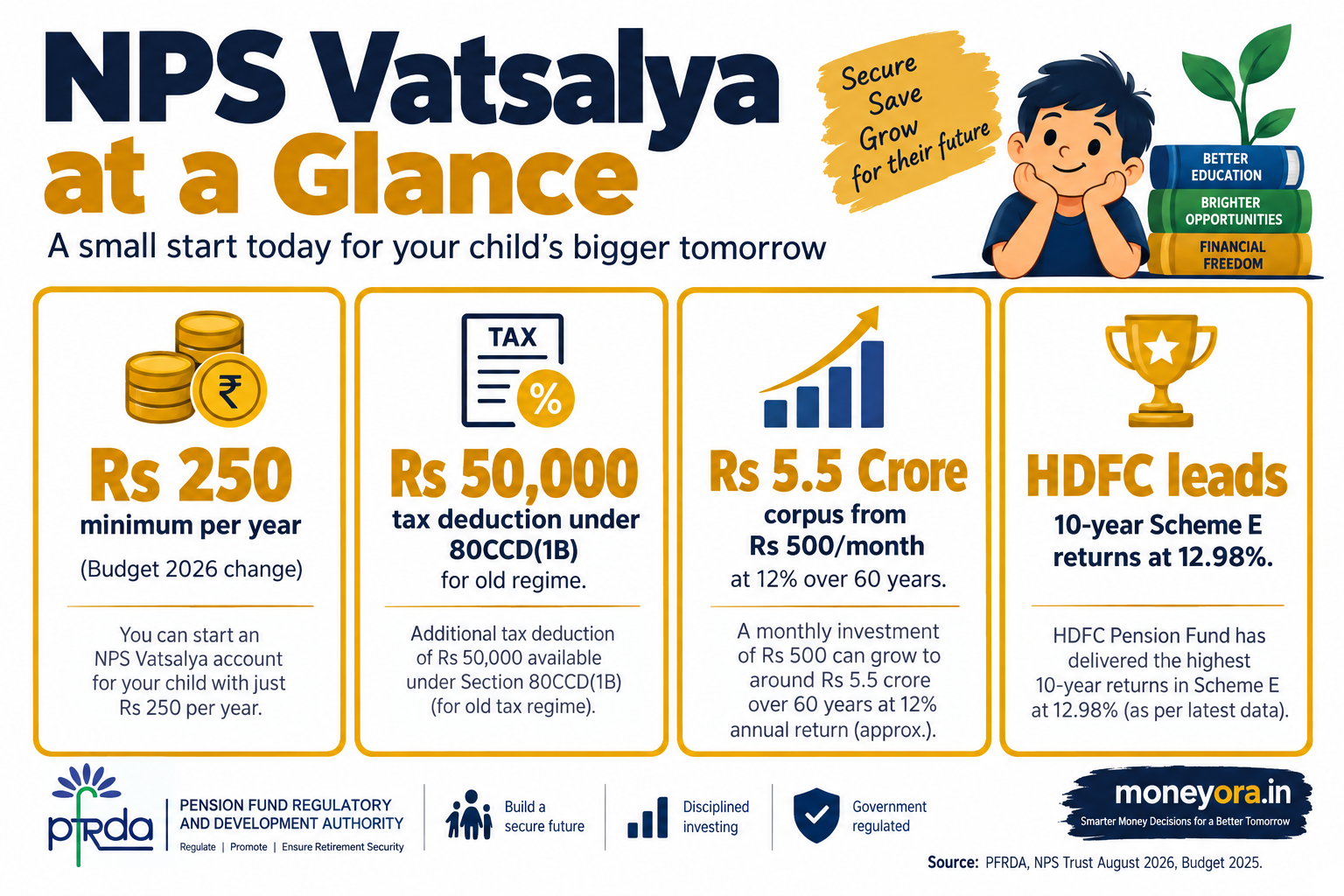
NPS Vatsalya starts at Rs 250 per year. A parent investing in NPS Vatsalya 2026 with Rs 500 per month from birth can build a Rs 5.5 crore corpus by the time the child turns 60, assuming 12 percent annualised returns.
What Changed in NPS Vatsalya 2026
NPS Vatsalya has two updates that most articles have not yet mentioned. The first update is the significant for accessibility.
Change 1: Minimum Contribution Drops to Rs 250
The NPS Vatsalya page from PFRDA now shows that the minimum amount to open an account is Rs 250. The minimum yearly contribution is also Rs 250. There is no upper limit on how much can be added. Some older articles, those from 2025 still say the minimum is Rs 1,000 because they were written before the change. The Rs 250 minimum makes NPS Vatsalya 2026 accessible to a salaried worker earning Rs 15,000 per month who wants to start something structured for their child without a heavy commitment.
At Rs 250 per year the amount is less than the cost of a meal delivery order. The idea is not to put in Rs 250 and expect a retirement fund. The idea is that you can begin NPS Vatsalya 2026 with whatever’s affordable and raise the contributions later as your income rises. The PRAN (Permanent Retirement Account Number) is given once. Stays the same for all future contributions no matter how the amounts change.
Change 2: Budget 2025 Tax Extension
After the Budget 2025 all tax benefits that apply to NPS, such as deductions under Sections 80CCD(1) and 80CCD(1B) were extended to NPS Vatsalya accounts. This extension did not occur automatically when the scheme started. It was announced in the Budget 2025 notification, which most articles written before February 2025 do not cover.
For parents who were under the tax regime the practical impact is an extra Rs 50,000 deduction specifically for NPS Vatsalya 2026 contributions on top of the Rs 1.5 lakh limit of Section 80C. That reduces the real cost of contributing to NPS Vatsalya a lot for anyone, in the 30 percent tax bracket.
What NPS Vatsalya Is
NPS Vatsalya is an investment account that the PFRDA regulates. A parent or legal guardian opens NPS Vatsalya for a child who’s under 18 years old. Finance Minister Nirmala Sitharaman introduced NPS Vatsalya in July 2024. This new plan is an extension of the National Pension System for children.
The design of NPS Vatsalya is simple. A parent opens an NPS Vatsalya 2026 account for the child. The parent then makes contributions picks how much money goes to equity, bonds and government securities and keeps the account running until the child reaches 18. When the child turns 18 the NPS Vatsalya account automatically changes into a NPS Tier-1 account. From that point the adult child uses the account on their own.
The investment choices in NPS Vatsalya are the same as in NPS. You can pick Auto Choice, where the computer changes the equity share as the child grows Active Choice, where you pick the amounts yourself for Scheme E (equity) Scheme C (corporate bonds) and Scheme G (government securities). In Auto Choice the equity share changes with the child’s age. There are options such as Aggressive (75 percent equity) Moderate (50 percent equity) and Conservative (25 percent equity).
Many parents want to know a detail: the NPS Vatsalya 2026 account is held in the child’s name and uses the child’s PRAN. It is not linked to the parent’s NPS account. Parents can keep both accounts at the time without any problem.
NPS Vatsalya is available to every minor even if the child is an NRI or OCI. Any parent or guardian of a child, under 18 can open an NPS Vatsalya Scheme account for that child. The account can also be opened for children who’re NRIs or OCIs.
Corpus Calculator: Rs 500 Per Month at 3 Return Scenarios
This is the section that most NPS Vatsalya 2026 articles skip because it requires actual math The compounding period here is unusually long From the child’s birth to retirement at 60 is roughly 60 years That time horizon changes the numbers dramatically compared to a 20 or 30-year calculation.
The table below uses Rs 500 per month (Rs 6,000 per year) as the base contribution starting at birth and running to age 60 Three return scenarios reflect historical NPS Scheme E performance.
| Scenario | Annual Return | Total Invested | Corpus at Age 60 | Growth Multiple |
|---|---|---|---|---|
| Conservative | 10% | Rs 3.6 lakh | Rs 2.3 crore | 64x |
| Moderate | 12% | Rs 3.6 lakh | Rs 5.5 crore | 153x |
| Aggressive | 14% | Rs 3.6 lakh | Rs 13.2 crore | 367x |
The 12 percent scenario is the most realistic for equity-heavy NPS Vatsalya allocation over 60 years given historical Scheme E performance Based on the 10-year returns reported on the NPS Trust website as of August 25 2025 HDFC Pension Fund delivered the highest return among the six pension fund managers at 12.98 percent ICICI Prudential Pension Fund followed with 12.87 percent while Kotak Mahindra Pension Fund and UTI Retirement Solutions delivered 12.70 percent and 12.50 percent respectively A 12 percent annualised return over the long run is achievable and consistent with the top fund managers’ track records.
What this calculator shows is the power of this scheme’s time horizon. Most child investment articles calculate to age 18 or age 21 NPS Vatsalya 2026 runs to the child’s retirement which adds 40 to 42 extra years of compounding on top of the childhood contribution period That is the unique edge of NPS Vatsalya that no other child plan offers.
Use the SIP calculator on MoneyOra to model your own contribution amount and preferred return scenario since the compound growth logic is identical to what drives NPS Vatsalya returns.
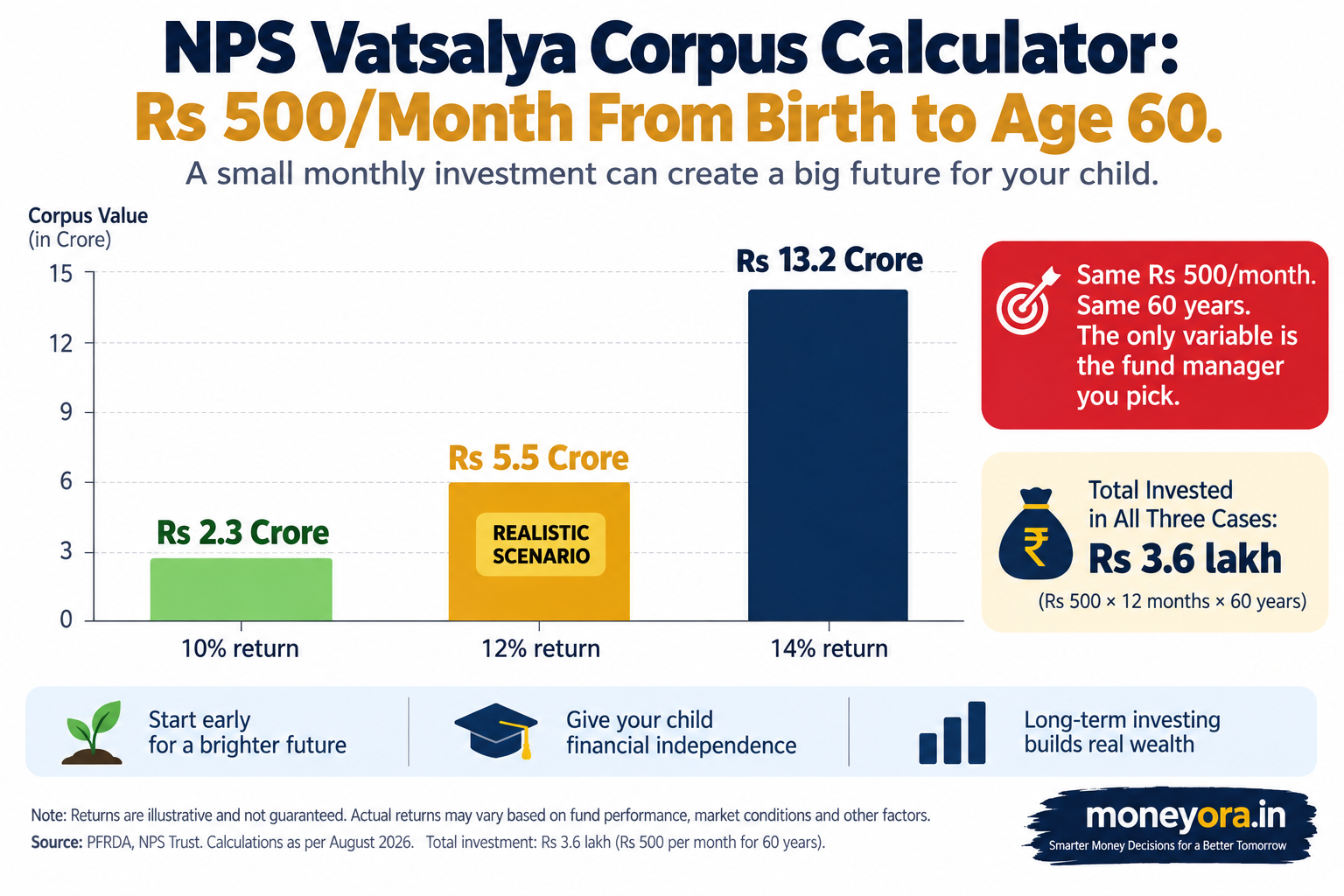
Rs 500 per month from birth to age 60 builds between Rs 2.3 crore and Rs 13.2 crore depending on whether your NPS Vatsalya fund manager delivers 10, 12 or 14 percent annualised returns.
Tax Benefits of NPS Vatsalya 2026: Old Regime vs New Regime
I find that the way NPS Vatsalya is taxed depends on the tax regime that the parent chooses. Many articles give information or make confident claims that do not match the current position.
Old Tax Regime
NPS Vatsalya gives a Rs 50,000 tax deduction under Section 80CCD(1B). This is in addition to the deduction of Rs 1.5 lakh under Section 80C. In Budget 2025 the government clarified that the Rs 50,000 extra deduction applies under both the Old and New Tax Regimes. I think this is a detail to keep in mind.
Note: That source says both regimes.. Other official interpretations and the PFRDAs own material say the 80CCD(1B) benefit is available only under the old regime for NPS Vatsalya. The safest current position is this: contributions to NPS Vatsalya under the regime clearly qualify for the Rs 50,000 deduction under Section 80CCD(1B). For the regime this benefit is still being interpreted differently by different sources so verify with your CA before filing. I think it is safer to rely on sources.
For a parent who’s in the 30 percent tax slab and uses the old regime contributing Rs 50,000 a year to NPS Vatsalya saves Rs 15,600 in tax (including 4 percent cess). This saving is on top of any 80C savings already used. I think this is an incentive to choose NPS Vatsalya over other long‑term options for the child.
New Tax Regime
Under the tax regime the picture is more conservative. The Rs 50,000 deduction under 80CCD(1B) is contested for NPS Vatsalya. Investment growth inside the NPS Vatsalya 2026 account stays tax‑free regardless of regime. When the child turns 60 and a withdrawal is made a corpus below Rs 8 lakh can be taken fully as a lump sum. If the corpus is Rs 8 lakh or more up to 80 percent can be taken as a lump sum while the remaining 40 percent is used to buy an annuity according to PFRDA regulations.
The 60 percent lump‑sum portion of any exit above Rs 8 lakh is tax‑exempt under Section 10(12A). The annuity bought with the remaining 40 percent is taxable as income, in the year it is received. I understand that this is the NPS exit tax treatment.
Fund Manager Comparison for NPS Vatsalya 2026
This is the section that no competitor NPS Vatsalya article has written with current data Choosing the right fund manager for NPS Vatsalya 2026 matters enormously over a 60-year compounding period The difference between a 10 percent and a 12 percent return is not 2 percentage points It is Rs 3.2 crore on a Rs 500 monthly contribution as shown in the calculator above.
Since NPS Vatsalya 2026 accounts sit under the same NPS structure you can use Scheme E (equity) returns from the same pension fund managers to evaluate performance As of 2026 there are 10 active PFRDA-registered pension fund managers SBI Pension Funds, LIC Pension Fund, UTI Retirement Solutions, HDFC Pension Management, ICICI Prudential Pension Fund Management, Kotak Mahindra Pension Fund, Aditya Birla Sun Life Pension Management, Tata Pension Management, Axis Pension Fund Management, and DSP Pension Fund Managers Max Life Pension Fund Management, previously an 11th option was discontinued from NPS operations effective April 18 2025.
| Fund Manager | 10-Year Scheme E Return | Suitable For | Rank |
|---|---|---|---|
| HDFC Pension | 12.98% | Equity-focused, growth-oriented | 1st |
| ICICI Prudential | 12.87% | Equity-focused, consistent | 2nd |
| Kotak Mahindra | 12.70% | Balanced equity approach | 3rd |
| UTI Retirement | 12.50% | Government employee default | 4th |
| LIC Pension | 11.65% | Conservative, government-linked | 5th |
| SBI Pension | 11.61% | Most established, largest AUM | 6th |
NPS Trust website as of August 25 2026 Past returns do not guarantee future performance.
The verdict for NPS Vatsalya with a 60-year time horizon: HDFC Pension Fund and ICICI Prudential are the leading choices based on 10-year equity performance. Despite delivering double-digit annualised returns over the 10-year period, none of the six pension funds outperformed the benchmark return of 13.12 percent. That benchmark context matters, since no manager consistently beats the index over the long run, which is an argument for keeping costs low and staying in equity allocation through the Auto Choice Aggressive option during the child’s younger years.
SBI and LIC historically dominate because of government employee mandates, not because their equity returns are better. For an NPS Vatsalya account where you are choosing freely, HDFC or ICICI Prudential for equity allocation is the data-backed starting point. You can switch fund managers once per year without cost.
The Boy Children Angle: NPS Vatsalya 2026 Fills the SSY Gap
Every article about NPS Vatsalya is written as if the only readers are parents of girl children. They compare NPS Vatsalya to Sukanya Samriddhi Yojana constantly. What they miss: Sukanya Samriddhi Yojana is exclusively for girl children. A parent with a son has no government-backed long-term investment scheme with PFRDA regulation and pension-linked structure.
NPS Vatsalya 2026 fills that gap directly. A parent of a boy can open an NPS Vatsalya 2026 account at birth contribute Rs 250 to Rs 500 per month benefit from the Section 80CCD(1B) tax deduction under the regime and build a retirement corpus for the son with the same structural advantages that SSY provides for daughters.
The right comparison for a parent of a son is NPS Vatsalya versus PPF for the child. Both are government-backed. PPF offers a rate of 7.1 percent per annum guaranteed. NPS Vatsalya 2026 at HDFC Pensions 10-year equity return of 12.98 percent is double that return with market risk attached but with a 60-year time horizon to smooth out volatility.
The PPF for a child has a 15-year lock-in. Then extends in 5-year blocks. NPS Vatsalya locks in until age 60 with defined withdrawal provisions. For a parent who understands that their sons retirement is 60 years away the longer lock-in is a feature not a problem. It prevents withdrawal of what should be a genuine retirement corpus.
The financial planning guide on MoneyOra explains how to layer NPS Vatsalya alongside education savings (which should be, in a duration liquid instrument) so the two goals do not compete with each other.
Partial Withdrawal from NPS Vatsalya 2026: The Exact Process
The 25 percent partial withdrawal rule appears in every NPS Vatsalya article. However none of those articles show how to apply for it. This guide will explain the steps.
Subscribers may take out up to 25 percent of their contributions (only self‑contributions, not employer contributions) once they have been members of NPS for three years. The PFRDA allows these withdrawals for reasons, such as treatment of certain critical illnesses for the subscriber, spouse or children and for education or marriage costs of children.
With NPS Vatsalya 2026 the allowed reasons during the phase are more limited. Only education costs for the child and treatment of an illness for the child count. The guardian’s own illness or marriage costs do not qualify in the phase of NPS Vatsalya. This difference is important compared to NPS withdrawal rules.
Step-by-Step Partial Withdrawal Process
- Log in to the NSDL CRA portal at cra‑nsdl.com with the parent’s registered login because the account is an account and the parent manages it.
- Go to the Withdrawal section and choose Partial Withdrawal.
- Enter the child’s PRAN number and pick the withdrawal purpose from the dropdown menu (Education or Critical Illness).
- Upload the required documents: fee receipts or an admission letter for education or a medical certificate from a PFRDA‑notified hospital for critical illness.
- Enter the amount to withdraw (no more than 25 percent of all contributions made to date excluding returns).
- Submit the request. Write down the acknowledgment number.
- The Central Recordkeeping Agency (CRA) will process the request. Deposit the money into the registered bank account within three to five working days after approval.
Partial withdrawal from NPS Vatsalya is tax‑free. It cuts your corpus in the same proportion because the withdrawn amount no longer earns interest. Use it for real needs. If you take out Rs 1 lakh today at a 12 percent return over 40 years you will miss about Rs 93 lakh, in growth.
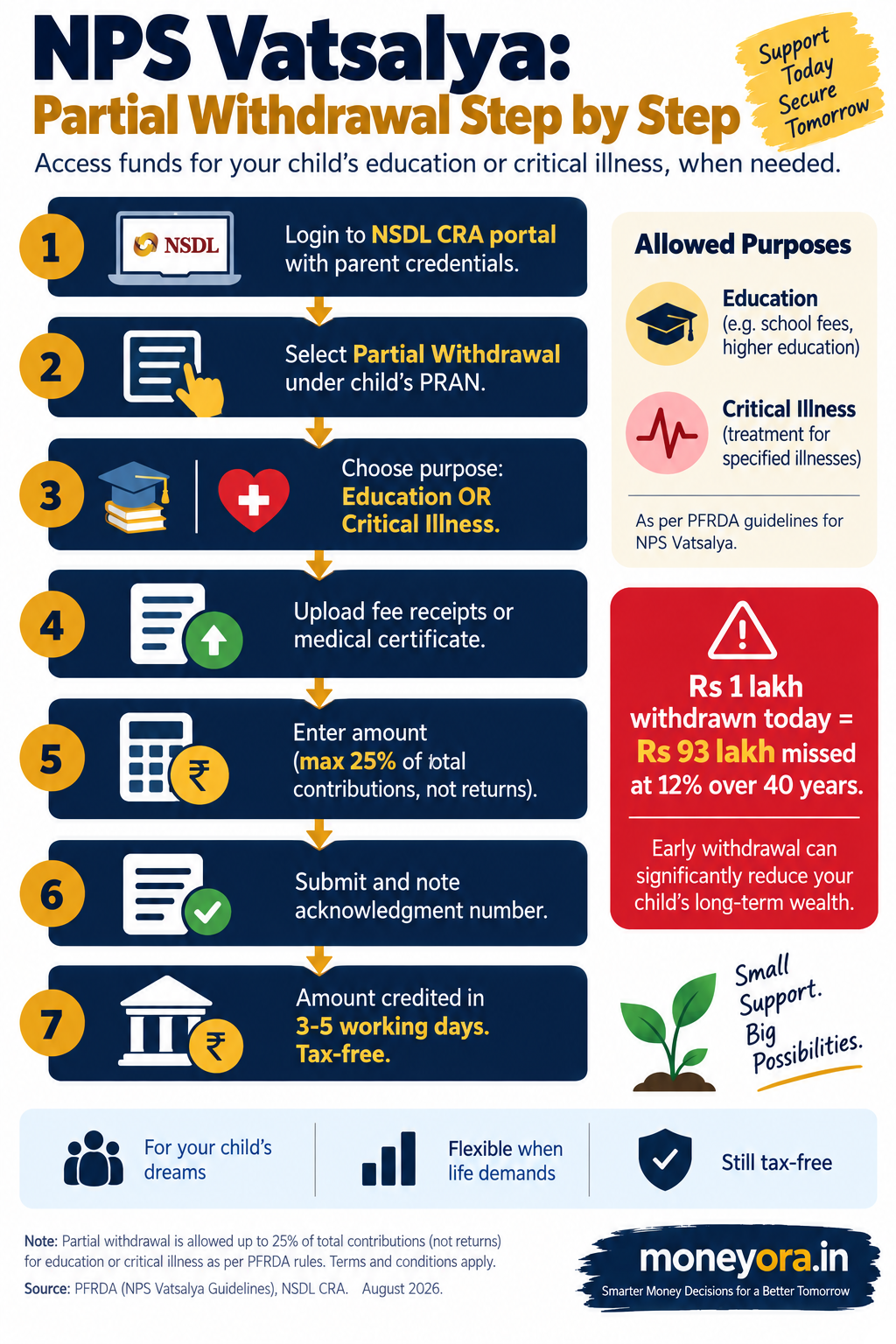
The NPS Vatsalya partial withdrawal process through NSDL CRA portal takes 3 to 5 working days and allows up to 25 percent of total contributions for education or critical illness purposes after 3 years of account holding.
What Happens When Your Child Turns 18
This is the transition that many competitors talk about but rarely explain. Here is what actually happens with your NPS Vatsalya 2026 account when the child turns 18.
The PRAN does not close. There is no need to open an account. The same PRAN that was assigned when you opened the NPS Vatsalya account continues into adulthood as a NPS Tier-1 account. The name of the account holder remains unchanged. What changes is the person who manages the account. The authority of the guardian. The now-adult child takes over all operations directly.
What the Child Needs to Do at Age 18
- First the child must visit the CRA portal. Update the PRAN from Minor status to Major status using the KYC update process.
- Next the child must submit KYC documents in their own name. These include Aadhaar, PAN and bank account details for credits.
- Then the child must update the bank account linked to the PRAN. This means changing it from the parent’s account to the child’s account.
- After that the investment allocation should be. Updated. What made sense for a 10-year-old. Like Aggressive Auto Choice. Might not fit an adult investor’s goals. So adjustments are necessary.
- Optionally if the child joins an employer that offers NPS they can link their PRAN to that employer’s NPS contributions. This helps consolidate savings in one place.
There is one scenario that creates complications. If the child decides at age 18 to exit the NPS instead of continuing they cannot withdraw everything right away. NPS exit rules apply.
If the corpus is below Rs 8 lakh full withdrawal is allowed. If the corpus is above Rs 8 lakh up to 60 percent can be taken as a lump sum. The remaining 40 percent must be used to buy an annuity.
For example consider a child whose parent started the NPS Vatsalya account at birth and contributed Rs 500 every month with a return rate of 12 percent. By age 18 the corpus would be around Rs 3.2 lakh. This is, below the Rs 8 lakh threshold. So full withdrawal would technically be permitted at 18 if the child chooses to exit.
What If the Parent Dies Before the Child Turns 18
This question appears in Google’s People Also Ask section for NPS Vatsalya but no article answers it clearly Here is the definitive answer based on current PFRDA regulations.
If the guardian who opened the NPS Vatsalya 2026 account dies while the child is still a minor the account does not automatically close and the corpus does not transfer out Two outcomes are possible.
The first and preferred outcome another family member typically the surviving parent or a court-appointed guardian applies to the CRA to be registered as the new guardian for the NPS Vatsalya account They submit a guardian change request with the death certificate of the original guardian, their own identity proof, and proof of guardianship Once the new guardian is registered contributions can continue under their supervision and the PRAN remains active.
The second outcome if no guardian is available or willing to manage the account the minor child’s corpus remains protected in the NPS Vatsalya account and continues to earn returns based on the last-set fund allocation No contributions need to be made for the account to remain active and growing When the child turns 18 they can independently take over the PRAN and continue or exit per the standard rules.
One critical point ensure the NPS Vatsalya account has a registered nominee The nominee for a minor NPS account is typically the same guardian who opened it After the NPS Vatsalya account converts at 18 the child should update the nomination to a family member or spouse Without a nominee on record accessing the corpus after death requires a lengthy legal heir certificate process The nomination guide on MoneyOra covers the principles that apply across all investment instruments including NPS accounts.
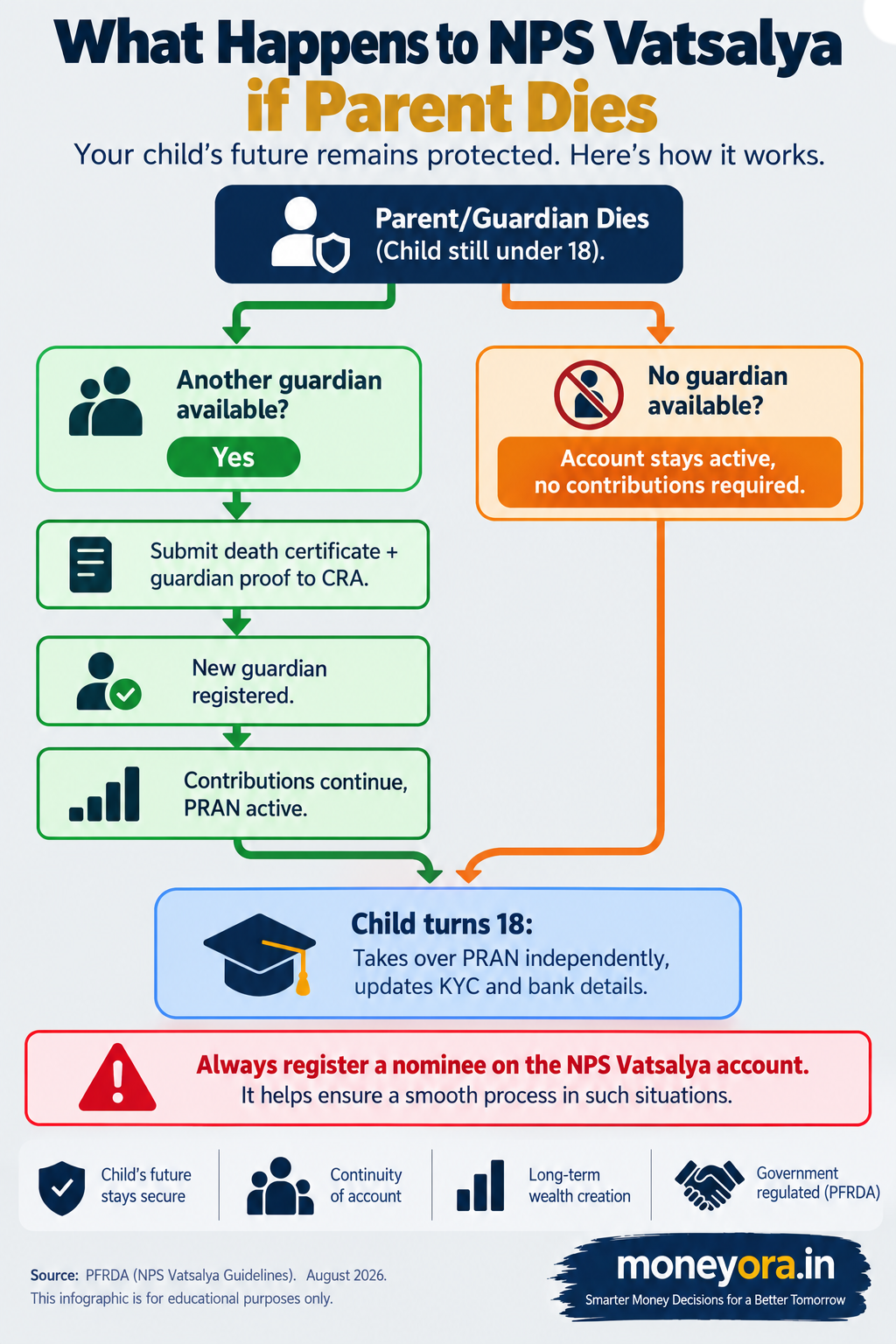
If a parent dies while the NPS Vatsalya account is active, a new guardian can be registered through the CRA. The child’s corpus continues growing under the existing fund allocation until the child turns 18 and takes over independently.
How to Open an NPS Vatsalya 2026 Account Online
Opening an NPS Vatsalya 2026 account takes 20 minutes online. Here is the process.
- Go to the eNPS portal at enps.nsdl.com or the NPS CRA portal
- Select NPS Vatsalya from the account type options
- Enter the guardians details: Aadhaar, PAN number for OTP verification
- Enter the childs details: name as per birth certificate, date of birth relationship to guardian
- Upload documents: childs birth certificate guardians Aadhaar and PAN
- Choose your fund manager (HDFC or ICICI Prudential for equity‑first approach based on return data)
- Select investment option: Auto Choice (Aggressive for young children) or Active Choice
- Make the initial contribution of minimum Rs 250 via net banking or UPI
- PRAN is generated and sent to the registered mobile and email within 2 working days
Alternatively NPS Vatsalya accounts can be opened offline through any PFRDA-registered Point of Presence (POP) which includes most major banks (SBI, HDFC Bank, ICICI Bank, Axis Bank, PNB) and selected post offices. The offline process requires physical form submission. May take 7 to 10 working days for PRAN generation.
For parents tracking their NPS or planning retirement alongside the childs NPS Vatsalya account the EPF vs PPF vs NPS guide on MoneyOra explains how the two NPS accounts the parents own NPS and the childs NPS Vatsalya can coexist and complement each other.
The NPS Vatsalya 2026 Decision
NPS Vatsalya 2026 is not for every family. It works best for parents who really want to build a retirement corpus for their child from an early age and are okay with a very long lock-in period. The Rs 250 minimum makes it available to many. The Section 80CCD(1B) deduction makes it tax-efficient for people who file under the tax regime. The 60-year compounding period makes it one of the powerful wealth-building tools available to an Indian child.
What NPS Vatsalya 2026 is not: a college fund, a marriage fund or a tool for medium-term savings. For those goals a separate SIP or PPF works better because NPS Vatsalya is focused on retirement not on short-term goals.
If you start NPS Vatsalya today with Rs 500 every month for an HDFC Pension Fund continues to give close to its historical 12.98 percent equity return you could end up with a Rs 5.5 crore retirement corpus by the time the child is 60. This comes from an investment of Rs 3.6 lakh. The power of compounding does the rest.
Use the SIP Calculator on MoneyOra.in to plan your exact contribution and see what your NPS Vatsalya investment looks like at any time period.
Disclaimer: This article is, for learning purposes and is not investment or tax advice. NPS Vatsalya returns depend on the market. Are not assured. Tax benefits depend on your tax regime and personal situation. Check the rules at pfrda.org.in and talk to a SEBI-registered investment advisor before making any investment.
FAQ: NPS Vatsalya 2026
What is the minimum contribution for NPS Vatsalya 2026?
The minimum contribution to open an NPS Vatsalya 2026 account and to make a contribution is Rs 250. This figure was updated on the PFRDA scheme page and reflects the Budget 2026 accessibility change. Many older articles and comparison sites still quote Rs 1,000. Those figures predate the rules. There is no contribution limit for NPS Vatsalya 2026.
Is NPS Vatsalya 2026 better than Sukanya Samriddhi Yojana?
SSY offers 8.2 percent guaranteed interest ( rate) with full corpus available at age 21. NPS Vatsalya 2026 offers market‑linked returns averaging 11 to 13 percent over 10 years through equity allocation. The corpus locks in until retirement at 60 except for the 25 percent partial withdrawal. SSY is better for short‑term goal funding by age 21. NPS Vatsalya 2026 is better for building a retirement corpus. Also SSY is for girls; NPS Vatsalya 2026 is the only equivalent option for boy children.
Which fund manager is best for NPS Vatsalya 2026?
Based on 10‑year Scheme E equity returns as of August 2026 on the NPS Trust website HDFC Pension Fund leads at 12.98 percent followed by ICICI Prudential at 12.87 percent. For a long‑horizon account such as NPS Vatsalya 2026 equity performance matters most. SBI and LIC perform well on government scheme returns. Lag in equity. HDFC or ICICI Prudential is the choice for NPS Vatsalya 2026 equity allocation. One can switch fund managers once per year at no cost.
What is the tax benefit of NPS Vatsalya 2026?
Under the tax regime contributions to NPS Vatsalya 2026 qualify for an additional deduction of up to Rs 50,000 per year under Section 80CCD(1B) separate from the Rs 1.5 lakh Section 80C basket. For a parent in the 30 percent tax bracket this saves Rs 15,600 annually. Growth inside the NPS Vatsalya 2026 account is tax‑free. At exit 60 percent of the lump‑sum withdrawal is tax‑exempt under Section 10(12A). The new tax regime benefit under 80CCD(1B) for NPS Vatsalya 2026 specifically is contested, so confirm with a CA for your situation.
What happens to the NPS Vatsalya 2026 account when the child turns 18?
The same PRAN continues as a NPS Tier‑1 account. No new account is needed. The child must update the PRAN from Minor to status at the CRA portal submit fresh KYC documents and update the linked bank account to their own. Contributions can continue employer NPS can be linked if applicable and investment allocation can be adjusted. If the child wants to exit at 18 and the corpus is below Rs 8 lakh full withdrawal is permitted. If the corpus is above Rs 8 lakh 60 percent lump sum and 40 percent annuity rules apply.
Can I open NPS Vatsalya 2026 for my son if I already have SSY for my daughter?
Yes. NPS Vatsalya 2026 and SSY are separate accounts with separate regulatory frameworks. One can hold SSY for daughter and NPS Vatsalya 2026 for son simultaneously. The Section 80CCD(1B) deduction from NPS Vatsalya 2026 contributions is separate from the Section 80C deduction for SSY contributions. They do not compete within the tax basket.
Can grandparents or relatives gift money to NPS Vatsalya 2026?
Yes. PFRDA explicitly allows gift contributions to an NPS Vatsalya 2026 account from relatives and friends not just parents or legal guardians. The contribution goes into the childs PRAN. Is invested as per the chosen allocation. The tax deduction under Section 80CCD(1B) however can only be claimed by the guardian who operates the account not by the gifting relative.
What is the NPS Vatsalya 2026 partial withdrawal rule?
After 3 years of account holding up to 25 percent of contributions (not including returns) can be withdrawn for specific purposes. During the phase eligible purposes are education expenses for the child and treatment of critical illness for the child. The withdrawal is tax‑free. One can withdraw up to 3 times during the account lifetime. Each withdrawal reduces the compounding base. The opportunity cost, over a 60‑year horizon is significant.