
Mutual Fund After Death Nominee Claim Process India 2026
Author: Moneyora Team | Published: September 2026 | Category: Mutual Funds
Imagine your father quietly put away Rs 7.8 lakh in funds over ten years. He never mentioned it at home. Then one day he is no longer around. You find some account statement papers hidden in a drawer. You don’t know what to do who to contact or how to get those mutual fund units.
This is a situation that thousands of Indian families experience every year. The question of what happens to a Mutual Fund After Death the investor dies is one of the most searched yet poorly explained topics, in Indian personal finance.
If you are reading this you may have just lost someone. You want to plan ahead so your family never faces this confusion. Either way this guide gives you everything you need. We explain exactly what happens to Mutual Fund After Death of the investor how to claim mutual fund units step by step what documents you need and what SEBIs new 2026 rules mean for Indian families.
- Mutual fund after death does not mean units are lost or cancelled permanently
- A nominee can claim mutual fund after death within 10 to 30 working days
- Without a nominee, the legal heir must follow a longer process using court documents
- SEBI released new simplified rules in July 2026 for mutual fund after death transmission
- Below Rs 5 lakh, legal heirs can claim mutual fund after death without a court order
- The AMFI MITRA portal helps locate all mutual fund folios of a deceased investor

Why Mutual Fund After Death Planning Matters More Than You Think
According to estimates from AMFI (Association of Mutual Funds in India), tens of thousands of crore worth of mutual fund units currently sit unclaimed across India because families simply did not know the process after an investor’s death. When an investor dies without proper nomination or documentation, the family often struggles for months or even years to claim what rightfully belongs to them.
The question of what happens to mutual fund after death is not just about paperwork. It is about protecting the wealth your family member spent years building through SIPs and lump sum investments.
The good news is that mutual fund after death does not mean those units are erased. Under Indian law, mutual fund units are part of the deceased investor’s estate. They cannot simply vanish from the system. But without proper knowledge of the process, families lose precious months and sometimes end up in legal disputes.
Understanding the mutual fund after death rules is now as important as choosing the right fund at the time of investment.
Who Can Claim Mutual Fund Units After Death of the Investor
When an investor passes away, three categories of people are eligible to claim mutual fund after death of the investor.
Registered Nominee
If the investor had added a nominee in the folio, that person gets the first right to claim mutual fund after death. Since SEBI’s landmark amendment of 2022, the nominee is now treated as the beneficial owner of the units and not just a trustee. This is a significant legal change that strengthens the nominee’s position in any mutual fund after death situation.
Legal Heir (When No Nominee Exists)
When there is no nominee in the folio, the legal heir can claim mutual fund after death. A legal heir is determined by the investor’s valid Will or by Indian succession laws. If there is no Will, Hindu succession law, Muslim personal law or Indian Succession Act determines who the rightful heirs are. In most cases, the spouse, children and parents are the primary legal heirs.
Surviving Joint Account Holder
If the mutual fund folio was held jointly and one of the holders passes away, the surviving joint holder can claim the units. This is the simplest mutual fund after death claim scenario and usually involves the least paperwork.
What Happens to Mutual Fund After Death – Full Step by Step Process
What happens to mutual fund after death depends entirely on whether a nominee was registered and how much money is involved in the folio.
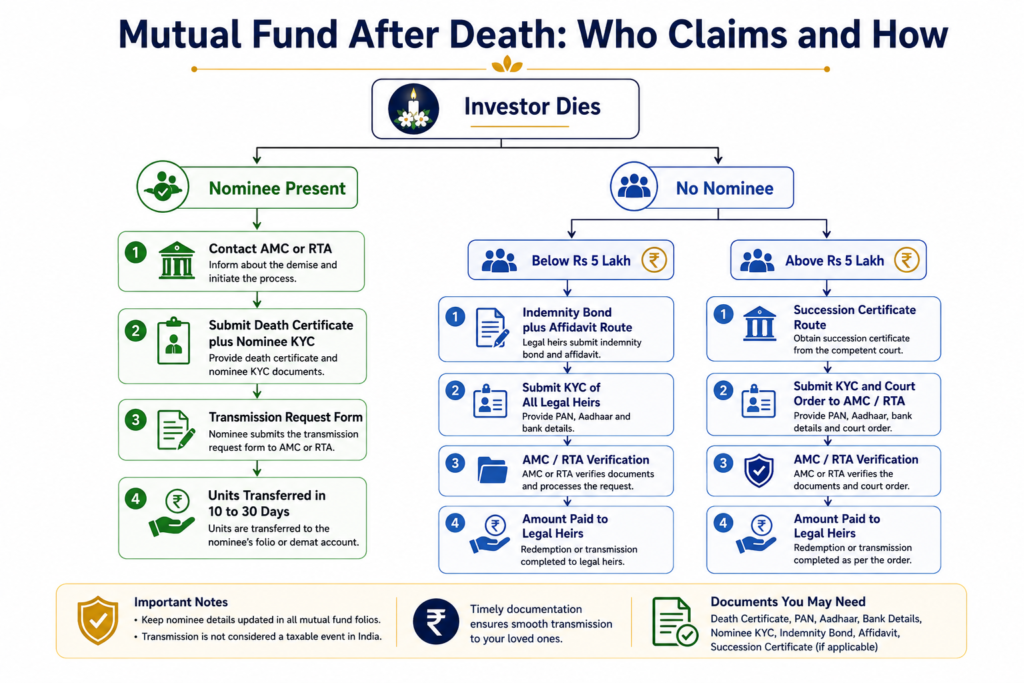
Scenario 1 – Nominee Is Registered (Sole Folio)
This is the fastest and clearest path for mutual fund after death claims.
The nominee contacts the fund house or the relevant RTA (Registrar and Transfer Agent). In India, the two main RTAs are CAMS (Computer Age Management Services) and KFintech. Most AMCs route their mutual fund after death transmission through one of these two RTAs.
After submitting the required documents, the AMC creates a new folio in the nominee’s name and transfers all units into it. Once the folio is created, the nominee can either redeem the units for cash or continue holding them for further wealth growth.
Processing time for this mutual fund after death scenario is typically 10 to 15 working days when documents are in order.
Scenario 2 – No Nominee, Amount Below Rs 5 Lakh
SEBI has simplified the mutual fund after death claim significantly for small amounts. The legal heir does not need a succession certificate from a court when the total value of units in all folios is below Rs 5 lakh.
Instead, the legal heir can submit an indemnity bond along with an affidavit signed before a notary or magistrate. This simplified path for mutual fund after death makes recovery accessible even for families with no legal background.
Scenario 3 – No Nominee, Amount Above Rs 5 Lakh
For mutual fund after death claims above Rs 5 lakh without a nominee, the legal heir must provide one of these three options.
The first option is a Succession Certificate issued by a civil court under the Indian Succession Act. The second option is a Probate of the investor’s Will if the deceased made a registered Will. The third option is a court order in cases of legal dispute among multiple heirs.
This is the most time-consuming path for mutual fund after death claims and typically takes 90 to 180 days depending on the city court workload.
SEBI New Rules 2026 That Make Mutual Fund After Death Claims Easier
In July 2026, SEBI directed AMFI to revise the Standard Operating Procedure for mutual fund after death transmission. This is the most significant update to the claim process in recent years and directly addresses the root cause of most delays.
Earlier, a nominee trying to claim mutual fund after death of the investor would face outright rejection if there was any mismatch between the investor’s registered address in the folio and the address on the nominee’s KYC. Even a spelling difference in the investor’s name, like “Suresh” instead of “Suresh Kumar”, was enough to reject the mutual fund after death claim entirely.
Under the revised SOP now applicable from July 2026, the AMC can rely on the nominee’s latest KYC address to process mutual fund after death claims. Small mismatches in name spelling or old addresses no longer lead to automatic rejection. Instead, they go through a defined document verification process with specific remedies.
What this means for a family claiming mutual fund after death today is that the process has become measurably faster and less frustrating. Before July 2026, many mutual fund after death claims were stuck for weeks because of a comma difference in the investor’s registered address.
The new rules also provide clarity for joint folio situations where both account holders have passed away. The revised SOP gives RTAs and AMCs a clear checklist to follow in such unusual mutual fund after death cases.
Full Documents Required for Mutual Fund After Death Claim
Getting your documents right is the most important part of any successful mutual fund after death claim. Below are the required documents organized by claim scenario.
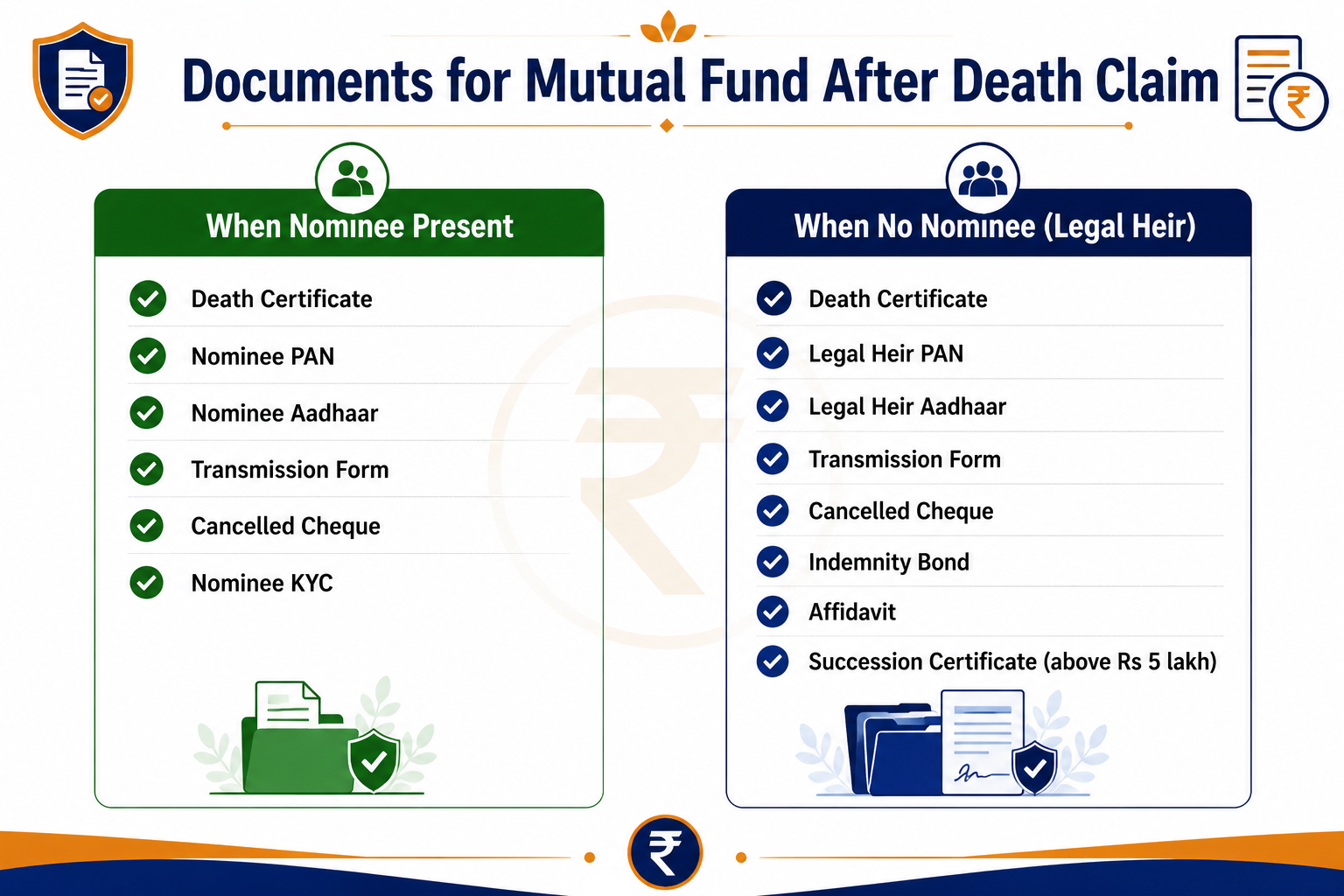
Documents When Nominee Is Present
These are the documents needed to claim mutual fund after death when a nominee has been registered in the folio.
Required for all mutual fund after death claims with nominee:
- Death certificate of the investor (original and self-attested photocopy)
- Nominee’s valid PAN card copy
- Nominee’s Aadhaar card copy
- Duly filled Transmission Request Form (available on the AMC or RTA website)
- Cancelled cheque from the nominee’s bank account in their name
- KYC of the nominee (complete via CAMS, KFintech or MF Central if not already done)
- For amounts above Rs 5 lakh — a notarized indemnity bond from the nominee
Documents When No Nominee Exists (Legal Heir Route)
This set of documents is required for mutual fund after death claims where no nominee was registered.
Required for legal heir mutual fund after death claims (below Rs 5 lakh):
- Death certificate of the investor (original and attested copy)
- Legal heir’s PAN card copy
- Legal heir’s Aadhaar card copy
- Cancelled cheque of legal heir’s bank account
- Transmission Request Form (fully filled and signed)
- Notarized indemnity bond signed by all legal heirs
- Affidavit stating there is no other legal claimant or dispute
- Standard KYC of legal heir
Additional documents for mutual fund after death claims above Rs 5 lakh (no nominee):
- Succession Certificate issued by a civil court
- OR Probate of Will (if investor left a registered Will)
Important note for mutual fund after death claims above a certain threshold: some AMCs require a signature attestation from a bank manager. Always verify the specific requirements with the relevant AMC or RTA before submitting.
Mutual Fund After Death Claim Timeline – Complete Reference
This original timeline table gives families a realistic expectation for each mutual fund after death scenario. No competitor article provides this level of detail.
| Mutual Fund After Death Scenario | Estimated Processing Time |
|---|---|
| Nominee present, amount below Rs 5 lakh | 10 to 15 working days |
| Nominee present, amount above Rs 5 lakh | 20 to 30 working days |
| No nominee, amount below Rs 5 lakh (indemnity bond route) | 30 to 45 working days |
| No nominee, amount above Rs 5 lakh (succession cert ready) | 45 to 75 working days |
| No nominee, amount above Rs 5 lakh (court process pending) | 90 to 180 working days |
| Joint folio – surviving holder claims after co-holder death | 7 to 15 working days |
These timelines apply only when all documents submitted for the mutual fund after death claim are accurate and complete. Any single document error or mismatch effectively resets the processing clock.
What Happens to SIP After Investor Dies
This is one of the most important sections that competitor articles on mutual fund after death have completely missed.
When an investor who was running a SIP passes away, the SIP does not automatically stop in most cases. The NACH mandate (National Automated Clearing House mandate) linked to the deceased investor’s bank account may continue attempting to debit SIP installments until the bank account is frozen or the mandate is cancelled.
Here is what the family should do immediately after a mutual fund after death situation that involved an active SIP.
Step 1 – Contact the bank and request a freeze or cancellation of the NACH mandate linked to the SIP. This prevents further debits from a deceased person’s bank account.
Step 2 – Notify the AMC in writing about the investor’s death. Once the AMC is informed, the folio is frozen for mutual fund after death transmission.
Step 3 – Review all bank accounts linked to any active SIPs. Some investors run multiple SIPs from multiple bank accounts. Each NACH mandate needs to be individually cancelled.
Existing mutual fund units already accumulated in the folio continue to exist and earn NAV returns even after the investor’s death. You will not lose invested money. But stopping future SIP debits promptly after a mutual fund after death situation prevents unnecessary complications with the bank and the estate.
Tax on Mutual Fund Units Received After Death
Tax treatment is another problem in most of the guides about mutual fund after death that you can find online. People who are trying to claim mutual fund after death usually don’t know if they will have to pay tax when the transfer happens.
At the time of transfer – No tax.
There is no inheritance tax in India. Getting mutual fund after death units from a fund after death transfer is completely tax-free when the units are transferred to the nominee or the legal heir.
At the time of selling capital gains tax is applied.
When the nominee or the legal heir finally decides to sell the mutual fund units capital gains tax applies. How this works in the case of mutual fund after death is something that is important to understand properly.
The cost of the units for the nominee is the same as the price that the person who died paid.
The time period that is used to decide whether it is term or long term capital gains is counted from the date when the person who died bought the units. Not from the date of the transfer.
This means that if the person who died held equity mutual fund units for than one year when they passed away the nominee immediately gets long term capital gains tax treatment when they sell the units. For the year 2026-27 long term capital gains on equity mutual funds are taxed at 12.5% on gains, over Rs 1.25 lakh every year. Short term gains are taxed at 20%.
Always talk to a tax advisor before selling mutual fund units that you received through a mutual fund after death transfer to make sure you get the best tax result.
What If the Nominee Is a Minor in a Mutual Fund After Death Claim
I have seen families who think the process of a Mutual Fund After Death claim is simple but when the registered nominee is a minor that is, younger than 18 years the process has one extra step that many do not expect.
A guardian has to be named to look after the mutual fund units for the minor. Usually the surviving parent becomes the guardian. If both parents are gone then a court will appoint a guardian.
The guardian must send the mutual fund after death claim paperwork plus extra papers. These extra papers include the birth certificate of the nominee and the guardian’s own KYC, PAN and Aadhaar copies.
The mutual fund units stay in the name of the minor. Are managed by the guardian. When the minor nominee turns 18 the AMC will ask for KYC so the folio can become a normal adult folio in the nominee’s own name.
This minor nominee rule, in Mutual Fund After Death cases keeps a child’s inheritance safe and makes sure that the law watches over the child until the child reaches adulthood.
How to Find Hidden Mutual Fund Investments Using MITRA Portal
Many families contact only one or two fund houses after a mutual fund after death situation. But the deceased investor may have held folios across multiple AMCs. This is extremely common among Indian investors who diversified across different fund houses over the years.
AMFI has created a free tool called MITRA (Mutual Fund Investment Tracing and Retrieval Assistant) at www.amfiindia.com specifically to solve this problem in mutual fund after death cases.
MITRA allows family members to search all mutual fund investments of a deceased investor using only the investor’s PAN number. This works across all AMCs registered with AMFI in India.

How to use MITRA for a mutual fund after death search:
Step 1 – Visit the official AMFI website and navigate to the MITRA section.
Step 2 – Enter the PAN number of the deceased investor in the search field.
Step 3 – The system returns a list of all active folios linked to that PAN number across all registered AMCs in India.
Step 4 – Use this comprehensive list to initiate mutual fund after death claim requests with each relevant fund house.
This tool is completely free and does not require you to create an account or login. For any mutual fund after death situation, using MITRA first ensures you claim every single folio the investor held and leave nothing on the table.
Mistakes Families Make During Mutual Fund After Death Claims
Based on the most searched questions about mutual fund after death on Google in 2026, here are the most common and costly mistakes that delay or permanently complicate the claim.
Only Contacting One AMC
Many families assume the deceased investor kept all their money in one fund house. Always use the MITRA portal first to identify every AMC before initiating a mutual fund after death claim.
Submitting Incomplete Documents
Even a single missing document in a mutual fund after death claim resets the entire processing timeline. Create a complete checklist before your first visit to the AMC or RTA.
Confusing Demat Mutual Fund Folios with Regular Folios
Mutual fund units held in demat form follow a different transmission path. The claim for demat mutual funds goes through the depository (CDSL or NSDL) rather than directly through the AMC. This is an entirely separate process from the standard mutual fund after death claim. Read our detailed guide on SWP for demat mutual funds to understand how demat-held units work differently.
Not Resolving Nominee vs Legal Heir Conflicts Early
The nominee gets the first right to the units. But if other family members have a competing legal claim based on a Will or succession law, disputes can freeze the entire mutual fund after death claim for months. Resolve family consensus before approaching the AMC.
Skipping KYC Update After Transmission
After a mutual fund after death claim is processed and units are transferred to the nominee’s new folio, the nominee must complete fresh KYC in their own name. Skipping this step causes problems during future redemptions.
Immediately Redeeming Without Checking Tax Implications
Many nominees redeem the full corpus immediately after receiving mutual fund after death units without calculating tax. If the units have been held for more than one year, the LTCG exemption of Rs 1.25 lakh means strategic redemption across two financial years could save significant tax.
How to Prevent Mutual Fund After Death Problems Starting Today
You can save your family from months of paperwork and legal stress by taking a few key steps right now.
Add a nominee to every mutual fund folio today. You can do this online through MF Central at mfcentral.com or through your AMC’s individual portal or app. As per SEBI’s June 2022 circular, nomination is now mandatory for individual mutual fund holders. If you choose not to nominate, you must sign a specific opt-out declaration. Many investors have not done either check all your folios urgently.
For a complete explanation of deadlines and compliance status, read our detailed article on SEBI mutual fund nomination deadline and verify your folios are fully compliant.
If you also hold shares in a demat account alongside mutual funds, the transmission of shares process has its own rules and documents separate from mutual fund after death claims.
For investors who want to build their overall financial safety net, our guide on financial planning for Indian investors covers how to organize all investments, nominations and emergency funds in one framework.
For comparing where to park your money once you receive a mutual fund after death payout, our FD vs liquid fund comparison article walks you through the pros and cons of each option for short-term parking of funds.
If you want to understand how mutual fund investments compare to EPF, PPF and NPS as long-term savings tools, read our detailed article on EPF vs PPF vs NPS for Indian investors for a side-by-side analysis.
Mutual Fund After Death in 2026
Understanding what happens to mutual fund after death becomes straightforward once you know the framework.
Mutual fund after death does not mean your money is gone. Units remain active and earn NAV returns. A registered nominee provides the fastest path to claim mutual fund after death units. Without a nominee, legal heirs follow a longer, more document-heavy route. SEBI’s new July 2026 SOP removes the common address and name-spelling mismatches that earlier caused repeated delays in mutual fund after death claims. For amounts below Rs 5 lakh, no court order is needed. The MITRA portal on the AMFI website helps locate all folios of a deceased investor. Adding a nominee to your folios today is the single most powerful action you can take to protect your family from a mutual fund after death ordeal.
FAQ – Mutual Fund After Death Questions
Q1. Does mutual fund investment lapse after the investor dies?
No. Mutual fund units do not lapse after the investor’s death under any circumstances. The units remain active in the folio and continue to earn NAV returns. The nominee or legal heir must initiate the mutual fund after death transmission process to claim them formally. There is no automatic cancellation.
Q2. Can a nominee redeem mutual fund after death or only transfer units?
A nominee has a full choice after a mutual fund after death transmission is complete. They can redeem the units for a cash payout, or they can transfer the units into a new folio in their own name and continue holding for further growth. For long-term wealth building, transferring and holding is usually the wiser financial decision.
Q3. How long does it take to get money from mutual fund after death?
With a registered nominee and complete documents, mutual fund after death claims are typically processed in 10 to 30 working days. Without a nominee, the process can take 30 to 180 working days depending on the amount and the legal documents required.
Q4. What if there are multiple nominees in a mutual fund after death case?
If the investor registered multiple nominees with a specific percentage allocation for each person, each nominee receives their designated percentage share. If no percentage was specified at the time of nomination, the units are divided equally among all registered nominees.
Q5. Can a legal heir claim mutual fund after death without going to court?
Yes. For total mutual fund amounts below Rs 5 lakh, SEBI allows the legal heir to claim mutual fund after death using an indemnity bond and a notarized affidavit. No court order or succession certificate is required in this case.
Q6. What happens to SIP when an investor dies?
The SIP NACH mandate linked to the bank account may continue attempting to debit installments after the investor’s death. Families must contact the bank and the AMC immediately to stop the NACH mandate and freeze the folio for mutual fund after death transmission.
Q7. Does a nominee pay tax on mutual fund units received after death?
No tax is paid at the time of transmission. Tax applies only when the nominee eventually redeems the units. At that point, capital gains are calculated using the original investor’s purchase price as the cost of acquisition and the original purchase date for determining the holding period.
Q8. Can an NRI nominee claim mutual fund after death of an Indian resident investor?
Yes, an NRI who is a registered nominee or legal heir can claim mutual fund after death of an Indian resident investor. However, additional FEMA (Foreign Exchange Management Act) compliance and documentation requirements apply for NRI nominees. Consulting a financial advisor with FEMA expertise is strongly recommended before initiating the claim.
Q9. What is the MITRA portal and how does it help in a mutual fund after death search?
MITRA stands for Mutual Fund Investment Tracing and Retrieval Assistant. It is a free search tool available on the AMFI website that allows family members to identify all mutual fund folios held by a deceased investor across all AMCs in India, using only the investor’s PAN number. This prevents any mutual fund after death investment from being missed.
Q10. Can family members lose mutual fund money permanently after investor’s death?
Mutual fund after death claims do not technically expire in India. However, extremely old dormant folios may eventually be treated differently under future regulations. Acting promptly after a mutual fund after death situation is the strongest protection against any risk of permanent loss.