
Tax Deductions Other Than 80C for Salaried Employees FY 2026-27
By Moneyora Team | September 2026 | Reading Time 12 Minutes
Priya works as a marketing manager. Earns 12 lakh rupees every year. Every January her HR department gives her an investment declaration form. She fills in 1.5 lakh rupees under Section 80C. This includes her ELSS, LIC premium and PPF contribution. She sends it back takes a breath and thinks that tax planning for the year is done.
When she files her income tax return her tax consultant finds out that she paid 87,000 rupees more in taxes than she needed to. Nine major deductions other than 80C were not claimed in her return. Deductions she was eligible for documents she already had and money she could have kept.
This is not a situation. It happens in millions of salaried families in India every year.
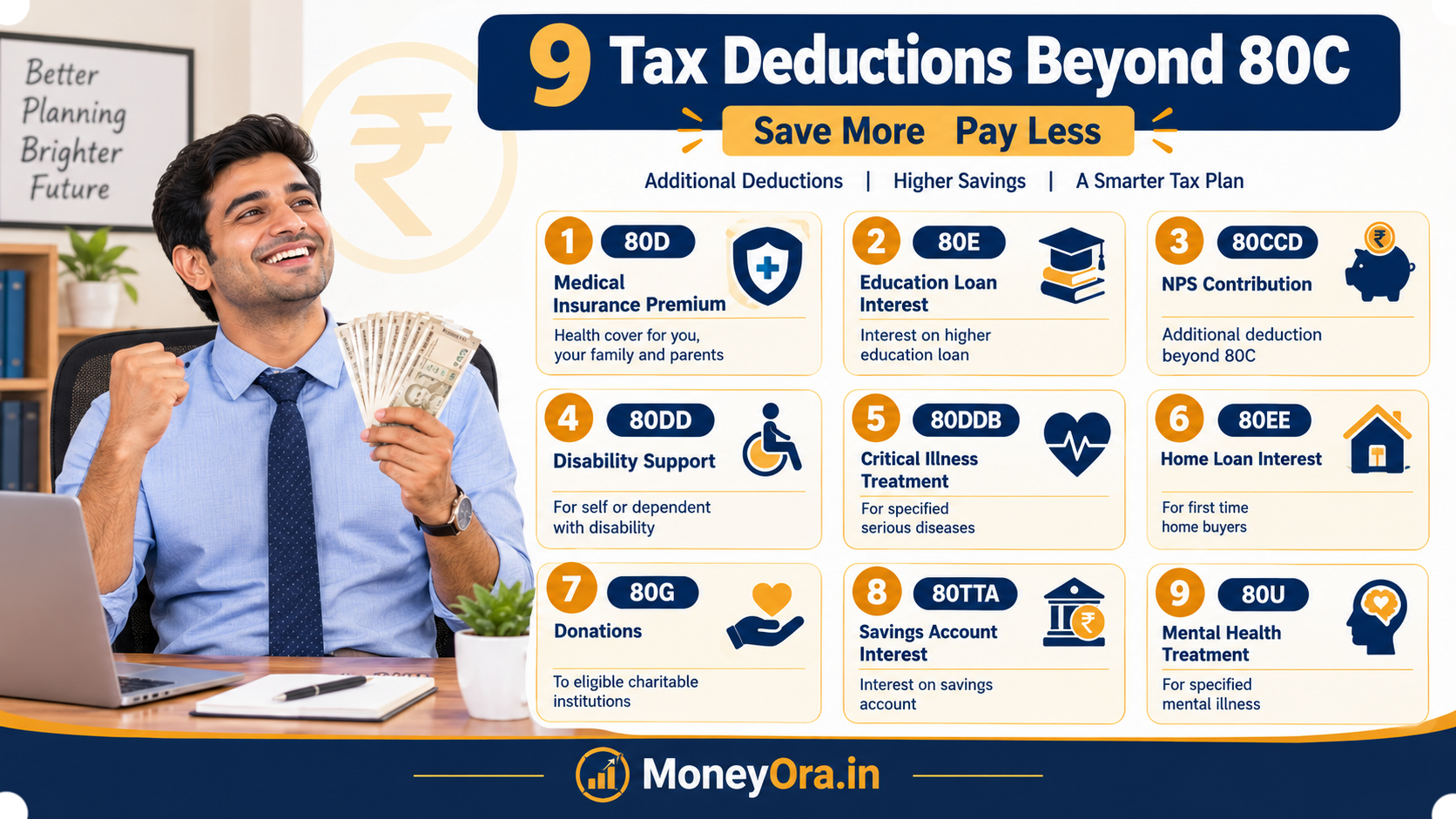
Most salaried people in India know Section 80C well. What they do not know is that the Income Tax Act provides nine major deductions besides 80C. Each of them completely separate from the 1.5 lakh rupees cap under 80C. Together these deductions other than 80C can legally lower your taxable income by another 1.5 lakh to 2.5 lakh rupees every year saving between 45,000 and 1,40,000 rupees in taxes depending on your income tax slab.
This article explains all the deductions other than 80C available to salaried people under the old tax system for the financial year 2026-27. For each section you will find who is eligible how much can be claimed what documents are needed and how each one functions, in a life Indian salary scenario.
Why Most Salaried Indians Stop at 80C
Section 80C gets the most attention for one simple reason. It is the largest single deduction bucket in the Income Tax Act at Rs 1.5 lakh, and it covers financial products that most people already use – EPF, PPF, ELSS mutual funds, life insurance premiums and home loan principal repayment.
For a salaried employee whose EPF alone consumes Rs 80,000 to Rs 1 lakh of the 80C limit, the remaining space fills up quickly with an LIC premium or a PPF deposit. Once the Rs 1.5 lakh ceiling is hit, most people assume the tax planning conversation is closed.
The problem is that the Income Tax Act does not stop at Section 80C. A full chapter of additional deductions other than 80C sits right below it – equally legal, equally powerful, and largely ignored.
According to data from the Income Tax Department of India, a large proportion of individual filers claim only the basic Chapter VI-A deductions while leaving several applicable deductions other than 80C completely unused. This represents real money walking out of millions of households every year.
The good news is that all nine deductions other than 80C covered in this article are straightforward to claim. Most require documents you already possess.
These Deductions Other Than 80C Work in Old Tax Regime
Before we go further remember the most important fact about deductions other than 80C.
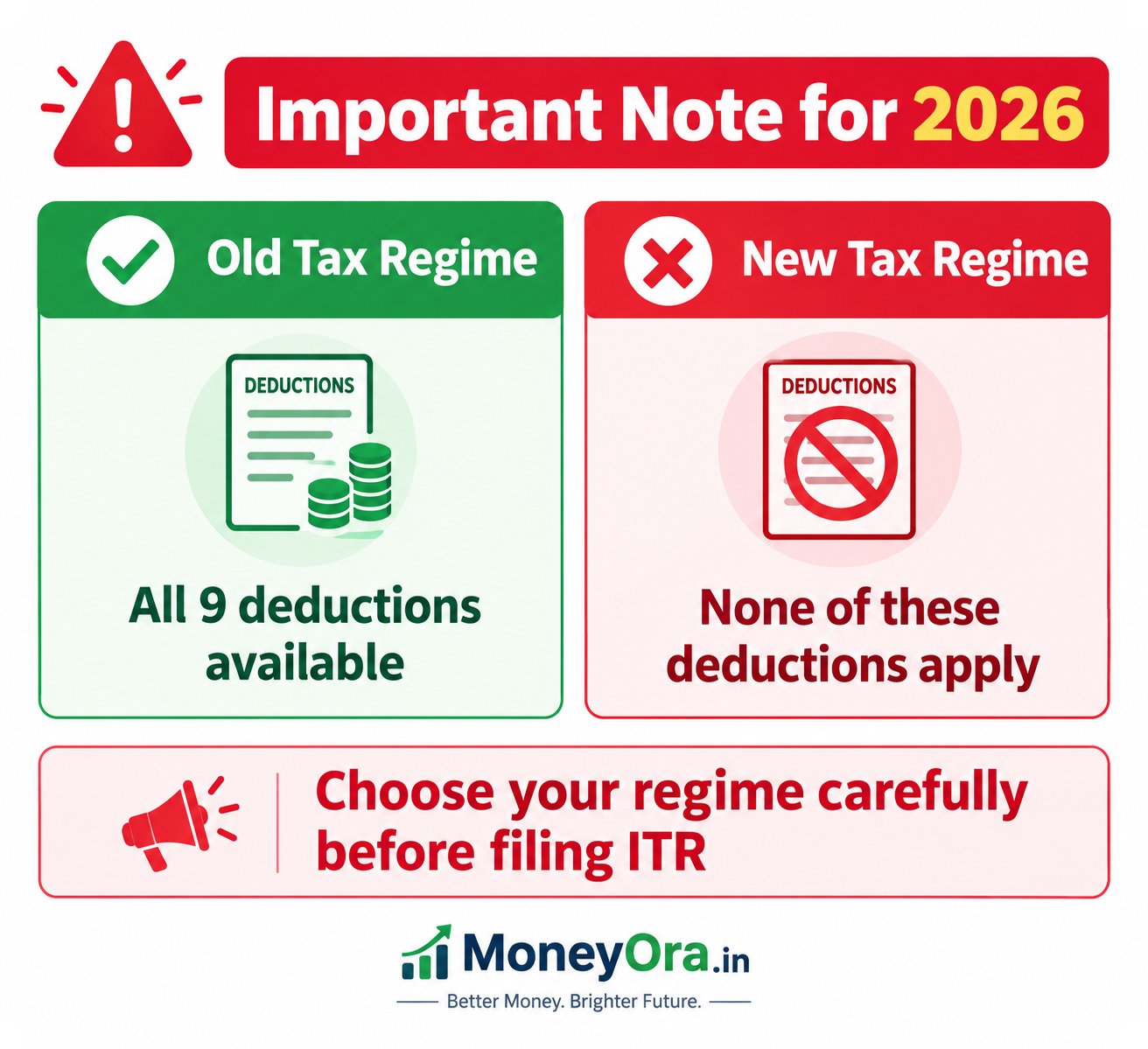
Every deduction covered in this article is available only under the old tax regime. Deductions other than 80C are not available under the tax regime, which became the default regime in India from FY 2023‑24.
The new tax regime offers slab rates but removes almost all Chapter VI‑A deductions, including Section 80C itself. If you have chosen the tax regime, deductions other than 80C in this article will not apply to your return.
Union Budget 2026 presented on 1 February 2026 made no changes to income tax slabs for FY 2026‑27. Old tax regime slabs remain at 5 % up to Rs 5 lakh 20 % up to Rs 10 lakh and 30 % above Rs 10 lakh. Section 87A rebate of Rs 12,500 remains available for income up to Rs 5 lakh under the old tax regime.
If you are unsure which regime saves you money for your specific income and deduction profile read the detailed comparison of new versus old tax regime for FY 2026‑27 before making this decision. A decision worth spending twenty minutes on.
For all salaried individuals who have chosen the tax regime here are the nine deductions other than 80C that most people miss.
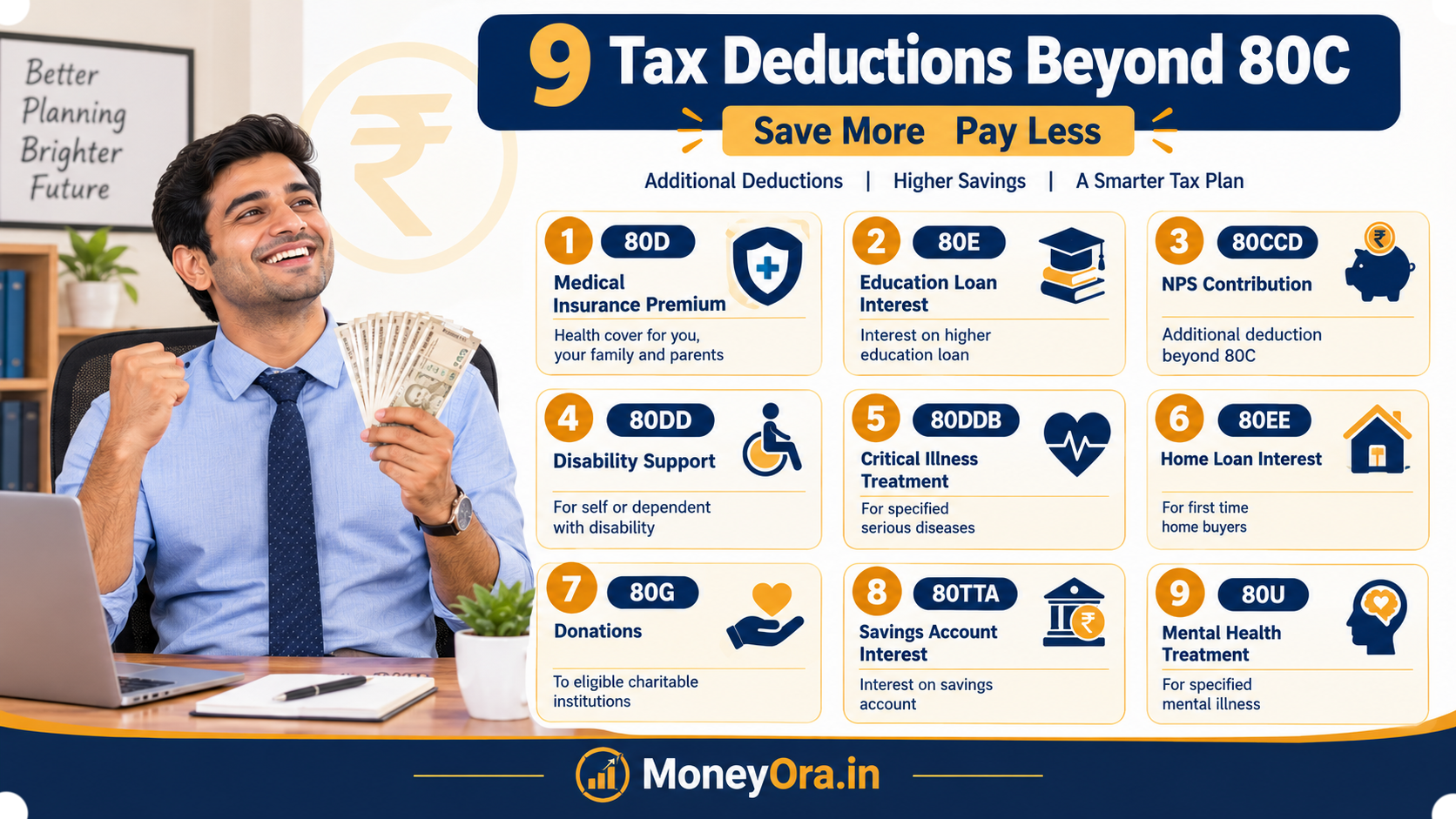
9 Deductions Other Than 80C. Section by Section Guide
1. Section 80CCD(1B). Rs 50,000 NPS Deduction
This is the single most powerful and most ignored deduction other than 80C available to Indian taxpayers.
Section 80CCD(1B) allows a deduction of up to Rs 50,000 per year for contributions made voluntarily to a National Pension System (NPS) Tier 1 account. This Rs 50,000 is completely separate from. Sits entirely above the Rs 1.5 lakh Section 80C ceiling.
In terms you can invest Rs 1.5 lakh under 80C and then put another Rs 50,000 into your NPS Tier 1 account under 80CCD(1B). Bringing your total eligible deductions to Rs 2 lakh from just these two sections combined.
For someone in the 30% tax bracket this single deduction other than 80C saves Rs 15,000 in tax. The applicable 4% Health and Education Cess, putting Rs 15,600 back in your pocket with one NPS transfer.
Who qualifies. Any individual with a NPS Tier 1 account whether salaried self employed or a government employee.
Documents needed. NPS contribution statement or PRAN card statement showing Tier 1 contributions made during the year. Your NPS account manager or CRA sends this statement each April.
One confusion that costs people money is mixing up Section 80CCD(1B) with Section 80CCD(2). The 80CCD(2) covers your employers contribution to your NPS account. Is actually available even in the new tax regime. The 80CCD(1B) covers your voluntary contribution and is available only in the old regime. Both are useful. They serve different purposes.
To understand how NPS compares with EPF and PPF as long term retirement tools read our article on EPF vs PPF vs NPS for salaried employees, in India.
2. Section 80D. Health Insurance Premium Deduction
Section 80D is the most important deduction after Section 80C and almost every working Indian qualifies for it yet many people do not claim it fully.
Section 80D allows deductions on the health insurance premiums that you pay for yourself your spouse, your dependent children and your parents. The limits for FY 2026‑27 are as follows.
For yourself your spouse and your dependent children who are below 60 years old the deduction is 25,000 rupees per year. If any of the insured members is a citizen above 60 years old this limit increases to 50,000 rupees.
For parents you get an additional 25,000 rupees if they are below 60 years old and an additional 50,000 rupees if they are senior citizens above 60.
This means a salaried employee who’s below 60 years old who has a family health plan and also pays premium for senior citizen parents can claim a total of 75,000 rupees under Section 80D alone – separate from Section 80C. That is one of the biggest single deductions other than 80C available and it is missed by many working professionals every year.
An additional 5,000 rupees within the limits can also be claimed for preventive health checkups for the family.
Documents needed. Health insurance premium payment receipts and the policy document showing the names of members. For checkup claims a receipt, from a recognised diagnostic centre is needed.
3. Section 80E – Education Loan Interest Deduction
If you are repaying an education loan for yourself, your spouse or your dependent children, Section 80E offers one of the most generous deductions other than 80C in the entire Income Tax Act.
There is no upper limit on the deduction amount under Section 80E. The entire interest paid on the education loan during the financial year can be deducted from your taxable income. Not a portion. Not a capped amount. The full interest figure for the year.
The deduction is available for a maximum of eight consecutive years starting from the year in which repayment begins. If you repay the full loan in five years, the deduction applies for those five years only.
Section 80E applies to education loans taken for graduate and post-graduate courses in India or abroad, covering engineering, medical, management, science and other professional disciplines.
Who qualifies Individual taxpayers who have taken a loan from a recognized financial institution, bank or an approved charitable institution for higher education.
Documents needed – A loan interest certificate from the bank or financial institution showing exactly how much interest was paid during the financial year. Most banks issue this automatically in April or provide it on request.
For a person repaying a Rs 6 lakh education loan at 9.5% interest per year, the interest component in the early years runs to approximately Rs 55,000 to Rs 65,000 annually – the entire amount deductible under this powerful deduction other than 80C with absolutely no ceiling.
4. Section 80EEA – Additional Home Loan Interest for First-Time Buyers
For people who are buying their home Section 80EEA gives an extra deduction of Rs 1.5 lakh every year on the interest of the home loan. Completely in addition to the Rs 2 lakh limit that Section 24(b) already allows for home loan interest.
Eligibility conditions for Section 80EEA
The stamp duty value of the property must be Rs 45 lakh or less. The home loan must have been approved between April 1 2019 and March 31 2022. The person must not own any residential property at the time the loan was approved.
Documents needed. The home loan sanction letter from the bank the interest certificate for the year and the property registration documents that show the stamp duty value of the property.
When Section 80EEA is used along with Section 24(b) a first-time home buyer who qualifies can get up to Rs 3.5 lakh in deductions for home loan interest in one year. That is one of the tax benefits available through deductions other than 80C and 24(b) for anyone who bought an affordable home.
Before applying for a home loan read our article on CIBIL score, for home loan approval to learn about the credit score requirements that banks check.
5. Section 80G Donations to Approved Charitable Organizations
Section 80G permits deductions other than 80C when money is donated to government‑approved charitable organizations, relief funds and registered trusts.
The deduction percentage depends on the type of organization that receives the donation.
Donations to the PM National Relief Fund PM CARES Fund and National Defence Fund qualify for a 100% deduction. There is no monetary limit. Donations to the Jawaharlal Nehru Memorial Fund and Indira Gandhi Memorial Trust receive a 50% deduction again with no limit. Donations to some approved institutions receive either a 100% or 50% deduction but the total deduction cannot exceed 10% of the donor’s adjusted gross income.
For salaried employees who donate to standard registered NGOs and trusts the deduction that is separate from 80C under Section 80G is 50% of the donated amount and it cannot exceed 10% of the employee’s adjusted gross income.
Documents required. A donation receipt that shows the organization’s 80G registration number and the PAN of the receiving organization. Cash donations that are more than Rs 2,000 do not qualify for the deduction. For any donation that’s more, than Rs 2,000 payment must be made by cheque UPI or bank transfer.
6. Section 80TTA Deduction for Interest from Savings Accounts
Section 80TTA gives you the chance to deductions other than 80C interest that you earn from savings accounts. This is in addition to the deductions you can get under Section 80C. The interest must come from savings accounts that’re with scheduled banks, post offices or co-operative societies.
Maximum amount you can deduct. Rs 10,000 every year. This is for the interest earned from savings accounts.
If the interest you earned in the year 2026-27 from savings accounts is Rs 7,000 then you can deduct all of that Rs 7,000.. If it is Rs 16,000 then you can deduct only Rs 10,000. The rest, which is Rs 6,000 will be considered as income.
Who is eligible. People who are below 60 years of age and Hindu Undivided Families (HUFs) are eligible.
You don’t have to do anything to claim this deduction. Just enter the interest you earned from savings accounts under the category of Income from Other Sources in your ITR form. Then in Schedule VI-A claim a deduction of Rs 10,000 or the interest if it is less than that under Section 80TTA.
A key point to remember. Section 80TTA is for interest from savings accounts. Interest from fixed deposits or recurring deposits is not covered here. The interest from fixed deposits is fully taxable as income, from sources.
7. Section 80TTB Senior Citizen Bank Interest Deduction
Section 80TTB is the more generous version of Section 80TTA made only for senior citizens who are 60 years old or older.
Section 80TTA includes interest from savings accounts. Section 80TTB includes interest from savings accounts, fixed deposits, recurring deposits, post office time deposits and co-operative bank deposits. All under one single deduction limit.
Maximum deduction under Section 80TTB. 50,000 Rupees per year.
For someone who has retired and earned 55,000 rupees from fixed deposits and 7,000 rupees from a savings account in a year the total interest of 62,000 rupees is eligible for this deduction apart from 80C. The allowed deduction is 50,000 rupees, which’s the highest limit and the rest 12,000 rupees is taxable.
One rule that often leads to mistakes in returns by citizens is this. You cannot use Section 80TTA and Section 80TTB in the return. Senior citizens who are 60 years old or older must use Section 80TTB. People under 60 years must use Section 80TTA. Filing both at the time is a mistake that can lead to a notice, from the tax department.
8. Section 80GG House Rent Deduction for Non-HRA Employees
This is the often missed deduction after 80C in India. It covers a group of people but very few claim it.
If your employer does not give you a House Rent Allowance (HRA) but you pay rent for the house you live in Section 80GG, which’s a House Rent Deduction allows you to claim a deduction for that rent.
The deduction amount is the lowest of the following three amounts.
Rs 5,000 per month which equals Rs 60,000 per year. 25% Of your adjusted income for the year. Actual rent paid. 10% Of your total adjusted income.
A example
Ajay is a salaried professional earning Rs 8 lakh adjusted income per year. His salary structure has no HRA. He pays Rs 12,000 per month in rent totalling Rs 1.44 lakh for the year.
Section 80GG Calculation Rs 5,000 per month limit = Rs 60,000 per year 25% of Rs 8 lakh = Rs 2 lakh Actual rent minus 10% of income = Rs 1,44,000 minus Rs 80,000 = Rs 64,000
The deduction allowed is Rs 60,000. The lowest of the three values.
Who qualifies. Self employed individuals. Salaried employees who do not receive HRA in their salary. The person must not own any property in the city where they live and work.
Documents needed. Rent receipts for every month during which rent was paid. A self-declaration, in Form 10BA must be filed along with the ITR stating the rent amount. That no residential property is owned at the place of residence.
9. Section 80U Flat Deduction for Persons with Disability
Section 80U gives a fixed tax deduction to individual taxpayers who have a certified physical or mental disability. This is separate from the 80C deductions.
The amount is fixed. It doesn’t matter how medical money you spent during the year. You get the deduction if you qualify.
If you have a disability of 40% or more you can claim Rs 75,000 every year. If your disability is severe. 80% Or more. You can claim Rs 1,25,000 per year.
Who can claim. Only you, the taxpayer must have the disability. This is for your disability. Section 80U is not for someone in your family. That’s different. Section 80DD is for expenses on a family member with disability.
What documents you need. You must have a disability certificate. It must be issued by an authority recognized under the Rights of Persons with Disabilities Act. The certificate must be up to date and valid, for the year you are claiming.
The disabilities recognized under Section 80U include: blindness, low vision, leprosy (cured) hearing impairment, locomotor disability, intellectual disability, mental illness, autism spectrum disorder, cerebral palsy and multiple disabilities.
Complete Master Table – All Deductions Other Than 80C at a Glance
This original reference table consolidates every major deduction other than 80C in one place. No publicly available article for FY 2026-27 has published this level of organized detail for Indian salaried employees.
| Section | What It Covers | Maximum Deduction | Who Qualifies |
|---|---|---|---|
| 80CCD(1B) | Own NPS Tier 1 voluntary contribution | Rs 50,000 | Anyone with NPS Tier 1 account |
| 80D | Health insurance premium | Rs 75,000 | Anyone paying health insurance |
| 80E | Education loan interest | No upper limit | Loan for higher education |
| 80EEA | Additional home loan interest | Rs 1,50,000 | First-time buyers, stamp duty below Rs 45 lakh |
| 80G | Donations to approved organizations | Varies by org type | Anyone donating to registered orgs |
| 80TTA | Savings account interest | Rs 10,000 | Individuals and HUFs below 60 years |
| 80TTB | All bank and FD interest | Rs 50,000 | Senior citizens above 60 years only |
| 80GG | Rent paid without HRA in salary | Rs 60,000 | Employees and self-employed without HRA |
| 80U | Own certified disability | Rs 75,000 or Rs 1,25,000 | Individuals with certified disability |
Income Tax Department of India — Deductions under the Income Tax Act
For complete and up-to-date technical provisions, always verify the latest rules on the official Income Tax India website or consult a qualified chartered accountant before filing.
Standard Deduction Under Section 16(ia)
Before salaried person calculates how much deductions other than 80C save Standard Deduction there is one deduction that every salaried person must be aware of.
The Standard Deduction under Section 16(ia) is a Rs 50,000 deduction available to all salaried individuals and pensioners under the old tax regime. No investment bills, no rent receipts and no documents of any kind are required. Standard Deduction is automatically applied to salaried persons ITR when salaried person files.
Under tax regime Standard Deduction has been enhanced to Rs 75,000. Under tax regime Standard Deduction remains at Rs 50,000 for FY 2026-27.
Standard Deduction works alongside all nine deductions than 80C listed above. Standard Deduction reduces salaried persons salary first before Chapter VI-A deductions are applied.
For a breakdown of salaried persons salary components and how each part affects salaried persons take-home pay and tax liability read the salary handbook, for Indian employees.
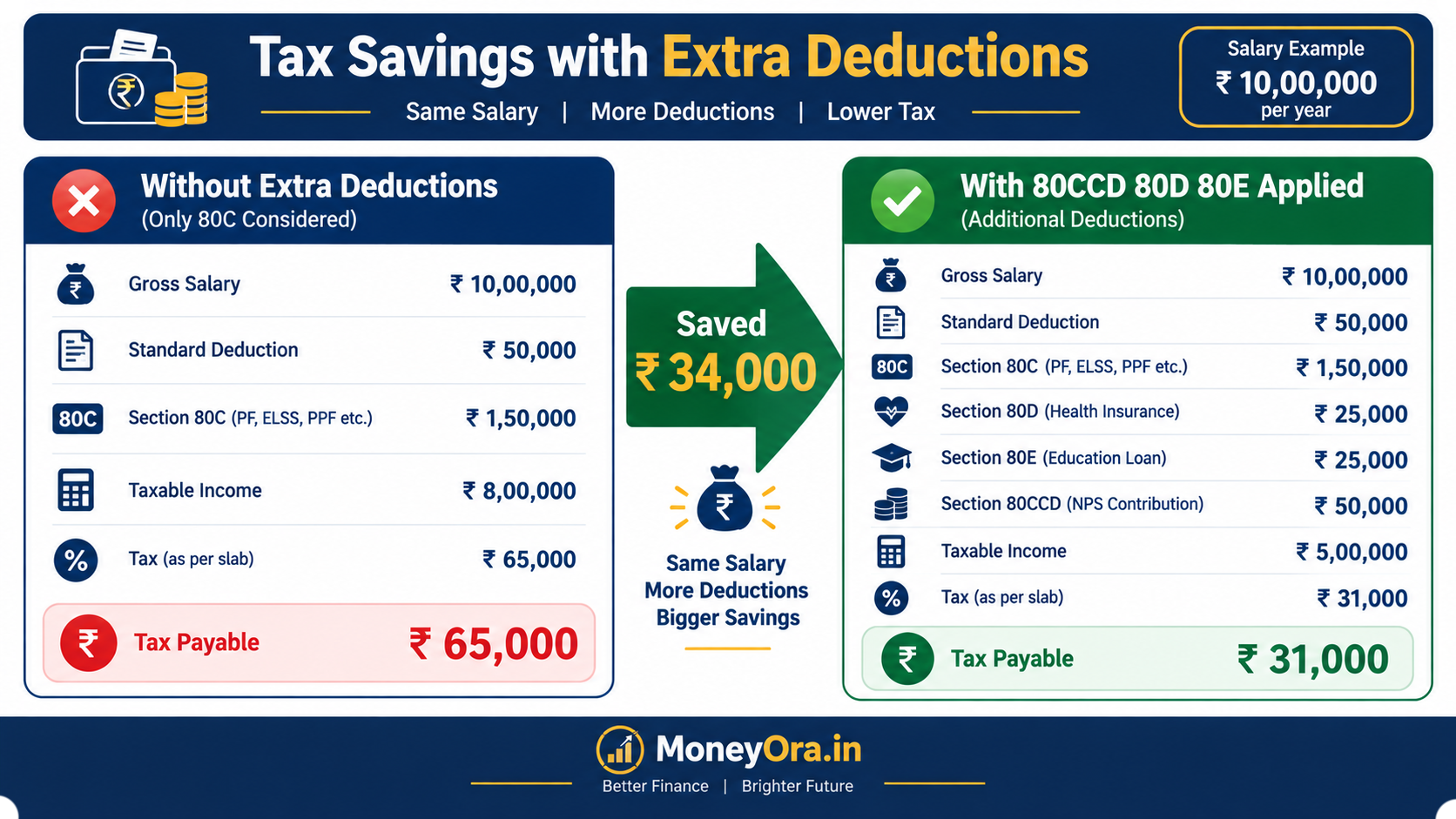
Real Calculation – How Priya Saved Rs 94,500 Using Deductions Other Than 80C
This is the section no competitor article on this topic has published for FY 2026-27. A real salary, real deductions and a real comparison of tax paid versus tax owed.
Priya’s Financial Profile Gross Annual Salary – Rs 12,00,000 Section 80C already fully claimed – Rs 1,50,000 (EPF, ELSS, LIC) HRA exemption claimed – Rs 80,000
Deductions Other Than 80C That Priya Qualifies For
| Deduction Other Than 80C | Section | Amount Claimed |
|---|---|---|
| Standard Deduction | 16(ia) | Rs 50,000 |
| NPS voluntary contribution | 80CCD(1B) | Rs 50,000 |
| Health insurance for family and senior citizen parents | 80D | Rs 75,000 |
| Education loan interest on Rs 6 lakh loan at 9.5% | 80E | Rs 57,000 |
| Savings account interest earned | 80TTA | Rs 8,500 |
| Total Deductions Other Than 80C Claimed | Rs 2,40,500 |
Tax Comparison – Before and After Claiming Deductions Other Than 80C
| Income and Tax Item | Without Extra Deductions | With Deductions Other Than 80C |
|---|---|---|
| Gross Salary | Rs 12,00,000 | Rs 12,00,000 |
| Standard Deduction Section 16(ia) | Rs 50,000 | Rs 50,000 |
| HRA Exemption | Rs 80,000 | Rs 80,000 |
| Section 80C | Rs 1,50,000 | Rs 1,50,000 |
| Deductions Other Than 80C (80CCD, 80D, 80E, 80TTA) | Rs 0 | Rs 1,90,500 |
| Net Taxable Income | Rs 9,20,000 | Rs 7,29,500 |
| Income Tax Payable (approx) | Rs 1,16,500 | Rs 70,850 |
| Tax Saved by Claiming Deductions Other Than 80C | Rs 45,650 | |
| Add 4% Cess on Tax Saved | Rs 1,826 | |
| Total Tax Saving from Deductions Other Than 80C | Rs 47,476 |
If Priya was also a first-time home buyer eligible for Section 80EEA, her additional deduction would be Rs 1.5 lakh more – pushing her total tax saving from deductions other than 80C past Rs 90,000 for the year.
This calculation makes one thing clear. For salaried Indians earning between Rs 8 lakh and Rs 20 lakh per year, deductions other than 80C are not supplementary tax planning. They are core tax planning that rivals Section 80C in total impact.
How to Claim Deductions Other Than 80C While Filing ITR
To claim deductions than 80C while filing the ITR follow these four clear steps.
Step 1. Confirm You Are Filing Under Old Tax Regime
All deductions than 80C are not available under the new tax regime. When you go to file your ITR online you will be asked which regime you want to choose for the year 2026-27. Choose the regime before entering any deductions. This is important because if you pick the regime you cannot claim deductions like 80D, 80E 80G or 80TTA.
Step 2. Collect All Supporting Documents
Before starting to fill out your ITR collect all the documents for every deduction other than 80C that you plan to claim. Make sure you have the NPS contribution statement, health insurance receipts, education loan interest certificate, donation receipts with 80G registration numbers, rent receipts and Form 10BA if you are claiming 80GG. These documents are needed to support your claims. May be checked by the tax authority later.
Step 3. Enter Under Schedule VI-A in the ITR Form
All deductions than 80C fall under Chapter VI-A of the Income Tax Act. These include 80D, 80E, 80EEA, 80G, 80TTA 80TTB 80GG, 80U and 80CCD(1B). You must enter each of these in Schedule VI-A of your ITR form. Fill each section carefully. Ensure the amount entered matches your supporting documents. Accuracy here helps avoid errors during assessment.
Step 4. Cross-Check With Form 26AS and AIS
After completing your ITR check the income details against what’s shown in your Form 26AS and Annual Information Statement (AIS). Any differences between your ITR and these statements can raise a flag and lead to an automated notice. Always verify that the salary, interest and investment data match across all records before submitting.
If you do not have your employers Form 16 refer to our guide on how to file ITR without Form 16. It explains the documents you can use such, as salary slips, bank statements and TDS certificates.
After your ITR is filed track your refund status online. This lets you know when your refund will be processed if you had TDS deducted during the year.
Mistakes Salaried Employees Make When Claiming Deductions Other Than 80C
Based on the most searched questions about deductions other than 80C in India in 2026, here are the most common and costly errors.
Mistake 1 – Assuming New Regime Still Allows These Deductions
Many employees switch to the new tax regime for its simplicity and lower rates but still try to claim deductions other than 80C in their ITR. This fails at processing and can attract scrutiny. The new regime simply does not allow Chapter VI-A deductions other than 80CCD(2) and 80CCH.
Mistake 2 – Confusing 80CCD(1B) With 80CCD(2)
Section 80CCD(1B) is your own voluntary NPS contribution giving Rs 50,000 extra deduction in the old regime. Section 80CCD(2) is your employer’s NPS contribution and is available in both regimes. Many employees claim 80CCD(2) thinking they are getting the extra Rs 50,000 – they are not. These are two entirely separate and very different deductions other than 80C.
Mistake 3 – Not Claiming 80D for Parents Separately
Most employees claim 80D for their own family health plan and stop there. They do not know they can also claim a completely separate and additional deduction for the health insurance premium paid for their parents. If the parents are senior citizens, this extra amount is Rs 50,000 – one of the biggest single deductions other than 80C that regularly goes unclaimed year after year.
Mistake 4 – Not Filing Form 10BA for Section 80GG
To claim deductions other than 80C for rent paid under Section 80GG, taxpayers must submit a self-declaration in Form 10BA along with the ITR. Skipping this form means the deduction gets disallowed during scrutiny even if rent was genuinely paid.
Mistake 5 – Claiming Both 80TTA and 80TTB in the Same Return
Senior citizens cannot claim Section 80TTA and Section 80TTB simultaneously. If you are above 60 years, only Section 80TTB applies. Filing both is a compliance error
.
Mistake 6 – Immediately Redeeming Investments Without Planning
Some employees make last-minute NPS contributions to claim 80CCD(1B) without understanding the lock-in implications. NPS Tier 1 has restricted withdrawal rules. Before investing for this deduction other than 80C, understand the NPS withdrawal conditions through our EPF vs PPF vs NPS comparison.
Deductions Other Than 80C in FY 2026-27
Section 80C at Rs 1.5 lakh is the starting point of tax planning, not the end of it.
Nine major deductions other than 80C are available under the tax regime that the majority of salaried Indians never claim. Section 80CCD(1B) gives Rs 50,000 extra for NPS. Section 80D gives up to Rs 75,000 for health insurance. Section 80E gives deduction for education loan interest for up to eight years. Section 80EEA gives a Rs 1.5 lakh for first-time affordable home buyers. Section 80GG covers rent paid when your salary has no HRA component. Section 80U provides Rs 75,000 to Rs 1.25 lakh for taxpayers with disability.
All deductions other than 80C require filing under the tax regime. Union Budget 2026 made no changes to these limits for FY 2026-27.
A salaried employee who systematically claims all deductions other than 80C can legally reduce taxable income by an additional Rs 1.5 lakh to Rs 2.5 lakh per year saving Rs 45,000 to Rs 1,00,000 in real tax money.
The effort required is one hour of document gathering before filing. The reward is thousands of rupees that stay in your account of going to the government when you were never legally required to pay them.
For a financial planning framework that goes beyond tax saving read our guide on financial planning for Indian investors to build a full wealth strategy for every stage of your financial life.
Disclaimer. This article is for purposes only and does not constitute tax advice. Tax laws are subject to amendment. Please consult a chartered accountant or tax advisor for guidance specific, to your income situation before filing your return.
FAQ – Deductions Other Than 80C
Q1. What are the main deductions other than 80C for salaried employees in India?
For individuals under the old tax regime the main deductions other than 80C are: Section 80CCD(1B) for NPS at 50,000 rupees; Section 80D for health insurance up to 75,000 rupees; Section 80E for education loan interest with no upper limit; Section 80EEA for extra home loan interest up to 1.5 lakh rupees; Section 80G for approved donations; Section 80TTA or 80TTB for bank interest; Section 80GG for rent paid without HRA; and Section 80U for certified disability.
Q2. How extra tax can I save using deductions other than 80C?
If a salaried person is in the 30% tax bracket. Takes full advantage of Section 80CCD(1B) and Section 80D the extra tax saving from deductions other than 80C will be between 37,500 rupees and 52,500 rupees before any health cess. When all eligible sections are claimed the total extra tax saving can reach between 80,000 rupees and 1,40,000 rupees each year depending on eligibility and income.
Q3. Are deductions other than 80C in the new tax regime?
No. The deductions other than 80C listed here work under the old tax regime. The new default tax regime does not permit Section 80D 80E, 80EEA, 80G 80GG, 80TTA, 80TTB, 80U or 80CCD(1B). In the regime only the standard deduction and the employer NPS contribution under Section 80CCD(2) are allowed.
Q4. Can I claim NPS deduction over and above the Rs 1.5 lakh 80C limit?
Yes. Section 80CCD(1B) provides a 50,000 rupees deduction for voluntary NPS Tier 1 contributions that is completely above the 1.5 lakh rupees limit of Section 80C. This makes it the strongest separate deduction other than 80C that all taxpayers with an NPS account can use.
Q5. Can I claim Section 80D and Section 80C together in the return?
Yes. Section 80D is totally separate from Section 80C. Both can be claimed in the financial year. Section 80C limits deductions to 1.5 lakh rupees while Section 80D allows up to 75,000 rupees. These are two deductions from different parts of the Income Tax Act.
Q6. Who can claim Section 80GG rent deductions other than 80C?
Section 80GG is for people who pay house rent but do not get HRA in their salary. Both salaried workers whose salary does not include HRA and self‑employed professionals can use it. A declaration in Form 10BA must be filed together with rent receipts to prove the claim.
Q7. Is there any limit on education loan interest under Section 80E deductions other than 80C?
No. Section 80E has no limit on the interest deduction. The entire interest paid on any education loan can be deducted from taxable income for up to eight straight years from the year repayment begins. This is one of the generous deductions other than 80C in Indian tax law.
Q8. Can both husband and wife separately claim health insurance deductions other than 80C?
Yes. If both spouses earn income each can claim Section 80D for health insurance premiums paid from their money. If a joint health policy is taken and one spouse pays the premium only that spouse can claim the deduction.
Q9. What documents are needed to claim deductions other than 80C?
To claim deductions than 80C you need the following documents:
for 80CCD(1B) – NPS contribution statement
for 80D – receipt of premium payment from the insurance company
for 80E – education loan interest certificate from the lender
for 80EEA – home loan sanction letter and interest certificate
for 80G – donation receipt showing the organization’s 80G registration number
for 80GG – rent receipts and Form 10BA
for 80U – current disability certificate from a notified medical authority.
Q10. Can I switch from the regime to the old regime to claim deductions other than 80C?
Salaried persons who do not have business income can change between the new tax regime each year when filing the ITR. However you should tell your employer at the beginning of the year which regime you will use so that TDS is taken at the right rate all year. Switching at ITR filing is possible but may lead to a big refund claim that delays the receipt of money.