

New vs Old Tax Regime FY 2026-27: Which Saves You More?
Every April, the same question lands in every salaried Indian’s inbox from HR: “Which tax regime do you want for TDS this year?” Most people Google it, read three articles, still feel confused, and just say “new regime” because that’s what their colleague chose.
That is a costly way to file taxes.
The decision between the new vs old tax regime for FY 2026–27 can shift your annual tax bill by anywhere from zero to ₹1.5 lakh depending on how you earn and what you invest. There is no universal right answer. What matters is your actual income level, your actual deductions, and whether you have a home loan, HRA, or aggressive 80C investments.
This guide walks through the exact slabs, the math behind the Section 87A rebate, and five worked salary examples — ₹8 lakh, ₹12 lakh, ₹15 lakh, ₹25 lakh, and ₹50 lakh — so you can see precisely where the new regime wins, where the old regime wins, and why. You can also use MoneyOra’s free financial calculator hub and the PPF calculator to model your 80C investments before deciding.
Disclaimer: This article is for educational purposes only. Tax calculations can vary based on individual circumstances. Please consult a qualified CA or tax professional before filing your returns.
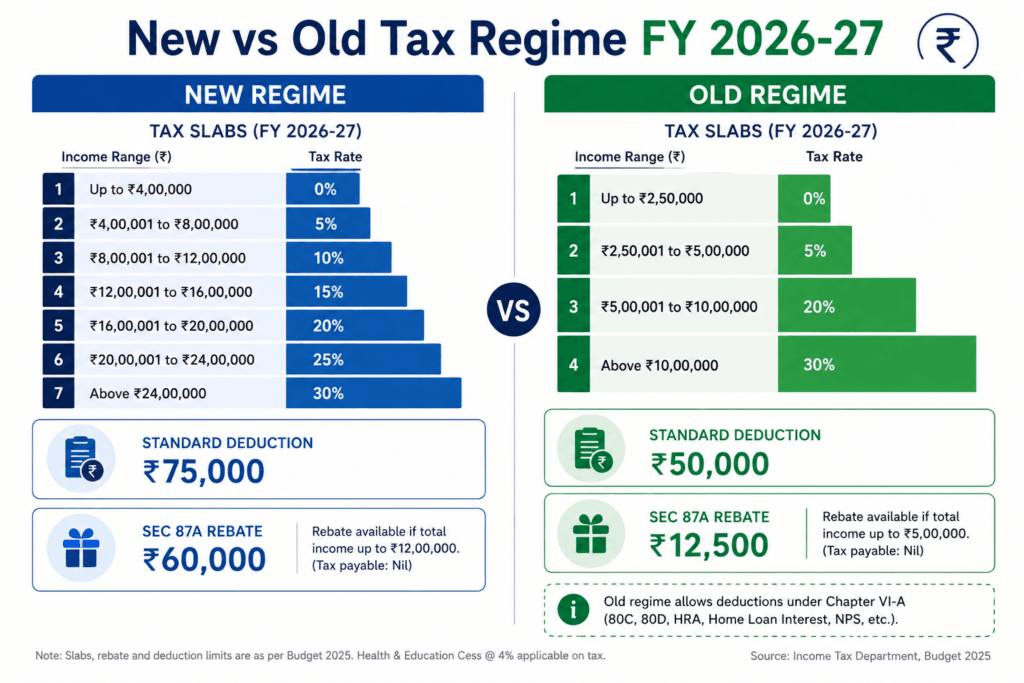
New vs Old Tax Regime FY 2026-27 : What changed for FY 2026–27 — and what stayed the same
Budget 2026 did not change income tax slabs or rates. The slab structure introduced in Budget 2025 continues without modification for FY 2026–27 (AY 2027–28). So if you already understand last year’s structure, very little has changed on the rate side.
What is new for FY 2026–27:
- The new Income Tax Act, 2025 replaces the Income Tax Act, 1961 with effect from April 1, 2026 — but the core slab rates, deductions, and both regimes remain structurally unchanged
- Revised income tax returns can now be filed up to March 31 of the following year (previously December 31), though a late fee applies
- The maximum surcharge rate under the new regime remains capped at 25% (versus up to 37% under the old regime for very high earners)
- The new regime stays the default — if you don’t actively opt out, your income is assessed under it
Source: Income Tax Department, Government of India — incometax.gov.in
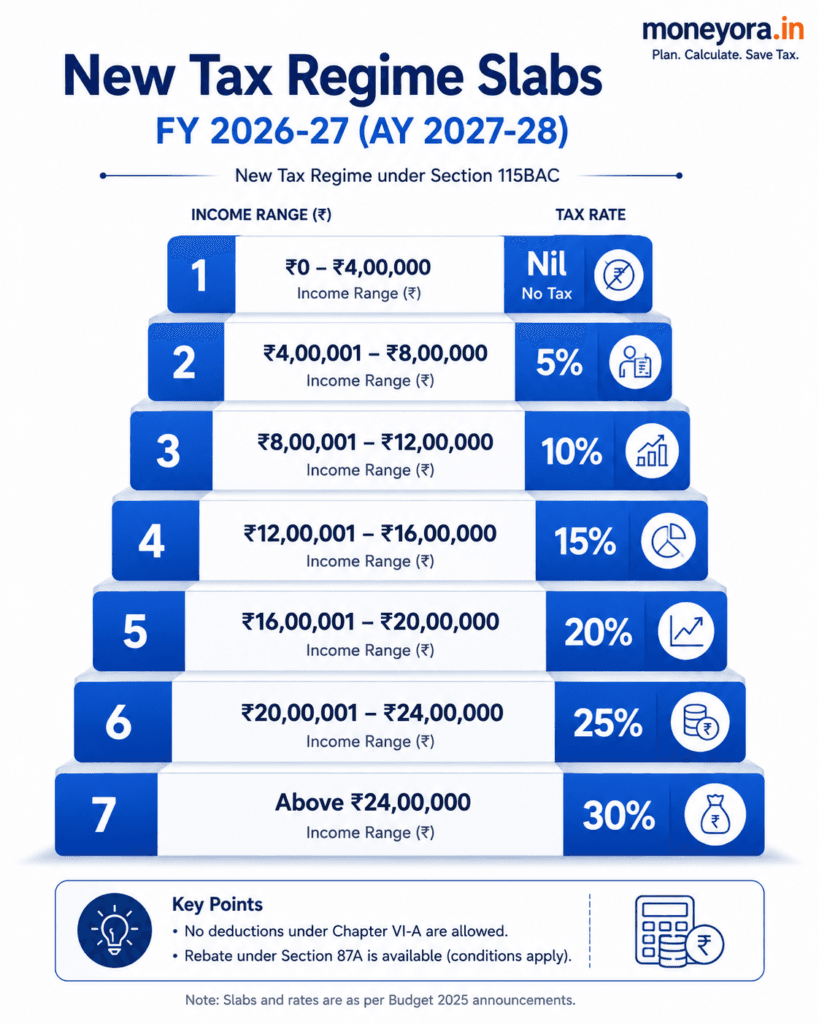
New vs Old Tax Regime FY 2026-27 : New tax regime slabs and rates for FY 2026–27
The new regime has 7 slabs. The big shift from the old structure is that income up to ₹4 lakh is nil — previously it was nil only up to ₹3 lakh. Combined with the rebate, a salaried employee earning up to ₹12.75 lakh gross pays zero tax.
New vs Old Tax Regime FY 2026-27 : New tax regime slabs — FY 2026–27 (AY 2027–28)
| Income Range | Tax Rate |
|---|---|
| Up to ₹4,00,000 | Nil |
| ₹4,00,001 – ₹8,00,000 | 5% |
| ₹8,00,001 – ₹12,00,000 | 10% |
| ₹12,00,001 – ₹16,00,000 | 15% |
| ₹16,00,001 – ₹20,00,000 | 20% |
| ₹20,00,001 – ₹24,00,000 | 25% |
| Above ₹24,00,000 | 30% |
Standard deduction under new regime: ₹75,000 (for salaried employees and pensioners)
Section 87A rebate: ₹60,000 for resident individuals with taxable income up to ₹12 lakh. This brings tax to nil.
Health and Education Cess: 4% on total tax (including surcharge)
Surcharge (new regime): Capped at 25% for income above ₹2 crore
Practical result: A salaried employee with gross income of ₹12,75,000 has a taxable income of ₹12,00,000 after the ₹75,000 standard deduction. On ₹12 lakh, the slab-wise tax is ₹60,000. The Section 87A rebate eliminates it entirely. Final tax = ₹0.
New vs Old Tax Regime FY 2026-27 : Old tax regime slabs and rates for FY 2026–27
The old regime’s slab rates have not changed in years. The rates are higher, but the mechanism allows you to bring down your taxable income significantly through deductions and exemptions.
New vs Old Tax Regime FY 2026-27 : Old tax regime slabs — FY 2026–27 (AY 2027–28)
| Income Range | Tax Rate (Below 60 yrs) | Tax Rate (Senior: 60–80 yrs) | Tax Rate (Super Senior: 80+ yrs) |
|---|---|---|---|
| Up to ₹2,50,000 | Nil | Nil | Nil |
| ₹2,50,001 – ₹3,00,000 | 5% | Nil | Nil |
| ₹3,00,001 – ₹5,00,000 | 5% | 5% | Nil |
| ₹5,00,001 – ₹10,00,000 | 20% | 20% | 20% |
| Above ₹10,00,000 | 30% | 30% | 30% |
Standard deduction (old regime): ₹50,000
Section 87A rebate (old regime): Up to ₹12,500 for income up to ₹5 lakh
Surcharge (old regime): Can go up to 37% for very high earners
The critical advantage here: every rupee of eligible deduction you claim reduces the taxable income before these slab rates apply. That is the lever the old regime gives you.
New vs Old Tax Regime FY 2026-27 : Side-by-side comparison: deductions, exemptions, standard deduction
This is where most guides either over-simplify or bury the important stuff. The table below shows exactly what you can and cannot claim under each regime.
| Deduction / Exemption | Old Regime | New Regime |
|---|---|---|
| Standard Deduction (Salaried) | ₹50,000 | ₹75,000 |
| Section 80C (PPF, ELSS, LIC, EPF, etc.) | Up to ₹1,50,000 | Not available |
| Section 80D (Health Insurance) | Up to ₹25,000–₹1,00,000 | Not available |
| HRA Exemption | Available (as per formula) | Not available |
| LTA (Leave Travel Allowance) | Available (every 4 years) | Not available |
| Home Loan Interest — Section 24(b) | Up to ₹2,00,000 (self-occupied) | Not available (self-occupied) |
| Home Loan Interest — Let-out property | Actual interest (no cap) | Available (let-out only) |
| Employer NPS — Section 80CCD(2) | Up to 10% of basic | Up to 14% of basic (govt employees) |
| Section 80TTA (savings interest) | Up to ₹10,000 | Not available |
| Section 87A Rebate | ₹12,500 (income up to ₹5L) | ₹60,000 (income up to ₹12L) |
| Standard 30% deduction on rental income | Available | Available |
| Chapter VI-A deductions (80C, 80D, etc.) | Most available | Not available |
One thing worth noting: the new regime’s higher standard deduction (₹75,000 vs ₹50,000) and its much stronger rebate (₹60,000 vs ₹12,500) are designed specifically to favor people who don’t invest in tax-saving instruments. If you invest nothing under 80C and don’t have HRA or a home loan, the new regime almost certainly saves you money.
If you’re actively using the PPF calculator on MoneyOra to plan annual deposits, or the EPF calculator to estimate provident fund returns, those contributions count as 80C deductions — and their tax value belongs to the old regime analysis.
New vs Old Tax Regime FY 2026-27 : Worked salary examples new vs old regime side-by-side
Here’s where abstract comparisons end and real numbers begin. All examples below assume a salaried individual, resident in India, below 60 years of age, with no special-rate income like capital gains.
New vs Old Tax Regime FY 2026-27 : Example 1 – ₹8 lakh gross salary (minimal deductions)
| Item | Old Regime | New Regime |
|---|---|---|
| Gross Salary | ₹8,00,000 | ₹8,00,000 |
| Standard Deduction | ₹50,000 | ₹75,000 |
| Section 80C | ₹50,000 (token) | Nil |
| Taxable Income | ₹7,00,000 | ₹7,25,000 |
| Tax on slabs | ₹62,500 | ₹16,250 |
| Section 87A Rebate | ₹12,500 | Nil (income > ₹7L) |
| Tax after rebate | ₹50,000 | ₹16,250 |
| Cess (4%) | ₹2,000 | ₹650 |
| Final Tax | ₹52,000 | ₹16,900 |
| Verdict | New regime saves ₹35,100 | |
New vs Old Tax Regime FY 2026-27 : Example 2 – ₹12 lakh gross salary (moderate deductions)
| Item | Old Regime | New Regime |
|---|---|---|
| Gross Salary | ₹12,00,000 | ₹12,00,000 |
| Standard Deduction | ₹50,000 | ₹75,000 |
| 80C deductions | ₹1,50,000 | Nil |
| 80D (health insurance) | ₹25,000 | Nil |
| HRA exemption | ₹60,000 | Nil |
| Taxable Income | ₹9,15,000 | ₹11,25,000 |
| Tax on slabs | ₹1,17,500 | ₹52,500 |
| Section 87A Rebate | Nil | Nil (income > ₹12L) |
| Cess (4%) | ₹4,700 | ₹2,100 |
| Final Tax | ₹1,22,200 | ₹54,600 |
| Verdict | New regime saves ₹67,600 | |
Note: Even with moderate deductions of ~₹2.35L in the old regime, the new regime wins here because the new slab rates are far lower at this income level.
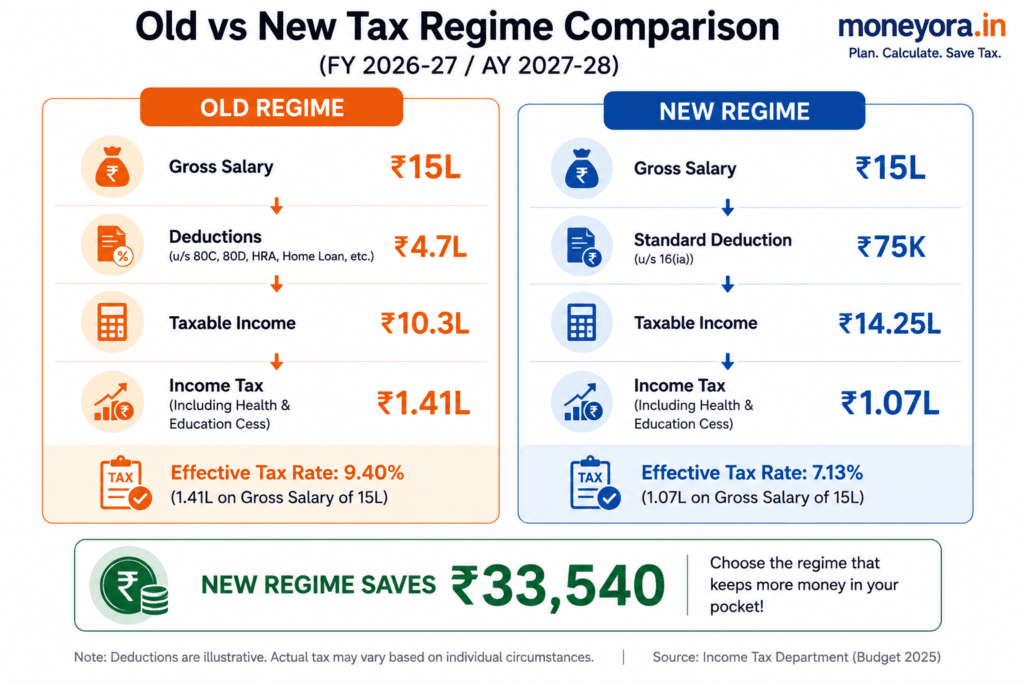
New vs Old Tax Regime FY 2026-27 : Example 3 – ₹15 lakh gross salary (high deductions — old regime’s sweet spot)
| Item | Old Regime | New Regime |
|---|---|---|
| Gross Salary | ₹15,00,000 | ₹15,00,000 |
| Standard Deduction | ₹50,000 | ₹75,000 |
| 80C (maxed out) | ₹1,50,000 | Nil |
| 80D (self + parents) | ₹50,000 | Nil |
| HRA exemption | ₹1,20,000 | Nil |
| Home loan interest 24(b) | ₹1,50,000 | Nil |
| Taxable Income | ₹9,80,000 | ₹14,25,000 |
| Tax on slabs | ₹1,36,000 | ₹1,03,750 |
| Cess (4%) | ₹5,440 | ₹4,150 |
| Final Tax | ₹1,41,440 | ₹1,07,900 |
| Verdict | New regime still saves ₹33,540 | |
Even with ₹4.7 lakh in total deductions, the new regime wins at ₹15 lakh. This surprises most people.
New vs Old Tax Regime FY 2026-27 : Example 4 – ₹25 lakh salary (maxed deductions, home loan)
| Item | Old Regime | New Regime |
|---|---|---|
| Gross Salary | ₹25,00,000 | ₹25,00,000 |
| Standard Deduction | ₹50,000 | ₹75,000 |
| 80C (maxed) | ₹1,50,000 | Nil |
| 80D | ₹50,000 | Nil |
| HRA | ₹1,50,000 | Nil |
| Home Loan — 24(b) | ₹2,00,000 | Nil |
| NPS 80CCD(1B) | ₹50,000 | Nil |
| Taxable Income | ₹18,50,000 | ₹24,25,000 |
| Tax on slabs | ₹3,87,500 | ₹4,56,250 |
| Cess (4%) | ₹15,500 | ₹18,250 |
| Final Tax | ₹4,03,000 | ₹4,74,500 |
| Verdict | Old regime saves ₹71,500 | |
At ₹25 lakh, the old regime finally wins — but only because this person claims every major deduction available: maxed 80C, HRA, home loan interest, 80D, and NPS. Total deductions here are ₹6.5 lakh. Most people in this bracket do not actually claim all of these.
New vs Old Tax Regime FY 2026-27 : Example 5 – ₹50 lakh salary
| Item | Old Regime (maxed deductions) | New Regime |
|---|---|---|
| Gross Salary | ₹50,00,000 | ₹50,00,000 |
| Standard Deduction | ₹50,000 | ₹75,000 |
| Total Deductions (80C+80D+HRA+24b+NPS) | ₹6,50,000 | Nil |
| Taxable Income | ₹43,00,000 | ₹49,25,000 |
| Tax on slabs | ₹11,62,500 | ₹13,13,750 |
| Surcharge (10% for >₹50L — marginal) | Nil (just under) | Nil (just under) |
| Cess (4%) | ₹46,500 | ₹52,550 |
| Final Tax | ₹12,09,000 | ₹13,66,300 |
| Verdict | Old regime saves ₹1,57,300 | |
High earners who maximize deductions — especially those with a home loan on a self-occupied property plus full 80C + 80D + HRA — will generally find the old regime cheaper. The surcharge situation also matters here: the old regime’s max surcharge is 37%, the new regime caps it at 25%. So for incomes above ₹2 crore, the new regime’s surcharge cap can actually save more than the deductions lost.
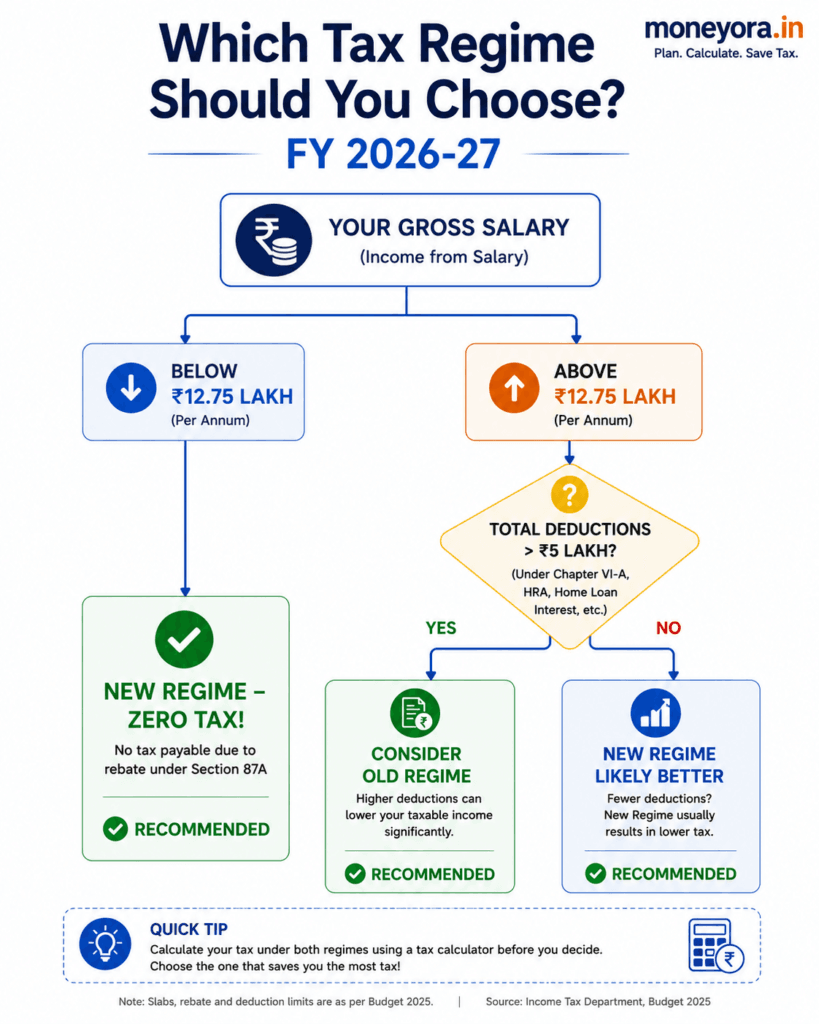
The break-even deduction level — when to switch
People ask “which is better?” but the real question is: “what is the minimum deduction level that makes the old regime worth it?” Here is how to think about this.
Break-even deduction thresholds (approximate, FY 2026–27)
| Gross Salary | Minimum deductions for old regime to win | Typical recommendation |
|---|---|---|
| ₹5 lakh – ₹8 lakh | Not achievable — new regime wins regardless | New regime |
| ₹8 lakh – ₹12 lakh | Very high (₹5+ lakh) — rarely achievable | New regime |
| ₹12 lakh – ₹15 lakh | ₹4–5 lakh in deductions | New regime for most people |
| ₹15 lakh – ₹20 lakh | ₹5–6 lakh in deductions | Calculate both; old regime wins only with maxed deductions |
| ₹20 lakh – ₹30 lakh | ₹5.5–7 lakh in deductions | Old regime if you have home loan + HRA + full 80C + 80D |
| ₹30 lakh – ₹50 lakh | ₹6 lakh+ in deductions | Old regime with maxed deductions; calculate both |
| Above ₹2 crore | The surcharge cap matters more than deductions | New regime (surcharge capped at 25%) |
The general observation from the numbers: you need somewhere around ₹3.75 lakh to ₹6 lakh in actual eligible deductions for the old regime to beat the new regime. Most middle-income salaried employees claiming only 80C and basic 80D don’t reach that threshold.
Who should choose which regime
Choose the new tax regime if you:
- Earn up to ₹12.75 lakh gross (zero tax under new regime)
- Don’t have a home loan on a self-occupied property
- Don’t pay rent (no HRA to claim)
- Haven’t maxed 80C through disciplined yearly investment
- Want simplicity and fewer documents at filing time
- Have income above ₹2 crore (surcharge capped at 25% under new regime)
Consider the old tax regime if you:
- Have a home loan on a self-occupied property with ₹1.5–2 lakh/year in interest
- Pay significant rent and receive HRA (₹1–2 lakh/year in exemption)
- Max out 80C every year through EPF + PPF + ELSS + LIC
- Pay health insurance premiums for self and parents (80D)
- Contribute to NPS under 80CCD(1B) for the additional ₹50,000 deduction
- Are in the ₹20–50 lakh income bracket with all of the above
If you invest regularly in SIP or lumpsum mutual funds, note that ELSS (Equity Linked Savings Schemes) mutual funds give 80C deduction in the old regime. If you invest ₹1.5 lakh/year in ELSS, that alone brings ₹45,000 in tax savings at 30% slab. Factor this into your decision.
Switching rules: one size does not fit all
This is the part that trips people up. The switching rules are completely different depending on whether you have business income or not.
Salaried employees (no business income)
- Can switch between old and new regime every financial year
- Inform your employer at the start of the year for TDS purposes
- You can choose a different regime when filing your actual ITR — even if TDS was deducted under a different regime
- The deadline for filing under your preferred regime is the ITR due date under Section 139(1) — July 31, 2027 for FY 2026–27 non-audit cases
Business owners and professionals (business income)
- To opt out of the new regime (default) into the old regime, file Form 10-IEA on or before the ITR due date
- You get only one lifetime opportunity to switch back to the new regime after opting out
- This is irreversible — plan carefully, ideally with a CA
Many salaried employees don’t realize they can correct their regime at ITR filing even if their employer’s TDS was deducted under the wrong regime. The tax department reconciles at assessment. You are not locked in by TDS.
what most guides miss
Most articles on this topic show you slabs and say “calculate both.” Here’s what they don’t tell you.
The opportunity cost problem with 80C
The old regime rewards you for 80C investments. But the best 80C instruments — PPF, ELSS — are long-term. If you’re already investing in them for wealth creation, not just tax saving, that’s fine. The deduction is a bonus. But if you’re investing in a low-return LIC endowment plan purely to claim 80C, you may be giving up 5–6% returns to save 20–30% in taxes. The math often doesn’t work. A ₹1.5 lakh ELSS investment saves ₹31,200 in taxes at 20% slab — but you can verify the long-term growth difference on MoneyOra’s CAGR calculator.
The home loan grey zone
Home loan interest on a self-occupied property (Section 24b) is not available under the new regime. But interest on a let-out property IS deductible under both regimes. If you’ve rented out your flat and live in rented accommodation yourself, the calculation changes entirely. Your rental income gets taxed, but the interest is set off. A CA is worth consulting in this scenario.
The NPS exception that most people ignore
Employer’s NPS contribution under Section 80CCD(2) is available under the new regime. If your employer contributes 10–14% of your basic to NPS, that deduction reduces your taxable income even in the new regime. This is the one significant deduction the new regime allows. If you’re not using this, check with HR — it’s essentially free money in tax savings. Use MoneyOra’s NPS calculator to see how employer NPS contributions affect both your retirement corpus and current tax liability.
The surcharge inversion above ₹2 crore
For very high earners, the new regime’s 25% surcharge cap can save more than all the deductions combined. A ₹3 crore income under the old regime faces a 37% surcharge. Under the new regime, it’s capped at 25%. On a ₹3 crore income, that’s a surcharge difference of roughly ₹5–6 lakh annually. This is a situation where the new regime wins decisively regardless of deductions.
Risks and common mistakes
Mistakes people make when choosing a regime
- Copying a colleague’s choice — their income, HRA situation, and home loan are different from yours. Their regime choice may be wrong for you.
- Forgetting employer NPS — this is the one deduction available in the new regime. Many people don’t realize it and leave money on the table.
- Assuming old regime always wins with a home loan — only if the home loan is on a self-occupied property and the interest is ₹1.5 lakh+. Otherwise it may not tip the balance.
- Thinking you’re locked in by TDS — you’re not, as a salaried employee. Correct your regime when filing ITR.
- Not factoring in the Section 87A rebate cliff — if your taxable income in the new regime is ₹12,00,001, you lose the entire ₹60,000 rebate. A ₹1 surplus costs you ₹60,000. Marginal relief exists but works in a specific way. If your income is close to this line, a CA review is worth the fee.
- Business owners switching carelessly — unlike salaried employees, business owners can only switch back once. An impulsive regime choice made in April can bind you for years.
Frequently asked questions
Is the new tax regime better for FY 2026–27?
For most salaried employees earning up to ₹20 lakh without a home loan or large HRA, yes. The new regime’s lower slab rates, higher standard deduction (₹75,000 vs ₹50,000), and the ₹60,000 Section 87A rebate make it favorable. The old regime only wins when total eligible deductions cross roughly ₹5–6 lakh. Always calculate both for your specific numbers.
Did income tax slabs change in Budget 2026?
No. Budget 2026 (Union Budget presented in February 2026) retained the slab structure introduced in Budget 2025 without changes. The 7-slab new regime and the 4-slab old regime both continue for FY 2026–27. However, revised ITR filing deadlines and the introduction of the Income Tax Act, 2025 are the notable administrative changes.
What is the Section 87A rebate in the new tax regime?
Under the new regime, resident individuals with taxable income up to ₹12 lakh get a tax rebate of ₹60,000, reducing their final tax to zero. Combined with the ₹75,000 standard deduction, a salaried employee with gross income up to ₹12.75 lakh pays no income tax. This rebate does not apply to income taxed at special rates, like capital gains.
Can I switch between old and new tax regime every year?
Salaried employees without business income can switch every financial year. You inform your employer at the start of the year, but you can also change at the time of filing your ITR (by the due date). Business owners and professionals can only switch from new to old regime once in their lifetime using Form 10-IEA, and can only revert once. For them, this requires careful long-term planning.
Is income up to ₹12 lakh tax-free under the new regime?
For resident individuals, yes — taxable income up to ₹12 lakh is effectively tax-free due to the ₹60,000 Section 87A rebate. The slab-wise tax on ₹12 lakh is exactly ₹60,000, which the rebate eliminates. For salaried employees, the ₹75,000 standard deduction means a gross salary of ₹12.75 lakh translates to ₹12 lakh taxable — still zero tax. Non-resident Indians (NRIs) do not get this rebate.
Is Section 80C available in the new tax regime?
No. Section 80C deductions — PPF, ELSS, NSC, life insurance premiums, home loan principal repayment, and others — are not available under the new tax regime. The only significant deduction available in the new regime is the employer’s NPS contribution under Section 80CCD(2), up to 14% of basic salary for government employees or 10% for others.
What happens if my income is just above ₹12 lakh in the new regime?
The Section 87A rebate applies only if taxable income does not exceed ₹12 lakh. If your taxable income is ₹12,00,001, you lose the entire rebate and pay tax on the full ₹12 lakh plus the rupee above. Marginal relief applies: your total tax cannot exceed the income above ₹12 lakh. But income near this cliff deserves careful tax planning — employer NPS contributions or a timing adjustment can make a large difference.
Which tax regime is better for a ₹15 lakh salary?
In most cases, the new regime. Our worked example above shows that even with ₹4.7 lakh in deductions under the old regime, the new regime still saves ₹33,540 at ₹15 lakh. The old regime only wins at this income level if you can claim deductions of ₹5–6 lakh — which requires a home loan, HRA, maxed 80C, maxed 80D, and NPS contributions all together.
Do I need to inform my employer about my tax regime choice?
Yes, at the beginning of the financial year. Employers use this to calculate your monthly TDS. If you don’t inform them, TDS is deducted under the new regime (the default). However, even if TDS was deducted under the wrong regime, you can file your ITR under your preferred regime and claim a refund or pay the balance. The employer’s TDS choice does not bind your final return.
Is HRA exemption available in the new tax regime?
No. HRA (House Rent Allowance) exemption is not available under the new tax regime. If you pay significant rent and receive a large HRA component, this can make the old regime attractive — particularly in metro cities where rent is high and HRA exemptions can reach ₹1–2 lakh per year or more. Calculate the actual HRA exemption using the formula (actual HRA received, 50%/40% of basic salary, rent paid minus 10% of basic) and factor that into your regime decision.
Which tax regime is better for senior citizens?
Senior citizens (60–80 years) have a higher basic exemption limit of ₹3 lakh under the old regime, and super seniors (80+) have ₹5 lakh. Under the new regime, the nil slab applies uniformly to all ages up to ₹4 lakh. For senior citizens with significant deductions (medical expenses under 80D can go up to ₹1 lakh for self + parents), the old regime may be advantageous. For those without major deductions, the new regime’s higher rebate tends to win.
new vs old tax regime FY 2026–27
The honest answer is that the new tax regime wins for the majority of Indian salaried employees in 2026–27. The wider nil-tax slab, the higher standard deduction, and the powerful ₹60,000 Section 87A rebate collectively make it better for anyone without a large combination of home loan, HRA, and maxed 80C.
The old regime remains worth it if — and this is genuinely an “if” — you can claim deductions of ₹5 lakh or more annually. That typically means: you have a home loan on a self-occupied property (₹2 lakh interest), you pay rent in a city (₹1–1.5 lakh HRA), you max 80C (₹1.5 lakh), and you have health insurance for family and parents (₹50,000 under 80D). If all four apply, the old regime is likely better above ₹20 lakh income.
- New regime is the default — do nothing and you’re in it
- Tax-free up to ₹12.75 lakh gross for salaried employees under new regime
- Old regime only wins with deductions of ₹5 lakh+ at middle incomes
- Salaried employees can switch regimes at ITR filing time — even if TDS was different
- Business owners get only one chance to switch from new to old — plan carefully
- Very high earners (₹2 crore+) benefit from new regime’s 25% surcharge cap
Before April ends, pull out your Form 16, estimate your deductions honestly, and run the numbers for both regimes. The difference can be ₹50,000–₹1.5 lakh at mid-to-high income levels. That is not a small amount.
To model your SIP investments and see how they grow over time, try MoneyOra’s SIP calculator. For fixed deposits in the old regime, the FD calculator shows after-tax returns under both regimes. And for retirement planning with NPS deductions, the NPS calculator on MoneyOra walks through the math step by step.
Use the free calculator now on MoneyOra.in — go to https://moneyora.in/financial-calculator-india/ and compare your exact tax under both regimes in minutes.
This article is for educational and informational purposes only. Tax laws are subject to change. Always verify calculations with the official Income Tax portal at incometax.gov.in and consult a qualified Chartered Accountant before filing your returns. MoneyOra does not provide individual tax advice.


Pingback: Tax Deductions Other Than 80C for Salaried Employees FY 2026-27 - MoneyOra
Pingback: Step Up SIP Calculator: How ₹5,000/Month Becomes ₹1.37Crore
Pingback: How Much Term Insurance Do I Need? Best HLV Method 2026