
Step Up SIP Calculator: How ₹5,000/Month Becomes ₹1.37 Crore
Most people start a SIP. Then forget to increase it. That one simple oversight ends up costing them crores in the run.
A step up SIP solves this problem automatically. You begin with an amount you can comfortably afford today like ₹5,000 per month. Set a rule to increase it by a fixed percentage every year. As your income grows your SIP grows with it. The compound interest on those contributions in later years completely changes the outcome.
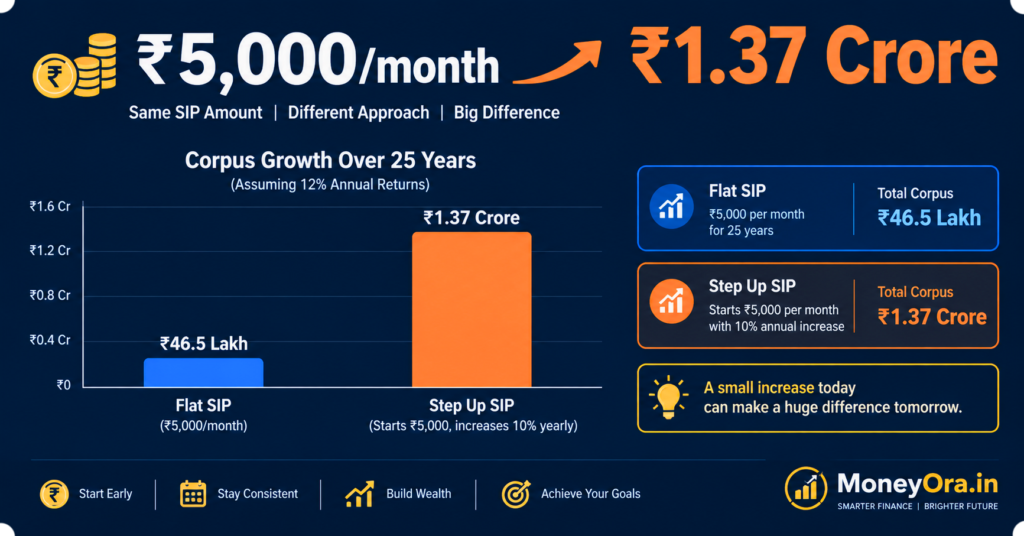
Here is the proof. A flat SIP of ₹5,000 per month at a 12% return over 25 years builds around ₹94 lakh. The same ₹5,000 step up SIP with a 10% annual increase grows to about ₹1.37 crore over the same period. That difference of ₹43 lakh came from nothing more than a small steady increase each year a rise you’d barely even notice in your monthly bank balance.
This guide walks through the math, behind it shows three real-life examples that Indian investors can relate to points out the mistakes that quietly destroy returns and explains how to set up a step up SIP today.
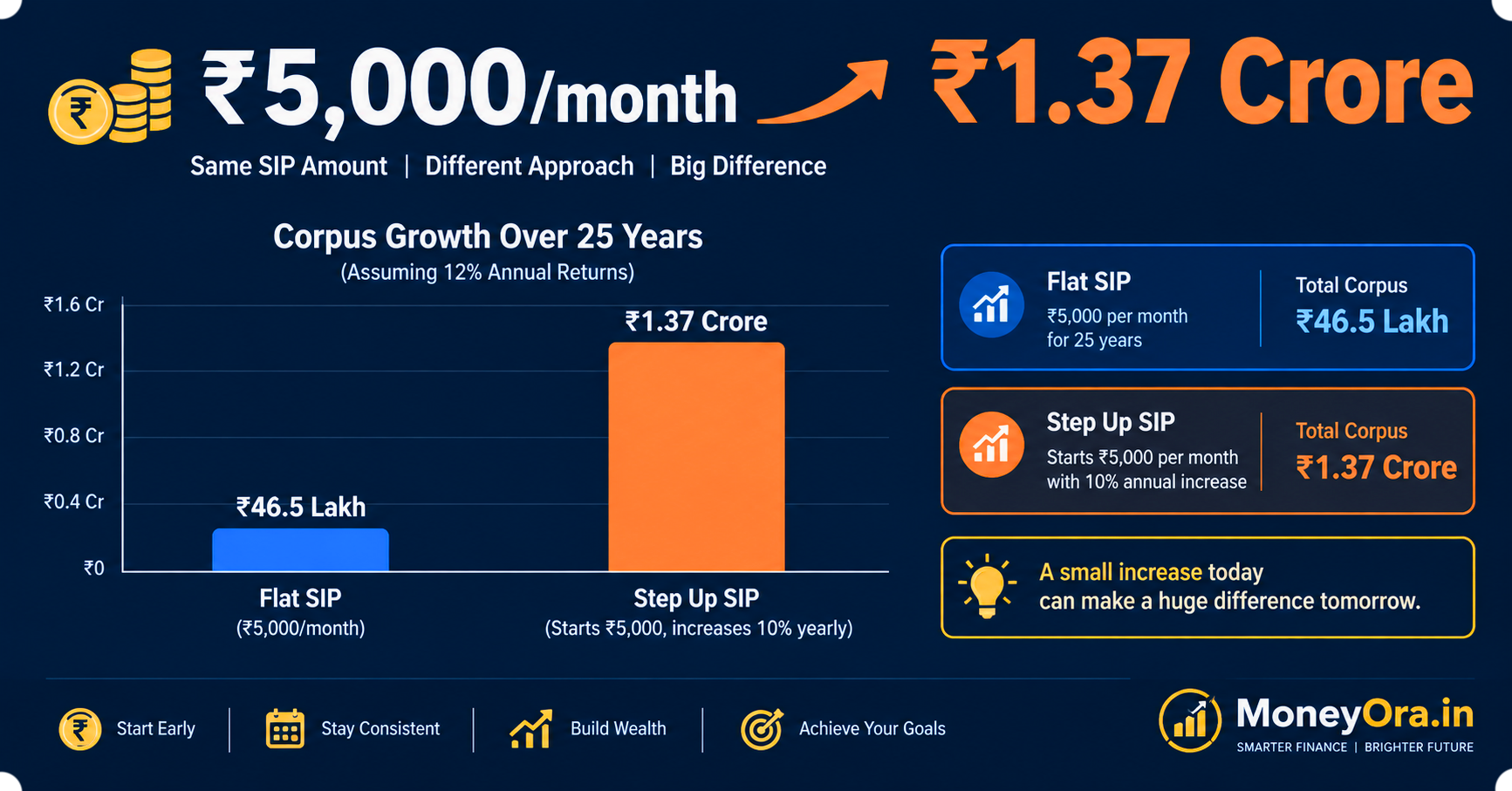
- A step up SIP with 10% annual increase can build 45% more corpus than a flat SIP from the same starting amount
- ₹5,000/month starting SIP at 12% CAGR with 10% annual step up grows to approx ₹1.37 crore in 25 years
- Monthly SIP inflows in India crossed ₹31,961 crore in July 2026 (AMFI data)
- The biggest mistake is not increasing the SIP amount even when income rises
- SEBI regulations require KYC completion before any mutual fund investment in India
What is a Step Up SIP Why Does It Beat a Regular SIP?
A step up SIP also called a up SIP is a type of Systematic Investment Plan where your monthly contribution increases automatically at a set time usually every year by a fixed percentage or a fixed amount.
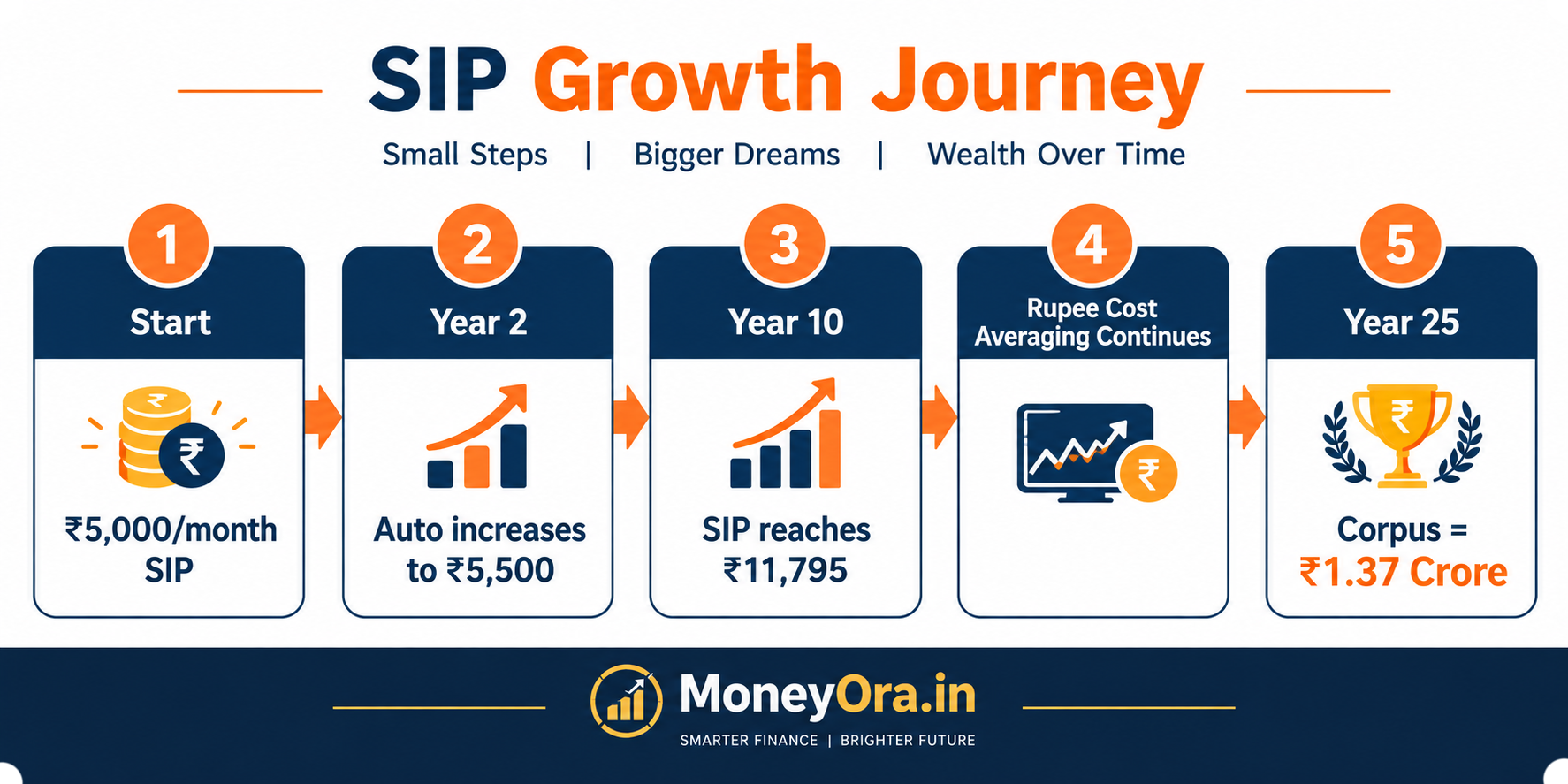
A regular SIP keeps the amount fixed at, say ₹5,000 for the entire time. A step up SIP starts at ₹5,000 and might go to ₹5,500 in year two ₹6,050 in year three and ₹12,968 by year ten assuming a 10% increase.
Why does this matter much? Because the rupees you invest in years 15 through 25 have less time to grow than the rupees from year one. The only way to make up for that time is to invest more in those later years. A step up SIP does that.
Imagine this. If your salary in year one was ₹50,000, per month. You put ₹5,000 into SIP that is a 10% savings rate. By year ten if your salary doubled to ₹1 lakh and your SIP is still ₹5,000 your savings rate dropped to 5%. A step up SIP keeps the savings rate even as your income grows.
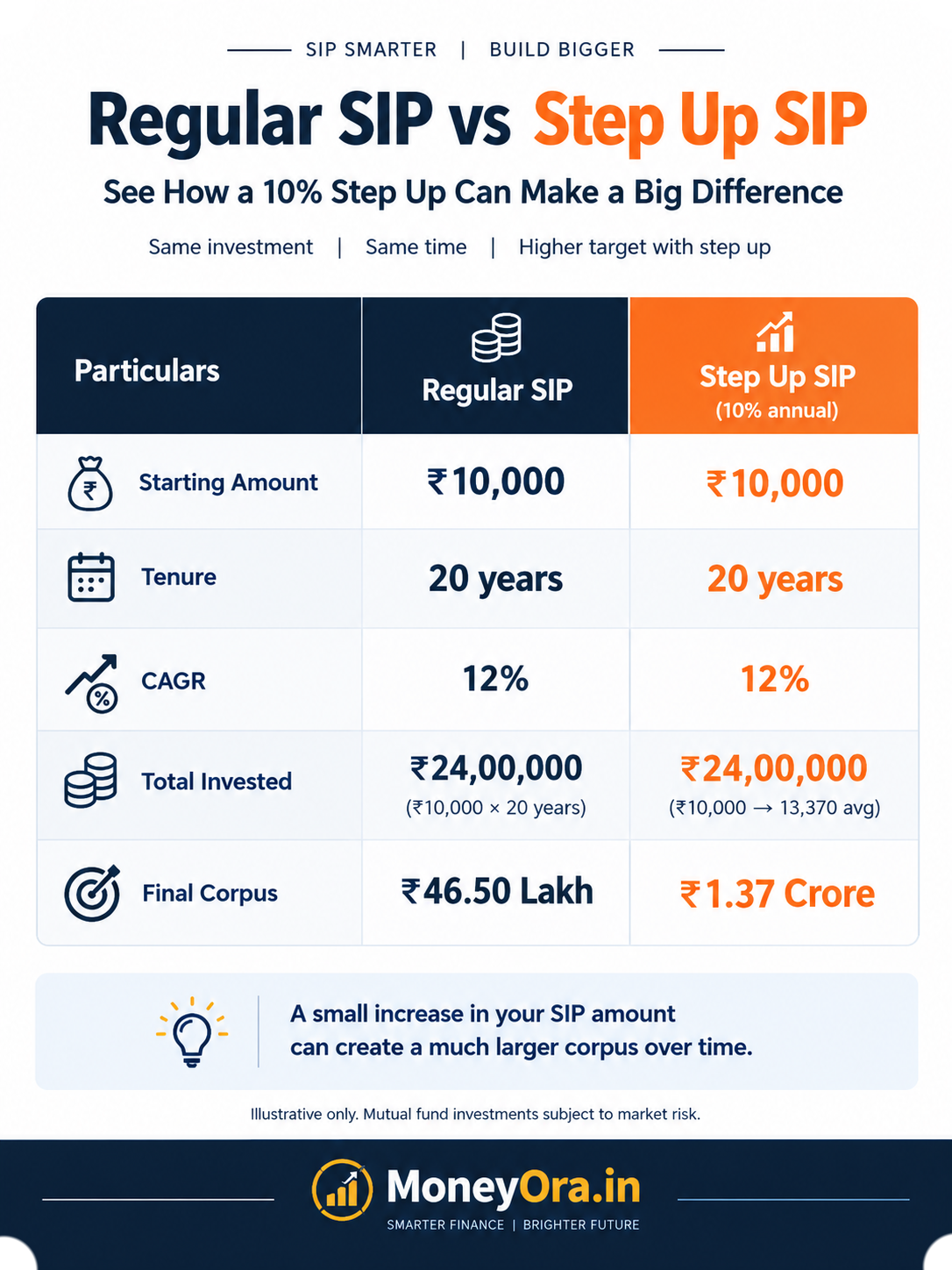
Regular SIP vs Step Up SIP at a glance:
| Feature | Regular SIP | Step Up SIP |
|---|---|---|
| Monthly amount | Fixed throughout | Increases every year |
| Investment discipline | Easy to maintain | Requires one-time setup |
| Corpus built (₹5K, 25 yrs, 12%) | ~₹94 lakh | ~₹1.37 crore (10% step up) |
| Savings rate over time | Decreases as income grows | Stays proportional to income |
| Corpus built (₹10K, 20 yrs, 12%) | ~₹99.9 lakh | ~₹2.74 crore (10% step up) |
| Best for | Fixed-income, conservative investors | Salaried professionals with annual increments |
The Exact Step Up SIP Calculation: ₹5,000 to ₹1.37 Crore
Let us run the actual math so you understand precisely what is happening not just a headline number.
Base assumptions:
- Starting monthly SIP: ₹5,000
- Annual step up: 10% (each year, the SIP amount increases by 10%)
- Expected CAGR: 12% (historical equity mutual fund average; not a guarantee)
- Tenure: 25 years
Here is how the SIP amount changes:
| Year | Monthly SIP Amount | Annual Investment |
|---|---|---|
| Year 1 | ₹5,000 | ₹60,000 |
| Year 2 | ₹5,500 | ₹66,000 |
| Year 5 | ₹7,321 | ₹87,852 |
| Year 10 | ₹11,795 | ₹1,41,540 |
| Year 15 | ₹19,013 | ₹2,28,156 |
| Year 20 | ₹30,641 | ₹3,67,692 |
| Year 25 | ₹49,380 | ₹5,92,560 |
Total amount you invest over 25 years approximately ₹58.2 lakh Estimated corpus at maturity approximately ₹1.37 crore Wealth created purely from market returns approximately ₹79 lakh
The earlier years lock in compounding on a low base. The later years add more capital that still has time to grow. It is this combination that drives the corpus so far above a flat SIP.
For comparison, the flat ₹5,000 SIP investor puts in just ₹15 lakh over 25 years and builds around ₹94 lakh. The step up SIP investor puts in ₹58.2 lakh and builds ₹1.37 crore. Yes, the step up investor invests more in absolute terms but that extra investment came from rising salary not from existing savings.
The real question is not “which builds more corpus” but “what does the extra ₹43 lakh cost you in monthly sacrifice?” In year 25 the step up SIP investor is putting in ₹49,380 per month. But if their salary grew at a conservative 8% annually from ₹50,000 in year one, their month-25 salary would be roughly ₹3.4 lakh per month. That ₹49,380 SIP is only 14.5% of their income not very different from the 10% they started with.
Three Real Situations for Indian Investors
Situation 1: The New Graduate Starting at ₹5,000
Priya is 24 recently joined her job and gets ₹40,000 every month. She does not have left. She begins a step up SIP at ₹5,000 every month with a 10% increase and wants a 12% CAGR in an index fund.
At 50 she has invested for 26 years. Her total savings are about ₹1.52 crore. Her total investment was around ₹64 lakh. She did not get rich quickly. She created real wealth from a good starting point and the step up SIP made her sacrifice feel small.
Situation 2: The Mid-Career Professional at ₹15,000
Rajesh is 35 earns ₹80,000 every month. He starts a step up SIP at ₹15,000 every month with an 8% increase and a 12% CAGR goal. He wants to retire at 60 so he has 25 years.
His estimated savings at 60 is ₹3.8 crore. Total invested: around ₹1.3 crore. The 8% step up was picked because it matched his usual salary raise history.
Situation 3: The Cautious Investor with a 5% Step Up
Anita is 40 careful with money and not sure her salary will grow quickly. She starts at ₹10,000 every month with a 5% increase and expects a 10% CAGR in a balanced or hybrid fund.
Over 20 years she builds around ₹82 lakh with an investment of about ₹40 lakh. A flat ₹10,000 SIP at 10% over 20 years would give her around ₹76 lakh. Even the small 5% step up added ₹6 lakh more. This was in a time of lower expected returns.
The lesson from all three situations: The step up percentage is not as important as starting. Even a 5% yearly increase makes a difference compared to a flat SIP, over long periods.
How to Set Up a Step Up SIP in India (Step by Step)
Setting up a step up SIP in India is not as complicated as many people think. Most of the platforms support this feature directly. You don’t need to go through any steps or paperwork. All you need is a basic things ready before you begin.
What you need before you start:
- A PAN card linked to Aadhaar (this is required by SEBI for all mutual fund investments)
- An active bank account where you can set up a NACH mandate
- KYC verification completed on the mutual fund platform you choose. Make sure the platform is registered with AMFI
Step 1: Choose the fund
If you are planning a step up SIP with a time horizon of 15 to 25 years equity mutual funds are the best option. They offer the potential for growth over the long term. Here are some good choices
- 50 index funds: These are low-cost funds that track the top 50 companies on the NSE. They offer market exposure with minimal management fee.
- Flexi-cap funds: These funds are managed by professionals who adjust the portfolio based on market conditions. They invest across mid and small-cap stocks.
- Mid-cap funds: These are riskier but have the potential for higher returns over time. They focus on sized companies that can grow quickly.
One important thing to check before investing the expense ratio. A difference of 0.5% in the expense ratio can cost you a lot over 20 years. For example on a corpus of ₹10 lakh that difference can grow to ₹5 to ₹10 lakh in returns. Always go for plans. These plans have expense ratios compared to regular plans.
Step 2: Select step up percentage
Now decide how much your SIP amount will increase each year. A simple rule is to match your expected salary increase. If you get 8% to 10% pay hikes every year then go with 8% to 10% step up If your salary increases are not fixed it’s better to choose a flat increase in rupees instead of a percentage. For example you might increase by ₹1,000 every year of a percentage.
Step 3: Register on the fund platform
popular platforms like Groww, Zerodha Coin MF Central or the official website of the mutual fund AMC allow you to set up a step up SIP. During the registration process you will be asked to enter:
- The starting monthly SIP amount
- The step up percentage or the fixed amount increase
- How often the increase should happen. Annual is the common
- The total duration of the SIP
Once you fill in these details your SIP will be set to increase automatically every year.
Step 4: Set the NACH mandate
The NACH mandate is how your bank automatically deducts the SIP amount from your account. It’s important to set the mandate amount. Many people make a mistake here. They set the NACH mandate to their current SIP amount If your SIP increases each year the mandate will fail when the amount goes beyond what you have authorized.
For example if you start with ₹5,000 and increase it by 10% each year the amount will grow to ₹7,000 by the year If your NACH mandate is only, for ₹5,000 the transaction will fail. To avoid this set the mandate amount to least twice your starting SIP amount. This way even if your SIP grows the mandate will still cover it.
So if you begin with ₹5,000 set the NACH mandate to ₹10,000 or more. This ensures that your SIP runs smoothly without any interruptions.
5 Step Up SIP Mistakes That Silently Destroy Returns
A lot of people start a step up SIP and still underperform. Here is where the damage usually happens.
Mistake 1: Setting the NACH mandate too low
As described above, the most common technical failure. When the auto-debit mandate is lower than the SIP amount due to previous step-ups, the instalment bounces. Three consecutive bounces can trigger automatic SIP cancellation per SEBI mutual fund regulations.
Mistake 2: Choosing too aggressive a step-up without a salary plan
A 20% annual step up sounds great on paper. In year eight, your SIP amount would be roughly 4.3x your starting amount. If your income did not keep pace, you will either pause the SIP or redeem prematurely. Both outcomes hurt returns more than a modest step-up that you actually stick with.
Mistake 3: Not accounting for inflation in return projections
A step up SIP may build ₹1.31 crore in 15 years at 12% CAGR, but the inflation-adjusted value of that corpus at 6% inflation would be around ₹52 lakh in today’s purchasing power. This does not mean step up SIP is bad. It means you need to plan for a large enough corpus to cover inflation-adjusted goals, not just the nominal number.
Mistake 4: Choosing a regular plan over a direct plan
The distributor commission embedded in regular plans adds 0.5-1.0% per annum to the expense ratio. On a large step up SIP corpus over 20+ years, this difference is enormous.
Mistake 5: Stopping SIP during market corrections
Avoid stopping your SIPs during market fluctuations. Market corrections are when rupee cost averaging works hardest in your favour. You buy more units at lower NAV. Pausing a step up SIP during a correction and restarting it later often means missing the best accumulation window.
Tax on Step Up SIP Returns: What You Actually Keep
Every SIP instalment every step up SIP instalment is treated as its own purchase for tax purposes in India. This means the holding period is calculated for each instalment separately not from the date the SIP began.
For equity mutual fund step up SIP:
- Long term capital gains (LTCG) applies when the holding period of step up SIP exceeds 12 months.
- LTCG tax rate is 12.5% on gains above ₹1.25 lakh per year (post-2024 budget).
- Short term capital gains (STCG) applies at 20% for holdings of step up SIP under 12 months.
When you redeem a step up SIP, the instalments of step up SIP that were bought more than 12 months before the redemption date qualify for LTCG treatment. Plan redemptions carefully especially if you have built a corpus.
For debt mutual fund step up SIP:
- All gains are now taxed at your income tax slab rate regardless of holding period.
- No indexation benefit removed in 2023 budget).
- Hybrid and balanced fund step up SIPs follow the equity/debt tax rule based on equity allocation above or below 65%.
The step up SIP itself has no tax treatment. Tax is on the gains of step up SIP, not, on the strategy.
Step Up SIP vs Lumpsum: When Each Makes Sense
Many investors wonder whether a Step Up SIP is better than investing a lumpsum every year when they receive their annual bonus.
Step Up SIP advantages:
- Automated, removes need for discipline every month
- Rupee cost averaging across the year not one date
- Works without a large lumpsum available at any point
Lumpsum annual investment advantages:
- If markets are low at the time of investment the full amount benefits from recovery
- Simpler to track
The comparison is largely a choice. Many Indian investors who receive bonuses do both maintain a Step Up SIP through the year for rupee cost averaging and make a separate lumpsum investment from the annual bonus in January or February historically a period when markets are not, at peak valuations.
The Step Up SIP handles the wealth‑building discipline. The annual lumpsum adds an accelerator when cash is available. This combination often outperforms either strategy.
The AMFI Data Behind the Step Up SIP Boom
Monthly SIP inflows in India crossed ₹25,000 crore for the time in early 2026 according to AMFI data. Over 10 crore SIP accounts are now active a threefold increase from 2021. This shows how more people are using SIPs to invest regularly.
In July 2026 monthly SIP contributions hit ₹31,961 crore. That’s a year-on-year growth of 12.3% compared to July 2025. The growth is strong. It’s not just from new investors opening accounts. A lot of it comes from existing investors increasing their SIP amounts. This is what we call step up behaviour. It doesn’t always show up as a top-up SIP. Many investors just start contributing without changing their original setup.
The average SIP amount per account has gone up significantly over the three years. That means people are not just joining the market. They are also putting in money as they gain confidence and see results.
India’s mutual fund industry has grown a lot. It started at ₹6,700 crore in 1988. In 2025 it reached ₹75.6 lakh crore. That’s a jump SEBI continues to introduce reforms. These changes aim to make the environment more transparent and better for investors.
For people who are using step up SIPs these reforms make a difference. SEBI is pushing for disclosure. This includes details on total expense ratios scheme categorisation and direct plans. These steps help investors avoid costs. Today investors are better protected than at any point in the history of mutual funds. AMFI monthly SIP data
Should You Choose Step Up by Percentage or Flat Amount?
Both options exist on most platforms. The choice affects your corpus differently.
Percentage step-up (say 10% annually):
- Compound growth on the SIP contribution itself
- In year 20 a 10% step-up SIP starting at ₹5,000 pays in ₹30,641 per month
- Best when salary growth is expected to be broadly proportional over time
Flat amount step-up (say ₹500 per year):
- Simple predictable
- In year 20 your SIP would be ₹5,000 + (₹500 x 19) = ₹14,500 per month
- Good for investors who want predictability and find percentage arithmetic confusing
For wealth maximisation over long periods, percentage step-up wins. The compounding of the contribution amount itself adds to the corpus effect. But a flat-amount step-up that you actually maintain consistently will always beat a percentage step-up you abandon in year five.
Before Starting a Step Up SIP
Step up SIP is not a guaranteed wealth-building machine. Here is what can go wrong.
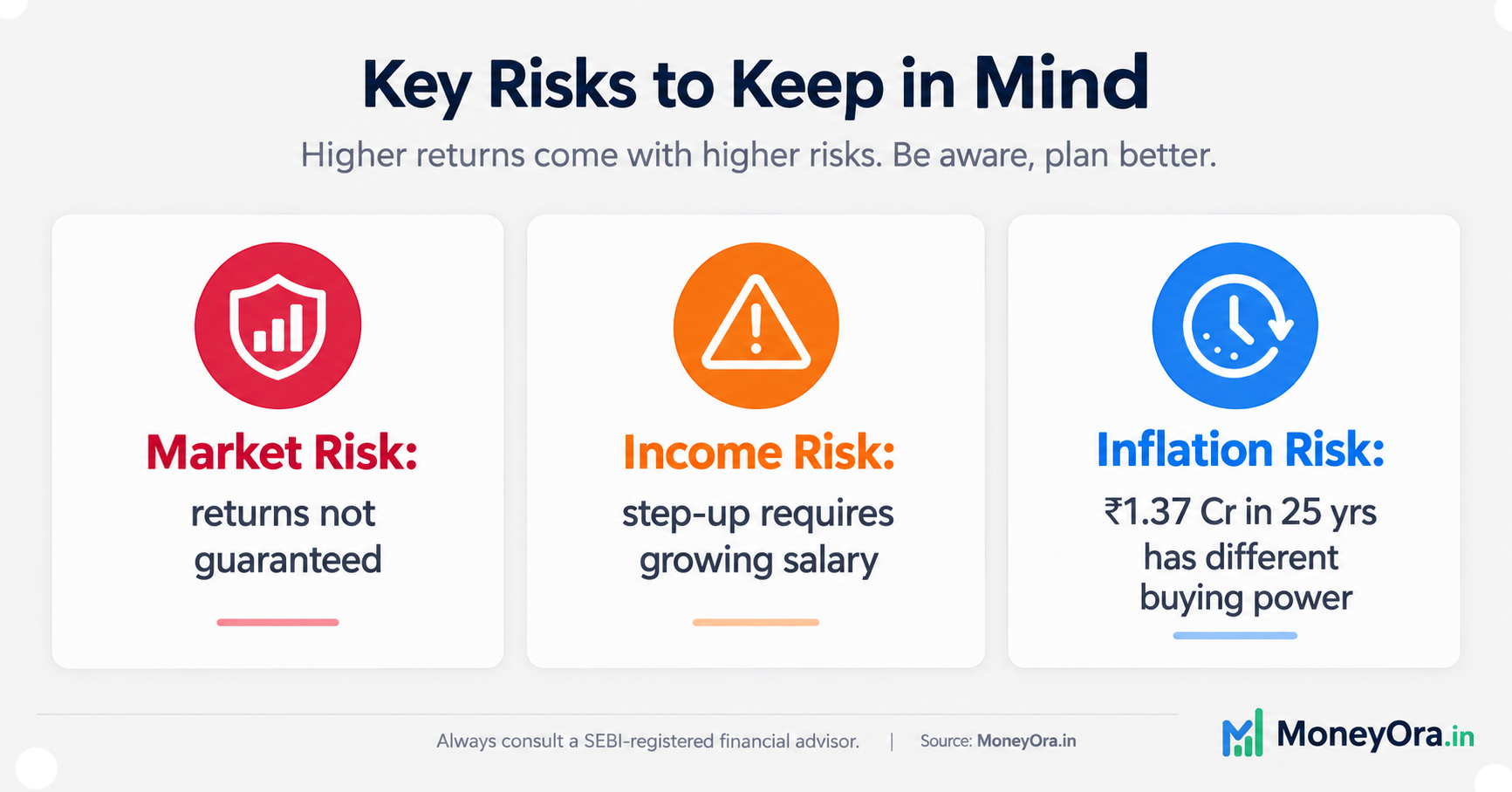
Market risk. A 12% CAGR assumption is based on historical data from Indian equity markets. Future returns may be lower especially if you invest during a period of high valuations and hold through prolonged market weakness.
Income risk. A 10% step up assumes your income grows at roughly that pace. Job loss, career transitions, or stagnant salaries can make the escalating SIP amount unaffordable. If you have to pause or stop you lose years of compounding.
Inflation risk. A ₹1.37 crore corpus in 25 years has a very different purchasing power than ₹1.37 crore today. Plan for an inflation-adjusted target not just a nominal number.
Behavioural risk. The biggest enemy of step up SIP returns is the investor not the market. Redeeming during corrections skipping step-up registrations or switching funds too frequently all erode the compounding effect.
A reasonable approach is to start with a conservative step-up percentage keep an emergency fund of 6 months of expenses in liquid assets and review the step up SIP annually not monthly. The less frequently you intervene the better compounding works.
Internal Links for Deeper Learning on MoneyOra
If you found this guide useful, these MoneyOra resources go deeper on related topics:
- SIP vs FD During Market Crashes: Which Performs Better? – Essential reading before you decide between a step up SIP and a fixed deposit strategy
- How to Build a ₹10 Lakh Emergency Fund in India – Build this before increasing your step up SIP commitment
- New vs Old Tax Regime FY 2026-27 – Understand how your SIP gains are taxed under each regime
- Financial Planning Meaning India – The broader context for how step up SIP fits into a financial plan
- EPF vs PPF vs NPS for Freshers in India – Compare step up SIP returns against other wealth-building instruments
- Salary Investment Plan: Can a ₹25,000 Salary Build Wealth? – Real scenarios for low-income investors using SIP
- FD vs Liquid Fund – Where to park emergency reserves outside your SIP
- Government Saving Schemes India – Compare step up SIP against PPF, NSC, and Sukanya Samriddhi
The Step Up SIP Is the Default Strategy for Salaried India
A step up SIP does not require discipline in the conventional sense. It requires one decision set up the step-up once and let the automation run.
The math is clear. A ₹5,000 flat SIP at 12% over 25 years builds around ₹94 lakh. The same SIP with a 10% annual step-up builds ₹1.37 crore. The difference is not luck or superior fund selection. It is the structural effect of investing more as your income grows.
The risks are real. Markets fluctuate incomes stagnate and inflation erodes nominal corpus. But the alternative of a flat SIP has all those same risks with less corpus to show at the end.
Start small if you must. A ₹1,000 step up SIP with a 10% annual increase started at 22 becomes a wealth-building engine by 45. The starting amount matters far less than starting sticking to it and stepping it up.
Use the free step up SIP calculator now on MoneyOra.in to run your own numbers with your starting amount your expected increment and your retirement target.
Disclaimer: All return projections in this article are illustrative and based on historical data. Mutual fund investments are subject to market risk. Past performance is not indicative of future returns. This article is educational and does not constitute financial advice. Please consult a SEBI-registered investment advisor before making investment decisions.
Frequently Asked Questions
What is the minimum amount for a step up SIP in India?
The minimum amount for a step up SIP in India is usually ₹500 per month on mutual fund platforms. The step-up amount is generally either ₹100 per year or 5% per year depending on the platform. There is no minimum set by SEBI for step up SIPs. Platforms like Groww and Zerodha Coin allow low starting amounts making step up SIPs easier for new investors to start.
How is step up SIP from a regular SIP?
A regular SIP keeps your investment amount the same every month until the end of the tenure. A step up SIP allows you to increase your investment amount at intervals such as every year. This helps investors grow their contributions along with their income. Over time this can lead to an investment corpus due to increased contributions.
Can I Stop a step up SIP?
Yes you can. Stop a step up SIP anytime without any penalty from the mutual fund company. However if there are three failed payments the SIP may be automatically canceled. To avoid this make sure your NACH mandate limit is set higher than your planned SIP amount. This ensures the payments go through smoothly.
What percentage step up should I choose?
Choose a step up percentage that matches your expected income growth. If you usually get 8% to 10% salary hikes a 10% increase each year is a choice. For those who prefer a conservative approach starting with 5% is safer. Even a 5% step up can significantly outperform a SIP over 15 to 20 years.
Is a step up SIP better than a lumpsum investment?
For people who earn a salary and do not have a large lumpsum to invest all at once a step up SIP is usually better than waiting to save a lumpsum. The habit of investing reduces the risk of choosing the wrong market timing. A mix of both step up SIP and lumpsum investments often gives the results especially for those who receive annual bonuses.
How do I calculate step up SIP returns?
You can use the step up SIP calculator available on MoneyOra.in. Just enter your starting SIP amount the annual step-up percentage the expected CAGR and the investment period. The calculator will show you the amount invested the estimated corpus and the growth in wealth. Remember these numbers are projections and not guaranteed.
What happens to my step up SIP if I change jobs?
Changing jobs does not automatically affect your step up SIP. The SIP is linked to your bank account not your employer. If your new salary goes into the bank account the SIP will continue as usual If you switch to a new bank you need to update your NACH mandate on the mutual fund platform. This usually takes between 3 to 7 business days.
Does step up SIP qualify for Section 80C deduction?
Only step up SIPs invested in ELSS (Equity Linked Saving Scheme) qualify for Section 80C tax deduction up to ₹1.5 lakh per year. Even if your monthly SIP amount increases the tax benefit remains capped at ₹1.5 lakh. Step up SIPs in -ELSS funds do not give any Section 80C benefit.