Compare every government saving scheme in India for 2026 – PPF, EPF, SSY,SCSS, NSC, KVP, RBI Bonds, POMIS, NPS, APY. Rates, tax benefits, eligibility.
What This Government Saving Scheme Guide Covers
- All 10 major government saving scheme options in India – rates, tax rules, and eligibility for each, current as of the July-September 2026 quarter
- A single comparison table so you’re not hunting across ten different pages
- Which one actually fits your specific goal – retirement, your daughter’s future, tax saving, or senior citizen income
- The EEE vs taxable-interest distinction that changes your real post-tax return
- The fresh 2026 update: APY extended to FY 2030-31 by Cabinet approval in January 2026
Every Indian saver eventually faces the same wall of options: PPF, EPF, Sukanya Samriddhi, Senior Citizen Savings Scheme, NSC, KVP, RBI Bonds, Post Office MIS, NPS, Atal Pension Yojana. Each one is backed by the Government of India, each one is genuinely safe, and each one solves a slightly different problem. Pick the wrong one for your actual goal, and you end up with money locked away in the wrong place at the wrong time – safe, but not useful.
This guide puts every government saving scheme available to Indian savers in one place, for the July-September 2026 quarter, with the rates, tax treatment, eligibility rules, and a straight answer to the question everyone actually has: which one is right for me?

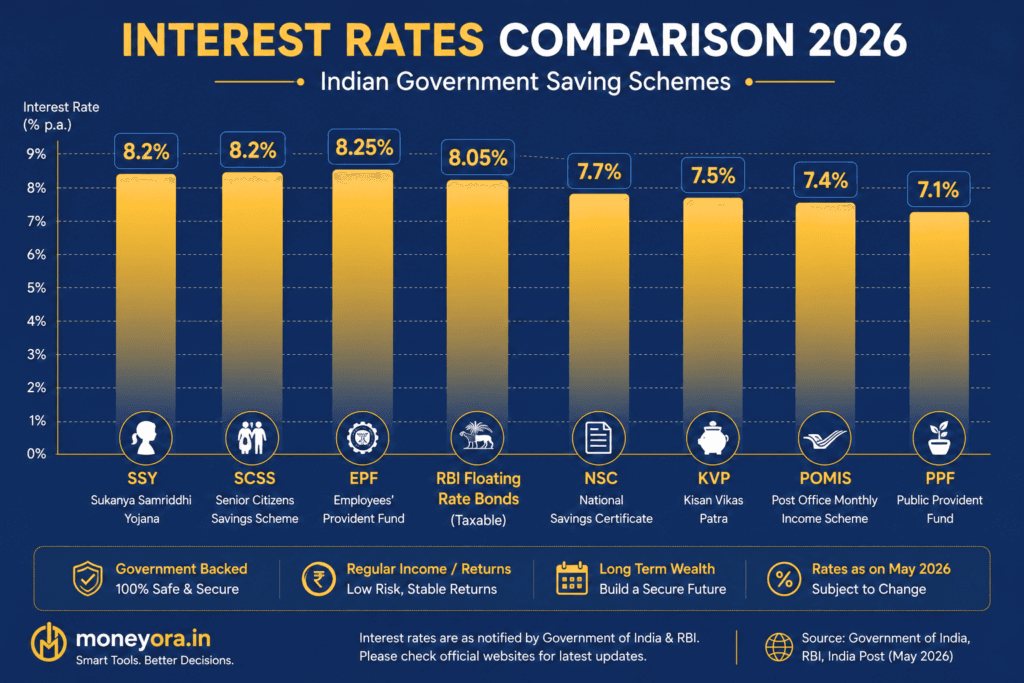
Government Saving Scheme Comparison Table – 2026 at a Glance
Before the deep dives, here’s every government saving scheme side by side – current interest rate for the July-September 2026 quarter, lock-in, and tax treatment.
| Scheme | Interest Rate | Lock-in / Tenure | Tax on Interest | Best For |
|---|---|---|---|---|
| PPF | 7.1% | 15 years | Tax-free (EEE) | Long-term tax-free growth |
| EPF | 8.25% | Until retirement | Tax-free up to ₹2.5L/yr | Salaried employees |
| SSY | 8.2% | 21 years | Tax-free (EEE) | Girl child’s future |
| SCSS | 8.2% | 5 years | Fully taxable | Senior citizens (60+) |
| NSC | 7.7% | 5 years | Taxable (80C on invest.) | Safe, fixed 5-yr return |
| KVP | 7.5% | 115 months | Fully taxable | Doubling money, no 80C need |
| RBI Floating Bonds | 8.05% | 7 years | Fully taxable | Higher-rate, no upper limit |
| POMIS | 7.4% | 5 years | Fully taxable | Monthly income seekers |
| NPS | Market-linked (~9-11%) | Until age 60 | 60% tax-free at maturity | Long-term retirement growth |
| APY | Fixed pension ₹1K–₹5K | Until age 60 | 80CCD deduction available | Informal-sector workers |
Government Saving Scheme : PPF – Public Provident Fund
PPF is the most well-known government saving scheme in India, and for good reason – it’s one of the only investment options offering complete EEE (Exempt-Exempt-Exempt) tax treatment: your contribution, the interest earned, and the maturity amount are all tax-free.
| Current Interest Rate | 7.1% per annum (July–September 2026, unchanged for 10 straight quarters) |
| Tenure | 15 years, extendable in blocks of 5 years |
| Minimum / Maximum Deposit | ₹500 / ₹1.5 lakh per financial year |
| Tax Benefit | Section 80C deduction up to ₹1.5 lakh; interest and maturity fully tax-free |
| Eligibility | Any resident Indian individual; one account per person (minors allowed via guardian) |
| Where to Open | Post office or most major banks |
PPF remains the benchmark against which every other tax-saving option gets compared, largely because of its EEE status – a rare combination in Indian personal finance. Model your exact 15-year corpus using MoneyOra’s free PPF Calculator.
Government Saving Scheme : EPF – Employees’ Provident Fund
For salaried employees, EPF is arguably the most powerful government saving scheme they never actively “choose” – it’s mandatory, employer-matched, and currently offers the highest rate among all major government-backed options.
| Current Interest Rate | 8.25% per annum (FY 2025-26, third consecutive year at this rate) |
| Contribution | 12% of basic salary from employee, matched by employer |
| Tax Benefit | Section 80C on employee contribution; interest tax-free up to ₹2.5 lakh contribution/year |
| Eligibility | Salaried employees at establishments with 20+ employees (some smaller firms covered too) |
| Managed By | Employees’ Provident Fund Organisation (EPFO) |
Because EPF is employer-linked, it isn’t a scheme you actively “join” – but you can still shape your outcome through Voluntary Provident Fund (VPF) top-ups, taxed the same way as EPF. Project your retirement corpus with MoneyOra’s EPF Calculator.
Government Saving Scheme : SSY – Sukanya Samriddhi Yojana
SSY is the government saving scheme built specifically for parents of a girl child – and it currently ties for the highest interest rate among all small savings instruments.
| Current Interest Rate | 8.2% per annum (July–September 2026) |
| Tenure | 21 years from account opening, or until the girl marries after 18 |
| Contribution Window | First 15 years only; account continues earning interest for the remaining 6 |
| Minimum / Maximum Deposit | ₹250 / ₹1.5 lakh per financial year |
| Tax Benefit | Section 80C deduction; interest and maturity fully tax-free (EEE) |
| Eligibility | Girl child below 10 years; account opened by parent/guardian; max 2 accounts per family (exceptions for twins) |
Government Saving Scheme : SCSS – Senior Citizen Savings Scheme
SCSS is the government saving scheme purpose-built for retirees, currently sharing the top interest rate spot with SSY, paid out quarterly for regular income.
| Current Interest Rate | 8.2% per annum, paid quarterly (July–September 2026) |
| Tenure | 5 years, extendable once by 3 years |
| Maximum Deposit | ₹30 lakh per individual |
| Tax Benefit | Section 80C on deposit; interest fully taxable (Section 80TTB deduction up to ₹50,000 available) |
| Eligibility | Age 60+; or 55+ for those who took VRS/superannuation (with conditions) |
SCSS is one of the very few government saving scheme options where existing deposits keep earning the rate at which they were opened, even if the quarterly rate later changes – new deposits alone follow the current quarter’s rate.
Government Saving Scheme : NSC – National Savings Certificate
NSC is a fixed-tenure government saving scheme that behaves much like a 5-year tax-saving FD, with a rate locked in at the time of purchase rather than floating quarterly.
| Current Interest Rate | 7.7% per annum, compounded annually (July–September 2026 issues) |
| Tenure | 5 years, fixed |
| Minimum Investment | ₹1,000, no maximum limit |
| Tax Benefit | Section 80C deduction on investment; interest taxable but reinvested interest (years 1-4) also qualifies for 80C |
| Eligibility | Any resident Indian individual (not available to HUFs, NRIs, or trusts) |
Government Saving Scheme : KVP – Kisan Vikas Patra
KVP is the simplest government saving scheme to explain: your money doubles, guaranteed, in a fixed number of months – no tax-saving complexity, no maximum limit.
| Current Interest Rate | 7.5% per annum (July–September 2026) |
| Maturity / Doubling Period | 115 months (9 years 7 months) at the current rate |
| Minimum Investment | ₹1,000, no upper limit |
| Tax Benefit | None – no Section 80C deduction, interest fully taxable |
| Eligibility | Any resident Indian individual, jointly or singly |
KVP is a genuinely useful government saving scheme for savers who have already exhausted their ₹1.5 lakh Section 80C limit through PPF, EPF, or ELSS and simply want another safe, government-backed place to park money without chasing another tax deduction.
Government Saving Scheme : RBI Floating Rate Savings Bonds
Frequently left out of “savings scheme” roundups, RBI Floating Rate Savings Bonds are a genuine government saving scheme issued directly by the Reserve Bank of India on behalf of the Government of India, currently offering one of the more competitive rates on this list.
| Current Interest Rate | 8.05% per annum, floating (linked to NSC rate + 0.35% spread), paid semi-annually |
| Tenure | 7 years |
| Minimum Investment | ₹1,000, no maximum limit |
| Tax Benefit | None – fully taxable as “Income from Other Sources”; no capital gains tax |
| Eligibility | Resident individuals and HUFs; premature withdrawal allowed for senior citizens with age-based lock-ins |
With no upper investment limit, this option suits savers who’ve maxed out PPF and SSY contribution ceilings but still want a government-guaranteed, non-market-linked home for larger sums.
Government Saving Scheme : Post Office Monthly Income Scheme (POMIS)
POMIS is the government saving scheme designed for one specific need: a steady, guaranteed monthly payout, rather than compounding growth.
| Current Interest Rate | 7.4% per annum, paid out monthly (July–September 2026) |
| Tenure | 5 years |
| Maximum Deposit | ₹9 lakh (single) / ₹15 lakh (joint account) |
| Tax Benefit | None – no 80C deduction, monthly payout fully taxable |
| Eligibility | Any resident Indian individual, single or joint accounts |
Retirees who’ve already used SCSS’s ₹30 lakh cap sometimes layer POMIS on top as a second income-generating option, though the payout structure and rate differ meaningfully from SCSS’s quarterly credit.
Government Saving Scheme : NPS – National Pension System
NPS stands apart from the other options on this list as the only market-linked government saving scheme – regulated by PFRDA, with returns that depend on your chosen equity/debt allocation rather than a government-declared fixed rate.
| Historical Returns | Market-linked, roughly 9-11% annualised long-term (varies by fund and equity allocation) |
| Tenure | Until age 60 (extendable), with partial withdrawal allowed after conditions |
| Tax Benefit | Section 80CCD(1) up to ₹1.5L, additional ₹50,000 under 80CCD(1B); employer contribution deductible under 80CCD(2) |
| Maturity Tax Treatment | 60% of corpus tax-free on withdrawal; remaining 40% must buy an annuity (taxable as pension income) |
| Eligibility | Any Indian citizen aged 18-70, resident or NRI |
NPS is the one government saving scheme on this list where you actively control your risk-return profile through fund and allocation choices. Model your projected retirement corpus using MoneyOra’s NPS Calculator.
Government Saving Scheme : APY – Atal Pension Yojana
APY is the government saving scheme aimed squarely at India’s unorganised-sector workers – a guaranteed fixed pension, not a market-linked corpus, for as little as ₹42 a month if you start young.
| Guaranteed Pension | ₹1,000 to ₹5,000 per month from age 60, based on chosen slab |
| Monthly Contribution | ₹42 to ₹1,454, depending on entry age and chosen pension amount |
| Eligibility | Indian citizens aged 18-40 with a savings account; closed to income-tax payers since October 2022 |
| Tax Benefit | Section 80CCD deduction on contributions |
| 2026 Update | Union Cabinet approved extension of the scheme to FY 2030-31 on 21 January 2026 |
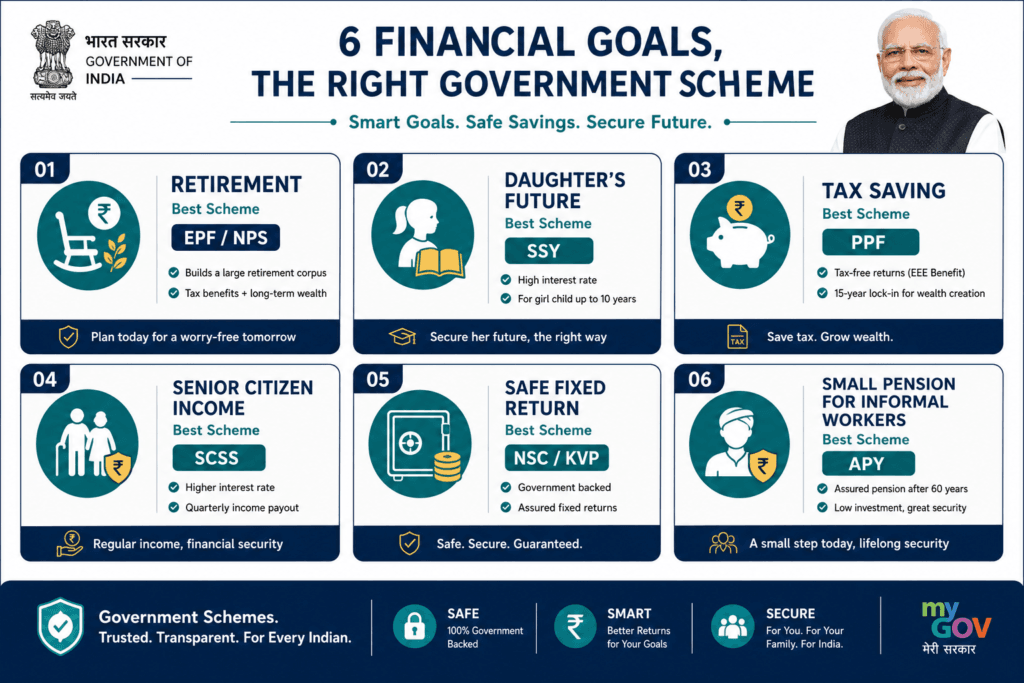
Which Government Saving Scheme Fits Your Goal?
With ten options on the table, the real question isn’t “which government saving scheme has the highest rate” – it’s “which government saving scheme actually matches what I’m trying to do.” Here’s a goal-based lookup.
| Your Goal | Best-Fit Government Saving Scheme |
|---|---|
| Long-term, tax-free wealth building | PPF |
| Retirement corpus (salaried) | EPF + NPS (employer match + market growth combo) |
| Daughter’s education / marriage fund | SSY |
| Regular income after 60 | SCSS (quarterly) or POMIS (monthly) |
| Safe, fixed 5-year parking with 80C | NSC |
| Doubling a lump sum, no tax-saving need | KVP |
| Large sum, no investment ceiling | RBI Floating Rate Bonds |
| Guaranteed small pension (informal sector) | APY |
| Higher long-term growth, comfortable with market risk | NPS (equity-heavy allocation) |
Notice most Indian households don’t rely on just one option – a typical salaried family might combine EPF (mandatory), PPF (tax-free top-up), SSY (if they have a daughter), and NPS (extra retirement growth) simultaneously.
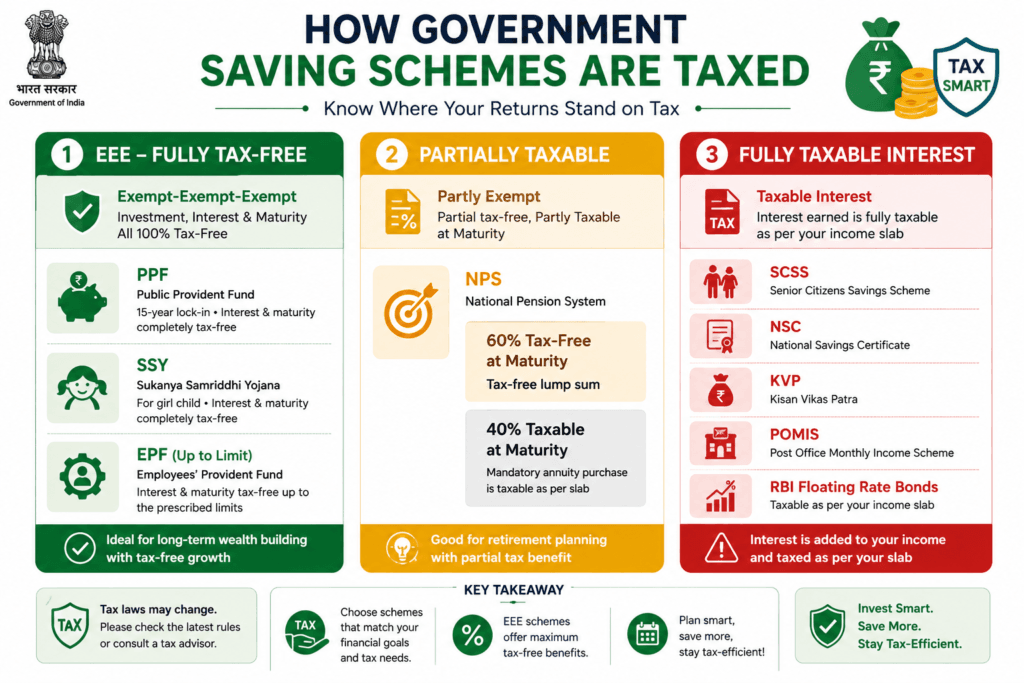
Tax Treatment – EEE vs Taxable, Explained Simply
The single biggest misunderstanding around any government-backed scheme is assuming “government-backed” automatically means “tax-free.” It doesn’t. Here’s the real breakdown.
| Tax Category | What It Means | Schemes |
|---|---|---|
| EEE (Exempt-Exempt-Exempt) | Contribution, interest, and maturity all tax-free | PPF, SSY, EPF (up to ₹2.5L/yr contribution) |
| Partially Taxable | Deduction on contribution, but part of maturity/interest taxed | NPS (60% tax-free, 40% annuity taxable as pension) |
| Fully Taxable Interest | Deduction on investment only (if any); interest added to your income, taxed at slab rate | SCSS, NSC, KVP, POMIS, RBI Floating Rate Bonds |
7 Mistakes Indians Make Picking a Government Saving Scheme
Mistake 1: Chasing the Highest Headline Rate
As shown above, a fully taxable 8.2% government saving scheme can deliver less post-tax return than a tax-free 7.1% one. Always compare after-tax, not headline rates.
Mistake 2: Ignoring Eligibility Before Getting Excited About a Rate
SCSS’s 8.2% is irrelevant if you’re 35. SSY’s 8.2% is irrelevant if you don’t have a daughter under 10. Filter by eligibility first, rate second.
Mistake 3: Forgetting NSC and KVP Rates Are Locked at Purchase
Unlike PPF, SSY, and SCSS – which float quarterly – your NSC or KVP rate is fixed for the entire tenure from the day you invest. A rate drop next quarter doesn’t touch your existing certificate.
Mistake 4: Putting All Long-Term Savings Into One Government Saving Scheme
Concentration risk applies even to safe instruments – not for default risk, but for liquidity and goal-matching risk. Spreading across 2-3 schemes that map to different goals and timelines is generally sounder than maxing out one.
Mistake 5: Missing the SSY Deposit Window
SSY only accepts deposits for 15 years, even though the account runs for 21. Parents who stop tracking after year 10-12 sometimes miss depositing before the window closes.
Mistake 6: Not Accounting for TDS on Taxable-Interest Schemes
SCSS, NSC (after year 5), KVP, and POMIS interest can attract TDS if it crosses prescribed thresholds. Submit Form 15G/15H (or the applicable current-year form) if your total income is below the taxable limit, to avoid unnecessary deduction.
Mistake 7: Assuming Every Government Saving Scheme Needs an 80C Slot
KVP, RBI Floating Rate Bonds, and POMIS offer zero Section 80C benefit – and that’s fine. If you’ve already used your ₹1.5 lakh 80C limit through PPF/EPF/ELSS, these are legitimate places for additional safe money without hunting for more tax deductions.
Risks and Limitations to Keep in Mind
- Rate revision risk: Floating-rate schemes (PPF, SSY, SCSS, RBI Bonds) can see their rate reduced in future quarters – new deposits follow the revised rate, so a long-term commitment doesn’t guarantee today’s rate throughout
- Liquidity risk: Most government saving scheme options have multi-year lock-ins (PPF 15 years, SSY 21 years) – don’t park emergency funds in these instruments
- Tax-drag risk: Fully taxable schemes (SCSS, NSC, KVP, POMIS, RBI Bonds) deliver meaningfully lower real returns for savers in higher tax brackets – always calculate post-tax return before committing
- Market risk (NPS only): Unlike the other nine schemes on this list, NPS returns are not government-guaranteed – equity allocation can produce negative returns in poor market years
- Inflation risk: Even at 7-8.25%, real (inflation-adjusted) returns on any single government saving scheme can be modest in high-inflation years – diversification with market-linked instruments like NPS or mutual funds is worth considering for long horizons
Calculate Your Numbers Across Every Government Saving Scheme
Reading about rates is step one. Seeing your actual numbers is step two. These MoneyOra calculators cover the major government saving scheme options discussed above.
- PPF Calculator – Project your 15-year PPF corpus with current rates
- EPF Calculator – Estimate your retirement EPF balance including employer match
- NPS Calculator – Model your NPS corpus and expected pension at retirement
- FD Calculator – Compare bank FD returns against government saving scheme options
- RD Calculator – Compare recurring deposits with POMIS-style regular contribution schemes
- SIP Calculator – See how equity SIPs compare to fixed-rate government saving scheme options over the long term
- All Bank Calculators – Full suite of MoneyOra’s savings and investment tools
Compare Every Government Saving Scheme Against Your Own Numbers
Rates and rules matter, but your actual outcome depends on your amount, timeline and tax bracket. Run the numbers with MoneyOra’s free calculators.
Use the free calculator now on MoneyOra.in →
Official Sources and External References
- National Savings Institute – nsiindia.gov.in (PPF, SSY, SCSS, NSC, KVP, POMIS official rules)
- EPFO – epfindia.gov.in (EPF rates and rules)
- NPS Trust / NSDL CRA – npscra.nsdl.co.in (NPS official portal)
- PFRDA – pfrda.org.in (NPS and APY regulator)
- Reserve Bank of India – rbi.org.in (RBI Floating Rate Savings Bonds)
- India Post – indiapost.gov.in (Post office scheme access points)
Frequently Asked Questions – Government Saving Scheme India 2026
Which government saving scheme currently offers the highest interest rate?
For the July-September 2026 quarter, EPF offers the highest rate at 8.25% (for salaried employees), followed closely by SSY and SCSS, both at 8.2%. RBI Floating Rate Savings Bonds follow at 8.05%. However, EPF and SSY have restricted eligibility (salaried employment and a daughter under 10, respectively), while SCSS requires being 60 or older.
Is PPF still a good government saving scheme in 2026?
Yes. While PPF’s 7.1% rate is lower than EPF, SSY, or SCSS, it remains one of the very few EEE (fully tax-free) instruments open to virtually any Indian resident, without the eligibility restrictions that limit SSY, SCSS, or EPF. For a 30% tax bracket saver, PPF’s post-tax return often beats several higher-headline-rate but fully taxable government saving scheme options.
Can I invest in more than one government saving scheme at the same time?
Yes, and most Indian households do. A typical combination might include mandatory EPF, a PPF account for additional tax-free savings, SSY if you have a daughter, and NPS for extra retirement growth – all simultaneously, since eligibility rules apply per scheme, not across schemes.
Are government saving scheme interest rates fixed for the whole year?
No, for most schemes. PPF, SSY, and SCSS rates are reviewed and can change every quarter by the Ministry of Finance, though existing SCSS deposits keep their original rate. NSC and KVP, by contrast, lock in the rate at the time of purchase for the full tenure. Rates for July-September 2026 have remained unchanged for the tenth consecutive quarter.
What is the safest government saving scheme for a senior citizen?
SCSS is purpose-built for this – currently at 8.2% with quarterly payouts, specifically for those 60 and above (55+ for VRS/superannuation cases with conditions). POMIS is a secondary option for those who’ve maxed out SCSS’s ₹30 lakh limit and want additional monthly income, though at a lower 7.4% rate.
What are the latest questions people are asking about government saving schemes in India in 2026?
- Did small savings scheme rates change for July-September 2026? – No, the Finance Ministry kept all rates unchanged for the tenth straight quarter, per its notification dated 30 June 2026.
- Is Atal Pension Yojana still available in 2026? – Yes, and it was just extended – the Union Cabinet approved extending APY through FY 2030-31 in January 2026.
- Which government saving scheme is best for a girl child born in 2026? – Sukanya Samriddhi Yojana remains the purpose-built option, currently at 8.2% with full EEE tax treatment.
- Is RBI Floating Rate Bond a government saving scheme? – Yes, it’s issued by the Reserve Bank of India on behalf of the Government of India, currently offering 8.05% with no upper investment limit.
- Can income-tax payers join Atal Pension Yojana? – No. Since October 2022, income-tax payers are not eligible to join APY.