Complete Banking Forms Library Every Bank Forms India Guide (2026)
What’s in This Bank Forms India Library
- Every major bank forms India customers actually need organised by what problem each one solves
- The biggest 2026 change: Form 15G/15H replaced by Form 121, Form 60 replaced by Form 97
- Field-by-field walkthroughs for the two most error-prone forms: NEFT/RTGS and DA1 nomination
- A decision guide “which form do I actually need” for 12 common banking situations
- Where to download each form and what documents to carry to the branch
Ask any Indian bank customer to name every form they’ve filled over the years, and most can recall two the account opening form, and whatever slip they used to deposit cash last week. Yet a typical banking relationship touches 15-20 distinct forms nomination, KYC updates, cheque requisition, standing instructions, locker access, TDS declarations, and more each with its own format, its own required documents, and its own quiet consequences if left unfiled. This Bank Forms India library exists to fix that gap one place, every form, organised by what you’re actually trying to do. Bookmark this Bank Forms India reference and you’ll never need to search bank-by-bank again.
This isn’t a generic banking glossary. This Bank Forms India guide is built for 2026 the year Form 15G and Form 15H were discontinued and replaced by a single unified Form 121, the year Form 60 became Form 97, and the year RBI pushed banks harder than ever to close the nomination gap on deposit accounts and lockers. If you’ve ever stood at a bank counter unsure which slip to ask for, this is the reference you keep bookmarked.
Which Bank Form Do You Actually Need?
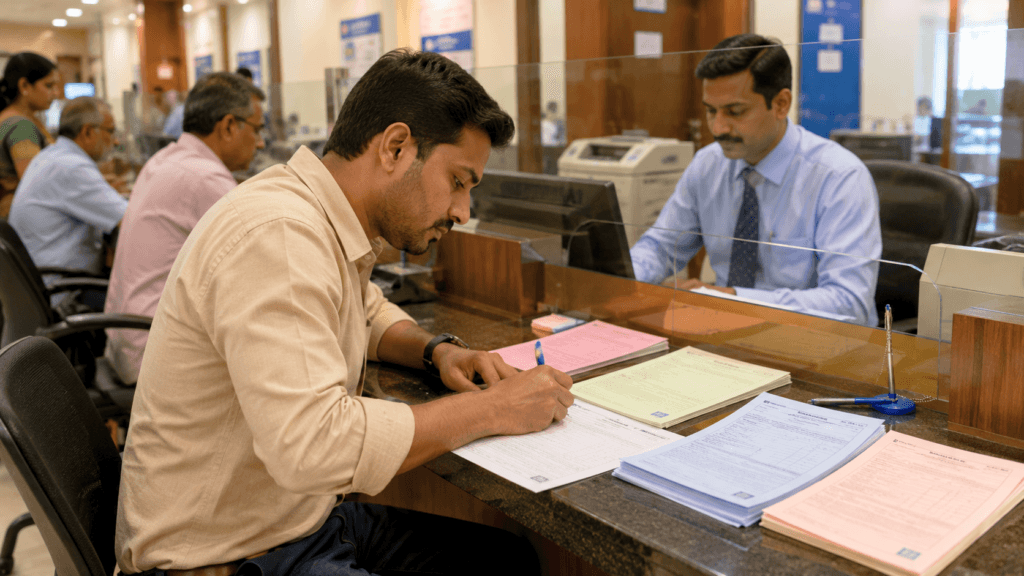
Before diving into the full Bank Forms India library, most people just want to know “What form do I need for my specific situation?” Here’s a fast lookup table covering the twelve most common reasons people visit a bank counter a shortcut into the rest of this Bank Forms India guide.
| Your Situation | Form You Need |
|---|---|
| Opening a new savings/current account | Account Opening Form + KYC Form |
| Interest income should not attract TDS | Form 121 (replaces 15G/15H from April 2026) |
| Don’t have a PAN for a specific transaction | Form 97 (replaces Form 60) |
| Ordering a new chequebook | Cheque Book Requisition Slip |
| Sending money via branch NEFT/RTGS | NEFT/RTGS Application Form |
| Adding a nominee to your account | DA1 Nomination Form |
| Renting a bank safe deposit locker | Locker Application Form + Locker Agreement |
| Automating a recurring bill payment | Standing Instruction (SI) Form |
| Your KYC documents expired or need updating | Re-KYC Form |
| Stopping payment on an issued cheque | Stop Payment Request Form |
| Closing your bank account | Account Closure Form |
| You’re an NRI opening or maintaining an account | NRE/NRO Account Opening Form + FATCA Declaration |
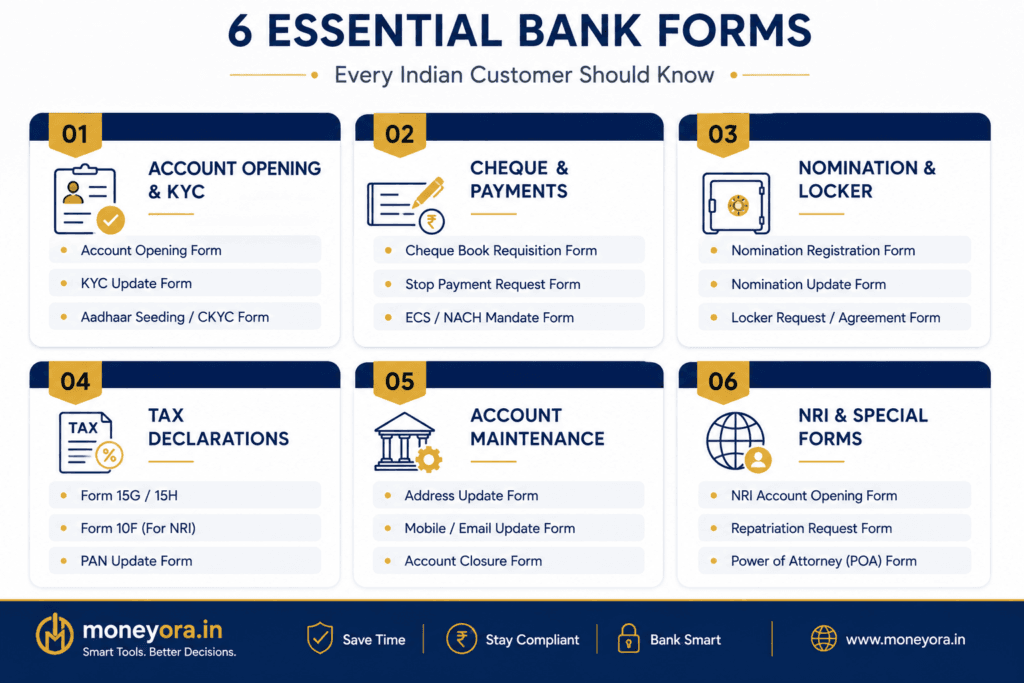
Account Opening and KYC Forms
Every banking relationship starts here. The account opening form and its accompanying KYC (Know Your Customer) form are, by volume, the most-filled documents in any Bank Forms India library and also where most avoidable errors happen. Get these two Bank Forms India essentials right, and everything downstream in your banking relationship moves faster.
What the Account Opening Form Covers
- Personal details: name (exactly as per ID proof), date of birth, marital status, occupation
- Contact details: registered mobile number, email, communication address, permanent address
- Account type selection: Savings, Current, Salary, Senior Citizen, Minor, Joint
- Initial deposit mode and amount
- Mode of operation (Self, Joint Either or Survivor, Joint Jointly)
KYC Form Documents You Must Carry
The KYC form is a separate but linked document, mandatory under RBI’s Know Your Customer guidelines. As of 2026, banks accept the following as valid Officially Valid Documents (OVDs):
| Proof Type | Accepted Documents |
|---|---|
| Identity Proof | Aadhaar, Passport, Voter ID, Driving Licence, PAN Card |
| Address Proof | Aadhaar, Passport, Utility Bill (<3 months), Rent Agreement |
| Photograph | Recent passport-size photograph (2 copies typically) |
| PAN / Form 97 | PAN Card mandatory for most accounts; Form 97 if PAN unavailable |
To check your bank’s IFSC code and branch details before filling any account-related form, use MoneyOra’s free IFSC Code Finder useful for confirming the exact branch name your account opening form should list.
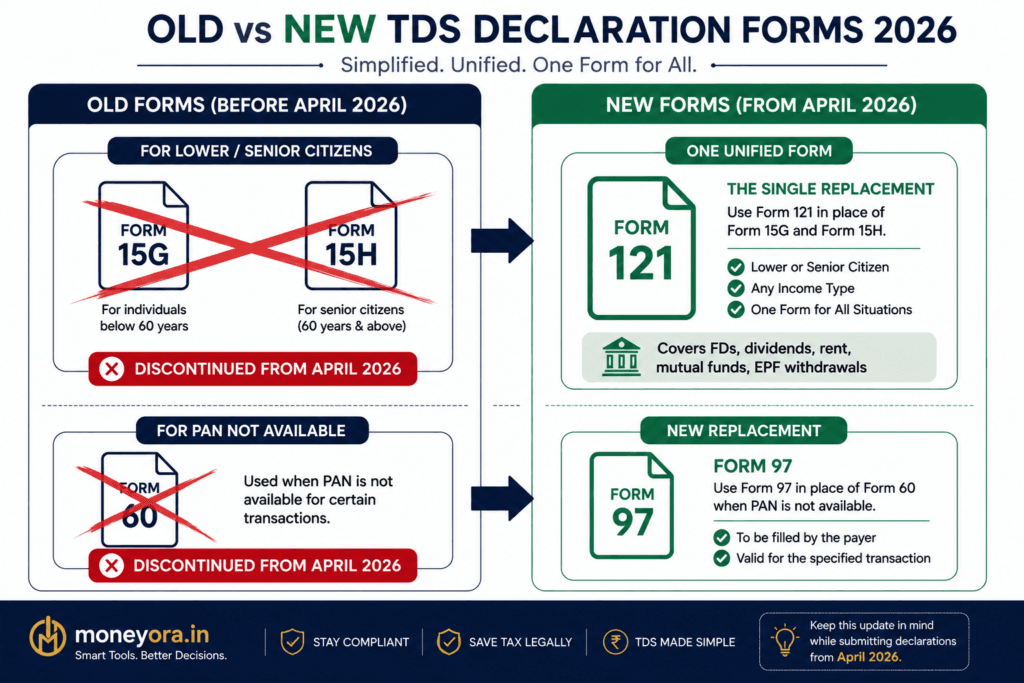
Form 121 The New TDS Declaration Form (Replaces Form 15G/15H)
This is the single most important update in any current Bank Forms India library. From 1 April 2026, under the Income Tax Act, 2025, Form 15G and Form 15H the self-declaration forms millions of Indians used every year to avoid TDS on FD and RD interest have been discontinued and replaced by a single unified Form 121. If you take away only one fact from this Bank Forms India guide, make it this one.
What Form 121 Does
If your total estimated tax liability for the year is nil, Form 121 tells your bank (or any other deductor) not to deduct TDS on your interest income. It performs the exact function that Form 15G and Form 15H used to perform just under one unified form instead of two age-based versions.
| Old System (Until 31 March 2026) | New System (From 1 April 2026) |
|---|---|
| Form 15G for individuals below 60 | Form 121 single unified form for all eligible individuals, regardless of age |
| Form 15H for senior citizens (60+) | |
| Governed by Section 197A, Income Tax Act 1961 | Governed by Section 393(6), Income Tax Act 2025 |
| Separate UIN generated per form, per deductor | Simplified reconciliation, single form format |
Where Form 121 Applies
Form 121 covers TDS-triggering income across several instruments not just bank FDs. It applies to:
- Fixed Deposit (FD) and Recurring Deposit (RD) interest
- Dividend income from shares and mutual funds
- Rent payments (for the payer’s TDS obligation, where applicable)
- EPF withdrawals
You can download Form 121 through your bank’s net banking portal, mobile app, or the Income Tax e-filing portal’s official forms section. It’s also accessible through EPFO’s website for EPF-related withdrawals.
Form 97 Replaces Form 60 for PAN-less Transactions
Alongside Form 121, another quiet but important change in the 2026 Bank Forms India landscape Form 60, the declaration long used by individuals without a PAN card for specified transactions, has been replaced by Form 97 under the Income Tax Act, 2025. This Bank Forms India update trips up more customers than any other, simply because so few people know it happened.
When You Need Form 97
Form 97 is required when you’re conducting a transaction that would normally require quoting your PAN, but you don’t have one or haven’t applied for one yet. Common situations:
- Opening a bank account without a PAN card
- Depositing cash above the prescribed threshold
- Purchasing a demand draft or pay order for a large sum
- Certain high-value time deposits
Cheque Book, Deposit Slip, and Payment Forms
This category covers the day-to-day transactional side of the Bank Forms India library the forms you’ll use most frequently once your account is active. These are the Bank Forms India documents you’ll refill again and again over a typical banking relationship.
Cheque Book Requisition Form
A simple slip (often the last leaf of your current chequebook) used to request a new one one of the most frequently reused Bank Forms India documents in this whole library. Fields typically include account number, number of leaves requested (usually 25 or 50), delivery preference (branch pickup or courier), and signature. Most banks now also accept this request via net banking or mobile app, bypassing the physical form entirely.
Deposit Slip (Cash/Cheque)
Used at the counter to deposit cash or cheques into your own or someone else’s account. Key fields account number, depositor name, denomination breakdown (for cash), and cheque details (for cheque deposits cheque number, drawee bank, amount).
Stop Payment Request Form
If you’ve issued a cheque and need to prevent it from being encashed lost cheque, wrong amount, disputed payment this form instructs your bank to dishonour that specific cheque number if presented. You’ll need the cheque number, date, amount, and payee name. Most banks charge a stop-payment fee (typically ₹100-₹300).
Demand Draft (DD) Application Form
Used to purchase a demand draft a prepaid, bank-guaranteed payment instrument often required for court fees, admission fees, or vendor payments where a personal cheque isn’t accepted. Requires payee name, amount, and the branch where the DD will be payable.
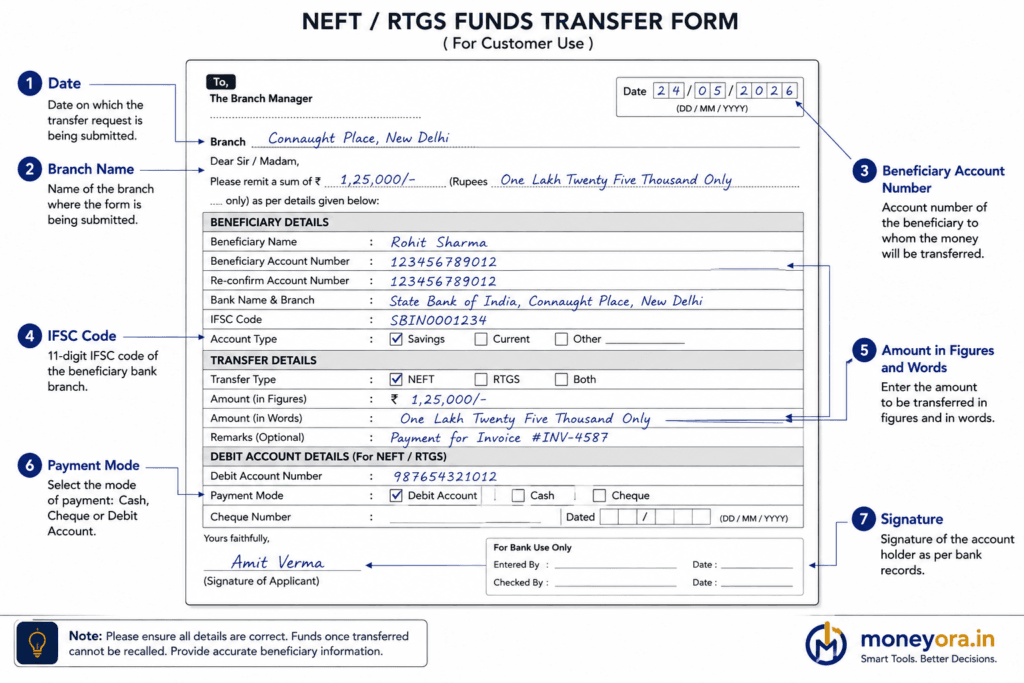
NEFT/RTGS Form Field-by-Field Walkthrough
The NEFT/RTGS application form is required only for branch-assisted fund transfers if you transfer online via net banking or a UPI-linked app, no physical form is needed. But for cash-based transfers, cheque-funded transfers, or when net banking isn’t set up, this remains one of the most-used forms in any Bank Forms India collection, and getting it wrong is the single most common Bank Forms India support complaint at branch counters.
How to Fill the NEFT/RTGS Form Section by Section
- Date and Branch Name: Enter today’s date and your home branch name at the top
- Sender’s Details: Your account number, name in CAPITAL LETTERS, registered mobile number, and PAN (mandatory above certain thresholds)
- Payment Mode: Tick one Cash, Debit My Account, or Cheque. If paying by cheque, note the cheque number and date
- Amount: Write clearly in both figures and words this is the most commonly mismatched field
- Beneficiary Details: Full name exactly as per their bank account, complete account number (double-check every digit), and the beneficiary’s bank branch IFSC code
- Beneficiary Bank Details: Bank name and branch address (the IFSC code technically makes this redundant, but most forms still require it)
- Signature: Sign matching your specimen signature on file
Confirm the correct IFSC code and branch address for any NEFT/RTGS transfer using MoneyOra’s IFSC Code Finder or the combined Bank Details Lookup tool both pull live data so you’re not copying a stale code from an old chequebook.
NEFT vs RTGS Which Form, Which Timing?
Both systems are operated under guidelines set by the National Payments Corporation of India (NPCI), which governs settlement timing and transaction limits across participating banks.
| Feature | NEFT | RTGS |
|---|---|---|
| Minimum Amount | No minimum | ₹2 lakh minimum |
| Settlement | Batch-wise, near real-time | Real-time, individual |
| Branch Processing Time | 2–3 hours typical | 30 minutes to a few hours |
| Form Required? | Yes, if branch-assisted | Yes, if branch-assisted |
DA1 Nomination Form The Form Everyone Skips
If there’s one form in this Bank Forms India library that deserves far more attention than it gets, it’s this one. The DA1 nomination form lets you name someone to receive your account balance in the event of your death without them needing to go through a lengthy succession certificate process. Despite its importance, RBI’s own supervisory data shows a large number of deposit accounts in India still have no nomination on file making this the most underused entry in the entire Bank Forms India library.
Why RBI Is Pushing This Harder in 2026
RBI has directed banks to review nomination coverage periodically and report progress on its DAKSH supervisory portal every quarter. Banks have been asked to sensitise frontline staff to proactively collect nominations meaning you may now be asked about this every time you visit a branch, even for an unrelated transaction.
How to Fill the DA1 Nomination Form
- Account number and account holder name(s)
- Nominee’s full name, relationship to you, address, and date of birth
- If the nominee is a minor, name and details of the guardian who will receive funds on the minor’s behalf until they turn 18
- Signature of the account holder(s) for joint accounts, all holders typically need to sign
- Two witnesses (required in some banks, especially for thumb-impression signatures)
Locker Nomination A Separate Form
Note that locker nomination uses a different form from account nomination, even at the same bank. If you hold both a savings account and a locker, you need to file nomination for each separately filing one does not automatically cover the other.
Locker Application and Locker-Related Forms
Safe deposit lockers involve their own distinct set of forms within the broader Bank Forms India library separate from your regular account paperwork. Locker-related Bank Forms India documents are easy to overlook precisely because they’re used so infrequently.
| Form | Purpose |
|---|---|
| Locker Application Form | Initial request for locker allotment, including size preference |
| Locker Agreement | Legal terms of locker rental, liability terms, annual rent |
| Locker Nomination Form | Separate from account nomination names who can access the locker’s contents on your death |
| Locker Surrender Form | Used when vacating and returning locker keys |
Most banks require you to hold an active account at the same branch before allotting a locker, and many now mandate a fixed deposit as security alongside the locker application.
Account Maintenance Forms Standing Instructions to Closure
These are the forms that manage your account over its lifetime beyond the initial opening and day-to-day transactions. This section of the Bank Forms India library covers everything from automating payments to formally closing an account.
Standing Instruction (SI) Form
Automates a recurring payment SIP deductions, EMI payments, insurance premiums, rent. You specify the beneficiary, amount, frequency, and start/end date. Once set up, the bank executes the transfer automatically without you visiting the branch each time.
Re-KYC Form
Banks are required to periodically re-verify customer KYC the frequency depends on your risk category (low, medium, high risk accounts have different re-KYC cycles). If your KYC documents expired or your bank flags your account for re-verification, this form (with updated documents) reactivates full account functionality.
Address/Signature Change Form
Used when you’ve moved homes or want to update your specimen signature on file. Requires the new address proof or a signature verification process (sometimes involving a bank officer’s attestation for signature changes).
Account Closure Form
Formally closes your account. You’ll need to return any unused chequebook leaves, settle any pending standing instructions, and specify where the remaining balance should be transferred. Some banks charge an early closure fee if the account is closed within a certain period of opening (commonly within 12-14 months).
Balance Confirmation / Certificate Request Form
Used when you need an official bank certificate for visa applications, loan processing, or audit purposes confirming your account balance or transaction history as of a specific date.
NRI Forms and Special-Purpose Bank Forms
Non-Resident Indians face an additional layer of forms within the Bank Forms India ecosystem, driven by FEMA regulations and international tax reporting requirements. NRIs should treat this section of the Bank Forms India library as a checklist, not a one-time task several of these forms need periodic renewal.
| Form | Purpose |
|---|---|
| NRE/NRO Account Opening Form | Opens a Non-Resident External or Non-Resident Ordinary account |
| FATCA/CRS Declaration | Mandatory tax-residency self-certification for international reporting compliance |
| Resident to NRI Status Change Form | Required when a resident account holder moves abroad and needs to redesignate accounts |
| Power of Attorney (POA) Registration Form | Registers someone in India to operate your account on your behalf |
| Repatriation Request Form | Authorises transfer of funds from NRO to overseas account, subject to limits |
NRI account holders should also check current PPF and NPS eligibility rules using MoneyOra’s PPF Calculator and NPS Calculator, since eligibility and contribution rules differ from resident accounts.
Where to Download Bank Forms India Bank-wise Portals
Every major Indian bank now hosts its own downloadable Bank Forms India library on its official website, organised in broadly similar categories. Here’s how to locate them at the largest public and private banks useful when this article’s general Bank Forms India guidance needs a bank-specific download link.
| Bank | Where Forms Are Hosted |
|---|---|
| State Bank of India (SBI) | retail.sbi.bank.in → Downloads section |
| Bank of India | bankofindia.bank.in → Downloads (categorised by form type) |
| Union Bank of India | unionbankofindia.bank.in → Download Forms |
| IDFC FIRST Bank | idfcfirst.bank.in/support → Form Center |
| Central Bank of India | centralbank.bank.in → PDF forms repository |
| South Indian Bank | southindianbank.bank.in → Forms and downloads |
Once your forms are submitted and your account is fully active, put your funds to work check current rates and compare options using MoneyOra’s FD Calculator and RD Calculator.
7 Mistakes People Make Filling These Forms
No Bank Forms India library is complete without a list of what goes wrong. These seven mistakes account for the overwhelming majority of rejected or delayed banking forms and nearly every one is avoidable once you know to check for it.
Mistake 1: Signature Inconsistency
The single most common rejection reason across every form category in this Bank Forms India guide cheque requisition, NEFT/RTGS, stop payment. Always sign exactly as recorded on your account opening form specimen signature.
Mistake 2: Name Mismatch with ID Proof
A missing middle name, an abbreviated first name, or inconsistent spelling between your form and your Aadhaar/PAN causes instant rejection at KYC stage. Copy your name character-for-character from your primary ID.
Mistake 3: Skipping the Nomination Form
As covered above, a large share of Indian deposit accounts still have no nominee on file. This single skipped form can create months of legal delay for your family later.
Mistake 4: Using an Outdated Form Version
With Form 15G/15H replaced by Form 121, and Form 60 replaced by Form 97 from April 2026, some old-format PDFs are still floating around on unofficial sites. Always download the current version directly from your bank or the Income Tax portal.
Mistake 5: Incorrect IFSC Code on NEFT/RTGS Forms
A single wrong character in the IFSC field routes your money to the wrong branch or gets the transfer rejected outright. Cross-verify using an official IFSC lookup before submitting any transfer form.
Mistake 6: Not Carrying Original Documents for Verification
Most KYC-linked forms require the original document for on-the-spot verification, even if you submit a photocopy. Carrying only photocopies is a common reason for a wasted branch trip.
Mistake 7: Writing Amount in Figures Only (Not Words)
Cheques, DD applications, and NEFT/RTGS forms all require the amount in both figures and words. Banks reject forms where only one is filled this discrepancy check exists specifically to prevent fraud through altered figures.
Risks and Limitations to Keep in Mind
- Form version risk: During the April 2026 transition, some banks’ websites, third-party aggregators, and even branch stationery may still circulate the old Form 15G/15H or Form 60 for a period. Always confirm you’re using Form 121 or Form 97 for FY 2026-27 onwards
- False declaration risk: Submitting Form 121 when your actual tax liability is not nil is a false declaration with penal consequences under the Income Tax Act. Only file it if you genuinely qualify
- Nomination limitation: A nomination is not the same as a will. If there’s a conflict between your nominee and your legal heirs under succession law, the matter can still go to court nomination simplifies bank-level claim processing but doesn’t override inheritance law
- Form processing delays: Physical forms submitted at busy branches can take longer to process than digital equivalents. Where your bank offers an app-based option for the same form, it’s usually faster
- Third-party site risk: Downloading bank forms India documents from unofficial aggregator or forum sites carries a risk of outdated formats or, in rare cases, phishing-adjacent fake forms. Stick to official bank domains
Bank Forms India Checklist Before You Visit the Branch
Bank Forms India Pre-Branch Visit Checklist
- ☐ Identified exactly which form you need from the decision guide above
- ☐ Downloaded the current version from the bank’s official website (not a third-party site)
- ☐ Confirmed you’re using Form 121 (not old Form 15G/15H) if declaring nil tax liability
- ☐ Confirmed you’re using Form 97 (not old Form 60) if you lack a PAN
- ☐ Original ID and address proof documents carried (not just photocopies)
- ☐ Name filled exactly as per your primary ID document
- ☐ Signature matches your bank specimen signature exactly
- ☐ Amount written in both figures and words where required
- ☐ IFSC code cross-verified via an official lookup tool before submitting
- ☐ Nomination form filed or updated if not already on record
Tools to Support Your Banking Paperwork
Filling out the right bank forms India documents is only half the job verifying account details, tracking rates, and planning what happens after your account is active matters just as much. These MoneyOra tools complement every Bank Forms India workflow described above.
- IFSC Code Finder – Verify any bank branch’s IFSC before filling an NEFT/RTGS form
- Bank Details Lookup – Full branch address and MICR code alongside IFSC
- All Bank Calculators – FD, RD, EMI and more, once your account paperwork is sorted
- FD Calculator – Estimate returns before opening a fixed deposit (and check whether Form 121 applies to your interest)
- RD Calculator – Plan recurring deposit contributions and maturity value
- PAN-Aadhaar Link Status Check – Confirm your PAN is active before it’s needed on any KYC-linked bank form
- CKYC Number Guide – Understand your Central KYC record, which many bank forms now reference directly
- Hidden Bank Charges Guide – Know what fees apply to locker rental, DD issuance, and stop-payment requests before you submit those forms
- Credit Card Charges Explained – Related banking paperwork every cardholder should understand
Verify Every Bank Detail Before You Submit a Form
A wrong IFSC code or branch detail is the top reason bank forms India submissions get delayed or rejected. Double-check everything with MoneyOra’s free tools first.
Use the free calculator now on MoneyOra.in →
Official Sources and External References
- Reserve Bank of India — rbi.org.in (KYC norms, nomination guidelines)
- Income Tax Department — Income Tax Forms (Form 121, Form 97)
- State Bank of India — Official Forms Portal
- National Payments Corporation of India — NEFT/RTGS Guidelines
- ClearTax — Form 15G/15H to Form 121 Transition Guide
Frequently Asked Questions Bank Forms India 2026
Here are the most common Bank Forms India questions people are searching for right now, answered directly.
What replaced Form 15G and Form 15H in 2026?
From 1 April 2026, under the Income Tax Act, 2025, both Form 15G and Form 15H were discontinued and replaced by a single unified Form 121. It serves the same purpose declaring that your estimated tax liability for the year is nil so banks don’t deduct TDS on your interest income but is now one form for all eligible individuals regardless of age, instead of separate forms for those below and above 60.
What is Form 97 and why did it replace Form 60?
Form 97 replaced Form 60 from 1 April 2026 under the Income Tax Act, 2025. It’s used by individuals who don’t have a PAN card but need to conduct a transaction that would normally require quoting one such as opening a bank account or making certain high-value deposits.
What documents do I need for the KYC form when opening a bank account in India?
You need one Officially Valid Document (OVD) for identity proof Aadhaar, Passport, Voter ID, Driving Licence, or PAN Card plus an address proof, which can also be Aadhaar or a recent utility bill. Most banks additionally require a recent passport-size photograph and your PAN Card (or Form 97 if you don’t have a PAN).
What is the DA1 form used for in Indian banks?
The DA1 form is the standard bank nomination form used to name a nominee for your deposit account someone who will receive your account balance in the event of your death, without needing a succession certificate. RBI has been actively pushing banks to increase nomination coverage, as supervisory data shows many accounts still lack a nominee on file.
Can I fill NEFT/RTGS forms without visiting the bank branch?
Yes if you have net banking or a mobile banking app enabled, NEFT and RTGS transfers can be done entirely online, 24×7, without any physical form. The physical NEFT/RTGS application form is required only for branch-assisted transfers, such as cash-funded transfers or when the sender doesn’t have net banking access.
What are the latest questions people are asking about bank forms India on Google in 2026?
- Is Form 15G still valid in 2026? Only for FY 2025-26 and earlier. From FY 2026-27 onwards, Form 121 is the only valid replacement.
- Where can I download Form 121 for my bank? Through your bank’s net banking portal, mobile app, or the Income Tax e-filing portal at incometax.gov.in.
- Do I need to fill a separate nomination form for my locker? Yes. Locker nomination is a distinct form from your regular savings account nomination, even at the same bank.
- What happens if I don’t file a bank nomination form? Your family would need to obtain a succession certificate or legal heir certificate to claim the funds after your death a lengthy court process compared to the simple nomination route.
- Is Form 60 completely gone in 2026? Yes, replaced by Form 97 from 1 April 2026 under the Income Tax Act, 2025, for all new PAN-less transaction declarations.