

If a bank, mutual fund, or insurer has just asked you for your CKYC Number and you’ve never heard the term before, you’re not alone — and you almost certainly already have one without realizing it. Every time you’ve opened a bank account, bought a mutual fund, or purchased an insurance policy in India over the past several years, that institution likely registered your KYC details with a central registry behind the scenes, and issued you a unique identifier in the process. “EPF passbook not showing your latest contribution? Here’s why”
This guide explains exactly what a CKYC Number is, breaks down the format of those 14 digits, walks through six real ways to actually find yours, and covers why RBI has been steadily tightening the rules around this system through 2026. Once your financial identity documentation is in order, it’s worth reviewing your broader financial plan using MoneyOra’s Financial Calculator India hub.
What Is a CKYC Number? The Real Definition
A CKYC Number is a unique 14-digit identifier, also called a KIN (KYC Identification Number), issued by CERSAI once your Know Your Customer (KYC) details are recorded in India’s Central KYC Records Registry (CKYCR). It lets any RBI, SEBI, IRDAI, or PFRDA-regulated institution pull your verified KYC record instantly, instead of asking you to resubmit documents every time you open a new financial account.
CERSAI — the Central Registry of Securitisation Asset Reconstruction and Security Interest of India — is the government-owned body that operates this registry under the framework of the Prevention of Money Laundering Act (PMLA). The system was launched in 2016 with a simple goal: do your KYC once, use it everywhere, instead of every bank, mutual fund house, insurer, and NBFC independently collecting and re-verifying the same identity and address documents. “Railway PSU stocks that moved the market”
The terminology can get confusing, so here’s the plain-language mapping:
CKYC Number, KIN, and CKYC ID all refer to the exact same 14-digit identifier. If a form asks for your “KIN” and another asks for the same identifier by a different name, they’re asking for the same thing.
CKYC Number Format: What Those 14 Digits Actually Mean
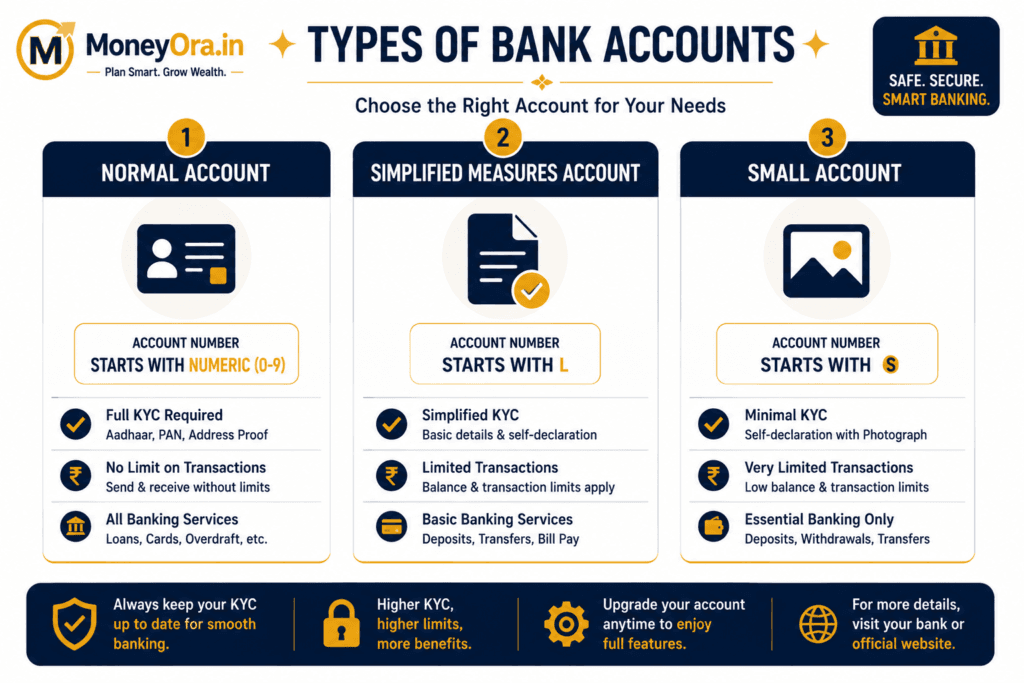
Not every one of these identifiers represents the same underlying account type — the first character tells you which category applies.
| Account Type | Starting Character | Created With |
|---|---|---|
| Normal Account | Numeric (standard 14-digit number) | One of six primary IDs: PAN, Aadhaar, Voter ID, Passport, Driving Licence, or NREGA Job Card |
| Simplified Measures Account | Starts with ‘L’ | Other RBI-approved documents (e.g., certain government-issued certificates) |
| Small Account | Starts with ‘S’ | Personal details and a photograph only, no formal ID proof — limited to small-value transactions |
Why this matters practically:
If your CKYC Number starts with ‘S’, you’re likely operating under transaction limits tied to a Small Account, and upgrading to a Normal Account (by submitting one of the six primary ID documents) removes those restrictions. This is a common, easily overlooked reason someone finds a transaction unexpectedly capped despite believing their KYC was fully complete.
How to Find Your CKYC Number (6 Real Methods)
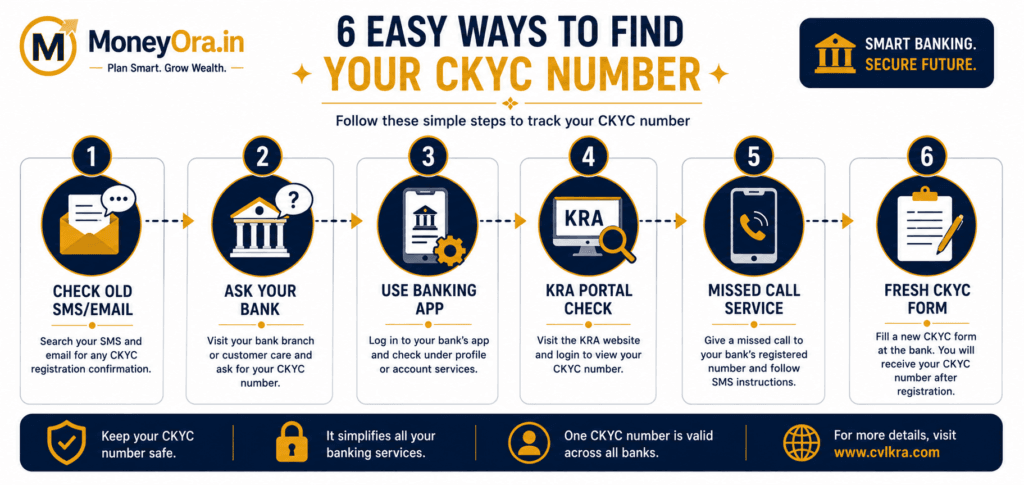
There is no single public portal where individuals can freely search and retrieve their own CKYC Number directly — access works differently than a typical online lookup, and understanding that upfront saves a lot of wasted searching.
Method 1: Check old SMS or emails from CERSAI
Search your inbox and messages for “CKYC,” “KIN,” or “CERSAI” — you were very likely sent a notification containing your number when your KYC was first registered.
Method 2: Ask the bank, insurer, or mutual fund where you completed KYC
Any institution where you’ve opened an account, bought a policy, or invested can look up and provide your CKYC Number directly, since they’re the ones who originally registered it.
Method 3: Use your bank or broker’s mobile app
Many banks and brokers now display your CKYC status and number directly within their app’s KYC or profile section — often the fastest method if you already use one regularly.
Method 4: Use the CKYC check facility via KRA portals
Karvy (KRA) and CDVL (Central Depository Services Limited) provide dedicated CKYC check facilities through their web portals, where entering your registered mobile number and completing OTP verification retrieves your record.
Method 5: Give a missed call to your bank’s registered CKYC helpline
Several banks now offer a missed-call-based retrieval service tied to your registered mobile number — genuinely the fastest option when it’s available for your specific bank.
Method 6: Complete a fresh CKYC form if you can’t locate an existing number
If you’ve only ever completed a “limited KYC” that never propagated to CERSAI, walk into any RBI/SEBI/IRDAI/PFRDA-regulated institution, submit a CKYC form with PAN, Aadhaar, address proof, a photograph, and signature, and complete In-Person Verification (IPV) if required — a fresh CKYC Number will then be issued.
Our honest recommendation: Start with the missed call or app-based check if your bank offers either — both are typically faster in practice than navigating a full web portal flow.
Why RBI Wants Every Financial Customer to Know Their CKYC Number
RBI’s push behind CKYC isn’t paperwork for its own sake — it addresses a genuine, longstanding friction point in Indian financial services: the same customer repeatedly proving their identity to every new institution they deal with.
Reducing duplicate document submission: Before CKYC, opening a mutual fund account, then a bank account, then buying insurance meant submitting identical PAN, Aadhaar, and address proof documents three separate times, to three separate KYC processes.
Standardising KYC across regulators: CKYC unifies KYC data across four different regulatory bodies — RBI (banking), SEBI (securities/mutual funds), IRDAI (insurance), and PFRDA (pensions) — into one consistent record, closing gaps that previously let inconsistent or incomplete KYC data exist across an individual’s different financial relationships.
Faster account opening and investment: Once your CKYC Number is on file, opening a new account or making a new investment can happen in real time, since the institution pulls your existing verified record instead of running a fresh verification cycle.
Anti-money-laundering compliance: A centralised, standardised KYC registry makes it structurally harder for the same individual to maintain inconsistent or fraudulent identity records across different financial institutions, directly supporting AML objectives under the PMLA framework.
Real Benefits of Having Your CKYC Number Handy
- Faster onboarding for every new financial product. Quoting your CKYC Number when opening a new bank account, demat account, or insurance policy can eliminate the need to resubmit physical documents.
- Fewer redundant document uploads. Once your details sit in the central registry, you generally don’t need to re-upload the same PAN and address proof at every new institution.
- Automatic detail syncing across institutions. Under recent rule changes, updating your address or other KYC details with one bank now automatically syncs across every other institution where your CKYC is registered, with no further action required from you.
- Real-time transaction enablement. Because CKYC allows real-time verification, you can often start transacting — investing, opening an account — the same day rather than waiting for a manual KYC review to clear.
- A built-in fraud-monitoring layer. Since any institution accessing or updating your CKYC record now triggers an electronic intimation to you, unauthorized or unexpected access attempts become visible rather than invisible.
Common CKYC Errors and How to Fix Them
| Error | Likely Cause | Fix |
|---|---|---|
| “Mobile number not registered” on the CKYC portal | The mobile number on your CKYC record differs from the one you’re currently using | Update your mobile number at the bank where you most recently completed KYC, then retry after the CERSAI sync window (typically around 7 days) |
| CKYC Number not found despite having opened accounts before | You completed a “limited KYC” that never propagated to the central registry | Complete a fresh CKYC form with a regulated institution to get a new number issued |
| Institution says your CKYC record is outdated | Your KYC details haven’t been refreshed within the periodic review cycle required by current RBI rules | Visit any regulated institution to complete a KYC update, which then syncs to your central record |
| Received an unexpected CERSAI intimation SMS/email | Another institution accessed or updated your CKYC record, which is now flagged to you automatically under current rules | This is expected behavior under recent transparency rules; verify the transaction was legitimate, and report to CERSAI or your bank if it wasn’t |
CKYC vs Regular KYC: The Real Difference
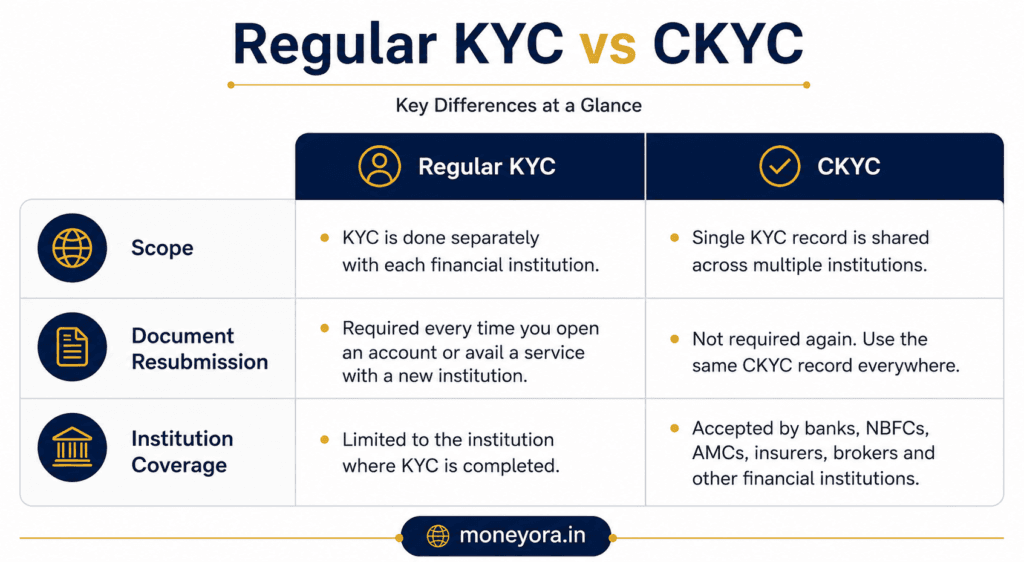
A lot of confusion around this topic comes from treating “KYC” and “CKYC” as interchangeable, when they describe two different layers of the same process.
Regular KYC is what any individual financial institution does when you open an account with them specifically — verifying your identity and address documents for their own internal compliance record.
CKYC is the centralised layer sitting above that — once any regulated institution completes your KYC, they upload that verified record to CERSAI’s central registry, generating your CKYC Number. Every subsequent institution you deal with can then reference that central record instead of repeating their own full verification process from scratch.
In practice: You still complete a KYC form the first time you deal with any given institution type, but CKYC is what prevents that from turning into a repeated, from-scratch process every single time you open a new account somewhere else.
Common Mistakes People Make With CKYC
- Paying a third-party website to “reveal” a CKYC Number for a fee. No legitimate route to retrieving your CKYC Number requires payment — if a site asks for money or unusually sensitive details to disclose it, verify through your actual bank or CERSAI-linked resources instead.
- Assuming CKYC and Aadhaar are the same thing. Aadhaar is commonly used as one of the documents to establish CKYC, but the CKYC Number itself is a separate, distinct 14-digit identifier tied to the central registry, not your Aadhaar number.
- Not updating your mobile number when you change it. Since CERSAI communications and OTP-based verification rely on your registered mobile number, an outdated number is one of the most common reasons people can’t retrieve or update their CKYC record.
- Assuming a Small Account CKYC Number has no limitations. A CKYC Number starting with ‘S’ indicates transaction limits are in place; treating it as identical to a Normal Account can lead to unexpected transaction rejections.
- Ignoring CERSAI intimation messages. Since institutions accessing your CKYC record now trigger an automatic notification to you, dismissing these messages without checking them means missing an early signal if something unauthorized is happening with your financial identity.
What CKYCRR 2.0 Changes for You in 2026
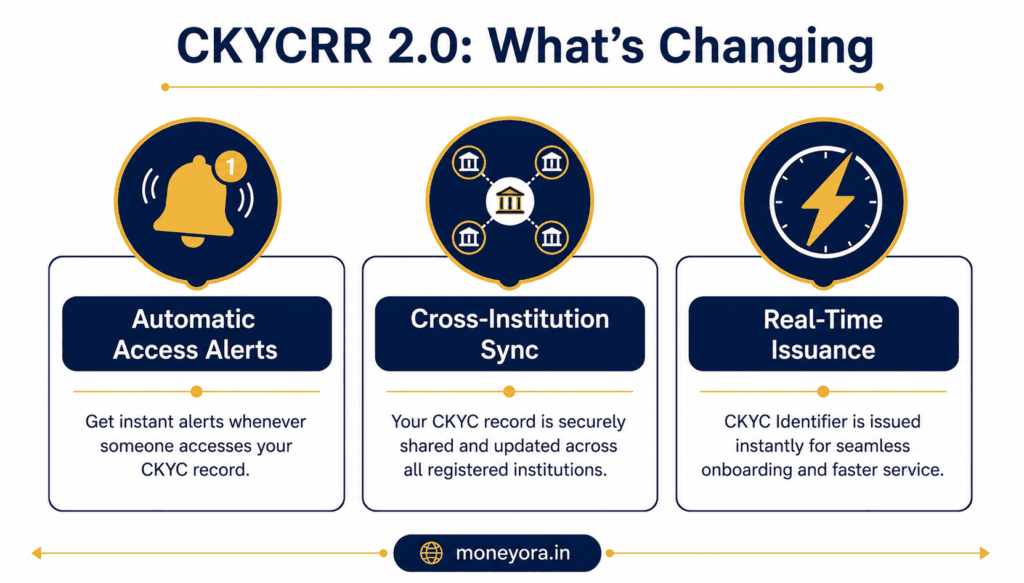
CKYC is entering a genuinely new phase in 2026, and the practical changes matter more to ordinary customers than the technical framing suggests. Following amendments to the Prevention of Money Laundering Act (July 2024) and the RBI Master Direction on KYC (November 2024), the system has moved toward what’s being called CKYCRR 2.0 — a more digital-first, consent-driven approach to how KYC data moves between institutions.
Three changes stand out. First, when any institution downloads or updates your CKYC record, CERSAI now sends you an electronic intimation automatically — a meaningful transparency improvement that effectively turns every customer into a passive monitor of their own financial identity. Second, changing your address or other KYC details with one institution now automatically propagates across every other institution where your CKYC is registered, removing what used to be a genuinely tedious update-everywhere-separately process. Third, and most practically, real-time API integration between regulated institutions and CERSAI means CKYC Number issuance is dropping from what was historically a multi-day wait to, in many cases, minutes.
For most readers, the actionable takeaway isn’t a specific new form to fill out — it’s simply worth locating your existing CKYC Number now, before you need it under time pressure for a specific transaction, and confirming your registered mobile number is current given how central it’s become to every part of this system’s verification flow.
Assumptions stated: this reflects publicly available regulatory reporting as of mid-2026 and is not a substitute for checking current RBI Master Directions or CERSAI notifications directly.
A CKYC Number is one of the more genuinely useful pieces of financial infrastructure most people have never heard of until they’re specifically asked for it — a single 14-digit identifier that, once located, can meaningfully speed up every future account opening, investment, or insurance purchase. Finding it usually takes one of two minutes: checking old SMS/email, calling your bank, or using their app, rather than requiring any complicated new process. The genuinely useful habit going forward is simply keeping your registered mobile number current, since nearly every part of the 2026 CKYCRR 2.0 system — from OTP verification to automatic update syncing to fraud-alert intimations — routes through it.
This article is for educational and informational purposes only and reflects publicly available CERSAI and RBI guidance as of mid-2026. Processes and portal availability can change; always verify current requirements through your regulated financial institution or official CERSAI-linked resources before taking any action.
1. What is a CKYC Number?
A CKYC Number is a unique 14-digit identifier, also called a KIN (KYC Identification Number), issued by CERSAI once your KYC details are recorded in India’s Central KYC Records Registry. It lets any regulated financial institution pull your verified KYC record instantly instead of asking you to resubmit documents.
2. How can I find my CKYC number?
Check old SMS or emails from CERSAI, ask the bank or institution where you completed KYC, check your bank or broker’s mobile app, use a KRA portal’s CKYC check facility, or give a missed call to your bank’s CKYC helpline if available. There’s no single public lookup portal for individuals.
3. Is CKYC Number the same as KIN?
Yes. CKYC Number, KIN (KYC Identification Number), and CKYC ID all refer to the exact same 14-digit identifier — different institutions and forms simply use different terminology for it.
4. What does it mean if my CKYC Number starts with ‘S’?
A CKYC Number starting with ‘S’ indicates a Small Account, created using only personal details and a photograph without formal ID proof, and typically carries transaction limits until upgraded to a Normal Account with a primary ID document.
5. Is there an official website to check my CKYC number directly?
Individuals cannot log in to the central CKYC registry directly — only regulated institutions can. However, some KRA portals (like Karvy and CDSL) offer a CKYC check facility for individuals using registered mobile number and OTP verification.
6. Do I need to pay any fee to find my CKYC number?
No. Retrieving your CKYC Number through legitimate channels — your bank, insurer, mutual fund, or an official KRA portal — is free. Any website demanding payment to reveal your CKYC Number should be treated with caution.
7. What happens if my CKYC record shows the wrong mobile number?
You’ll typically see a “mobile number not registered” error. The fix is to update your mobile number at the bank where you most recently completed KYC, then retry after the CERSAI sync window, which is typically around 7 days.
8. Why does RBI want everyone to have a CKYC number?
CKYC reduces duplicate document submission across banks, mutual funds, insurers, and pension providers, standardises KYC across four different regulators, enables faster real-time account opening, and strengthens anti-money-laundering compliance by centralising identity verification.
9. Does updating my address with one bank update it everywhere under CKYC?
Yes, under recent rule changes, updating your address or other KYC details with one institution automatically syncs across every other institution where your CKYC is registered, without requiring separate updates at each one.
10. What documents are needed to complete CKYC for the first time?
Typically PAN, Aadhaar or another primary ID (Voter ID, Passport, Driving Licence, or NREGA Job Card), address proof, a passport-size photograph, and a signature, submitted through any RBI/SEBI/IRDAI/PFRDA-regulated institution, along with In-Person Verification if required.



Pingback: PAN Aadhaar Link Status Check 2026: Urgent Penalty Alert
Pingback: Gold Price Today India: Record Highs-Should Buy or Wait 2026
Pingback: EPF Interest Credited 2026: Check Your PF Balance Now