

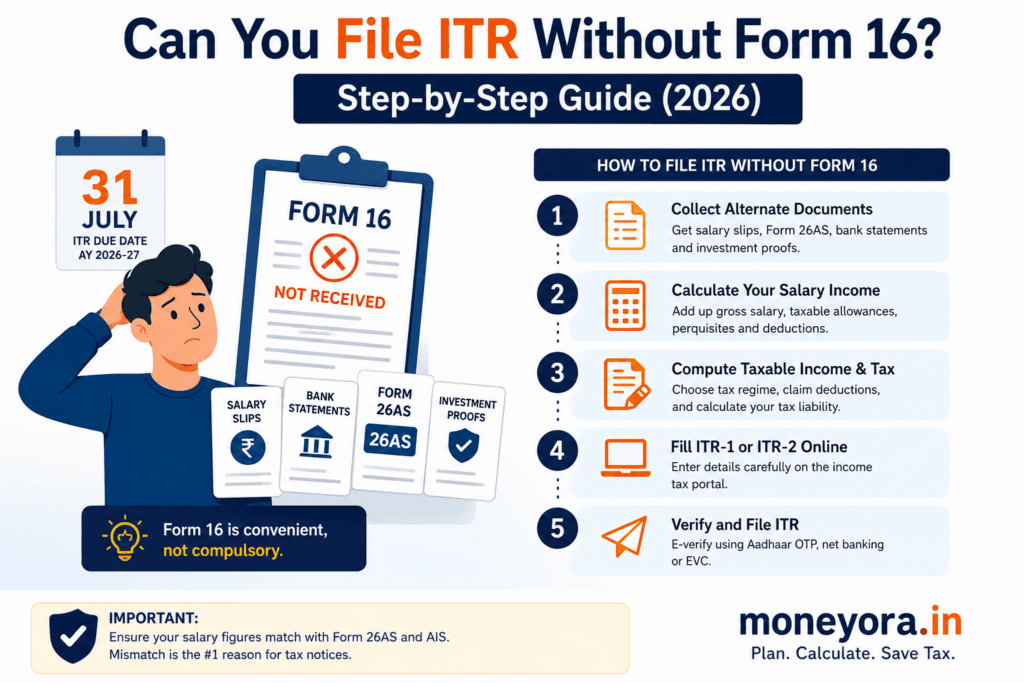
Can You File ITR Without Form 16? Step-by-Step Guide (2026)
July 31 is closer than you think, and half my inbox this week is the same panic message: “My HR still hasn’t sent Form 16, what do I do now?”
Short answer: you can still file. Form 16 is convenient, not compulsory. I’ve walked friends and readers through this exact situation for three tax seasons in a row — job switchers, contract employees whose HR is slow, and people whose Form 16 simply had wrong numbers on it. Every one of them filed on time without it.
This guide answers can I file ITR without Form 16 in full, with the actual documents you need, the exact salary calculation method, common mistakes that trigger notices, and a walkthrough you can copy line by line. For FY 2025-26 (AY 2026-27), salaried taxpayers filing ITR-1 or ITR-2 still have to file by 31 July 2026 — Form 16 or not.
Before we get into the steps, if you want to check your exact tax outgo under both regimes while you gather these documents, MoneyOra’s Income Tax Calculator does that comparison in under a minute.
Form 16 mandatory to file ITR?
No. Form 16 is not a legal requirement for filing your Income Tax Return. It’s a TDS certificate your employer issues under Section 203 of the Income Tax Act, summarizing what you earned and what tax was deducted. It’s a convenience document, not a filing permit.
You can file ITR-1 or ITR-2 using your salary slips, Form 26AS, the Annual Information Statement (AIS), and your bank statements instead. The income tax portal doesn’t ask you to upload Form 16 at any stage — it never has.
Where this gets tricky is when your employer changed mid-year, when your HR department is simply late, or when Form 16 has an error you haven’t caught yet. In every one of those cases, the fix is the same: rebuild the numbers yourself from primary documents, and let Form 16 (when it eventually shows up) act as a cross-check, not your only source.
Why employees end up without Form 16
A few situations show up again and again:
- Job switch during the year. One or both employers delay issuing Form 16, or one employer simply forgets.
- Startups and small companies with weak payroll processes. Form 16 gets issued in September instead of June.
- Contract-to-permanent conversions. Payroll vendors change mid-year and records get split.
- Company shutdowns or HR exits. Nobody left to generate the certificate.
- Errors in the issued Form 16. Wrong PAN, wrong TDS figure, missing HRA — waiting for a corrected version eats the calendar.
None of these are your fault, and none of them extend your filing deadline. That’s the part people miss — the due date doesn’t wait for your employer’s paperwork.
Documents you need instead of Form 16
Keep these open in separate tabs before you start:
| Document | What it gives you | Where to get it |
|---|---|---|
| Monthly salary slips (all 12) | Basic pay, HRA, allowances, deductions | Employer payroll portal / HR email |
| Form 26AS | TDS actually deposited against your PAN | Income Tax e-filing portal |
| AIS (Annual Information Statement) | Interest, dividends, mutual fund transactions, other reported income | Income Tax e-filing portal |
| TIS (Taxpayer Information Summary) | Simplified, category-wise version of AIS | Income Tax e-filing portal |
| Bank statements (savings + FD) | Interest income, unexplained credits you need to account for | Net banking / bank app |
| Rent receipts and rental agreement | HRA exemption proof | Landlord |
| Investment proofs (PPF, ELSS, LIC, NPS) | Section 80C, 80CCD deductions | Investment platforms, insurers |
| Home loan interest certificate | Section 24(b) deduction | Bank / housing finance company |
| Form 12BB (if you filed one with your employer) | What you declared for TDS purposes | Your own copy |
If you switched jobs, get salary slips and, if possible, a relieving letter from both employers — you’ll need to combine income across employers when computing tax liability, especially since the basic exemption limit and slab benefit apply only once per year, not once per employer.
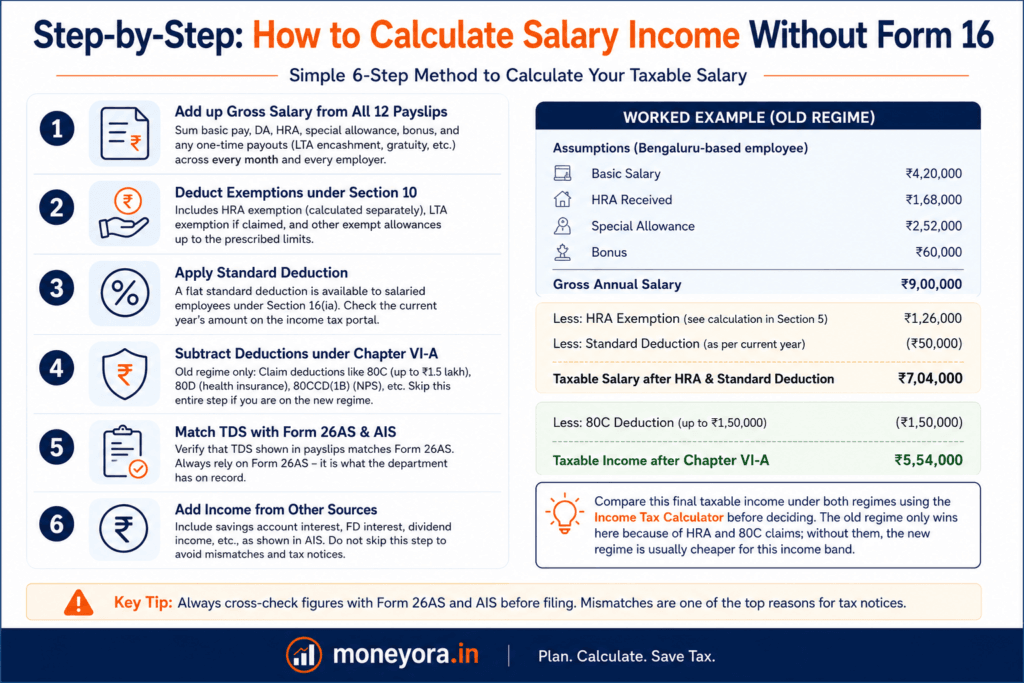
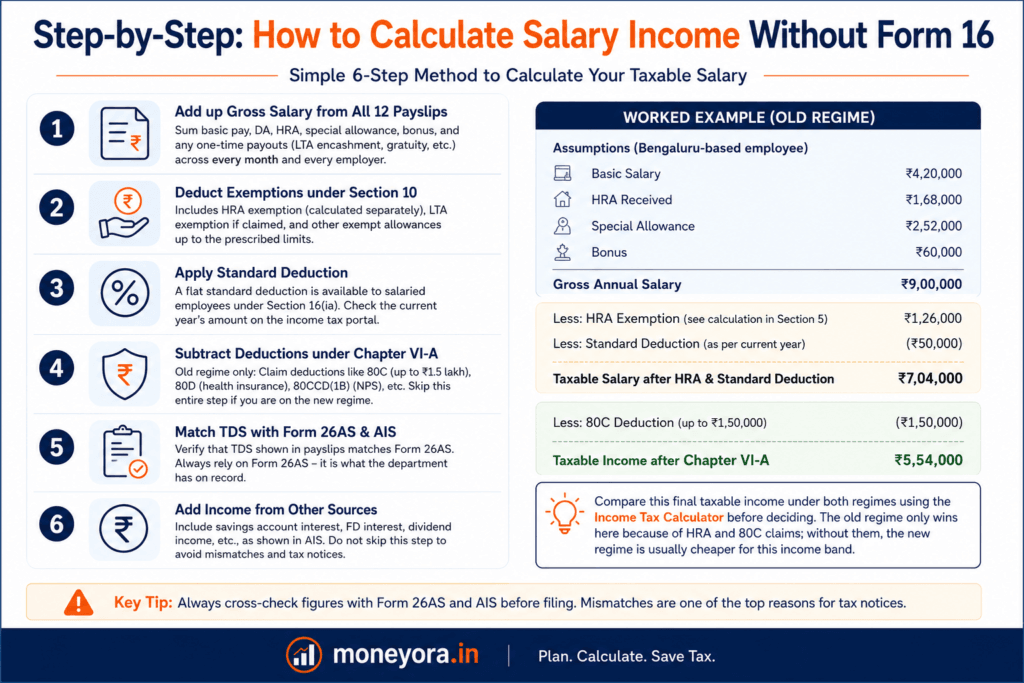
Step-by-step: how to calculate salary income without Form 16
This is the part people find intimidating, and it really isn’t. Here’s the sequence I use.
Step 1 — Add up gross salary from all 12 payslips.
Sum basic pay, DA, HRA, special allowance, bonus, and any one-time payouts (LTA encashment, gratuity if applicable) across every month and every employer for the year.
Step 2 — Deduct exemptions under Section 10.
This includes HRA exemption (calculated below), LTA exemption if claimed, and any other allowance that’s exempt up to a limit (like conveyance or children’s education allowance, where still applicable).
Step 3 — Apply the standard deduction.
A flat standard deduction is available to salaried employees under Section 16(ia) — check the current year’s amount on the income tax portal before you finalize, since this has been revised in recent budgets.
Step 4 — Subtract deductions under Chapter VI-A (old regime only).
Section 80C (up to ₹1.5 lakh — PPF, ELSS, life insurance, EPF), 80D (health insurance premium), 80CCD(1B) (additional NPS), and others, if you’re on the old regime. Skip this step entirely if you’re on the new regime, since most of these deductions aren’t available there.
Step 5 — Match TDS against Form 26AS and AIS.
Whatever tax was actually deducted by your employer(s) should show up in Form 26AS. If your payslip TDS total doesn’t match Form 26AS, trust Form 26AS — that’s what the department has on record, and that’s the number that determines your refund or demand.
Step 6 — Add income from other sources.
Savings account interest, FD interest, dividend income — all visible in AIS. Don’t skip this. AIS mismatches are one of the most common reasons for tax notices in the last two assessment years.
A worked example:
Assume a Bengaluru-based employee, gross annual salary ₹9,00,000 (basic ₹4,20,000, HRA ₹1,68,000, special allowance ₹2,52,000, bonus ₹60,000), monthly rent ₹18,000, and old regime chosen for 80C investments of ₹1,50,000.
- HRA exemption (see calculation in Section 5): ₹1,26,000
- Standard deduction: as per current year’s provision
- Taxable salary after HRA and standard deduction: roughly ₹7,04,000 before Chapter VI-A
- After 80C deduction of ₹1,50,000: taxable income around ₹5,54,000
- Compare this final number under both regimes using the Income Tax Calculator before deciding which one to file under — the old regime only wins here because of the HRA and 80C claims; without them, the new regime is usually cheaper for this income band.
How to claim HRA and other deductions without Form 16
HRA exemption is the deduction people most often lose money on simply because Form 16 didn’t carry it. You’re allowed to claim it directly in your ITR under Section 10(13A), even if your employer never processed it.
HRA exemption is the lowest of these three:
- Actual HRA received during the year
- Rent paid minus 10% of (basic salary + DA)
- 50% of basic salary (Delhi, Mumbai, Kolkata, Chennai) or 40% of basic salary (every other city)
Example: Basic salary ₹4,20,000/year, HRA received ₹1,68,000, rent paid ₹2,16,000/year, non-metro city.
- Actual HRA received: ₹1,68,000
- Rent minus 10% of basic: ₹2,16,000 − ₹42,000 = ₹1,74,000
- 40% of basic (non-metro): ₹1,68,000
- Exempt HRA = lowest of the three = ₹1,68,000
Keep rent receipts and, if annual rent crosses ₹1,00,000, your landlord’s PAN — this is mandatory documentation the department can ask for later, even though ITR forms themselves are attachment-less.
No HRA in your salary at all?
You can still claim a deduction under Section 80GG, provided you, your spouse, or your minor child don’t own a house in the city where you work. This deduction is the lowest of: rent paid minus 10% of total income, ₹5,000 per month, or 25% of total income. You’ll need to file Form 10BA for this.
Home loan interest, 80C investments, NPS contributions
all of these are claimed the same way: pull the actual certificates from your bank or investment platform and enter them directly into the relevant ITR schedule. Form 16 was never the source document for these anyway; it was just a summary.
Step-by-step ITR filing process without Form 16
- Log in to the Income Tax e-filing portal using your PAN.
- Download Form 26AS and AIS from the portal — these become your TDS and income cross-check.
- Select the correct ITR form. Most salaried individuals with income up to ₹50 lakh, one house property, and no capital losses to carry forward use ITR-1. If you have capital gains, more than one house property, or foreign assets, you’ll need ITR-2.
- Compute gross salary from your 12 payslips as shown in Section 4.
- Calculate and enter HRA exemption under Section 10(13A), even though it isn’t reflected in any document your employer sent you.
- Choose your tax regime. The new regime is the default; you actively opt for the old regime if your deductions make it cheaper.
- Enter Chapter VI-A deductions (old regime) using actual proofs — 80C, 80D, 80CCD(1B), home loan interest under Section 24(b).
- Add income from other sources — interest, dividends — matched against AIS.
- Reconcile TDS — enter the TDS figure from Form 26AS, not your payslip estimate, if the two differ.
- Preview the computed tax liability or refund, verify every field once more against your source documents.
- Submit and e-verify within 30 days using Aadhaar OTP, net banking, or your demat account — an unverified return is treated as not filed at all.
Do this on a laptop with two tabs open — one for the ITR form, one for Form 26AS/AIS — rather than trying to remember figures from memory. That single habit prevents most of the mismatches people run into later.
FY 2025-26 (AY 2026-27) deadlines you should know
- 31 July 2026 — due date for salaried individuals and others filing ITR-1 or ITR-2, no audit required.
- 31 August 2026 — due date for taxpayers filing ITR-3 or ITR-4 who are not subject to a tax audit.
- 31 October 2026 — due date for taxpayers whose accounts require an audit.
- 31 December 2026 — general deadline for belated or revised returns for this assessment year, based on current provisions.
- Updated return (ITR-U) — can generally be filed later, subject to additional tax, under the extended window the government has provided in recent years.
These dates can shift if the Central Board of Direct Taxes issues an extension — it happened for AY 2025-26 when the department pushed the salaried deadline out because of ITR form revisions. Check the official Income Tax India site closer to the date rather than relying on any single article, including this one, for the final word.
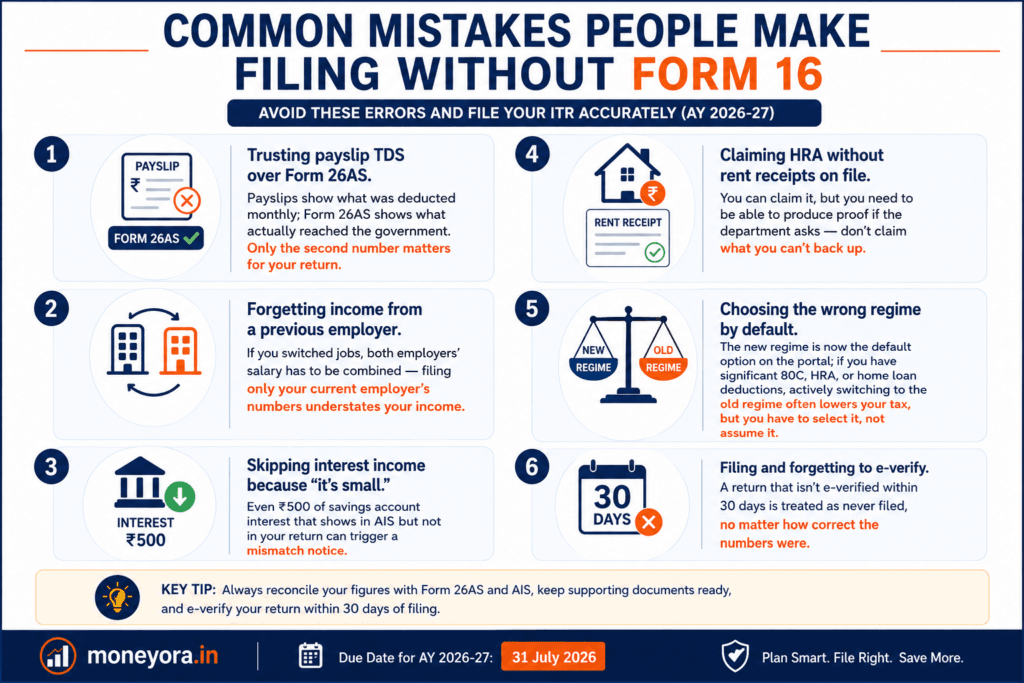
Common mistakes people make filing without Form 16
- Trusting payslip TDS over Form 26AS. Payslips show what was deducted monthly; Form 26AS shows what actually reached the government. Only the second number matters for your return.
- Forgetting income from a previous employer. If you switched jobs, both employers’ salary has to be combined — filing only your current employer’s numbers understates your income.
- Skipping interest income because “it’s small.” Even ₹500 of savings account interest that shows in AIS but not in your return can trigger a mismatch notice.
- Claiming HRA without rent receipts on file. You can claim it, but you need to be able to produce proof if the department asks — don’t claim what you can’t back up.
- Choosing the wrong regime by default. The new regime is now the default option on the portal; if you have significant 80C, HRA, or home loan deductions, actively switching to the old regime often lowers your tax, but you have to select it, not assume it.
- Filing and forgetting to e-verify. A return that isn’t e-verified within 30 days is treated as never filed, no matter how correct the numbers were.
Risks of filing without cross-checking your numbers
Filing without Form 16 is completely legal, but it does shift the responsibility of accuracy onto you instead of your employer’s payroll system. A few real risks worth naming plainly:
- TDS mismatch risk — if your reported TDS doesn’t match Form 26AS, your refund can get delayed or you may receive a demand notice.
- Under-reporting risk — missing an old employer’s income or a chunk of FD interest can flag your return for scrutiny.
- Regime-selection risk — picking a regime that doesn’t suit your deduction profile means paying more tax than necessary, not a compliance issue, but a real money cost.
- Documentation risk — HRA and 80GG claims without receipts can be reversed on inquiry, along with interest.
- Deadline risk — waiting for Form 16 that never arrives and missing 31 July altogether adds late fees under Section 234F and interest under Section 234A.
None of these are reasons to avoid filing on time. They’re reasons to slow down on Steps 4 and 5 above and actually reconcile your numbers against Form 26AS and AIS before you submit.
what changes this year
The ITR forms for AY 2026-27 carry meaningfully more structured reporting requirements than a few years ago — separate schedules for pre- and post-July capital gains treatment carried over from earlier Finance Act changes, and tighter validation between what you report and what shows up in AIS. In practice, this means the income tax department’s system is now better at catching a mismatch than it was three years ago, so filing without Form 16 doesn’t carry more procedural risk than before, but filing carelessly does get caught faster.
The other shift worth flagging: with the new tax regime as the default and a higher basic exemption threshold under it, a meaningful number of salaried taxpayers who used to lean on Form 16’s HRA and 80C fields no longer need those deductions at all — for them, filing without Form 16 is actually simpler than it used to be, because there’s less to reconstruct. If your salary sits comfortably under the new regime’s effective tax-free threshold and you don’t have large 80C or HRA claims, the entire Form 16 question becomes far less consequential than it feels in the moment.
The taxpayers who still need to be careful are the ones with rent, a home loan, or serious 80C investments, where the old regime remains cheaper — that’s exactly the group where reconstructing HRA and deduction figures by hand, carefully, actually saves money.
Expert perspective: what to watch before you submit
A few things I’d flag before anyone hits submit on a return built without Form 16:
Watch the AIS “feedback” option. If AIS shows an interest or transaction figure you disagree with, don’t silently ignore it — use the feedback mechanism on the portal to flag it as incorrect. Silence gets read as agreement.
Watch your employer’s TDS deposit timing. TDS deducted in March sometimes reflects in Form 26AS only in May or June. If you’re filing in early July and a chunk of TDS is missing from 26AS, wait a few days and refresh before assuming an error.
Watch which regime the portal defaults you into. Since the new regime became the default, taxpayers who mean to opt for the old regime sometimes miss the explicit selection step and end up taxed under the regime they didn’t want.
Watch for revised return eligibility. If Form 16 arrives after you’ve filed and something doesn’t match, you’re not stuck — a revised return is available well past the original date, so filing now without Form 16 is a low-risk decision, not a one-shot gamble.
Try this calculation yourself
Before you finalize your numbers, run them through MoneyOra’s tools rather than doing it by hand twice:
- Income Tax Calculator — compare old vs new regime tax liability instantly using the salary figures you’ve reconstructed from payslips.
- EMI Calculator — if you’re claiming home loan interest under Section 24(b), check your annual interest breakup first.
- SIP Calculator — if you’re deciding whether to top up 80C investments before the financial year closes next time, model the numbers here.
- PPF Calculator — useful if PPF forms part of your 80C claim and you want to project next year’s maturity value.
Related MoneyOra Tools: you’ll also find the FD Calculator, NPS Calculator, and EPF Calculator useful for cross-checking interest and retirement contribution figures that show up in AIS.
What happens if Form 16 arrives after you’ve already filed?
Nothing dramatic. Compare the Form 16 figures against what you already filed. If everything matches, you’re done. If there’s a discrepancy — say Form 16 shows a slightly different TDS number or an HRA figure you didn’t have — file a revised return under Section 139(5). For AY 2026-27, the revision window generally extends well beyond the original due date, giving you enough runway to correct things without penalty, provided you file the correction in good faith and within the prescribed timeline.
This is exactly why filing without Form 16, using your own reconstructed numbers, is a reasonable decision rather than a risky one — the system is built to accommodate exactly this scenario.
Latest questions people are asking right now
“My company shut down and I can’t get Form 16 at all — what now?”
Use your last available payslips, bank statements showing salary credits, and Form 26AS to reconstruct income. Form 26AS is generated from TDS filings your employer made with the government, so it should exist even if the company itself has closed.
“I have two Form 16s from two employers — do I add both?”
Yes. Combine gross salary from both, and don’t apply the standard deduction or basic exemption limit twice — it applies once per financial year, regardless of how many employers you had.
“Is the ITR deadline for salaried people delayed this year too?”
As of now, salaried taxpayers filing ITR-1 or ITR-2 for FY 2025-26 are expected to file by 31 July 2026, while non-audit business taxpayers filing ITR-3 or ITR-4 have been given until 31 August 2026. Always confirm on the official portal in case of a last-minute extension.
“Can I file ITR without any Form 16 if I’m a freelancer, not a salaried employee?”
Yes, and this is actually more common — freelancers and consultants don’t receive Form 16 at all; they file based on Form 26AS, AIS, and their own income records under the “profits and gains from business or profession” head, typically using ITR-3 or ITR-4.
“Will I get flagged for scrutiny if I file without Form 16?”
No. The income tax system doesn’t track whether Form 16 was used to prepare your return. What gets flagged is a mismatch between what you report and what AIS/Form 26AS show — that risk exists whether or not you have Form 16 in hand.
Form 16 makes filing convenient, not possible. If yours hasn’t arrived, or it has arrived with errors, you have every legal right to reconstruct your income from payslips, Form 26AS, and AIS and file on time. The one habit that matters more than any other here is reconciliation — matching your self-computed TDS, HRA, and other-source income against what the department already has on record before you hit submit.
Risks to consider: TDS mismatches, missed income from a previous employer, and regime-selection errors are the three things that actually cost people money — not the absence of Form 16 itself.
Opportunities: filing early, without waiting on a slow employer, protects you from late fees under Section 234F and gets any refund moving faster.
Long-term, this is a documentation habit worth building regardless of whether Form 16 shows up on time — payslips, 26AS, and AIS are the real source of truth every year, Form 16 or not.
Before you file, run your numbers through the free Income Tax Calculator on MoneyOra.in to confirm which regime actually saves you more — can I file ITR without Form 16 stops being a stressful question the moment you have that number in front of you.
Use the free calculator now on MoneyOra.in
Frequently Asked Questions
Can I file ITR without Form 16?
Yes. Form 16 is a TDS certificate, not a legal requirement for filing. You can prepare your return using salary slips, Form 26AS, AIS, and bank statements, and file within the regular due date.
What documents replace Form 16 when filing ITR?
Twelve months of salary slips, Form 26AS, the Annual Information Statement, bank statements, rent receipts for HRA, and investment proofs for 80C, 80D, and other deductions together cover everything Form 16 would have summarized.
How do I calculate HRA exemption without Form 16?
Take the lowest of three figures: actual HRA received, rent paid minus 10% of basic salary plus DA, and 50% of basic salary for metro cities or 40% for non-metro cities. Enter this figure directly under Section 10(13A) in your ITR.
Is it risky to file ITR without Form 16?
Not inherently. The main risk is a mismatch between your self-reported numbers and Form 26AS or AIS, which can delay a refund or trigger a notice. Cross-checking every figure before submission removes most of that risk.
What if my employer sends Form 16 after I’ve already filed?
Compare the two. If figures differ, file a revised return under Section 139(5) within the extended revision window available for the relevant assessment year.
Which ITR form should I use without Form 16?
Most salaried individuals with income up to ₹50 lakh, one house property, and no carried-forward capital losses use ITR-1. Those with capital gains, multiple properties, or foreign assets need ITR-2.
Can freelancers or consultants file without Form 16?
Yes — freelancers never receive Form 16 in the first place. They file under the business/profession income head using ITR-3 or ITR-4, based on their own records and Form 26AS/AIS.
What is the last date to file ITR for FY 2025-26 without Form 16?
31 July 2026 for salaried taxpayers filing ITR-1 or ITR-2, and 31 August 2026 for non-audit business taxpayers filing ITR-3 or ITR-4, based on current provisions.
Do I need to submit Form 16 or rent receipts along with my ITR?
No. ITR forms are annexure-less — you don’t upload any supporting documents at filing. You do need to retain them in case the department asks for verification later.
Can I claim 80C deductions without Form 16?
Yes. Use your actual investment proofs — PPF passbook, ELSS statement, insurance premium receipt — and enter the total directly under Chapter VI-A in your return.


Pingback: EPF vs PPF vs NPS: Which Is Best for Freshers? (2026)
Pingback: Home Loan Eligibility by Salary: Best ₹21K to ₹1 Lakh+
Pingback: CIBIL Score for Home Loan: Best Numbers for 2026
Pingback: Best Foreign Asset Exchange Rate for ITR 2026 - SBI TTBR Calculator