Adani Power Stock Split Impact Calculator
See exactly how the 1:5 split changed a real holding, using your own numbers.
Illustrative calculator for educational purposes only. Actual post-split market price is determined by live trading, not a mechanical division - the figure shown here is the theoretical adjusted price on the split date, before any further market movement.
Adani Power Stock Split: 1:5 Ratio, Record Date & What It Means

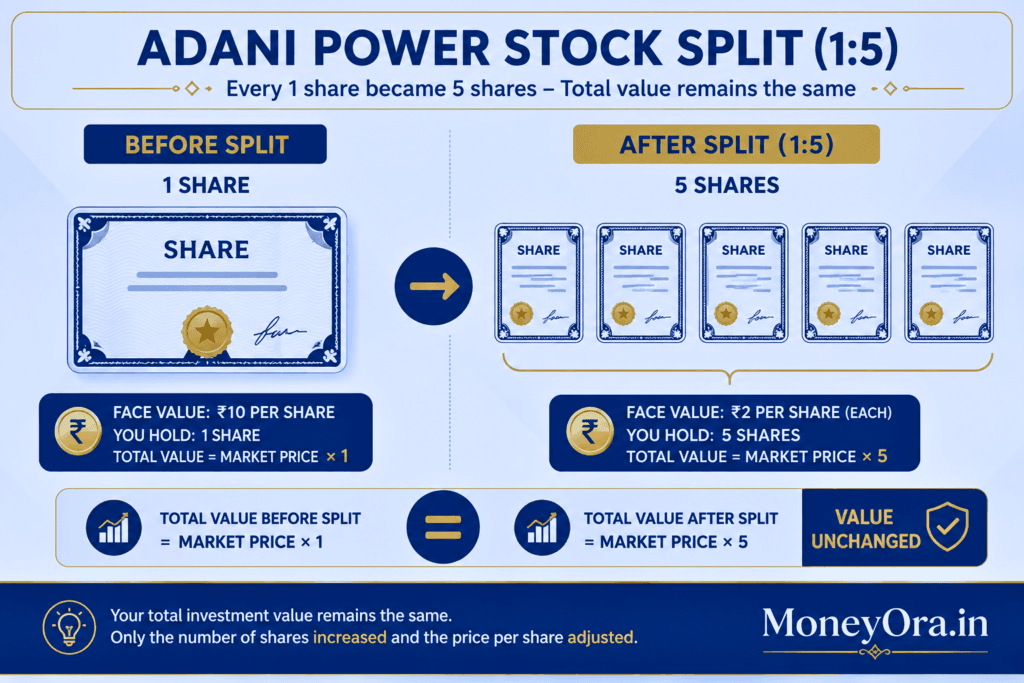
- The Adani Power stock split was executed in a 1:5 ratio – every 1 share became 5
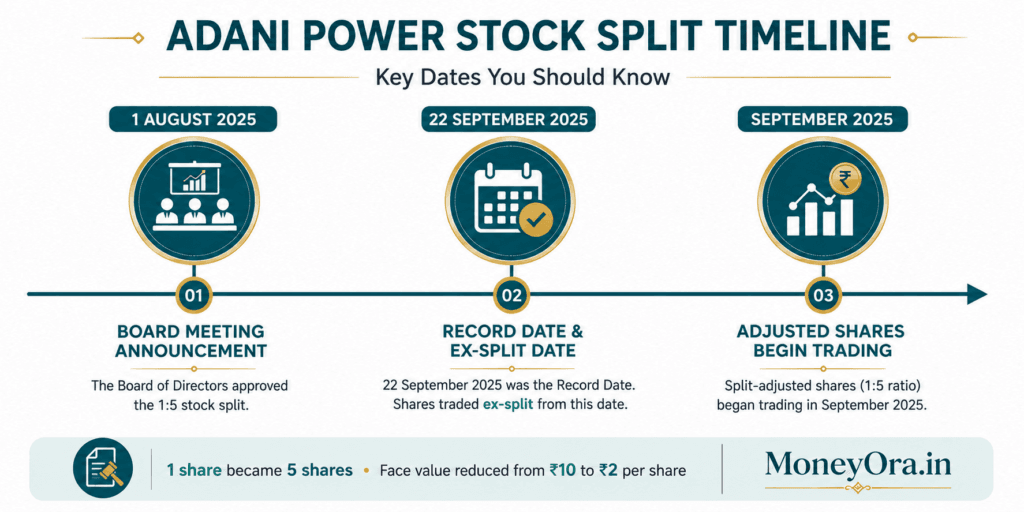
- Record date and ex-split date were both 22 September 2025
- Face value dropped from ₹10 to ₹2 per share
- This was Adani Power’s first-ever stock split since its 1996 incorporation
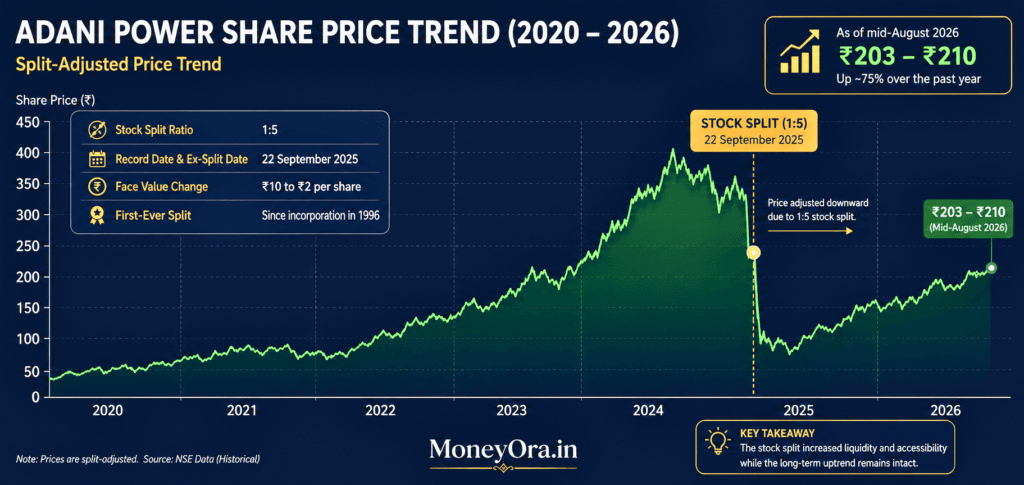
- As of mid-August 2026, the split-adjusted stock trades around ₹203-210, up roughly 75% over the past year
If you’ve held Adani Power shares since before September 2025 and noticed your demat account suddenly showing five times as many shares at a much lower price, you weren’t hacked and nothing went wrong. The Adani Power stock split did exactly what it was designed to do: multiply your share count while keeping your total investment value untouched. This guide walks through the full ratio, dates, history, and what the split means for your holdings today, alongside where the stock stands nearly a year later.
Adani Power Stock Split: Ratio, Date & Face Value
The Adani Power stock split was executed in a 1:5 ratio – meaning every single share held before the split became five shares afterward. This was achieved by sub-dividing the face value of each equity share from ₹10 to ₹2, a standard mechanism companies use to increase their outstanding share count without issuing any new capital.
| Split Ratio | 1:5 (one share split into five) |
| Face Value Before | ₹10 per share |
| Face Value After | ₹2 per share |
| Record Date / Ex-Split Date | 22 September 2025 |
| Board Approval Meeting | 1 August 2025 |
| Was This the First Split? | Yes – Adani Power’s only stock split to date |
Adani Power Stock Split Timeline – Key Dates
| Date | Event |
|---|---|
| 1 August 2025 | Board of Directors met to consider the stock split proposal, under Regulation 29 of SEBI’s Listing Obligations and Disclosure Requirements |
| 1 August 2025 | Board approved the 1:5 split ratio, converting each ₹10 face value share into five shares of ₹2 each |
| 22 September 2025 (Record Date) | Cut-off date for determining shareholder eligibility for the split |
| 22 September 2025 (Ex-Split Date) | Stock began trading ex-split; the adjusted share price took effect on this date |
| Within 1-2 working days after | Additional split shares credited automatically to eligible shareholders’ demat accounts |
Shareholders needed to have purchased shares before the ex-split date to be eligible for the additional shares. Anyone buying after 22 September 2025 would have purchased the already-adjusted, post-split shares directly.
Why Did Adani Power Announce a Stock Split?
Understanding the rationale helps make sense of the timing. The company’s own stated reason for the Adani Power stock split was straightforward to enhance liquidity of its equity shares by encouraging greater participation from retail investors, since a lower per-share price makes the stock more affordable to buy in board lots and smaller quantities.
Before the split, Adani Power shares traded at a level that, while not prohibitively expensive by Indian large-cap standards, still represented a meaningful per-share commitment for retail investors buying in round lots. By reducing the face value and multiplying the share count fivefold, the company made the stock more accessible without giving up any capital or diluting existing shareholders’ proportional ownership.
Before vs After: A Worked Example
Numbers make this clearer than definitions alone. Here’s exactly what happened to a hypothetical shareholder through the Adani Power stock split.
Rohan owned 100 shares of Adani Power before the record date, purchased at an average price of ₹700 per share (total investment ₹70,000).
Before the split: 100 shares x ₹700 = ₹70,000 total value. Face value ₹10 per share.
After the 1:5 split: 100 shares x 5 = 500 shares. Theoretical adjusted price = ₹700 ÷ 5 = ₹140 per share. Total value = 500 x ₹140 = ₹70,000 – unchanged.
Rohan’s total investment value did not change on the split date itself. What changed was purely the share count and the per-share price – a cosmetic restructuring, not a gain or loss event.
Adani Power Stock Split History
Unlike some peers that have split their stock multiple times over the years, the September 2025 event was Adani Power’s only stock split since the company’s incorporation on 22 August 1996. This makes the Adani Power stock split history a single-entry table, unlike multi-decade companies with several splits and bonus issues layered on top of each other. Searching for a longer Adani Power stock split history won’t turn up additional entries – this is genuinely the complete record.
| Split Event | Record Date | Ratio | Face Value Change |
|---|---|---|---|
| First and only split to date | 22 September 2025 | 1:5 | ₹10 → ₹2 |
Approximate price context around the event: the stock traded near ₹709 immediately before the split and adjusted to roughly ₹170 immediately after, broadly consistent with the mechanical 1:5 division once you account for regular market movement on the same trading day.
What a Stock Split Does NOT Change
This is the part every Adani Power stock split explainer should emphasise, and few actually do clearly.
- Total investment value: Unchanged on the split date itself – more shares at a proportionally lower price
- Market capitalisation: Unaffected – the company’s total value in the market stays the same
- Company fundamentals: Revenue, profit, assets, and debt are entirely untouched by a split
- Your proportional ownership: If you owned 0.001% of the company before, you still own 0.001% after
- Dividend entitlement (in absolute terms per rupee invested): A per-share dividend rate would adjust proportionally too, keeping your total payout the same
What a split genuinely does change is purely mechanical: share count, per-share price, and face value. Any actual gain or loss in your holding after the split comes entirely from normal market price movement, not from the split mechanism itself.
Adani Power Share Price – Where It Stands in August 2026
Nearly a year after the Adani Power stock split, the stock has continued its underlying business momentum, and tracking its post-split performance is where most current search interest now sits. As of mid-August 2026, shares trade in the ₹203-210 range on NSE and BSE, with a 52-week range of roughly ₹116 to ₹254, and one-year returns of approximately 74-77%.
| Price (mid-August 2026) | Approximately ₹203-210 |
| 52-Week Range | ₹116.22 – ₹254.20 |
| 1-Year Return | Approximately 74-77% |
| Market Capitalisation | Roughly ₹4 lakh crore |
| Q1 FY27 Net Profit | ₹4,805.69 crore, up 41.98% year-on-year |
| Q1 FY27 Revenue | ₹17,936 crore, up 26.6% year-on-year |
| Capacity Target | 45 GW by 2031 (raised from a prior 42 GW target) |
Following the June-quarter results, several brokerages issued bullish assessments: Morgan Stanley set an Overweight rating with a ₹275 target, Cantor Fitzgerald an Overweight rating at ₹266, and Bernstein an Outperform rating at ₹220. The consensus target across nine analyst estimates stood at approximately ₹247.67, implying meaningful upside from current levels at the time of that coverage.
Track live movement using MoneyOra’s Share Market Today tracker, and compare Adani Power against other power-sector names in our Railway and PSU Stocks list.
Will Adani Power Split Again?
This is one of the most common forward-looking questions around the Adani Power stock split. There has been no announcement of a second split as of August 2026. Companies typically consider further splits when the share price climbs back to a level perceived as expensive for retail participation, and Adani Power’s current price band, still well below its pre-split level even after a strong year of gains, does not obviously fit that pattern yet.
That said, given the company’s aggressive capacity expansion plans (45 GW by 2031) and consistently strong quarterly performance, continued price appreciation over the coming years could eventually put another split back on the table – though this remains speculative and unconfirmed by any company communication at this time.
Tax Treatment of Split Shares
A practical question many shareholders have: how does the Adani Power stock split affect capital gains tax when you eventually sell?
- Cost basis: Your original total cost of acquisition doesn’t disappear – it spreads proportionally across the new, larger share count
- Holding period: The holding period for split shares carries forward from your original purchase date, unlike bonus shares which get a fresh holding-period clock
- No taxable event: The split itself is not a taxable event – no capital gains tax applies simply because your shares split
If Rohan from our earlier example originally bought 100 shares at ₹700 (total cost ₹70,000), after the split his 500 shares carry an adjusted cost of ₹140 each – still totaling ₹70,000. When he eventually sells, gains are computed against this adjusted cost, not the pre-split ₹700 figure. For a deeper look at how this compares to bonus share taxation, where the treatment is meaningfully different, see MoneyOra’s Tax on Bonus Shares guide.
6 Mistakes Investors Make About Stock Splits
Thinking a Split Made Them Richer
The Adani Power stock split increased share count and reduced price proportionally – it did not add any value to your holding on its own.
Confusing Stock Split With Bonus Shares
Bonus shares carry a zero cost of acquisition and a fresh holding period; split shares retain the original cost (spread across more shares) and the original holding period. These are taxed differently.
Assuming a Lower Share Price Means “Cheaper” in Value
A ₹140 post-split share is not inherently cheaper than a ₹700 pre-split share in any meaningful valuation sense – the company’s total market value and per-share earnings adjust in exactly the same proportion.
Expecting the Split to Trigger a Rally
While splits sometimes coincide with renewed retail interest, the split mechanism itself does not cause price appreciation – subsequent gains come from business performance, as Adani Power’s own post-split trajectory shows.
Forgetting to Update Cost Basis Records
For tax purposes, your per-share cost basis needs to be divided by the split ratio (by 5, in this case) – failing to update this can cause an incorrect capital gains calculation at the time of sale.
Assuming Every Adani Group Stock Has Split
The Adani Power stock split is specific to this one company. Other Adani Group listed entities have their own independent corporate action histories and should not be assumed to have split on the same terms or timeline.
- Split creates no inherent value: Treating a lower post-split share price as a “buying opportunity” without evaluating the underlying business is a common investor error
- Sector-specific headwinds: Adani Power has faced international contract disputes and regulatory scrutiny around some of its projects, which are separate from and unrelated to the stock split itself
- Cost-basis tracking: Investors need to correctly adjust their per-share cost basis for accurate capital gains reporting when they eventually sell split shares
- Analyst targets are not guarantees: Brokerage price targets reflect estimates at a point in time and are subject to revision as new information emerges
- This calculator is educational only: It shows the theoretical mechanical adjustment on the split date and does not reflect subsequent market price movement
Related MoneyOra Guides and Tools
- Tax on Bonus Shares in India – Compare split-share tax treatment with bonus share rules
- Closing Price vs LTP – Understand how closing prices are calculated for stocks like Adani Power
- Closing Auction Session Explained – Learn how F&O-eligible stocks now determine daily closing price
- Reliance Power Share Price Analysis 2026 – Compare with another major power-sector stock
- Railway and PSU Stocks List – Explore other infrastructure and power-adjacent names
- Share Market Today – Track live Nifty and Sensex movement
Official Sources and External References
- NSE India – Adani Power (ADANIPOWER) Corporate Actions
- BSE India – Adani Power (533096) Corporate Actions
- SEBI – Listing Obligations and Disclosure Requirements Regulations
- Adani Power Limited – Official Investor Relations
Disclaimer: This article on the Adani Power stock split is for general educational and informational purposes only and does not constitute investment advice or a recommendation to buy or sell any security. Share prices, analyst targets, and financial figures cited are as reported at the time of research and are subject to change. The embedded calculator is an educational aid showing only the theoretical mechanical split adjustment. Always verify current data with official exchange sources and consult a qualified financial adviser before making investment decisions. MoneyOra does not provide individual investment advice and holds no position in the security discussed.
Calculate Your Own Adani Power Stock Split Impact
Use the calculator at the top of this page, or explore MoneyOra's full suite of free stock market tools.
Use the free calculator now on MoneyOra.in →
Frequently Asked Questions
What was the Adani Power stock split ratio?
The Adani Power stock split was executed in a 1:5 ratio – every one share held before the split became five shares afterward, with the face value reducing from ₹10 to ₹2 per share.
What was the Adani Power stock split record date?
The record date and ex-split date were both 22 September 2025. Shareholders who held shares on or before this date were eligible to receive the additional split shares.
Do I need to do anything to receive my Adani Power split shares?
No action was required. If you held Adani Power shares in dematerialised form before the record date, the additional shares were automatically credited to your demat account within one to two working days.
Has Adani Power split its stock before 2025?
No, the September 2025 event was Adani Power’s first-ever stock split since the company’s incorporation in August 1996.
What are the latest questions people are asking about the Adani Power stock split in 2026?
What is Adani Power’s current share price after the split?
Approximately ₹203-210 as of mid-August 2026, well above the immediate post-split level near ₹170.Did the Adani Power stock split increase the share price?
No, the split itself only adjusted the share count and price mechanically; subsequent price gains came from business performance and quarterly results.What was Adani Power’s Q1 FY27 performance after the split?
Net profit of ₹4,805.69 crore, up 41.98% year-on-year, with revenue up 26.6% to ₹17,936 crore.Is Adani Power planning another stock split?
No official announcement has been made as of August 2026.What analyst price targets exist for Adani Power post-split?
Following June-quarter results, targets ranged from ₹220 (Bernstein) to ₹275 (Morgan Stanley), with a consensus around ₹247.67.