

Closing Price vs LTP Comparison Tool
See why these two numbers differ for your stock, based on its category and price movement.
Illustrative tool for educational purposes only. It does not reflect live NSE/BSE data or actual auction/VWAP outcomes - real closing prices depend on genuine exchange order-book activity.
Why Your Stock Closing Price Is Different From LTP (2026 Guide)
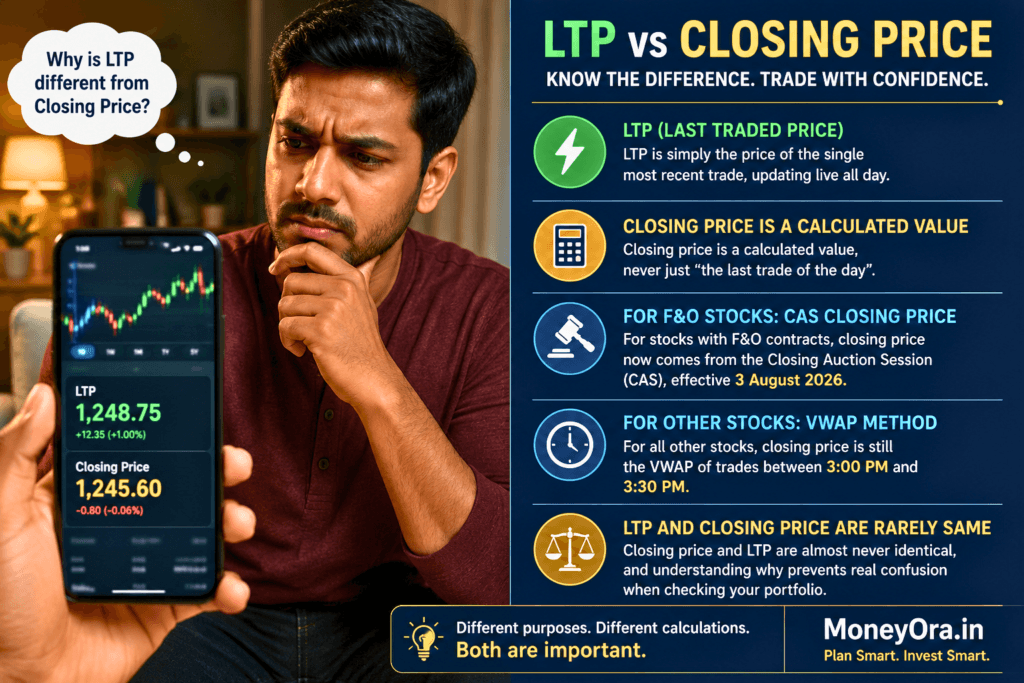
- LTP (Last Traded Price) is simply the price of the single most recent trade, updating live all day
- Closing price is a calculated value, never just “the last trade of the day”
- For stocks with F&O contracts, closing price now comes from the Closing Auction Session (CAS), effective 3 August 2026
- For all other stocks, closing price is still the VWAP of trades between 3:00 PM and 3:30 PM
- Closing price and LTP are almost never identical, and understanding why prevents real confusion when checking your portfolio
Open any trading app right now and look at a stock you hold. Chances are you’ll see two prices sitting close together – one labeled LTP, one labeled closing price (or previous close, if the market is shut). They look similar, they’re both in rupees, and half the time investors assume they should just match. They don’t, and understanding closing price vs LTP is one of the most useful five-minute lessons a new investor can learn, because it explains a genuine gap that shows up on every single stock, every single day.
What Is LTP (Last Traded Price)?
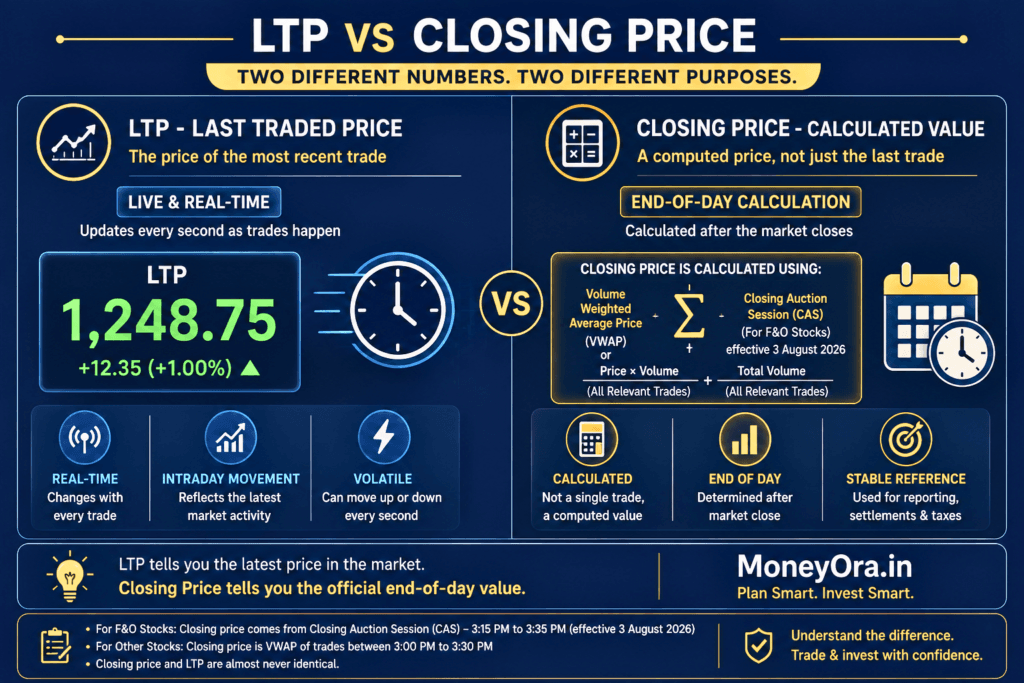
Before comparing closing price vs LTP directly, let’s define each term on its own. LTP stands for Last Traded Price – exactly what it sounds like. It’s the price at which the most recent transaction in a stock actually took place, and it updates continuously throughout the trading day, every time a buyer and seller agree on a trade. If you’re watching a live chart, the LTP is the number that’s constantly flickering, ticking up and down with every executed order.
LTP is a real, actual transaction price – not an estimate, not an average, not a calculated figure. Someone bought, someone sold, and that price is now the LTP until the next trade happens.
What Is Closing Price?
This is the second half of the closing price vs LTP puzzle. Closing price, in contrast, is a calculated value. It does not automatically flash like LTP, and critically, it is not simply the last trade of the day. It’s not even the price at the exact moment the market closes. Exchanges use a specific methodology to arrive at closing price, precisely because the final moments of trading can be chaotic, thin on volume, and easy for a single trade to distort.
Understanding closing price vs LTP starts with accepting this one fact: closing price is engineered to be a more stable, representative benchmark of a stock’s value at day’s end – not a snapshot of whatever happened to trade last.
Why Closing Price vs LTP Are Almost Never the Same
The core reason behind the closing price vs LTP gap is simple: they capture two fundamentally different moments and methodologies. LTP represents a single, real point-in-time transaction. Closing price represents a calculated consensus value built from multiple trades or orders.
If a stock trades between ₹1,000 and ₹1,010 all day, and one small trade happens at ₹980 right as the market shuts, that outlier trade becomes the LTP – but it would badly distort the closing price if the exchange simply used it directly. This is exactly the scenario closing price methodology exists to prevent.
The gap between closing price and LTP tends to widen specifically when:
- The stock is volatile in the final minutes of trading
- Volume is thin, so a single trade has outsized influence on LTP
- News breaks close to market close, causing a late price swing
- For F&O stocks, the auction discovers demand that differs meaningfully from where continuous trading left off
How Closing Price Is Calculated in 2026 – Two Methods Now Exist
This is the single most important update to the closing price vs LTP conversation in 2026, and most existing articles online haven’t caught up to it. As of 3 August 2026, SEBI’s Closing Auction Session (CAS) reform means closing price vs LTP is no longer a single, uniform comparison across every stock.
| Stock Category | Closing Price Method | Trading Cutoff |
|---|---|---|
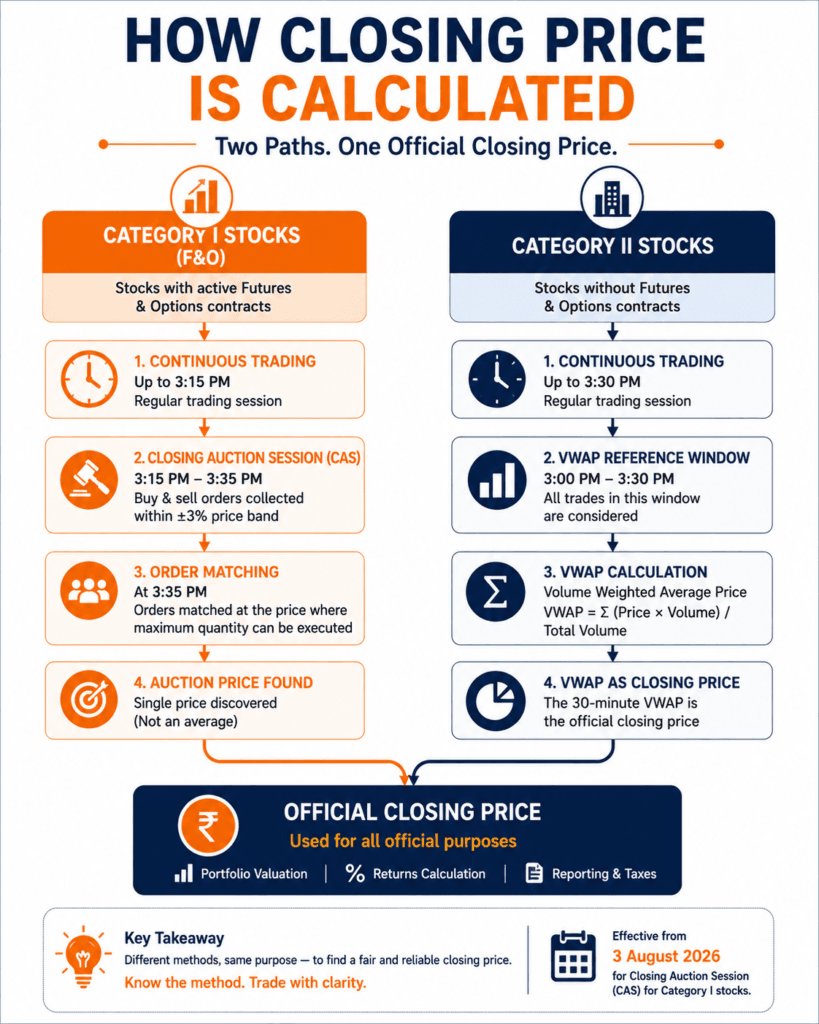
| Category I – Stocks with active F&O contracts | Closing Auction Session (order matching) | 3:15 PM, then auction until 3:35 PM |
| Category II – All other listed stocks | VWAP of last 30 minutes (unchanged) | 3:30 PM, as before |
Category II: The VWAP Formula
Category I: The Auction Method
For Category I stocks, continuous trading stops at 3:15 PM. Orders entered during a short auction window are collected, and the exchange identifies the single price at which the maximum number of shares can be matched between buyers and sellers – that price becomes the closing price, discovered fresh rather than averaged from earlier trades.
LTP vs Closing Price vs Previous Close
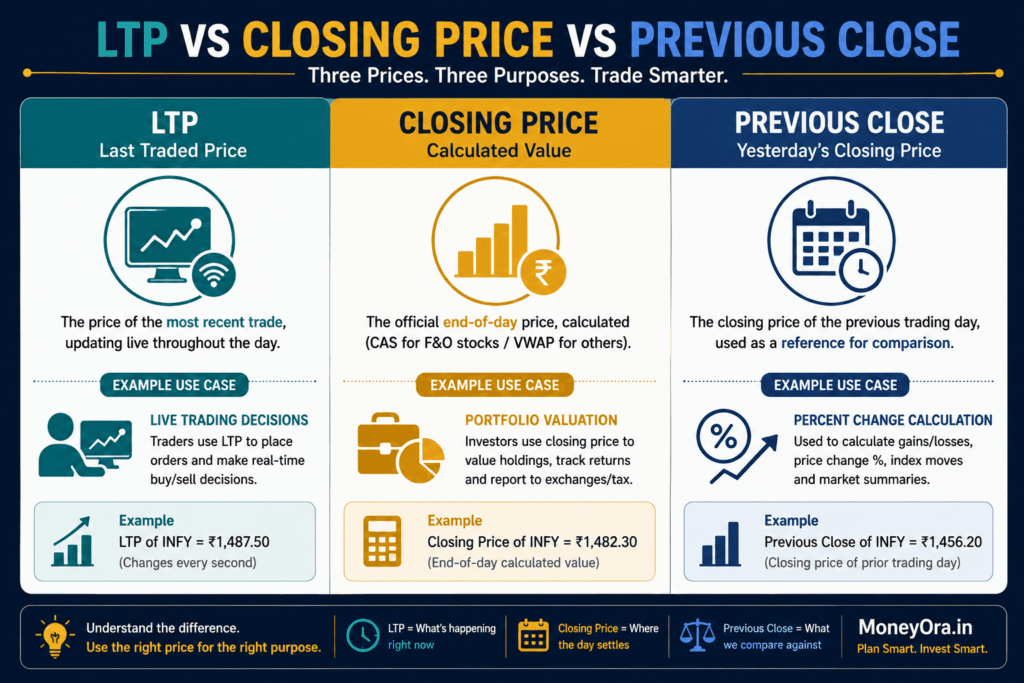
A third term frequently gets tangled into the closing price vs LTP discussion: Previous Close. Understanding all three together clears up most beginner confusion at once.
| Term | Definition | Primary Use |
|---|---|---|
| LTP | Price of the single most recent trade, updating live | Live trading decisions, order placement |
| Closing Price | Calculated value from auction (Category I) or VWAP (Category II) | Portfolio valuation, index calculation, NAV, charts |
| Previous Close | Yesterday’s closing price, used as today’s reference point | Calculating today’s percentage change (% up/down) |
When your app shows a stock “up 2.3% today,” that percentage is calculated against Previous Close, not against yesterday’s LTP. This is a separate but related confusion many investors run into once they’ve grasped the closing price vs LTP distinction.
Why the Closing Price vs LTP Gap Actually Matters
This isn’t just trivia – understanding closing price vs LTP has real, practical consequences depending on what you’re doing.
- Portfolio valuation: Your broker values your holdings using closing price, not LTP, for end-of-day reports and margin calculations
- Mutual fund NAV: NAV computation for funds holding a stock uses that stock’s official closing price, directly tying fund performance to the closing price vs LTP methodology discussed above
- Index calculation: Sensex and Nifty values are computed using constituent closing prices, not LTPs
- Daily candlestick charts: The “close” on a daily candle is the official closing price, which is why it may not match the very last tick you saw on an intraday chart
- Collateral and margin valuation: Pledged shares are valued using closing price for margin purposes, not the fluctuating LTP
Use MoneyOra’s Stock Return Calculator to compute returns using accurate closing price data rather than an intraday LTP snapshot, and the CAGR Calculator for annualised return figures built on consistent closing price history.
Closing Price vs LTP: 5 Worked Examples
A Quiet, Stable Category II Stock
A mid-cap stock with no F&O contracts trades in a tight ₹485-₹489 range for the entire 3:00-3:30 PM window. The very last trade at 3:29:58 PM happens at ₹487.60.
VWAP across the 30-minute window works out to ₹487.10. LTP = ₹487.60, Closing Price = ₹487.10 – a small closing price vs LTP gap of just ₹0.50, because the stock barely moved.
A Volatile Category II Stock
A small-cap stock swings from ₹210 to ₹225 during the last 30 minutes on thin volume, with the final trade at ₹224.80 – near the top of the range.
The VWAP, weighted across the whole swing, comes out to ₹217.40. LTP = ₹224.80, Closing Price = ₹217.40 – a substantial ₹7.40 gap, illustrating how volatility widens the closing price vs LTP difference.
A Category I Stock Through the Auction
A large-cap bank stock with F&O contracts has an LTP of ₹1,240.50 right before continuous trading stops at 3:15 PM. During the 3:15-3:35 PM auction, fresh buy and sell orders match at maximum volume at ₹1,238.20.
LTP (pre-auction) = ₹1,240.50, Closing Price (post-auction) = ₹1,238.20. This ₹2.30 gap reflects genuinely fresh price discovery through the closing auction session, not simply an average of older trades.
A Stock That Barely Traded Near Close
A thinly traded small-cap Category II stock has only one trade in the entire last 30-minute window, executed at ₹92.15.
With only one trade, VWAP equals that single trade’s price. LTP = Closing Price = ₹92.15 – a rare case where closing price vs LTP shows zero gap, simply because there was only one data point to work with.
Checking Percentage Change the Next Morning
Yesterday’s closing price for a stock was ₹500. This morning at 9:20 AM, LTP shows ₹510.
The app displays “+2.00%” – this is calculated as (₹510 – ₹500) ÷ ₹500, using yesterday’s closing price (Previous Close) as the base, not any LTP from yesterday. Understanding closing price vs LTP here explains exactly which number drives that percentage.
6 Mistakes Investors Make Confusing These Terms
These six mistakes cover most of the closing price vs LTP confusion MoneyOra readers ask about.
Expecting LTP and Closing Price to Match
As covered throughout this guide, they capture two fundamentally different things – expecting them to align is the root of most closing price vs LTP confusion.
Using LTP for Portfolio Valuation
Your broker’s official end-of-day valuation, margin calculations, and reports use closing price, not the LTP you might glance at after hours.
Not Knowing Which Category Your Stock Falls Into
Since 3 August 2026, the closing price calculation method genuinely differs between Category I and Category II stocks – and this changes how large a closing price vs LTP gap you should reasonably expect.
Calculating Percentage Change Against LTP Instead of Previous Close
Today’s percentage move is always measured against yesterday’s closing price (Previous Close), never against an LTP from any point in time.
Assuming a Large Gap Means Something Is Wrong
A wide closing price vs LTP gap on a volatile or thinly traded stock is completely normal – it reflects genuine price movement or an active auction, not a system error.
Ignoring the Auction Cutoff Time for F&O Stocks
Category I stocks stop continuous trading at 3:15 PM, not 3:30 PM. Watching LTP tick past 3:15 PM on such a stock is watching stale, non-tradeable information.
- Misreading portfolio value: Relying on LTP instead of closing price for end-of-day decisions can give a misleading picture of your actual portfolio worth
- Stop-loss timing risk: For Category I stocks, stop-loss orders based on LTP are cancelled once the Closing Auction Session begins at 3:15 PM – fifteen minutes earlier than the old 3:30 PM cutoff
- Category confusion: Not checking whether a stock is Category I or Category II can lead to wrong assumptions about how large a closing price vs LTP gap to expect
- Thin-volume distortion: On illiquid stocks, both LTP and the VWAP-based closing price can be distorted by very few trades – treat both cautiously for small-cap and micro-cap names
- This comparison tool is educational only: It does not reflect live NSE/BSE order-book data – actual closing prices depend on genuine market-wide activity at the time
Related MoneyOra Guides and Tools
- Closing Auction Session (CAS) Explained – Full detail on the new closing price mechanism for F&O stocks
- Stock Return Calculator – Calculate returns using accurate closing price data
- CAGR Calculator – Find your annualised return based on closing price history
- Stop Loss Calculator – Plan stop-loss levels with the new auction cutoff in mind
- P/E Ratio Calculator – Value stocks using accurate closing price inputs
- Share Market Today – Track live Nifty and Sensex movement
Official Sources and External References
- NSE India – Closing Price and Bhavcopy Documentation
- BSE India – Market Timing and Price Discovery Notices
- SEBI – Official Circular on Closing Auction Session
- Reserve Bank of India – Financial Market Infrastructure Oversight
See the Closing Price vs LTP Gap for Your Stock
Use the comparison tool at the top of this page, or explore MoneyOra's full suite of free stock market tools.
Use the free calculator now on MoneyOra.in →
Frequently Asked Questions
The most common closing price vs LTP questions investors search for, answered directly.
What is the difference between closing price and LTP?
LTP (Last Traded Price) is the price of the single most recent actual trade, updating continuously throughout the day. Closing price is a calculated value – either the outcome of the Closing Auction Session for F&O stocks, or the Volume Weighted Average Price (VWAP) of the last 30 minutes for other stocks. They capture different moments and rarely match exactly.
Why is the closing price different from LTP on NSE?
Because NSE (and BSE) don’t use the single last trade of the day as the closing price. For Category I stocks with F&O contracts, closing price comes from the Closing Auction Session, an order-matching process from 3:15-3:35 PM. For Category II stocks, it remains the VWAP of trades between 3:00 PM and 3:30 PM – both methods produce a calculated figure that differs from whatever LTP happened to be at any single moment.
Which price should I use to check my portfolio value?
Closing price is the correct figure for end-of-day portfolio valuation, not LTP. Brokers, mutual funds, and index providers all use official closing price for their calculations, which is why your broker’s reported portfolio value may differ slightly from what LTP suggested just before market close.
Does the closing price vs LTP calculation differ for all stocks now?
Yes, as of 3 August 2026. Stocks with active F&O contracts (Category I) now use the Closing Auction Session to discover closing price through order matching. All other stocks (Category II) continue using the older VWAP method. Check which category your stock falls into to understand which methodology applies.
What are the latest questions people are asking about closing price vs LTP in 2026?
Why did my stock’s closing price change so much from its LTP after August 2026?
If it’s a Category I (F&O) stock, the new Closing Auction Session discovers a fresh price through order matching, which can differ more from the pre-auction LTP than the old VWAP method typically did.Is LTP or closing price used for stop-loss orders?
Stop-loss orders trigger based on live LTP during market hours, not closing price – though for Category I stocks, pending stop-loss orders are cancelled once the Closing Auction Session begins at 3:15 PM.Why does my app show a different closing price than my broker’s contract note?
Both should reflect the same official exchange-published closing price; a mismatch is usually a display delay on one platform, not a genuine difference in the underlying data.Does closing price vs LTP affect F&O settlement?
Yes, for stock derivatives, expiry-day settlement now uses closing auction session-derived closing prices across exchanges, not LTP at any point in the day.Is Previous Close the same as yesterday’s LTP?
No, Previous Close is yesterday’s official closing price (auction or VWAP-derived), not yesterday’s last traded price.


Rất cảm ơn những chia sẻ này. Nếu cần tư vấn du học Hàn Quốc, hãy tìm đến Letco — kinh nghiệm nhiều năm, dịch vụ uy tín. Chi tiết tại letco.vn.
Pingback: Adani Power Stock Split: Ratio, Date, History & Investor Guide 2026