

Tax on Bonus Share India: Everything Investors Must Know (2026)
Bonus Shares Tax Calculator
Enter your original and bonus share details to estimate your capital gains tax on bonus share sale (FY 2025-26 rates).
Illustrative estimate only, FY 2025-26 (AY 2026-27) rates: STCG 20% under Section 111A, LTCG 12.5% above ₹1.25 lakh under Section 112A. Assumes shares sold on FIFO basis and original shares acquired after 31 January 2018 (no grandfathering applied). Consult a CA for your actual filing.
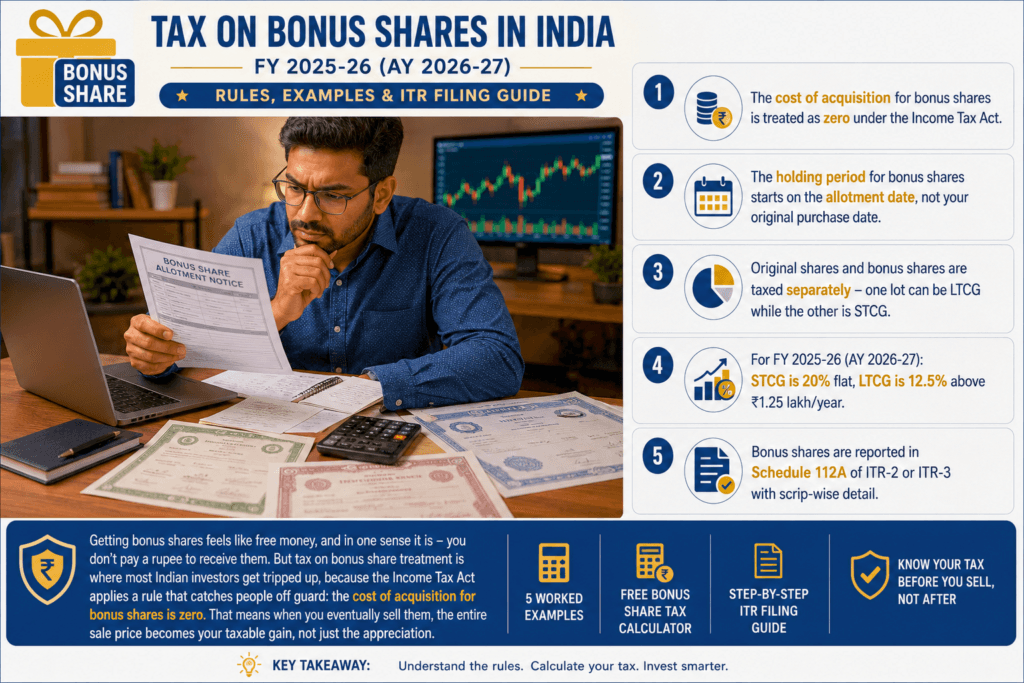
- The cost of acquisition for bonus shares is treated as zero under the Income Tax Act
- The holding period for bonus shares starts on the allotment date, not your original purchase date
- Original shares and bonus shares are taxed separately – one lot can be LTCG while the other is STCG
- For FY 2025-26 (AY 2026-27): STCG is 20% flat, LTCG is 12.5% above ₹1.25 lakh/year
- Bonus shares are reported in Schedule 112A of ITR-2 or ITR-3 with scrip-wise detail
Getting bonus shares feels like free money, and in one sense it is – you don’t pay a rupee to receive them. But tax on bonus share treatment is where most Indian investors get tripped up, because the Income Tax Act applies a rule that catches people off guard: the cost of acquisition for bonus shares is zero. That means when you eventually sell them, the entire sale price becomes your taxable gain, not just the appreciation. This guide breaks down exactly how tax on bonus shares in India works for FY 2025-26 (AY 2026-27), with five worked examples, a free calculator, and the precise ITR filing steps – so you know your tax on bonus share liability before you sell, not after.
What Are Bonus Shares?
Bonus shares are additional shares a company issues to existing shareholders, free of cost, funded from the company’s reserves or retained earnings rather than fresh capital. If a company announces a 1:1 bonus, every shareholder gets one new share for each share already held – so an investor with 100 shares ends up with 200. Your overall investment value doesn’t change on day one, since the share price typically adjusts downward in proportion, but your understanding of tax on bonus share liability becomes critical the moment you decide to sell.
Companies issue bonus shares to reward shareholders without a cash outflow, improve stock liquidity by increasing the number of tradeable shares, and signal confidence in future earnings. SEBI requires companies to announce a record date in advance, and shares held as of that date qualify for the bonus allotment. None of this changes the eventual tax on bonus share outcome, though – that depends entirely on when you sell, not on why the company issued the bonus.
Cost of Acquisition of Bonus Shares – Why It Is Zero
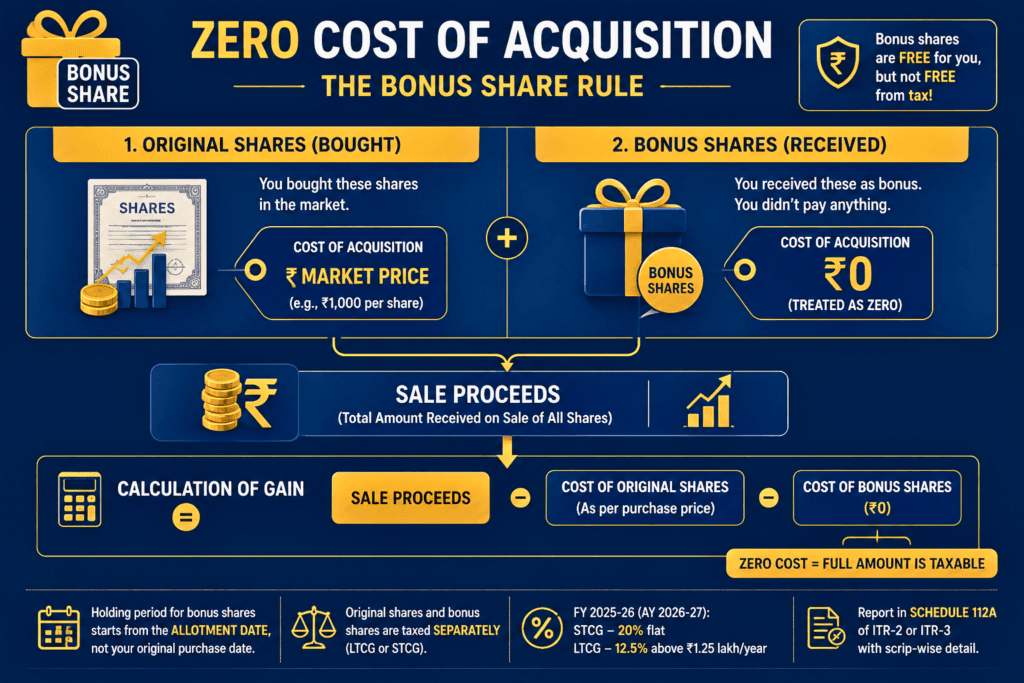
This is the single most important rule governing tax on bonus share sales in India, and the one that every tax on bonus share calculation ultimately depends on. Under the Income Tax Act, since you paid nothing to receive bonus shares, the law treats your cost of acquisition as zero for capital gains purposes. When you eventually sell those bonus shares, your capital gain is calculated as:
Capital Gain on Bonus Shares = Full Sale Price
This is a sharp contrast to your original shares, where the gain is only the difference between what you paid and what you sold for. With bonus shares, there’s no such offset – the entire proceeds from selling bonus shares becomes your taxable capital gain, which is exactly why understanding the tax on bonus shares rule matters before you decide when to sell.
Holding Period Rules for Bonus Shares
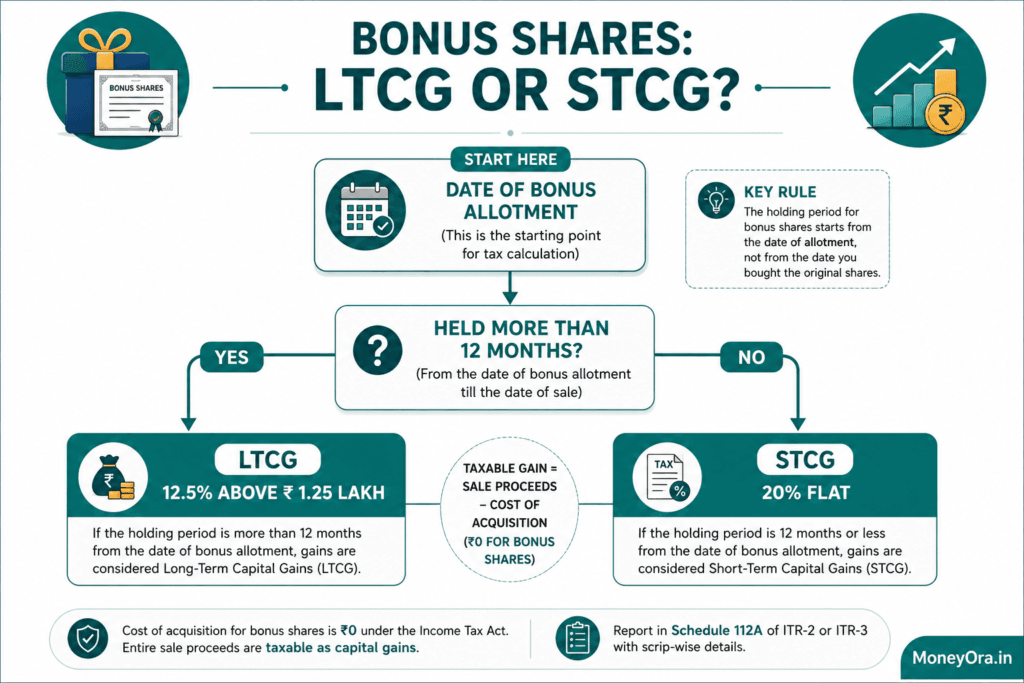
The second rule that catches investors off guard: your holding period for bonus shares begins on the date of allotment, not the date you originally invested in the company. This directly determines whether tax on bonus share sale falls under LTCG or STCG, and it’s one of the most searched questions about tax on bonus share treatment in India.
- Original shares: Holding period starts from your original purchase date
- Bonus shares: Holding period starts fresh from the bonus allotment date
- Listed equity threshold: More than 12 months = long-term; 12 months or less = short-term, and this single date decides your entire tax on bonus share rate
This means you can hold the underlying company for five years and still owe short-term capital gains tax on bonus shares allotted just eight months before you sell – even though you’ve technically been a shareholder for years. Getting this holding-period detail wrong is the single most common cause of an incorrect tax on bonus share filing.
Tax on Bonus Shares: LTCG and STCG Rates for FY 2025-26
For FY 2025-26 (AY 2026-27), the applicable rates for tax on bonus shares – and equity in general – follow the Finance (No. 2) Act 2024 changes, effective 23 July 2024, which continue unchanged into the current year. Understanding these rates is the final piece needed to compute your actual tax on bonus share liability.
| Gain Type | Holding Period | Rate | Section |
|---|---|---|---|
| STCG (Short-Term) | 12 months or less | 20% flat | 111A |
| LTCG (Long-Term) | More than 12 months | 12.5% above ₹1.25L/year | 112A |
No indexation benefit applies to equity LTCG under the current rules, and the Section 87A rebate cannot be claimed against gains taxed under Section 111A or 112A.
Use MoneyOra’s CAGR Calculator to work out your annualised return before deciding when to sell, and the Stock Return Calculator to model your total gain across both original and bonus lots.
Bonus Shares vs Stock Split: Tax Difference
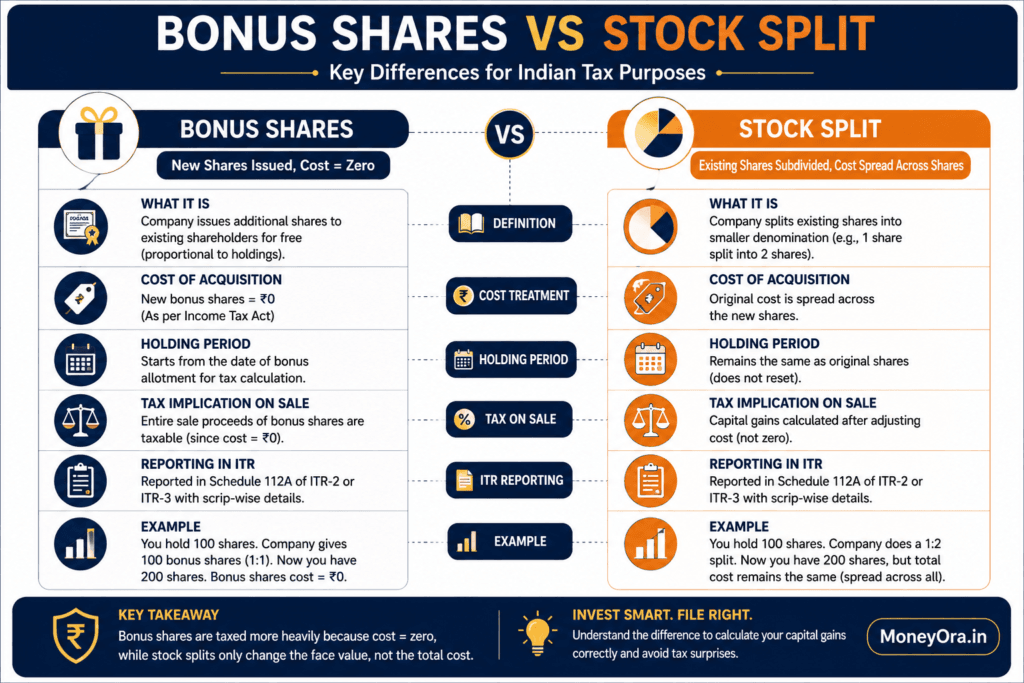
Bonus shares and stock splits both increase your share count without costing you anything extra, which is why investors frequently confuse the two. But tax on bonus share treatment is fundamentally different from how a stock split is taxed – and mixing up the two produces genuinely wrong numbers.
| Feature | Bonus Shares | Stock Split |
|---|---|---|
| New shares | Yes, entirely new shares issued | No, existing shares subdivided |
| Cost treatment | Special rule – cost is zero | Original cost adjusted across resulting shares |
| Holding-period treatment | Can differ from original shares | Generally traces original holding date |
| Tax calculation | Requires care – separate lot, zero cost | Requires adjusted cost-per-share calculation |
In a stock split, if you held 100 shares at ₹1,000 each (total cost ₹1,00,000) and the company does a 5:1 split, you now hold 500 shares with an adjusted cost of ₹200 each – your total cost basis of ₹1,00,000 doesn’t disappear, it just spreads across more shares. The holding period also carries forward from your original purchase date. With bonus shares, neither of those things happens – the cost genuinely goes to zero, and the holding period genuinely resets to the allotment date. This is the core reason tax on bonus share sales requires more careful tracking than a simple split.
Bonus Shares Tax Examples (5 Worked Scenarios)
Here are five worked examples covering the most common tax on bonus share situations investors actually run into.
Example 1: Simple 1:1 Bonus
This is the most common tax on bonus share scenario Indian retail investors encounter.
Ravi buys 100 shares at ₹200 in June 2023. Company announces a 1:1 bonus in August 2024 – Ravi gets 100 bonus shares. He sells all 200 shares in March 2026 at ₹350 each.
Original shares: held June 2023 to March 2026 (33 months) = LTCG. Gain = 100 x (₹350 – ₹200) = ₹15,000
Bonus shares: held August 2024 to March 2026 (19 months) = LTCG. Gain = 100 x ₹350 = ₹35,000
Total LTCG = ₹50,000. Below the ₹1.25 lakh exemption, so zero tax if no other equity LTCG this year.
Example 2: 1:2 Bonus With Mixed Holding Periods
Here the tax on bonus share outcome splits across both LTCG and STCG in the same sale.
Priya buys 300 shares at ₹150 in April 2024. Company announces a 1:2 bonus (1 bonus for every 2 held) in June 2025 – Priya gets 150 bonus shares. She sells all 450 shares in February 2026 at ₹220 each.
Original shares: held April 2024 to February 2026 (22 months) = LTCG. Gain = 300 x (₹220 – ₹150) = ₹21,000
Bonus shares: held June 2025 to February 2026 (8 months) = STCG. Gain = 150 x ₹220 = ₹33,000
LTCG tax on ₹21,000 (below exemption) = ₹0. STCG tax = ₹33,000 x 20% = ₹6,600 + cess
Example 3: Bonus Shares Plus a Later Stock Split
Combining a bonus issue with a subsequent stock split is where tax on bonus share tracking gets genuinely complex – here’s exactly how it plays out.
Arjun buys 100 shares at ₹500 in March 2023. In September 2023, company issues a 1:1 bonus – Arjun now has 200 shares (100 original, cost ₹500 each; 100 bonus, cost ₹0). In January 2025, the company does a 2:1 stock split – every share splits into 2. Arjun now holds 400 shares: 200 from the original lot (adjusted cost ₹250 each) and 200 from the bonus lot (still cost ₹0 each, since zero split any way is still zero). He sells all 400 in April 2026 at ₹180 each.
Original-lot shares (post-split): held March 2023 to April 2026 (37 months) = LTCG. Gain = 200 x (₹180 – ₹250) = -₹14,000 (loss)
Bonus-lot shares (post-split): held September 2023 to April 2026 (31 months) = LTCG. Gain = 200 x ₹180 = ₹36,000
Net LTCG = ₹36,000 – ₹14,000 = ₹22,000. Below exemption = zero tax. The loss on the original lot offsets gain on the bonus lot within the same LTCG bucket.
Example 4: Partial Sale With FIFO
Partial sales are where tax on bonus share calculations get genuinely tricky for most investors.
Meera holds 100 original shares (bought March 2024 at ₹400) and received a 1:1 bonus in July 2025 (100 bonus shares). She sells only 150 shares in March 2026 at ₹500 each. Under the FIFO (First-In-First-Out) method, the original 100 shares are treated as sold first, then 50 bonus shares.
Original shares sold: 100, held March 2024 to March 2026 (24 months) = LTCG. Gain = 100 x (₹500 – ₹400) = ₹10,000
Bonus shares sold: 50, held July 2025 to March 2026 (8 months) = STCG. Gain = 50 x ₹500 = ₹25,000
Total LTCG ₹10,000 (tax-free, below exemption). STCG tax = ₹25,000 x 20% = ₹5,000 + cess. The remaining 50 bonus shares stay unsold, still tracked at zero cost for a future sale.
Example 5: Old Shares Acquired Before 2001
Legacy holdings add an extra layer to tax on bonus share computation that most guides skip entirely.
Suresh’s father bought 200 shares in 1998 at ₹20 each, and Suresh inherited them. The company issued a 1:1 bonus in 2010. Suresh sells all 400 shares in 2026 at ₹600 each.
For the original 200 shares acquired before 1 April 2001, the cost of acquisition is the higher of the actual cost or the Fair Market Value (FMV) as on 1 April 2001. Say the FMV on that date was ₹80/share – that becomes the cost basis, not the original ₹20. This FMV-stepped-up cost then also needs the 31 January 2018 grandfathering comparison applied on top for the final LTCG computation.
Bonus shares from 2010 still carry a zero cost of acquisition – the pre-2001 rule only affects the original lot, never the bonus lot, since bonus shares are always valued at the rule in force on the sale, and their cost is always zero regardless of allotment year.
Grandfathering Rules for Old Bonus Shares
Grandfathering is a topic every tax on bonus share guide needs to cover carefully, since it only ever applies to the original lot. If your original shares were bought before 31 January 2018, a grandfathering provision protects gains that accrued before that date from the newer tax regime. For LTCG purposes, the cost of acquisition is the higher of:
- The actual purchase price, or
- The Fair Market Value (FMV) as on 31 January 2018 (capped at the actual sale price)
Critically, this grandfathering benefit applies to your original shares only. Bonus shares, regardless of when they were allotted, are always valued at zero cost of acquisition for tax on bonus share calculations – grandfathering has no effect on the bonus lot’s tax on bonus share treatment at all, since there was never a purchase price to step up in the first place.
For shares originally acquired before 1 April 2001, an additional layer applies: the cost of acquisition can be taken as the FMV on 1 April 2001, which then feeds into the same 31 January 2018 grandfathering comparison for the final LTCG figure – as shown in Example 5 above.
How to Report Bonus Shares in Your ITR
Correctly reporting tax on bonus share sales in your ITR is where the theory above becomes practical. Capital gains from selling bonus shares must be reported in ITR-2 (if you have no business income) or ITR-3 (if you do), never ITR-1 – using the wrong form triggers a defective return notice under Section 139(9).
- Open Schedule CG (Capital Gains) in your ITR form
- For LTCG on bonus shares, go to Part B(3), which covers Section 112A gains
- For STCG on bonus shares, go to Part B(1), which covers Section 111A gains
- Within Section 112A, fill Schedule 112A with scrip-wise detail: ISIN, company name, number of shares, sale price, sale date, cost of acquisition (enter ₹0 for the bonus lot specifically), and FMV as on 31 January 2018 where applicable
- Report the original shares and bonus shares as separate line entries in Schedule 112A, since they have different cost bases and different acquisition dates
- The portal auto-computes gains once cost, sale price, and dates are entered correctly
- Cross-check the totals against your broker’s Annual Capital Gains Statement before submitting
Your broker’s contract notes or annual tax P&L statement typically already segregate original and bonus lots using FIFO, which makes cross-verification straightforward.
Use MoneyOra’s Dividend Yield Calculator alongside your capital gains planning if the same company also pays regular dividends, since dividend income is taxed separately from capital gains.
6 Mistakes Investors Make With Bonus Share Tax
These six errors account for most of the incorrect tax on bonus share filings MoneyOra readers ask about every filing season.
Assuming Cost Gets Averaged
As covered above, original and bonus shares are never averaged together. Treating them as one blended cost basis is the most common tax on bonus share error.
Using the Original Purchase Date for Bonus Shares
The holding-period clock for bonus shares starts on the allotment date. Using your original investment date instead can wrongly classify a short-term gain as long-term – a tax on bonus share mistake that draws scrutiny if caught during processing.
Forgetting the FIFO Rule on Partial Sales
When you sell only part of a combined holding, tax law assumes original shares are sold first, then bonus shares. Selling and reporting in the wrong order misclassifies which lot’s gain is LTCG versus STCG, distorting your final tax on bonus share figure.
Confusing Bonus Shares With a Stock Split
As the comparison table above shows, these are taxed completely differently. Applying stock-split logic (adjusted cost, carried-forward holding period) to a genuine bonus issue understates your actual tax on bonus share liability.
Not Applying Pre-2001 FMV for Old Original Shares
Investors with decades-old holdings sometimes use the original purchase price directly, missing the 1 April 2001 FMV step-up they’re entitled to – this only affects the original lot, never the bonus shares themselves, but it still meaningfully changes the total tax on bonus share plus original-share liability.
Filing ITR-1 Instead of ITR-2/ITR-3
Any capital gains, bonus shares included, require ITR-2 or ITR-3. Filing ITR-1 with tax on bonus share income leads to a defective return notice and forces a revised filing.
Beyond the calculation rules above, keep these practical tax on bonus share risks in mind before you plan a sale.
- Zero-cost gain is unavoidable: Unlike original shares, you cannot reduce your taxable tax on bonus share gain through cost – the entire sale price is taxable once the exemption is used up
- Short-term classification risk: Selling too soon after a bonus allotment, even years into holding the underlying stock, can trigger the higher 20% STCG rate on that portion
- Record-keeping complexity: Multiple bonus issues, stock splits, and partial sales over time require careful lot-wise tracking – errors here commonly cause under- or over-reporting of gains
- Exemption is shared: The ₹1.25 lakh LTCG exemption applies across all your equity holdings combined, not separately to bonus shares – heavy trading elsewhere in the year reduces what’s left for your bonus lot
- Rules can change: Capital gains tax rates and exemption limits have changed materially since 2018 and could change again in future budgets – always verify current rates before filing
Once you understand the tax on bonus share rules above, these tools help you plan your actual sale and reinvestment.
- Stock Return Calculator – Calculate your total return across original and bonus share lots
- Stock Average Calculator – Work out your blended average price after a bonus issue
- CAGR Calculator – Find your annualised return before deciding when to sell
- Dividend Yield Calculator – Check dividend income alongside your capital gains planning
- Position Size Calculator – Plan your next equity position with proper risk sizing
- SIP Calculator – Model long-term equity SIP growth alongside direct stock holdings
Disclaimer: This article on tax on bonus share liability in India is for general educational purposes only and does not constitute tax or investment advice. Tax rules, rates, and exemption limits are subject to change. The embedded calculator provides estimates based on FY 2025-26 rates and standard FIFO assumptions – actual liability may vary based on your specific holdings, other income, and applicable grandfathering provisions. Always consult a qualified Chartered Accountant before filing your ITR. MoneyOra does not provide individual tax advice.
Frequently Asked Questions
The most common tax on bonus share questions investors search for, answered directly.
Is the cost of acquisition of bonus shares always zero?
Yes, this is the core rule behind every tax on bonus share calculation. Since bonus shares are received free of cost, the Income Tax Act treats the cost of acquisition as zero for capital gains computation, regardless of the company, the bonus ratio, or how long you hold them before selling.
How is the holding period calculated for bonus shares?
The holding period for tax on bonus share purposes starts on the date the bonus shares are allotted to you, not your original investment date in the company. If bonus shares are held for more than 12 months from allotment, gains are long-term (LTCG); 12 months or less is short-term (STCG).
What is the difference between bonus shares and a stock split for tax purposes?
This is a genuinely different tax on bonus share calculation compared to a split. Bonus shares are new shares issued with a zero cost of acquisition and a fresh holding period starting from allotment. A stock split simply subdivides your existing shares – your original cost is spread proportionally across the resulting shares, and the holding period generally continues from your original purchase date.
Can I set off a loss on original shares against a gain on bonus shares?
Yes, if both fall in the same category (both LTCG or both STCG) in the same financial year, they can be netted against each other before applying the ₹1.25 lakh LTCG exemption, as shown in Example 3 above. Losses in one category generally cannot offset gains in the other category directly under equity-specific set-off rules.
What are the latest questions people are asking about bonus share tax in 2026?
Is tax on bonus share different from tax on regular shares?
Only in the cost of acquisition (zero) and holding period start date (allotment, not original purchase). The LTCG/STCG rates for tax on bonus share sales themselves are identical to regular equity.Do I pay tax when bonus shares are allotted, or only when sold?
Only when sold. Receiving bonus shares itself is not a taxable event.How does FIFO work when I have shares from multiple bonus issues?
Each bonus tranche is tracked separately by allotment date; the earliest-dated shares (original or earliest bonus tranche) are treated as sold first.Does the Income Tax Act, 2025 change bonus share taxation?
No, the substantive rules (zero cost, holding period from allotment, 20%/12.5% rates) remain the same from 1 April 2026; only section numbering has changed.Is STT payment required for the concessional LTCG/STCG rates to apply?
Yes, Securities Transaction Tax must have been paid on both purchase (where applicable) and sale for Sections 111A/112A concessional rates to apply.


Pingback: Adani Power Stock Split: Ratio, Date, History & Investor Guide 2026