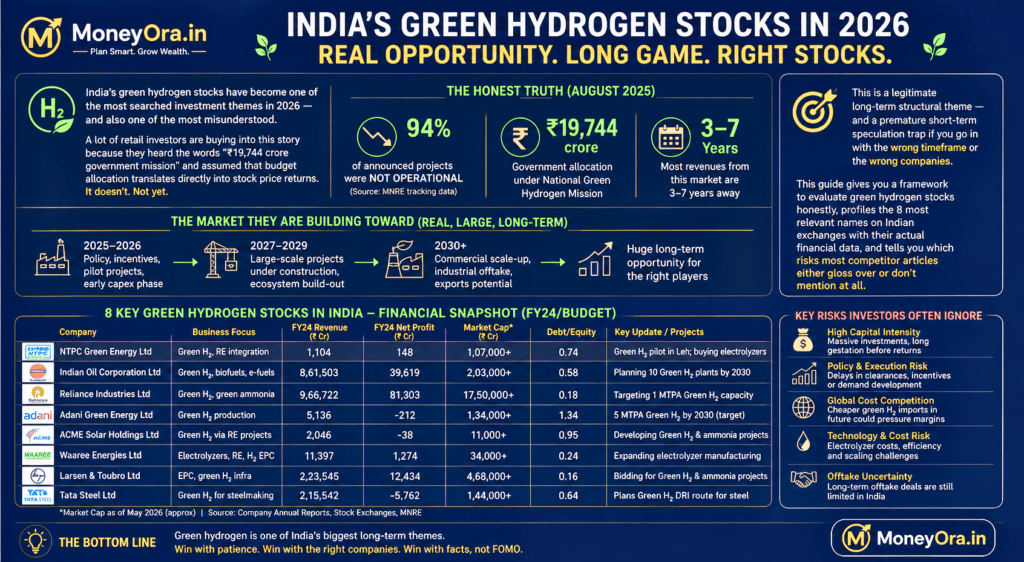
India’s green hydrogen stocks have become one of the most searched investment themes in 2026 — and also one of the most misunderstood. A lot of retail investors are buying into this story because they heard the words “₹19,744 crore government mission” and assumed that budget allocation translates directly into stock price returns. It doesn’t. Not yet. And that gap between narrative and financial reality is exactly what this analysis is going to cover.
The honest truth about green hydrogen stocks in India right now: 94% of announced projects were not operational as of August 2025, according to publicly available MNRE tracking data. The market they are building toward is real. The revenues from that market are mostly 3–7 years away. This is a legitimate long-term structural theme — and a premature short-term speculation trap if you go in with the wrong timeframe or the wrong companies.
This guide gives you a framework to evaluate green hydrogen stocks honestly, profiles the 8 most relevant names on Indian exchanges with their actual financial data, and tells you which risks most competitor articles either gloss over or don’t mention at all. Run your own return projections at different entry points using MoneyOra’s Stock Return Calculator.
- India’s National Green Hydrogen Mission targets 5 MMT/year by 2030 with a ₹19,744 crore outlay. Budget 2025-26 doubled allocation to ₹600 crore, and 2026-27 maintained the same figure.
- No single listed Indian company is a pure-play green hydrogen stock. Every player — NTPC, Reliance, L&T, JSW — earns the overwhelming majority of current revenue from other businesses.
- JSW Energy commissioned India’s largest commercial green hydrogen plant (3,800 TPA) in November 2025 at Vijayanagar, Karnataka — the most tangible near-term milestone in the sector.
- Green hydrogen costs ₹300–500/kg to produce today vs ₹80–100/kg for grey hydrogen. Reaching cost parity without subsidies requires electrolyzer costs to fall 70% from current levels.
- For investors: treat green hydrogen stocks as a 5–10 year thematic position. The safer approach is exposure through diversified companies (NTPC, L&T, GAIL) where hydrogen is a future option rather than current revenue.
What Green Hydrogen Actually Is — and Why India Is Betting Big
Green hydrogen is produced by splitting water (H₂O) into hydrogen and oxygen using an electrolyser powered entirely by renewable electricity — solar, wind, or hydro. It produces zero carbon emissions, unlike grey hydrogen (made from natural gas) or blue hydrogen (fossil fuel-based with carbon capture). For sectors that cannot electrify directly — steel, fertilisers, cement, heavy transport, shipping — green hydrogen is currently the most viable low-carbon fuel alternative.
Why India specifically has a structural advantage
- Solar resource: India has among the world’s cheapest solar power — sub-₹1.5/kWh in recent auctions. Electricity is 60–70% of green hydrogen production cost, so cheap solar directly translates to competitive hydrogen.
- Industrial demand from day one: India already consumes approximately 6 million tonnes of hydrogen annually — mostly grey — in fertilisers, refineries, and chemicals. Replacing that captive demand with green hydrogen doesn’t require finding new customers.
- Export opportunity: Japan, South Korea, and Germany are actively seeking hydrogen import partners. India’s geography and solar advantage position it as a potential low-cost exporter by 2028–2030.
- Net-zero commitment: India’s 2070 net-zero target and 500 GW renewable capacity goal by 2030 make green hydrogen a policy priority with budgetary commitment behind it.
The global green hydrogen market is projected to grow at an 11.11% CAGR from 2025 to 2032, reaching $12.98 billion. For Indian green hydrogen stocks, this global trajectory matters because India’s export story depends on it.
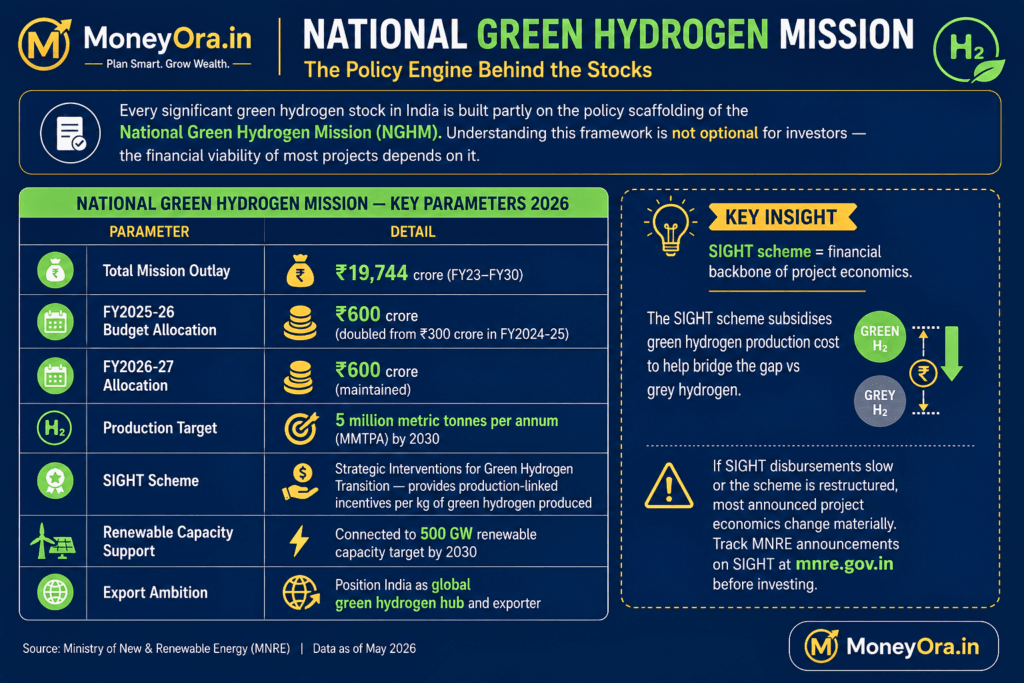
National Green Hydrogen Mission — The Policy Engine Behind the Stocks
Every significant green hydrogen stock in India is built partly on the policy scaffolding of the National Green Hydrogen Mission (NGHM). Understanding this framework is not optional for investors — the financial viability of most projects depends on it.
| Parameter | Detail |
|---|---|
| Total Mission Outlay | ₹19,744 crore (FY23–FY30) |
| FY2025-26 Budget Allocation | ₹600 crore (doubled from ₹300 crore in FY2024-25) |
| FY2026-27 Allocation | ₹600 crore (maintained) |
| Production Target | 5 million metric tonnes per annum (MMTPA) by 2030 |
| SIGHT Scheme | Strategic Interventions for Green Hydrogen Transition — provides production-linked incentives per kg of green hydrogen produced |
| Renewable Capacity Support | Connected to 500 GW renewable capacity target by 2030 |
| Export Ambition | Position India as global green hydrogen hub and exporter |
Investor Framework — How to Evaluate Green Hydrogen Stocks Differently
Standard stock analysis tools — P/E ratio, quarterly earnings growth, dividend yield — are insufficient for evaluating green hydrogen stocks at this stage. Most of these companies derive near-zero current revenue from hydrogen. You’re not buying current cash flows; you’re buying optionality on a future market.
What to look at instead
| Criterion | What to Look For | Why It Matters |
|---|---|---|
| Balance Sheet Strength | Debt-to-equity below 2, strong operating cash flows from existing business | Hydrogen projects require 5–7 years before revenue. Companies need cash to survive that window. |
| Project Pipeline Specificity | Named, contracted, funded projects — not press release commitments | Many companies announced hydrogen plans with no project-level contracts. Specificity = credibility. |
| Captive Demand Advantage | Companies with internal hydrogen consumption (refineries, steel) | Finding external buyers at a green premium is the hardest part. Captive demand removes this risk. |
| Renewable Energy Base | Existing renewable capacity or development pipeline | Cheap renewable electricity is the primary input cost. Companies without it must buy from outside. |
| Government Contract Access | SIGHT scheme approvals, government offtake agreements | Subsidies and government offtake contracts are what make early-stage economics viable. |
| Diversification Safety Net | Strong existing non-hydrogen revenue stream | If hydrogen timelines slip (likely), the rest of the business must sustain the company. |
Calculate how different investment amounts and entry prices compound over a 5–7 year horizon using MoneyOra’s CAGR Calculator — realistic expectations matter more than enthusiasm in this sector.
Top 8 Green Hydrogen Stocks in India 2026 — Deep Analysis
1. NTPC Limited — The Infrastructure Giant
NTPC is India’s largest power utility with over 76 GW installed capacity — still predominantly coal — but its green hydrogen transition is the most credible of any PSU. The Pudimadaka Green Hydrogen Hub in Andhra Pradesh is the centrepiece: a ₹1.85 lakh crore project targeting 1,500 tonnes per day (TPD) of green hydrogen, primarily for green ammonia export. In May 2026, NTPC awarded an EPC mandate for India’s first Sustainable Aviation Fuel (SAF) plant at the same site.
NTPC’s renewable arm, NTPC Green Energy Ltd (NGEL), listed in November 2024 and has 4.9 GW of operational capacity. NGEL’s revenue grew 10× between FY23 and FY24. The parent company posted Q4 FY25 net profit of ₹7,897 crore (22% YoY growth) and full-year FY25 revenue of ₹1,90,862 crore.
- Market Cap (approx): ₹3,81,661 crore
- PE Ratio: ~16.29
- Dividend Yield: ~2.12%
- Green hydrogen exposure type: Large-scale hub, green ammonia export
- MoneyOra view: Safest PSU play. The coal overhang creates ESG drag for international funds, but balance sheet strength (Maharatna) makes it low bankruptcy risk over the multi-year development window.
2. Reliance Industries — The Integrated Ecosystem Play
Reliance is building what may be the world’s most integrated hydrogen ecosystem at Jamnagar. The electrolyser giga-factory is targeting 3 GW of annual manufacturing capacity by late 2026. Net-zero commitment: 2035. Total commitment to green energy initiatives: ₹75,000 crore.
The key insight most analyses miss: Reliance’s own refineries already consume large quantities of grey hydrogen. Replacing that captive demand with internally produced green hydrogen removes the hardest commercial challenge — finding external buyers at a green premium. This makes Reliance’s hydrogen economics more credible than most pure-play announcers.
- Market Cap: ~₹18,47,192 crore (India’s largest company)
- PE Ratio: ~26.52
- Green hydrogen exposure type: Electrolyser manufacturing + captive refinery demand
- MoneyOra view: The captive demand advantage is real and underappreciated. But at 26× earnings, patience is required — hydrogen won’t move the needle on Reliance’s consolidated financials for years.
3. JSW Energy — The Commercial Milestone Setter
JSW Energy is the most operationally advanced green hydrogen stock in India right now. In November 2025, it commissioned India’s largest commercial green hydrogen plant (3,800 TPA) at Vijayanagar, Karnataka — supplying green hydrogen to JSW Steel for industrial decarbonisation. This is not a pilot. It is a commercial operation with an internal offtaker.
Total renewable capacity: 13.3 GW as of Q3 FY26, targeting 15 GW by mid-2026 and 20,000 MW by 2030. JSW Neo Energy — its subsidiary — targets 30 GW generation and 40 GWh of battery storage by 2030. Under the SIGHT scheme, JSW has secured 6,800 TPA capacity allocation.
- Market Cap: ~₹1,25,856 crore
- 5-Year CAGR Return: 55.06%
- Green hydrogen exposure type: Commercial steel decarbonisation, SIGHT-backed production
- MoneyOra view: The only large listed company that has actually commissioned commercial-scale green hydrogen supply. This earns it a higher conviction rating than companies still at announcement stage.
4. Larsen & Toubro (L&T) — The Electrolyser Infrastructure Play
L&T isn’t producing green hydrogen — it’s building the machines that produce it. The company has commissioned a 1 MW electrolyser manufacturing facility and is positioned as India’s primary electrolyser supplier and hydrogen infrastructure EPC contractor. As India’s hydrogen project pipeline executes over 2026–2030, every plant that gets built needs an electrolyser. L&T wants to supply most of them.
L&T’s balance sheet is among the cleanest in the capital goods sector. Order book visibility is strong. The hydrogen business is currently small within L&T’s total revenues, but it’s the early-stage version of exactly what L&T did in the power sector decades ago.
- Green hydrogen exposure type: Electrolyser manufacturing, hydrogen infrastructure EPC
- MoneyOra view: The infrastructure enabler play. Less dependent on any single project’s commercial success. If India’s green hydrogen pipeline executes at even 30–40% of announced capacity, L&T benefits.
5. GAIL (India) — The Distribution Network Advantage
GAIL operates India’s largest natural gas pipeline network — 15,000+ km. The company is blending green hydrogen into natural gas (H2 blending in PNG networks in Rajkot, Vadodara), building toward a future where its existing distribution infrastructure carries hydrogen at scale. In partnership with L&T, GAIL is also developing India’s largest green hydrogen plant.
- Market Cap: ~₹1,03,768 crore
- PE Ratio: ~8.33
- Dividend Yield: ~4.75%
- Debt-to-Equity: 0.25 (very low)
- Green hydrogen exposure type: Distribution network, H2 blending, production
- MoneyOra view: GAIL is an unusual combination in this sector — dividend income (4.75%) while holding a long hydrogen option. Low PE and low debt make it defensively positioned for a long wait.
6. Adani Green Energy (AGEL) — The Renewable Capacity Machine
AGEL reported 22% revenue growth in FY26, with operational capacity surging to 19.3 GW. The group’s dedicated hydrogen platform, Adani New Industries (ANIL), targets 1 MMTPA green hydrogen by 2030 supported by the massive Khavda Renewable Energy Park and a 5 GW electrolyser manufacturing ecosystem. Total group commitment: $50 billion over 10 years.
The Adani Total Gas (ATGL) subsidiary has moved past pilot-phase H2-natural gas blending in Ahmedabad and is scaling toward 8% blend in its PNG network. But AGEL carries a higher valuation and has faced well-documented governance scrutiny in 2023–2024 — factors institutional investors continue to weigh.
- Green hydrogen exposure type: Renewable electricity backbone for hydrogen, electrolyser manufacturing, green ammonia export
- MoneyOra view: The renewable scale is genuinely impressive. The high valuation and governance history make it a higher-risk position. Suitable for investors who’ve done independent due diligence on the group structure.
7. Indian Oil Corporation (IOC) — The Refinery Conversion Play
IOC is developing India’s largest green hydrogen plant at its Panipat refinery — 10,000 TPA, targeted for commissioning by December 2026–27. Its subsidiary Terra Clean will manage 18 GW of renewable energy goals and is slated for an IPO by 2027–28. IOC’s stated goal: green hydrogen as 50% of portfolio by 2030, 100% by 2040.
The refinery context matters. IOC’s refineries already consume grey hydrogen at scale. Transitioning that captive demand to green hydrogen is a more reliable revenue model than finding new external buyers — the same captive advantage Reliance holds but at a PSU scale with government backing.
- Market Cap: ~₹2,32,111 crore
- Green hydrogen exposure type: Refinery captive demand conversion, standalone production
- MoneyOra view: Strong captive demand logic. Lower valuation than private peers. The 2026–27 Panipat commissioning timeline is the nearest concrete catalyst to watch.
8. KPI Green Energy — The Small-Cap Emerging Player
KPI Green is the most interesting small-cap name in the green hydrogen stocks universe. FY26 revenue hit ₹2,742 crore. Installed capacity: 1.6 GW with 4.6 GW under construction targeting 10 GW by 2030. The company commissioned a 1 MW green hydrogen plant in Bharuch and secured an NTPC award for a plasma-based waste-to-hydrogen project. It also signed an international MoU for a $1 billion project in Botswana.
- Revenue FY26: ₹2,742 crore
- Green hydrogen exposure type: Own plant commissioning, NTPC subcontract, international MoU
- MoneyOra view: The highest-risk, highest-potential name on this list. Small-cap volatility is real. The NTPC contractor relationship and own commissioning give it more credibility than pure-announcement plays. Do not allocate more than you can afford to hold flat for 3–5 years.
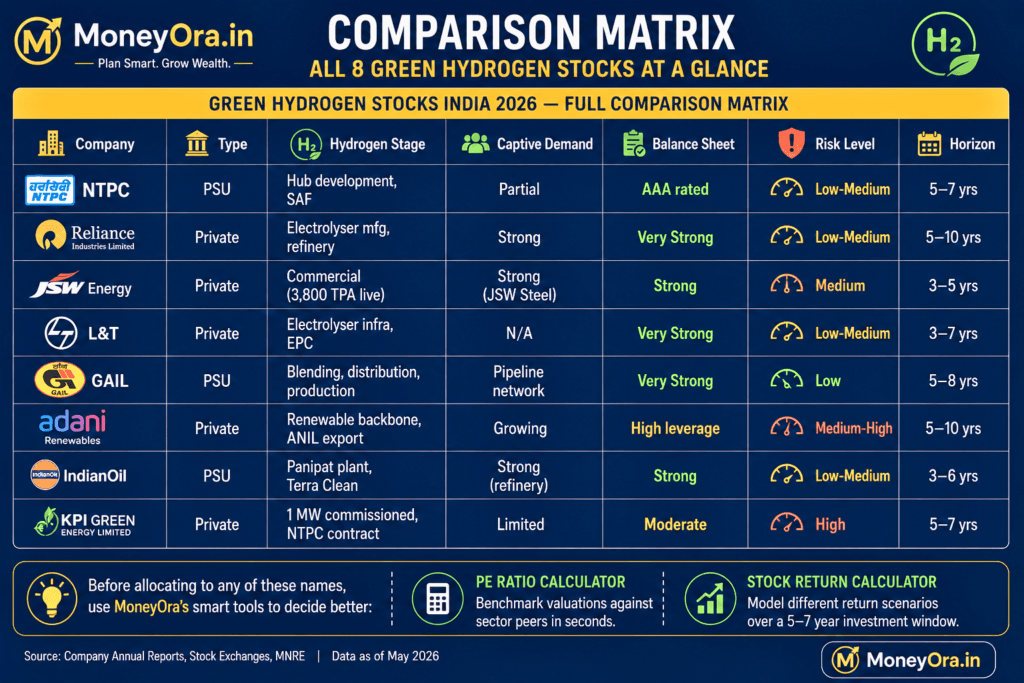
Comparison Matrix — All 8 Green Hydrogen Stocks at a Glance
| Company | Type | Hydrogen Stage | Captive Demand | Balance Sheet | Risk Level | Horizon |
|---|---|---|---|---|---|---|
| NTPC | PSU | Hub development, SAF | Partial | AAA rated | Low-Medium | 5–7 yrs |
| Reliance | Private | Electrolyser mfg, refinery | Strong | Very Strong | Low-Medium | 5–10 yrs |
| JSW Energy | Private | Commercial (3,800 TPA live) | Strong (JSW Steel) | Strong | Medium | 3–5 yrs |
| L&T | Private | Electrolyser infra, EPC | N/A | Very Strong | Low-Medium | 3–7 yrs |
| GAIL | PSU | Blending, distribution, production | Pipeline network | Very Strong | Low | 5–8 yrs |
| Adani Green | Private | Renewable backbone, ANIL export | Growing | High leverage | Medium-High | 5–10 yrs |
| IOC | PSU | Panipat plant, Terra Clean | Strong (refinery) | Strong | Low-Medium | 3–6 yrs |
| KPI Green | Private | 1 MW commissioned, NTPC contract | Limited | Moderate | High | 5–7 yrs |
Before allocating to any of these names, use MoneyOra’s PE Ratio Calculator to benchmark their current valuations against sector peers, and MoneyOra’s Stock Return Calculator to model different return scenarios over a 5–7 year investment window.
Risk Analysis — What Most Green Hydrogen Investor Guides Skip
Risk 1 — The 94% project operationalisation gap
As of August 2025, 94% of India’s announced green hydrogen projects were not operational. This is not a data error — it’s the current state of the sector. Announcement-to-commissioning timelines in hydrogen are 3–7 years. Most stock prices moved on the announcement. The revenue will come (if it comes) years after. Investors who bought on the headline often wait longer than anticipated.
Risk 2 — Cost parity is still 5–7 years away without subsidies
Green hydrogen costs approximately ₹300–500/kg to produce in India today. Grey hydrogen costs ₹80–100/kg. For green hydrogen to compete without SIGHT subsidies, electrolyser costs need to fall ~70% from current levels — and renewable electricity costs, already low in India, need to fall further still. The IEA projects this cost crossover happening somewhere between 2030 and 2035 globally. India may get there faster given solar costs, but investors should not assume cost parity before 2028.
Risk 3 — SIGHT policy dependency
Most project financial models assume SIGHT disbursements arrive on schedule. India’s energy subsidy disbursement history is uneven — delays are common. If SIGHT payouts are delayed even 6–12 months, project IRRs deteriorate. Track MNRE disbursement data at mnre.gov.in quarterly.
Risk 4 — Offtake commitment gap
Industrial buyers (steel, fertiliser, chemical companies) have broadly not committed to paying a meaningful green premium for hydrogen at scale. Without locked-in offtake at a premium price, project cash flows are uncertain. This is why captive demand players (Reliance, IOC, JSW) are structurally safer — they’re their own customer.
Risk 5 — Valuation premium risk
Several green hydrogen stocks trade at significant premiums to their current fundamentals because the market is pricing in a future that hasn’t arrived yet. If timelines slip — which in infrastructure projects they almost always do to some degree — the valuation premium can compress sharply even if the underlying thesis is intact. Use MoneyOra’s Lumpsum Calculator to model downside scenarios, not just upside projections.
Risk 6 — Technology disruption risk
Electrolyser technology is still evolving. PEM (Proton Exchange Membrane), alkaline, and solid oxide electrolysers have different cost and efficiency profiles. Companies betting on one technology could face disruption if a competing technology achieves cost breakthroughs faster. L&T’s role as an EPC contractor is somewhat technology-agnostic, which is part of its appeal.
MoneyOra Analysis — The 94% Problem and What It Actually Means for Investors
There’s a number that should be on the first page of every green hydrogen stocks guide in India but rarely is: 94% of announced projects were not operational as of mid-2025. That’s not a criticism of the sector — it’s the normal early-stage development pattern. Solar went through the same thing in India between 2010 and 2014. The difference is that solar had a cost curve that was already bending downward fast when adoption started. Green hydrogen’s cost curve is bending, but more slowly.
What this means practically for investors in 2026: you are, at best, 3–5 years away from meaningful hydrogen revenues for most companies on this list. JSW Energy is the exception — 3,800 TPA of commercial supply is operational today. That operational milestone is genuinely significant and distinguishes JSW from the announcement-stage majority.
There are two ways to position in green hydrogen stocks given this reality. The first is the proxy approach: buy companies where hydrogen is a future option on top of an existing business that’s already profitable — NTPC for its power generation, GAIL for its gas distribution, L&T for its engineering order book. If hydrogen delivers, these stocks get an additional re-rating. If hydrogen timelines slip 3 years, these companies don’t go under. The second approach — pure-play hydrogen betting — doesn’t exist in India’s listed markets yet because no pure-play company is meaningfully revenue-generating from hydrogen.
The third observation worth making: electrolyser cost trajectories globally are following a solar-style learning curve. In 2020, electrolysers cost approximately $1,000–1,200 per kW. By 2025, leading manufacturers are targeting $300–400/kW. If that trajectory continues to $150–200/kW by 2030 — which analysts at BloombergNEF and Wood Mackenzie consider achievable — the economics of green hydrogen flip dramatically without subsidy dependence. India’s solar advantage amplifies this effect. The companies best positioned to capture that cost curve shift are those that are already committed, already building manufacturing capacity, and won’t run out of cash waiting for it.
On that last criterion: NTPC, Reliance, L&T, and GAIL all qualify. KPI Green and Adani Green are higher risk on the same criterion.
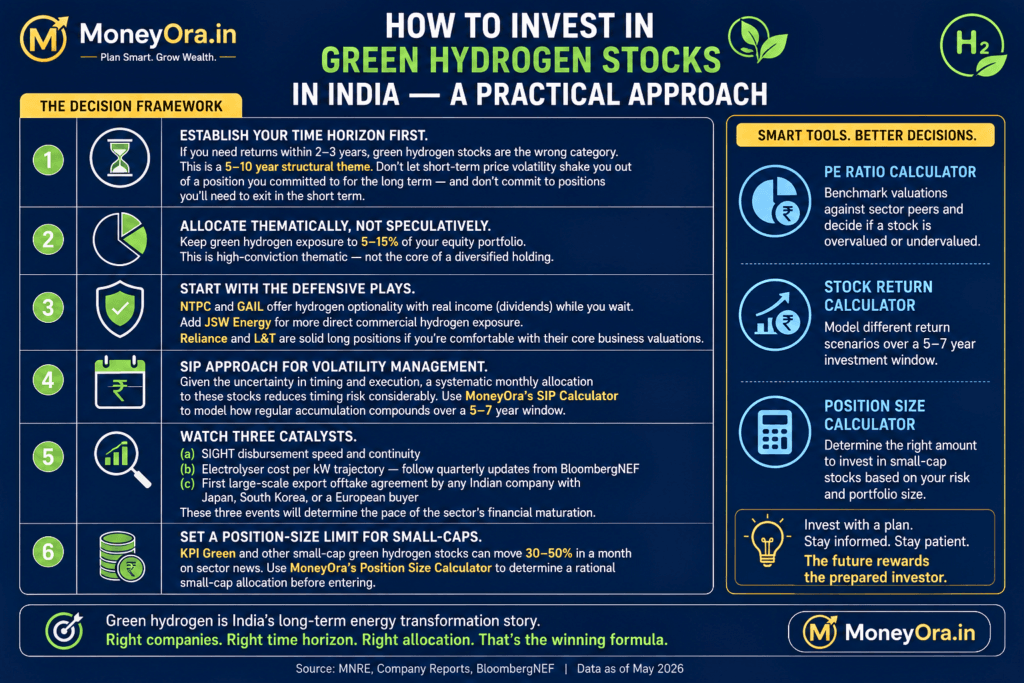
How to Invest in Green Hydrogen Stocks in India — A Practical Approach
The decision framework
- Establish your time horizon first. If you need returns within 2–3 years, green hydrogen stocks are the wrong category. This is a 5–10 year structural theme. Don’t let short-term price volatility shake you out of a position you committed to for the long term — and don’t commit to positions you’ll need to exit in the short term.
- Allocate thematically, not speculatively. Keep green hydrogen exposure to 5–15% of your equity portfolio. This is high-conviction thematic — not the core of a diversified holding.
- Start with the defensive plays. NTPC and GAIL offer hydrogen optionality with real income (dividends) while you wait. Add JSW Energy for more direct commercial hydrogen exposure. Reliance and L&T are solid long positions if you’re comfortable with their core business valuations.
- SIP approach for volatility management. Given the uncertainty in timing and execution, a systematic monthly allocation to these stocks reduces timing risk considerably. Use MoneyOra’s SIP Calculator to model how regular accumulation compounds over a 5–7 year window.
- Watch three catalysts. (a) SIGHT disbursement speed and continuity; (b) Electrolyser cost per kW trajectory — follow quarterly updates from BloombergNEF; (c) First large-scale export offtake agreement by any Indian company with Japan, South Korea, or a European buyer. These three events will determine the pace of the sector’s financial maturation.
- Set a position-size limit for small-caps. KPI Green and other small-cap green hydrogen stocks can move 30–50% in a month on sector news. Use MoneyOra’s Position Size Calculator to determine a rational small-cap allocation before entering.
Tax considerations for hydrogen stock investors
- Short-term capital gains (held under 12 months): 20% flat rate on equity
- Long-term capital gains (held over 12 months): 12.5% on gains above ₹1.25 lakh per year
- Given the 5–10 year recommended horizon, LTCG is the appropriate tax bracket. This also means strategic partial redemptions at year-end can manage the ₹1.25 lakh exemption threshold efficiently.
- Use MoneyOra’s Brokerage Calculator to factor in transaction costs when planning accumulation or rebalancing trades.
Green Hydrogen Stocks — Where the Opportunity Is Real and Where the Risk Is Underpriced
India’s green hydrogen stocks represent one of the most significant long-term industrial investment themes of the decade. The policy support is real. The competitive advantages — solar resources, low labour costs, industrial demand — are structural. The companies involved have the scale to survive the development window.
What the current market prices in varies by company. Some are being valued on hydrogen futures already. Others — particularly GAIL and IOC — are trading at valuations that don’t fully reflect their hydrogen optionality. JSW Energy is operationally ahead of most and deserves credit for that.
The investor’s job here is not to pick the single winner — it’s almost certainly going to be multiple companies capturing different parts of the value chain. The job is to calibrate position sizes appropriately for a 5–10 year wait, diversify across defensive and more aggressive names, and track the three catalysts that will determine when the financial thesis starts to materialise in quarterly results.
Start building your return model. A 5–7 year CAGR scenario at different entry prices tells you whether current valuations already price in the optimistic case — or whether there’s room for the thesis to mature without needing perfect execution. Use the free calculator now on MoneyOra.in.
Calculate Your Green Energy Stock Returns
Stock Return • CAGR • SIP • Position Size • Brokerage — all free, no login required.
Related MoneyOra Tools
- Stock Return Calculator — Model returns from any green hydrogen stock at different entry prices
- CAGR Calculator — Find what annual return is required to hit your wealth targets
- SIP Calculator — Build systematic positions in green hydrogen stocks over 5–7 years
- Lumpsum Calculator — Project lump sum returns across different CAGR assumptions
- Position Size Calculator — Set rational small-cap allocation limits before entering
- PE Ratio Calculator — Compare current valuations across green hydrogen stocks
- Brokerage Calculator — Factor in transaction costs across accumulation phases
- Stop Loss Calculator — Set rational exit levels before entering any position
- Dividend Calculator — Estimate dividend income from GAIL and NTPC positions
- Share Market Calculator Hub — All stock analysis tools in one place
Related MoneyOra Articles
- Top 5 Solar Power Companies India — The renewable backbone for green hydrogen production
- Defence Index India 2026 — Another long-horizon thematic investment comparison
- AI Stock Picks 2026 — Cross-sector thematic investing comparison
- Semiconductor Stocks India — Another high-conviction multi-year theme
- Data Center Stocks India — Power infrastructure parallel to green hydrogen
- MTAR Technologies — Clean energy component manufacturing
- Share Market Category — All MoneyOra stock and sector analysis
Frequently Asked Questions — Green Hydrogen Stocks India 2026
What are green hydrogen stocks in India?
Green hydrogen stocks are shares of companies producing, storing, distributing, or building infrastructure for hydrogen generated using renewable electricity (solar or wind) via electrolysis. In India, no pure-play listed green hydrogen company exists yet — the main plays are diversified companies like NTPC, Reliance, JSW Energy, L&T, GAIL, and IOC with significant hydrogen commitments and pipelines alongside their existing businesses.
Which is the best green hydrogen stock in India for 2026?
There’s no single “best” answer — it depends on your risk appetite. For lowest risk: NTPC (AAA balance sheet, PSU backing) and GAIL (4.75% dividend yield, low debt). For commercial hydrogen milestone: JSW Energy (India’s largest commercial green hydrogen plant operational as of November 2025). For infrastructure optionality: L&T. For aggressive growth exposure: KPI Green Energy (small-cap, higher risk).
Is green hydrogen a good investment in India in 2026?
As a 5–10 year thematic investment, yes — India has genuine competitive advantages in solar energy costs, industrial hydrogen demand, and export positioning. As a 1–2 year investment, it’s premature. 94% of announced green hydrogen projects in India were not operational as of mid-2025. Revenue realisation is years away for most players. Invest with an appropriate time horizon, not based on near-term price momentum.
How does JSW Energy compare to NTPC for green hydrogen investment?
JSW Energy has commissioned India’s largest commercial green hydrogen plant (3,800 TPA) and has a captive offtaker in JSW Steel — making it operationally ahead of NTPC in commercial hydrogen. NTPC, however, has a stronger balance sheet (AAA-rated Maharatna PSU), larger absolute scale, and government policy tailwinds. JSW is the higher-conviction green hydrogen bet; NTPC is the safer one with additional income from dividends.
What is the SIGHT scheme and why does it matter for green hydrogen stocks?
SIGHT (Strategic Interventions for Green Hydrogen Transition) is India’s production-linked incentive scheme under the National Green Hydrogen Mission. It provides per-kg subsidies to green hydrogen producers, bridging the gap between green hydrogen’s current production cost (₹300–500/kg) and grey hydrogen’s cost (₹80–100/kg). Most green hydrogen project economics depend on SIGHT disbursements — delays or policy changes directly affect financial projections for companies in this sector.
Can I buy green hydrogen ETF or mutual fund in India?
As of 2026, there is no dedicated green hydrogen ETF or mutual fund listed in India. Investors must access this theme through individual stocks. Some clean energy or ESG-focused funds hold NTPC, Adani Green, or Tata Power with hydrogen exposure. Internationally, hydrogen-focused ETFs exist (e.g., Global X Hydrogen ETF), but these require LRS (Liberalised Remittance Scheme) investment and include global companies, not India-specific exposure.
What are the biggest risks in green hydrogen stocks India?
Six key risks: (1) 94% of announced projects not yet operational — timeline slippage is the norm. (2) Green hydrogen costs 3–5× grey hydrogen — cost parity requires electrolyser prices to fall ~70%. (3) SIGHT policy dependency — disbursement delays affect project IRRs directly. (4) Offtake risk — industrial buyers haven’t committed to large green premiums. (5) Valuation premium compression if timelines slip. (6) Technology risk — electrolyser type competition could strand investments in one specific approach.
What is the NTPC Pudimadaka Green Hydrogen Hub?
The Pudimadaka Green Hydrogen Hub is NTPC’s flagship hydrogen project in Andhra Pradesh — a ₹1.85 lakh crore development targeting 1,500 tonnes per day (TPD) of green hydrogen production, primarily for conversion into green ammonia for export to Japan, South Korea, and Europe. In May 2026, NTPC awarded an EPC contract for India’s first Sustainable Aviation Fuel (SAF) plant at the same site, adding another revenue stream to the hub’s long-term vision.
How is Reliance Industries involved in green hydrogen?
Reliance is building an integrated new energy ecosystem at Jamnagar, Rajasthan, committing ₹75,000 crore to green energy including green hydrogen. The centrepiece is an electrolyser giga-factory targeting 3 GW of annual manufacturing capacity by late 2026. The strategic advantage: Reliance’s own refineries already consume large quantities of grey hydrogen, creating captive internal demand that removes the need to find external buyers — the hardest commercial challenge for any hydrogen producer.
What is the difference between green hydrogen and grey hydrogen?
Grey hydrogen is produced from natural gas via steam methane reforming — it generates significant CO₂ emissions and costs ₹80–100/kg in India. Green hydrogen is produced by electrolysis of water using renewable electricity — zero carbon emissions but currently costs ₹300–500/kg. Blue hydrogen uses fossil fuels but captures the CO₂ via CCS (carbon capture and storage). India’s policy focus is on green hydrogen given its abundant renewable energy resources and 2070 net-zero commitment.