
SIP & Lumpsum
Calculator
Estimate wealth creation from systematic & one-time investments — with year-by-year projections.
| Year | Invested | Returns | Corpus | CAGR |
|---|
SIP Calculator SBI - Estimate SBI Mutual Fund Returns for FY 2025-26
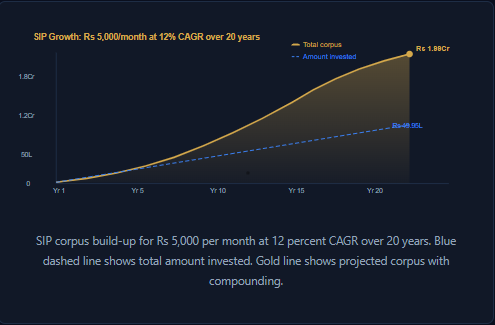
The SIP calculator SBI tool above gives you the estimated maturity corpus for any SBI Mutual Fund SIP in seconds. But a number without context is just a number. This guide explains exactly how the SIP calculator SBI works the math behind every figure it produces what the tax bill looks like on redemption and the four mistakes that silently reduce what SBI MF investors actually take home.
For Indian investors choosing SBI Mutual Fund for their SIP, the SIP calculator SBI is particularly relevant because SBI MF is India’s largest asset management company by AUM, managing over Rs 10 lakh crore across equity, debt, and hybrid schemes registered with AMFI. The SIP calculator SBI estimates returns across all SBI MF equity categories using the same compound interest formula, regardless of whether you are investing in SBI Bluechip Fund, SBI Flexicap Fund, SBI Magnum Midcap Fund or SBI Small Cap Fund
This guide covers the exact formula the SIP calculator SBI uses, three real-money scenarios in INR, the current tax rules under the Income Tax Act for FY 2025-26 and FY 2026-27, and the mistakes that cost SBI MF SIP investors the most.
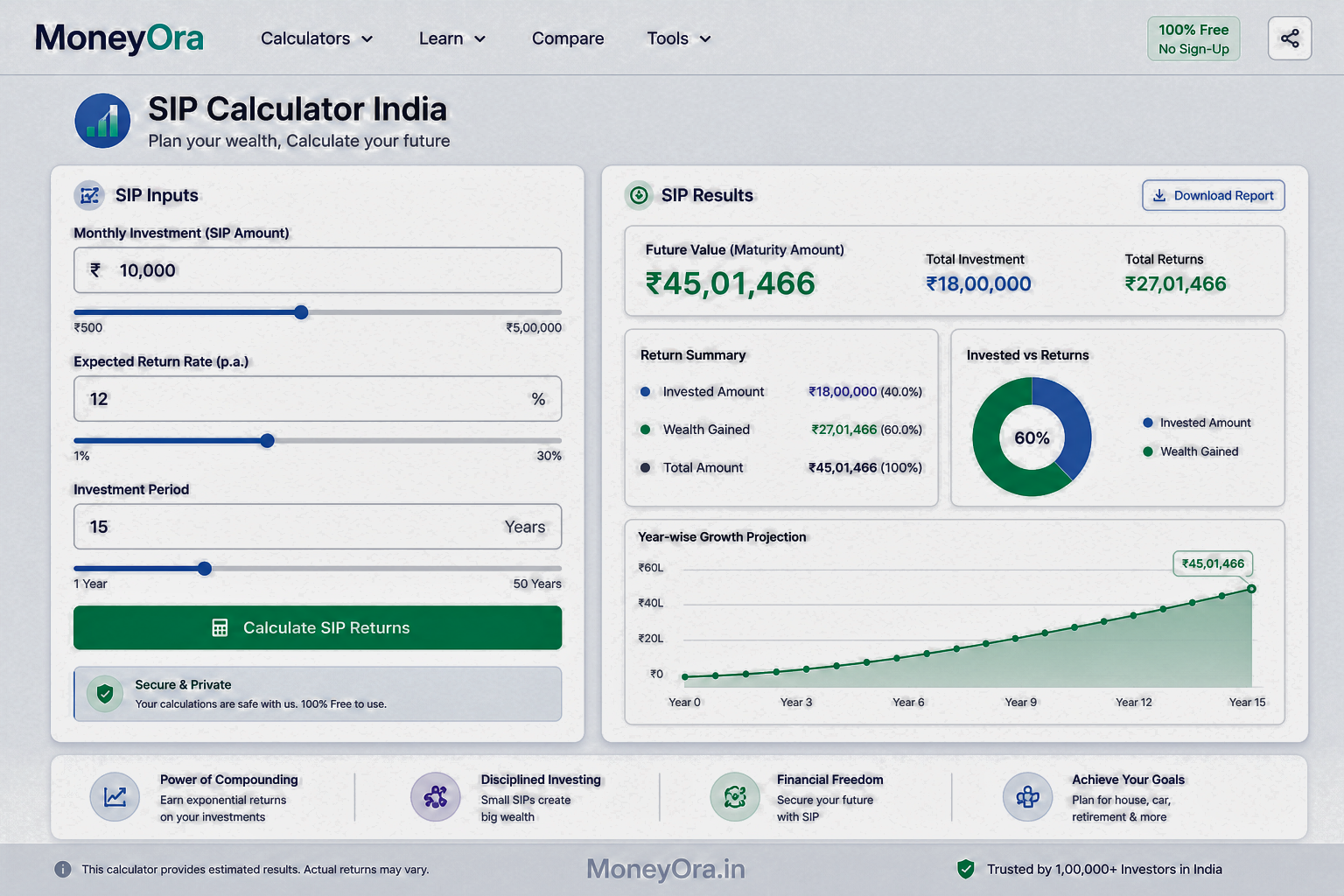
How the SIP calculator SBI works
A SIP calculator SBI models a Systematic Investment Plan in SBI Mutual Fund schemes. A Systematic Investment Plan is not a product. It is a method you instruct SBI Mutual Fund to debit a fixed amount from your bank account on a set date each month and invest it at that month’s Net Asset Value (NAV) in your chosen scheme. All SBI MF schemes are SEBI-registered per SEBI guidelines.
It gives you a higher number than simple multiplication because of compounding. Each unit purchased in month one has more months of growth than units purchased in month six. The tool adds up all these independently compounding instalments. Zerodha Varsity has a full primer on compounding in mutual funds if you want to go deeper on the mechanics.
Two things this calculator cannot do: it cannot predict future NAVs of SBI MF schemes and it does not deduct the fund’s expense ratio from the return you enter. For SBI direct plans the expense ratio is typically 0.5 to 0.8 percent lower than regular plans. Use this tool to plan direction and order of magnitude not to predict an exact corpus to the rupee.
The SIP calculator SBI formula with a worked example in INR
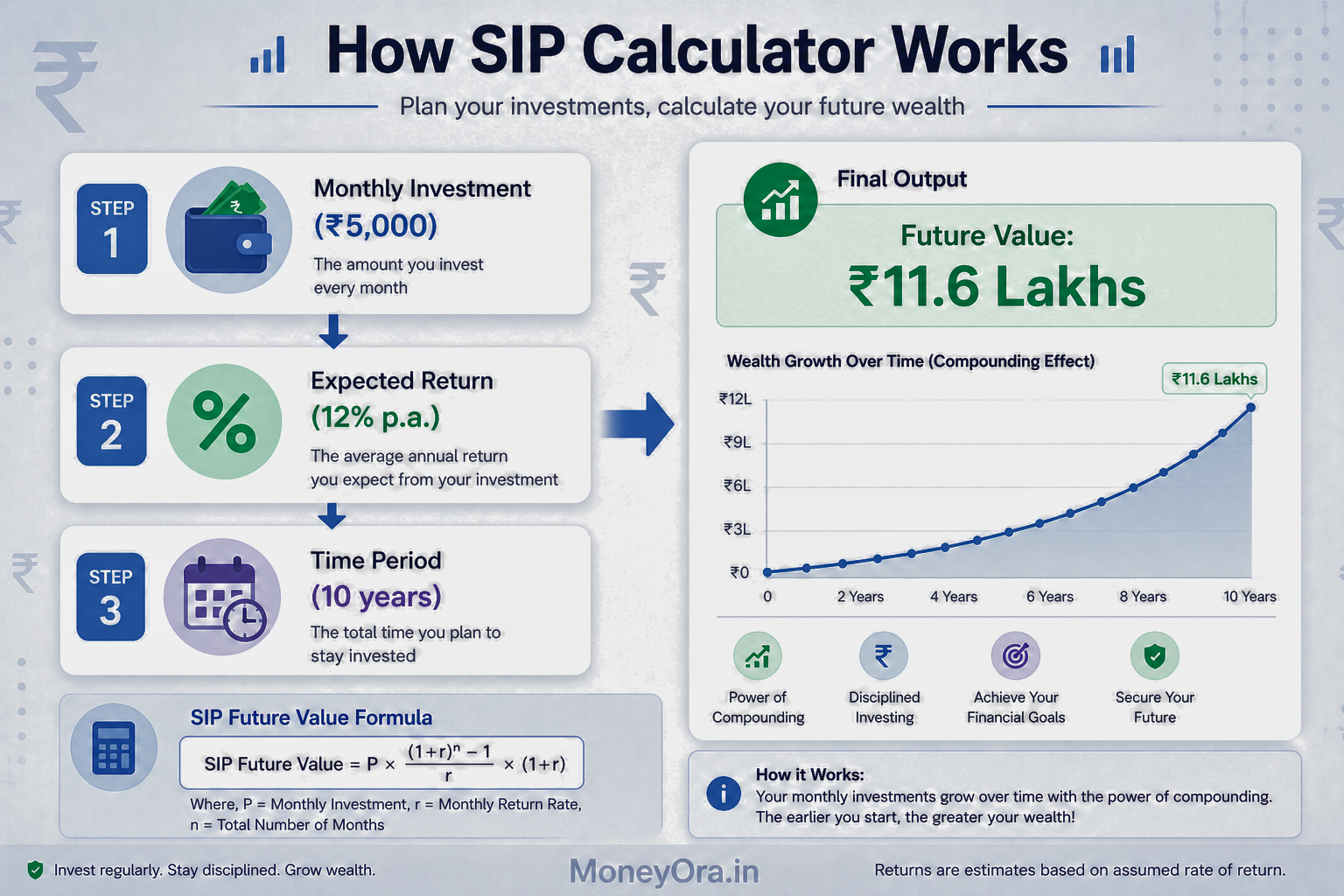
- FV = Future Value (estimated SBI MF maturity corpus)
- P = Monthly SIP amount in rupees
- r = Monthly interest rate = Annual expected return / 12
- n = Total number of months (years x 12)
- (1 + r) at the end = annuity-due factor (start-of-month investment assumed)
The tool runs these steps for every scenario automatically. Most SBI SIP calculators assume investment at the start of each month. The final (1 + r) factor accounts for that. If the calculator assumes end-of-month investment it drops that factor. Over 10 years at 12 percent the difference is roughly one additional month of returns.
Worked example: Rs 10,000 per month in SBI Bluechip Fund for 10 years at 12 percent annual return
Step one: convert annual rate to monthly. 12 percent per year means r = 12 / 12 / 100 = 0.01.
Step two: n = 10 years x 12 = 120 months.
Step three: plug into the formula.
- (1.01)^120 = 3.3004
- (3.3004 – 1) / 0.01 = 230.04
- 230.04 x 1.01 = 232.34
- 10,000 x 232.34 = Rs 23,23,400 (approx Rs 23.23 lakh)
- Total invested in SBI MF: Rs 10,000 x 120 = Rs 12 lakh
- Estimated wealth gained: Rs 11.23 lakh
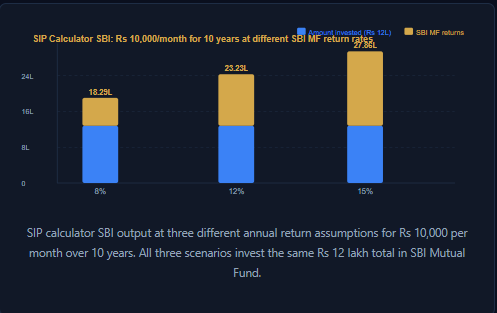
That is roughly 94 percent return on your principal over 10 years. At 15 percent annual return the same SIP calculator SBI inputs produce Rs 27.86 lakh. At 8 percent they produce Rs 18.29 lakh. The return rate is the most sensitive variable in the SIP calculator SBI. A 3 percentage point change over 10 years shifts your SBI MF corpus by Rs 4 to 10 lakh on a Rs 10,000 monthly SIP.
Practical scenarios and tables for SBI MF SIP investors
Scenario A: Short-term SIP (3 years) vs long-term SIP (20 years) in SBI equity funds
The SIP calculator SBI makes this comparison easy. A 3-year SIP is useful for goal-based investing but the compounding curve barely starts bending in three years. The real corpus build-up happens after year ten when the earliest instalments have compounded several times over.
Monthly SIP amount: Rs 5,000 in SBI Mutual Fund at 12% annual return
| Tenure | Total invested | Estimated corpus | Wealth gained | Return multiple |
|---|---|---|---|---|
| 3 years | Rs 1.80 lakh | Rs 2.15 lakh | Rs 35,000 | 1.19x |
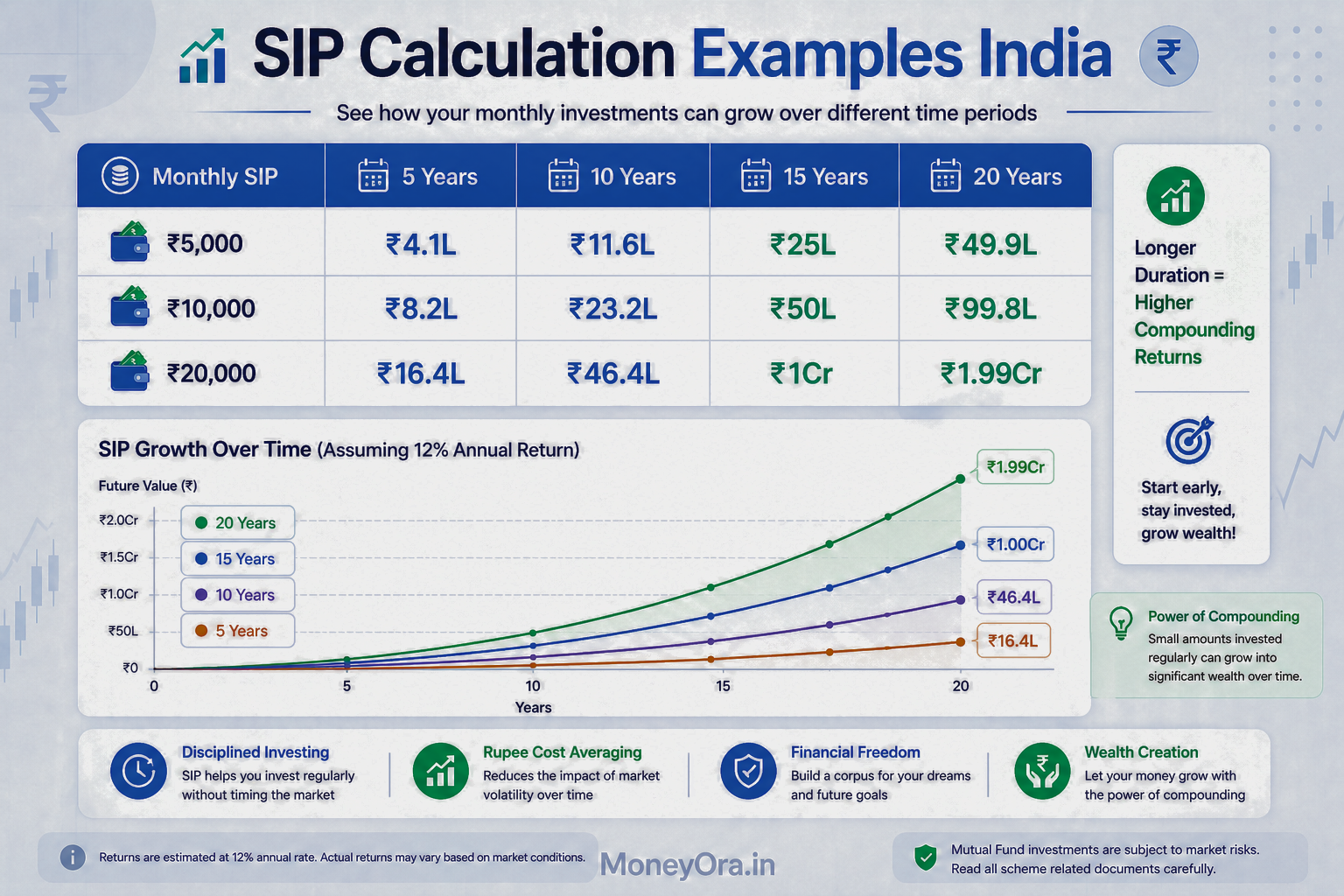
| 5 years | Rs 3.00 lakh | Rs 4.12 lakh | Rs 1.12 lakh | 1.37x |
| 10 years | Rs 6.00 lakh | Rs 11.61 lakh | Rs 5.61 lakh | 1.94x |
| 20 years | Rs 12.00 lakh | Rs 49.96 lakh | Rs 37.96 lakh | 4.16x |
Returns estimated at 12 percent CAGR using the SIP calculator SBI formula. Does not account for LTCG tax or SBI MF expense ratio.
The jump from 10 years to 20 years in the SIP calculator SBI is not a doubling. It is a 4.3x increase in corpus for a 2x increase in time and invested amount. No calculator makes this visible until you actually compare the rows side by side. The early instalments from year one to year five are doing the heavy lifting by year twenty.
Scenario B: Impact of inflation on your SBI MF SIP corpus
The SIP calculator SBI shows you a nominal corpus number in rupees. What it does not show is purchasing power. Rs 50 lakh in 2046 is not the same as Rs 50 lakh today. Assuming 6 percent average inflation over 20 years, the real value of that corpus in today’s money is roughly Rs 15.6 lakh. That is still far better than a savings account, but it is a useful check before deciding whether the SIP amount you are planning is actually enough for your goal.
Inflation-adjusted SBI MF corpus: Rs 5,000/month SIP at 12% for 20 years
| Inflation assumption | Nominal corpus | Real corpus (today’s Rs) | Real return rate |
|---|---|---|---|
| 4% per year | Rs 49.96 lakh | Rs 22.75 lakh | ~7.7% |
| 6% per year | Rs 49.96 lakh | Rs 15.59 lakh | ~5.7% |
| 8% per year | Rs 49.96 lakh | Rs 10.72 lakh | ~3.7% |
Real corpus = Nominal value / (1 + inflation rate)^years. Use the SIP calculator SBI with a step-up option to get personalised real-return estimates for your SBI MF goal.
If your financial goal is inflation-linked (buying a house, funding a child’s education, building a retirement corpus) you should either target a higher SBI MF return rate through a step-up SIP or increase your monthly SIP amount as income grows. Check the step-up SIP calculator on MoneyOra to model how increasing your SBI MF SIP by 10 percent each year changes the real outcome.
Scenario C: Small SBI MF SIP started early vs large SIP started late
This is the scenario most people miss when planning for retirement. Starting smaller but earlier consistently beats starting larger but later. Every time.
Early starter vs late starter in SBI equity mutual funds at 12% CAGR
| Investor | SIP amount | Start age | Tenure | Total invested | Corpus at 55 |
|---|---|---|---|---|---|
| Priya (early) | Rs 5,000/mo | 25 | 30 years | Rs 18 lakh | Rs 1.76 crore |
| Rahul (late) | Rs 15,000/mo | 40 | 15 years | Rs 27 lakh | Rs 75.8 lakh |
The numbers make this unavoidable: Priya invests 33 percent as much each month in SBI MF and still ends up with 2.3x the corpus. This is the cost of delayed investing.
Taxation on SBI MF SIP redemptions: FY 2025-26 and FY 2026-27
One thing the SIP calculator SBI does not show by default is the post-tax corpus. The Union Budget 2024 (presented in July 2024) made the biggest changes to mutual fund taxation in several years. The full Finance Act is available on the India Budget portal. The rules below apply for both FY 2025-26 and FY 2026-27.
SBI equity mutual fund taxation
SBI equity-oriented funds are those where at least 65 percent of the portfolio is in Indian equities as defined by SEBI. This covers SBI Bluechip, SBI Flexicap, SBI Magnum Midcap, SBI Small Cap, SBI Equity Hybrid Fund, and similar schemes. Fund category definitions are standardised per BSE India listing requirements.
| Holding period | Tax category | Tax rate | Section |
|---|---|---|---|
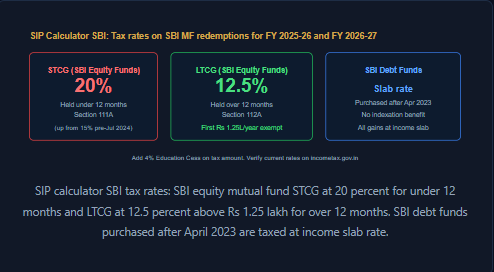
| Up to 12 months | STCG | 20% (flat) | Section 111A |
| More than 12 months | LTCG | 12.5% on gains above Rs 1.25 lakh | Section 112A |
SBI equity mutual fund units held for more than 12 months attract LTCG tax at 12.5 percent on gains above Rs 1.25 lakh per financial year under Section 112A. You can verify the latest rates on the Income Tax India e-filing portal. The Rs 1.25 lakh LTCG exemption applies across all equity investments in a financial year (SBI MF units, shares, and ETFs combined). Not Rs 1.25 lakh per SBI fund separately.
How FIFO applies to SBI MF SIP redemptions
When you redeem units from an SBI Mutual Fund scheme you have been running a SIP in, the tax department uses FIFO (First In First Out). The units purchased earliest are treated as sold first. Redemptions use the FIFO method, so the oldest SBI MF units are treated as sold first and are most likely to qualify for LTCG rates. You can track your folio-level SBI MF holding statements through CAMS, NSDL or CDSL.
SBI debt mutual fund taxation
This calculator uses equity fund return assumptions by default. If you are modelling a debt fund SIP, note that SBI debt funds purchased after April 1 2023 are taxed at your income slab rate on all gains regardless of holding period. There is no LTCG benefit and no indexation. Before considering an SBI debt fund SIP, compare the post-tax return against a tax-free bond, PPF, or bank FD. Current benchmark rates are published by the Reserve Bank of India. Also see the FD calculator and PPF calculator on MoneyOra for a direct post-tax comparison.
Dividend taxation on SBI MF schemes
Dividends from any SBI Mutual Fund scheme are added to your income and taxed at your applicable slab rate. Section 194K mandates 10 percent TDS if dividends from a single fund house exceed Rs 5,000 in a financial year (verify on the Income Tax e-filing portal). NRIs face 20 percent TDS on SBI MF dividends. The growth option makes more sense than the dividend option for most long-term SBI MF SIP investors in a tax-efficiency context.
Common mistakes SBI MF SIP investors make
1 – Using an unrealistic return rate in the SIP calculator SBI
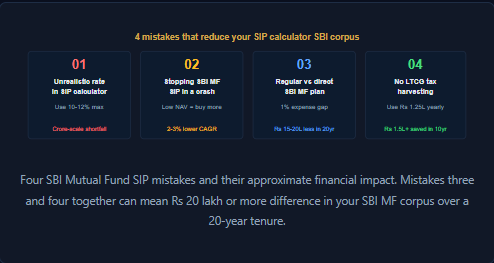
Plugging 18 or 20 percent into the calculator to make the corpus number look impressive is the most common error. Nifty 50 index funds have delivered approximately 12 to 13 percent CAGR over rolling 15-year periods historically per NSE India total returns index data. For SBI MF equity funds, use 10 to 12 percent for long-term planning in the SIP calculator SBI and never assume any fund’s past returns will repeat. The difference between calculator output at 18 percent versus 12 percent over 20 years is not marginal. It is a gap of several crore rupees that can derail an entire retirement plan built on an inflated number.
2 – Stopping the SBI MF SIP during a market crash
The investors who stop their SBI MF SIP when markets fall 20 to 30 percent are doing the opposite of what the SIP calculator SBI math requires. A market crash means every monthly instalment buys more SBI MF units at a lower NAV. Those cheap units, when markets recover, generate outsized returns. This calculator does not model this behavioral gap, which is why actual investor returns are typically 2 to 3 percentage points lower than the fund’s own declared CAGR. Running two SBI MF scenarios in the SIP calculator SBI (one continuous, one with a 6-month pause) shows the precise cost of stopping.
3 – Investing in regular plan instead of direct plan SBI MF
The SIP calculator SBI assumes a given return rate, but the SBI MF expense ratio comes directly out of your returns before you see them. An SBI regular plan with a 1.5 percent expense ratio versus an SBI direct plan with a 0.5 percent expense ratio seems like a minor difference. Over 20 years on a Rs 10,000 per month SIP the corpus difference is Rs 15 to 20 lakh. Use direct plans for all long-term SBI MF SIPs. Platforms like Groww and Zerodha Coin offer SBI MF direct plan SIPs with zero commission.
4 – Skipping LTCG tax harvesting on SBI MF gains
The Rs 1.25 lakh LTCG exemption resets every April 1. If you hold SBI equity mutual fund units with long-term gains, selling up to Rs 1.25 lakh worth before March 31 and immediately buying back resets the cost basis and uses the annual exemption tax-free. Done systematically, this saves Rs 15,625 per year in LTCG tax. Over 10 years that is Rs 1.56 lakh saved with minimal effort. You can model the effect by running two versions of the SBI SIP calculator: one with and one without annual redemptions up to the Rs 1.25 lakh limit. This strategy is legal, straightforward, and underused by SBI MF investors.
For goal-based planning beyond what the SIP calculator SBI covers, also check how your SBI MF SIP interacts with your overall portfolio. The lumpsum calculator helps if you have an existing amount to invest alongside the SBI MF SIP. The SWP calculator shows how to draw down your SBI MF corpus systematically after you reach your goal.
These are the questions Indian investors ask most often before and after using this tool on MoneyOra.
How does the SIP calculator SBI work for SBI Mutual Fund investments?
The SIP calculator SBI uses the standard formula: FV = P x [((1 + r)^n – 1) / r] x (1 + r). You enter your monthly SIP amount, expected annual return rate, and tenure in months. The SIP calculator SBI applies this formula to each SBI Mutual Fund instalment and sums the compounded values to give the estimated maturity corpus.
What is the LTCG tax on SBI Mutual Fund SIP redemptions in FY 2025-26?
SBI equity mutual fund units held for more than 12 months attract LTCG tax at 12.5 percent on gains above Rs 1.25 lakh per financial year under Section 112A. Units held under 12 months attract STCG at 20 percent under Section 111A. Each SIP instalment in an SBI fund counts its own 12-month holding period from its purchase date using the FIFO method.
Which SBI Mutual Fund is best for a long-term SIP?
SBI Bluechip Fund, SBI Flexicap Fund, and SBI Magnum Midcap Fund are among the widely tracked SBI MF options for long-term SIP investing. The right choice depends on your risk tolerance and investment horizon. Use the SIP calculator SBI tool above to model returns at different expected rates before selecting a fund category.
What return rate should I use in the SIP calculator SBI for equity funds?
For long-term planning with SBI equity mutual funds, 10 to 12 percent annual return is a reasonable conservative assumption based on historical Nifty 50 CAGR over rolling 15-year periods per NSE India data. Mid-cap SBI funds have historically delivered higher returns with greater volatility. Avoid entering rates above 15 percent in the SIP calculator SBI for planning beyond 5 years. You can also run two SIP calculator SBI scenarios in parallel (10 percent and 12 percent) to see the range your SBI MF corpus might land in.
Frequently asked questions about the SIP calculator SBI
A SIP calculator is a free online tool.
It estimates the future value of your investments.
It works for monthly SIP contributions.
You enter monthly amount, return rate, and duration.
It shows maturity value and expected returns instantly.
It uses the compound interest formula for annuity.
M = P × [{(1 + r)^n – 1} / r] × (1 + r).
It accounts for monthly contributions.
It includes compounding returns.
It calculates projected maturity value.
At 12% return, ₹2,000 per month grows significantly.
After 20 years, value is around ₹19.98 lakh.
Total investment is ₹4.80 lakh.
Estimated gains are ₹15.18 lakh.
This is nearly 4× growth.
At 12% return, monthly SIP required is ₹61,000–₹65,000.
Five years is a short period.
Market performance plays a big role.
For 10 years, SIP requirement drops significantly.
It becomes around ₹21,500 per month.
At 12% return, ₹1,000 monthly grows to ₹82,486.
Total investment is ₹60,000.
Returns are approximately ₹22,486.
At 12% return, ₹5,000 monthly becomes ₹25.23 lakh.
Total investment is ₹9 lakh.
Estimated returns are ₹16.23 lakh.
FDs give fixed returns of 6–7.5%.
SIPs in equity funds offer higher returns.
They can deliver 10–15% over long periods.
SIPs carry market risk.
For long-term goals, SIP is generally better.
M = P × [{(1 + r)^n – 1} / r] × (1 + r).
M is maturity value.
P is monthly investment.
r is monthly return rate.
n is total months.
Yes, SIP can be stopped anytime.
You can cancel through your broker or fund house.
Stopping early reduces compounding benefits.
Long-term continuation gives better growth.
Rupee cost averaging spreads your investment.
You buy more units when price is low.
You buy fewer units when price is high.
This reduces overall cost.
It helps manage market volatility.