



Every decade has its defining AI stocks moment. In the 1990s it was software. In the 2000s it was internet. In the 2010s it was cloud. In the 2020s, the structural shift is artificial intelligence — and the AI stocks universe in India is finally developing depth, with real companies generating real revenue from real AI deployments. “defence index stocks share the Make in India theme with these top AI stocks”
But not every company that puts “AI” in its investor presentation is a genuine AI stocks worth owning. The ones worth owning show it in the revenue — 80%, 90%, even 459% segment growth. They show it in the order book. They show it in the government mandates that are routing hundreds of crores of sovereign AI compute spending to domestic manufacturers. “data center stocks in India and AI stocks share the same infrastructure buildout theme”
This article identifies five AI stocks in India with genuine multibagger potential over the next 3–5 years. For each one you get the full story — what the company actually does, the latest FY26 financials, what the analysts say, the realistic price target, and the specific risks that could derail the thesis. These are not tips. They are starting points for serious research. “data center stocks in India and AI stocks share the same infrastructure buildout theme — and the electricity powering all of it is coming from solar power companies growing faster than any other energy sector”
AI Market — Why Now Is the Right Time to Study Every AI Stocks
- India AI market size (2026):~₹62,000 crore and growing
- Projected CAGR (2025–2031):26.37% — reaching US$31.94 billion by 2031
- IndiaAI Mission budget:₹10,371 crore approved for sovereign AI compute
- Government AI spending FY26:First ₹2,200 crore tranche deployed through domestic AI stocks
- NITI Aayog estimate:AI could add ₹80 lakh crore to India’s GDP by 2035
- Listed pure-play AI stocks in India:Still fewer than 10 — first-mover advantage is real
India’s AI market growth creates a long runway for every listed AI stocks in this space. The question is which ones have the fundamentals to convert that opportunity into shareholder wealth. Here are the five that stand out. “semiconductor stocks are the hardware layer beneath India’s AI stocks”
What Makes a True Multibagger AI Stock? The 5-Point Test
Before picking an AI stocks, you need a framework. The Indian market is full of companies that added “AI” to their name or investor decks after 2023 without any real AI revenue to show for it. Here is how to separate the real AI stocks from the theme-riders. Reliance Power share and the power demand story
1. AI Revenue as a Measurable Segment
A genuine AI stocks can tell you exactly how much revenue came from AI-specific products or services — not just “we use AI in our operations.” Netweb’s AI segment contributed 43.4% of FY26 revenue. Persistent Systems reports GenAI services bookings separately. If a company cannot break out its AI revenue, treat its AI claims with scepticism.
2. Order Book Visibility
Multibagger returns come from compounding. The best AI stocks positions have strong order book visibility — confirmed contracts that give you 12–24 months of revenue predictability. An AI stock with a thin, lumpy order book is far harder to hold through market corrections.
3. ROCE Above 20%
Return on Capital Employed (ROCE) tells you whether the business is actually generating superior returns on the money it deploys. The best AI stocks in India — Netweb (37.5%), Persistent (28%+) — generate ROCE well above 20%. An AI stock with low ROCE is burning through capital for growth that may never materialise profitably.
4. Structural Moat
Every AI stock faces competition. What prevents the next entrant from taking the market? For Netweb it is the IndiaAI Mission empanelment and 13 server design patents. For Persistent it is 20+ years of engineering relationships with global tech giants. For Kaynes it is ESDM manufacturing capabilities that take years to replicate. Identify the moat before sizing any AI stocks position.
5. Management Track Record
Has management delivered on guidance before? Has revenue growth converted into profit growth, or just top-line expansion? The best AI stocks in India have managements that under-promise and over-deliver. Use our CAGR calculator to verify a company’s actual historical revenue and profit compounding before trusting forward guidance.


Rs 1 Lakh Monthly Income After Retirement 2026: The Exact Portfolio Plan

Health Insurance Waiting Period India 2026: 4 Types and 5 Ways to Reduce

Gift Tax India 2026: Is Your Diwali Gift Taxable? (7 Scenarios)

NSE IPO 2026: Issue Price, Dates, Lot Size, Investment Amount and How to Apply
AI Stock 1: Netweb Technologies India (NSE: NETWEB) — India’s Only Listed AI Infrastructure AI Stock
NSE: NETWEB BSE: 543945 Market Cap: ₹23,175 Cr CMP: ₹4,521
If you had to pick just one AI stocks in India that sits at the absolute intersection of hardware, software, and government AI policy — it is Netweb Technologies India. This company designs and manufactures India’s AI servers, supercomputers, and HPC clusters from the ground up, and it is the only listed company in the country that does it. As an AI stock investment thesis, the uniqueness of that position is hard to overstate.
Why Netweb Is the Purest AI Stock in India
Most companies in India that call themselves an AI stock are actually IT services firms that use AI tools. Netweb is different — it builds the physical infrastructure that AI runs on. When the IndiaAI Mission decided to deploy 10,000+ GPU-equivalent compute units across India, Netweb got the ₹1,734 crore order because no other domestic AI stock can build what it builds.
FY26 Numbers That Make This AI Stock Stand Out
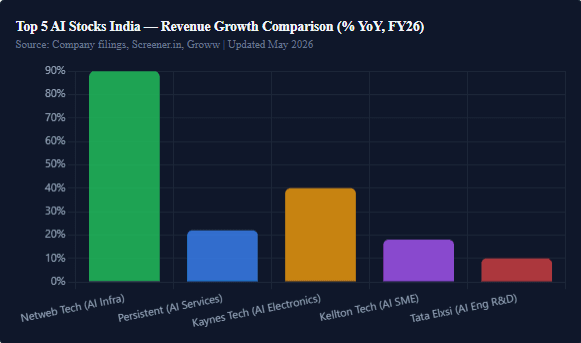
- Revenue: ₹2,184 crore (+90% YoY) — fastest revenue growth of any listed Indian AI stock
- PAT: ₹206 crore (+80.9% YoY)
- AI segment growth: +459.6% YoY — no other AI stock in India comes close
- AI segment share: 43.4% of total revenue (from near-zero 3 years ago)
- ROCE: 37.5% — software-company grade returns from an AI stock hardware company
- Net debt: Zero — ₹83.3 crore net free cash
- Order pipeline: ₹4,431 crore — 2x the full-year FY26 revenue
| Metric | Value | Context |
|---|---|---|
| CMP | ₹4,521 | 52-week range: ₹1,700–₹4,575 |
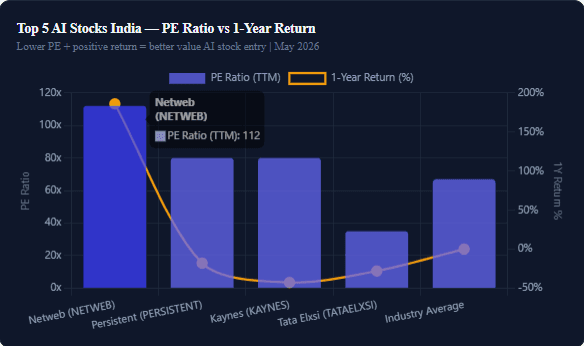
| PE Ratio (TTM) | 112.59x | Industry PE: 67.71x |
| EPS (TTM) | ₹36.15 | +79.6% YoY |
| 1-Year Return | +186% | 3-year: ~850% total |
| 5Y Revenue CAGR | 49% | 3Y Revenue CAGR: 67% |
| 5Y Profit CAGR | 96% | Fastest among Indian AI stocks |
| Analyst Target (consensus) | ₹4,080–₹4,500 | Bull case: ₹6,000 | 3Y: ₹8,500 |
For a full deep-dive analysis of this AI stock including quarterly charts, shareholding pattern, technical levels, and risk factors, read our dedicated Netweb Technologies India complete analysis.
The Risk with This AI Stock
Q4 FY26 was 35% of the full year — meaning Q1 FY27 will look soft. NVIDIA GPU supply constraints from US export controls remain a risk. Promoter holding has declined from 75% to 67%. The stock trades at 112x TTM PE — already pricing in the bull case. This AI stock rewards patience, not trading.
2 AI Stock 2: Persistent Systems (NSE: PERSISTENT) — India’s Fastest-Growing Mid-Cap AI Stock
NSE: PERSISTENT BSE: 533179 Market Cap: ~₹37,000 Cr CMP: ~₹4,850
If Netweb is the hardware side of India’s AI stock story, Persistent Systems is the software and services side — and it may be the more consistent multibagger AI stock for most long-term investors. This company has delivered revenue growth every single quarter for 14+ consecutive quarters. That consistency is rare in any market, and extraordinarily rare in any AI stock in India.
What Makes Persistent a Different Kind of AI Stock
Persistent Systems specialises in AI-powered cloud computing, data analytics, digital engineering, and enterprise automation. It works directly with global technology giants — Microsoft, Google, AWS, Salesforce — to help their enterprise clients deploy AI across operations. As an AI stock, Persistent is not a hardware play; it is an intellectual property and implementation play.
The GenAI Opportunity for This AI Stock
Persistent has been explicitly tracking its GenAI bookings as a separate metric since FY25. GenAI services revenue is growing faster than the overall company — contributing to the company’s $2 billion FY27 annual revenue target. In Q2 FY26, net profit was ₹471 crore, up 45% YoY. Multiple brokerages raised targets after Q2 — Motilal Oswal to ₹6,550, Nuvama to ₹7,000, citing “consistent execution and clear growth visibility.”
| Metric | Value | Context |
|---|---|---|
| CMP | ~₹4,850 | 52-week high: ₹6,788 | low: ₹4,300 |
| 1-Year Return | −18% | Correction from peak — potential re-entry zone |
| FY27 Revenue Target | $2 billion | ~₹16,700 crore at ₹83/$ |
| Revenue Growth (YoY) | +15% guided FY27 | Beating 12–13% IT sector average |
| ROE | ~28% | Top quartile among Indian AI stocks |
| Analyst Target | ₹5,800–₹7,000 | +20% to +44% upside from CMP |
| 5Y Profit CAGR | ~40% | Consistent compounding AI stock |
Why This AI Stock Is Down 18% from Its Peak
MOFSL noted “deal ramp-up delays” and “elongated decision cycles” as the reason for the pull-back. Macro headwinds — tariff uncertainty, US enterprise IT budget caution — weighed on near-term deals. But the long-term AI stock thesis is intact: GenAI is not a trade, it is a platform shift, and Persistent has the relationships and engineering talent to ride it. The correction could be an entry point for long-term AI stock investors.
To model what ₹1 lakh invested in this AI stock today could grow to over 5 years at different CAGR scenarios, use our lumpsum calculator. For systematic monthly investing into AI stocks, our SIP calculator shows the power of rupee-cost averaging into a volatile AI stock over time.
3 AI Stock 3: Kaynes Technology India (NSE: KAYNES) — The Electronics Manufacturing AI Stock
NSE: KAYNES BSE: 543278 Market Cap: ~₹25,000 Cr CMP: ~₹4,185
Kaynes Technology is a different kind of AI stock. It does not write AI algorithms. It does not run AI servers. What it does is make the electronics that go inside AI systems — and in India’s race to build indigenous AI hardware, that position is quietly powerful.
What This AI Stock Does
Kaynes is an end-to-end Electronics System Design and Manufacturing (ESDM) company. It serves automotive, industrial, aerospace, defence, medical, and railway sectors — building PCBs, sensors, IoT modules, and embedded electronics. The AI stock angle comes from its growing exposure to AI hardware components: embedded computing modules, IoT intelligence systems, and electronics for defence AI applications.
Kaynes as an AI Stock: The Key Data Points
- Revenue growth forecast: +28.8% annually — more than 2.5x the Indian market average
- Earnings forecast: +31.2% annually through FY27
- FY26 earnings growth: 90.7% — vs electronics industry average of 19.8%
- Simply Wall St AI Growth Rating: ★★★★★☆ (5/6 stars)
- New Hyderabad facility: Advanced AI-integrated electronics manufacturing capacity
- 1-Year Return: −42.7% — the sharpest correction among our 5 AI stocks
- Share price target 2026: ₹7,200–₹8,400 (analyst estimates)
| Metric | Value | AI Stock Angle |
|---|---|---|
| CMP | ~₹4,185 | Down 42.7% from 52W high — deep value zone |
| Revenue CAGR (projected) | 28.8% annually | Driven by automotive AI, defence IoT |
| Earnings growth FY26 | 90.7% | Vs 19.8% sector average |
| Key Sectors | Auto, Defence, Aerospace | All AI-embedded electronics beneficiaries |
| 2026 Target Price | ₹7,200–₹8,400 | +72% to +100% upside potential |
| 2027 Target Price | ₹8,700–₹10,000 | Motilal Oswal top pick |
The Contrarian AI Stock Case for Kaynes
A 42.7% correction in a fundamentally sound AI stock creates a very different risk-reward compared to chasing Netweb at 112x PE. Kaynes’ ESDM capabilities take years to build — the new Hyderabad facility, the customer relationships with Tier 1 auto and defence OEMs — these represent a durable moat. As India’s defence AI spending and automotive electronics content per vehicle both rise, this AI stock has a long structural runway at what may now be an attractively discounted price.
Compare this AI stock’s potential return using our stock return calculator. And always size your position correctly with the position size calculator — never let even a high-conviction AI stock represent
4 AI Stock 4: Kellton Tech Solutions (NSE: KELLTONTEC) — The Small-Cap AI Stock Wild Card
NSE: KELLTONTEC BSE: 519602 Segment: SME / Small-Cap
Every genuine AI stock list needs a high-risk, high-reward small-cap pick. Kellton Tech fills that role. This is the AI stock that most large investors have not looked at yet — which is exactly when the multibagger potential is highest.
What Kellton Tech Does as an AI Stock
Kellton Tech Solutions is an Indian IT services and digital transformation company. It helps mid-sized enterprises deploy AI, machine learning, cloud computing, IoT, blockchain, and SAP solutions. Its client base spans India and the US. As an AI stock, Kellton is pure services — it implements AI for other companies, charges project and retainer fees, and builds recurring revenue through managed digital transformation contracts.
Why This Small-Cap AI Stock Has Multibagger Potential
- Revenue diversification: India and US client exposure — global AI services demand flowing to Indian implementers
- Emerging technologies: Active in blockchain, IoT, and AI/ML — areas where enterprise demand is accelerating
- Undiscovered: Small market cap means institutional investors have not yet built positions — when they do, the re-rating can be dramatic
- Digital transformation wave: India’s enterprise digitisation is in early innings — Kellton’s core service market is structurally growing
The Risk Profile of This AI Stock
Kellton is small. That means thin liquidity — it can be hard to exit quickly at a fair price in a market downturn. It is more exposed to client concentration risk. Its financials are less transparent than large-cap AI stocks. And small-cap AI stocks typically fall harder in market corrections before recovering.
This AI stock is suited for investors who have already built positions in the larger AI stocks above and want a speculative 5–10% allocation to a small-cap AI stock with genuine upside optionality. Position size carefully. Use our stop loss calculator to define your maximum loss before entering any small-cap AI stock.
5 AI Stock 5: Tata Elxsi (NSE: TATAELXSI) — The Premium Engineering AI Stock
NSE: TATAELXSI BSE: 500408 Market Cap: ~₹26,000 Cr CMP: ~₹4,650
Tata Elxsi is the most mature and established AI stocks on this list. It is a premium engineering R&D (ER&D) services company that specialises in embedded software, product engineering, and AI integration for automotive, media, healthcare, and broadcast industries. As an AI stock, it is less about India’s domestic AI buildout and more about India’s role as the global engineering R&D hub for AI-embedded products.
Tata Elxsi as an AI Stock: What the Business Actually Does
When a car manufacturer in Germany needs the AI software stack for its autonomous driving system, or when a US medical device company needs AI diagnostics embedded in its hardware — they hire Tata Elxsi. The company is the engineering brain behind AI in physical products. Its 14,000+ engineers work across silicon, software, and systems — building AI that you interact with without knowing it is there.
AI Stock Fundamentals for Tata Elxsi
| Metric | Value | Context |
|---|---|---|
| CMP | ~₹4,650 | 52W high near ₹8,000 — deep correction |
| MOFSL Target | ₹3,350 | Downgrade — near-term caution |
| ICICI Securities Target | ₹4,110 (Add) | More constructive view |
| FY27 Revenue Growth Guidance | High single digits | Slower than peak years; automotive recovery key |
| 1-Year Return | −28% | Sector-wide ER&D pressure since Feb 2026 |
| ROE | ~35% | Consistently high — premium AI stock quality |
| Moat | Automotive ADAS, Medical AI | Domain expertise takes 10+ years to replicate |
The Bear and Bull Case for This AI Stock
Our View on This AI Stock
Tata Elxsi at ₹4,650 is best treated as a long-term accumulation AI stock, not a near-term momentum play. It has the highest quality fundamentals of any engineering AI stock in India. The business model — being embedded in product development cycles of global automotive and medical OEMs — means once you are in, you are in for 5+ years. Buy in tranches, not all at once. Use our stock average calculator to track your average cost as you build the position.
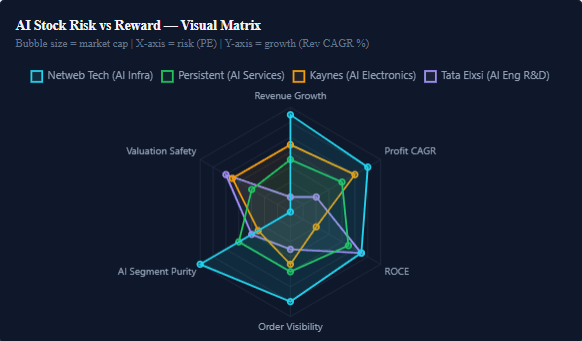
AI Stock Comparison: All 5 Multibagger AI Stocks at a Glance
Why India’s AI Stock Universe Is Different from Global AI Stocks
When most investors think of an AI stock, they think Nvidia, Microsoft, Alphabet, or Meta. Those are world-class AI stocks — but they are priced for perfection and denominated in US dollars. India’s AI stock universe offers something different: earlier-stage, rupee-denominated exposure to the same global AI buildout theme, at valuations that still have room to re-rate.
Three Unique Advantages of Indian AI Stocks
1. Government Procurement Tailwind
India’s IndiaAI Mission, Make in India, and Digital India programs actively direct AI spending toward domestic companies. An Indian AI stock like Netweb or Kaynes gets business that a foreign company simply cannot win. No Nvidia, Dell, or HPE can qualify for an IndiaAI Mission AI server order the way Netweb can. This government procurement moat is not available to any US AI stock.
2. Rupee Depreciation Premium
As we noted in the gold rate analysis, the rupee has historically depreciated against the dollar at ~3–4% annually. For an AI stock with export revenues (Persistent Systems earns mostly in dollars), this creates a natural rupee-return premium over and above the underlying business growth. The same structural dynamic that makes gold return more in rupees than dollars also benefits export-oriented AI stocks.
3. Early-Stage Compounding
India’s AI market is at the beginning of its adoption curve. When Netweb’s AI segment was generating less than 10% of revenue in FY23, early investors who identified it as an AI stock worth owning had 3 years to compound at extraordinary rates. The same early-stage opportunity may still exist in Kaynes (−42% from peak) and Tata Elxsi (−28% from peak) right now.
The Risk That Cuts Across All Indian AI Stocks
The Reserve Bank of India’s monetary policy affects AI stocks through interest rates (cost of capital for growth companies), rupee movement (import costs for AI hardware), and credit availability. Higher rates hurt high-PE AI stocks more than value stocks. Always monitor RBI’s stance when building an AI stock portfolio. Similarly, India’s AI policy landscape on Wikipedia provides helpful background on the regulatory context shaping every AI stock in the country.
Comparing AI stock performance to what guaranteed instruments like FDs deliver is also valuable portfolio context — our FD calculator shows the return you forgo by holding zero-dividend AI stocks vs senior citizen FD rates. The gap in expected returns must justify the additional risk of any AI stock position.
How to Invest in an AI Stock: A Practical Checklist
Identifying a good AI stock is step one. Investing in it correctly is step two. Many investors who got the right AI stock still lost money because they entered at the wrong price, sized the position incorrectly, or had no exit discipline.
Step 1 — Verify the AI Revenue
Read the company’s last two annual reports. Find the section that specifically breaks out AI-related revenue. If it is not broken out, or if management only talks about AI in qualitative terms without revenue numbers, be sceptical. A genuine AI stock shows the numbers.
Step 2 — Calculate the PE on Forward Earnings
Most AI stocks look expensive on trailing PE. What matters is the forward PE — based on the next 12–24 months of estimated earnings. Use our PE ratio calculator to compute the forward PE at analyst consensus EPS estimates. If forward PE is still above 80x, the AI stock is fully pricing in the best-case scenario.
Step 3 — Check the Order Book
For infrastructure and product AI stocks (Netweb, Kaynes), order book = future revenue visibility. For services AI stocks (Persistent, Kellton), check the “deal wins” or “total contract value” disclosures. A healthy AI stock should have 1–2x its annual revenue as confirmed or probable near-term business.
Step 4 — Size the Position by Risk, Not Conviction
Even your highest-conviction AI stock should not be more than 5–10% of your equity portfolio. AI stocks are volatile. Use our position size calculator to determine the right number of shares to buy based on your total portfolio value and maximum acceptable loss on this AI stock position.
Step 5 — Define Your Stop Loss Before You Buy
Every AI stock investment needs a pre-defined exit level — a price below which you accept you were wrong and exit without further debate. This is not pessimism; it is risk management. Our stop loss calculator helps you set this level properly based on technical support and your risk tolerance, before you purchase any AI stock.
Step 6 — Build the Position in Tranches
Buying an AI stock in one large chunk at current prices means you have no room to average down if it corrects. Break your planned investment into 3–4 tranches. Use our stock average calculator to track how your average cost evolves as you buy more at different prices.
Step 7 — Monitor Quarterly Results
An AI stock is only as good as its execution. Every quarter, check: Did revenue grow? Did the order book expand? Did margins hold? Did management guidance improve or worsen? Set calendar reminders for quarterly results of every AI stock you hold. One quarter of missed guidance does not mean the thesis is broken. Two or three quarters do.
Risks Every AI Stock Investor in India Must Know
The best AI stock investments can still destroy capital if you ignore the risks. Here are the real ones — not the generic “markets are volatile” disclaimers, but the specific risks that apply to Indian AI stocks right now.
Risk 1: US Export Controls on AI Chips
NVIDIA, AMD, and Intel AI chips are subject to US export control regulations that restrict sales to certain countries and entities. India is not currently on the restricted list, but the policy environment is dynamic. An AI stock like Netweb, which uses approximately 70% NVIDIA GPUs in its AI systems, faces genuine supply risk if export controls tighten. Any AI stock with high NVIDIA dependency should be monitored for this risk.
Risk 2: IndiaAI Mission Execution Timeline
Government programmes in India historically run behind schedule. The IndiaAI Mission’s multi-crore compute deployments depend on procurement processes, security clearances, and government budget disbursements. An AI stock that is overly dependent on a single government programme (like Netweb in Q4 FY26) can see lumpy quarterly performance that frightens short-term holders.
Risk 3: High PE Multiples Across All AI Stocks
Every AI stock on this list trades at a premium to its sector. Netweb at 112x, Persistent at 75x forward, Kaynes at 80x — these are not cheap stocks. In any market downturn or earnings disappointment, high-PE AI stocks correct harder than value stocks. An AI stock at 100x PE that misses its EPS by 20% can fall 40–60% before stabilising.
Risk 4: Promoter Selling
Both Netweb (67% → multiple quarter declines) and Persistent have seen promoter or founder stake adjustments in recent quarters. While a promoter selling a small percentage to diversify personal wealth is normal, consistent and significant promoter selling at a high-PE AI stock is a warning signal worth monitoring.
Risk 5: Competition and Technology Disruption
The AI space moves faster than almost any other technology sector. An AI stock that is dominant today can face new competition from unexpected directions in 18–24 months. ICICI Securities noted that the ER&D sector — including Tata Elxsi — has been under pressure partly because AI coding tools are reducing demand for some traditional engineering services. Every AI stock faces the risk that AI itself disrupts its business model.
To put these risks in context against your overall financial plan — including safe instruments, retirement savings, and loan obligations — use our NPS calculator, PPF calculator, and EPF calculator to ensure your equity AI stock allocation does not crowd out the risk-free foundations of your portfolio.
Also compare any AI stock holding against what the same capital would earn in our RD calculator or SWP calculator — the opportunity cost of equity is real.
Related Calculators to Help You Invest in Every AI Stock Smarter
Stock Analysis Tools
- PE Ratio Calculator — Compute forward PE for any AI stock at different EPS scenarios
- Stock Return Calculator — Track actual CAGR from your AI stock entry date
- Stock Average Calculator — Average down or up as you build an AI stock position in tranches
- CAGR Calculator — Verify historical revenue and profit CAGR before trusting any AI stock’s forward guidance
- Dividend Calculator — Most AI stocks pay zero dividend; calculate what you are giving up
- Brokerage Calculator — Transaction cost on high-volume AI stock trades
- Margin Calculator — Leverage requirements for AI stock futures trading
- Option Price Calculator — Hedging or speculating with AI stock options
- Position Size Calculator — Risk-appropriate sizing for volatile AI stocks
- Stop Loss Calculator — Essential before buying any high-PE AI stock
Investment Planning
- SIP Calculator — Monthly SIP in a small-cap AI stock fund vs direct AI stock investment
- Lumpsum Calculator — Model a one-time AI stock investment at 30%, 50%, or 90% CAGR scenarios
- FD Calculator — Safe FD returns as benchmark for your AI stock return expectations
- RD Calculator — Compare stable RD savings with AI stock equity risk
- PPF Calculator — Tax-free debt allocation to balance high-risk AI stock portfolio
- NPS Calculator — Retirement corpus planning alongside equity AI stock positions
- EPF Calculator — Provident fund as the foundation beneath AI stock equity bets
- SWP Calculator — Plan systematic withdrawal from AI stock gains after target is hit
Loan & Banking Tools
- EMI Calculator — Loan Against Securities (LAS) on your AI stock holdings
- Home Loan EMI Calculator — Balance property investment with equity AI stock allocation
- Car Loan EMI Calculator
- Personal Loan EMI Calculator
- IFSC Code Finder — Look up any bank branch for fund transfers to demat accounts
- Bank Details Finder — Verify bank details before any transfer
Which is the best AI stock to buy in India in 2026?
The best AI stock depends on your risk tolerance and investment horizon.
For pure-play AI infrastructure with the highest revenue growth,
Netweb Technologies India (NSE: NETWEB) is India’s only listed domestic AI server manufacturer.
For quality AI services with consistent compounding, Persistent Systems
(NSE: PERSISTENT) has a 14+ quarter unbroken growth streak.
For a value entry in a deeply corrected AI stock, Kaynes Technology
(NSE: KAYNES) at −42% from its peak deserves attention.
There is no single “best AI stock” — a basket approach across 2–3 AI stocks is the standard recommendation from portfolio managers.
What is an AI stock?
An AI stock is a share in a company that generates significant revenue from artificial intelligence — whether by building AI hardware (Netweb), delivering AI services (Persistent, Kellton), manufacturing AI electronics components (Kaynes), or engineering AI-embedded products (Tata Elxsi). A genuine AI stock shows measurable AI revenue growth, not just AI marketing language in press releases.
Can AI stocks in India be multibaggers?
Yes — and they already have been. Netweb Technologies delivered approximately 850% returns in under 3 years. Persistent Systems has been a 5x stock over 5 years. The IndiaAI Mission’s ₹10,371 crore budget, Make in India mandates, and India’s 26.37% AI market CAGR create structural conditions for continued AI stock outperformance over the next 3–5 years. The key is buying the right AI stock at a reasonable entry price.
What is the IndiaAI Mission and how does it affect AI stocks?
The IndiaAI Mission is a Government of India programme with ₹10,371 crore in budget to build sovereign AI compute infrastructure within India. It directly benefits domestic AI stocks through large government procurement orders. Netweb Technologies India secured the first ₹1,734 crore AI server order. Future tranches represent multi-year growth visibility for any AI stock empanelled under the mission.
Is it risky to invest in an AI stock in India?
Every AI stock in India carries meaningful risk. High PE multiples (50–130x for most AI stocks) mean any earnings disappointment triggers sharp corrections. Government procurement timelines are unpredictable. US AI chip export controls could constrain hardware AI stocks. And the technology landscape moves fast — today’s AI stock leader can be disrupted faster than any other sector. Always invest in AI stocks with a clear position size, stop loss, and at least a 3–5 year investment horizon.
How do I calculate potential returns from an AI stock?
Use MoneyOra’s CAGR calculator to compute historical returns from any AI stock. Use the lumpsum calculator to model future returns at assumed CAGR scenarios. Use the PE ratio calculator to determine whether the current AI stock price is justified at different earnings growth rates.
How much of my portfolio should be in AI stocks?
Most financial advisors recommend that speculative high-growth positions (including any AI stock) should not exceed 10–20% of total equity allocation. Within that allocation, no single AI stock should exceed 5–10% of total portfolio value. The remaining 80–90% should be in diversified large-cap equity, debt instruments (PPF, NPS, FDs), and liquid holdings. This ensures a single AI stock position — however compelling — cannot permanently impair your wealth if it fails to execute.
Conclusion: The AI Stock Opportunity Is Real — But Requires Real Discipline
India’s AI stock universe is still small. That is the opportunity.
When a ₹10,000 crore government programme has exactly one qualified domestic AI stock to fulfill it, that AI stock wins a transformational order.
When global enterprises need engineering AI embedded in their next product generation and India has 14,000 engineers ready to build it, that AI stock compound value year after year.
The five AI stocks on this list — Netweb, Persistent, Kaynes, Kellton, Tata Elxsi — each represent a different layer of India’s AI economy. Infrastructure. Services. Electronics. Digital transformation. Engineering. Together they cover the full AI value chain.
None of them are cheap. Every AI stock on this list requires patience, stomach for volatility, and discipline on position sizing. The ones that pay you most are the ones where the fundamentals compound faster than the stock price — and where you are holding through the noise.
Do your homework. Size properly. Set your stop loss. And let compounding do the rest.
Track AI Stocks & Manage Your Portfolio on MoneyOra
Use our PE Ratio Calculator to evaluate any AI stock’s forward valuation. Protect your downside with the Stop Loss Calculator. Size positions correctly with the Position Size Calculator. Model SIP investing into AI sectors with our SIP Calculator.
Also explore our in-depth analysis of other high-conviction stocks on MoneyOra:
- Netweb Technologies India — Full Analysis
- MTAR Technologies Share Price — Defence & Clean Energy AI Stock
- LIC Q4 FY2026 Results — The Other Side of India’s Financial Markets
Disclaimer: This article is for informational and educational purposes only. It does not constitute investment advice. All data is sourced from publicly available information as of May 30, 2026. AI stock prices are highly volatile and past performance is not indicative of future results. Please consult a SEBI-registered investment advisor before making any investment decision.


Pingback: Netweb Technologies Share Price Target 2026: Next AI Multibagger Stock? - MoneyOra
Pingback: MTAR Technologies Share Price Soars 260% in a Year
Pingback: LIC Q4 Results FY2026: Profit Up 23% to ₹57,419 Crore — Full Breakdown
Pingback: Should You Invest in the Defence Index India in 2026? Top Stocks, Returns & Future - MoneyOra
Pingback: Reliance Power Share: Honest Analysis After Q4 FY26 Results