
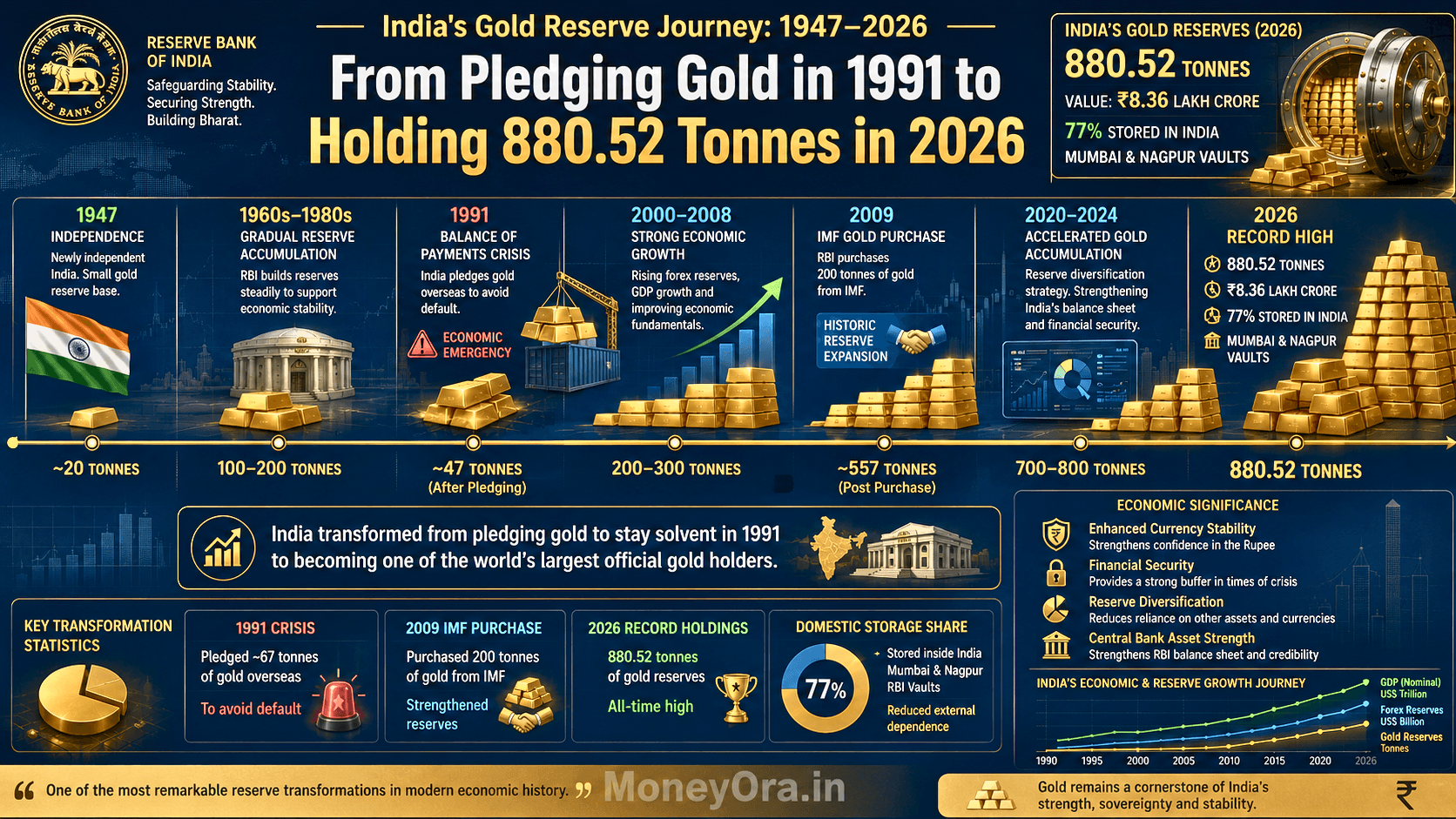
In 1991, India secretly airlifted 67 tonnes of gold to London. The country was broke. Forex reserves were down to $1.1 billion — barely two weeks of import cover — and gold was the only thing that could keep the lights on. It was one of the most humiliating moments in independent India’s economic history. “another government-backed asset class worth understanding: state bonds”
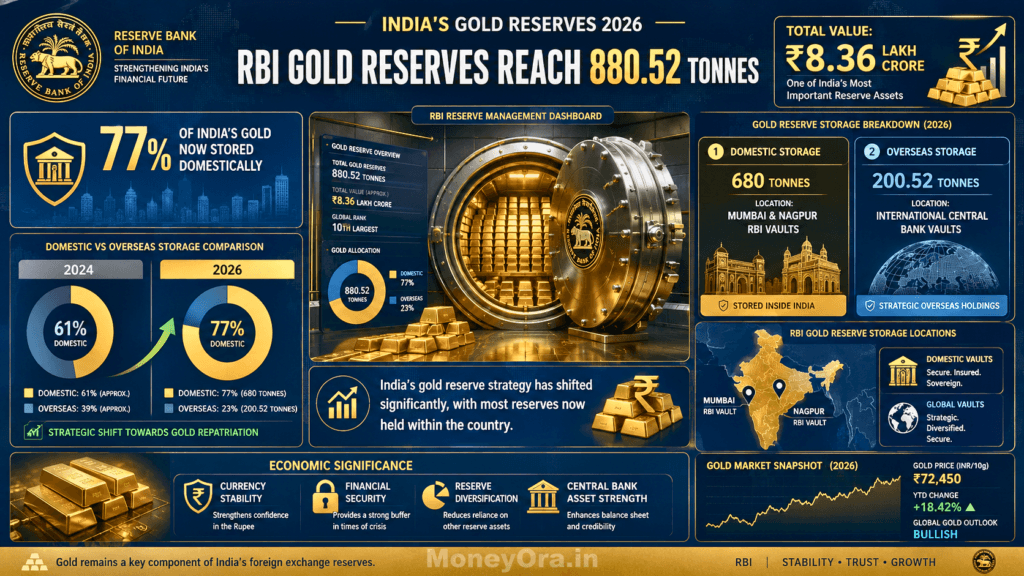
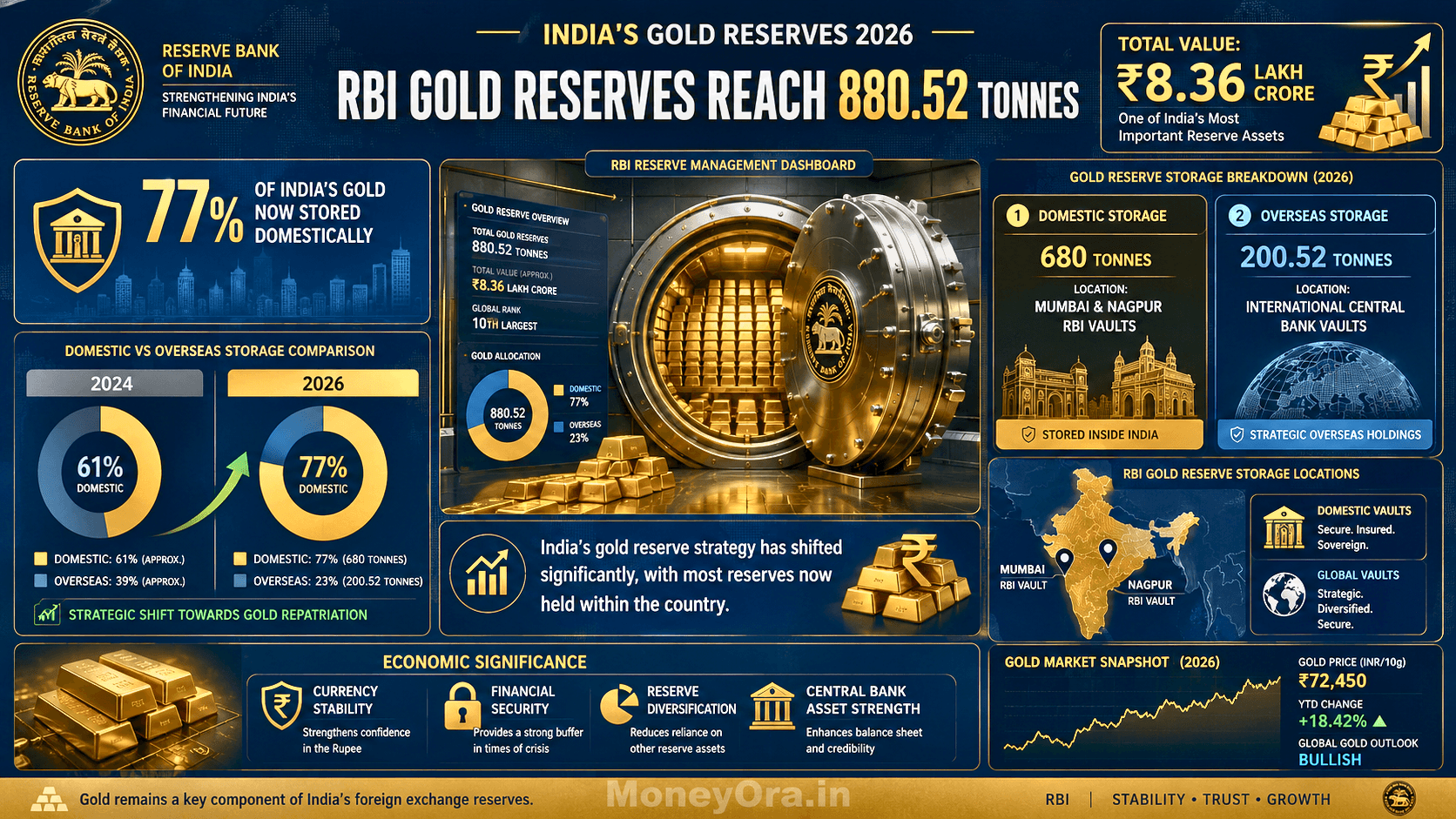
Thirty-five years later, the RBI is doing the reverse. India is flying gold home. “check today’s gold price before deciding to buy” As of March 2026, gold reserve in India stands at 880.52 metric tonnes — the highest in the country’s history — and 680 of those tonnes now sit in vaults in Mumbai and Nagpur, not London.
That reversal is the story. And it tells you something interesting about where India is economically, what the RBI thinks is coming geopolitically, and what it might mean for anyone tracking India’s financial strength from the outside.
This article covers the full picture: how much gold India holds today, how it got there, where it is stored, why the RBI is buying and bringing it home, how India compares globally, and what all of this means practically — for the economy, for investors, and for anyone curious about how central banks actually manage national wealth.
Gold Reserve in India — Quick Facts (March 2026)
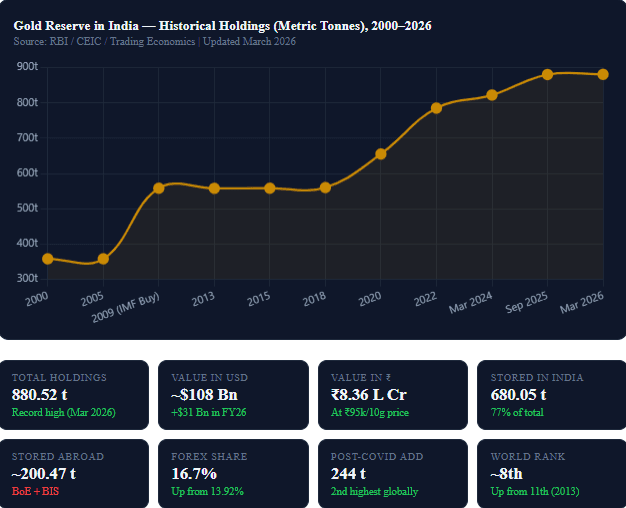
- Total Holdings:880.52 metric tonnes (record high)
- Value:~₹8.36 lakh crore (~$108 billion)
- Stored in India:680.05 tonnes (77% of total)
- Stored abroad:~200 tonnes (Bank of England + BIS)
- Gold share in forex reserves:16.7% (up from 13.92% six months earlier)
- World rank:Approximately 8th (up from 11th in 2013)
- Post-Covid additions (2020–2024):244 tonnes — 2nd highest globally
- All-time gold value high:$126.9 billion (January 2026)
What Is a gold reserve in india? How Central Banks Actually Use It
Quick Definition: A gold reserve in india is the amount of gold held by a country’s central bank as part of its foreign exchange reserves. Central banks use gold as a store of value, a hedge against currency risk, and a financial buffer during economic crises. Unlike paper currencies, gold cannot be printed, devalued by another country’s policy, or frozen under international sanctions.
Gold is unusual in a way that makes it useful to central banks. It has no issuer. The US can devalue the dollar. The ECB can print euros. But nobody controls gold. That independence is exactly why countries hold it.
What Central Banks Do with Their gold reserve in india
Central banks do not just lock gold in a vault and forget about it. There are active uses:
- Collateral for emergency loans — as India used it in 1991 to borrow from the IMF
- Currency stabilisation signal — a large gold reserve in india increases international confidence in a currency
- Inflation hedge — gold tends to rise when currencies lose purchasing power
- Geopolitical insurance — unlike dollar accounts, gold in domestic vaults cannot be seized or frozen
- Gold leasing — some central banks earn income by lending gold to commercial banks for a fee
- Portfolio diversification — reducing reliance on any single reserve currency, especially the US dollar
Why Gold Is Different from Other Reserve Assets
India’s forex reserves also include US dollars, euros, yen, and Special Drawing Rights (SDRs). Each of these carries a specific risk. Dollar assets depend on US policy. Eurozone bonds carry political risk. SDRs are an IMF construct tied to global institutions.
Gold carries none of those risks. It is a physical asset that has retained purchasing power across centuries. The World Gold Council’s data shows that central banks globally have been net buyers of gold every year since 2010 — a trend that accelerated sharply after Russia’s reserves were frozen in 2022.
India’s gold reserve in india 2026: The Numbers That Tell the Story

The Value Surge: From $77 Billion to $108 Billion in One Year
India’s gold reserve in india were worth $77 billion at the end of March 2025. By January 2026, the same holdings were worth $126.9 billion. That is a $49 billion gain in less than a year — and most of it came not from buying more gold, but from the global gold price rally of approximately 65% through 2025.
The price move matters. In October 2025, gold crossed $3,000 per ounce for the first time, then pushed past $4,000 per ounce by early 2026. At $4,251 per ounce (one of the peaks recorded), India’s 880-tonne holding was worth north of $120 billion. When you track gold price movements day to day, use our live gold rates page for 22K and 24K prices per gram.
What ₹8.36 Lakh Crore Actually Looks Like
To put ₹8.36 lakh crore in context: it is roughly 2.5 times India’s annual defence budget. It is more than the combined market capitalisation of TCS and Infosys. The gold reserve in India is not a rounding error on the balance sheet — it is a genuinely significant chunk of the country’s national wealth.
Where Is India’s Gold Stored? The Domestic vs Overseas Split

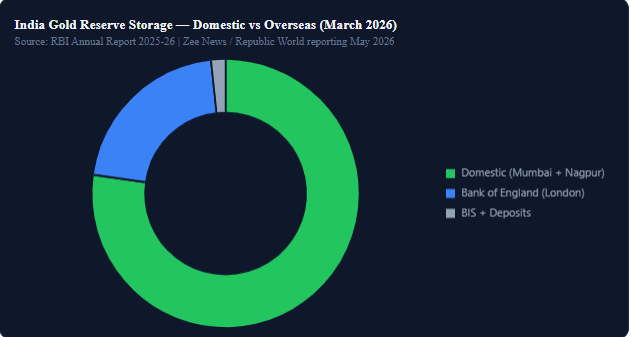
India Gold Reserve Storage Breakdown — March 2026| Location | Quantity (Tonnes) | Share (%) | Change vs Mar 2024 |
|---|
| Domestic (Mumbai + Nagpur) | 680.05 | 77.2% | Up from <50% in Mar 2024 |
| Bank of England (London) | ~185 | ~21% | Down significantly |
| BIS (Bank for International Settlements) | ~15 | ~1.7% | Stable |
| Gold deposits | ~0.47 | ~0.05% | Minimal |
| TOTAL | 880.52 | 100% | Record high |
The RBI’s Mumbai and Nagpur Vaults
India’s domestically stored gold sits in high-security vaults operated by the Reserve Bank of India. The two main facilities are in Mumbai and Nagpur. The specifics — exact locations, security arrangements, logistics — are classified. What the RBI has confirmed is that the shift from offshore to onshore storage accelerated dramatically in FY24 (100 tonnes repatriated), FY25 (64 tonnes), and FY26 (104+ tonnes). Since March 2023, the RBI has repatriated 274 tonnes in total.
The Bank of England Connection
The Bank of England is the world’s largest custodian of central bank gold, holding reserves for dozens of countries in vaults below its London headquarters. India has used BoE storage for decades — it is secure, internationally recognised, and liquid (easy to sell internationally if needed). But the 2022 lesson from Russia changed the calculus for many central banks, including India’s. When Western powers froze approximately half of Russia’s $650 billion in reserves, every central bank that kept assets in London or New York received a very clear message about geopolitical risk.
Gold Reserve in India: A History from 1947 to 2026
India’s relationship with gold as a national reserve — not household jewellery — has gone through three very distinct phases.
Phase 1: Post-Independence to 1991 — Modest Holdings, Growing Pressures
After independence in 1947, India inherited modest reserves from the colonial era. Gold was held primarily in the physical sense — the RBI managed some gold, but the priority was building dollar reserves to pay for imports as the new economy developed. The licence raj era (1950s–1980s) suppressed gold imports, but household gold continued to grow through smuggling and domestic production.
By the late 1980s, India’s foreign exchange position was deteriorating. Rising import bills for oil (after the 1973 and 1979 oil shocks), growing defence spending, and weak export earnings created a structural gap that dollars alone could not fill. The gold reserve at this point was modest — roughly 330–380 tonnes — but it was about to become the most important asset India had.
Phase 2: 1991 Crisis to 2009 — Stability and Gradual Accumulation
After repaying the pledged gold (more on this in the next section), India maintained relatively stable gold reserves through the 1990s and early 2000s. The landmark event of this phase was the 2009 purchase of 200 tonnes from the IMF at $1,045 per ounce — a single transaction that jumped India’s holdings by nearly 50%.
Phase 3: 2010 to Today — Systematic Accumulation and Repatriation
After 2010, global central banks turned net buyers. India joined this trend gradually at first, then accelerated. The post-Covid period (2020–2024) saw India add 244 tonnes — the second-highest addition globally after China. In 2022 alone, India added approximately 200 tonnes before slowing purchases. The pace of buying became more measured in 2025, but repatriation continued at full speed.
- 1956
CEIC records begin. Gold at ₹175 million.
- 1991
67 tonnes pledged to Bank of England during BoP crisis. Emergency $2.2 billion IMF loan secured.
- 1992
Pledged gold fully redeemed. P.V. Narasimha Rao government initiates economic reforms.
- 2009
200 tonnes purchased from IMF at $1,045/oz. Total holdings jump to ~558 tonnes.
- 2020–22
RBI begins aggressive buying. 244 tonnes added over 5 years — 2nd highest post-Covid addition globally.
- 2024
100 tonnes repatriated from Bank of England to India — largest single airlift since 1991. Required special aircraft, months of planning.
- Oct 2025
Gold reserve value crosses $100 billion for first time. Domestic holdings hit 510.5 tonnes. 102 more tonnes repatriated.
- Mar 2026
880.52 tonnes total. 680 tonnes domestic (77%). Gold share 16.7% of forex reserves. RBI Annual Report confirms record.
Gold Reserve in India: Decade-by-Decade Data
India’s Gold Reserve Holdings — Historical Data (Selected Years)| Year | Gold Holdings (Tonnes) | Gold Value ($ Billion, approx.) | Key Event |
|---|
| 1990 | ~330 | ~$3.7 | Pre-crisis, reserves under pressure |
| 1991 | ~330 (67t pledged) | ~$3.5 | 67t pledged to BoE; emergency IMF loan |
| 2000 | ~358 | ~$3.2 | Post-reforms; gradual recovery |
| 2005 | ~358 | ~$5.0 | Stable; gold price rising |
| 2009 | ~558 | ~$17.0 | Bought 200t from IMF at $1,045/oz |
| 2013 | ~557.7 | ~$19 | India ranked 11th globally |
| 2018 | ~560 | ~$22 | Slow but steady accumulation |
| 2020 | ~655 | ~$37 | Post-Covid buying begins; gold price surge |
| 2022 | ~785 | ~$45 | Rapid buying; 200t added vs 2020 |
| 2024 | ~822 | ~$77 | 100t repatriated from BoE; FY25 54t added |
| Mar 2025 | 879 | ~$77 | 512t domestic; 348.6t abroad |
| Mar 2026 | 880.52 | ~$108 | 680t domestic (77%); forex share 16.7% |
The 1991 Crisis: When India Pledged Its Gold to Stay Solvent
This is the part of the story that every Indian finance student knows, but most people do not know the full detail of what actually happened.
By the summer of 1991, India’s foreign exchange reserves had fallen to $1.1 billion. At the time, India was spending about $6 billion a month on imports. That means the country had roughly two weeks of import cover left. A month earlier, the rating agency Moody’s had cut India’s credit rating to junk. Foreign banks were refusing to roll over short-term loans. India could not pay its bills.
The Airlift: 67 Tonnes to London
The Chandra Shekhar government — working with RBI Governor S. Venkitaramanan — authorised a secret operation. Sixty-seven tonnes of gold from RBI’s vaults were loaded onto specially chartered Air India flights and flown to the Bank of England in London, where the gold was pledged as collateral against a $405 million loan. Another 47 tonnes were sent to the Union Bank of Switzerland (UBS) against an additional loan of about $200 million.
Total secured: approximately $2.2 billion. Enough to survive and then access the IMF’s emergency facility for more.
“The operation was carried out in complete secrecy. Even the flight crew did not know what they were transporting. The boxes were marked as ‘government cargo.'”
— Contemporary accounts from RBI officials, reported by Business Standard and Economic Times
The Political Backlash
When the news broke, Parliament erupted. Opposition leaders called it a national humiliation. Former PM V.P. Singh reportedly said India had “mortgaged its jewels.” The BJP’s senior leaders used it extensively in the election campaign that followed.
But the pledge was repaid within a year. The new P.V. Narasimha Rao government, with Finance Minister Manmohan Singh, launched a sweeping economic liberalisation — devaluing the rupee, removing import licences, opening up foreign investment. India never looked back.
Why 1991 Still Matters in 2026
The 1991 crisis is the reason RBI governors quote when explaining the logic of holding large reserves and why the gold reserve in India should be stored domestically. The institutional memory is clear: if you store your most critical assets abroad, you cannot be certain they will be accessible in a crisis. Germany learned the same lesson and repatriated 674 tonnes from the New York Fed between 2013 and 2017. India is now doing its own version of the same repatriation.
Why the RBI Is Bringing Gold Home from London
The repatriation programme is the most dramatic shift in India’s gold management strategy in decades. Between FY24 and FY26, the RBI moved over 266 tonnes of gold from London to India — roughly 30% of total holdings — using specialised aircraft, classified logistics, and security protocols that remain undisclosed.
Four Reasons for the Repatriation
1. The Russia Lesson: Geopolitical Risk
When the US, EU, and UK froze approximately $300 billion of Russia’s foreign exchange reserves in 2022 — a response to the Ukraine invasion — it was a watershed moment for every central bank on earth. India’s government and RBI noted that a large portion of Russia’s frozen assets were held in exactly the same type of offshore accounts and custody arrangements that India uses.
India is not in conflict with the West. But it also has an explicitly multi-aligned foreign policy. It abstained on the UN vote condemning Russia’s invasion. It buys Russian oil. The lesson was clear: do not store assets you cannot afford to lose in jurisdictions where political relationships can change.
2. Cost Savings
Storing gold at the Bank of England is not free. BoE charges annual custody fees — estimated at several million pounds per year for a holding of India’s size. By moving gold to domestic vaults (already owned and operated by the RBI), India eliminates this ongoing cost entirely. The savings compound over time as the holding grows.
3. Portfolio Rebalancing
As India’s gold holdings grew from 550 tonnes to 880 tonnes over fifteen years, the practical need to diversify storage locations grew proportionally. The RBI’s mandate includes managing reserves prudently, which includes avoiding single-point custody risk. Spreading holdings between domestic vaults and international custodians — while tilting more toward domestic — is standard reserve management practice.
4. Symbolic and Strategic Signal
There is an element of strategic communication in the repatriation. India moving its gold home signals financial confidence and economic maturity. In 1991, India sent gold abroad because it was desperate. In 2024–2026, India is sending gold back because it does not need to keep it abroad. That reversal is not subtle — it is meant to be noticed.
The Logistics of Moving 100+ Tonnes of Gold
Moving 100 tonnes of gold is not a normal logistics exercise. Gold is dense — 100 tonnes fits in roughly 10–12 large pallets, but each pallet weighs 10 tonnes. You need specialised aircraft rated for that weight, reinforced flooring, and exact temperature and humidity control to prevent vault corrosion during transit. Security arrangements involve multiple agencies, classified flight plans, and armed escorts at both ends. The Bank of England transfer in May 2024 reportedly required months of planning. Details remain classified.
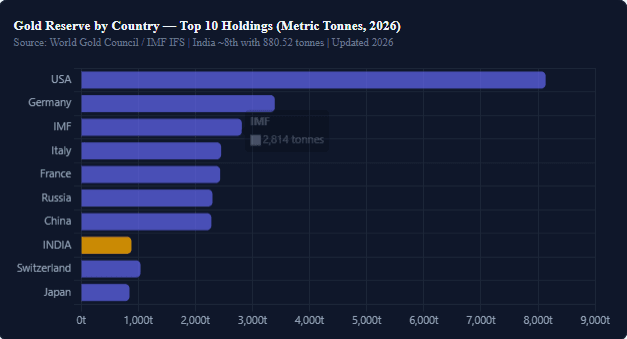
India’s Gold Reserve World Ranking 2026

Top 10 Countries by Gold Reserve — World Ranking 2026| Rank | Country / Institution | Gold Holdings (Tonnes) | % of Forex Reserves | Key Note |
|---|
| 1 | United States | 8,133 | ~73% | Unchanged for decades; Fort Knox + West Point |
| 2 | Germany | 3,391 | ~75% | Repatriated 674t from NY Fed 2013–2017 |
| 3 | IMF | 2,814 | N/A | International institution; sold 200t to India 2009 |
| 4 | Italy | 2,451 | ~68% | Stable; domestic storage controversy ongoing |
| 5 | France | 2,435 | ~69% | Most stored at Banque de France, Paris |
| 6 | Russia | ~2,300 | ~30% | Post-sanctions, largely domestic |
| 7 | China | ~2,280 | ~5% | Likely under-reported; bought 336t post-Covid |
| 8–9 | INDIA | 880.52 | 16.7% | Record; 77% domestic; rising fast |
| 9–10 | Switzerland | ~1,040 | ~7% | Per capita highest; sold 60% in 1990s, regrets it |
| 10–11 | Japan | 846 | ~4% | Low share despite large total reserves |
India’s position in the world ranking tells its own story. In 2013, India held 557 tonnes and ranked 11th. By March 2026, India holds 880 tonnes and ranks approximately 8th. In 13 years, India has added 323 tonnes and overtaken Japan and potentially Switzerland depending on data timing.
India vs China: The Emerging Market Reserve Race
China and India are the two largest emerging market holders of gold. China officially holds approximately 2,280 tonnes — but many analysts at the World Gold Council and IMF suspect China’s true holdings are significantly higher, as China does not always report purchases promptly. India is transparent — it reports RBI gold data monthly to the IMF via its IFS (International Financial Statistics) filing.
What is interesting is the share of gold in total reserves. India’s gold is 16.7% of total reserves — much higher than China’s 5%. India is structurally more committed to gold as a reserve component than China appears to be.
RBI’s Gold Buying Strategy: Why Keep Buying?
The RBI bought 54 tonnes in FY25, then slowed to under 1 tonne in the first half of FY26. That is not a reversal — it is tactical. The primary driver of the $31 billion increase in gold reserve value in FY26 was not fresh buying; it was the 65% appreciation in gold prices globally.
RBI’s Three-Part Gold Strategy
1. Diversify Away from the Dollar
According to the RBI Annual Report 2025-26, India’s forex reserves are primarily in US dollar assets — Treasuries, dollar deposits, dollar-denominated securities. This creates concentration risk. Gold is the natural diversifier because it has zero correlation with US interest rate policy.
2. Hedge Against Rupee Depreciation
The rupee has depreciated against the dollar at an average rate of about 3–4% per year over the past two decades. Gold in rupee terms benefits from this depreciation — even if global gold prices are flat, the same gold is worth more rupees when the rupee weakens. This makes gold an automatic hedge against the structural trend in the currency.
3. Maintain Import Cover Buffer
Gold is instantly liquid internationally. If India faces a crisis like 1991 again, the gold reserve can be pledged or sold to generate foreign currency within days. As of December 2025, India’s total reserves (including gold) provided 10.8 months of import cover — comfortable by international standards, though slightly below the 12+ months seen at peak.
“Central banks globally have been net buyers of gold since 2010, viewing it as a stable store of value amid shifting economic conditions. The pace continues for India even as some others have slowed.”— Business Standard, March 2025, citing World Gold Council data
Why Did RBI Slow Down Purchases in FY26?
Simple: gold got expensive. At $3,000–$4,000 per ounce, buying large quantities strains the RBI’s cost framework. The valuation gains from existing holdings were enormous — there was less need to add new tonnes when the existing 880 tonnes were appreciating at $1,000+ per ounce. The RBI added only 0.6 tonnes in the first half of FY26 (April–September 2025), compared to 50 tonnes in the same period of the previous year. Market forecasts suggest the RBI plans additional 50-tonne purchases per fiscal year through 2026 once prices stabilise.
What the Gold Reserve in India Means for the Economy
Gold reserves are not just a financial safety net. They have direct macroeconomic effects that touch every Indian indirectly.
1. Strengthens Sovereign Credit Rating
International rating agencies (Moody’s, S&P, Fitch) factor the composition and size of foreign exchange reserves into sovereign credit ratings. A large gold reserve, especially one that is growing and is increasingly stored domestically, is a positive signal. India’s rating upgrade potential is linked partly to the quality of its reserve management.
2. Provides RBI with Rupee Defence Capability
When the RBI wants to defend the rupee against sharp depreciation, it sells dollars from reserves into the market. But this depletes dollar reserves. Gold provides an additional buffer — it can be sold in international markets to raise dollars without depleting the core forex reserve pool. The RBI’s FY26 annual report noted that gains from forex transactions jumped 52% YoY to ₹1.69 trillion — a sign of heavy currency intervention activity that drew on multiple reserve categories.
3. Supports Import Cover
India’s 10.8 months of import cover as of December 2025 includes the gold valuation. Gold’s appreciation contributed to maintaining the import cover ratio even as the dollar value of other reserves fluctuated. Without gold’s 65% price appreciation, the import cover figure would be noticeably lower.
4. Signal Effect on Capital Flows
Foreign investors — both FII equity investors and FDI investors — monitor India’s reserve position as part of their macro due diligence. A country that holds 880 tonnes of gold and is growing its domestic storage is seen as financially serious. This contributes to India’s ability to attract long-term capital flows, which in turn supports the equity market. For investors tracking FII flows alongside gold, our daily share market today analysis covers FII/DII activity in real time.
Household Gold vs RBI Gold: India’s Full Gold Story
The RBI’s 880 tonnes is only the official reserve. India’s full gold story is much larger.
Indian Households Hold Approximately 25,000 Tonnes
India is the world’s largest private consumer of gold. Estimates vary — the World Gold Council has put household gold holdings at approximately 25,000 to 40,000 tonnes, accumulated across generations in the form of jewellery, bars, coins, and temple gold. At today’s prices, this household gold is worth somewhere between ₹230 lakh crore and ₹370 lakh crore — dwarfing the RBI’s reserve entirely.
India’s Gold — Official vs Household Holdings| Category | Quantity (Tonnes) | Value (₹ Lakh Crore) | Who Holds It |
|---|
| RBI Official Reserve | 880.52 | ~₹8.36 | Reserve Bank of India |
| Household Gold (est.) | ~25,000–40,000 | ~₹230–₹370 | Indian families, temples, institutions |
| Government / Temple Trust Gold | ~5,000 (est.) | ~₹47 | Tirupati, Padmanabhaswamy, etc. |
The Mobilisation Problem
The government has tried several schemes to mobilise this idle household gold — Gold Monetisation Scheme, Gold Bond Scheme — with limited success. Indians regard their gold as personal wealth and emergency collateral, not as something to hand to a bank for modest interest. The cultural relationship with physical gold runs too deep for policy instruments to easily change it.
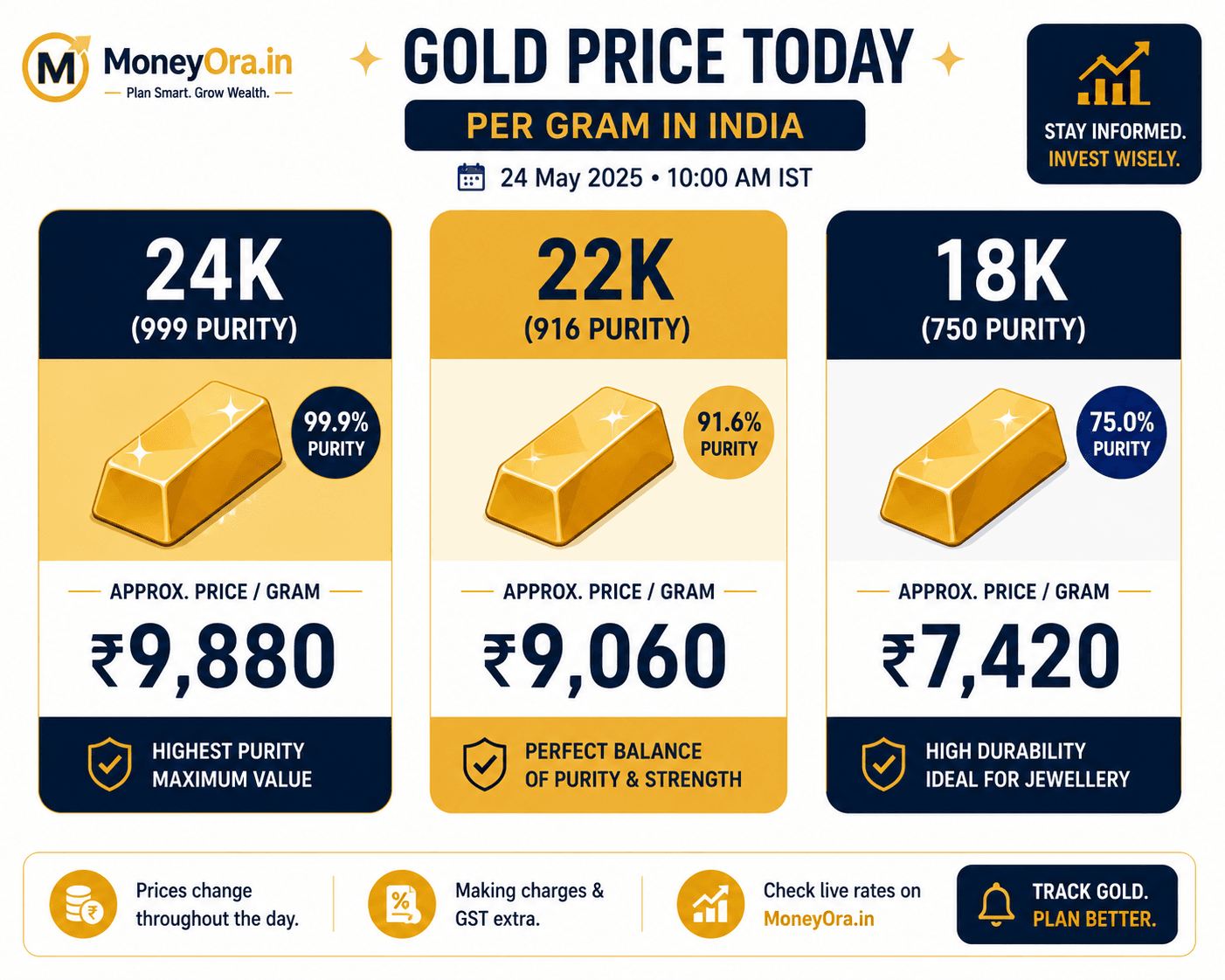
For investors interested in how gold fits into their own financial plan — whether to buy jewellery, digital gold, SGBs, or gold ETFs — the choice matters. Track today’s gold rate using our live gold rate page, which shows 22K and 24K prices per gram for major cities daily.
How to Invest in Gold in India: Your Practical Options in 2026
The gold reserve in India context matters for personal investment in one direct way: the RBI’s buying signals that institutional money continues to view gold as a core asset. That is a macro backdrop worth understanding when you decide how much gold belongs in your portfolio.
Four Ways to Invest in Gold in India
Gold Investment Options in India — 2026 Comparison| Format | Min. Investment | Cost/Charges | Interest | Tax at Maturity | Best For |
|---|
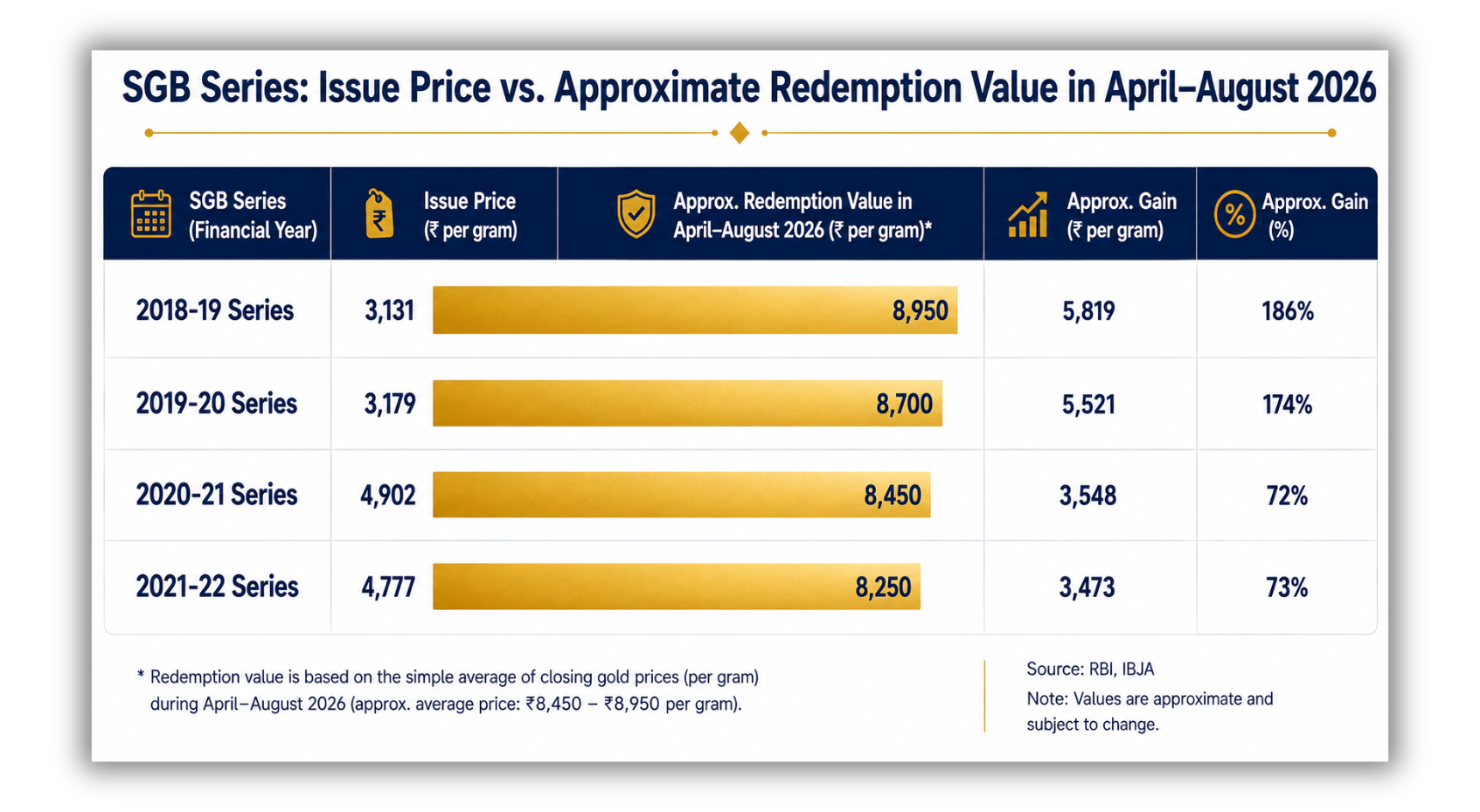
| Sovereign Gold Bond (SGB) | 1 gram (~₹9,500) | Nil (₹50 discount online) | 2.5% p.a. | Nil if held to 8 years | Long-term (5–8 years) |
| Gold ETF | ~₹500 (0.5g unit) | 0.35–0.50% p.a. expense ratio | None | 12.5% LTCG (24+ months) | Short to medium term |
| Digital Gold | ₹1 | ~3% spread on buy | None | 12.5% LTCG | Micro-investing |
| Physical Gold (Jewellery) | Gram minimum | 8–25% making charges + 3% GST | None | 12.5% LTCG | Cultural use, heritage |
| Physical Gold (Coins/Bars) | ~1g coin | 3% GST + small premium | None | 12.5% LTCG | Pure investment storage |
For most investors with a 5+ year horizon, Sovereign Gold Bonds are the most efficient option — you earn 2.5% annually while holding gold price exposure, and capital gains at maturity (8 years) are completely tax-free for individuals. Gold ETFs are better for shorter horizons or when you need liquidity. Physical gold remains important culturally but carries the highest transaction cost.
Model what your gold investment grows to over time using our lumpsum calculator. Compare gold’s historical CAGR (approximately 12–13% in rupee terms over 20 years) versus other assets using our CAGR calculator. If you are doing monthly systematic buying of digital gold, our SIP calculator shows how the corpus builds.
Gold vs Other Investment Options
Historically, gold in India has returned approximately 12–13% CAGR over 20 years in rupee terms (2004–2024). Nifty 50 has returned 14–15% over the same period. Fixed deposits have returned 6–8%. Gold’s return lies between FD rates and equity — with lower volatility than equity but more uncertainty than FD. Compare using our FD calculator and stock return calculator.
Tax Note (Post Budget 2024): Gold sold after 24+ months is taxed at 12.5% LTCG without indexation. SGBs held to 8-year maturity: zero capital gains tax. Interest on SGBs: taxable at slab rate. Always confirm with a CA before selling large gold holdings.
MoneyOra Calculators for Gold Investors and Economy Watchers
Gold Investment Tools
- Lumpsum Calculator — Model a one-time gold investment at 12–15% CAGR over 5–10 years
- SIP Calculator — Monthly systematic gold buying through digital gold or gold fund
- CAGR Calculator — Calculate gold’s actual return between any two dates
- FD Calculator — Compare guaranteed FD returns against gold’s historical CAGR
- SWP Calculator — Plan systematic withdrawals from a gold fund or gold ETF position
- RD Calculator — Safe recurring deposits as portfolio anchor alongside gold holdings
Long-Term Savings & Retirement
- PPF Calculator — Tax-free savings as the risk-free core of your financial plan, alongside gold
- NPS Calculator — National Pension System corpus planning; NPS equity+debt balance
- EPF Calculator — Provident fund as the foundation alongside gold as a hedge
Stock Market Tools
Loan & Banking Tools
How much gold reserve does India have in 2026?
India holds 880.52 metric tonnes of gold as of March 2026, per RBI data. At current prices of approximately ₹95,000 per 10 grams, this is worth about ₹8.36 lakh crore ($108 billion). Gold now makes up 16.7% of India’s total foreign exchange reserves of $681.4 billion.gold reserve in india
What is India’s rank in global gold reserves?
India ranks approximately 8th globally with 880.52 tonnes, up from 11th in 2013. The top holders are: USA (8,133t), Germany (3,391t), IMF (2,814t), Italy (2,451t), France (2,435t), Russia (~2,300t), China (~2,280t), then India. See the full ranking on the World Gold Council’s country-by-country data.
gold reserve in india
Where is the gold reserve in India stored?
As of March 2026: 680.05 tonnes (77%) are stored in RBI vaults inside India, primarily in Mumbai and Nagpur. The remaining ~200 tonnes are held at the Bank of England in London and at the Bank for International Settlements (BIS). Two years earlier, less than half was stored domestically — the repatriation has been rapid and deliberate.gold reserve in india
Why is India bringing gold home from the Bank of England?
Four reasons: geopolitical risk reduction (the Russia reserves freezing in 2022 showed offshore assets can be seized), cost savings on Bank of England custody fees, practical storage diversification as holdings grew, and a broader de-risking strategy. Since March 2023, India has repatriated 274 tonnes. Read the full repatriation story in the dedicated section above.gold reserve in india
What happened to India’s gold in 1991?
India faced a balance of payments crisis in 1991. Foreign reserves fell to $1.1 billion — barely two weeks of import cover. To secure emergency IMF financing, India secretly airlifted 67 tonnes of gold to the Bank of England and 47 tonnes to UBS as collateral. The gold was redeemed within a year after the Narasimha Rao government initiated economic liberalisation.gold reserve in india
When did India buy 200 tonnes of gold from the IMF?
India bought 200 tonnes from the IMF in November 2009 at $1,045 per ounce — a total of approximately $6.7 billion. It remains India’s largest single gold purchase. That same gold, at today’s prices above $3,000 per ounce, is worth approximately $19 billion — nearly 3x the purchase price.gold reserve in india
Why does the RBI buy gold?
The RBI buys gold to: (1) diversify away from US dollar concentration in reserves; (2) hedge against rupee depreciation — gold in rupee terms benefits from a weakening rupee; (3) provide geopolitical insurance — gold cannot be frozen; (4) maintain import cover buffer; (5) signal financial confidence internationally. India has added 244 tonnes post-Covid (2020–2024), the second-highest globally after China.gold reserve in india
What is the value of India’s gold reserve in rupees?
At the gold price of approximately ₹95,000 per 10 grams (mid-2026), India’s 880.52 tonnes is worth roughly ₹8.36 lakh crore. In dollar terms, the value peaked at $126.9 billion in January 2026 (CEIC data), primarily driven by the global gold price rally rather than fresh purchases.gold reserve in india
What is the gold share in India’s forex reserves?
Gold’s share in India’s total forex reserves rose to 16.7% by March 2026, up from 13.92% in September 2025. India’s total forex reserves stood at approximately $681.4 billion as of May 22, 2026. The RBI’s FY26 annual report highlighted this shift as a deliberate strategy of reserve diversification.gold reserve in india
How should I invest in gold in India?
For investment purposes: Sovereign Gold Bonds (SGBs) are the most efficient for 5–8 year horizons — 2.5% annual interest plus price appreciation, with zero capital gains tax at maturity. Gold ETFs are better for shorter horizons or when liquidity matters. Physical gold is essential culturally but carries 8–25% making charges and 3% GST. Use MoneyOra’s lumpsum calculator and CAGR calculator to model your gold investment returns.gold reserve in india
Conclusion: What the Gold Reserve in India Story Actually Tells Us
In 1991, gold reserve in india airlifted gold to London to pay its bills. In 2024, gold reserve in india airlifted gold from London to bring it home. gold reserve in india
The arc of those 33 years is one of the more striking economic reversals in modern history. gold reserve in india
The gold reserve in India at 880.52 tonnes is not just a large number. gold reserve in india
It is the RBI’s answer to three uncomfortable questions:
What happens if geopolitical relationships with Western countries deteriorate?
What happens if the dollar weakens and dollar-denominated assets lose value?
What happens if India faces another crisis and needs collateral fast?
The answer, apparently, is: 880 tonnes of gold, 77% of it stored in gold reserve in india,
worth ₹8.36 lakh crore, accessible within days if needed. gold reserve in india
For individual investors, gold reserve in india
the RBI’s continued commitment to gold reserve in india as a reserve asset is worth noting. gold reserve in india
It is the largest institutional validation you will find for gold reserve in india as a long-term store of value in the Indian context. gold reserve in india
That does not mean you should put everything in gold reserve in india.
But an allocation of 10–15% of a financial portfolio in gold reserve in india
through SGBs, ETFs, or even physical coins gold reserve in india
has sensible historical and macroeconomic backing. gold reserve in india
Track gold’s daily price movements.gold reserve in india
Model your returns. And understand that when you hold ,gold reserve in india
you are holding the same asset that both thegold reserve in gold reserve in india
RBI and 25,000 tonnes of Indian household wealth have collectively decided is worth keeping.gold reserve in india
Start Tracking Gold & Planning Your Investment on MoneyOra
- Today Gold Rate — Live 22K & 24K prices per gram, updated daily
- Lumpsum Calculator — Model a one-time gold investment at 12% CAGR over 10 years
- CAGR Calculator — Calculate gold’s actual return between your buy date and today
- SIP Calculator — Monthly gold buying through systematic investment plans
- FD Calculator — Compare fixed deposit returns with gold’s CAGR for your portfolio decision
Disclaimer: This article is for informational and educational purposes only. All data is sourced from RBI, CEIC, World Gold Council, Trading Economics, and published news reporting as of May–June 2026. This does not constitute investment advice. Please consult a SEBI-registered investment advisor before making gold investment decisions.




Pingback: Defence Index 2026: Top Investment Opportunity or Overvalued Risk for Investors?
Pingback: Share Market Today: Will Nifty & Sensex Continue Their Bull Run This Week 26? - MoneyOra
Pingback: LIC Q4 Results FY2026: Profit Up 23% to ₹57,419 Crore — Full Breakdown
Pingback: SGB Premature Redemption Calculator: Should You Exit Now?26