

Transmission of Shares: Step-by-Step Process 2026
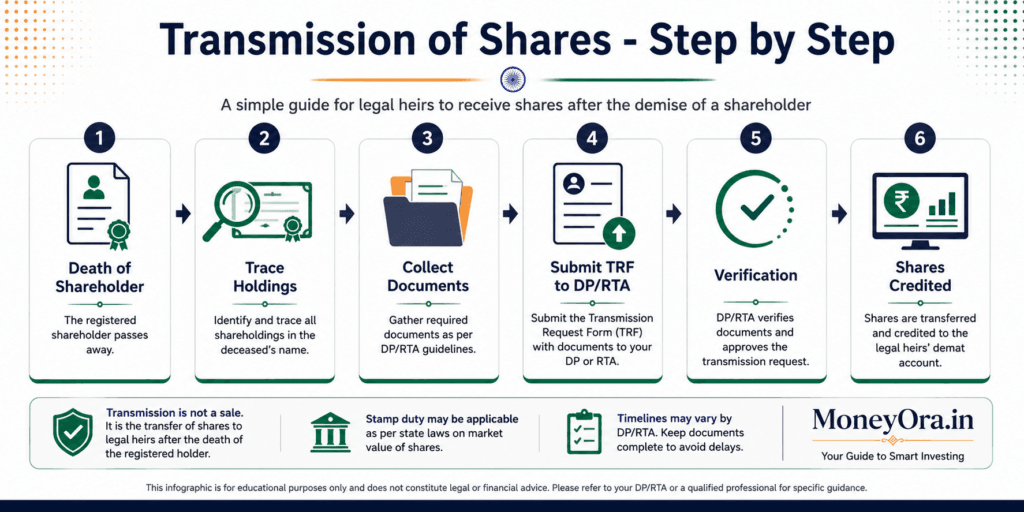
Transmission of Shares: How to Claim Shares After a Family Member Dies (2026 Guide)
Dealing with a parent’s or spouse’s death is hard enough without discovering that their stock market investments are stuck in bureaucratic limbo. A lot of families in India find out sometimes years later that the deceased held shares they never knew about. Those shares are not gone. But if you don’t follow the right process, they can end up locked in the IEPF (Investor Education and Protection Fund) for years.
This guide covers the transmission of shares process in India from start to finish including the new SEBI rules from 2026 that have made things significantly easier. Whether your family member had a demat account, old physical share certificates, or no nominee registered at all, there is a path forward.
For broader context on how share markets work in India, check MoneyOra’s share market calculator and stock return calculator.
What Is Transmission of Shares?
Transmission of shares is the legal process of transferring ownership of shares from a deceased or legally incapacitated shareholder to their legal heirs, nominees, or surviving joint holders. It is governed by Section 56 of the Companies Act, 2013 and SEBI regulations. Unlike a regular sale or transfer, transmission happens by operation of law – not by choice.
The key point most people miss: the shares do not automatically go to the family. Someone has to actively initiate the process with the Depository Participant (DP) or the company’s Registrar and Transfer Agent (RTA). If nobody does this, the shares just sit there. And if dividends go unclaimed for 7 consecutive years, both the dividends and the shares get transferred to IEPF.
India’s two main depositories – NSDL and CDSL – hold all demat shares. The registered DP (think Zerodha, Groww, HDFC Securities, ICICI Direct) acts as the point of contact for transmission.
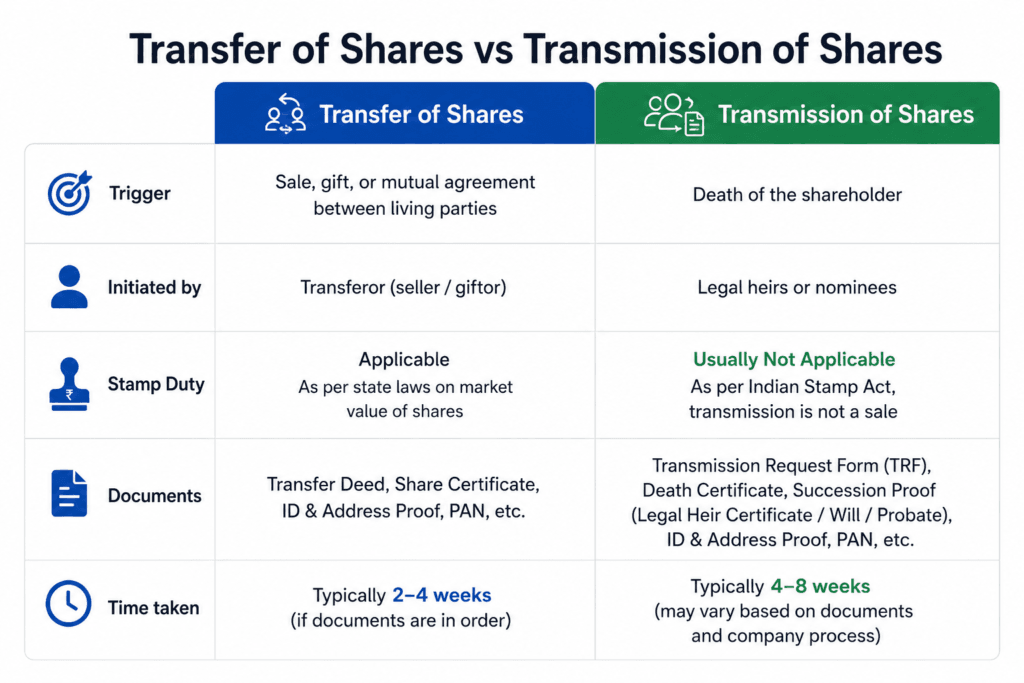
Transmission vs Transfer: The Key Difference
Most people confuse these two. Here’s a clean breakdown:
| Feature | Transmission of Shares | Transfer of Shares |
|---|---|---|
| Trigger | Death, insolvency, legal incapacity | Voluntary sale or gift |
| Initiated by | Legal heir, nominee, joint holder | Buyer and seller together |
| Stamp duty | Generally waived | Applicable |
| Legal paperwork | Higher – death certificate, succession docs | Share transfer deed |
| Governed by | Companies Act 2013 + SEBI | Companies Act 2013 |
| Time taken | 15-30 days (demat), longer for physical | Usually 7-15 days |
The waiver on stamp duty is a meaningful benefit. For large portfolios, this can save families thousands of rupees.
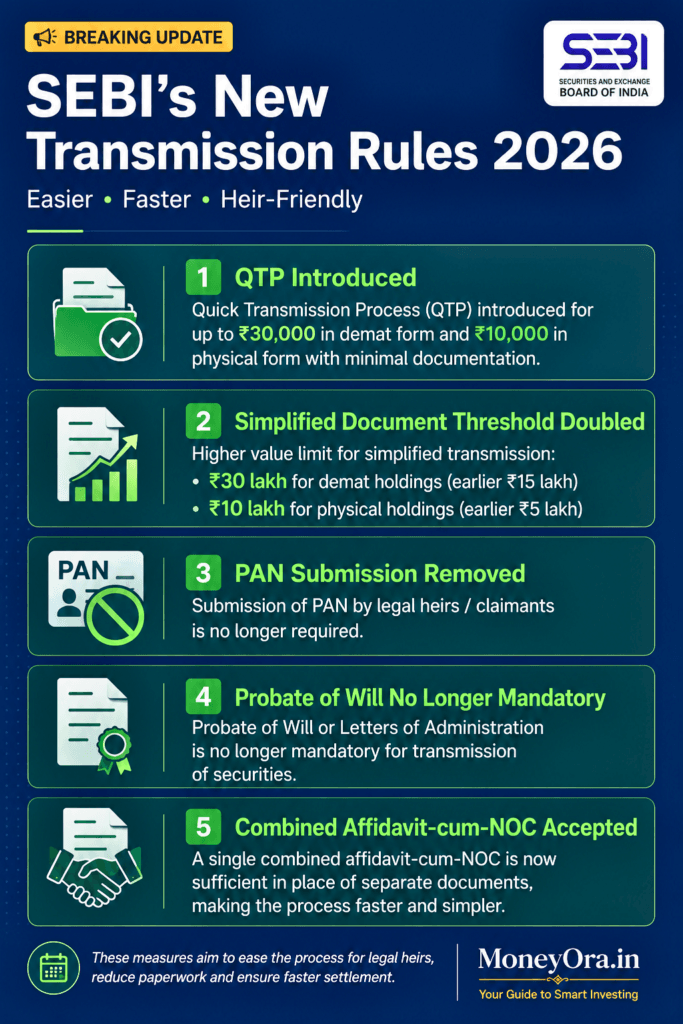
SEBI’s New 2026 Rules: What Changed and Why It Matters
SEBI’s board meeting in June 2026 approved the most comprehensive overhaul of transmission rules in years. These changes are directly relevant to any family dealing with this process right now.
Here is what changed:
1. Quick Transmission Processing (QTP) introduced
A new fast-track category for small-value claims. If the deceased’s shares are worth up to Rs 10,000 (physical) or Rs 30,000 (demat), the transmission can now be processed with minimal documentation. Before this, even tiny portfolios required the same mountain of paperwork as a large one.
2. Simplified documentation thresholds doubled
The previous limit for using simplified documentation was Rs 5 lakh for physical shares and Rs 15 lakh for demat shares. SEBI has now doubled both – to Rs 10 lakh (physical) and Rs 30 lakh (demat). This means a much larger proportion of Indian families can avoid complex legal procedures.
3. PAN requirement removed
Since PAN is already linked to a demat account when it’s opened, SEBI has eliminated the requirement to submit PAN again during transmission. One less document to chase.
4. Probate of Will no longer mandatory
Section 213 of the Indian Succession Act, which previously required probate of Wills in Mumbai, Chennai, and Kolkata for certain communities, was amended effective December 20, 2025. SEBI has aligned its transmission rules accordingly. For uncontested claims, you no longer need to go through a court for probate.
5. Combined affidavit-cum-NOC accepted
Earlier, families had to file separate affidavits and No Objection Certificates (NOCs) for multiple heirs. Now a single combined document covers both.
6. QR-code death certificates accepted
Many states now issue death certificates with scannable QR codes. SEBI’s new rules explicitly allow these to be submitted instead of requiring original attested copies.
7. Overseas death certificates covered
For NRI families or Indians who died abroad, Indian banks’ overseas branches and foreign banks with correspondent banking relationships can now verify foreign-issued death certificates.
These changes are expected to be formalized through a detailed SEBI circular outlining the operational framework. For current-status updates, check SEBI’s official investor page.
Three Scenarios: Which One Applies to You?
The transmission process depends entirely on how the shares were held. Read your scenario carefully – the documents and process differ.
Scenario A: Nominee Exists (Demat Account)
This is the easiest case. If the deceased registered a nominee when opening the demat account, transmission to that nominee is straightforward.
The nominee is not automatically the legal owner – they hold the shares in trust for the legal heirs under personal law. But the actual transfer to their account is quick.
Documents needed:
- Transmission Request Form (TRF) – available on the DP’s website
- Notarized copy of the death certificate (or QR-code version under new rules)
- Client Master Report (CMR) of the nominee’s demat account
That’s it. No succession certificate, no court order, no indemnity bond in most cases. The DP will process this within 15-30 days.
Contact the deceased’s DP directly. If you don’t know which DP they used, check their email inbox for account statements, or check bank statements for brokerage-related debits. You can also call NSDL (1800-222-990) or CDSL (1800-200-5533) with the PAN number to check.
Scenario B: No Nominee, Sole Holder (Demat Account)
This is where most families struggle. Without a nominee, legal heirs must prove their right to the shares.
Sub-scenario: Value below Rs 30 lakh (new rule) Under the new simplified documentation route:
- Transmission Request Form (TRF)
- Death certificate
- Legal Heir Certificate or Succession Certificate or Probate
- Indemnity bond (on stamp paper)
- Affidavit-cum-NOC from other legal heirs (new combined format)
- KYC documents of the claimant
Sub-scenario: Value above Rs 30 lakh
You will likely need a Succession Certificate from a civil court or probate of the Will. This takes time and may require a lawyer. Courts in India typically take 3-6 months for succession certificates, sometimes longer.
A common mistake families make:
They wait for all legal heirs to agree before approaching the DP. You can actually initiate the transmission with one legal heir as the claimant, as long as the others sign NOCs. Don’t let disagreements within the family cause the shares to lapse into IEPF.
Scenario C: Physical Share Certificates
Old physical certificates are a separate challenge. Many families of investors who held shares in the 1980s and 1990s discover physical certificates in cupboards or bank lockers years after the investor’s death.
These need to be processed differently:
- The transmission must go through the company’s Registrar and Transfer Agent (RTA), not a DP
- Major RTAs in India: Link Intime, KFintech (formerly Karvy), Cameo Corporate Services, Bigshare Services
- Once transmitted, the shares ideally need to be dematerialized (converted to demat format)
Document requirement (below Rs 10 lakh under new rules):
- Transmission request to the RTA
- Death certificate
- Share certificates (original)
- Legal Heir Certificate from Tehsildar or Revenue Authority
- NOC from other legal heirs
- Indemnity bond
Above Rs 10 lakh: Succession Certificate from court or notarized Grant of Probate.
If you can’t find the physical certificates, request a duplicate from the RTA by filing an FIR and submitting an indemnity bond. Under new SEBI proposals, the threshold for this has also been raised to Rs 10 lakh.
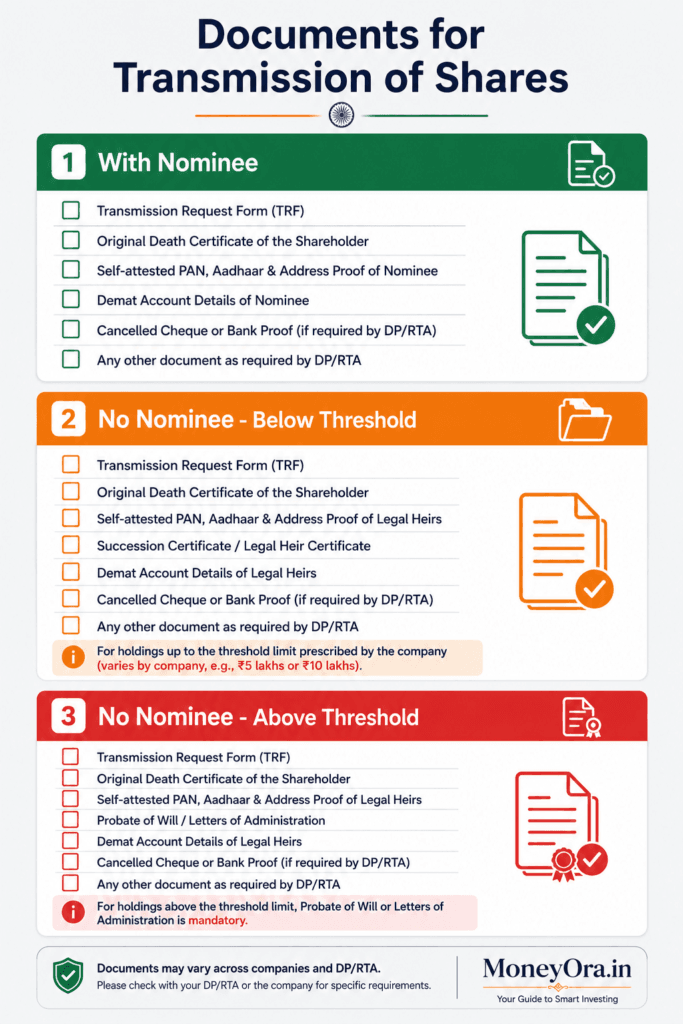
Documents Required for Transmission of Shares: Quick Reference
| Document | Nominee Case | No Nominee (Below Threshold) | No Nominee (Above Threshold) |
|---|---|---|---|
| Transmission Request Form | Yes | Yes | Yes |
| Death Certificate | Yes | Yes | Yes |
| Claimant KYC/PAN | Yes | Yes | Yes |
| CMR (demat account) | Yes | Yes | Yes |
| Legal Heir Certificate | No | Yes | Yes |
| Succession Certificate | No | May be accepted | Usually required |
| Affidavit-cum-NOC | No | Yes | Yes |
| Indemnity Bond | No | Yes | Yes |
| Probate of Will | No | No | May be required |
| Share Certificate (physical) | N/A | If physical shares | If physical shares |
Step-by-Step: How to Claim Shares After a Family Member Dies
Step 1: Find out what shares they held
Start with personal documents – old demat account statements, dividend warrants, tax returns showing dividend income. Check email for broker statements. If you find a folio number, call the relevant RTA. You can also visit the IEPF portal at iepf.gov.in to check for unclaimed assets.
For shares in NSDL/CDSL, the DP can give you a statement if you can establish that you’re the legal heir.
Step 2: Identify the type of holding
- Demat account with a known broker? Contact the DP.
- Old physical certificates? Contact the company’s RTA.
- No account found? Check IEPF.
- Multiple companies across physical and demat? You’ll need to follow separate processes for each.
Step 3: Get the required documents in order
Based on your scenario (A, B, or C above), collect the documents. Death certificates with QR codes are now accepted. For NOCs, use the new combined affidavit-cum-NOC format – most DPs and RTAs will have updated forms under the new SEBI framework.
Step 4: Submit the Transmission Request Form (TRF)
Download the TRF from your DP’s website or the RTA’s website. Fill it carefully – errors in folio numbers, DP IDs, or share counts are a common reason for rejection. Attach all documents.
Submit physically at the DP’s branch or by registered post. Some DPs are moving toward online submission portals.
Step 5: Wait for processing
Under SEBI regulations, DPs are required to process transmission requests within 30 days of receiving complete documentation. If they delay without reason, you can escalate to SEBI’s SCORES portal or the relevant depository (NSDL/CDSL).
Step 6: Shares are credited to your demat account
Once approved, the shares are transferred to the claimant’s demat account. At this point, you can decide to hold, sell, or gift the shares.
Step 7: File taxes correctly
Inherited shares do not attract capital gains tax at the time of inheritance. When you eventually sell them, the cost of acquisition is the price the deceased originally paid (not the market price at the time of inheritance). The holding period for tax purposes includes the deceased’s holding period. Consult a tax advisor for your specific situation.
For calculating returns on the inherited shares, MoneyOra’s CAGR calculator and stock return calculator can help you understand what they are worth now compared to when they were bought.
What Happens If Shares Were Transferred to IEPF?
If dividends on a deceased investor’s shares went unclaimed for 7 consecutive years, both the accumulated dividends and the shares get transferred to the IEPF Authority under Section 125 of the Companies Act, 2013.
This is more common than most families realize – especially for investors who died without telling family members about their share holdings.
IEPF shares are not lost permanently. Legal heirs can claim them by filing Form IEPF-5.
Steps to claim IEPF shares:
- Check the company’s website or IEPF portal for whether shares are in IEPF
- Contact the company’s RTA to get an Entitlement Letter confirming your eligibility
- File Form IEPF-5 online at the MCA/IEPF portal
- After submission, print the form and send it with an indemnity bond, ID proof, demat CMR, PAN copy, and cancelled cheque to the company’s Nodal Officer
- The company verifies the claim within 30 days and forwards it to IEPF Authority
- IEPF Authority transfers the shares to your demat account and credits accumulated dividends to your bank account
The process takes 2-4 months on average. There is no time limit to claim – you can file even if the shares have been in IEPF for 10+ years.
Example: Consider a case where someone’s father held 500 shares of a large PSU company bought in 2005. The father passed away in 2014, and the family discovered the shares only in 2024. By then, 10 years of dividends had gone unclaimed and the shares were in IEPF. But the family still successfully claimed both the shares and accumulated dividends by following the IEPF-5 process. With shares that multiplied 8-10x in 20 years, this is not a trivial amount.
How to Find Out If Your Deceased Family Member Owned Shares
This is genuinely one of the most common questions families have. People don’t always know what investments their parents held.
Checklist to trace hidden share investments:
- Look for old dividend warrants or cheques (even if outdated)
- Check bank passbook for dividend credits from companies
- Look for Annual Report envelopes or AGM notice letters
- Check ITR filings for schedule of assets or dividend income
- Search the IEPF portal with the deceased’s PAN or name
- Call major RTAs (Link Intime, KFintech) with the PAN number
- Check NSDL or CDSL with the deceased’s PAN to find demat accounts
- Contact their known broker or bank depository service
If you discover the deceased’s demat account through their broker, request a portfolio statement. You’ll need the death certificate and your own KYC to get access.
Common Mistakes Families Make (and How to Avoid Them)
Most families make at least one of these. Each one adds months to the process.
1. Waiting too long Shares don’t have a legal deadline for transmission. But dividends do – after 7 consecutive years of non-claim, shares go to IEPF and recovery becomes more complex. Act within the first 1-2 years.
2. Submitting notarized copies when certified copies suffice Under new SEBI rules, QR-code death certificates from municipalities are accepted. You don’t always need expensive notarized copies.
3. Submitting to the wrong entity Physical shares go to the RTA, not the DP. Demat shares go to the DP, not the company. Sending documents to the wrong place costs 2-4 weeks.
4. Not accounting for shares in multiple companies A father who invested regularly over 20 years may have shares in 15-20 different companies. Transmission has to be done separately for each RTA or DP. Create a list first.
5. Fighting over inheritance before initiating transmission Family disputes about who gets what can be resolved after the shares are transmitted. Don’t let legal debates among heirs cause shares to sit idle and reach the IEPF deadline.
6. Ignoring physical certificates in bank lockers Bank lockers often hold physical share certificates that families don’t know about. Open the locker early and check.
7. Assuming the nominee is the final legal owner The nominee is a custodian, not automatically the owner. Other legal heirs may have valid claims under personal law (Hindu Succession Act, Muslim Personal Law, etc.). Take proper legal advice if there are multiple heirs.
MoneyOra Analysis: Real Cost of Delaying a Transmission Claim
Here is something most guides don’t discuss: the actual financial cost of delay.
Let’s say your parent held 1,000 shares of a Nifty 50 company, bought in 2010 at Rs 200 per share (total cost Rs 2 lakh). The current market price in 2026 is Rs 1,800 per share (total value Rs 18 lakh).
If transmission is delayed by 3 years and the stock grows at 12% CAGR in that period:
- Value at transmission (Year 0): Rs 18 lakh
- Value if delayed 3 years (12% CAGR): Rs 25.3 lakh
- Opportunity cost of 3-year delay: ~Rs 7.3 lakh in gains you couldn’t reinvest
But here’s what’s worse: if dividends go unclaimed during those 3 years, and the 7-year IEPF clock was already ticking, you could be entering far more complex territory.
If you’re unsure what a portfolio of inherited shares might be worth over time, use MoneyOra’s lumpsum calculator or SIP calculator to model reinvestment scenarios once the shares are in your account.
1. Shares might already be in IEPF If the deceased’s dividends were unclaimed for 7+ years, shares may have already transferred to IEPF. This is recoverable but adds 2-4 months to the process.
2. Incorrect beneficiary claims If a nominee is registered but you believe you have a stronger legal claim as a spouse or child, this becomes a legal dispute. SEBI’s rules allow the DP to transmit to the nominee, and legal heirs must then resolve this through civil courts.
3. Dematerialization required for physical shares Physical certificates cannot be directly sold on the stock exchange. After transmission, they must be dematerialized first. For very old certificates, SEBI’s deadline to dematerialize all physical shares has long passed – companies may refuse to register transfer of physical securities for certain categories.
4. Fraud risk for unclaimed portfolios Large unclaimed demat accounts can attract fraud attempts. Keep account access details secure and report suspicious activity to NSDL, CDSL, or SEBI’s SCORES portal immediately.
5. Tax implications on sale Inherited shares have a zero cost of acquisition for the heir but the original purchase cost still applies when calculating capital gains. If the original purchase is from before 2018 (pre-LTCG era), grandfathering provisions may apply. Consult a chartered accountant.
For tax calculations once shares are in your name, MoneyOra’s dividend calculator and brokerage calculator can help you plan the financial side.
MoneyOra Tools
Once you’ve completed the transmission of shares, these tools will help you manage the portfolio:
- Stock Return Calculator – Calculate actual returns on inherited shares
- CAGR Calculator – Compare historical growth
- Dividend Calculator – Estimate future dividend income
- SIP Calculator – Plan reinvestment using dividends
- Brokerage Calculator – Know the costs before you sell
- PPF Calculator – For parallel safe-investment planning
- Share Market Calculator Hub – Full calculator suite
Transmission of shares is one of those financial tasks most families never prepare for. A lot of people only discover the problem when they’re already dealing with grief, which makes everything harder.
The process has genuinely improved with SEBI’s 2026 reforms – less paperwork, faster timelines, and simpler documentation for most cases. But it still requires action. Shares don’t transfer themselves, and every month of delay is a month where dividends go unclaimed and the 7-year IEPF clock keeps ticking.
If you’ve recently lost a family member who invested in the stock market, start by tracing what they held. Once you know the scope, the process is manageable – whether it’s a demat account with a nominee (a few weeks) or old physical certificates across multiple companies (a few months).
If you need to calculate what those shares might be worth, or want to plan how to reinvest them, use the free calculator now on MoneyOra.in.
Disclaimer: This article is for educational purposes only and does not constitute legal or financial advice. Tax implications vary based on individual circumstances. For succession disputes or large portfolios, consult a qualified chartered accountant or a legal professional.
Sources: SEBI Board Meeting Circular, June 2026; Companies Act, 2013 (Section 56, Section 125); Indian Succession Act, 1925 (as amended December 2025); Ministry of Corporate Affairs, IEPF Authority guidelines.
Frequently Asked Questions
Q1. What is the meaning of transmission of shares?
Transmission of shares is the legal transfer of share ownership from a deceased or legally incapacitated shareholder to their nominee, legal heir, or surviving joint holder. It is not initiated by the shareholder – it happens by operation of law. Under Section 56 of the Companies Act, 2013, SEBI regulations govern the process for listed company shares in India.
Q2. How long does transmission of shares take in India?
For demat shares with a registered nominee, the process typically takes 15-30 days after submitting complete documents. For cases without a nominee or for physical shares, it can take 1-3 months. If a Succession Certificate from court is needed, add another 3-6 months. SEBI mandates that DPs complete transmission within 30 days of receiving complete documentation.
Q3. What documents are needed for transmission of shares after death?
For demat shares with a nominee: Transmission Request Form, death certificate, and the nominee’s CMR (Client Master Report). For cases without a nominee: additionally a Legal Heir Certificate or Succession Certificate, affidavit-cum-NOC from other heirs, and indemnity bond. Physical shares require the original share certificate plus the above documents submitted to the company’s RTA.
Q4. Is Succession Certificate mandatory for transmission of shares?
Not always. Under SEBI’s 2026 rules, a Succession Certificate is not mandatory for demat holdings below Rs 30 lakh. A Legal Heir Certificate from a Tehsildar or Revenue Authority, combined with an affidavit and NOC, is sufficient in most cases at this value level. Above Rs 30 lakh, a Succession Certificate or court-issued Probate is generally required.
Q5. What happens to shares if there is no nominee and no will?
Legal heirs inherit shares according to personal succession laws – Hindu Succession Act for Hindus, Muslim Personal Law for Muslims, etc. The heirs must collectively approach the DP or RTA with a Legal Heir Certificate, affidavits, and NOCs, and designate one person to receive the shares (or split the portfolio). This process is more document-heavy but entirely possible.
Q6. Can shares go to the IEPF after an investor dies?
Yes. If dividends on the deceased’s shares remain unclaimed for 7 consecutive years, both dividends and shares transfer to IEPF. However, legal heirs can still claim them by filing Form IEPF-5 on the MCA portal. There is no deadline for this claim – you can file even 10-15 years after the IEPF transfer.
Q7. Is transmission of shares taxable in India?
The act of transmission itself is not taxable – you don’t pay capital gains when you receive inherited shares. When you eventually sell, capital gains tax applies based on the original purchase cost and the original purchase date (for holding period calculation). Shares held for more than 1 year qualify as long-term capital gains (LTCG), taxed at 12.5% above Rs 1.25 lakh gain per year under current rules.
Q8. What is Quick Transmission Processing (QTP) under new SEBI rules?
QTP is a new fast-track category introduced by SEBI in 2026 for small-value transmission claims. It applies to physical share claims up to Rs 10,000 and demat claims up to Rs 30,000. Under QTP, minimal documentation is required, making it faster and easier for families to access small inherited portfolios.
Q9. Can a joint holder claim shares after co-holder’s death?
Yes, this is actually the simplest scenario. When shares are held jointly, the surviving joint holder automatically gets the shares transferred to their name. They submit the death certificate and a transmission request, and the deceased’s name is removed. No succession certificate or court orders are needed.
Q10. How do I find out if my deceased parent held shares?
Check old dividend warrants, bank passbooks for dividend credits, tax returns, and email inboxes. You can contact NSDL (1800-222-990) or CDSL (1800-200-5533) with the deceased’s PAN to trace demat accounts. For unclaimed assets, search the IEPF portal at iepf.gov.in. RTAs like Link Intime and KFintech can also be contacted with the PAN number.


Pingback: SEBI Mutual Fund Nomination Deadline: New Rules Sept 2026
Pingback: SWP for Demat Mutual Funds: New SEBI Rules 2026 Best Guide