
Stock Return
Calculator
Calculate historical returns on any NSE/BSE stock — enter investment, pick a stock & time period to see what you'd have today.
| Period | Invested | Current Value | Return (%) | CAGR |
|---|
Stock Return Calculator: 7 Best Free Tools to Track Your Gains in India (2026)
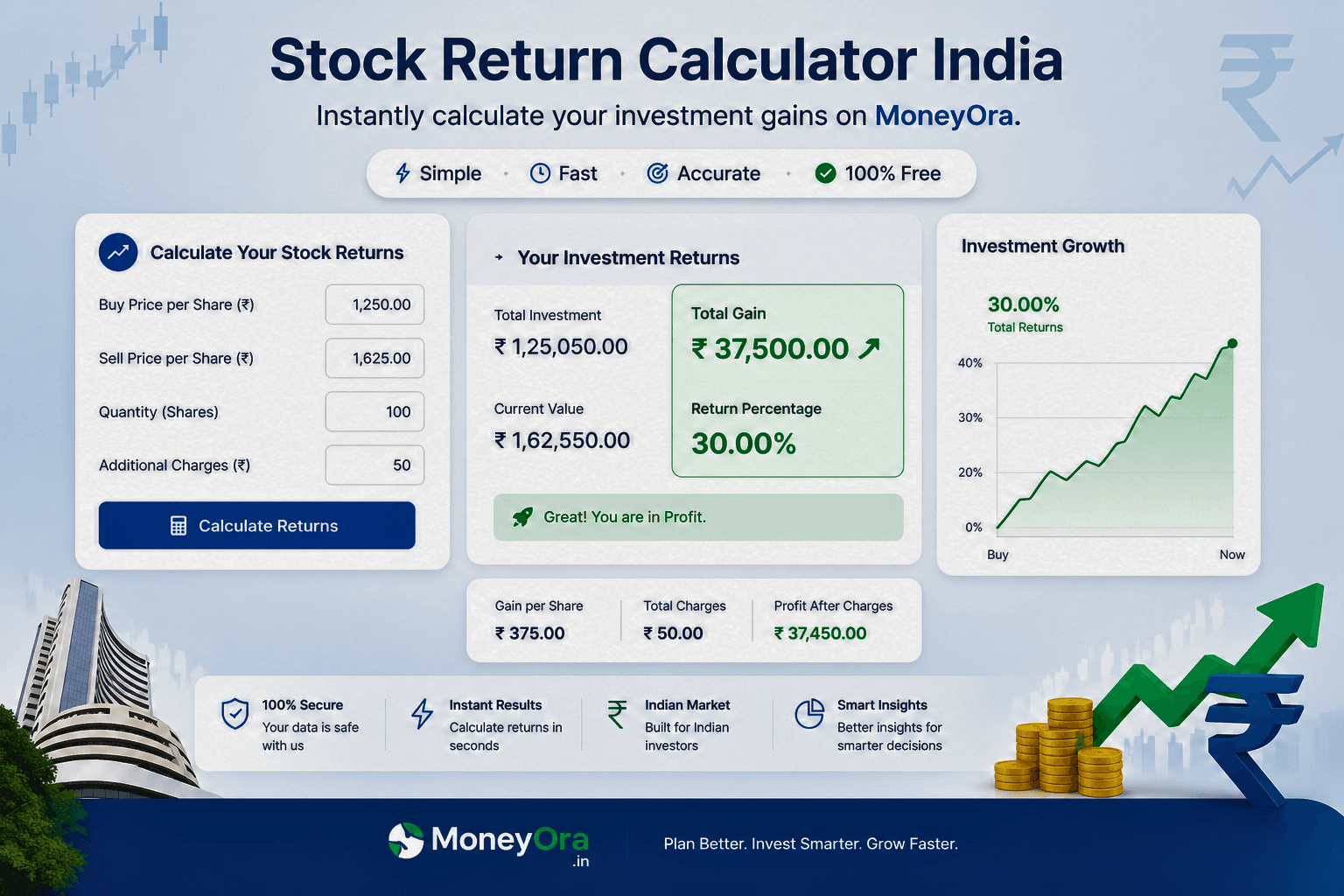
A stock return calculator is the single most useful tool any investor — beginner or expert — can keep bookmarked. Whether you put ₹10,000 into Reliance three years ago or started an SIP in Infosys last month, this tool tells you exactly how much you made (or lost), your annualised CAGR, and whether your money outperformed a plain fixed deposit. “true CAGR after brokerage charges — what your stock actually returned”
This guide covers everything: the stock return calculator formula, how different platforms like Zerodha and Groww handle return calculations, the best stock return calculator India tools available free online, and step-by-step examples you can follow right now. By the end, you will know how to calculate total returns, include dividends, and use the right tool for long-term or historical analysis. “share market today data — context for measuring your stock returns”
What Is a Stock Return Calculator?
A stock return calculator is a free online tool that takes your buy price, sell price, the number of shares you held, and your holding period — and instantly gives you the profit or loss in rupees, the percentage return, and the Compound Annual Growth Rate (CAGR). Reliance Power share return analysis
Think of it like a report card for your investment. Instead of spending 10 minutes with a spreadsheet, you type in four numbers and get all the answers in seconds.
This is especially important in India where retail investors have grown from roughly 4 crore demat accounts in 2019 to over 15 crore by 2024, according to SEBI’s official data. Many of these new investors have never formally tracked their returns. A good stock return calculator bridges that gap.
Who Needs a Stock Return Calculator?
- New investors who want to know if their first stock pick was profitable
- Experienced traders comparing returns across multiple positions
- Long-term investors reviewing 5–10 year CAGR on blue-chip stocks
- SIP investors calculating XIRR on monthly stock purchases
- Tax planners who need exact profit/loss figures for LTCG and STCG calculations
Stock Return Calculator Formula Explained
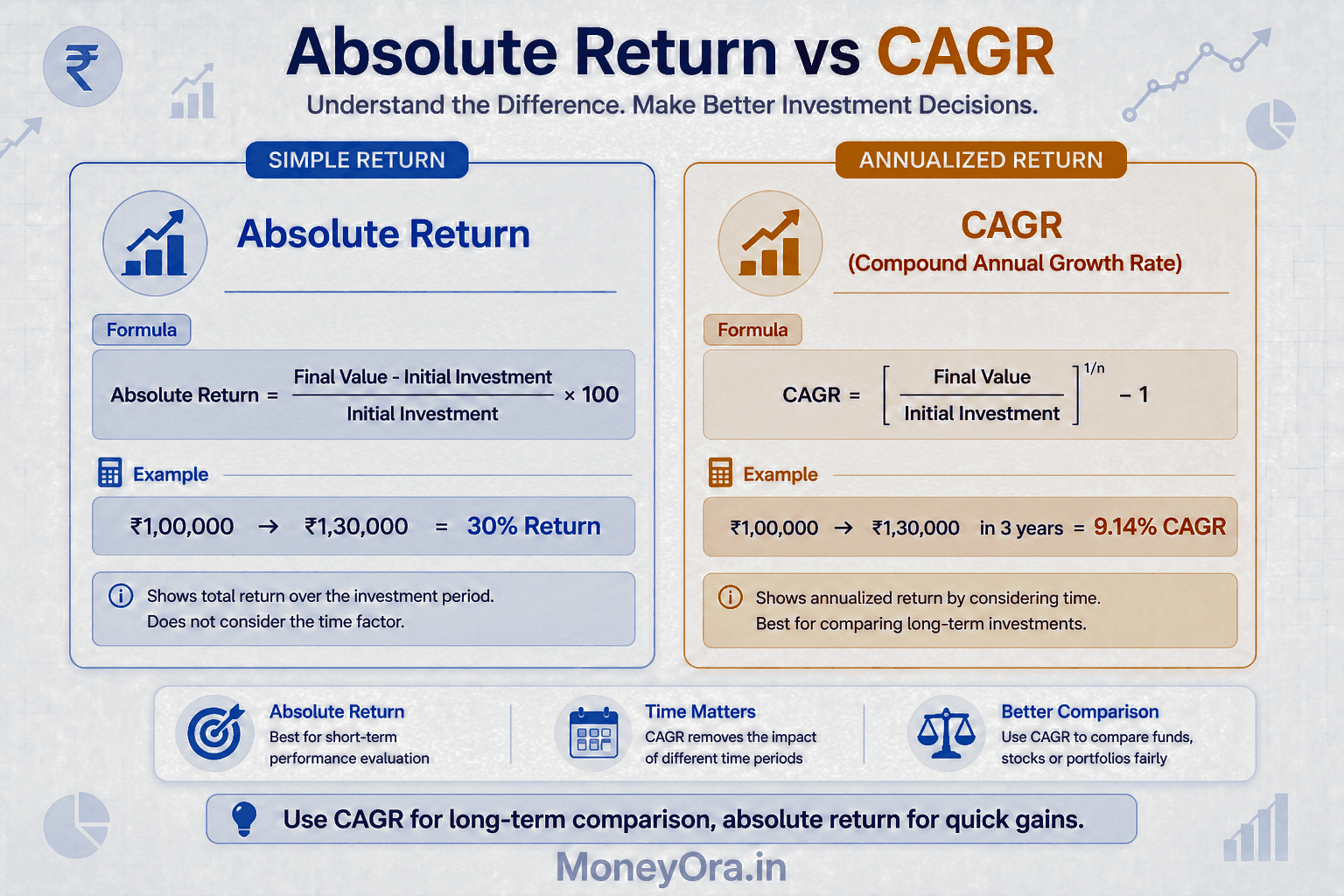
Before using any online tool, understanding the stock return calculator formula gives you confidence that the numbers are right. There are two main formulas every investor should know.
Formula 1 — Absolute Return (Simple Return)
Example: You bought 200 shares of TCS at ₹3,200 and sold at ₹4,000.
Your total profit = ₹800 × 200 shares = ₹1,60,000. Simple and clear.
Formula 2 — CAGR (Compound Annual Growth Rate)
Absolute return does not tell you how long it took. CAGR fixes that by annualising your gain.
Example: You invested ₹50,000 in Infosys. After 5 years it became ₹1,00,000.
That 14.87% annual compounding is what stock market investment return calculators display as CAGR. You can compare this directly against an FD rate (say 7%) to judge whether equities outperformed.
Speaking of FDs — if you want to compare your stock gains against fixed deposit growth, use MoneyOra’s FD Calculator to run the comparison side by side.
Formula 3 — Total Return Including Dividends
This is used in a stock return calculator with dividends, and it almost always shows a higher return than price appreciation alone — which is why dividend-paying stocks are often underrated.
Types of Stock Returns You Should Know
Different situations call for different return metrics. Here is a quick breakdown:
| Return Type | What It Measures | Best For |
|---|---|---|
| Absolute Return | Total % gain/loss, no time factor | Short-term trades |
| CAGR | Annualised growth rate, compounded | Multi-year holdings |
| XIRR | IRR for irregular cash flows | SIP / multiple buy-ins |
| Total Return | Price gain + dividends received | Dividend stocks |
| Real Return | Return adjusted for inflation | Long-term wealth planning |
| Risk-Adjusted Return | Return relative to risk (Sharpe Ratio) | Portfolio comparison |
For long-term investors, CAGR and total return are the most meaningful. You can also compare CAGR from stocks against the CAGR Calculator on MoneyOra to benchmark different asset classes.
7 Best Stock Return Calculator Tools in India (2026)
There are dozens of tools claiming to be the best stock return calculator India option. Here are the seven most reliable and useful ones, with honest observations on each.
1. MoneyOra Stock Return Calculator Best Free Tool
The MoneyOra Stock Return Calculator is purpose-built for Indian investors. Enter your buy price, sell price, quantity, and optionally dividend income — and get absolute return, CAGR, total profit/loss, and a visual summary instantly. It is completely free, mobile-friendly, and requires no login.
- Covers CAGR, absolute return, and dividend income
- Works for NSE/BSE listed stocks
- No registration needed
- Clean mobile UI
2. Zerodha Stock Return Calculator (Kite)
Zerodha users can access a basic stock return calculator Zerodha through the Kite platform’s P&L report. It shows realised and unrealised gains for each position including brokerage costs. You can export data to compare against MoneyOra’s standalone calculator. If you trade via Zerodha, also check the Brokerage Calculator to factor in your trading costs before calculating net returns.
3. Groww Stock Return Calculator
The Groww stock return calculator (also called Groww stock calculator) is embedded in the Groww app under each stock’s holding detail. It shows a simplified return % and absolute gain since purchase date. For a standalone tool, the stock return calculator Groww approach is convenient but limited — it does not show CAGR or dividend adjustments as clearly. MoneyOra fills that gap.
4. NSE India Return Tool
The NSE stock return calculator on NSE India’s official website (nseindia.com) lets you pull historical price data for any NSE-listed stock. It is the go-to source for historical stock return calculator needs — accurate, official, and free. The limitation is that it shows price data; you still need to calculate returns manually or paste the data into a tool like MoneyOra.
5. Dhan Stock Return Calculator
The Dhan stock return calculator is available inside the Dhan trading app. Like Zerodha, it integrates with your actual portfolio data, so figures include brokerage and STT (Securities Transaction Tax). Useful for active traders.
6. DQYDJ Historical Stock Return Calculator
DQYDJ (dqydj stock return calculator) is a US-focused tool but is widely used by global investors to calculate individual stock return calculator figures for US-listed companies. It supports US stock return calculator and compound stock return calculator scenarios. Useful if you invest in Indian ADRs or directly in US stocks like Nvidia (Nvidia stock return calculator queries often land here). For Canadian investors, a stock return calculator Canada is also available on their platform.
7. Axis Securities Return Tool
The Axis stock return calculator is part of Axis Securities’ research platform. It is clean and accurate, and particularly useful for SBI and PSU bank stock analysis (SBI stock return calculator queries often lead here). For SBI specifically, returns can also be analysed using price history from BSE India or NSE India.

How to Use MoneyOra’s Stock Return Calculator — Step by Step
Using the MoneyOra stock return calculator takes less than 60 seconds. Here is the exact process:
- Go to moneyora.in/stock-return-calculator/
- Enter Buy Price — the price per share when you purchased (e.g., ₹1,200)
- Enter Sell Price — the price per share at exit or today’s price (e.g., ₹1,850)
- Enter Number of Shares — how many shares you hold (e.g., 50)
- Enter Holding Period — how many years/months you held the stock
- Add Dividends (Optional) — total dividend income received during the period
- Click Calculate — see instant results: absolute return %, CAGR %, total profit in ₹
If your investment involves monthly contributions rather than a one-time lump sum, check the SIP Calculator for a more accurate XIRR-based result.
Stock Return Calculator With Dividends — Why It Matters
Many investors only look at price appreciation and completely ignore dividends. This is a major mistake. A stock return calculator with dividends includes all dividend payouts received during the holding period to give you the total return.
Consider this example with ITC Limited:
| Metric | Without Dividends | With Dividends |
|---|---|---|
| Buy Price | ₹200 | ₹200 |
| Sell Price | ₹450 | ₹450 |
| Dividends Received | — | ₹60 (over 5 years) |
| Total Return | 125% | 155% |
| CAGR (5 years) | 17.6% | 20.7% |
The difference of 3+ percentage points in CAGR is enormous over long periods. For dividend stock analysis, also check out MoneyOra’s Dividend Calculator to estimate future dividend income from your holdings.
What Dividends to Include?
- Cash dividends paid per share × number of shares
- Interim dividends during the holding period
- Special one-time dividends
- Exclude: Bonus shares (handled separately as they reduce per-share cost basis)
Long-Term Stock Return Calculator for India
Using a long-term stock return calculator India brings a different perspective to wealth building. Over 10–20 years, even modest annual returns compound into life-changing wealth.
The Power of Long-Term Compounding
| Investment Amount | CAGR | 10 Years | 20 Years | 30 Years |
|---|---|---|---|---|
| ₹1,00,000 | 12% | ₹3,10,585 | ₹9,64,629 | ₹29,95,992 |
| ₹1,00,000 | 15% | ₹4,04,556 | ₹16,36,654 | ₹66,21,177 |
| ₹1,00,000 | 18% | ₹5,23,384 | ₹27,39,302 | ₹1,43,37,066 |
The Nifty 50 has historically delivered a CAGR of approximately 12–14% over the last 25 years, according to data available on NSE India’s historical data section. Individual stocks have done better — and worse.
When thinking about long-term wealth creation, it also makes sense to compare stocks against instruments like PPF and NPS. Check out MoneyOra’s PPF Calculator and NPS Calculator to see how these safe-haven alternatives stack up.
Inflation Adjustment — The Real Return
For a truly honest long-term picture, subtract the inflation rate from your CAGR. If your stock delivered 14% CAGR and inflation averaged 6%, your real return is approximately 8% per year. That is still excellent — but it is the figure that actually protects and grows purchasing power.
Stock SIP Return Calculator — Calculate XIRR on Monthly Investments
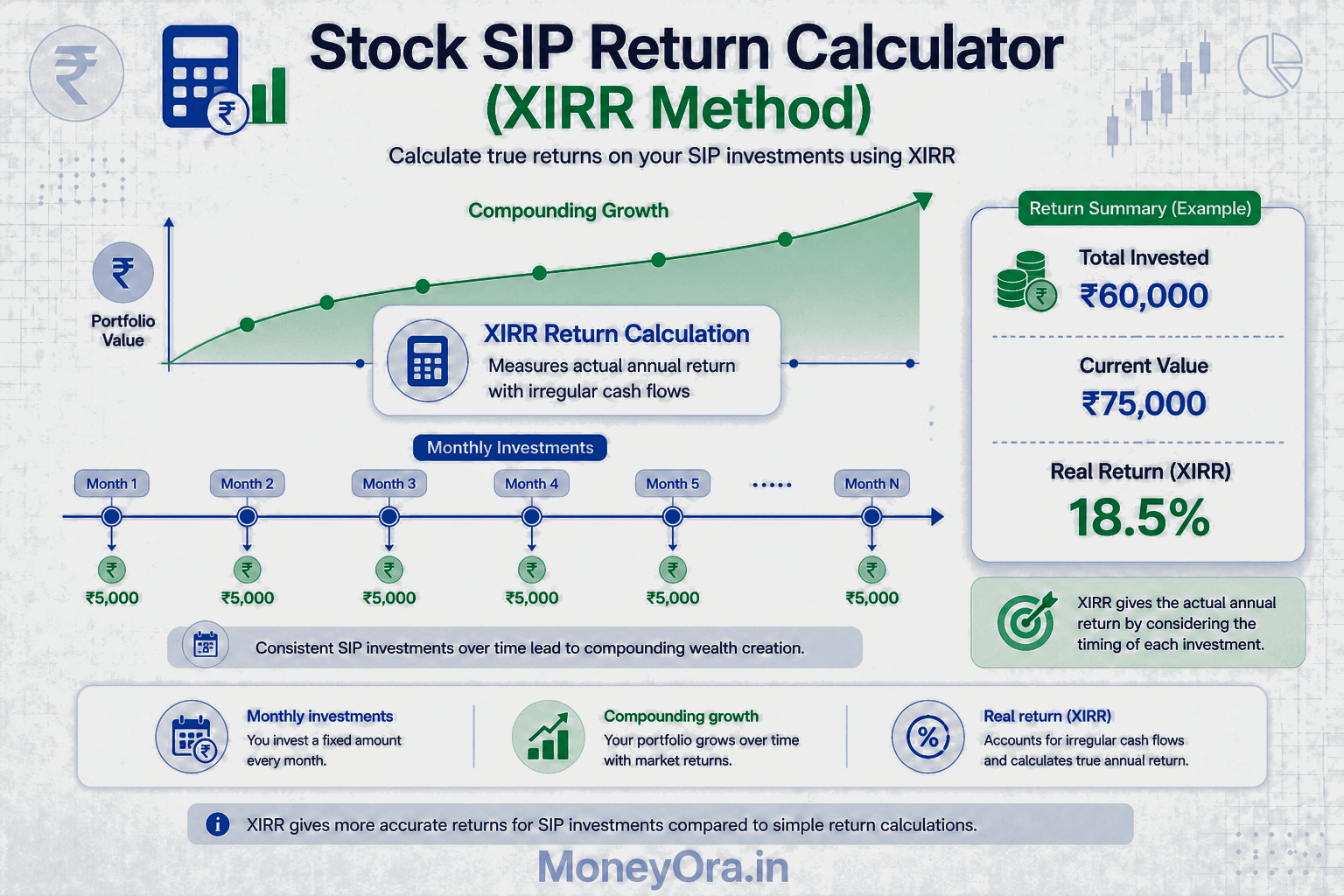
Many investors buy the same stock every month rather than in a single lump sum. This is called a stock SIP (Systematic Investment Plan applied to equities). A stock SIP return calculator computes XIRR — the internal rate of return that accounts for each cash flow at its exact date.
Why XIRR, Not CAGR, for SIPs?
CAGR assumes one investment at the start and one exit at the end. When you invest every month at different prices, each lot has a different cost basis and holding period. XIRR handles this correctly by weighting each cash flow. It is the industry-standard metric for mutual fund SIPs, and the same logic applies to stock SIPs.
For mutual fund SIPs with this XIRR logic built in, use MoneyOra’s SIP Calculator — it works for both equity mutual funds and stock SIPs. Also consider the Lumpsum Calculator to compare what a one-time investment would have returned instead.
Comparison Table: Top Stock Return Calculators at a Glance
| Tool | Free? | CAGR | Dividends | Historical Data | Best For |
|---|---|---|---|---|---|
| MoneyOra | Yes | Yes | Yes | Manual entry | All Indian investors |
| Zerodha Kite | Yes (for users) | Partial | No | Via P&L report | Zerodha account holders |
| Groww App | Yes (for users) | No | No | Via holding view | Groww account holders |
| NSE India | Yes | No | No | Full history | Historical price research |
| DQYDJ | Yes | Yes | Yes | Automated | US stock investors |
| Dhan App | Yes (for users) | Partial | No | Via portfolio | Dhan account holders |
| Axis Securities | Yes | Yes | No | Limited | Axis Securities clients |
MoneyOra’s calculator stands out because it is the only completely standalone free tool that covers CAGR and dividends without requiring a broker account. For traders who also want to calculate P/E valuation alongside returns, the P/E Ratio Calculator on MoneyOra is a natural next step.
Pro Tips for Getting Accurate Stock Return Calculations
Common Mistakes Investors Make When Calculating Stock Returns
Other Financial Calculators to Complement Your Stock Analysis
Calculating stock returns is just one piece of financial planning. A complete picture includes your overall loan burden, retirement savings, and investment strategy. MoneyOra offers a full suite of free tools:
- Planning to take a home loan? Use the Home Loan EMI Calculator to understand your monthly outgo.
- For car financing, the Car Loan EMI Calculator gives instant results.
- Tracking all EMIs together? The master EMI Calculator covers any loan type.
- Personal loans for short-term needs can be checked using the Personal Loan EMI Calculator.
- Retirement savings via EPF? The EPF Calculator projects your corpus at retirement.
- Options traders can use the Option Price Calculator and Position Size Calculator to manage risk.
- Always define your exit before entering a trade — the Stop Loss Calculator makes this quick and precise.
- For margin-based trading, check the Margin Calculator to know your exposure.
- Need to verify a bank account? The IFSC Code Finder and Bank Details Finder are right there.
- SWP investors — use the SWP Calculator to plan systematic withdrawals from your corpus.
Conclusion — Start Tracking Your Real Stock Returns Today
A stock return calculator is not just a nice-to-have tool — it is essential for any investor who wants to make data-driven decisions. Whether you are evaluating a 3-month trade or reviewing a 10-year holding in a Nifty 50 stock, the numbers tell a story that gut feeling cannot.
We covered the stock return calculator formula (absolute return and CAGR), how dividends dramatically change the total return picture, why long-term compounding at even 12–15% CAGR creates massive wealth, and the most common mistakes that lead investors to overstate or understate their gains.
The key takeaways:
- Always use CAGR to compare investments across different timeframes
- Include dividends for a complete and honest total return
- Adjust for corporate actions (splits, bonuses) to get the correct cost basis
- Benchmark your stock return against the Nifty 50 CAGR
- Account for taxes and brokerage to find your actual net return
Frequently Asked Questions (FAQ)
A stock return calculator is a free online tool.
It calculates profit or loss on stock investments.
You enter buy price, sell price, and quantity.
You can also include holding period.
It shows return %, CAGR, and total profit or loss.
Return (%) = ((Sell Price – Buy Price) / Buy Price) × 100.
For annual returns, use CAGR formula.
CAGR = ((Ending Value / Beginning Value) ^ (1 / Years)) – 1.
You can use a calculator for quick results.
Yes, it is completely free.
No login is required.
No subscription charges.
Works on mobile and desktop.
Yes, dividends can be included.
Enter total dividend received.
The calculator adds it to total return.
This gives a complete return picture.
Absolute return shows total gain or loss.
It does not consider time.
CAGR shows annual growth rate.
It allows comparison across time periods.
CAGR is better for long-term analysis.
Absolute = ((Sell Price – Buy Price) / Buy Price) × 100.
CAGR = ((Ending Value / Beginning Value) ^ (1 / Years)) – 1.
With dividends = ((Sell Price – Buy Price + Dividends) / Buy Price) × 100.
Yes, long-term returns can be calculated.
Use historical buy price and current price.
Enter exact holding period.
The calculator gives CAGR for full duration.
Zerodha and Groww show returns for your holdings.
They require account login.
MoneyOra works without login.
It works for any stock.
It allows flexible calculation.
Use XIRR for SIP calculations.
Each investment has a different date.
CAGR is not suitable here.
Excel XIRR function is accurate.
SIP calculator can also help.
Yes, always include brokerage.
Charges reduce your net profit.
Net return = (Sale – Cost – Charges) / Cost × 100.
Use brokerage calculator for accuracy.