
Gold, Silver & Crypto Prices
Live INR rates · India · goodreturns.in
| Weight | Gold 24K | Gold 22K | Gold 18K | Silver 999 |
|---|
| Date | Price/gram | 10 Gram | 1 Tola | Change |
|---|
| Period | Gold 24K Avg | Gold 22K Avg | vs Today | Silver Avg/g | vs Today |
|---|
Seed: 24K ₹15,622/g · Silver ₹279.90/g · BTC $76,800 · ETH $2,109 · 19 May 2026
Prices are indicative — excludes GST & making charges · moneyora.in
Gold Rates : Best Ways to Track and Invest in Gold in 2026
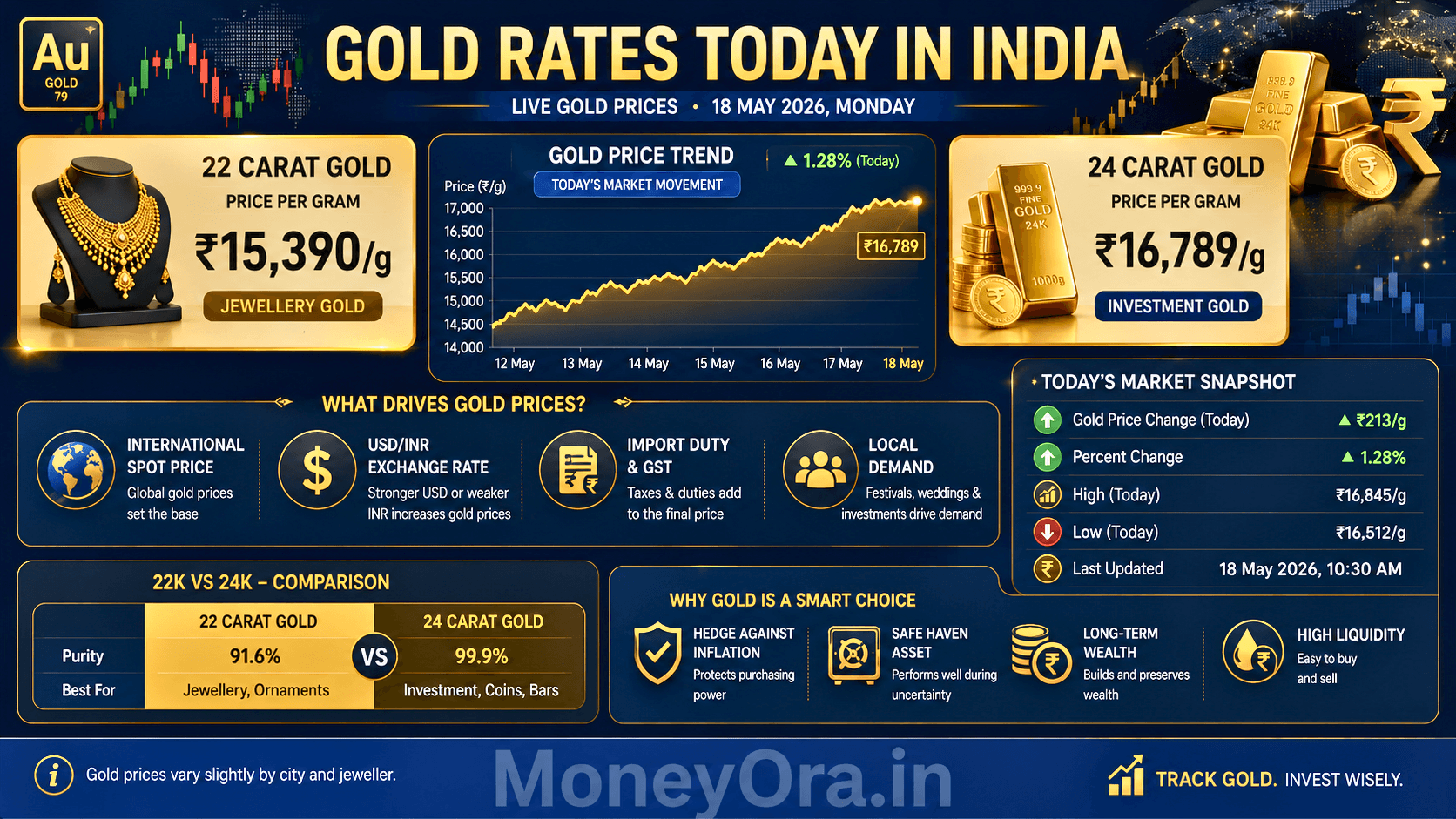
Gold has a way of being relevant in almost every stage of an Indian’s financial life. You buy it at weddings. You pledge it when cash runs tight. You invest in it when markets turn uncertain. And through all of that, the one thing everyone wants to know is the same: what is the gold rate today?
The answer is not as simple as looking up a single number. Gold rates in India vary by city, by purity (22 carat vs 24 carat), by time of day, and by how you are buying — jewellery, coins, ETFs, or Sovereign Gold Bonds. Understanding this properly saves real money. A buyer who does not know the spot price, adding charges, or purity markup can pay 15%–30% more than the actual gold value. “understand why India’s gold rate matters — India holds 880 tonnes in reserve”
This guide covers how today’s gold price is set in India, what moves it up or down, how to read a 22 and 24 carat price, and the seven most practical ways to use gold rate data — whether you are buying jewellery next week or building a long-term investment position.
Quick Facts: Gold in India (2025)
- India is the world’s second-largest consumer of gold, importing roughly 700–900 tonnes per year
- Import duty on gold: 15% (as of 2025, post July 2024 budget reduction from 18.45%)
- GST on gold purchases: 3% on gold value + 3% on making charges
- BIS hallmarking mandatory since June 2021 for jewellers above ₹40 lakh turnover
- Sovereign Gold Bonds earn 2.5% annual interest + price appreciation, with tax-free maturity redemption
How Gold Rates Are Set in India
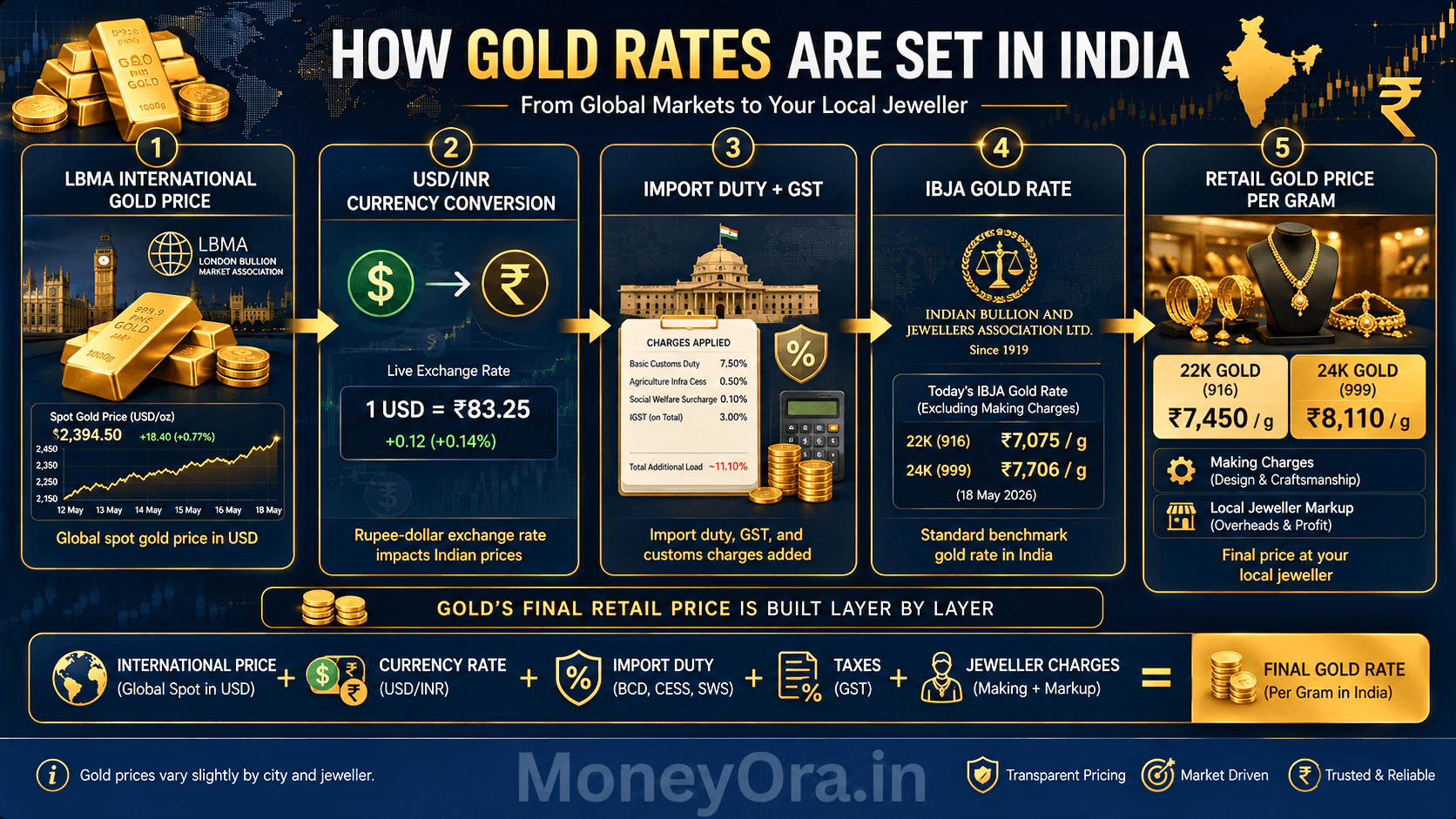
The gold price in India is not fixed by any government body. It flows from a chain of pricing mechanisms that starts in London and New York and ends at your local jeweller’s shop.
Step 1: International Spot Price (LBMA and COMEX)
The global benchmark for gold is the LBMA (London Bullion Market Association) Gold Price, set twice daily in London — at 10:30 AM and 3:00 PM London time. This “fix” represents the price in US dollars per troy ounce at which major bullion banks are willing to buy and sell gold. In parallel, COMEX (part of the New York Mercantile Exchange) trades gold futures contracts 24 hours a day, and its near-month futures price tracks closely with the LBMA spot price.
What Is a Troy Ounce?
A troy ounce is 31.1035 grams — not the standard 28.35-gram ounce used in everyday weight measurement. All gold prices globally are quoted per troy ounce. When you see an international gold price of $2,400 per ounce, divide by 31.1035 to get the price per gram: roughly $77.2 per gram.
Step 2: USD to INR Conversion
Once the international price is known, it is converted to Indian rupees using the current USD/INR exchange rate. This is why gold rates in India can rise even when the global dollar price of gold is flat — if the rupee weakens against the dollar (say, from ₹83 to ₹85 per dollar), the same international price costs more rupees to buy. The exchange rate is a silent variable that most gold buyers overlook.
Step 3: Import Duty and Other Levies
India imports most of its gold. As of 2025, the import duty on gold is 15% (reduced from 18.45% in the July 2024 Union Budget). This is added on top of the CIF (Cost + Insurance + Freight) price before the gold enters the domestic market. There is also a 3% Agriculture Infrastructure and Development Cess (AIDC) on imports, making the effective import levy structure significant.
Step 4: IBJA (India Bullion and Jewellers Association) Rate
The India Bullion and Jewellers Association publishes two daily gold rates — morning and evening — for 999 purity (24 carat, 99.9% pure) and 995 purity. Most retail jewellers and gold trading platforms use the IBJA rate as the day’s reference. It already incorporates import duty, customs clearing charges, and basic overhead. City-specific variations (MMTC, state-level levies) are added on top.
Step 5: Retail Gold Rate (What You Pay at the Shop)
The retail gold rate is the IBJA base rate plus:
- Local jewellers’ association premium (varies by city)
- State-specific VAT or entry tax (in some states)
- Making charges (for jewellery) — typically 8%–25% of gold value
- 3% GST on (gold value + making charges)
Why the Same Jewellery Can Cost Different Amounts at Two Shops
Both shops may quote the same gold rate per gram that day. The difference comes from making charges. One shop charges 10% making on a necklace; another charges 18%. On a ₹2 lakh piece of gold jewellery, that gap alone is ₹16,000 — before GST. Always ask for the making charges separately, and compare them across shops before buying.
MCX Gold Futures Price: How It Differs from the Spot Rate
The MCX (Multi Commodity Exchange) gold futures price is a contract to buy or deliver gold at a specified future date, typically in the near month or three months out. Because of the cost of carry (storage, insurance, interest cost of money over time), futures prices are typically slightly higher than the current spot rate. When gold investors and traders reference “MCX gold price,” they usually mean the near-month futures contract price.
Key Takeaway on How Rates Are Set
The gold rate you see quoted at a shop is the end of a chain: global spot price → USD/INR conversion → import duty → IBJA rate → city premium → making charges → GST. Any link in that chain can shift the final price, which is why the rate changes every day and can vary between cities.
22 Carat vs 24 Carat Gold: Price, Purity and Use
When you check the gold rate today per gram, you will usually see two prices: one for 22 carat and one for 24 carat. This confuses a lot of buyers. Here is what the difference actually means.
What Does “Carat” Mean in Gold?
Carat (not to be confused with “carat” for diamonds, which measures weight) indicates how many parts out of 24 are pure gold. So:
- 24 carat = 24/24 = 99.9% pure gold (BIS purity: 999)
- 22 carat = 22/24 = 91.6% pure gold (BIS purity: 916)
- 18 carat = 18/24 = 75.0% pure gold (BIS purity: 750)
Pricing: How to Convert 24 Carat Rate to 22 Carat Rate
The 22 carat gold rate today is derived from the 24 carat rate by multiplying by 0.916. If today’s 24 carat gold rate per gram is ₹7,500, then the 22 carat rate per gram = ₹7,500 × 0.916 = ₹6,870.
| 24 Carat Rate (per gram) | 22 Carat Rate (×0.916) | Difference per gram | Difference per 10 gram |
|---|---|---|---|
| ₹6,500 | ₹5,954 | ₹546 | ₹5,460 |
| ₹7,000 | ₹6,412 | ₹588 | ₹5,880 |
| ₹7,500 | ₹6,870 | ₹630 | ₹6,300 |
| ₹8,000 | ₹7,328 | ₹672 | ₹6,720 |
| ₹8,500 | ₹7,786 | ₹714 | ₹7,140 |
Which Purity Is Used for What Purpose?
22 Carat Gold (916)
- Used for most gold jewellery in India — necklaces, bangles, rings, earrings
- The alloy metals (copper, silver) added to the remaining 8.4% make it harder and more durable for everyday wear
- The 22 carat gold rate today is what most retail jewellery buyers are concerned with
24 Carat Gold (999)
- Used for gold coins, gold bars, and bullion sold for investment
- Very soft — not suitable for jewellery that needs to hold its shape under wear
- The basis for Gold ETFs, Sovereign Gold Bonds, and digital gold
- The 24 carat gold rate today is what gold investors track
18 Carat Gold (750)
- Common in studded or diamond jewellery where a lower gold weight is acceptable because the value is in the stones
- Cheaper per gram than 22 or 24 carat
- Less popular in South India, more common in metro jewellery retail
Why Some Jewellers Quote “10 Gram Gold Rate”
Most Indian gold rate quotations are per 10 grams rather than per gram, because the traditional unit for gold pricing in India is the tola (11.66 grams) and the market evolved to using 10 grams as a round-number alternative. Both are correct; just divide by 10 to get the per-gram price, or multiply by 10 to convert from per-gram to per-10-gram.
Today’s Gold Rate in India: City-Wise Breakdown
Gold rates are not uniform across India. While the base IBJA price is national, city-level differences exist due to local jewellers’ association levies, state taxes, and logistics costs. The following table gives typical indicative rates — for the live daily rate, check the MoneyOra gold rates page.
| City | 22 Carat (₹ per 10g) | 24 Carat (₹ per 10g) | State/Local Premium |
|---|---|---|---|
| Mumbai | ₹65,200–₹68,500 | ₹71,100–₹74,700 | Low |
| Delhi | ₹65,300–₹68,600 | ₹71,200–₹74,800 | Low |
| Chennai | ₹65,500–₹68,800 | ₹71,400–₹75,000 | Low–Medium |
| Bangalore | ₹65,400–₹68,700 | ₹71,300–₹74,900 | Low |
| Hyderabad | ₹65,350–₹68,650 | ₹71,250–₹74,850 | Low |
| Kolkata | ₹65,500–₹68,900 | ₹71,500–₹75,100 | Low–Medium |
| Pune | ₹65,200–₹68,500 | ₹71,100–₹74,700 | Low |
| Ahmedabad | ₹65,300–₹68,600 | ₹71,200–₹74,800 | Low |
| Jaipur | ₹65,400–₹68,700 | ₹71,300–₹74,900 | Low |
| Lucknow | ₹65,450–₹68,750 | ₹71,350–₹74,950 | Medium |
* Rates are indicative ranges for mid-2025. Actual daily rates vary. Check the MoneyOra live gold rates page for today’s figures from IBJA.
Why South Indian Cities Often Have Slightly Higher Rates
Chennai, Hyderabad, and Coimbatore tend to have slightly higher gold rates than Mumbai or Delhi. South India accounts for roughly 40% of India’s total gold demand (per the World Gold Council), and local jewellers’ associations in Tamil Nadu and Andhra Pradesh historically add a small city premium. The difference is small — ₹100–₹300 per 10 grams — but it is consistent enough to be visible in daily rate comparisons.
How to Check Today’s Live Gold Rate
- MoneyOra gold rates page — updated daily from IBJA morning fix
- MCX website (mcxindia.com) — live gold futures prices during market hours (9 AM – 11:30 PM)
- IBJA website (ibja.co) — official morning and evening rate announcements
- Your jeweller’s display board — should match IBJA ± local premium
What Makes Gold Rates Rise or Fall?
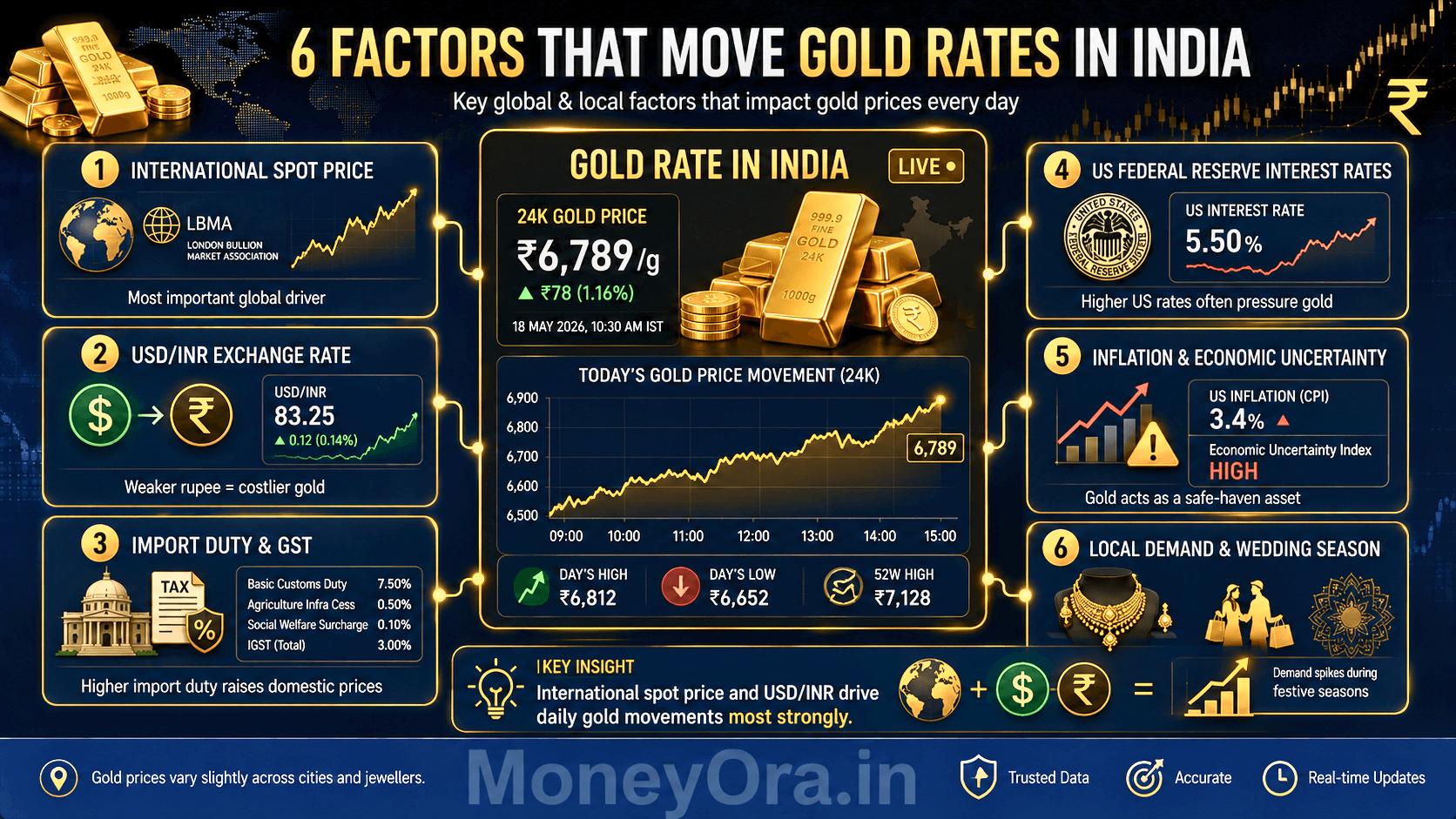
Gold does not produce earnings or dividends. Its price is entirely a function of supply, demand, and investor psychology. Here are the six main factors that move gold rates in India.
1. International Gold Spot Price (USD per Ounce)
Everything starts here. When global investors move money into gold — because of war, financial crisis, inflation, or central bank buying — the dollar price of gold rises. When risk appetite recovers and money flows into equities or bonds, gold tends to pull back. The 2020 COVID crisis pushed gold to a then-record $2,075 per ounce. In 2024–25, ongoing geopolitical uncertainty and central bank demand pushed prices past $2,400–$2,500 per ounce in global markets.
2. USD/INR Exchange Rate
This is the variable most Indian gold buyers underestimate. Gold is priced globally in US dollars. To buy gold in India, those dollars must be converted to rupees. When the rupee weakens against the dollar, imported gold costs more in rupee terms — even if the global dollar price of gold has not moved at all. In 2013–14, the rupee fell sharply (from ₹55 to ₹68 per dollar), pushing gold prices in India to record highs even as global prices corrected.
3. Import Duty and Government Policy
India levies significant import duty on gold. The July 2024 Union Budget cut the basic customs duty on gold from 10% to 6% (with AIDC and other levies, the effective rate went from ~18.45% to ~15%). This single policy change caused gold prices in India to drop ₹4,000–₹5,000 per 10 grams almost overnight. Government policy is a major short-term price driver that is unique to India compared to global markets.
Import Duty Structure on Gold in India (2025)
| Levy Component | Rate |
|---|---|
| Basic Customs Duty (BCD) | 6% |
| Agriculture Infrastructure Development Cess (AIDC) | 5% |
| Social Welfare Surcharge (SWS) | on BCD portion |
| Effective Total Import Levy (approximate) | ~15% |
4. US Federal Reserve Policy (Interest Rates)
Gold pays no interest or dividend. When US interest rates are high, holding gold has a higher “opportunity cost” — money in US Treasury bonds earns a real return while gold earns nothing. This typically puts downward pressure on gold prices. Conversely, when the Fed cuts rates (or signals cuts), gold becomes relatively more attractive. The 2024 Fed rate cut cycle was one reason global gold prices broke records that year.
5. Festive Season and Wedding Demand in India
India’s cultural calendar drives significant seasonal demand for gold. Demand peaks during:
- Akshaya Tritiya (April–May) — considered the most auspicious day for gold purchases
- Dhanteras (October–November) — gold buying considered mandatory for prosperity
- Wedding season (October–December, April–June) — gold jewellery is central to Indian wedding traditions
Domestic demand spikes can push local gold rates ₹200–₹500 per 10 grams above the international-equivalent price during peak periods.
6. Central Bank Gold Buying
Central banks globally have been net buyers of gold since 2010, accelerating since 2022. The Reserve Bank of India has significantly increased its gold reserves in recent years — from around 557 tonnes in 2021 to over 800 tonnes by 2024. When large central banks buy gold, it reduces supply available to the market and supports prices. According to the World Gold Council data summarized on Wikipedia, central banks bought over 1,000 tonnes of gold in both 2022 and 2023 — the highest levels in over 50 years.
7 Best Ways to Track and Use Gold Rates
Knowing today’s gold rate is useful. Knowing how to act on it is better. Here are the seven most practical ways to use gold rate information.
1. Check the IBJA Rate Before Any Gold Purchase
Before walking into a jewellery shop, pull up the day’s IBJA rate. The retail jeweller’s board should show a rate within ₹100–₹200 of the IBJA figure (for bare gold value, before making charges). If their base gold rate is significantly higher, ask why. You are entitled to know what you are paying for the metal vs the craftsmanship.
2. Use the Rate to Verify Jewellery Pricing
Ask for the weight of the jewellery in grams, the purity (22 or 24 carat), and the making charge percentage. Then calculate: Weight (grams) × Today’s rate per gram × (1 + making charge %) × 1.03 (for GST) = total price. If the jeweller’s quote matches, you are dealing with a transparent shop. If it does not, ask them to show the calculation. Most reputable jewellers now provide itemized bills.
3. Time Large Purchases Around Rate Dips
Gold prices are volatile. In any given year, the price swings ₹5,000–₹15,000 per 10 grams. For a purchase of 50 grams of jewellery (a fairly standard wedding set), waiting for a ₹2,000-per-10-gram dip saves ₹10,000 in gold value alone. Track the 3-month and 6-month gold rate charts — MoneyOra’s gold rates page shows historical trends — before deciding when to buy.
4. Compare Gold Investment Returns with Other Assets
Gold has returned approximately 12–14% annually in rupee terms over the past 20 years (2004–2024), largely because the rupee has weakened steadily against the dollar over this period. Compare this with equity market returns using our CAGR calculator and stock return calculator. Gold outperformed during 2008–2012 and 2019–2020; equities outperformed during 2014–2017 and 2021–2024. Diversification between gold and equity is the standard recommendation from most financial planners.
5. Calculate the True Cost of Gold Jewellery (All-In)
Use today’s gold rate to calculate the intrinsic gold value in any piece of jewellery you plan to buy or sell. If you are selling old jewellery, the buyback value is typically the gold rate for the purity minus 2%–5%. If you are buying, the total cost includes the gold rate, making charges, and GST. Knowing both numbers tells you exactly how much you are paying for the craftsmanship premium.
6. Decide Between Physical Gold, Gold ETF, or Sovereign Gold Bond
When the gold rate is high and you want exposure without making charges, gold ETFs trade at near-spot prices on the NSE. When you have a 5–8 year horizon and want to earn 2.5% annual interest on top of price appreciation, Sovereign Gold Bonds are the most cost-efficient option. Use today’s gold rate as the baseline to compare what each format actually costs you at the current market level.
7. Pledge Gold Loans at the Right Rate
Gold loans are sanctioned at a percentage of the gold’s current market value — typically 75% of the appraised gold value (per RBI guidelines). Knowing today’s gold rate per gram and the total gold weight you plan to pledge gives you a realistic estimate of the loan amount you can get. Use this alongside our EMI calculator to check whether the gold loan repayment is feasible before applying.
How to Buy Gold in India Without Overpaying
Most gold buyers in India lose 10%–30% in value the moment they step out of the shop — not because gold prices fell, but because of making charges, unverified purity, and buying formats that carry high costs. Here is how to avoid the most common mistakes.
Always Insist on BIS Hallmarked Gold
BIS (Bureau of Indian Standards) hallmarking has been mandatory for gold jewellery in India since June 2021 for jewellers above the ₹40 lakh turnover threshold. A BIS hallmark on jewellery guarantees the purity matches what is stated on the tag. Look for three things on the hallmark: the BIS triangle logo, the purity number (916, 750, or 999), and the HUID (Hallmark Unique Identification number — a 6-digit alphanumeric code). You can verify any HUID on the BIS Care app.
Negotiate Making Charges
Making charges are not fixed. Especially for large purchases (above 20 grams), jewellers will negotiate. The national average for making charges in 2025 is roughly 8%–12% for machine-made jewellery and 15%–25% for handmade or intricate designs. For plain gold jewellery, anything above 12% is worth questioning. At a ₹75,000 per 10-gram gold rate, 1% difference in making charges on a 25-gram purchase is ₹1,875 — significant when multiplied across a full wedding set.
Ask for an Itemized Bill
A legitimate jeweller will provide a bill that separately shows: net gold weight (in grams), gold rate per gram, total gold value, making charges (in rupees or as a percentage), stone or other charges if any, and GST at 3%. If a jeweller refuses to itemize the bill, that is a red flag.
Check the Weight Yourself
Request that gold jewellery be weighed on the shop’s certified balance in your presence. Cross-check the weight on the tag against what the balance shows. Some older shops still quote gross weight (including the clasp and other fittings) rather than the net gold weight. The difference matters on your final bill.
Best Time of Year to Buy Gold in India
Historically, gold prices in India tend to be relatively softer in February–March and July–August, outside the peak festive and wedding seasons. There is no guaranteed pattern (global events can override seasonal trends), but if your purchase is flexible, avoiding Akshaya Tritiya week (late April–May) and the Dhanteras period (October) can save you a few hundred rupees per 10 grams. Use the historical rate chart on MoneyOra to check recent seasonal patterns before deciding.
Physical Gold vs Gold ETF vs Sovereign Gold Bond vs Digital Gold
For someone who wants exposure to gold as an investment — not for jewellery — there are now four main options in India. Each has a different cost structure, liquidity, and tax treatment.
Physical Gold: Jewellery, Coins, and Bars
Advantages
- Tangible ownership — you hold the asset directly
- No counterparty risk if stored securely
- Culturally important for Indian households; serves both investment and personal use
Disadvantages
- Jewellery: making charges (8%–25%) reduce investment value immediately
- Storage and insurance cost for large quantities
- Purity risk on older or unverified gold
- Capital gains tax applies on sale (20% with indexation for LTCG after 2 years)
Gold ETF (Exchange Traded Fund)
A gold ETF holds physical gold in a vault and issues units on the NSE or BSE that track the gold price. Each unit typically represents 1 gram of gold (or 0.5 grams in some funds). You buy and sell through your demat account at near-spot prices during market hours.
Advantages
- No making charges — buy at near-spot price
- No storage or purity risk
- High liquidity — can be sold any trading day
- Regulated by SEBI; gold holdings audited
Disadvantages
- Requires a demat account (easy to open, but not everyone has one)
- Fund management expense ratio (~0.5% per year)
- No interest income; pure price play
- LTCG taxable (held for 24 months+ qualifies; 12.5% without indexation under new 2024 tax rules)
Use our lumpsum calculator to model what a one-time gold ETF investment at today’s price grows to over 5, 10, or 15 years at estimated return rates.
Sovereign Gold Bond (SGB)
Sovereign Gold Bonds are issued by the RBI on behalf of the Government of India in tranches throughout the year. The bond is denominated in grams of gold (minimum 1 gram, maximum 4 kg per individual per financial year). The price is fixed at the IBJA average rate for the week preceding the issue, with a ₹50 discount for online applications.
Advantages
- 2.5% annual interest on the initial investment amount (paid semi-annually)
- Capital gains fully exempt from tax if held to 8-year maturity
- No storage or making charges
- Backed by the Government of India — zero default risk
- Can be used as collateral for loans
Disadvantages
- Liquidity is limited — traded on exchange but with thin volumes; exit before 5 years is difficult practically
- Interest income is taxable as per your income tax slab
- New tranches are not always available; depends on RBI issuance schedule
SGB vs Gold ETF: Which Is Better for Investment?
For a 5–8 year horizon, Sovereign Gold Bonds are almost always better than Gold ETFs. The 2.5% annual interest alone makes up for the thin secondary market liquidity. For shorter horizons or when you need to be able to exit quickly, Gold ETFs are the better choice. For amounts above ₹20 lakh (approaching the 4 kg annual limit), split between SGBs and Gold ETFs.
Digital Gold
Digital gold is offered by platforms like MMTC-PAMP, SafeGold, and Augmont through apps and payment platforms. You buy fractions of physical gold stored in a vault. The minimum purchase can be as low as ₹1.
Advantages
- Very low minimum investment — accessible to first-time buyers
- Can be converted to physical gold delivery (above minimum weight)
- Real-time pricing linked to IBJA/MCX rates
Disadvantages
- Not regulated by SEBI — falls in a grey area (IRDAI has flagged this)
- Typically a 3% spread on buy price over the market rate
- Storage charges kick in after a specified holding period on many platforms
- Counterparty risk in case the platform faces financial distress
Side-by-Side Comparison
| Factor | Physical Gold | Gold ETF | Sovereign Gold Bond | Digital Gold |
|---|---|---|---|---|
| Making charges | 8%–25% | None | None | ~3% spread |
| Interest income | None | None | 2.5% p.a. | None |
| Liquidity | Medium | High (market hours) | Low (before year 5) | Medium |
| Tax on gains (LTCG) | 12.5% (24+ months) | 12.5% (24+ months) | Nil at maturity | 12.5% (24+ months) |
| SEBI regulated | N/A | Yes | RBI/Govt | No |
| Minimum investment | ~₹500 (fraction coins) | ~₹500 (0.5g ETF unit) | 1 gram (~₹6,500+) | ₹1 |
| Storage/custody cost | Your risk | ~0.5% p.a. expense ratio | None | Free initially, then charges |
| Best for | Jewellery, culture | Short–medium term | 5–8 year investment | Micro-investing |
BIS Hallmark and Gold Purity: What the Numbers Actually Mean
Hallmarking is the only guaranteed way to verify gold purity in India without a laboratory test. Since June 2021, BIS hallmarking has been mandatory for gold jewellery sold by registered jewellers. Here is how to read the marks on your jewellery.
The Three Required BIS Hallmark Elements
1. BIS Logo (Triangle Mark)
The Bureau of Indian Standards logo — a triangle within a circle — certifies that the item has been tested at a BIS-recognized Assaying and Hallmarking Centre.
2. Purity Number
The numerical purity of the gold:
- 999 = 24 carat (99.9% pure)
- 995 = near 24 carat (99.5% pure)
- 916 = 22 carat (91.6% pure)
- 875 = 21 carat (87.5% pure)
- 750 = 18 carat (75% pure)
- 585 = 14 carat (58.5% pure)
3. HUID (Hallmark Unique Identification Number)
Introduced in 2021 to replace the earlier year mark. Each piece of hallmarked jewellery has a unique 6-digit alphanumeric code. You can enter this code on the BIS Care mobile app to verify that the piece was genuinely tested and that the purity shown is correct. This one feature makes counterfeiting BIS hallmarks extremely difficult.
What the Old Hallmark System Looked Like (Before 2021)
Before July 2021, hallmarked jewellery had four marks: BIS logo, purity, Assaying and Hallmarking Centre mark, and a year of hallmarking code (a letter representing the year). Since HUID replaced this, older pieces with the year letter are still valid but cannot be verified digitally on the BIS app.
What to Do If Purity Is Disputed
If you suspect the purity of old gold jewellery, BIS-licensed Assaying and Hallmarking Centres across India will test it for a small fee (typically ₹35–₹100 per item). You can find the nearest centre on the BIS website. This is the only legally recognized purity test in India.
Tax on Gold in India: What You Actually Owe
Gold taxation in India changed materially in the July 2024 Union Budget. Here is the updated picture.
GST on Gold Purchase
- GST on gold: 3%
- GST on making charges: 5% (for job work by jeweller) or 3% if included in overall gold value
- No GST on Gold ETF purchases (securities)
- No GST on Sovereign Gold Bond purchases
Capital Gains Tax on Gold Sale
Long-Term Capital Gains (LTCG) — Held More Than 24 Months
- Tax rate: 12.5% without indexation (post Budget 2024 change — indexation benefit removed for gold)
- Applies to: physical gold, gold ETFs, digital gold
- Sovereign Gold Bond held to maturity (8 years): exempt from capital gains tax
- Sovereign Gold Bond sold before maturity (on exchange): LTCG at 12.5% if held 24+ months
Short-Term Capital Gains (STCG) — Held Less Than 24 Months
- Tax rate: as per your income tax slab (can be 5%, 20%, or 30%)
- Applies to all gold formats sold within 24 months of purchase
Interest from Sovereign Gold Bonds
The 2.5% annual interest paid by SGBs is taxable as income from other sources at your applicable slab rate. TDS is not deducted on SGB interest, but you must declare it in your ITR.
TDS on Gold Purchase: Reporting Obligation
If you pay ₹2 lakh or more for gold jewellery in a single transaction in cash, the jeweller must collect PAN and file Form 60 if PAN is not provided. Cash transactions above ₹2 lakh are also subject to Section 269ST of the Income Tax Act. For investment-grade gold purchases above ₹10 lakh, an Income Tax notice is possible if the source of funds is unexplained. Always keep receipts and payment proof for large gold purchases.
Historical Gold Rate in India: How Prices Have Moved
Gold’s long-term performance in India looks impressive in rupee terms. A lot of that is the rupee’s depreciation against the dollar, but the underlying commodity has also had genuine bull cycles. Here is a decade-by-decade summary.
Historical Gold Rate Per 10 Grams in India (Approximate)
| Year | Gold Rate (₹/10g) | Key Driver |
|---|---|---|
| 2000 | ~₹4,400 | Base period |
| 2005 | ~₹7,000 | Post dot-com recovery, weak dollar |
| 2008 | ~₹12,500 | Global financial crisis safe-haven demand |
| 2010 | ~₹18,500 | QE1/QE2 by US Fed, rupee weakening |
| 2012 | ~₹31,000 | Eurozone crisis, rupee at ₹55+/dollar |
| 2015 | ~₹26,500 | Fed rate hike cycle, dollar strength |
| 2018 | ~₹31,500 | Rupee depreciation, trade war uncertainty |
| 2020 | ~₹55,000 | COVID-19 crisis, global safe-haven rush |
| 2022 | ~₹52,000 | Fed rate hike cycle begins, gold pullback |
| 2024 | ~₹72,000–₹74,000 | Import duty cut, geopolitics, central bank buying |
| 2025 (mid) | ~₹71,000–₹75,000 | Range-bound; Fed rate cut cycle ongoing |
Gold CAGR Over Long Periods in India
- 10-year CAGR (2015–2025): ~11–12% per year in rupee terms
- 20-year CAGR (2005–2025): ~13–14% per year in rupee terms
- Sensex 20-year CAGR (2005–2025): ~14–15% per year (slightly above gold, but with higher volatility)
Use our CAGR calculator to input any two gold rate data points and calculate the annualized return for that period. This is the most honest way to compare gold’s performance against SIP returns, FD rates, or PPF returns.
Why Gold’s Indian Return Exceeds Its Dollar Return
In US dollar terms, gold went from roughly $280 per ounce in 2000 to $2,400 per ounce in 2024 — a CAGR of about 9.4% per year. In Indian rupee terms, gold went from about ₹4,400 to ₹74,000 per 10 grams over the same period — a CAGR of roughly 12.8%. The difference of ~3.4% per year closely tracks the annual average depreciation of the rupee against the dollar over this period. This is a structural feature: Indian gold returns in rupees will almost always exceed global gold returns in dollars by the rate of rupee depreciation.
Related Financial Calculators on MoneyOra
Gold is one component of a broader financial plan. These calculators help you see the full picture.
Investment Return Calculators
- CAGR Calculator — Calculate gold’s annualized return over any period
- Lumpsum Calculator — Model what a one-time gold investment grows to at assumed return rates
- SIP Calculator — Compare monthly SIP in equity funds vs gold over the same period
- FD Calculator — Benchmark gold returns against guaranteed FD rates
- RD Calculator — Recurring deposit vs systematic digital gold buying comparison
- PPF Calculator — Tax-free PPF returns vs Sovereign Gold Bond returns
- SWP Calculator — Plan systematic withdrawal from a gold fund or hybrid fund post-retirement
Retirement Planning
- NPS Calculator — National Pension System corpus alongside gold allocation for retirement
- EPF Calculator — Provident fund balance to compare with gold savings
Loan Calculators (for Gold Loans)
- EMI Calculator — Calculate gold loan repayment; most gold loans have 12–24 month tenures
- Home Loan EMI Calculator — Compare a home loan vs pledging gold as an alternative source of funds
- Personal Loan EMI Calculator — Gold loan rates are typically lower than personal loan rates
- Car Loan EMI Calculator — All loan EMI comparisons
Stock Market Tools
- Stock Return Calculator — Equity returns vs gold returns for the same investment period
- Dividend Calculator — Income from dividend stocks vs the 2.5% interest on SGBs
- PE Ratio Calculator — Equity valuation tool for comparing equity vs gold allocation decisions
- Brokerage Calculator — Transaction costs when buying or selling gold ETF units
- Stock Average Calculator — Cost averaging logic applies equally to gold ETF purchases over time
- Margin Calculator — For MCX gold futures traders managing leverage
- Option Price Calculator — MCX gold options pricing
- Position Size Calculator — Risk management for gold commodity trades
- Stop Loss Calculator — Define your downside on MCX gold positions
Banking Tools
- IFSC Code Finder — For transferring funds when buying SGBs through bank platforms
- Bank Details Finder — Verify branch details for any gold-related bank transfer
Conclusion: Use Gold Rates as a Tool, Not Just a Number
The gold rate you see today was shaped in London, New York, and New Delhi. Traders, policymakers, central bankers — none of them were thinking about your next jewellery purchase.
That does not make the number useless. It means you need to read it correctly.
Buying jewellery? Check the IBJA rate before you walk into any shop. Ask for the gold weight, the purity, and the making charges separately. Accept only BIS hallmarked pieces with a verifiable HUID.
Investing? Skip the making charges. Gold ETFs and Sovereign Gold Bonds give you the same price exposure — at lower cost, better liquidity, and in the SGB’s case, an extra 2.5% annual interest with tax-free gains at maturity.
Gold belongs in an Indian portfolio. It hedges the rupee. It holds up in a crisis. It has delivered 12–13% CAGR over two decades in rupee terms.
It just works better when you buy it smart.
Track Today’s Gold Rate & Plan Your Investment
Check MoneyOra’s live gold rates page for the latest IBJA-sourced 22 carat and 24 carat gold prices per gram and per 10 grams.
Then use our CAGR Calculator to see what your gold investment has returned, or our Lumpsum Calculator to model future returns. And if you are funding a gold purchase through a loan, the EMI Calculator gives you the repayment picture before you commit.
Frequently Asked Questions About Gold Rates
Gold prices change every day.
Rates depend on global spot prices.
USD/INR exchange rate also affects pricing.
Import duty and local taxes impact rates.
IBJA publishes standard 999 and 916 rates daily.
MCX also shows live trading prices during market hours.
24 carat gold is 99.9% pure.
It is also called BIS 999 purity.
22 carat gold is 91.6% pure.
It contains alloy metals for strength.
Most jewellery in India uses 22 carat gold.
Coins and bars usually track 24 carat rates.
22 carat rate = 24 carat rate × 0.916.
Base IBJA gold rate is national.
City rates vary because of local charges.
Transport and freight costs also matter.
Jewellers' association premiums differ by city.
Demand is higher in some regions.
South Indian cities often trade slightly higher.
SGBs suit long-term investors.
They pay 2.5% annual interest.
Maturity gains are tax-free after 8 years.
Gold ETFs offer better liquidity.
ETFs are useful for shorter investment periods.
Both avoid purity and making charge issues.
International gold spot price is the main factor.
USD/INR exchange rate affects Indian prices.
Import duty changes influence domestic rates.
US Federal Reserve decisions impact gold demand.
Indian wedding and festive demand matters.
Central bank gold buying also affects prices.
BIS hallmark certifies gold purity.
Issued by Bureau of Indian Standards.
Hallmarked jewellery is tested officially.
Look for BIS logo and purity number.
HUID code should also be present.
Verify HUID using BIS Care app.
No, gold rates are usually shown before GST.
Jewellery purchases attract 3% GST on gold value.
Making charges also attract GST.
Gold ETFs do not attract GST.
Sovereign Gold Bonds are also GST-free.
Gold held over 24 months qualifies for LTCG.
LTCG tax rate is 12.5% without indexation.
Gold sold before 24 months attracts STCG.
STCG is taxed as per income slab.
SGB maturity gains remain tax-free for individuals.
SGB interest is taxable as regular income.