
Margin Calculator
SPAN + Exposure margin for F&O, Equity Futures, Commodity, Currency & Equity positions.
| Exchange | Symbol | Prod | Strike | Dir | SPAN | Exposure | Total |
|---|
| Symbol | Expiry | Dir | Lots | Units | Contract Value | SPAN | Exposure | Total |
|---|
| Commodity | Contract | Dir | Lots | Price | Contract Value | SPAN | Exposure | Total |
|---|
| Pair | Product | Dir | Lots | Rate | Contract Value | SPAN | Exposure | Total |
|---|
| Stock | Product | Dir | Qty | Price | Trade Value | Margin Req. | Brokerage* |
|---|
Margin values are indicative. Actual requirements vary with volatility, broker policy & SEBI circulars. Buy options require full premium — SPAN not applicable for long options. moneyora.in — Your trusted money guide.
Margin Calculator – Calculate F&O & Trading Margin Online
Before you place a trade—whether it’s options, futures, or intraday equity—you need to know one number: how much margin you actually need. Miss this, and your broker liquidates your position. Know it, and you trade with confidence.
That’s where a margin calculator comes in. Instead of manually adding SPAN margin, exposure margin, and premium amounts, the calculator does it instantly. You see exactly what your broker will charge to hold that F&O position or intraday trade.
This matters because margin isn’t some random number your broker invented. It’s calculated on mathematical formulas designed to protect both you and them from sudden market moves. Understanding margin before you trade separates traders who blow up their accounts from traders who actually make money.
The MoneyOra margin calculator handles equity, F&O, options—all the complex combinations traders actually use.
https://moneyora.in/emi-calculator Why: Someone calculating trading margin likely has loans or big purchases
What Is Margin in Trading?
Margin is money your broker holds as security. You don’t own this money—it’s a cushion protecting them (and you) if the trade goes bad.
Here’s the simple version: You have ₹1,00,000 in your trading account. You want to buy stock worth ₹5,00,000. Your broker won’t let you—that’s insane leverage. Instead, they require you to have ₹1,00,000 sitting aside as margin. Now if the stock drops ₹1,00,000, your margin covers that loss. Nobody’s surprised, nobody loses everything.
In F&O trading, it’s the same concept but more sophisticated. Futures and options prices move fast. Your broker calculates how much the contract could move overnight based on volatility. That’s your margin requirement.
Margin varies by: https://www.nseindia.com/
– The type of instrument (options cost more margin than stock)
– Market volatility (turbulent markets = higher margin)
– Your broker’s rules (some are stricter than others)
– The position size (bigger positions = bigger margin)
MoneyOra’s margin calculator accounts for all of these. You input what you’re trading, and it shows the exact margin requirement.
SPAN Margin vs Exposure Margin—What’s the Difference?
This confuses most traders. They see two numbers—SPAN margin and exposure margin—and wonder why their broker requires both.
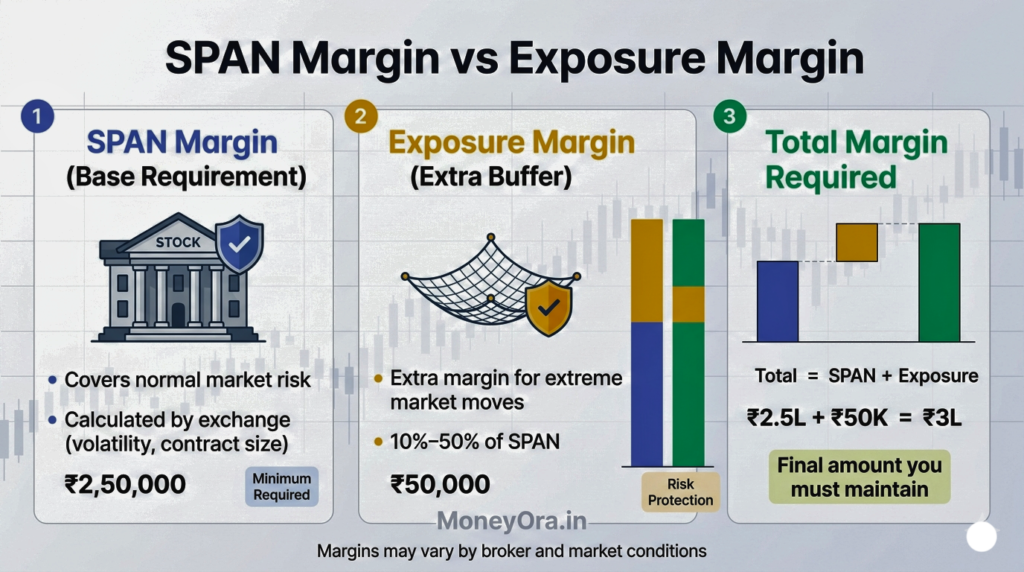
SPAN Margin = The standard minimum margin for your position. SPAN stands for Standardized Portfolio Analysis. It’s what the stock exchange requires brokers to collect. SPAN covers “normal” market moves.
Think of it as the baseline. Your broker checks the contract specifications, volatility history, and size of your position. Then they calculate: you need ₹15,000 SPAN margin minimum to hold this futures contract.
Exposure Margin = Extra buffer on top of SPAN. Different brokers set this differently, but it usually ranges from 10-50% of SPAN. If your SPAN margin is ₹15,000, exposure might add another ₹5,000 to ₹7,500.
Why both? Because SPAN assumes one thing doesn’t change overnight. But in reality, extreme events happen. Liquidity dries up. Gaps occur. Exposure margin is the safety net for those “wait, that actually happened?” moments.
Total Margin = SPAN Margin + Exposure Margin
Our margin calculator combines both automatically, so you see the real number your broker will charge.
Example:
– SPAN margin for 1 Nifty futures: ₹2.5 lakh
– Exposure margin (20% of SPAN): ₹50,000
– Total margin required: ₹3 lakh
Now you know exactly what to keep in your account.
Equity Margin vs F&O Margin—Which Applies to You?
These are completely different animals, and traders often confuse them.
Equity Margin (Intraday Margin)
Used for buying stocks on the same day you sell them. Classic day trading.
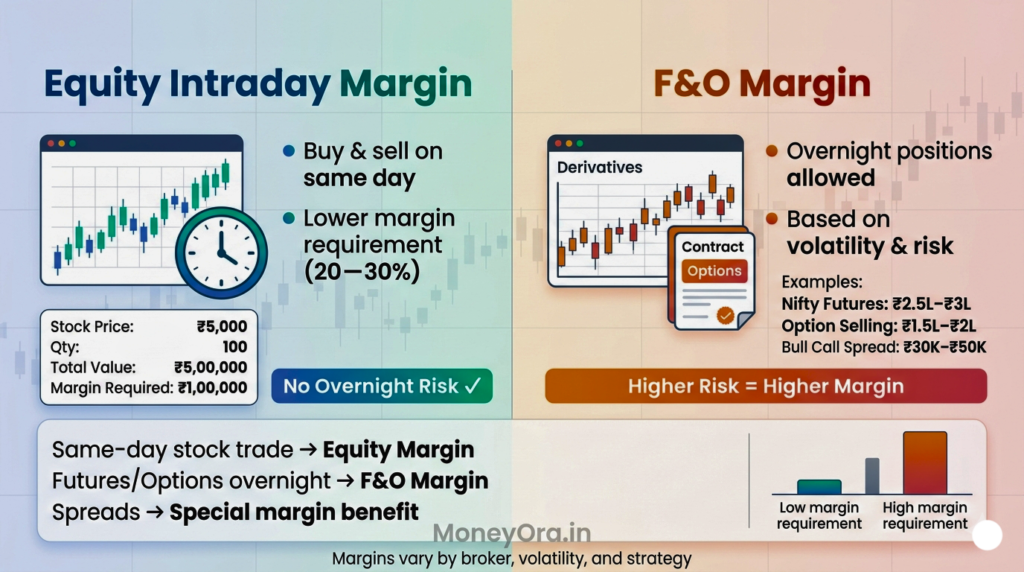
Margin for equity is usually much lower because you’re closing the position before market close. No overnight risk, so brokers require less safety buffer. You might need only 20-30% of the stock’s value as margin.
Example:
– Stock price: ₹5,000 per share
– Quantity: 100 shares
– Total value: ₹5,00,000
– Intraday margin required: ₹1 lakh (20%)
– You can hold this trade with only ₹1 lakh in your account
F&O Margin (Futures & Options)
Required for contracts that can stay open overnight. Different calculation entirely.
F&O margin depends on the contract’s volatility and risk profile. “understand brokerage charges before you trade on margin” Options are riskier than futures, so they require more margin. Spreads (multi-leg strategies) sometimes require less margin than single positions.
Example:
– 1 Nifty futures contract: ₹2.5-3 lakh margin
– 1 ATM call option (selling): ₹1.5-2 lakh margin
– 1 Bull call spread: ₹30,000-50,000 margin (protected)
Our calculator handles both. Input whether you’re doing equity intraday or F&O, and we show the right margin.
Which one applies to your trade?
– Buying stock and selling same day = Equity intraday margin
– Holding futures or options overnight = F&O margin
– Multi-leg strategies (spreads) = Special F&O margin calculation
How Does the Margin Calculator Work?
Using our calculator takes 60 seconds. Here’s the exact process:
Step 1: Choose Your Instrument
Select what you’re trading:
– Equity (stocks)
– Futures (Nifty, Banknifty, etc.)
– Options (call or put)
– Spread strategies (bull call, iron condor, etc.)
Step 2: Enter Contract Details
Type in the specifics:
– Quantity (how many shares or contracts)
– Price (at what level you’re entering)
– Strike price (for options)
– Spot price (current market rate)
Step 3: Select Your Broker
Different brokers calculate margin slightly differently because exposure margin varies. We have Zerodha, Angel One, Upstox, Fyers preloaded. If your broker isn’t listed, use the manual entry.
Step 4: Let It Calculate
Click “Calculate Margin” and we show you:
– SPAN margin
– Exposure margin
– Total margin required
– Leverage provided
– Margin utilization if you enter your account balance
That’s it. Now you know if you have enough margin to place this trade, or if you need to deposit more.
No formulas to memorize. No spreadsheets. Just straight answers. https://www.sebi.gov.in/
Premium Receivable & Spread Benefit—Advanced Margin Concepts
Once you master basic margin, you notice traders using fancy terms: premium receivable, spread benefit. Here’s what they mean and why they matter.
Premium Receivable (Options Selling)
When you *sell* an option, you get paid immediately. This money reduces your margin requirement.
Example:
– You sell 1 Nifty call option
– Buyer pays you ₹5,000 (the premium)
– Your margin requirement: ₹2 lakh
– But that ₹5,000 premium counts as credit in your account
– Effective margin needed: ₹1.95 lakh
The calculator automatically accounts for premium received and deducted from your total margin.
Spread Benefit (Multi-Leg Strategies)
When you combine two related positions (like selling a call AND buying a call at a higher strike), the margin requirement drops dramatically because they hedge each other.
Example:
– Sell 1 Nifty call @ 20000: ₹2 lakh margin required
– Buy 1 Nifty call @ 20100: ₹1 lakh margin required
– If you did them separately: ₹3 lakh total
– If you do them as a spread: ₹70,000 total (spread benefit)
The spread benefit recognizes that your loss on one side is capped by your gain on the other. Much safer trade, much less margin.
Our calculator handles spreads automatically—you don’t need to calculate benefit manually.
When Should You Care About These?
– Premium receivable: Every time you sell options
– Spread benefit: When you’re doing multi-leg strategies (bull call spreads, iron condors, calendar spreads, etc.)
These are the advanced moves that separate casual traders from people who actually manage risk professionally. https://www.rbi.org.in/
How Much Margin Do You Actually Need? (Real Examples)
Theory is fine, but here’s what real traders actually deal with:
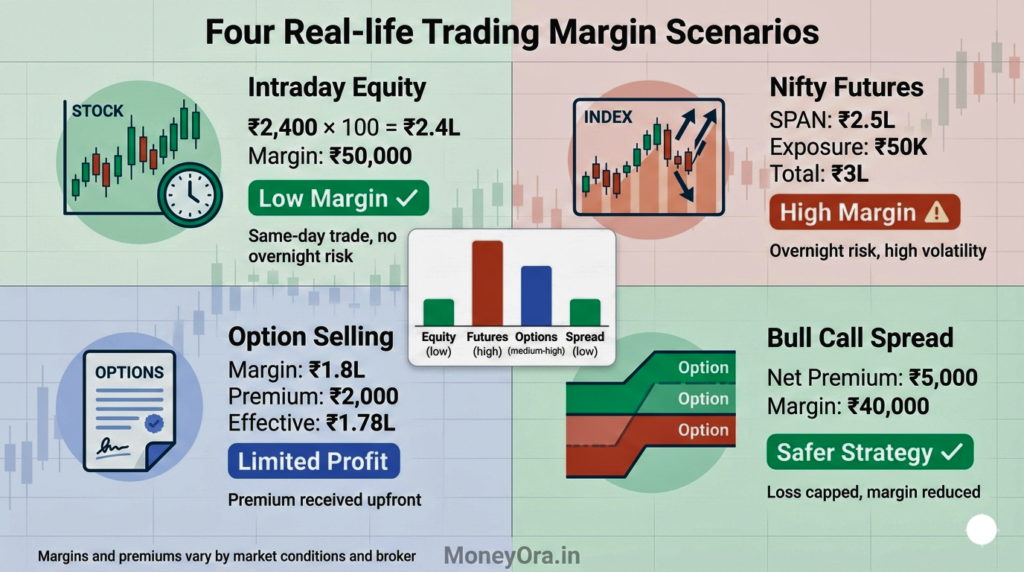
Example 1: Intraday Equity Trading
You want to buy RELIANCE stock at ₹2,400 for 100 shares (₹2,40,000 total).
– Intraday margin required: ₹50,000 (20-25% typical)
– You close it same day
– No overnight risk, low margin
Example 2: Nifty 50 Futures (Overnight Hold)
You buy 1 Nifty futures contract at 21,000.
– SPAN margin: ₹2.5 lakh
– Exposure margin (20%): ₹50,000
– Total: ₹3 lakh minimum
– You hold overnight
– Volatility could swing ₹1 lakh in either direction
Example 3: Selling a Call Option
You sell 1 Nifty 22000 call, get ₹2,000 premium.
– Margin required: ₹1.8 lakh
– Premium received: ₹2,000
– Effective margin: ₹1.78 lakh
– Buyer pays you upfront
– Limited profit, but defined and calculated upfront
Example 4: Bull Call Spread (Safer Strategy)
You sell 1 Nifty 21000 call @ ₹1,200 (get ₹12,000)
You buy 1 Nifty 21100 call @ ₹700 (pay ₹7,000)
Net received: ₹5,000
– Margin for naked calls: ₹3.5 lakh (total)
– Margin for spread: ₹40,000
– Spread benefit saves you ₹3,10,000
– Your profit is capped at ₹5,000, but loss is also capped
– Much safer trade, minimal margin
These aren’t arbitrary examples—they’re what traders literally face every day.
https://moneyora.in/nps-calculator/ Why: Serious traders think about long-term wealth, not just speculation
Why Margin Matters More Than You Think
You know what kills trading accounts? Not bad picks. Not unlucky trades. Bad margin management.
Here’s the brutal sequence:
1. Trader has ₹5,00,000
2. Wants to trade ₹50,00,000 worth of futures (10x leverage)
3. Calculates margin wrong or ignores it
4. Market moves 2% against them
5. Margin call hits
6. Broker liquidates entire position
7. Losses hit ₹50,000+
8. Account wiped in one trade
This happens because traders treat margin as “optional complexity” instead of “the foundation of not blowing up.”
Smart traders:
– Know their margin before placing any trade
– Keep buffer margin (never use 100% of available)
– Scale position size to their account (not the other way around)
– Understand that leverage multiplies both gains AND losses
– Use our calculator to confirm before hitting enter
Dumb traders:
– Ignore margin until broker sends liquidation notice
– Go all-in on every trade (emotional, not mathematical)
– Don’t understand SPAN vs exposure
– Think “margin available” means “margin I should use”
– Get surprised when losses compound fast
The margin calculator isn’t just a tool—it’s a reality check. It forces you to think before you trade.
https://moneyora.in/fd-calculator Why: Risk-aware traders also think about conservative investments
Margin Calculator Across All Trading Platforms
Your broker might be Zerodha, Angel One, Upstox, Fyers, or someone else. Margin requirements vary slightly because each broker sets exposure margin differently.
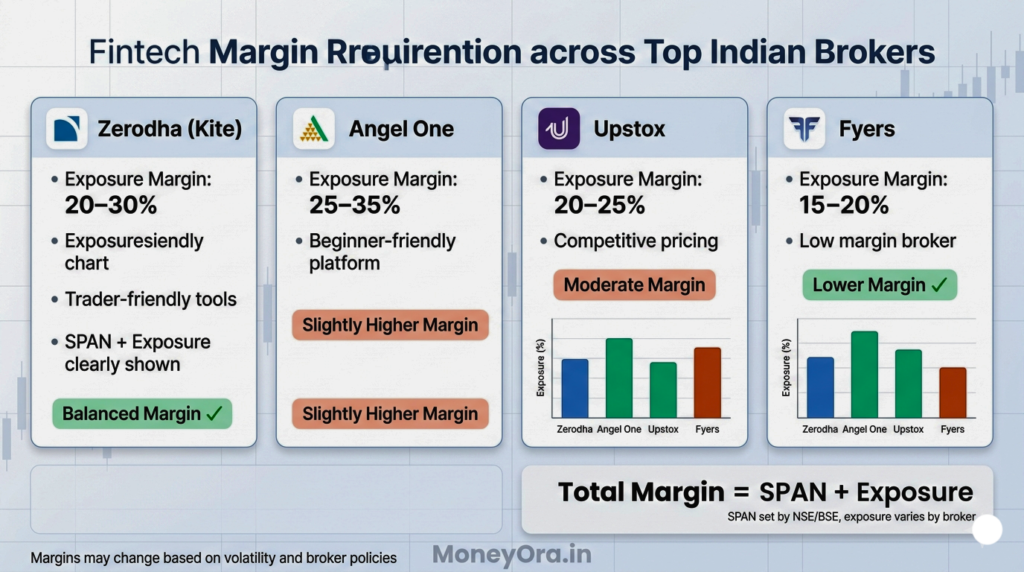
Zerodha (Kite platform)
– Most trader-friendly margin calculator
– Shows SPAN + exposure separately
– Advanced tools for spreads
– Exposure margin: typically 20-30% of SPAN
– MoneyOra calculator supports Zerodha’s methodology
Angel One (Angel Broking)
– Slightly higher exposure margins than Zerodha
– Good for beginner traders
– Exposure margin: 25-35% of SPAN
– We support Angel One’s structure
Upstox
– Competitive margin rates
– Growing trader base
– Exposure margin: 20-25% of SPAN
– Built into our calculator
Fyers
– Low margin broker
– Exposure margin: 15-20% of SPAN
– Calculator supports Fyers rates
Manual Calculation
If your broker isn’t listed, our calculator lets you input SPAN margin and exposure percentage. We calculate the rest.
Why the variation?
Different brokers have different regulatory mandates, risk appetites, and trading volumes. NSE/BSE set the minimum (SPAN), but brokers can require more. Use your broker’s official numbers for precision, but our calculator gives you the ballpark figure instantly.
Pro Tip: Check your broker’s official margin calculator first. Use ours to double-check and compare across brokers before you switch.
Common Margin Mistakes (And How to Avoid Them)
After talking to hundreds of traders, the same mistakes keep coming up:
Mistake 1: Confusing Margin Available with Margin You Should Use
You have ₹5,00,000 account.
Broker shows “₹4,50,000 available margin.”
You think: “I can use all of it!”
You can. But you shouldn’t.
Smart traders keep 20-30% buffer. If market moves against you, you don’t want a margin call. The calculator shows what you *need*, not what you can *stretch* to use.
Mistake 2: Ignoring Overnight Risk
Intraday trading? Margin is low because you close same day.
Overnight hold? Margin doubles or triples because risk compounds.
Same position size, totally different margin. The calculator switches based on your timeframe.
Mistake 3: Using the Wrong Margin for Your Broker
You look at Zerodha’s margin, then trade with Angel One.
Angel One charges 30% more exposure margin.
Your calculation was off by ₹50,000.
You can’t take the trade.
Solution: Select your actual broker in our calculator. It adjusts automatically.
Mistake 4: Not Accounting for Premium When Selling Options
You think: “If I sell this call, I need full margin.”
Wrong. The premium reduces margin.
You sell a call, get ₹10,000 premium.
Margin needed: ₹2 lakh
With premium credit: ₹1.9 lakh
The calculator subtracts premium automatically. Your effective margin is lower.
Mistake 5: Thinking Leverage = Free Money
10x leverage doesn’t mean “win 10x bigger.”
It means “lose 10x faster too.”
You control position size, not markets. Use the calculator to size positions based on *your account*, not on available leverage.
Mistake 6: Placing Spreads Without Understanding Spread Benefit
You sell a call and buy a call. Separately, you’d need ₹3,50,000 margin.
Together? ₹50,000.
But you won’t know unless you calculate it correctly.
Our calculator computes spread benefit for you.
How to Use the Margin Calculator Step-by-Step
Real walkthrough (5 minutes, 4 steps):
STEP 1: Open the Calculator
Go to MoneyOra margin calculator page. You see:
– Instrument type (dropdown)
– Contract details (input fields)
– Broker selection
– Calculate button
STEP 2: Pick Your Instrument
Let’s say you’re doing Nifty 50 futures.
Click “Instrument Type” → Select “Futures”
Then select “Nifty 50” from the contract list
STEP 3: Enter Your Position Details
– Quantity: 1 (1 Nifty contract)
– Price: 21,500 (entry price)
– Broker: Zerodha (select from dropdown)
STEP 4: Hit Calculate
Results appear:
– SPAN Margin: ₹2,50,000
– Exposure Margin (20%): ₹50,000- Total Margin Required: ₹3,00,000
– Leverage provided: 7x (account value ÷ margin)
– Margin utilization: Shows what % of your account this uses
Now what?
– If you have ₹5,00,000 account, this trade uses 60% of available margin
– Safe trade—plenty of buffer
– If you have ₹3,00,000 account, you’re at 100%
– Not safe—no room for adverse movement
For Multi-Leg Spreads:
Same process, but add second leg:
– Sell 1 Nifty 21500 call
– Buy 1 Nifty 21600 call
– Calculator shows spread benefit separately
– Margin cuts from ₹3.5 lakh to ₹75,000
That’s literally all there is. Most traders overthink margin. The calculator removes that overthinking.
Margin Calculator vs Manual Calculation—Why Use Ours?
You could calculate margin manually. Here’s why you shouldn’t:
Manual Calculation Takes:
– Looking up current contract specs: 2 minutes
– Finding SPAN margin tables: 2 minutes
– Calculating exposure margin (multiply by percentage): 1 minute
– Adding them together: 1 minute
– Double-checking your math: 2 minutes
– Total: 8 minutes per trade
Do this 10 times a day and you’re wasting 80 minutes daily.
Our Calculator Takes:
– Input details: 1 minute
– Click calculate: 10 seconds
– Total: ~1.5 minutes
Plus:
– No mental math errors
– Handles complex spreads automatically
– Adjusts for premium automatically
– Accounts for different broker policies
– Saves results so you can reference later
You’re trading, not doing accounting. The calculator frees up mental energy for what actually matters—reading charts, managing positions, staying disciplined.
Real Example:
Trader places 8 F&O trades in a day.
– Manual calculation: 64 minutes wasted
– Our calculator: 12 minutes
– Time saved: 52 minutes
In that 52 minutes, you could actually analyze setups, manage risk, or just take a break. All things better than recalculating margin you already knew.
That’s why traders use calculators. Not because it’s complicated, but because it’s faster and removes human error. https://en.wikipedia.org/wiki/Margin_(finance)
Margin Calculator FAQs
Margin is money your broker holds as security.
It protects both you and the broker.
It is used if the trade moves against you.
You do not own this money.
It acts as a cushion to cover losses.
Margin depends on whether you are buying or selling options.
Buying options requires low margin.
Usually only the premium paid.
Selling options requires high margin.
It can be ₹1–2 lakh per Nifty option.
This depends on strike price and broker.
SPAN margin is the minimum required by the exchange.
It is calculated based on volatility and contract size.
Exposure margin is an extra buffer added by the broker.
It is usually 10–50% of SPAN margin.
Total margin = SPAN + Exposure margin.
Total Margin = SPAN Margin + (Exposure Margin Rate × SPAN Margin).
Example: ₹2,50,000 + (20% × ₹2,50,000) = ₹3,00,000.
You can also use a margin calculator for instant results.
Intraday margin is lower than delivery margin.
It applies when you buy and sell on the same day.
It is usually 20–30% of stock value.
This is because there is no overnight risk.
Options can move more sharply than futures.
Sellers face unlimited loss risk.
Exchange rules require higher margin for protection.
Spreads reduce margin because risk is limited.
Your broker will block new trades.
If margin falls due to losses, you get a margin call.
You must add funds immediately.
If not, the broker will liquidate your position.
Yes, premium reduces margin.
When you sell options, you receive premium.
This amount is credited to your account.
It lowers your effective margin requirement.
Spread benefit reduces margin in multi-leg strategies.
Examples include bull call spreads and iron condors.
Both legs hedge each other.
This reduces overall risk.
Margin can drop significantly compared to naked positions.
Leverage = Account Balance ÷ Margin Required.
Example: ₹5,00,000 ÷ ₹1,00,000 = 5x leverage.
This means you control more value with less capital.
But losses also multiply.
Leverage is not free money.
No, always keep a buffer.
Professional traders keep 20–30% margin unused.
This protects against sudden market moves.
Using full margin increases risk significantly.
Both use similar calculation logic.
But brokers may use different exposure margins.
MoneyOra allows you to select your broker.
You can also enter custom margin values.
This gives more flexibility and comparison options.