

What Happens to Your Mutual Fund if the AMC Shuts Down?
- What happens to mutual fund if AMC shuts down is one of the most misunderstood topics in Indian personal finance
- The AMC does not hold your money at all. A separate SEBI-registered Custodian does
- SEBI operates a mandatory 3-layer protection structure involving the Trustee Company, the Custodian, and direct regulatory oversight
- 4 real Indian AMC closures happened since 2014 and investor money was protected in every single case
- The real risk to your mutual fund is market performance and debt fund credit quality, not AMC closure
- There is a 30-day no-exit-load window any time SEBI mandates a scheme transfer or merger
The question of what happens to mutual fund if AMC shuts down comes up every single time a financial company makes the news in India. You are running a SIP. You hear that SEBI has cancelled some fund house’s registration. The newspaper says “investors’ money is safe” but gives no explanation. You are left wondering whether that is actually true or just a reassuring line.
This article gives you the real answer. It covers what happens to mutual fund if AMC shuts down using SEBI’s actual regulatory framework, four documented Indian cases where AMCs did close, the one risk most investors never factor in, and a section covering gaps that every other article on this topic leaves out entirely.
If you are thinking about your broader financial plan alongside your mutual fund investments, the financial planning guide on MoneyOra walks through how to build a full plan around both investment goals and protection.
The Fear Behind This Question
Most people who search for what happens to mutual fund if AMC shuts down are not asking out of theoretical curiosity. Something specific triggered the search. A news headline about regulatory action on a fund house. A WhatsApp forward saying a particular AMC is in trouble. A friend who works in finance saying something ominous about the market.
The fear is understandable and completely rational. You have put real money in. SIPs running for years. A lump sum from a bonus. Money meant for a child’s education or your own retirement. When the entity managing that money is in the news for the wrong reasons, the instinct is to panic.
Here is what this article will show you. What happens to mutual fund if AMC shuts down is actually one of the better-protected scenarios in Indian investing. The structural design of the Indian mutual fund industry, as mandated by SEBI since 1996, makes it nearly impossible for an AMC closure to wipe out your invested corpus. The same cannot be said for market risk or debt fund credit risk, which are the actual threats most investors should spend their energy on.
Read this once and you will never need to panic-search this topic again.
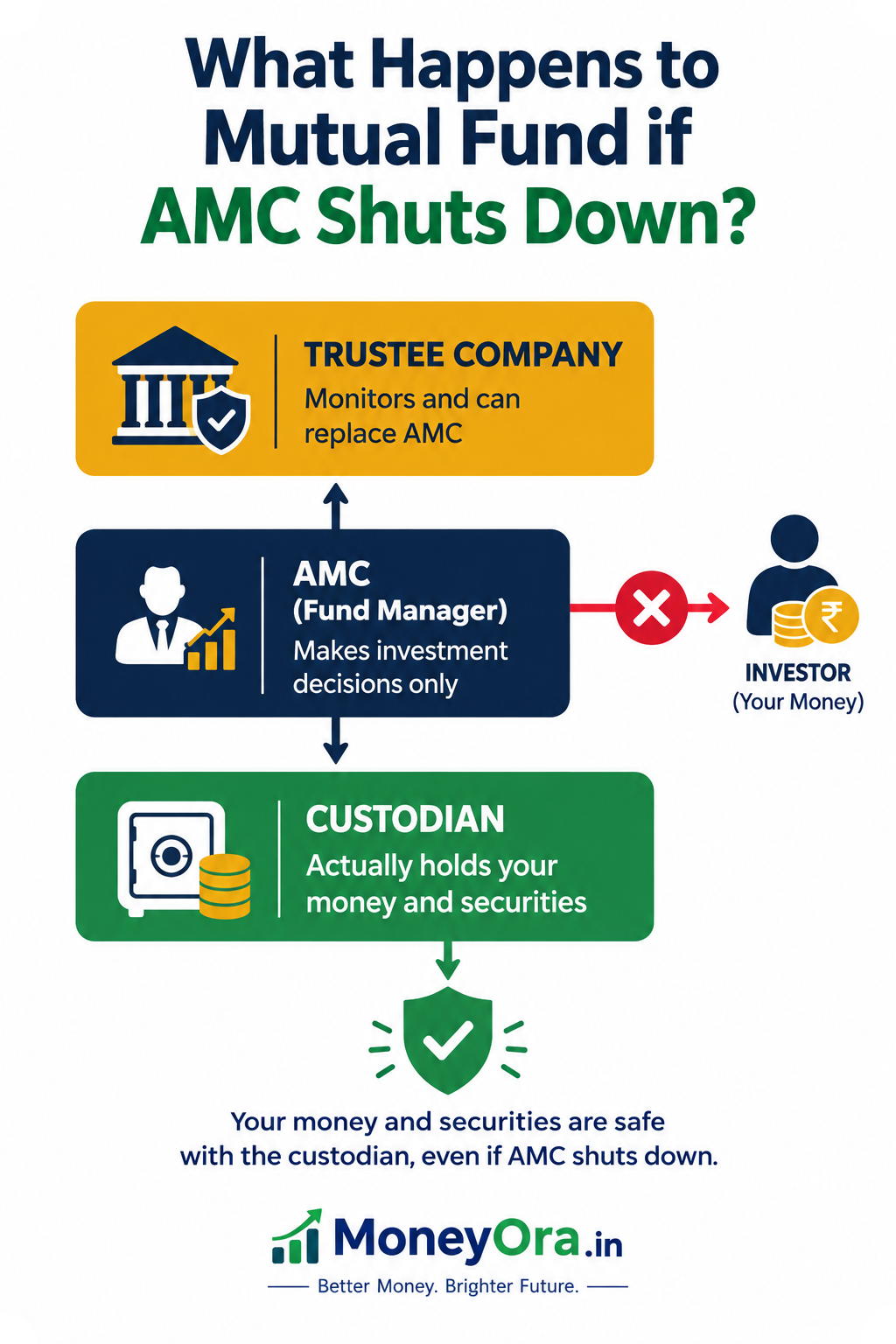
SEBI’s mandatory 3-layer structure keeps your mutual fund money ring-fenced from the AMC’s business operations at all times.
Who Actually Holds Your Mutual Fund Money
Understanding what happens to mutual fund if AMC shuts down starts with understanding a basic structural fact that most investors never learn the AMC does not hold your money.
When you invest in any Indian mutual fund, three completely separate legal entities are involved Most investors think there is only one That misunderstanding is the entire reason this question causes so much anxiety.
Entity 1: The AMC
HDFC Asset Management Company, SBI Funds Management, Nippon India Mutual Fund, Mirae Asset and every other fund house you have heard of These are Asset Management Companies Their job is to manage your money They decide which stocks to buy, when to rebalance a portfolio, how to respond to market conditions But they do not hold your money in any direct sense Think of the AMC as a fund manager you hire They make investment calls, but they cannot open a drawer and take out your cash.
Entity 2: The Trustee Company
Every AMC in India must have a separate Trustee Company by law under SEBI (Mutual Funds) Regulations, 1996 This entity sits above the AMC and exists specifically to protect investor interests The Trustee Board can and does override AMC decisions if those decisions threaten investor money In theory the Trustees can fire the AMC and appoint a replacement.
HDFC Trustee Company Limited is a separate legal entity from HDFC Asset Management Company Limited. Different boards, different registration, different legal accountability This is not a technicality It is the first line of defence in understanding what happens to mutual fund if AMC shuts down.
Entity 3: The Custodian
This is where your money actually lives. A SEBI-registered Custodian physically holds all the securities that your mutual fund scheme has purchased on your behalf. Stocks, bonds, government securities, money market instruments, all of which sit in a segregated account in the name of the mutual fund scheme, not in the name of the AMC.
India’s major custodians include HDFC Bank, Deutsche Bank India, Citibank India, and ICICI Bank. These are separately regulated entities with no dependency on the AMC’s financial health. The SEBI (Custodian) Regulations, 1996, last amended in September 2025, govern how custodians operate and protect investor assets.
The key point for understanding what happens to mutual fund if AMC shuts down: even if the AMC disappears entirely tonight, the Custodian still holds every unit of every security in your scheme. The AMC never had the ability to withdraw your assets.
For investors tracking multiple financial products at once, the FD versus Liquid Fund comparison on MoneyOra is useful context for understanding how custodial protection differs between bank deposits and mutual funds.

Your mutual fund investment passes through three independent entities. The Custodian holds the actual securities and remains independent of the AMC’s corporate finances entirely.
SEBIs 3-Layer Protection Structure
What happens to mutual fund if AMC shuts down is governed by a framework that SEBI has kept in place since 1996. The SEBI ( Funds) Regulations 1996 require every Indian mutual fund to operate through a three-party structure. This structure is built specifically to make sure no single entity can take control of investor money in a way.
Here is what each layer does and why removing any one of them would make the system unsafe.
Layer 1: The Trustee Company
The Trustee Company is the owner of the mutual fund. It holds the assets in trust for the benefit of the unit holders. The AMC works under a contract with the Trustee Company. If the Trustee Company sees that the AMC is not acting in the interest of investors it can end that contract and bring in a new AMC. The Trustees must report to SEBI every six months. They also have to confirm that the AMC has followed all the rules.
Layer 2: The AMC with Restricted Powers
The AMC has the power to make investment decisions. It does not have custody of the assets. This is not a rule that makes things difficult. It is a regulatory requirement. The AMC cannot move securities into its name. It cannot use the money from the mutual fund schemes as security for its loans. It also cannot mix the fund money with its corporate money. This separation is required, no matter how big or small the AMC is.
Layer 3: The Independent Custodian
The Custodian carries out trades as instructed by the AMC.. It holds the securities that result from those trades in a separate independent account. The Custodian will not follow instructions that ask it to move investor assets to the AMC or to any party without correct permission. It operates under SEBIs rules for custodians. It keeps accounts for each mutual fund scheme.
This three-layer structure is why the situation of what happens to mutual fund if AMC shuts down does not lead to a loss of investor money. The Trustee Company stays in place. The Custodian stays in place. The only thing the AMCs closure takes away is the job of managing the fund. SEBI steps in, to either choose a manager or to close the scheme in a fair and organized way.
What Exactly Happens When an AMC Shuts Down
When an AMC in India closes, whether by choice or by SEBI direction, there is a defined process. Understanding this process gives you the clearest possible answer to what happens to mutual fund if AMC shuts down.
SEBI prefers three outcomes in order of preference.
Option A: Scheme Transfer to Another AMC
This is what happens to mutual fund if AMC shuts down in the majority of cases. SEBI identifies a suitable fund house and mandates that the closing AMC’s schemes transfer to the new manager. Your NAV continues to be calculated and published daily. Your SIP continues without interruption. You receive a formal communication saying your scheme is now managed by a different AMC. No money is lost. No redemption is forced. Your units remain exactly as they were.
Option B: Scheme Merger Into an Existing Fund
If a direct scheme transfer is not structurally possible, SEBI may direct that the closing AMC’s schemes merge into similar schemes at a healthy fund house. In this case you receive units in the absorbing scheme at a NAV equivalent to your original investment value. You retain your money, you just hold it in a different scheme wrapper going forward.
Option C: Scheme Wind-Up
This is the last resort in the question of what happens to mutual fund if AMC shuts down. If neither transfer nor merger is feasible, SEBI directs the Custodian to liquidate all securities in the scheme at prevailing market prices. The proceeds are distributed to investors in proportion to their unit holdings at the then-current NAV. Investors get their money back. The NAV at that moment reflects current market prices for the underlying securities, not some arbitrary value decided by the AMC.
In every scenario, SEBI supervises the process. The AMC’s corporate finances, whatever state they are in, never touch the scheme assets. The answer to what happens to mutual fund if AMC shuts down is never “investors lose their money because the AMC collapsed.”
Investors curious about how systematic withdrawal plans interact with these protections can review the SWP in demat mutual funds explainer on MoneyOra for context on how SEBI supervises withdrawal structures.
4 Real AMC Closures in India and What Investors Experienced
Theory is useful. What actually happened to real investors when fund houses closed in India answers the question of what happens to mutual fund if AMC shuts down more convincingly than any regulatory explanation can.
Case 1: Sahara Mutual Fund (2015)
SEBI cancelled Sahara Asset Management Company’s registration following regulatory violations. This was not a voluntary exit. The regulator forcibly closed the AMC. SEBI mandated that Sahara’s mutual fund schemes transfer to Kotak Mahindra Mutual Fund. Every Sahara investor was migrated to equivalent Kotak schemes at fair NAV. Zero investor money was lost in the transition. The Custodian held the assets throughout and transferred them to Kotak’s custodial arrangement without any disruption to the underlying securities.
Case 2: Morgan Stanley Mutual Fund India (2014)
Morgan Stanley decided to exit the Indian mutual fund business entirely. Their India MF schemes transferred to HDFC Mutual Fund. Investors who chose not to exit at the time of the announcement simply held their positions and watched their units convert to equivalent HDFC MF units at the same NAV. The transition was orderly because SEBI’s oversight ensured it was.
Case 3: Goldman Sachs Mutual Fund India (2017)
Goldman Sachs exited the Indian AMC business. Their schemes transferred to Reliance Nippon Life Asset Management, now operating as Nippon India Mutual Fund. Again, scheme transfer was entirely seamless for investors who stayed. The question of what happens to mutual fund if AMC shuts down in this case had a clean answer: your units move to a new manager, nothing else changes.
Case 4: PineBridge Mutual Fund India (2015)
PineBridge Investments exited India. Schemes transferred to Kotak Mahindra Mutual Fund. No investor was forced to redeem. Investors who stayed simply continued their positions under Kotak’s management.
The pattern across all four cases is consistent. What happens to mutual fund if AMC shuts down in India: the scheme transfers to a larger, healthier AMC. Investor money continues working. Losses from the closure itself: zero across all four documented cases.

In all 4 documented AMC closures in India since 2014, investor money was protected through SEBI-supervised scheme transfers. Not a single rupee was lost due to the closure itself.
The One Risk Investors Actually Miss
Having understood what happens to mutual fund if AMC shuts down and why it is a low-probability low-impact scenario, the more useful thing to understand is where the real risk in mutual fund investing actually lives.
AMC closure is almost never the genuine threat. Two other risks are far more real.
Risk 1: Market Risk in Equity Funds
If an equity mutual fund falls 30%, that loss is real and permanent until the market recovers. The stocks in the fund lost value. This has nothing to do with what happens to mutual fund if AMC shuts down. Even the most reputable AMC in India cannot protect you from market drawdowns because the scheme holds market-linked securities. This is exactly the risk that every mutual fund SID and advertisement refers to when it says “mutual fund investments are subject to market risk.”
Understanding how SIPs perform during market crashes on MoneyOra is a more relevant study for equity fund investors than spending energy worrying about AMC closure.
Risk 2: Credit Risk in Debt Funds
In debt mutual funds, the risk that matters is whether the companies whose bonds the scheme holds will repay their debts. If a bond issuer defaults, that loss flows directly to investors in the scheme. The AMC is not at fault. The AMC did not steal the money. A corporate borrower failed to repay, and the fund absorbed that loss.
Franklin Templeton India demonstrated this in April 2020. Franklin India shut down 6 of its debt schemes, not because the AMC itself was in financial trouble, but because the underlying bonds in those schemes became illiquid. There was no market buyer for those bonds and the fund could not meet redemption requests. Under SEBI and Supreme Court supervision, unit holders received their money in tranches over roughly 2 years as the bonds were repaid or sold. Most investors received 90 to 95 percent of their invested amount. Some took a loss on papers that defaulted entirely.
This was not what happens to mutual fund if AMC shuts down in the sense people fear. Franklin Templeton India AMC continued operating and still manages other schemes today. The 6 schemes closed because their underlying assets failed, not because the company failed.
The lesson from this research the scheme’s underlying holdings, not just the AMC’s brand name. A household-name AMC running a high-risk debt fund is riskier than a smaller AMC running a liquid fund with short-duration government paper.
What Most Articles Never Tell You About AMC Closure
Every competitor article on what happens to mutual fund if AMC shuts down covers the basics your money is safe, SEBI protects you, here is the three-layer structure. None of them explain the specific things that actually go wrong for investors in these transitions or the rights investors have that most people never exercise. This section fills those gaps.
Gap 1: The 30-Day Exit Window Is a Right, Not a Courtesy
This is one detail that every investor asking what happens to mutual fund if AMC shuts down deserves to know in advance. When SEBI mandates a scheme merger or transfer, investors receive a formal notice and a window of typically 30 days to exit the scheme with no exit load applied. This is a regulatory right under SEBI circular guidelines, not a goodwill gesture from the incoming AMC. If you receive a scheme merger letter and the new AMC’s investment style or fund manager does not match your original choice, you can exit without paying the 1 percent or higher exit load that normally applies to early redemption. Most investors miss this because they discard the letter as routine communication.
Gap 2: Your Units Do Not Transfer Unless You Have Updated KYC
What happens to mutual fund if AMC shuts down and your contact details in the MF registry are outdated: the transfer happens without your receiving notification. Your money moves to the new AMC correctly, but you find out about it months later when you check your CAMS statement. This creates no financial loss but it creates confusion and in some cases investors attempt to contact the old AMC, find nobody there, and assume something has gone wrong when in fact everything went right. Keep your KYC contact details current at all times via CAMS (camsonline.com) or KFintech.
Gap 3: Tax Treatment of AMC-Mandated Transfers Is Neutral
A mandatory scheme transfer or merger triggered by AMC closure does not constitute a taxable redemption. SEBI’s framework treats these transfers as continuations of the original investment. Your original purchase date is preserved for the purpose of calculating long-term capital gains eligibility. An investor who has held equity fund units for 11 months at the time of a forced merger retains that 11-month holding period in the new scheme. They do not reset to zero. This distinction is critical for anyone who has held units for close to the 12-month LTCG threshold.
Gap 4: Nominee Registration Protects Your Family During AMC Transitions
If an AMC closes while you are holding units without a registered nominee, the transfer to the new AMC happens correctly but your family’s access to those units in the event of your death becomes a lengthier legal process. Nominee registration is always good practice but it matters especially when a transition event creates a window where administrative processes are in flux. Read SEBI’s guidance on mutual fund nomination to understand what the SEBI mutual fund nomination deadline means for your existing folios.
Gap 5: SIPs Stop Automatically but Corpus Remains Safe
Most articles that describe what happens to mutual fund if AMC shuts down do not clarify SIP mechanics. Your SIP mandate is linked to the AMC’s bank debit arrangement. When that AMC’s operational systems go offline, the SIP instruction linked to that AMC stops processing new investments. Money already in the scheme is unaffected and transfers to the new AMC entirely. But your SIP auto-debit ceases and must be set up fresh with the incoming AMC if you want to continue investing systematically. This is an administrative step, not a financial loss, but investors who do not take that step end up with a gap in their SIP investment timeline.
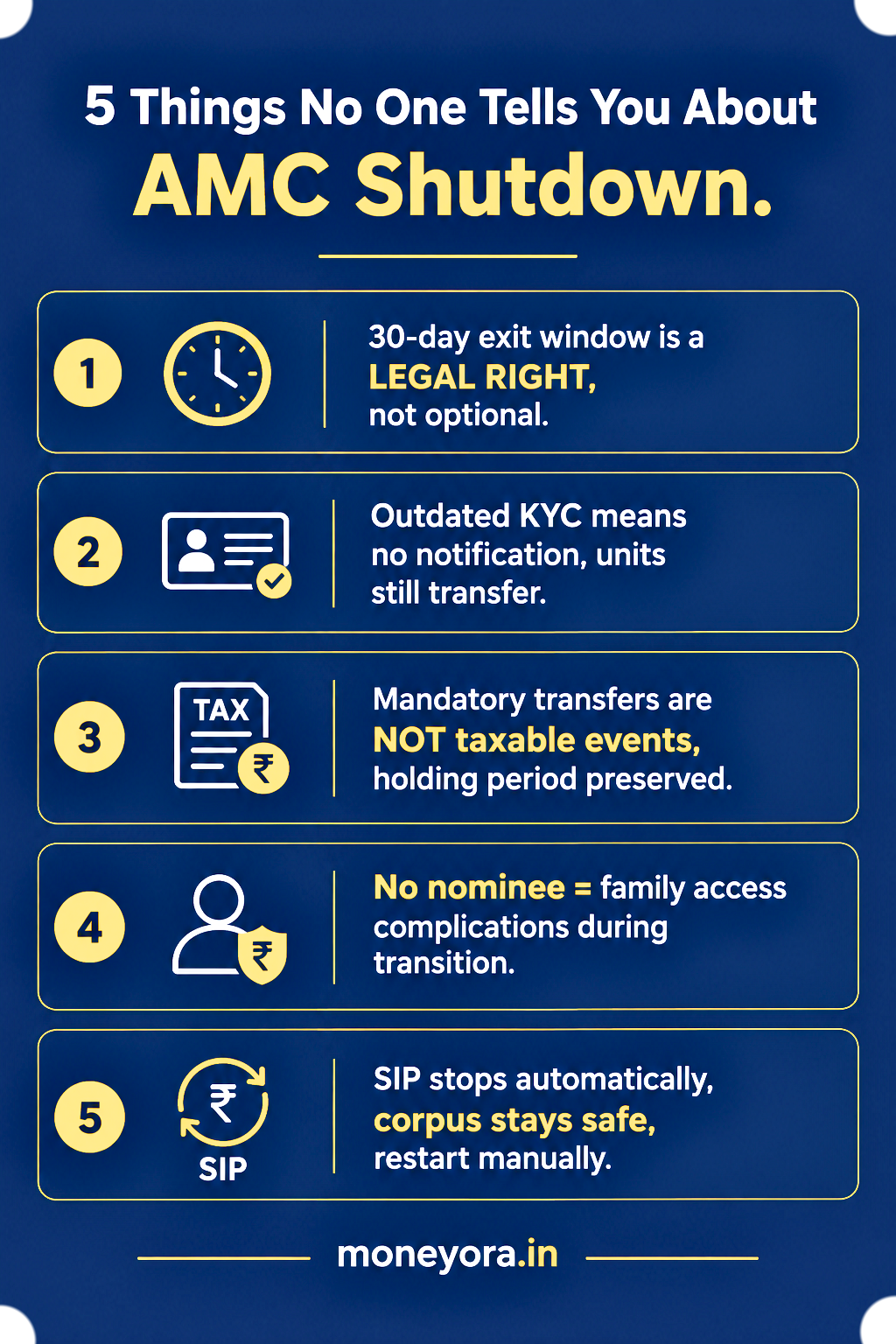
Five things no other article explains about what happens to mutual fund if AMC shuts down in India, including the 30-day exit right, tax-neutral transfer, and SIP restart requirement.
A Simple Checklist to Protect Yourself
You cannot prevent what happens to mutual fund if AMC shuts down or fully predict when an AMC might exit the market. But you can ensure that if it does happen, you face zero disruption and recover 100 percent of what is owed to you. These six steps cover everything.
- Keep KYC contact details current. Register or update your email and mobile number at CAMS (camsonline.com) or KFintech. SEBI communications about scheme changes go to your registered contact details. If those details are wrong, you miss the notification window.
- Register on MF Central. MF Central at mfcentral.com gives you a single consolidated view of all mutual fund holdings across every AMC. If one AMC closes and your scheme transfers, you see the new scheme appear automatically without needing to chase paper statements.
- Check your CAS quarterly. Your Consolidated Account Statement from CAMS or KFintech shows your exact unit holdings scheme-wise. Review it once per quarter to ensure all your schemes are where they should be.
- Know your AMC’s Trustee Company. Look this up on AMFI’s website at amfiindia.com. If you ever receive unusual communication about your AMC, you can contact the Trustee Company directly to verify its authenticity before taking any action.
- Read scheme change letters immediately. When what happens to mutual fund if AMC shuts down triggers a merger or transfer, you will receive official communication. The 30-day exit window with no exit load begins from that letter’s date. If you let it expire without reading it, you lose the fee-free exit option.
- Register a nominee for every folio. Do this today regardless of whether you expect any AMC trouble. Nomination ensures that during any transition event, the operational complexity of your family eventually accessing your units is minimized.
For investors building a complete picture of their long-term savings across instruments, the EPF vs PPF vs NPS comparison on MoneyOra is a useful next step alongside mutual fund holdings.
The Bottom Line on What Happens to Mutual Fund if AMC Shuts Down
What happens to mutual fund if AMC shuts down in India is one of the better-protected scenarios in the entire financial system. Your money is not held by the AMC. It sits with a SEBI-regulated Custodian in a segregated account that the AMC cannot access. The Trustee Company provides an oversight layer above the AMC. SEBI itself has direct authority to mandate orderly transitions.
Every documented AMC closure in India’s mutual fund history ended with investors receiving their money. Sahara, Morgan Stanley, Goldman Sachs, PineBridge: four closures, zero investor losses from the closure itself.
Spend your research energy on the risks that do affect you: market performance in equity funds and credit quality in debt funds. Those are the risks that move your actual returns. AMC closure risk, while real in theory, has never once resulted in an Indian mutual fund investor losing money solely because their fund house shut down.
Check your KYC details, register on MF Central, read your scheme communication, register a nominee. That is what investors with this knowledge actually do differently.
Use the free financial calculators on MoneyOra.in to model your investment goals alongside this understanding of mutual fund safety.
The Bottom Line on What Happens to Mutual Fund if AMC Shuts Down
What happens to Mutual fund if AMC shuts down in India is one of the better-protected scenarios in the entire financial system. Your money is not held by the AMC. It sits with a SEBI-regulated Custodian in an account that the AMC cannot access. The Trustee Company provides an oversight layer above the AMC. SEBI itself has authority to mandate orderly transitions.
Every documented AMC closure in Indias mutual fund history ended with investors receiving their money. Sahara, Morgan Stanley, Goldman Sachs, PineBridge: four closures, zero investor losses from the closure itself.
Spend your research energy on the risks that do affect you: market performance in equity funds and credit quality in debt funds. Those are the risks that move your returns. AMC closure risk, while real in theory has never once resulted in a mutual fund investor losing money solely because their fund house shut down.
Check your KYC details register on MF Central read your scheme communication register a nominee. That is what investors with this knowledge actually do differently.
Use the financial calculators on MoneyOra.in to model your investment goals alongside this understanding of mutual fund safety.
Disclaimer: This article is for purposes only and does not constitute investment advice. Mutual fund investments are subject, to market risks. Please read all scheme-related documents carefully before investing. Verify regulatory details at sebi.gov.in and amfiindia.com.
FAQ: Questions What Happens to Mutual Fund if AMC Shuts Down
Can an AMC run away with my mutual fund money?
No. The AMC does not hold your money A SEBI-registered Custodian holds all mutual fund securities in a segregated account in the name of the mutual fund scheme completely separate from the AMC’s own assets Even if every employee at the AMC disappeared overnight your securities would remain with the Custodian The AMC never had the legal access to withdraw or transfer them.
What happens to my SIP if the AMC shuts down?
Your SIP instalments stop processing when the AMC’s systems go offline Money already invested in the scheme is completely unaffected and transfers to the new AMC per SEBI instructions The corpus you have built is safe The SIP auto-debit instruction must be reactivated with the incoming AMC after the transition to resume systematic investments.
Is mutual fund money insured like a bank FD?
No. Bank deposits up to ₹5 lakh are insured under DICGC Mutual fund investments do not have deposit insurance What they have instead is structural separation the AMC does not hold your assets so AMC insolvency cannot touch your investment This protects against institutional risk It does not protect against market risk or debt fund credit risk both of which remain your exposure as an investor.
What happened to investors in Sahara Mutual Fund?
When SEBI cancelled Sahara Asset Management’s registration in 2015 after regulatory violations all Sahara mutual fund schemes transferred to Kotak Mahindra Mutual Fund Every investor was migrated at fair NAV to equivalent Kotak schemes Zero rupees of investor money was lost due to the closure This is the clearest documented answer to what happens to mutual fund if AMC shuts down under SEBI-forced closure.
Who protects mutual fund investors in India if the AMC fails?
Three entities operate in layered protection The Trustee Company acts first and can replace the AMC The SEBI-registered Custodian continues to hold your securities regardless of AMC status SEBI itself has direct regulatory authority to mandate scheme transfers mergers or wind-ups and has exercised this authority in every historical AMC closure case in India.
Is a large AMC safer than a small AMC for mutual fund investment?
In terms of what happens to mutual fund if AMC shuts down AMC size does not change your protection The SEBI regulatory framework applies equally to the largest and smallest registered AMC A large AMC is more likely to find a merger partner quickly which makes transitions smoother But a smaller AMC running a liquid fund with high-quality short-duration paper may carry less actual risk than a large AMC running a high-yield credit risk fund.
What happened to Franklin Templeton investors when those debt schemes closed?
Franklin Templeton India voluntarily wound down 6 debt schemes in April 2020 because the underlying bonds became illiquid not because the AMC itself was failing Under SEBI and Supreme Court supervision investors received their money in tranches over approximately 2 years Most investors recovered 90 to 95 percent of their invested amount Some took losses on papers that defaulted This case illustrates that what happens to mutual fund if AMC shuts down is less dangerous than what happens when the bonds inside a debt fund stop paying.
How do I check if my AMC is in good regulatory standing?
Check AMFI’s registered AMC list at amfiindia.com. All currently registered AMCs are listed You can also review SEBI’s published enforcement orders at sebi.gov.in to check if any regulatory action has been initiated against your fund house Both checks take under 5 minutes and give you accurate information directly from the regulatory source.
Does a mandatory scheme transfer count as a taxable redemption?
No. Under SEBI’s framework mandatory scheme transfers and mergers triggered by AMC closure or SEBI direction are continuations of the original investment not redemptions Your original purchase date is preserved for calculating long-term capital gains eligibility If you had held equity units for 10 months before a forced merger you enter the new scheme with 10 months of holding period intact and not starting from zero.