
SGB Premature Redemption Calculator 2026: Should You Exit Your Sovereign Gold Bond?
MoneyOra › Gold › SGB Premature Redemption Calculator
By MoneyOra Research Team | Updated September 2026 | 8 min read
- The SGB premature redemption calculator helps you compare all three exit routes RBI redemption, exchange sale and hold‑to‑maturity.
- Budget 2026 changed everything: premature redemption is now taxable at 12.5% LTCG for original subscribers.
- Only holding to 8‑year maturity keeps your gains tax‑free.
- A total of 33 SGB tranches are eligible for redemption in FY 2026‑27 with the busiest windows in April, July and August 2026.
- Missing the submission window means waiting for the eligible date. You cannot redeem on any day. Secondary market buyers face 12.5% LTCG tax, on all exits including maturity.
- No exemption applies to them. The break‑even price tool below shows what gold price makes early exit worthwhile versus waiting out the full term.
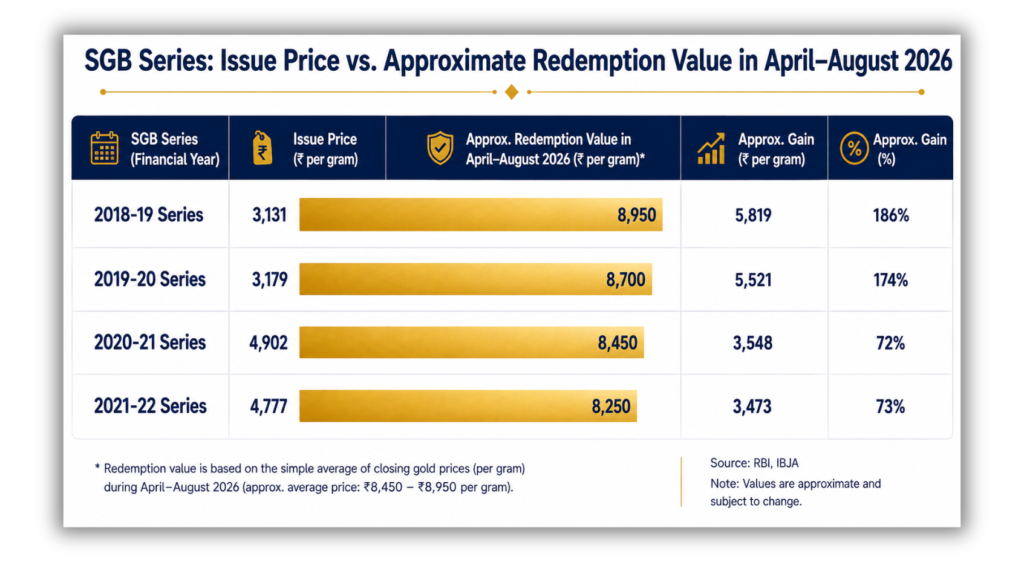
Gold has given some of its returns in ten years. People who bought Sovereign Gold Bonds from 2018 to 2021 are enjoying returns of between 150 percent and 202 percent. Now many portions of those Sovereign Gold Bonds are reaching five years. At that time the SGB premature redemption calculator is very useful.
The choice is not as simple as before. Budget for 2026 quietly changed the tax rules and many people have not seen this yet. Leaving early is no longer the tax‑free event it was before April 1 2026.
This guide will show you the numbers, the three exit options, the 2026 tax truth and a free SGB premature redemption calculator that you can use now. Before you send that redemption request make sure you have done the math. The difference between redeeming and waiting can be worth hundreds of thousands of rupees if you have a big holding.
For a view of today’s gold price look at the live gold rate tracker, on MoneyOra before you put in your numbers below.
What is SGB premature redemption?
Sovereign Gold Bonds have an 8-year tenure. But the Reserve Bank of India gives investors the option to exit early after completing five years, on specific interest payment dates. This is the premature redemption window.
The process works like this:
- The RBI announces a calendar showing which tranches are eligible and when
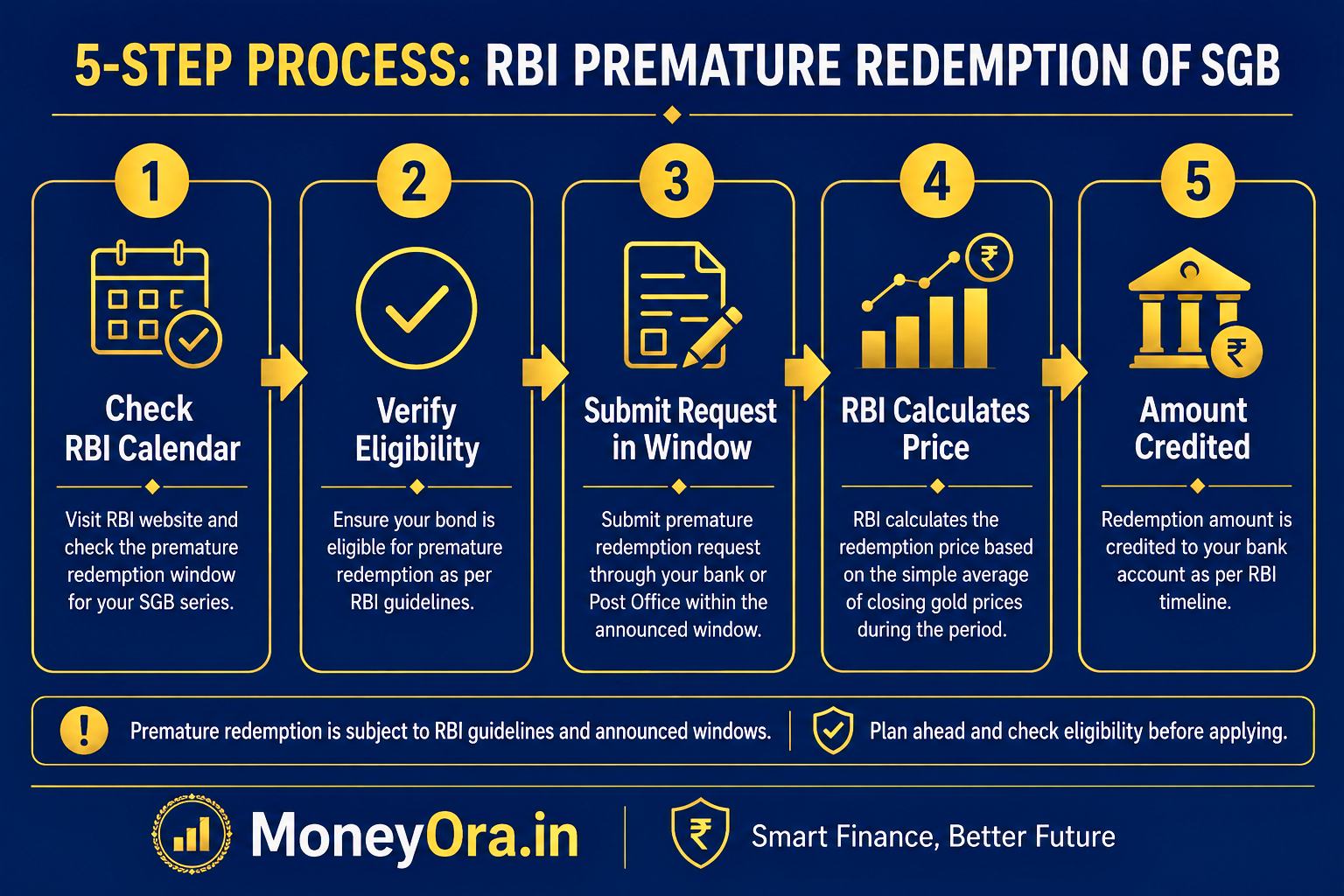
- You submit your redemption request through the bank, post office, NSDL, CDSL, or RBI Retail Direct within the specified window
- The RBI calculates the redemption price a few days before the payout date
- The amount is credited to your registered bank account
Three things matter most here. First, you cannot redeem on any date you choose. Second, missing the submission window means waiting for the next eligible date. Third, the SGB premature redemption calculator below can tell you whether the exit makes mathematical sense before you go through the process.
The SGB scheme has been effectively paused for new issuances, with no new tranches announced for FY 2026-27. That matters because if you redeem now, there is currently no way to reinvest into a new SGB at the original tax efficiency.
Free SGB Exit Decision Calculator
Free SGB Exit Decision Calculator
Compare premature redemption, maturity and exchange sale to understand your potential SGB returns and exit decision.
Find the gold price your SGB would need to reach at maturity to beat the net amount you could receive from an early exit.
Compare RBI premature redemption, holding until maturity, and selling your SGB on the exchange.
RBI Premature Redemption
Hold to Maturity
Sell on Exchange
SGB Premature Redemption Calendar 2026
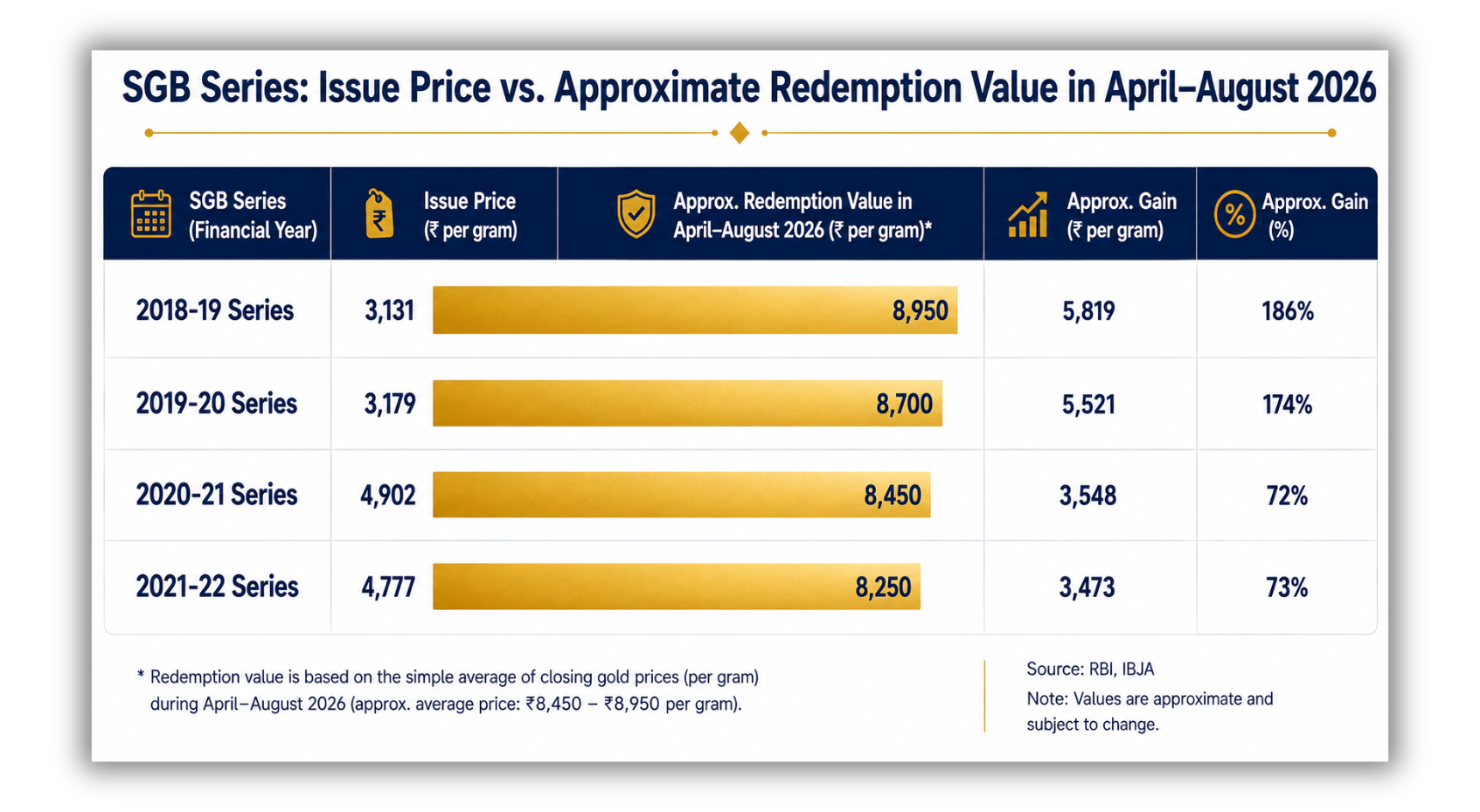
The RBI has released the schedule for April through September 2026. A total of 33 tranches from the 2018-19 through 2021-22 series are eligible for premature redemption in FY 2026-27. April, July, and August 2026 are the busiest months for redemptions.
| SGB Series | Issue Year | Approx Issue Price | Redemption Month (2026) | Returns Delivered |
|---|---|---|---|---|
| 2018-19 Series (various) | 2018 | ~₹3,119 per gram | April / July 2026 | ~200%+ |
| 2019-20 Series VIII | 2019 | ~₹3,788 per gram | July 2026 | ~195%+ |
| 2020-21 Series IV | July 2020 | ₹4,852 per gram | July 2026 | ~185%+ |
| 2020-21 Series V & VI | 2020 | ₹5,051 per gram | April 2026 | ~202% |
| 2021-22 Series IV, V, VI | 2021 | ₹4,765–5,109 per gram | Aug–Sep 2026 | ~180%+ |
The redemption price is not set at the time of application. The RBI announces it separately a few days before payout. It is calculated as the simple average of closing gold price of 999 purity published by the India Bullion and Jewellers Association (IBJA) for the three business days preceding the redemption date.
The 2026 Tax Rule Change: What Every SGB Investor Must Know
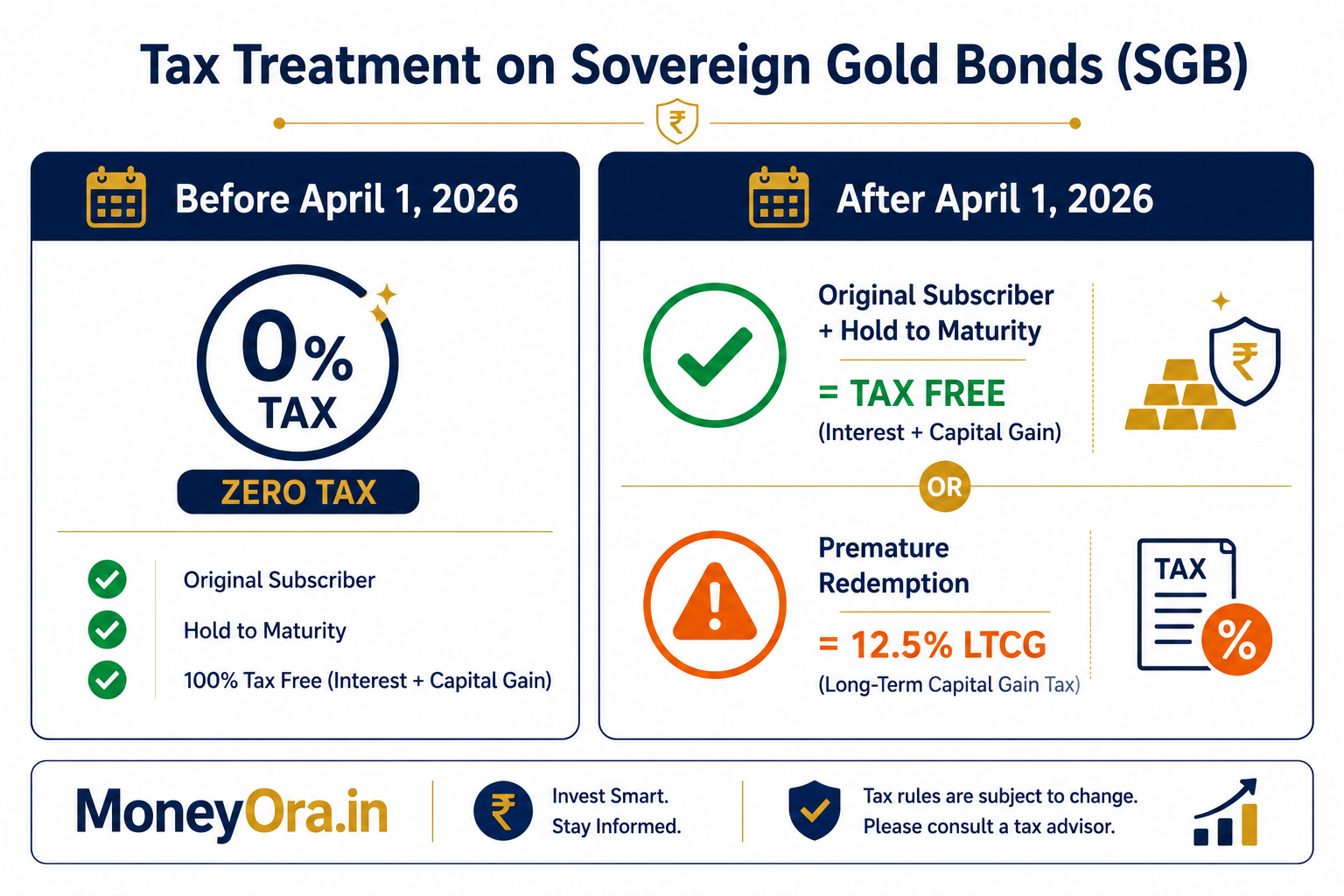
| Your Situation | Exit Route | Tax Treatment |
|---|---|---|
| Original subscriber, hold to full 8-year maturity | RBI maturity redemption | ZERO capital gains tax (fully exempt) |
| Original subscriber, exit after 5-7 years | RBI premature redemption | 12.5% LTCG (taxable from Apr 1, 2026) |
| Original subscriber, sell via NSE/BSE | Exchange sale | 12.5% LTCG if held >12 months |
| Secondary market buyer (bought from exchange) | Any route including maturity | 12.5% LTCG, no exemption at all |
The key distinction is simple. The law now requires two conditions for the exemption: you must be the original subscriber from the primary RBI issue, and you must hold the bond continuously until the 8-year maturity date. Break either condition and you owe 12.5% LTCG on the gain.
Before April 1, 2026, redemptions of any kind with the RBI were not treated as a “transfer” under the old Income Tax Act, 1961, Section 47(viic). No transfer meant no capital gains. That logic no longer applies under the new framework.
Interest income was always taxable at your applicable slab rate. It always will be. No TDS is deducted, but you need to declare it in your ITR under “Income from Other Sources.”
Three Exit Options: A Complete Comparison
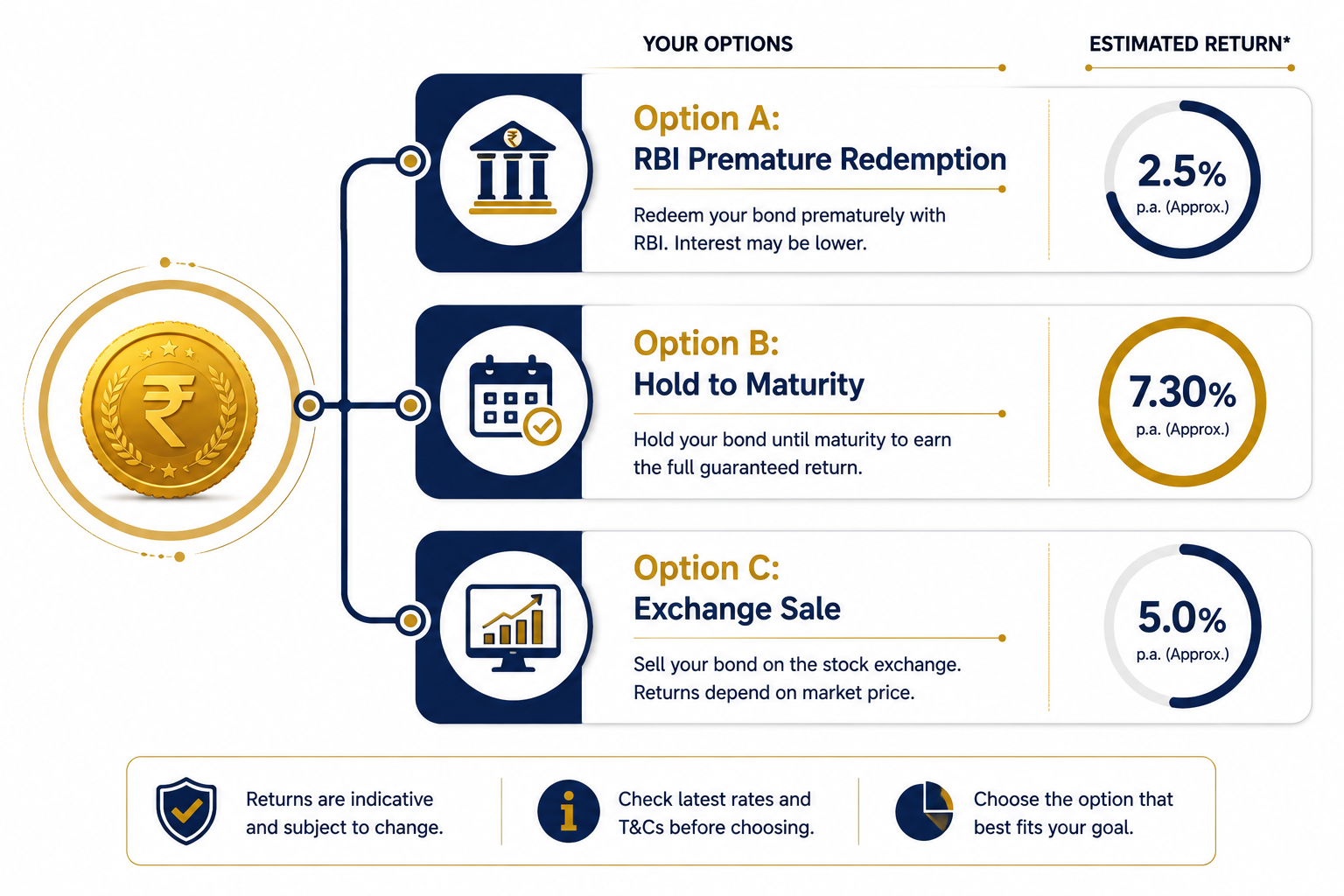
Every SGB investor actually has three choices, not one. The SGB premature redemption calculator above models all three. Here is what each involves
Option A: RBI Premature Redemption (Years 5-7)
- Available only on scheduled interest payment dates after completing 5 years
- Redemption price is linked to IBJA gold price average
- Taxable at 12.5% LTCG from April 1, 2026 onward
- Request submission window typically 3-4 weeks before the redemption date
- No risk of liquidity discount (RBI pays at gold price, not market sentiment)
Option B: Hold to 8-Year Maturity
- Completely tax-free capital gains for original subscribers
- Redemption is automatic; no action required from the investor
- You collect 2.5% annual interest for the full remaining period (taxable)
- You are exposed to gold price movement for 3 more years if exiting at year 5
- No new SGB tranches available, so you cannot redeploy at the same tax efficiency
Option C: Sell on the Secondary Market (NSE/BSE)
- Can be done any trading day without waiting for a specific window
- Price depends on buyer demand, often slightly below the gold spot price
- Taxable at 12.5% LTCG if held over 12 months
- Useful when you need liquidity before the next premature redemption window opens
- Lower trading volumes may mean a poor price if you have a large holding
| Factor | Option A: RBI Premature | Option B: Hold to Maturity | Option C: Exchange Sale |
|---|---|---|---|
| Price received | IBJA 3-day average | IBJA 3-day average | Market price (may be lower) |
| Capital gains tax | 12.5% LTCG | Zero (original sub.) | 12.5% LTCG |
| Timing flexibility | Fixed windows only | None needed | Any trading day |
| Liquidity | 3-4 week process | Automatic at 8 years | T+2 settlement |
| Gold price risk | Locked at redemption | Exposed till maturity | Locked at sale date |
| Best for | Need cash, specific window available | Original subscriber, patient investor | Urgent liquidity need |
Real Calculation Examples: The Numbers Tell the Story
Example 1: Original Subscriber in SGB 2020-21 Series V
Ravi bought 20 grams at the issue price of ₹5,051 per gram in April 2020. His original investment was ₹1,01,020. By April 2026, the redemption price was fixed at ₹15,254 per gram.
| Item | Amount |
|---|---|
| Original investment (20g × ₹5,051) | ₹1,01,020 |
| Redemption value (20g × ₹15,254) | ₹3,05,080 |
| Capital gain | ₹2,04,060 |
| Interest over 6 years (2.5% p.a. on issue price) | ₹15,153 |
| LTCG tax on premature redemption (12.5%) | ₹25,508 |
| Net gain after tax | ₹1,93,705 |
| Return on original investment (net) | ~192% |
If Ravi had waited two more years for full maturity redemption, and gold stayed at the same price: zero capital gains tax. The tax saved would be ₹25,508, which is essentially two extra years of SGB interest income he would also collect. The math strongly favors waiting if Ravi does not need the money.
Example 2: Secondary Market Buyer in the Same Series
Priya bought the same SGB 2020-21 Series V on NSE in 2022 at ₹7,200 per gram (she paid a small premium above gold price at the time). She holds 10 grams, so her cost was ₹72,000.
| Item | Amount |
|---|---|
| Cost of purchase | ₹72,000 |
| Redemption value (10g × ₹15,254) | ₹1,52,540 |
| Capital gain | ₹80,540 |
| LTCG tax (12.5%, applies even at maturity) | ₹10,068 |
| Net gain | ₹70,473 |
Priya cannot escape capital gains tax regardless of when or how she exits. Her best option is usually to wait for the actual maturity redemption, so she gets the RBI-calculated gold price rather than a potentially discounted exchange price.
When Should You Actually Exit Your SGB Early?
The SGB premature redemption calculator gives you the numbers. But here is a real-world decision framework based on the most common investor situations
Exit early makes sense if
- You are a secondary market buyer (tax is unavoidable, so timing matters less)
- You have an urgent liquidity need that cannot be met any other way
- You believe gold prices are near a peak and may correct significantly before maturity
- The redemption window aligns with a large financial goal (home purchase, education)
- Your tax bracket is low enough that the 12.5% LTCG is a manageable cost
Wait for maturity if
- You are an original subscriber with 2-3 years left (tax saving is substantial)
- You do not urgently need the funds
- Your alternative reinvestment options do not offer better after-tax returns
- You believe gold has more room to run before your maturity date
For help thinking through your overall investment allocation, the lumpsum calculator and CAGR calculator on MoneyOra can help you model what alternative assets might earn with the same funds.
Mistakes Investors Make With SGB Premature Redemption
Mistake 1: Assuming premature redemption is still tax‑free
The most costly mistake in 2026 is assuming that premature redemption is still tax‑free. Before April 1 2026 premature redemption through the RBI was not treated as a “transfer” under the Income Tax Act and therefore it was fully exempt. That exemption has now ended. Many investors rushed to exit in 2026 expecting no tax and received an unpleasant surprise on their ITR. Use the SGB redemption calculator above to determine your exact tax liability before you act.
Mistake 2: Missing the submission window
The redemption window is usually 3-4 weeks, before the redemption date. Investors often focus on the redemption date. Miss the submission deadline. If you submit late your request will be rejected and you will have to wait for the next eligible window, which may be months away.
Mistake 3: Assuming secondary market transactions preserve the tax exemption
Several financial websites and social media posts claimed, before Budget 2026 that you could buy SGBs cheaply on the exchange and then redeem at the gold price tax‑free. That window closed on April 1 2026. Secondary market buyers now owe 12.5 % LTCG on all exits.
Mistake 4: Selling on exchange without checking the discount
SGB trading volumes on NSE and BSE are relatively thin for some series. Investors with large holdings sometimes sell in a hurry and get a price 3-5% below the IBJA gold price. That discount is a real loss. If you have time, waiting for the formal premature redemption window often gets you a better price tied directly to the gold market.
Mistake 5: Not accounting for interest income in the tax calculation
The 2.5% annual interest is always taxable at your slab rate. At ₹5,000 per gram issue price with 10 grams, that is ₹1,250 of interest income per year. Over 5 years, ₹6,250 that needs to go into your ITR. It is small but real, and many investors forget to declare it.
Risks to Consider Before Using the SGB Premature Redemption Calculator
Gold Price Risk
The redemption price is set 3 business days before the actual payout. If gold drops sharply in that window, you cannot withdraw your redemption request.
Reinvestment Risk
No new SGB tranches are available right now. If you exit, you cannot reinvest into a new SGB with the same tax structure. Finding equivalent post-tax returns elsewhere is not straightforward.
Tax Law Risk
Tax rules have changed once and may change again. Always verify the current position with a tax advisor before making the final call on a large holding.
Window Miss Risk
If you miss the submission deadline, your funds remain locked in the SGB until the next eligible interest payment date, which may be 6 months away.
For a broader picture of how gold fits your portfolio, see MoneyOra’s live gold rate page and the analysis of India’s RBI gold reserve strategy.
If you are also thinking about other long-term instruments, compare with the returns available through PPF, NPS, or fixed deposits using MoneyOra’s free calculators.
SGB Premature Redemption Action Checklist
- Confirm which SGB series you hold (check your Demat statement or SGB certificate)
- Verify whether your series is eligible for premature redemption in the current window (check RBI’s official calendar)
- Confirm whether you are an original subscriber or a secondary market buyer
- Use the SGB premature redemption calculator above to compute your returns, tax, and net gain
- Run the break-even tool to see what gold price at maturity would justify waiting
- Check the submission deadline and ensure you apply within the window
- Ensure your bank account and KYC are up to date with the issuing entity
- Declare interest income in your ITR under “Income from Other Sources”
- If paying LTCG, factor in advance tax requirements to avoid Section 234C interest
MoneyOra Analysis: What Should You Actually Do?
There is no universal answer. The SGB premature redemption calculator gives you the math. The decision depends on who you are.
Original subscribers with 2-3 years to maturity are in the strongest position. Waiting costs them nothing beyond opportunity cost, and the tax exemption at maturity is genuinely valuable at large holding sizes. The only reason to exit early is genuine liquidity need or strong conviction that gold prices have peaked.
Original subscribers at year 5 who need the money should not feel bad about using the premature redemption window. They are paying 12.5% on gains that are often 150-200% above their issue price. Even after tax, these are outstanding real returns relative to almost any alternative.
Secondary market buyers should focus on timing rather than route. Their tax bill is fixed regardless. The better question for them is whether the current gold price represents a good exit point, and whether they can find a reinvestment that does better on an after-tax, after-inflation basis.
One thing is worth saying plainly: the SGB scheme has been extraordinary for long-term investors. Series issued in 2017-18 delivered 341% returns. The 2020-21 series is at over 200%. Investors who just held through market noise and did nothing made out very well. That history matters when thinking about patience versus impatience with the remaining years.
Use the stock return calculator or SIP calculator on MoneyOra to see how your redemption proceeds could work for you in the next investment cycle.
Ready to Calculate Your SGB Exit Numbers?
The SGB premature redemption calculator above is free and works instantly. Enter your series, holding period, and current gold price to get your full return breakdown and a hold vs exit recommendation.
Also try our CAGR Calculator, Lumpsum Calculator, and Live Gold Rate Tracker
Use the free calculator now on MoneyOra.in
Research Sources
- Reserve Bank of India (RBI) – SGB Premature Redemption Circulars 2026
- Finance Act, 2026 – Section 70(1)(x), Income-tax Act, 2025
- IBJA (India Bullion and Jewellers Association) – Gold price data
- NSDL Participant Services Circular – Premature Redemption Calendar H2 2025-26
- ClearTax, Business Standard, Upstox – Redemption price and window data
Frequently Asked Questions
What is the SGB redemption calculator and how does it help?
The SGB premature redemption calculator lets you calculate all the money you will get if you end a Sovereign Gold Bond early. It shows capital gain interest earned, tax you owe and the net money you will receive. It also has a break‑even tool that tells you the gold price at maturity that would make holding the bond longer more profitable than selling. This tool helps you decide wisely of guessing.
Is SGB premature redemption tax‑free in 2026?
No. From April 1 2026 SGB premature redemption calculator is taxed as Long‑Term Capital Gains (LTCG) at a rate of 12.5 per cent even for people who first bought the bond. The tax exemption applies to original subscribers who keep the SGB until its full eight‑year maturity. This is a shift from the old rule that let all RBI redemptions escape tax.
How is the SGB premature redemption price calculated?
The RBI sets the SGB premature redemption calculator price from the simple average of the closing price of 999‑purity gold as published by the India Bullion and Jewellers Association (IBJA) for the three business days before the redemption date. The price is released separately before each redemption date. Because of this you cannot see the price when you send in your request.
Which SGB series can be redeemed early in 2026?
A total of 33 SGB tranches from the 2018‑19 to 2021‑22 series can be redeemed early during FY 2026‑27. The active months are April, July and August 2026. Investors should look at the RBI’s premature redemption calendar to find the exact dates for their SGB series and the window when they can submit their request because dates may move because of unscheduled holidays.
What happens if I miss the SGB redemption window?
If I miss the submission window SGB will reject my request. The bond will keep going to the next eligible early‑redemption date. Because SGB early redemption is only allowed on interest‑payment dates after the fifth year the next chance might be about six months later. I should always keep an eye on the submission deadline, not the redemption date. That deadline is usually three to four weeks before the redemption date.
Can I still get a tax‑free exit from my SGB?
Yes,. Only if a few conditions are met. If I bought SGB directly during an RBI issue not through the secondary market and I keep the bond all the way to its full eight‑year maturity the capital gains stay completely tax‑free. This exemption is kept in the Finance Act, 2026 for subscribers who hold until maturity.
How do I use the break‑even price tool in the SGB redemption calculator?
The break‑even tool finds the gold price that my SGB must reach at maturity so that selling at maturity is more profitable than selling via early redemption. It takes into account the 12.5 per cent LTCG tax due on an exit and the interest I would still earn if I hold the bond. If I think gold will rise above that break‑even price then holding the bond is the choice.
Should I sell my SGB on the stock exchange of using early redemption?
Selling on the exchange gives cash on any trading day but the price I receive depends on how many buyers are looking and how many units are traded and that can be thin for SGB units. If I want to sell an amount I might get a price that is noticeably lower than the real gold price. The RBI early redemption price is always based on the IBJA gold price average, which usually gives a price. I would consider using an exchange sale only if I need cash away and there is no early‑redemption window coming up soon.
Where can I submit my SGB early‑redemption request?
I can send my request through the bank or institution where I first bought the SGB or through any SHCIL (Stock Holding Corporation of India) office. I can also visit the post office if I bought the SGB there or use NSDL or CDSL if my bond sits in a Demat account. If I hold the SGB on RBI Retail Direct I can apply directly there. I should make sure that my bank account and KYC information are current before I submit.
Are there SGB tranches available for investment in 2026?
No. As of September 2026 the government has not announced any Sovereign Gold Bond issuances for FY 2026‑27. It appears that new issuances are on hold probably because borrowing costs are high. Investors who want gold exposure should look at buying existing SGBs on the market or consider other options, like gold ETFs or gold mutual funds remembering that those have different tax rules.