

Closing Auction Session Timeline Simulator
Select your stock category and see exactly what happens to its closing price mechanism today.
Illustrative simulator for educational purposes only. Actual closing prices are determined by NSE/BSE's live order book and auction matching - this tool does not predict or reflect real-time exchange data.
Closing Auction Session in India 2026 – SEBI’s New CAS Rules
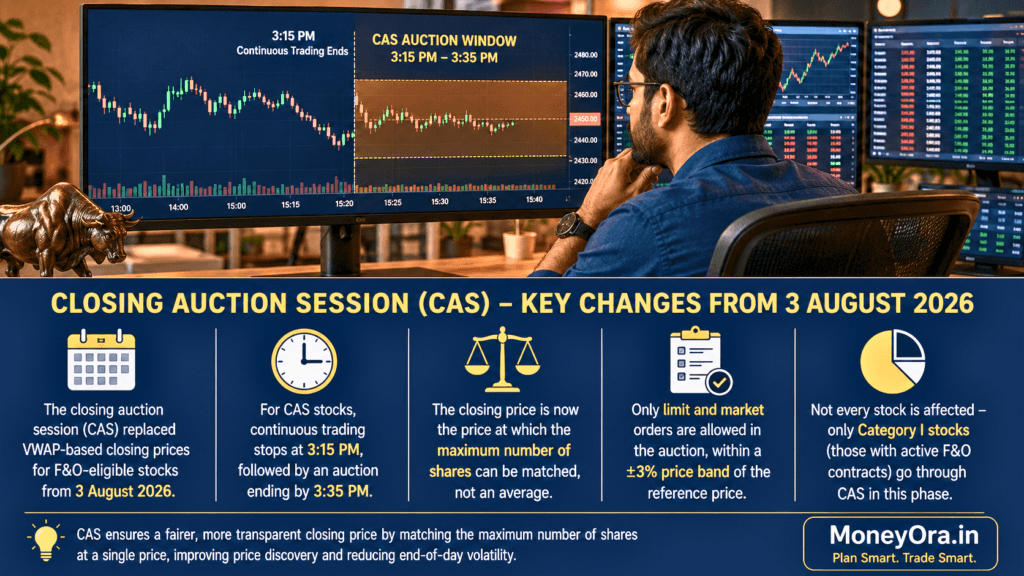
- The closing auction session (CAS) replaced VWAP-based closing prices for F&O-eligible stocks from 3 August 2026
- For CAS stocks, continuous trading stops at 3:15 PM, followed by an auction ending by 3:35 PM
- The closing price is now the price at which the maximum number of shares can be matched, not an average
- Only limit and market orders are allowed in the auction, within a ±3% price band of the reference price
- Not every stock is affected – only Category I stocks (those with active F&O contracts) go through CAS in this phase
If a stock you track has started closing at a slightly different price than what you saw flash on your screen at 3:29 PM, you’re not imagining it. The closing auction session is the reason. From 3 August 2026, SEBI replaced the decades-old VWAP method of setting closing prices with a genuine order-matching auction for stocks that carry F&O contracts – a structural change to how nearly every index, mutual fund NAV, and derivative settlement in India gets computed each evening. This guide breaks down exactly how the closing auction session works, minute by minute, with a live simulator and five worked examples.
What Is the Closing Auction Session?
The closing auction session (CAS) is a structured process introduced by NSE and BSE to determine the official closing price of eligible stocks through a genuine buy-sell auction, rather than averaging trades over the last half hour of the day. Under CAS, the exchange identifies the single price at which the maximum number of shares can be matched between buyers and sellers – that price becomes the day’s official closing price.
This is a meaningful shift from how Indian markets have worked for years. The closing auction session brings India’s price discovery mechanism closer to how major global exchanges like the NYSE and LSE already determine their closing prices, and SEBI expects it to improve transparency and reduce the tracking error index funds and ETFs experience against their benchmark.
Why Was the Closing Auction Session Introduced?
SEBI introduced the closing auction session via Circular HO/47/11/11(3)2025-MRD-POD2/I/2765/2026, dated 16 January 2026, effective from 3 August 2026. The closing price of a stock isn’t just a number that flashes on a screen at day’s end – it feeds directly into index calculations (Sensex, Nifty), mutual fund NAV computation, derivatives settlement, and portfolio valuation for margin and collateral purposes. Getting it wrong, or leaving it vulnerable to manipulation by a single small trade near 3:30 PM, has outsized consequences across the entire market.
SEBI specifically noted that major global markets already determine closing prices through a closing auction session because it pools buy and sell interest into a single liquidity event, producing a fairer, more transparent, and harder-to-manipulate closing price than averaging scattered trades.
The Old Method: How VWAP Calculated Closing Price
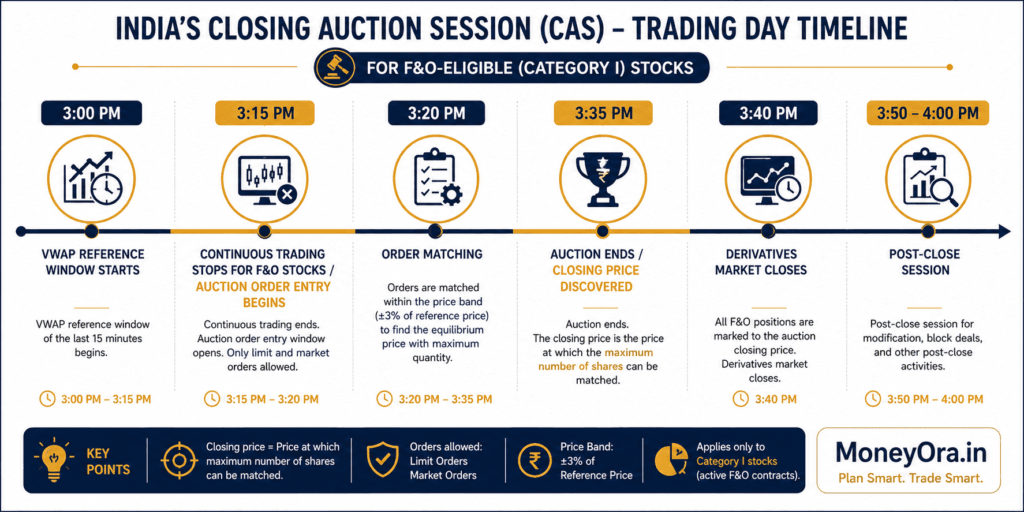
Before the closing auction session existed, and still today for stocks not yet covered by CAS, the closing price was calculated using the Volume Weighted Average Price (VWAP) of all trades executed during the final 30 minutes of the continuous trading session.
This method exists because the very last traded price alone can be misleading. If a stock trades between ₹1,000 and ₹1,010 all day, and a single small trade happens at ₹980 right at 3:30 PM, that one outlier trade shouldn’t define the entire day’s closing price. VWAP smooths this out by weighting every trade in the window by its volume.
The problem the closing auction session fixes: VWAP can still be nudged by a determined trader placing a series of trades late in the day, and it doesn’t reflect genuine, pooled buy-and-sell demand the way a true auction does.
Closing Auction Session Timeline – Minute by Minute
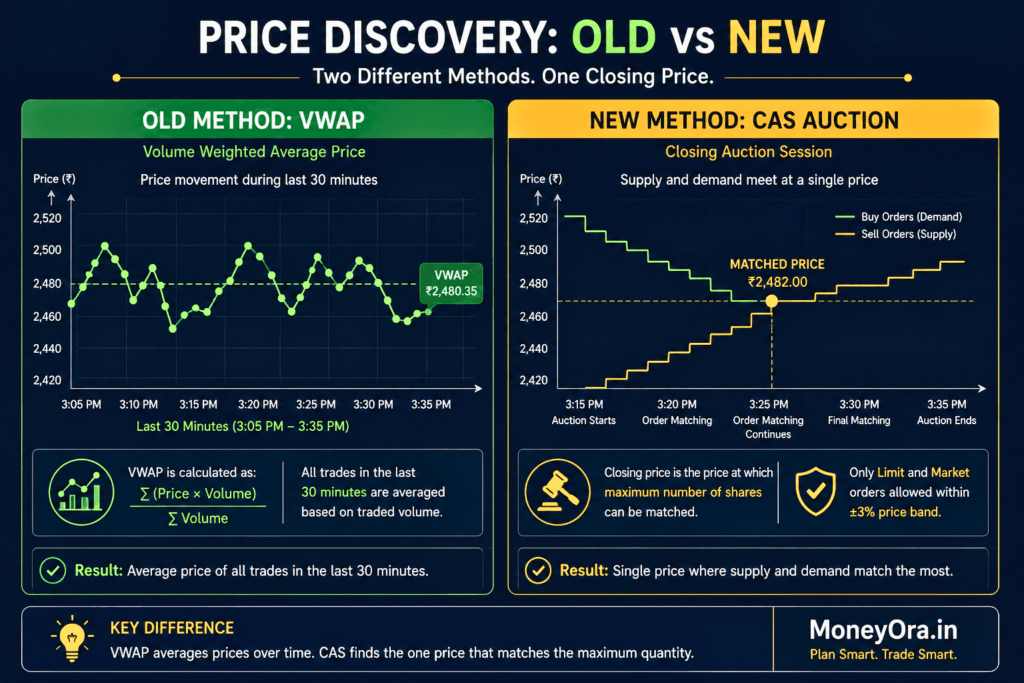
This is the exact sequence for Category I (CAS-eligible) stocks on any regular trading day from 3 August 2026 onward.
| Time | What Happens |
|---|---|
| 3:00 PM – 3:15 PM | Regular continuous trading carries on. In the background, exchange systems track this window to establish the Reference Price for the auction |
| 3:15 PM | Continuous trading STOPS for CAS-eligible stocks. Pending stop-loss orders are cancelled. Closing auction session order entry begins |
| 3:15 PM – 3:20 PM | Order entry window. Only limit and market orders accepted, within a ±3% band around the reference price |
| 3:20 PM – 3:35 PM | Random closing time within this window (to prevent last-second gaming); the exchange matches orders to find the price maximising matched volume |
| 3:35 PM | Auction ends. The matched price becomes the day’s official closing price |
| 3:40 PM | Equity derivatives (F&O) segment closes, giving derivative participants time to react after the cash market closing price is known |
| 3:50 PM – 4:00 PM | Post-close session runs, ten minutes later than the previous timing |
Use the Closing Auction Session Timeline Simulator at the top of this page to see this sequence applied to your own stock and reference price.
Category I vs Category II – Which Stocks Are Affected?
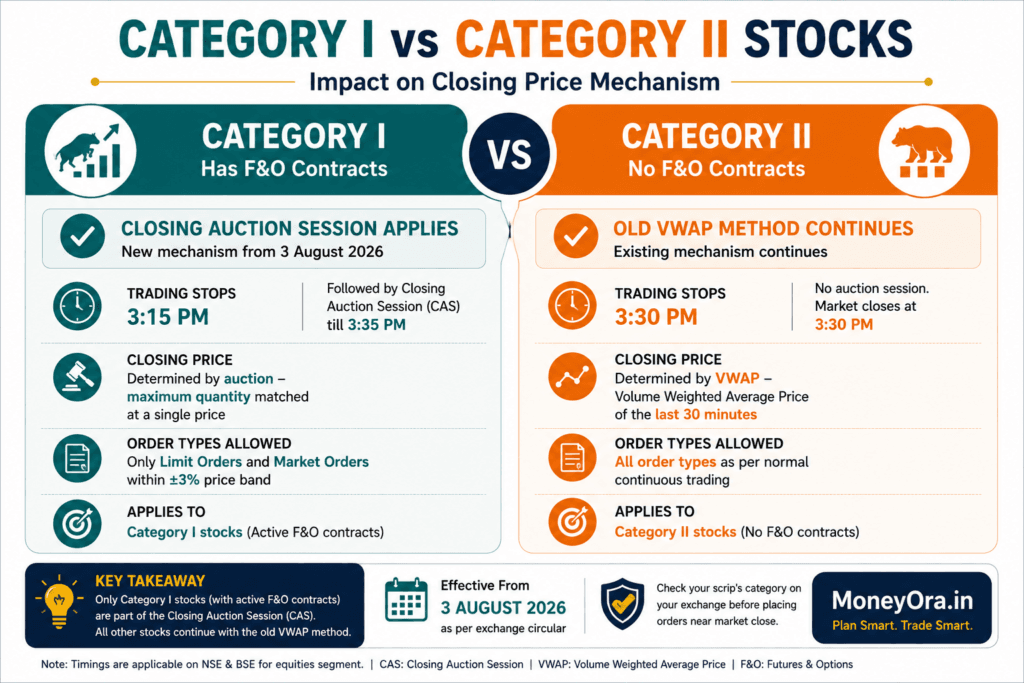
SEBI’s phased rollout splits the entire equity cash segment into two buckets, and which one your stock falls into determines whether the closing auction session applies at all.
| Feature | Category I | Category II |
|---|---|---|
| Which stocks | Stocks with active F&O contracts on NSE and BSE | All other listed stocks (no F&O contracts) |
| Closing price method | Closing auction session (order matching) | VWAP of last 30 minutes (unchanged) |
| Continuous trading ends | 3:15 PM | 3:30 PM (as before) |
| Effective from | 3 August 2026 | Not yet – future phase possible |
How the Closing Price Is Actually Discovered
Unlike VWAP’s averaging approach, the closing auction session works through genuine order-book matching, similar in spirit to the pre-open session many traders already know.
- All buy and sell orders entered during the 3:15-3:20 PM window are collected into a single order book
- The exchange’s matching algorithm tests every possible price point and calculates how many shares would get matched at each price
- The price that maximises the total matched volume is selected as the equilibrium closing price
- All eligible orders at or better than this price get executed at exactly this single price – not at whatever price they were individually placed at
- Any unmatched orders remain unexecuted and effectively lapse for the auction
This is fundamentally different from VWAP’s backward-looking average of already-executed trades – the closing auction session is forward-looking, discovering a fresh equilibrium price based on live standing interest at that specific moment.
What Happens to Stop-Loss Orders?
This is one of the most practically important changes traders need to know. When the closing auction session begins at 3:15 PM for a Category I stock, any pending stop-loss orders on that stock are automatically cancelled. This isn’t an oversight – a conditional trigger order has no coherent function inside a single-point auction where price is discovered fresh, not continuously.
Similarly, disclosed quantity (revealed quantity) orders are not permitted during the auction window – only straightforward limit and market orders are accepted.
Impact on F&O Settlement and Derivatives
The closing auction session’s effects extend well beyond the cash market. Daily mark-to-market settlement for stock derivatives continues using the same underlying logic, though the calculation window has shifted to align with the new timeline.
On expiry day specifically, stock derivative contracts now settle using a volume-weighted average of the underlying security’s closing auction session-derived closing prices across recognised exchanges – meaning NSE and BSE closing prices for the same stock now feed jointly into a single settlement number, rather than each exchange’s price being used independently.
Use MoneyOra’s Position Size Calculator to reassess your risk sizing around expiry given this settlement change, and check current market movement with our Share Market Today tracker.
Closing Auction Session: 5 Worked Examples
Simple Category I Stock Close
A large-cap bank stock with active F&O contracts trades between ₹1,235 and ₹1,242 during the 3:00-3:15 PM window, with the reference VWAP settling at ₹1,238.75. The ±3% auction band is therefore ₹1,201.59 to ₹1,275.91.
Orders entered during 3:15-3:20 PM show maximum matched volume at ₹1,240.10 – this becomes the closing auction session’s official closing price, even though the last trade before 3:15 PM was at ₹1,239.50.
Category II Stock (VWAP Still Applies)
A mid-cap stock with no F&O contracts trades normally until 3:30 PM. Trades between 3:00 PM and 3:30 PM average out, weighted by volume, to ₹487.25.
The closing auction session doesn’t apply here at all – ₹487.25 (the VWAP) remains the official closing price, exactly as it worked before 3 August 2026.
A Trader With an Unprotected Stop-Loss
A trader holds a long intraday position in a Category I stock with a stop-loss order at ₹1,225. At 3:14 PM, the stock is trading at ₹1,232 and the stop-loss hasn’t triggered.
At 3:15 PM, when the closing auction session begins, this pending stop-loss order is automatically cancelled. If the auction price later comes in below ₹1,225, the trader has no automatic protection – they needed to exit manually before 3:15 PM.
Maximum Matched Volume in Action
During the 3:15-3:20 PM order entry window, buy orders for a Category I stock total 50,000 shares at ₹500 or better, and sell orders total 45,000 shares at ₹500 or lower. At ₹502, buy interest drops to 30,000 shares while sell interest rises to 55,000 shares.
₹500 produces 45,000 matched shares (limited by the smaller side); ₹502 produces only 30,000 matched shares. The exchange selects ₹500 as the closing price, since it maximises total matched volume across the auction.
F&O Expiry Day Settlement
On monthly expiry day, a stock’s closing auction session determines a closing price of ₹850.40 on NSE and ₹850.15 on BSE.
The final settlement price for that stock’s F&O contracts is the volume-weighted average of these two closing auction session-derived prices across both exchanges – not simply NSE’s number in isolation, as was more commonly the reference point before this cross-exchange rule took effect.
6 Mistakes Traders Make With the Closing Auction Session
Assuming the Last Traded Price Is the Closing Price
The closing auction session deliberately discovers a fresh price during the 3:15-3:35 PM window – the price you saw flash at 3:14 PM is not automatically the closing price.
Leaving Stop-Loss Orders Unmanaged Into the Auction
As covered above, stop-loss orders are cancelled once the closing auction session begins at 3:15 PM for Category I stocks. Manage or close positions before that cutoff.
Not Checking Whether a Stock Is Category I or Category II
Trading strategies built around the old 3:30 PM close won’t work correctly for Category I stocks, which now stop continuous trading fifteen minutes earlier.
Trying to Place Disclosed Quantity Orders During the Auction
Only plain limit and market orders are accepted in the closing auction session window – disclosed quantity orders are simply not permitted.
Ignoring the ±3% Price Band
Orders placed outside the ±3% band around the reference price during the auction window will be rejected, not queued for later matching.
Assuming NSE and BSE Closing Prices Are Independent for F&O Settlement
For expiry-day settlement, the closing auction session prices across both exchanges are combined into a single volume-weighted figure – treating NSE’s number alone as the settlement reference is now outdated.
- Stop-loss exposure: Positions relying on stop-loss orders in Category I stocks lose that protection automatically once the closing auction session begins at 3:15 PM
- Price band limitation: Orders outside the ±3% band around the reference price are rejected outright during the auction, not queued for a wider range
- Phased rollout uncertainty: SEBI has indicated Category II stocks may join the closing auction session in a later phase, but no confirmed timeline exists – rules could change further
- Cross-exchange settlement complexity: The volume-weighted combination of NSE and BSE closing auction session prices for expiry-day settlement adds a layer of complexity traders need to understand, particularly around large F&O positions
- This simulator is educational only: It does not reflect live exchange order books or actual auction outcomes – real closing prices depend on genuine market-wide buy and sell interest at the time
Related MoneyOra Tools
- Stock Return Calculator – Calculate returns using accurate closing price data
- CAGR Calculator – Find your annualised return based on closing price history
- Stop Loss Calculator – Plan your stop-loss levels with the new auction cutoff in mind
- Position Size Calculator – Size your F&O positions around the new settlement mechanism
- P/E Ratio Calculator – Value stocks using accurate closing price inputs
- Share Market Today – Track live Nifty and Sensex movement
Official Sources and External References
- SEBI – Official Circular on Closing Auction Session
- NSE India – Closing Auction Session Implementation Circulars
- BSE India – Market Timing and Segment Notices
- Reserve Bank of India – Financial Market Infrastructure Oversight
Understand Your Stock's Closing Auction Session Timeline
Use the simulator at the top of this page, or explore MoneyOra's full suite of free stock market tools.
Use the free calculator now on MoneyOra.in →
Frequently Asked Questions
What is the closing auction session on NSE and BSE?
The closing auction session is a new mechanism, effective from 3 August 2026, that determines the official closing price of eligible stocks through an order-matching auction rather than averaging trades. The exchange identifies the price at which the maximum number of shares can be matched between buyers and sellers, and that price becomes the closing price.
Which stocks are covered by the closing auction session?
In Phase I, the closing auction session applies only to Category I stocks – those with active F&O (futures and options) contracts on NSE and BSE. All other listed stocks (Category II) continue using the older VWAP method based on the last 30 minutes of trading.
Why does my stock’s closing price differ from its last traded price now?
Because the closing auction session discovers a fresh equilibrium price during the 3:15-3:35 PM window, based on new orders entered specifically for the auction. This price reflects genuinely matched buy and sell interest at that moment, and can differ from whatever price the stock was trading at just before 3:15 PM.
What happens to my stop-loss order when the closing auction session starts?
Any pending stop-loss order on a Category I stock is automatically cancelled at 3:15 PM when continuous trading stops and the closing auction session begins. Traders need to manage such positions manually before this cutoff, since stop-loss orders have no function inside the single-point auction mechanism.
What are the latest questions people are asking about the closing auction session in 2026?
When did the closing auction session start in India?
3 August 2026, following SEBI’s circular dated 16 January 2026.Does the closing auction session apply to all stocks?
No, only Category I stocks with active F&O contracts in Phase I. SEBI may extend coverage in future phases.How does the closing auction session affect mutual fund NAV?
Since mutual fund NAV computation uses the official closing price of portfolio holdings, a more robust closing auction session-derived price can improve NAV accuracy for funds holding Category I stocks.Is the closing auction session the same as the pre-open session?
No, though the matching mechanism is conceptually similar. The pre-open session happens before market opens at 9:00 AM; the closing auction session happens at market close, 3:15-3:35 PM.Can I still place normal orders during the closing auction session?
You can place limit and market orders within the ±3% price band, but not stop-loss or disclosed quantity orders.


Pingback: Closing Price vs LTP: Why They Never Match on NSE/BSE 2026