SBI TTBR for Schedule FA: Foreign Asset Exchange Rate for ITR Guide 2026
Foreign Asset INR Conversion Calculator
Enter your foreign asset details to convert the value to INR for Schedule FA reporting using the applicable SBI TTBR rate.
This calculator is an educational aid. Verify the applicable exchange-rate rule (acquisition date, peak date, 31 December closing date, or month-end preceding for income) and filing instructions for your specific Schedule FA table before submission. The SBI TTBR entered above must be looked up separately from SBI's published rate card for your exact date - this tool does not fetch live rates.
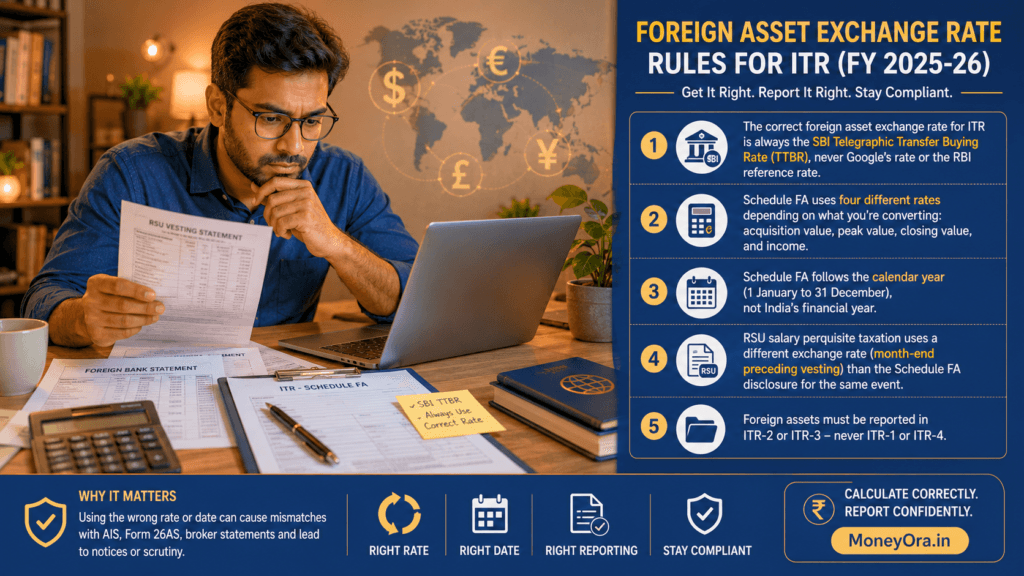
- The correct foreign asset exchange rate for ITR is always the SBI Telegraphic Transfer Buying Rate (TTBR), never Google’s rate or the RBI reference rate
- Schedule FA uses four different rates depending on what you’re converting: acquisition value, peak value, closing value, and income
- Schedule FA follows the calendar year (1 January to 31 December), not India’s financial year
- RSU salary perquisite taxation uses a different exchange rate (month-end preceding vesting) than the Schedule FA disclosure for the same event
- Foreign assets must be reported in ITR-2 or ITR-3 – never ITR-1 or ITR-4
If you hold a foreign bank account, RSUs from an overseas employer, or shares in a foreign company, the number you eventually type into Schedule FA depends entirely on one thing which exchange rate you use, and on which date. Get the foreign asset exchange rate for ITR wrong, and your Schedule FA figures won’t match your AIS data, your Form 26AS, or your broker’s own tax statement – a mismatch that reliably triggers scrutiny. This guide walks through exactly which SBI TTBR rate applies to which value, with a free calculator and worked examples for FY 2025-26 (AY 2026-27).
What Is Schedule FA and Who Must File It?
Before you can apply the correct foreign asset exchange rate for ITR, you need to know whether Schedule FA applies to you at all. Schedule FA is the section of ITR-2 and ITR-3 where Indian tax residents disclose foreign assets and foreign income – bank accounts, equity shares, mutual funds, immovable property, and financial interests held anywhere outside India. It exists to prevent unreported offshore wealth and carries penalties up to ₹10 lakh under the Black Money Act for non-disclosure, even when the asset itself generates zero income.
Schedule FA applies only to Resident and Ordinarily Resident (ROR) individuals. Non-residents and RNORs (Resident but Not Ordinarily Resident) are exempt from this specific disclosure. If you qualify as ROR and held any foreign asset at any point during the relevant calendar year, disclosure is mandatory regardless of value – there is no minimum threshold below which Schedule FA can be skipped.
What Is SBI TTBR and Why Is It Mandatory?
Understanding SBI TTBR is the foundation of every correct foreign asset exchange rate for ITR calculation you’ll ever make. SBI’s Telegraphic Transfer Buying Rate (TTBR), commonly shortened to “TT Buying Rate,” is the rate State Bank of India uses when it buys foreign currency remitted via wire transfer. CBDT’s own ITR-2 and ITR-3 filing instructions specifically mandate this exact rate – not the RBI reference rate, not Google’s or XE’s mid-market rate, and not your bank’s card rate – as the only acceptable foreign asset exchange rate for ITR purposes.
This rule traces back to Rule 115 of the Income-tax Rules, 1962 (which governs the foreign asset exchange rate for ITR calculations on FY 2025-26 income being reported this filing season). From 1 April 2026, the Income-tax Act, 2025 and its accompanying Income-tax Rules, 2026 carry the same SBI TT Buying Rate mechanism forward under new numbering – Rule 206, borrowing the TTBR definition from Rule 207. The substance of the foreign asset exchange rate for ITR rule is unchanged; only the rule numbers move.
Use MoneyOra’s calculator above to apply your looked-up SBI TTBR figure and instantly see the INR conversion for your Schedule FA entry.
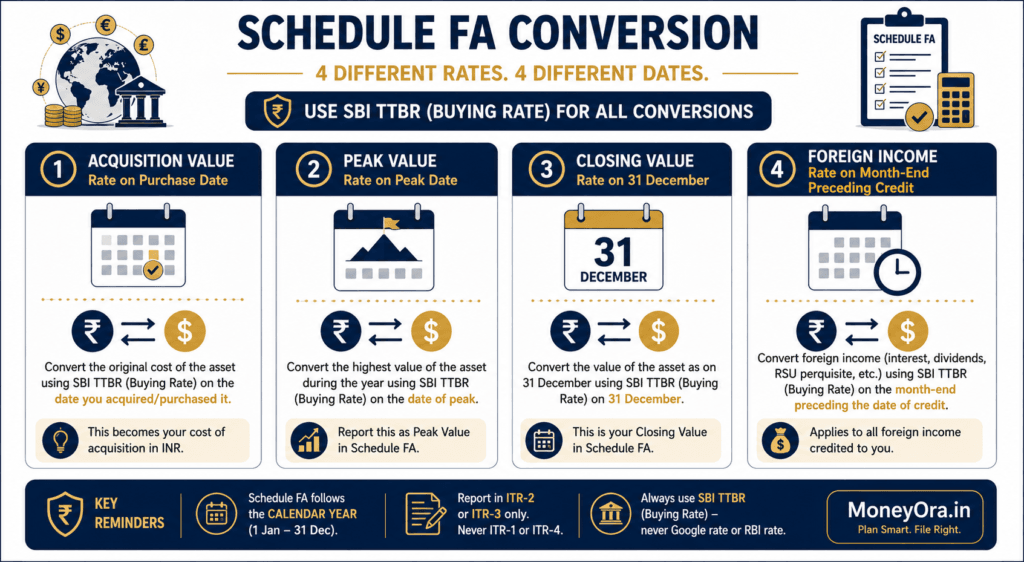
The Four Exchange Rates Schedule FA Actually Uses
This is where most guides oversimplify. Schedule FA doesn’t use one foreign asset exchange rate for ITR – it uses four separate rates, each tied to a specific date depending on which figure you’re converting.
| What You’re Reporting | Specified Date for TTBR |
|---|---|
| Acquisition value (initial investment) | Rate on the actual date of acquisition/investment |
| Peak balance / peak value | Rate on the date the value reached its highest point during the calendar year |
| Closing value | Rate on 31 December of the reporting calendar year |
| Foreign-sourced income (dividends, interest) | Rate on the last day of the month immediately preceding the month income was credited or paid |
Each of these figures within a single Table A3 entry (for foreign equity, say) can legitimately use a different foreign asset exchange rate for ITR, because each figure is anchored to its own specific date. This is precisely why a single blanket “current exchange rate” approach – which many taxpayers default to – produces an incorrect foreign asset exchange rate for ITR outcome across the board.
Calendar Year vs Financial Year – The Mismatch That Trips Up Filers
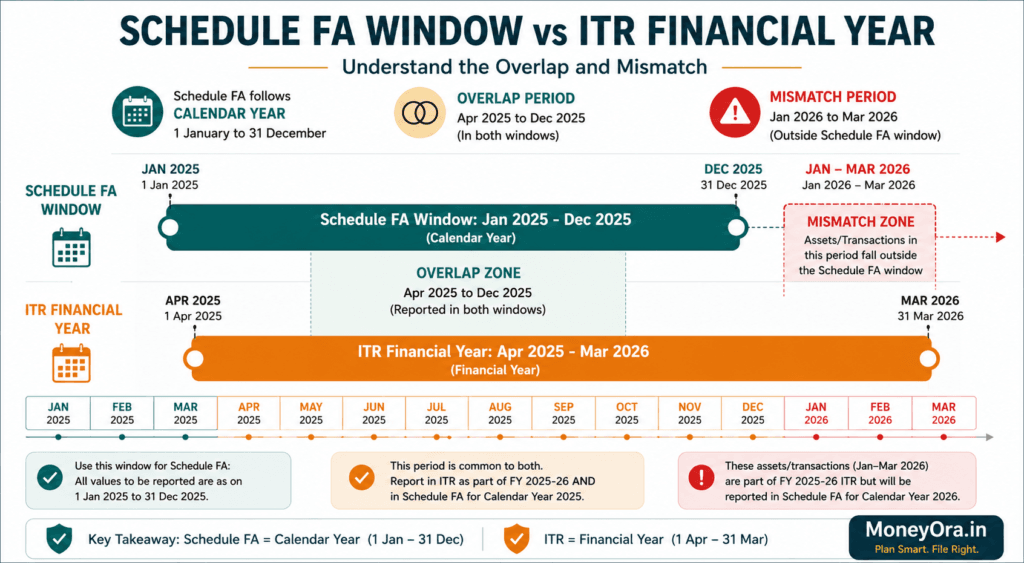
Schedule FA runs on the calendar year – 1 January to 31 December – while your actual income for the same ITR is computed on India’s financial year, 1 April to 31 March. This mismatch is a genuine source of confusion, and getting the foreign asset exchange rate for ITR right doesn’t help if you’ve reported the wrong assets for the wrong period in the first place.
For AY 2026-27, Schedule FA covers foreign assets held at any point between 1 January 2025 and 31 December 2025. Many taxpayers mistakenly report only assets held as of 31 March 2026 (the financial year-end), which either misses assets sold before that date or wrongly includes assets acquired after 31 December 2025.
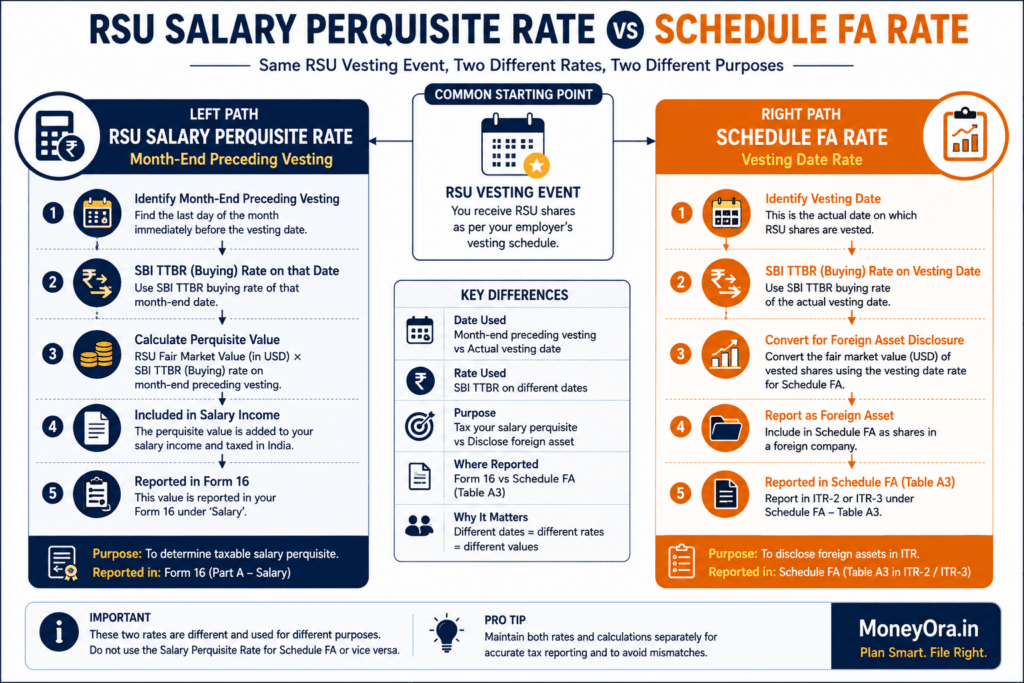
RSU Salary Perquisite Rate vs Schedule FA Rate
This is where the foreign asset exchange rate for ITR rules get genuinely tricky for salaried professionals. RSUs or ESOPs from multinational employers run into a confusing overlap: the same vesting event can require two different exchange rates for two different purposes, and both are simultaneously correct.
- For salary perquisite taxation (Form 16 / Schedule Salary): The RSU’s value is converted using the SBI TT Buying Rate as on the last day of the month immediately preceding the month the RSU vests or is paid
- For Schedule FA disclosure: The initial value of the same RSU holding is reported using the foreign asset exchange rate for ITR applicable specifically on the vesting date itself
Because these are two different specified dates governed by different rules, the resulting INR figures can genuinely differ – and that’s not an error. If your RSUs vested on 15 July 2025, your employer’s payroll team likely used the June 2025 month-end SBI TTBR to compute your taxable salary perquisite. But when you fill Schedule FA’s Table A3 for that same RSU tranche, the acquisition value uses the TTBR specifically on 15 July 2025.
Do Not “Reconcile” These Figures : Some filers try to force the Schedule FA acquisition value to match their Form 16 salary figure, assuming a discrepancy is an error. It isn’t. The two figures are governed by genuinely different rate rules and are allowed to differ – trying to make them match introduces an actual error where none existed.
What If SBI Published No Rate on Your Exact Date?
SBI does not publish a TTBR every single calendar day – weekends, bank holidays, and days with no telegraphic transfer activity in a currency pair can leave a gap. When your specified date for the foreign asset exchange rate for ITR falls on such a day, the rule steps back to the last preceding date on which SBI actually published a rate.
Practically, this means if your RSU vested on a Saturday, or your foreign asset’s peak fell on a bank holiday, you use the most recent business day’s published TTBR before that date – not the next available date afterward, and not an average of the two.
Foreign Asset Exchange Rate for ITR: 5 Worked Examples
These five examples show the foreign asset exchange rate for ITR rules applied to real numbers, across the scenarios investors and salaried professionals actually run into.
Simple US Bank Account
Sameer holds a US checking account. Balance moved between $2,000 and $9,500 during 2025, with the peak on 14 August. Closing balance on 31 December 2025 was $4,200. Assume TTBR on 14 August was ₹84.00 and on 31 December was ₹85.50.
Peak balance (14 August rate): $9,500 x ₹84.00 = ₹7,98,000
Closing balance (31 December rate): $4,200 x ₹85.50 = ₹3,59,100
RSU Vesting With Two Different Rates
Priya’s employer vests 50 RSUs worth $60 each on 15 July 2025. TTBR on 30 June 2025 (month-end preceding vesting) was ₹83.40. TTBR on 15 July 2025 (vesting date itself) was ₹83.75.
Salary perquisite value (30 June rate): 50 x $60 x ₹83.40 = ₹2,50,200 (taxed as salary)
Schedule FA acquisition value (15 July rate): 50 x $60 x ₹83.75 = ₹2,51,250 (disclosed in Table A3)
Foreign Shares Bought and Sold Within the Same Year
Arjun buys 100 shares of a US company on 10 March 2025 at $50 each and sells all of them on 20 November 2025 at $70 each. TTBR on 10 March was ₹82.90; on 20 November was ₹85.10.
Even though the asset was fully exited before 31 December, it must still be reported in Schedule FA since it was held during CY2025, and each figure needs its own foreign asset exchange rate for ITR conversion. Acquisition value: 100 x $50 x ₹82.90 = ₹4,14,500
Peak value (assuming sale date was also the peak): 100 x $70 x ₹85.10 = ₹5,95,700. Closing value on 31 December = ₹0, since the holding was fully sold.
Dividend Income From Foreign Shares
Meera receives a $150 dividend on her US shares, credited on 12 September 2025. The month-end preceding rate (31 August 2025) was ₹84.60.
Dividend income in INR = $150 x ₹84.60 = ₹12,690, reported under Schedule OS using this specific month-end-preceding foreign asset exchange rate for ITR, not the rate on the actual credit date.
Foreign Bank Interest (The Miscategorisation Trap)
Rohan earns $80 in ordinary savings interest from his foreign bank account, credited throughout 2025 (aggregate figure). TTBR on 31 March 2026 was ₹85.90. This is a genuinely common foreign asset exchange rate for ITR trap.
Since ordinary bank interest is “Income from Other Sources” (not interest on securities), it uses the 31 March rate, not a month-end-preceding rate. Interest in INR = $80 x ₹85.90 = ₹6,872. Using the wrong category here is one of the most common foreign asset exchange rate for ITR errors among salaried NRIs who became residents mid-year.
How to Report Foreign Assets in Your ITR
With your foreign asset exchange rate for ITR figures ready, here’s exactly how to file them correctly. Since you cannot use ITR-1 or ITR-4 with any foreign asset holding, filing correctly starts with the right form.
- Use ITR-2 (no business income) or ITR-3 (with business income)
- Open Schedule FA, which is divided into Tables A1 through G by asset type
- Table A1 – Foreign Depository Accounts (savings, current, time deposits): report bank name, address, account number, opening date, peak balance, closing balance, and gross interest, each converted at its own specified-date foreign asset exchange rate for ITR figure
- Table A2 – Foreign Custodial Accounts and other financial interests
- Table A3 – Foreign Equity and Debt Interest (shares, RSUs, ESOPs): report per-security, per-line, with acquisition date, cost, peak, closing value, dividends, and any sale proceeds
- Report dividend income under Schedule OS and any capital gains from sale under Schedule CG, cross-referenced by transaction date to your Schedule FA entries
- If you paid foreign tax on this income, file Form 67 (Rule 128) online, on or before the assessment year deadline and preferably before submitting your ITR, to claim Foreign Tax Credit
- Keep documented evidence of every SBI TTBR used for your foreign asset exchange rate for ITR figures – each peak date, 31 December, each acquisition date, each relevant month-end – in case of a query
Check your ITR filing eligibility and requirements alongside this guide using MoneyOra’s Can I File ITR Without Form 16 guide, and compare the New vs Old Tax Regime for FY 2026-27 if your foreign salary income affects your regime choice.
7 Mistakes Filers Make With Foreign Asset Exchange Rates
These seven errors account for most incorrect foreign asset exchange rate for ITR filings MoneyOra readers ask about.
Using Google’s or a Bank’s Card Rate Instead of SBI TTBR
The single most common error. Any rate other than SBI’s specific TT Buying Rate produces a technically incorrect foreign asset exchange rate for ITR, even if the figure looks reasonable.
Applying One Rate to the Entire Schedule FA Entry
Acquisition, peak, and closing values each need their own date-specific rate. Using a single “current” foreign asset exchange rate for ITR across all three understates or overstates at least two of the three figures.
Reporting Assets by Financial Year Instead of Calendar Year
Schedule FA’s window is 1 January to 31 December, and this window governs which assets need a foreign asset exchange rate for ITR conversion at all. Filers who default to India’s April-March financial year either miss early-year assets or wrongly include ones acquired after the calendar-year cutoff.
Trying to Reconcile RSU Salary Value With Schedule FA Value
As covered above, these legitimately differ because they follow different specified-date rules within the broader foreign asset exchange rate for ITR framework. Forcing them to match introduces an actual error.
Miscategorising Foreign Bank Interest
Ordinary savings interest takes the 31 March rate under “Income from Other Sources,” not the month-end-preceding rate used for dividends and “interest on securities.”
Skipping Disclosure for Fully Exited Holdings
An asset bought and sold entirely within the calendar year still requires Schedule FA disclosure if it was held at any point during that window – a zero closing balance doesn’t exempt you from reporting the acquisition and peak values.
Not Keeping Rate Evidence
Without documented proof of which SBI TTBR you used for each specified date, defending your foreign asset exchange rate for ITR figures during a scrutiny becomes far harder than it needs to be.
Getting your foreign asset exchange rate for ITR figures right reduces risk, but a few practical limitations remain worth knowing.
- Penalty exposure: Non-disclosure of foreign assets under Schedule FA carries penalties up to ₹10 lakh under the Black Money Act, independent of whether the asset generated any taxable income
- Rule numbering transition: Income of FY 2025-26 and earlier follows old Rule 115; income of FY 2026-27 onward follows new Rule 206 under the Income-tax Act 2025 – confirm the correct reference for your filing year
- Mismatched documentation risk: If your Schedule FA figures don’t align with your broker’s annual tax statement or AIS data due to a rate error, expect a query even if no tax was actually evaded
- Peak-date identification effort: Finding the true peak balance date for a foreign account requires going through the full year’s statements – guessing or approximating this date produces an incorrect foreign asset exchange rate for ITR figure
- This calculator is educational only: It does not fetch live SBI TTBR rates – you must independently verify the correct rate for your specific date from an authoritative source before filing
Related MoneyOra Guides and Tools
Once your foreign asset exchange rate for ITR conversion is done, these related guides help with the rest of your filing.
- Can I File ITR Without Form 16? – Related ITR filing eligibility guide
- New vs Old Tax Regime FY 2026-27 – Check how foreign income affects your regime choice
- ITR Refund Status Check – Track your refund after filing with foreign asset disclosures
- PAN-Aadhaar Link Status Check – Confirm your PAN is active before an ITR-2/ITR-3 filing
- Stock Return Calculator – Calculate returns on your foreign equity holdings once converted to INR
- CAGR Calculator – Find your annualised return on foreign shares in INR terms
Official Sources and External References
- Income Tax Department – Official Portal (ITR-2, ITR-3, Schedule FA)
- State Bank of India – Official TT Buying Rate Card
- Income Tax Department – ITR-2 and ITR-3 Forms and Instructions
- Reserve Bank of India – Foreign Exchange Regulations
Frequently Asked Questions
The most common foreign asset exchange rate for ITR questions filers search for, answered directly.
What is the correct foreign asset exchange rate for ITR filing?
The correct foreign asset exchange rate for ITR is SBI’s Telegraphic Transfer Buying Rate (TTBR), also called the TT Buying Rate. CBDT’s ITR-2 and ITR-3 filing instructions specifically mandate this rate for every rupee figure in Schedule FA – not the RBI reference rate, Google’s conversion rate, or any bank’s card rate.
Does Schedule FA use one exchange rate or multiple rates?
Multiple rates. Acquisition value uses the rate on the purchase date, peak value uses the rate on the date the peak occurred, closing value uses the rate on 31 December, and foreign-sourced income uses the rate on the last day of the month preceding when the income was credited or paid.
Why does my RSU show a different value in my salary slip versus Schedule FA?
Because two different rules apply to the same vesting event. Salary perquisite taxation uses the SBI TTBR on the month-end preceding vesting, while Schedule FA disclosure uses the TTBR on the vesting date itself. Both figures are correct and don’t need to be reconciled to match.
What happens if I use the wrong exchange rate for Schedule FA?
An incorrect foreign asset exchange rate for ITR can cause your Schedule FA figures to mismatch your AIS data or broker tax statements, which commonly triggers scrutiny even when the underlying disclosure was made honestly. It’s worth verifying your SBI TTBR figures carefully before filing rather than after receiving a notice.
What are the latest questions people are asking about foreign asset exchange rates in 2026?
Does the Income-tax Act 2025 change the SBI TTBR rule?
No, the mechanism is identical; only the rule numbering changes from Rule 115 to Rule 206/207 from 1 April 2026 onward.Is Schedule FA required for a zero-balance foreign account?
Yes, disclosure is mandatory if the account was held at any point during the calendar year, regardless of balance or income generated.Which rate applies if SBI has no published TTBR for my exact date?
The rule steps back to the last preceding date on which SBI actually published a TT Buying Rate.Do I need Schedule FA if I only held foreign mutual funds, not shares?
Yes, foreign mutual funds are reportable financial interests and follow the same SBI TTBR conversion rules as equity holdings.Is the foreign asset exchange rate for ITR the same as the rate used for capital gains on sale?
Not necessarily. Schedule FA uses specified dates (acquisition, peak, 31 December), while Schedule CG capital gains computation on a sale uses the rate applicable on the sale/transaction date, which is a separate calculation.