Foreign Assets Disclosure in ITR 2026: Schedule FA, Exchange Rate and Step-by-Step Examples
Published: August 2026 | AY: 2026-27 (FY 2025-26) | Reading time: 12 min
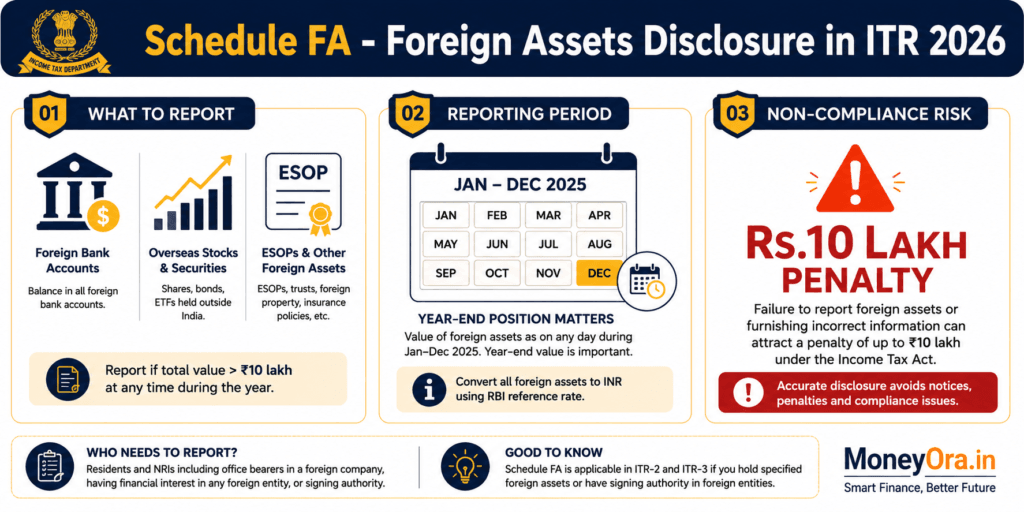
Foreign assets disclosure in ITR If you are a Resident or an Ordinarily Resident (ROR) and you had any asset at any time between January 1 and December 31 2025 you must include foreign assets disclosure in your ITR.
Foreign assets disclosure in ITR must be filed inside Schedule FA, which’s only available in ITR‑2 or ITR‑3. ITR‑1 cannot carry Schedule FA all.
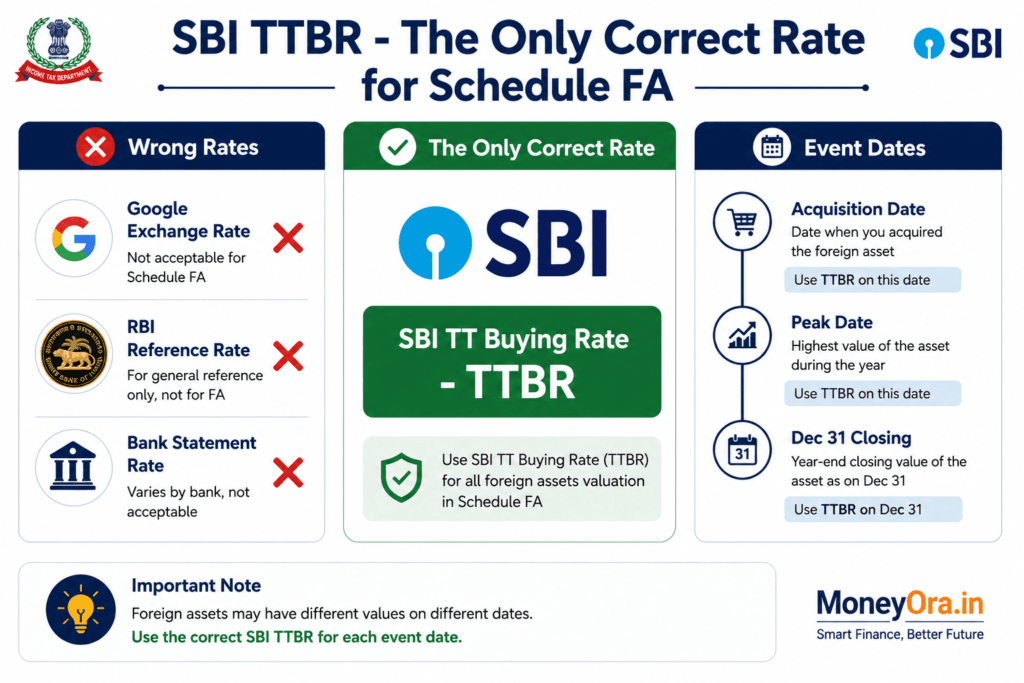
All foreign asset values must be converted using the SBI Telegraphic Transfer Buying Rate (TTBR) on the event date. Do not use Google rates or RBI reference rates.
The penalty for missing or wrong foreign assets disclosure is Rs.10 lakh per asset per year as stated in the Black Money Act.
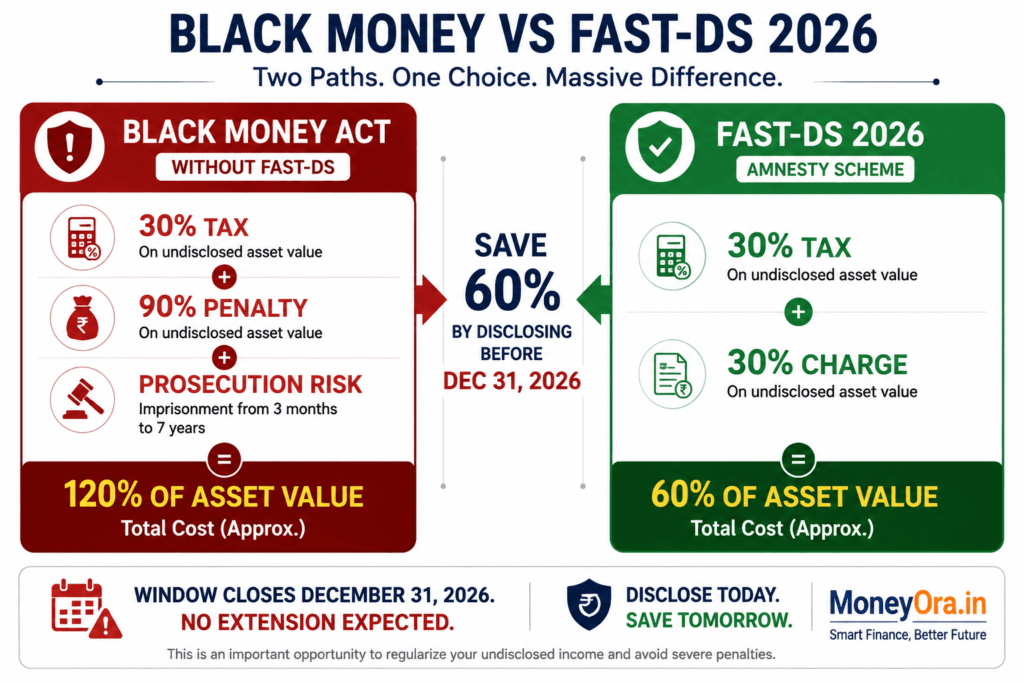
FAST‑DS 2026 offers a one‑time amnesty window that closes on December 31 2026. During this window you can regularise past foreign assets non‑disclosures at 60 % of asset value of 120 %.
The deadline for the return is July 31 2026 for salaried filers using ITR‑2 or ITR‑3 and August 31 2026 for business filers.
Many people think that because they have already paid tax abroad on their income they are finished. That is one of the costly assumptions in Indian tax law today.
Tens of thousands of taxpayers-salaried professionals with US RSUs freelancers with PayPal balances returning NRIs with dormant overseas accounts and retail investors holding US stocks through apps like Vested or Stockal are unknowingly sitting on a Rs.10 lakh penalty every single year. They do not do this because they evaded tax; they simply do not know that foreign assets disclosure in ITR is an obligation, from paying tax on foreign income.
This guide covers everything you need to know for AY 2026‑27. It explains what qualifies as an asset how Schedule FA works, the SBI TTBR exchange rate rule that trips up even CA‑assisted filers the new FAST‑DS 2026 amnesty window and gives worked examples for the most common scenarios. It also shows where you can use MoneyOras calculators to estimate your tax position accurately before filing.
What Is Foreign Assets Disclosure in ITR?
Foreign assets disclosure in ITR means you must list all the assets you own outside of India in the Schedule FA part of your income tax return. Foreign assets disclosure in ITR is a must for Resident and Ordinarily Resident (ROR) people because of the Black Money Act, 2015. You have to do Foreign assets disclosure in ITR even if your foreign assets did not earn any money.
You will find Foreign assets disclosure in ITR inside Schedule FA. Schedule FA is a section found in ITR-2 and ITR-3. Reporting these assets does not change how you calculate your income. I like to think of Foreign assets disclosure in ITR as a list you give to the government to show every bit of money or property you own outside of India.
The law that makes Foreign assets disclosure in ITR happen is the Black Money (Undisclosed Foreign Income and Assets) and Imposition of Tax Act 2015. The Income Tax Act, 2025 which started working on April 1 2026 keeps the rule for Foreign assets disclosure in ITR, in place.
Who Must File Schedule FA?
The requirement applies to you if you are a Resident and Ordinarily Resident (ROR) for FY 2025‑26. You had any foreign asset at any time during the year from January 1 to December 31 2025.
Two key tests determine ROR status:
You were physically present in India for 182 or more days during FY 2025‑26 OR
You were present in India for 60 or more days in FY 2025‑26. You were present in India for 365 or more days in total over the four previous financial years.
Non‑Residents (NRs) and Residents but Not Ordinarily Residents (RNORs) are usually exempt from Schedule FA.
If you are a returning NRI who crossed the 730‑day threshold in the last seven years you may already be classified as ROR without knowing it.
That ROR status triggers the full foreign assets disclosure in ITR immediately.
Watch out: Tech professionals on H1B visas who visit India for family trips may cross the 60‑day presence test when combined with earlier India residency.
If that applies to you run the residential status test before assuming you are exempt, from Schedule FA.
The Critical Calendar Year Rule for Schedule FA (Most People Get This Wrong)
This part is often skipped by guides and this is where many mistakes happen.
Your Indian income tax return covers the year from April 1 to March 31. Schedule FA does not follow this period.
Schedule FA follows the calendar year from January 1 to December 31.
For AY 2026-27 you must report assets that you hold at any time between January 1 2025 and December 31 2025 not the Indian financial year from April 2025 to March 2026.
Here is a clear example that shows why this matters. Suppose you bought US shares in November 2025 and sold them in January 2026.
- The purchase made in November 2025 falls inside the Schedule FA window for AY 2026-27. You must report it.
- The sale in January 2026 falls outside the Schedule FA window for AY 2026-27. It falls inside the financial year 2025-26 for income purposes. Therefore the capital gain is taxed in AY 2026-27. The Foreign Assets Disclosure in ITR will not be listed again in Schedule FA for that year because the sale occurred after December 31 2025.
This mismatch between the calendar year disclosure window and the financial year income period is where most small inconsistencies in returns show up. The safest approach is to pull two statements from your broker: one covering January to December 2025 for Schedule FA and another covering April 2025 to March 2026 for income calculation. Label them separately before you begin.
What Counts as a Foreign Asset Under Schedule FA?
The definition is broader than most people expect. There is no minimum value. A $5 dormant bank account carries exactly the same reporting obligation as a $500,000 portfolio.
| Schedule FA Table | Asset Type | Common Examples |
|---|---|---|
| Table A1 | Foreign bank accounts | US checking/savings accounts, UK current accounts, NRE/NRO accounts abroad |
| Table A2 | Signing authority in foreign accounts | Business accounts you can operate but don’t own |
| Table A3 | Foreign equity and debt interests | US stocks, foreign mutual funds, international ETFs, RSUs, ESOPs |
| Table A4 | Foreign cash value insurance/annuity | Life insurance policies issued abroad |
| Table A5 | Financial interest in foreign entities | Stake in a foreign LLP, company, trust |
| Table A6 | Immovable property outside India | Flat in Dubai, land in the US, inherited property abroad |
| Table A7 | Trusts where you are settlor/trustee/beneficiary | Family trusts set up abroad |
| Table A8 / Other | Any other capital asset outside India | Foreign pension funds, gold held abroad, art, vehicles |
One important point disclosure is required even if the asset generated zero income during the year. A dormant bank account you opened while studying in the UK ten years ago still needs to appear in your foreign assets disclosure in ITR every year you are an ROR.
The Exchange Rate Rule: Only One Rate Is Legal for Schedule FA
This is where a large number of CA-assisted returns also go wrong. People use Google’s exchange rate, the RBI reference rate, or whatever their broker shows on the statement. None of those are correct for Schedule FA.
The only legally prescribed rate is the SBI Telegraphic Transfer Buying Rate (TTBR).
Which Date’s TTBR Do You Use?
Different figures in Schedule FA require the TTBR from different dates:
| Schedule FA Field | TTBR Date to Use |
|---|---|
| Acquisition value of foreign asset | TTBR on the date of acquisition (purchase/vesting date) |
| Peak value during the year | TTBR on the date when the peak occurred |
| Closing balance as of December 31 | TTBR as of December 31, 2025 |
| Dividend income from foreign shares | TTBR on the last day of the month preceding the dividend month |
| Capital gain on foreign share sale | TTBR on the last day of the month preceding the month of sale |
| Foreign salary or RSU vesting income | TTBR on the vesting/credit date |
If the required date falls on a Sunday or bank holiday, use the rate from the immediately preceding working day. You can find historical SBI TTBR rates on the SBI website or through the RBI’s reference rate archive.
Worked Example: Reporting US Stocks in Schedule FA
Suppose Ananya, a software engineer in Pune, holds Apple shares purchased through Vested:
- She bought 5 shares of Apple on March 10, 2025 at $175 per share.
- The peak value of her Apple holding occurred on July 15, 2025 when the stock was at $210 per share.
- On December 31, 2025, the closing price was $190 per share.
For Schedule FA Table A3, she needs three separate INR conversions:
| Field | USD Amount | SBI TTBR (Illustrative) | INR Value |
|---|---|---|---|
| Acquisition value (5 shares x $175) | $875 | Rs.83.20 (March 10, 2025) | Rs.72,800 |
| Peak value (5 shares x $210) | $1,050 | Rs.84.10 (July 15, 2025) | Rs.88,305 |
| Closing value (5 shares x $190) | $950 | Rs.85.40 (Dec 31, 2025) | Rs.81,130 |
Note: Exchange rates above are illustrative. Always use the actual SBI TTBR published for each specific date.
If Ananya received any dividend on these shares during the calendar year 2025, she also needs to separately report that income in Schedule FSI and claim Foreign Tax Credit via Form 67 if US withholding tax was deducted.
To estimate how much your Indian tax liability might be on foreign dividends or capital gains, MoneyOra’s Stock Return Calculator can help you model returns across different scenarios.
Schedule FA vs Schedule FSI vs Schedule TR: Which Does What?
Most people get confused between these three schedules. They are not interchangeable.
| Schedule | Purpose | What Goes Here |
|---|---|---|
| Schedule FA | Asset disclosure | Details of every foreign asset held during Jan-Dec 2025, regardless of income |
| Schedule FSI | Foreign income reporting | All income earned from foreign assets during FY 2025-26: dividends, rent, capital gains, salary, interest |
| Schedule TR | Tax relief summary | Country-wise summary of foreign tax paid, drawn from Schedule FSI |
| Form 67 | Foreign Tax Credit claim | Must be filed separately before submitting ITR if you want to claim credit for tax paid abroad |
Filing Schedule FA without Schedule FSI when you had income from those assets is an incomplete filing. Both need to be accurate and consistent.
The ITR Form Question: Not ITR-1
This one trip-up costs people dearly. If you hold foreign assets and file ITR-1 (Sahaj), that is automatically a reporting default. ITR-1 cannot accommodate Schedule FA at all.
Foreign assets disclosure in ITR requires either:
- ITR-2 for individuals and HUFs without business or professional income, or
- ITR-3 for individuals and HUFs with business or professional income.
If you filed ITR-1 in a previous year while holding foreign assets, you have a reporting gap. The FAST-DS 2026 amnesty scheme (covered below) may be your best route to correct that without facing the full Black Money Act penalty.
The Penalty for Missing Foreign Assets Disclosure in ITR
The Black Money Act, 2015 has some of the most severe penalties in Indian tax law. There is no proportionality here based on asset size.
| Violation | Consequence |
|---|---|
| Non-disclosure of foreign asset in ITR | Rs.10 lakh penalty per asset per year |
| Inaccurate particulars in Schedule FA (wrong table, wrong values) | Rs.10 lakh penalty (same as non-disclosure) |
| Wilful evasion / undisclosed foreign asset | 30% tax on FMV + 90% penalty (total 120% of asset value) |
| Criminal prosecution | Up to 10 years imprisonment |
The penalty applies even if the asset earned zero income and no tax was due. Even if you paid tax in India on the source of funds used to buy the asset. Even if the asset is now closed. The only thing that matters is whether it was held at any time during the calendar year and whether it was reported.
One important nuance introduced by the Finance Act 2024 and carried forward in Finance Act 2026: there is a Rs.20 lakh threshold for foreign movable assets below which prosecution does not automatically apply. But that threshold does not remove the Rs.10 lakh per-year penalty for non-disclosure. The obligation to disclose has no minimum threshold.
FAST-DS 2026: The One-Time Amnesty Window You Should Not Miss
The Union Budget 2026 introduced the Foreign Assets of Small Taxpayers Disclosure Scheme 2026 (FAST-DS 2026). CBDT notified the rules via Notification No. 114/2026 Dated August 14 2026.
I think you should know that FAST-DS 2026 is a six-month voluntary disclosure window. This window gives taxpayers a chance to fix mistakes where they did not disclose assets. By using FAST-DS 2026 you can avoid the penalties of the Black Money Act. The FAST-DS 2026 window closes on December 31 2026. I do not think any extension, for FAST-DS 2026 will happen.
Who Can Use FAST-DS 2026?
The scheme targets small taxpayers who genuinely missed disclosure rather than large-scale offshore evaders. Two categories are covered:
Category A: Assets acquired from foreign income when you were an NRI, or from income that was already offered to tax in India, but the asset was never reported in Schedule FA. This is the most common scenario for returning NRIs and ESOP holders.
Category B: Assets or income that were never taxed or reported. These represent a higher-risk category from a compliance standpoint.
What Does FAST-DS Cost?
| Route | Tax Rate | Additional Charge | Total Outgo |
|---|---|---|---|
| FAST-DS 2026 (voluntary disclosure) | 30% on FMV | 30% additional charge | 60% of asset value |
| Black Money Act (if caught) | 30% on FMV | 90% penalty | 120% of asset value |
That is a 60-percentage-point difference. For someone holding $50,000 worth of undisclosed foreign assets, that gap is roughly Rs.25 lakh in potential savings.
What FAST-DS Provides
- Full immunity from Black Money Act penalty and prosecution for the disclosed assets.
- No reassessment of earlier years for those assets.
- No interest on tax for periods before the disclosure.
The scheme is not applicable to assets that represent proceeds of crime under the Prevention of Money Laundering Act, 2002.
Common Profiles That Should Look at FAST-DS
- Returning NRI who held foreign bank accounts and shares but did not file Schedule FA after becoming an ROR.
- Student who opened a foreign bank account while studying abroad and never reported it after returning.
- ESOP holder who declared the perquisite income at vesting but never put the resulting shares into Schedule FA.
- Freelancer with a PayPal or Payoneer balance that was never reported.
The NUDGE Initiative and Why the Tax Department Already Knows
Here is something worth understanding. The Income Tax Department launched the “NUDGE” initiative specifically to push taxpayers toward voluntary compliance on foreign assets. This is not a random programme. It is built on data from global information exchange frameworks: FATCA (with the US), CRS (Common Reporting Standard with most countries), and various bilateral tax treaties.
When you hold a foreign bank account or brokerage account, the foreign financial institution reports your details to its local regulator, who shares it with CBDT under these agreements. The tax department may already have your foreign account balance, interest income, and transaction history. If that information does not match what you filed in Schedule FA, you will get a notice. It is not a question of whether – it is a question of when.
The Income Tax Department’s AIS portal now also auto-populates certain foreign asset and income data sourced from FATCA and CRS. Check your AIS carefully before filing. If it shows foreign account details you have not disclosed, that mismatch needs to be addressed before you submit your return.
Concurrent Schedule AL Reporting
Filing Schedule FA does not remove your obligation to also report foreign assets in Schedule AL (Assets and Liabilities). Schedule AL is applicable to taxpayers with total income above Rs.50 lakh. If that threshold applies to you, your foreign property, investments, and bank accounts need to appear in both Schedule FA and Schedule AL consistently. Discrepancies between the two schedules are a common scrutiny trigger.
MoneyOra Analysis: What Changed in 2026 and What It Means for Indian Investors
The Income Tax Act, 2025, which replaced the 1961 Act from April 1, 2026, renumbered some provisions but preserved the substance of the foreign assets disclosure framework entirely. The SBI TTBR requirement remains (now referred to under Rule 206 instead of Rule 115 of the new rules framework, though filers should verify final rule numbers). The penalty structure under the Black Money Act remains unchanged.
What changed significantly in 2026 is the enforcement posture. The combination of FATCA, CRS, the AIS pre-fill, and NUDGE notices means that the gap between what you hold abroad and what the department knows is narrowing quickly. The window where non-disclosure could go undetected is essentially closed for major financial centres including the US, UK, Singapore, UAE, and most of Europe.
The introduction of FAST-DS 2026 is itself a signal. It suggests the department anticipates a large volume of previously undisclosed assets coming to light and is offering a structured exit rather than mass prosecution. That window closes in four months. After that, the only resolution available is the full Black Money Act route, which means 120% of the asset value plus potential imprisonment.
For investors who use platforms like Vested, Stockal, or INDmoney to hold US stocks, the ITR filing is now genuinely two-part: income computation for the financial year AND asset disclosure for the calendar year. Both need to be done carefully, with separate data pulls and separate exchange rate lookups. If you are using MoneyOra’s CAGR Calculator or Stock Return Calculator to understand your investment returns, pair that with a careful Schedule FA review before your return is filed.
Step-by-Step Checklist for Foreign Assets Disclosure in ITR 2026
- Determine your status. Run the test and the 60‑plus‑365‑day test. If you are a Resident Outside India the Schedule FA applies to you.
- Identify every asset held at any time between January 1 and December 31 2025. Include accounts, assets that closed during the year and assets that had zero balance on December 31 if they existed at any point.
- Pull two statements: one for the period January to December 2025 (the Schedule FA period) and one for the period April 2025 to March 2026 (the income period).
- Look up the SBI TTBR for each date: acquisition date, peak date December 31 2025 dividend dates and sale dates. Do not use any rate.
- Map each asset to the correct Schedule FA table (A1 through A8). Using the table will trigger the same penalty as non‑disclosure.
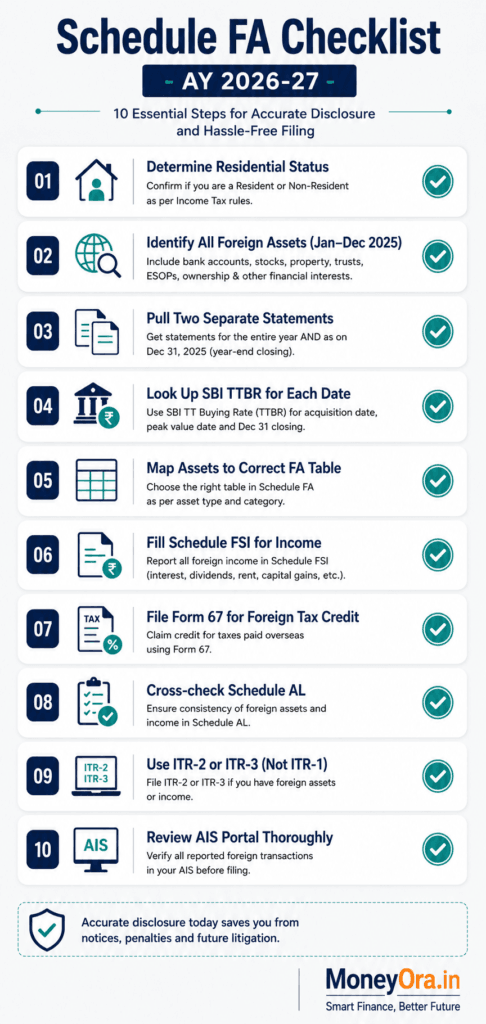
- Report income from each foreign asset in the Schedule FSI broken down by country for the fiscal year 2025‑26.
- File Form 67 before submitting the ITR if you are claiming a Foreign Tax Credit for taxes paid abroad.
- Cross‑check the Schedule FA values against Schedule AL if your income exceeds fifty lakh rupees.
- Use. Itr‑3, not ITR‑1. If you previously filed ITR‑1 while holding assets consider FAST‑DS for those earlier years.
- Review your AIS on the income tax portal to find any pre‑populated foreign asset data. Resolve any mismatch, before filing.
- Incorrect residential status assessment. Many taxpayers assume NRI status when they have already crossed the ROR threshold. Get the days count right.
- Wrong exchange rate. Using Google or RBI rates instead of SBI TTBR for Schedule FA is a non-compliant filing.
- Incomplete asset coverage. Forgetting pension accounts, employer stock plan accounts with zero activity, or accounts you were a signatory to.
- Calendar year confusion. Mixing up the April-March financial year with the January-December Schedule FA period leads to gaps and double-counting.
- FAST-DS eligibility check. The scheme excludes assets linked to proceeds of crime. If you are unsure about the source classification, professional advice is essential before filing a declaration.
- DTAA double-counting. Non-disclosure removes your right to claim Double Taxation Avoidance Agreement benefits for that income. Foreign assets disclosure in ITR is the price of entry for DTAA relief.
For a broader view of how your overall portfolio is performing while you navigate these compliance requirements, it is worth using the NPS Calculator or EPF Calculator on MoneyOra alongside your foreign holdings review.
Common Beginner Mistakes in Foreign Assets Disclosure in ITR
| Mistake | Why It Happens | Consequence |
|---|---|---|
| Filing ITR-1 while holding foreign assets | People forget they changed forms | Automatic reporting default, Rs.10 lakh penalty risk |
| Using Google or RBI rate instead of SBI TTBR | More accessible, seems reasonable | Incorrect disclosures, scrutiny, potential penalty |
| Reporting only income-generating assets | Assumption that zero-income = zero obligation | Missed disclosure = penalty even for dormant accounts |
| Using financial year period for Schedule FA | Confusion between April-March and Jan-Dec | Wrong reporting period, gaps in asset coverage |
| Not filing Form 67 before return submission | Not aware it is a prerequisite for FTC | Foreign Tax Credit claim rejected, double taxation |
| Skipping Schedule FSI when foreign income exists | Thinking Schedule FA is enough | Incomplete filing, income underreported |
Foreign Assets Disclosure in ITR Is Not Optional
If there is one thing this guide makes clear, it is this: the assumption that “I paid tax on it, so I am done” does not hold under Indian tax law when foreign assets are involved. Foreign assets disclosure in ITR is a separate, annual obligation. The penalty for getting it wrong is disproportionately large relative to the effort of getting it right.
The FAST-DS 2026 amnesty window is a genuine opportunity for taxpayers who have gaps in past Schedule FA filings. It closes on December 31, 2026. After that, the only available route is the full Black Money Act treatment at 120% of asset value.
For the current filing year (AY 2026-27), the checklist is straightforward determine your residential status, identify all foreign assets held between January and December 2025, use SBI TTBR for all conversions, file ITR-2 or ITR-3 with Schedule FA and Schedule FSI correctly filled, and cross-check your AIS for data the department may already have.
Foreign assets disclosure in ITR is one of those areas where precision matters more than speed. Do not rush through it. Get the exchange rates right, get the tables right, and if you have a complicated situation, professional advice is worth every rupee.
Frequently Asked Questions
1. Is foreign assets disclosure in ITR mandatory if my foreign account has zero balance?
Yes if the account existed at any point during January 1 to December 31 2025 it must be reported in Schedule FA even if the closing balance on December 31 was zero. The obligation triggers on existence during the year not on closing balance.
2. Which ITR form is required for foreign assets disclosure in ITR?
You must use ITR-2 (for salaried individuals and HUFs without business income) or ITR-3 (for those with business or professional income). ITR-1 cannot carry Schedule FA. Using ITR-1 when you hold assets is an automatic reporting default under the Black Money Act.
3. What exchange rate should I use for Schedule FA in ITR AY 2026-27?
You must use the SBI Telegraphic Transfer Buying Rate (TTBR) on the date relevant to each figure: acquisition date for initial cost the date the peak occurred for peak value and December 31 2025 for closing balance. Using Google rates RBI reference rates or broker rates is non-compliant. Can trigger scrutiny.
4. What is the penalty for not doing foreign assets disclosure in ITR?
Under the Black Money Act, 2015 the penalty is Rs.10 lakh per asset per year of non-disclosure. For undisclosed assets (income not offered to tax) the tax rate is 30% of the fair market value plus a 90% penalty totalling 120% of the asset value. Criminal prosecution of up to 10 years imprisonment is also possible.
5. Can NRIs skip foreign assets disclosure in ITR?
Non-Residents (NRs) and Residents but Not Ordinarily Residents (RNORs) are generally exempt from Schedule FA. However returning NRIs who have crossed the 730-day residency threshold over the preceding seven years may already be classified as ROR. In that case Schedule FA is mandatory. Check your status carefully before assuming exemption.
6. What is FAST-DS 2026. How does it help with past non-disclosures?
Ds 2026 (Foreign Assets of Small Taxpayers Disclosure Scheme) is a one-time six-month amnesty window introduced in Union Budget 2026 with rules notified in August 2026. It allows eligible taxpayers to voluntarily disclose unreported foreign assets at a total outgo of 60% of asset value (30% tax plus 30% charge) compared to 120% under the Black Money Act. The window closes December 31 2026.
7. Do I need to report ESOPs and RSUs in Schedule FA?
Yes. RSUs and ESOPs that have vested and resulted in foreign shares are foreign assets that must be reported in Table A3 of Schedule FA. Many employees correctly declare the income at vesting in their ITR but forget to report the resulting share holdings in Schedule FA every year they remain an ROR. Both obligations run independently.
8. What period does Schedule FA cover for AY 2026-27?
Schedule FA for AY 2026-27 covers the calendar year January 1 2025 to December 31 2025. This is not the same as the financial year (April 2025 to March 2026). Foreign assets held at any time during that calendar year must be reported, regardless of whether they were held on March 31 or at any Indian financial year boundary.
9. What happens to my DTAA benefits if I miss foreign assets disclosure in ITR?
Non-disclosure under Schedule FA revokes your right to claim Double Taxation Avoidance Agreement relief for the income. This means income you paid tax on can also be taxed fully in India with no credit for the tax already paid abroad. Proper foreign assets disclosure in ITR is a prerequisite for accessing DTAA benefits.
10. Is a PayPal or Payoneer balance an asset for ITR?
Generally yes, if the account is registered abroad and you are classified as an ROR in India. Balances in foreign payment processor accounts may need to be reported in Schedule FA under the foreign bank accounts or financial interests categories. Consult a CA with foreign assets compliance to determine the exact classification, for your specific account structure.