
Regular to Direct Mutual Fund 2026: The Commission You Are Paying and the Tax-Smart Way to Switch
The switch from regular to direct mutual fund is one of those financial decisions that sounds straightforward until you look at the tax consequences. Most articles on this topic tell you to switch immediately and show you a chart of the long-term cost difference. Almost none of them tell you that switching this switch is legally a redemption, that it triggers capital gains tax at the point of switch, and that with the new 12.5% LTCG rate since Budget 2024, the tax bill can be significant enough to change your entire switching strategy.
This guide gives you the full picture. It covers what the commission is actually costing you with original compound-loss calculations, the exact tax implications of switching plans using current 2024 LTCG rules, two strategies that minimise the tax hit, a break-even calculator showing when switching makes financial sense, a separate strategy for debt funds where the tax logic is completely different, and the process for switching through CAMS and MF Central.
Before you decide whether to switch regular to direct mutual fund, understanding how your overall financial plan is structured helps frame the decision. The financial planning guide on MoneyOra explains how expense ratios fit into the broader picture of long-term wealth building.
- Switching regular to direct mutual fund is a taxable redemption. Most investors do not realise this until they get a tax notice
- LTCG on equity funds is now 12.5% on gains above Rs 1.25 lakh per year since Budget 2024, not the 10% most articles still quote
- The no-tax first step, stop all SIPs in regular plans today and restart them in direct. Zero tax, instant saving
- Annual LTCG harvesting, redeem Rs 1.25 lakh of regular plan gains each year and reinvest in direct, paying zero tax on each tranche
- Rs 10 lakh in a regular fund at 1% higher TER costs Rs 2.1 lakh extra over 10 years after compounding. Original MoneyOra calculation
- Debt fund switch strategy is completely different from equity. All gains are taxable at your slab rate regardless of holding period
- ELSS switching is only possible when the 3-year lock-in has expired. No AMC can process a switch before that
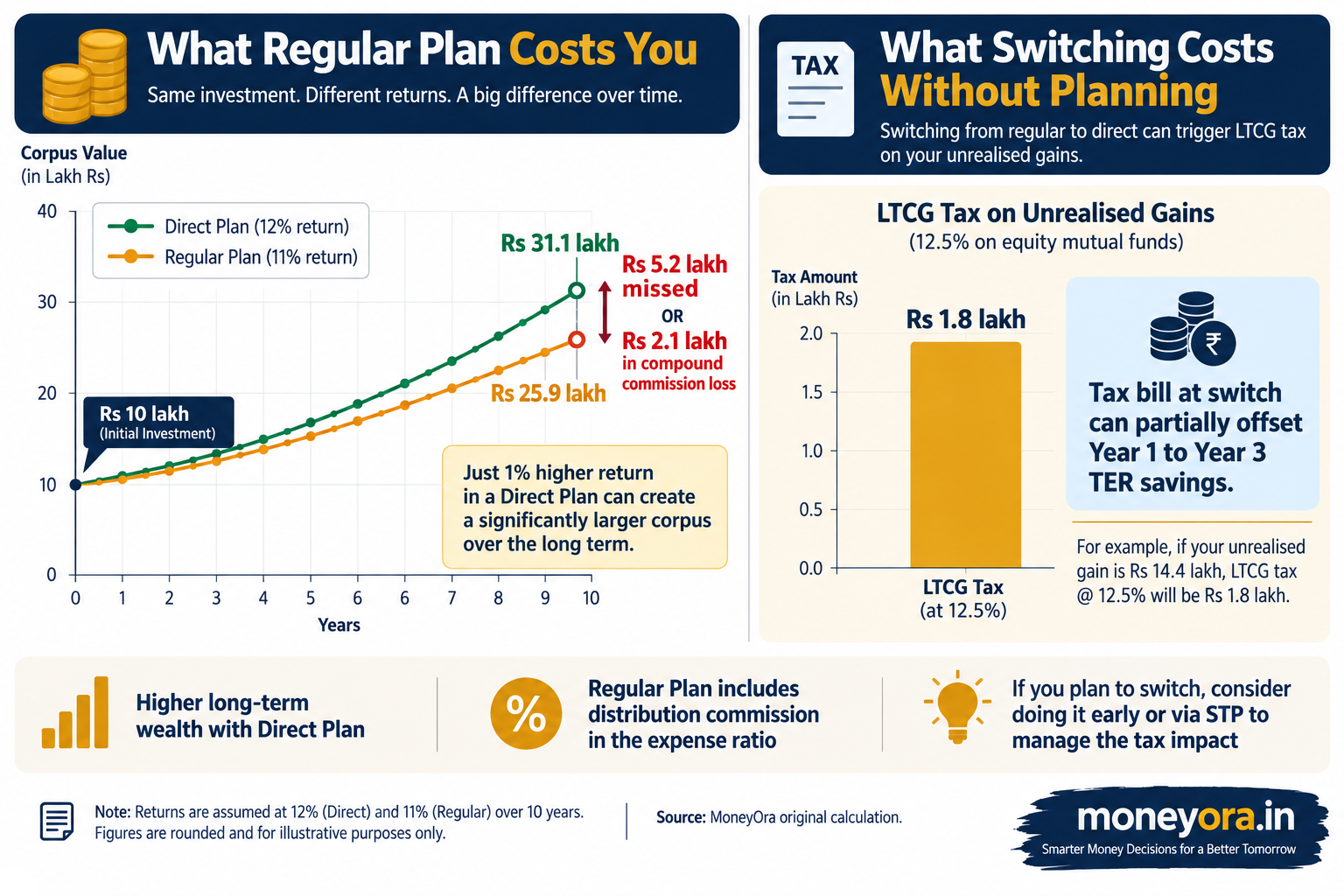
Rs 10 lakh in a regular mutual fund plan at 1% higher TER costs Rs 2.1 lakh in foregone returns over 10 years at 12% growth, but switching without a tax strategy can wipe out part of that saving on Day 1.
What the Commission Is Actually Costing You (Original Calculator)
Switching regular to direct mutual fund saves you the commission embedded in the regular plan’s Total Expense Ratio (TER). The TER difference between regular and direct plans of the same fund is typically 0.5% to 1.5% per year depending on the fund category. Equity funds tend to have the highest gap. Liquid funds and overnight funds have near-zero gap because commission cannot be hidden in a fund with a 4% gross return.
Most comparison articles show you the TER difference as a percentage. What they skip is the compound loss calculation, specifically how much that percentage difference costs you in actual rupees over time on a real corpus size.
| Corpus Size | TER Gap | Annual Commission Paid | Compound Loss Over 10 Years (12% base) |
|---|---|---|---|
| Rs 5 lakh | 1% | Rs 5,000 | Rs 1.04 lakh |
| Rs 10 lakh | 1% | Rs 10,000 | Rs 2.1 lakh |
| Rs 25 lakh | 1% | Rs 25,000 | Rs 5.2 lakh |
| Rs 50 lakh | 1% | Rs 50,000 | Rs 10.4 lakh |
| Rs 1 crore | 1% | Rs 1 lakh | Rs 20.8 lakh |
The compound loss figure is based on a calculation. It compares money growing at 12% in plans versus 11% in regular plans over ten years assuming a fixed starting corpus.. In real life your corpus keeps growing each year and so does the annual commission amount. This means the actual loss ends up being slightly higher than what these numbers show.
Take this example: a Rs 10,000 annual commission on a Rs 10 lakh corpus doesn’t just cost you Rs 1 lakh over ten years. That Rs 10,000 per year could have been. Grown at 12%. The power of compounding means that missing Rupee has a bigger impact. Over ten years the lost opportunity from not investing that Rs 10,000 every year adds up to Rs 2.1 lakh. That number—Rs 2.1 lakh—is the cost you should consider when deciding if switching to a direct plan makes financial sense.
Also keep in mind that the TER difference between direct and regular plans changes depending on the size of your investment. For amounts the gap stays wide because both plans charge similar rates.. For larger corpus sizes especially when the fund size crosses Rs 500 crore the fund house reduces the commission rate due to SEBI’s TER slab rules. That means the difference shrinks as your corpus grows.
Before making any decision check the Total Expense Ratio (TER) for your exact regular and direct plan. You can find this information on the AMFI’s TER disclosure page at amfiindia.com under the TER disclosure section. Always verify the numbers before running any calculations.
Why Switching from Regular to Direct Mutual Fund Is an Event
This is something that most guides either hide in a small disclaimer or completely overlook When you switch from regular to direct mutual fund the Income Tax Act sees it as two separate events First you redeem your plan units Then you buy direct plan units There is no thing as a “conversion” in the tax law Even if both plans are managed by the AMC and hold the same underlying securities the switch still triggers a capital gains tax.
SEBI’s switching mechanism makes the process simple for the investor You just file a switch request through CAMS KFintech or MF Central and the whole transaction happens in one step The tax department doesn’t see it that way On that day two things happen you sell your regular plan units at the current NAV which may create a capital gain You buy direct plan units at the same NAV which starts a new holding period.
The gain calculation for switching regular to direct mutual fund follows the same FIFO method-First In First Out-that applies to any redemption The oldest units are considered sold Each unit’s holding period decides whether the gain is term or long-term If you sell units that were bought than 12 months ago the gain is short-term capital gain taxed at 20% If the units have been held for than 12 months the gain is long-term capital gain taxed at 12.5% after a Rs 1.25 lakh exemption per year.
Take a term regular plan investor with five years of SIP history Most of their units will qualify as term Suppose their investment of Rs 10 lakh has grown to Rs 20 lakh The unrealised gain is Rs 10 lakh After subtracting the Rs 1.25 lakh exemption Rs 8.75 lakh is taxable. At 12.5% that comes to Rs 1.09 lakh in tax-paid on the day of the switch.
That tax payment immediately cancels out the year or more of savings from lower expense ratios This is why the tax strategy matters as much as the decision to switch The SIP performance guide on MoneyOra explains how capital gains from SIP units are calculated using FIFO That same method determines your tax bill when you switch from regular to mutual fund.
New LTCG Rules After Budget 2024 What Changed and What Did Not
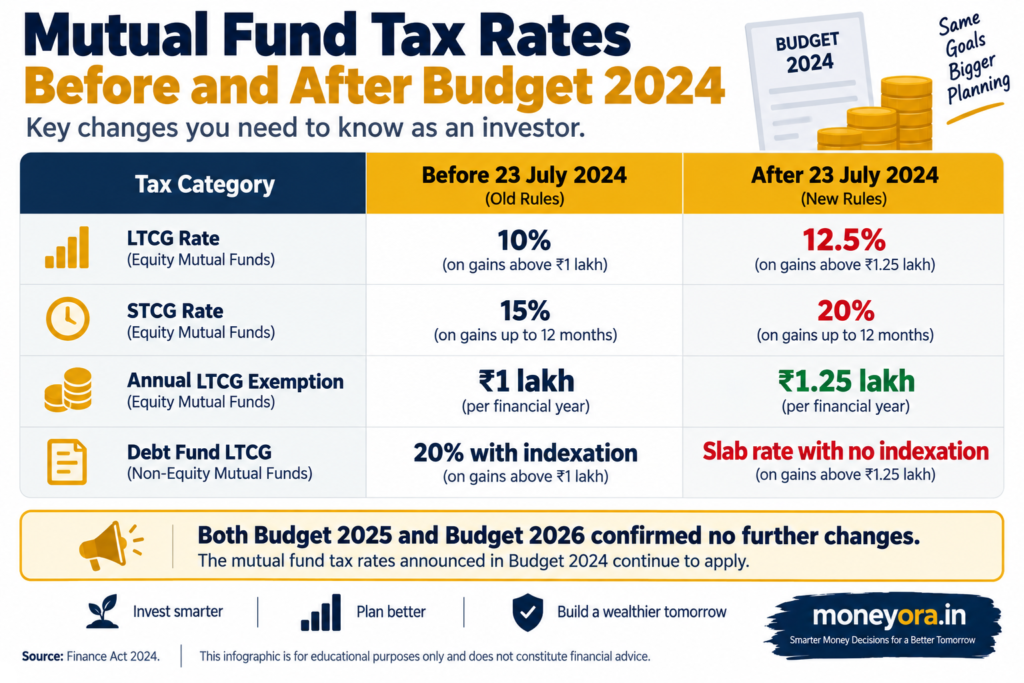
Budget 2024 changed two things and left one thing. Many articles on switching regular to direct mutual fund still quote the old numbers Here is the current position.
What changed on 23 July 2024
- LTCG tax rate on equity-oriented funds increased from 10% to 12.5%
- STCG tax rate on equity-oriented mutual funds increased from 15% to 20%
- Annual LTCG exemption increased from Rs 1 lakh to Rs 1.25 lakh per financial year
- Indexation benefit removed for all equity fund gains (it was not available for equity even before so this primarily affects hybrid funds with equity-like classification)
What did not change
- Holding period for equity LTCG 12 months
- FIFO method for unit redemption unchanged
- The basic principle that switching regular to direct mutual fund = taxable redemption unchanged
- Budget 2025 and Budget 2026 confirmed no further changes to these rates
What changed for debt funds (important for debt fund switchers)
From 1 April 2023 debt mutual fund gains lost their LTCG/indexation advantage entirely All debt fund gains are now taxed at your income tax slab rate regardless of holding period This means switching a debt fund to direct plan still triggers a tax event, but the rate is your slab rate, not a flat 12.5%. For someone in the 30% tax bracket switching a debt fund with large unrealised gains is more expensive, than switching an equity fund with the same gain.
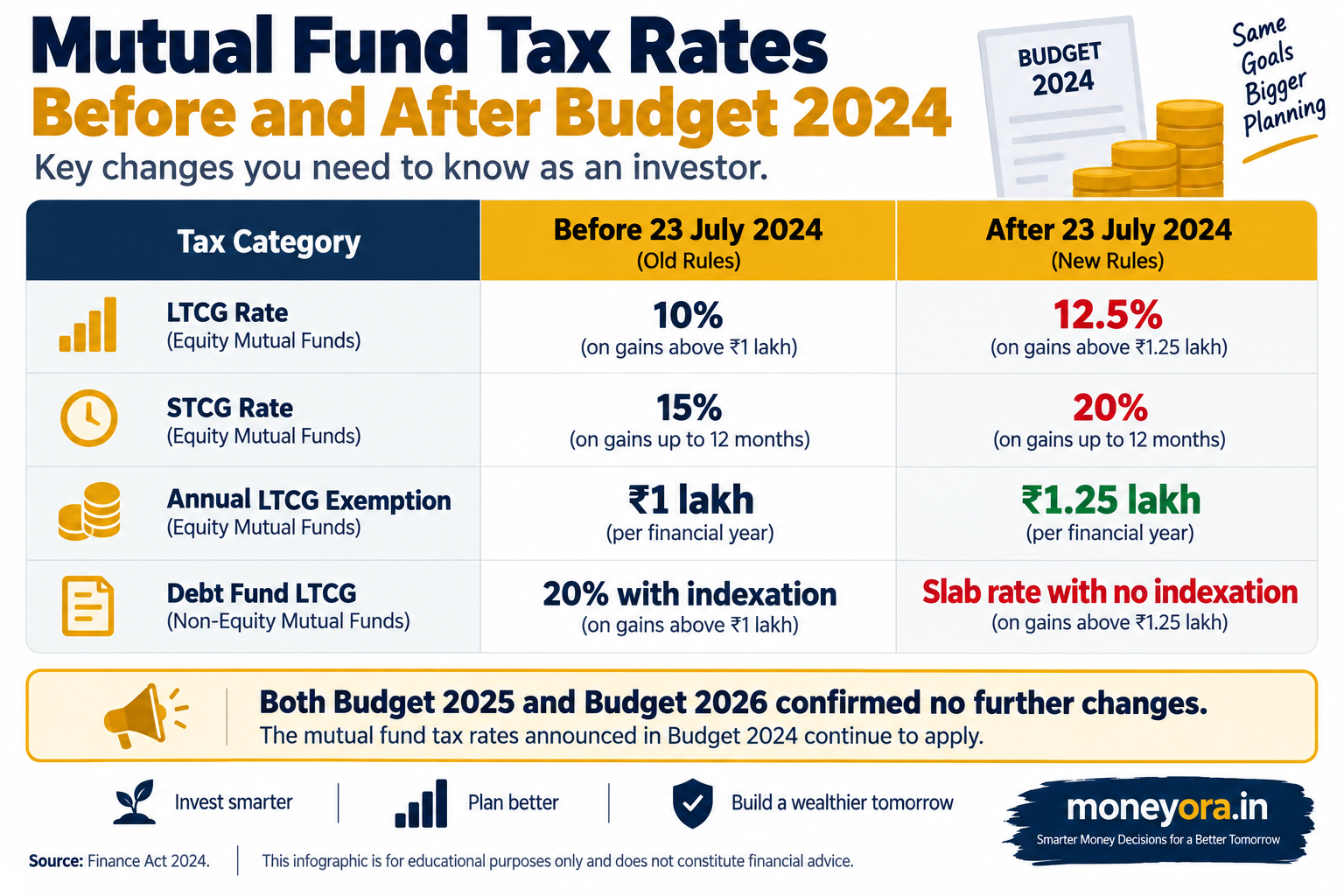
Budget 2024 raised LTCG to 12.5% and STCG to 20% on equity funds from 23 July 2024. The Rs 1.25 lakh annual exemption is the core tool for tax-free switching regular to direct mutual fund over multiple years.
Strategy 1 for Switching Regular to Direct Mutual Fund Without Paying Tax
Every article on switching regular to direct mutual fund jumps straight to “how to switch your existing holdings.” They skip the most obvious and most tax-efficient first move, stop investing new money in the regular plan immediately.
If you are running a SIP in a regular plan, pause it today. Set up a new SIP in the direct plan of the same fund. This costs zero tax. Zero exit load (SIPs stopped within the free-switch period have no load). Zero paperwork beyond setting up the new SIP. And it takes effect from the very next instalment.
The logic is simple. New SIP money going into a regular plan will compound at the lower TER rate for the next 10 to 20 years. New SIP money in the direct plan earns the full return. Every future rupee you invest in the regular plan is choosing to pay commission indefinitely. Stopping new regular plan investments is the first and most impactful step in switching regular to direct mutual fund, and it is available to you at no cost right now.
After stopping the SIP in regular and starting in direct, you now have two positions, a growing direct plan SIP (clean, no tax cost) and your existing regular plan corpus (which you will migrate gradually using Strategy 2 below).
Strategy 2. Annual LTCG Harvesting to Switch Tax-Free
This is the method that no competitor on Google has written about clearly. Annual LTCG harvesting uses the Rs 1.25 lakh annual exemption strategically to migrate your existing regular plan corpus to direct, paying zero or near-zero tax in the process.
How LTCG Harvesting Works for Switching Regular to Direct Mutual Fund
Each financial year you are entitled to Rs 1.25 lakh of LTCG gains tax-free. If you switch regular to direct mutual fund in tranches such that each year’s switch generates no more than Rs 1.25 lakh in LTCG you pay zero tax on the entire migration.
Here is a worked example You have Rs 15 lakh in a regular equity fund with an unrealised LTCG of Rs 6 lakh (meaning you originally invested Rs 9 lakh and it is now worth Rs 15 lakh). At 12.5% LTCG, switching everything in one day means. Rs 6 lakh gain minus Rs 1.25 lakh exemption = Rs 4.75 lakh taxable at 12.5% = Rs 59,375 in tax.
With annual harvesting, switch the portion of your regular plan that generates Rs 1.25 lakh in LTCG each year. Assuming gains are spread proportionally you switch Rs 3.125 lakh of corpus each year (which carries Rs 1.25 lakh of gain). That switch generates zero tax. Over 5 years you have migrated all Rs 15 lakh to the direct plan and paid no LTCG at all.
The tradeoff you continue paying regular plan commission on the remaining unharvested corpus for up to 5 years. The break-even section below tells you exactly when that tradeoff is favourable.
Important Caveat on the Rs 1.25 Lakh Exemption
The Rs 1.25 lakh annual LTCG exemption is aggregate across all equity gains in a financial year. It covers equity mutual funds, direct equity shares, equity-oriented hybrid funds, and ETFs. If you are already using part of this exemption through share trading or other fund redemptions, the available tax-free switching room for your regular to direct mutual fund migration is correspondingly reduced. Plan your annual harvesting only after accounting for other equity LTCG in the year.
To model how much SIP corpus you would have built up and what your unrealised gains are, use the SIP calculator on MoneyOra before planning your LTCG harvesting schedule.
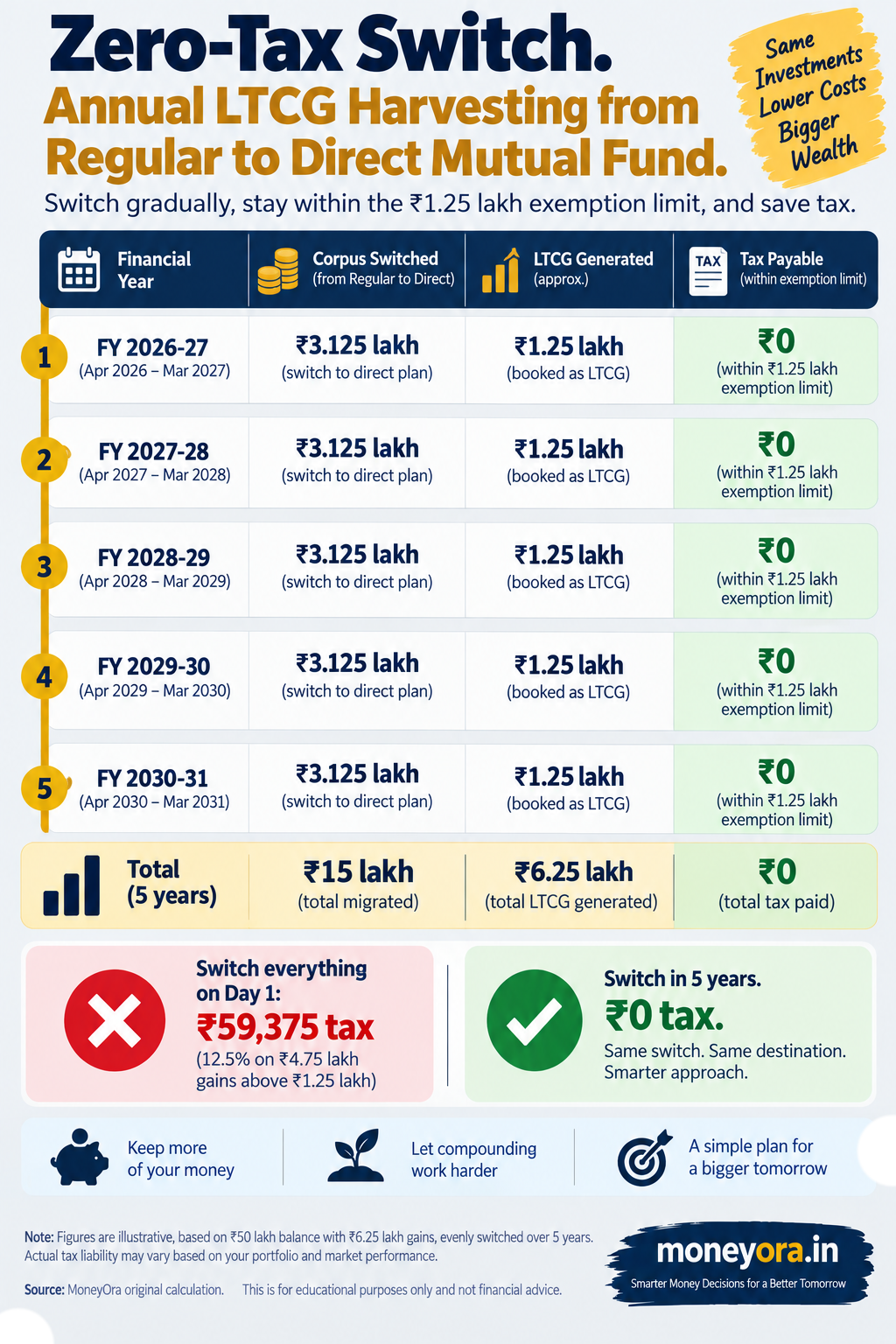
Annual LTCG harvesting uses the Rs 1.25 lakh tax-free exemption to migrate a regular plan corpus to direct in annual tranches, paying zero tax. A Rs 15 lakh corpus with Rs 6 lakh unrealised gain migrates completely in 5 financial years at zero tax cost.
Break-Even Calculator When Does Moving from Regular to Direct Mutual Fund Make Financial Sense
This is the calculation zero competitors have done. The question is, how many years of TER saving does it take to recover the one-time tax cost of switching and come out ahead?
The formula is straightforward.
Break-even period (years) = One-time tax cost at switch divided by Annual TER saving
But both numbers depend on your specific situation. Here is the calculation for three scenarios using a Rs 10 lakh corpus with a 1% TER gap.
| Scenario | Unrealised Gain | LTCG Tax at Switch | Annual TER Saving | Break-Even |
|---|---|---|---|---|
| Newer investment (30% gain) | Rs 3 lakh | Rs 21,875 | Rs 10,000 | 2.2 years |
| Medium holding (60% gain) | Rs 6 lakh | Rs 59,375 | Rs 10,000 | 5.9 years |
| Older holding (120% gain) | Rs 12 lakh | Rs 1.34 lakh | Rs 10,000 | 13.4 years |
The table reveals a clear pattern. Switching regular to direct mutual fund makes obvious financial sense when the holding period is shorter and unrealised gains are small relative to corpus. For older highly appreciated holdings, the annual LTCG harvesting strategy from Section 5 beats an immediate switch in almost all cases.
The annual TER saving used above (Rs 10,000 on Rs 10 lakh at 1% gap) also assumes the TER gap stays at 1%. Some funds have a 0.5% gap and others have a 1.5% gap. Use your specific fund’s TER differential from AMFI’s disclosure page to run this calculation for your own situation.
One additional factor the break-even calculation above does not capture, the opportunity cost of the tax payment itself. Rs 59,375 paid in tax at switch could have compounded at 12% for 10 years to become Rs 1.84 lakh. The real break-even for the medium-holding scenario is therefore significantly longer than 5.9 years when this compounding loss is included.
Debt Fund Regular to Direct Switch. A Different Strategy
Every article on switching from regular to direct mutual funds talks only about equity funds. The debt fund side is always left out even though it matters a lot more for investors with big debt fund holdings.
Debt mutual funds. Like funds, short duration funds, corporate bond funds and gilt funds. Are taxed in a completely different way than equity funds.
Since April 1 2023 all gains from debt funds are taxed at your income tax slab rate. There is no long-term capital gains rate. There is no tax exemption of Rs 1.25 lakh. Whether you hold a debt fund for one year or ten years the gains you make when you switch from regular to direct mutual fund are added to your income. Taxed at 20% 30% or whatever your slab rate is.
This changes the break- calculation a lot. Take a 30% tax bracket investor with Rs 10 lakh in a debt fund and Rs 3 lakh in unrealised gains. Switching in one go means paying Rs 90,000 in tax. That’s 30% of Rs 3 lakh.
Now the difference in expense ratio between direct debt funds is usually between 0.3% and 0.7%. If we take a 0.5% gap, the annual saving on Rs 10 lakh is Rs 5,000.
So to recover the Rs 90,000 tax cost it would take 18 years of savings. That’s a long time. The switch just doesn’t make sense unless the holding period from this point is really long.
This means the practical strategy for switching debt funds from regular to direct mutual fund is different from equity funds.
The best approach is one of two options.
First switch when you were already planning to redeem. Then reinvest the money into the plan.
Second accept that the regular debt fund is a cost and don’t switch existing holdings. Instead make all new debt fund investments go directly into the plan from now on.
This way you avoid tax and still benefit from lower costs, over time.
ELSS Switching from Regular to Direct Mutual Fund. The Lock-In Constraint
Equity Linked Saving Schemes have a mandatory 3-year lock-in from the date of each investment. You cannot switch regular to direct mutual fund for ELSS units that are within the lock-in period. No AMC can process the switch, and CAMS and KFintech will reject the switch request for locked units.
Once the 3-year lock-in expires, ELSS units can be switched exactly like any other equity fund. There is no exit load. The gain on ELSS units held for more than 12 months (which all post-lock-in ELSS units will be, since the lock-in is 36 months) is LTCG at 12.5% above the Rs 1.25 lakh exemption.
The practical ELSS strategy is to stop new ELSS SIPs in the regular plan immediately (if you want to continue using ELSS for Section 80C, redirect new SIPs to the direct ELSS plan of the same fund). For your existing ELSS corpus in regular plans, check the lock-in expiry date for each investment tranche and schedule switches as each tranche unlocks. CAMS and KFintech both show lock-in expiry dates in your holding statement.
One thing to note, if you are switching ELSS regular to direct mutual fund after lock-in to reinvest in the same fund’s direct plan, the fresh direct plan units start a new 3-year lock-in. This is not an issue if you intend to hold the fund long-term, but it removes liquidity that the post-lock-in regular plan units did not have.
How to Switch Regular to Direct Mutual Fund CAMS and MF Central
The actual switch process for switching regular to direct mutual fund uses one of three platforms depending on which registrar holds your fund.
Via CAMS Online
- Log in at camsonline.com using your registered mobile and OTP
- Go to Transact and select Switch
- Choose the source fund (regular plan) from your holdings
- Enter the destination as the same fund’s direct plan
- Select amount or all units to switch
- Confirm via OTP
- CAMS executes the switch at the same day’s NAV if submitted before 3 PM on a business day
Via MF Central
MF Central at mfcentral.com allows switching regular to direct mutual fund across both CAMS and KFintech registered funds from a single login. This is the most convenient option if you hold funds serviced by different registrars. Log in with Aadhaar OTP or PAN, navigate to Transactions and select Switch, then follow the same process as CAMS above.
Via KFintech
KFintech’s investor portal at kfintech.com covers funds not serviced by CAMS. The switch process is the same, log in, select the regular plan holding, select the direct plan of the same fund as destination, and confirm. Franklin Templeton, Nippon India, and UTI funds are primarily serviced by KFintech.
Timing Note
When switching regular to direct mutual fund, the switch happens at the closing NAV of the day it is submitted (if before 3 PM) or the next business day’s NAV (if after 3 PM). For equity funds the NAV difference between a same-day and next-day switch is typically minor. For debt funds where intraday gains can be relevant, submit before 3 PM.
Which AMCs Allow Within-Plan Conversion vs Forced Redemption
This information appears in scattered investor forums. Is never compiled clearly. The position across AMCs for switching regular to direct mutual fund is as follows.
No Indian AMC currently offers a “within-plan conversion” that would allow switching to direct mutual fund without a redemption event for tax purposes. The SEBI switch mechanism and Income Tax Act interpretation both treat the switch as a redemption and fresh purchase of which AMC you are with.
Some AMCs market their switch process as. Instant, which is true operationally.. Quick” means there is no paperwork gap or liquidity gap. It does not mean there is no tax event. The tax implications are identical whether you use HDFC Mutual Funds website, Mirae Assets portal or CAMS. The legal treatment is a redemption of plan units and a purchase of direct plan units.
The only practical difference across AMCs is the mechanism some allow switching via their portal others require CAMS or KFintech. The following major AMCs allow the switch to be initiated directly on their investor portals in addition to CAMS and MF Central. HDFC Mutual Fund, SBI Mutual Fund ICICI Prudential Mutual Fund, Axis Mutual Fund and Mirae Asset Mutual Fund.
For the list of AMC investor portals, check AMFI’s member page at amfiindia.com. Each AMCs portal link is listed under the member directory.
Three Things Every Other Article Misses About Switching Regular to Direct Mutual Fund
Gap 1. The Grandfathering Date and Its Effect on Old Regular Plan Holdings
Units purchased before 31 January 2018 have their LTCG cost base “grandfathered,” meaning the deemed cost of acquisition is the higher of the purchase price or the NAV as of 31 January 2018. For old regular plan holdings bought before 2018 the effective LTCG liability at switch is lower than it appears because the grandfathered NAV reduces the taxable gain. This is particularly relevant for investors who started SIPs in 2015 to 2018. Their oldest regular plan units carry lower LTCG liability than the current NAV gap suggests.
Gap 2. SWP in Regular vs Direct Changes Your Withdrawal Tax Efficiency
If you are running a Systematic Withdrawal Plan in a plan each SWP instalment already triggers partial redemption and capital gains. Switching that SWP to a plan does not reduce the tax per instalment. What it does is increase the NAV at which you are redeeming because the direct plan NAV’s higher than the regular plan NAV for the same fund. Over a retirement drawdown period that higher NAV translates to fewer units needing to be redeemed to get the same monthly cash, which preserves more units for future withdrawals. The SWP in demat mutual funds guide on MoneyOra explains how SWP tax calculations work that you can apply to both regular and direct plan contexts.
Gap 3. Switching in a Loss Year Eliminates the Tax Cost Entirely
If you have realised short-term or long-term capital losses from equity investments in the same financial year, those losses can be set off against the LTCG generated by switching regular to direct mutual fund. If your net equity LTCG after set-off falls below Rs 1.25 lakh, you pay zero tax on the switch. Investors who had significant market losses in a year have a rare window to switch this switch at zero or near-zero tax cost regardless of how large their unrealised regular plan gains are. This opportunity is entirely missed by competitors.
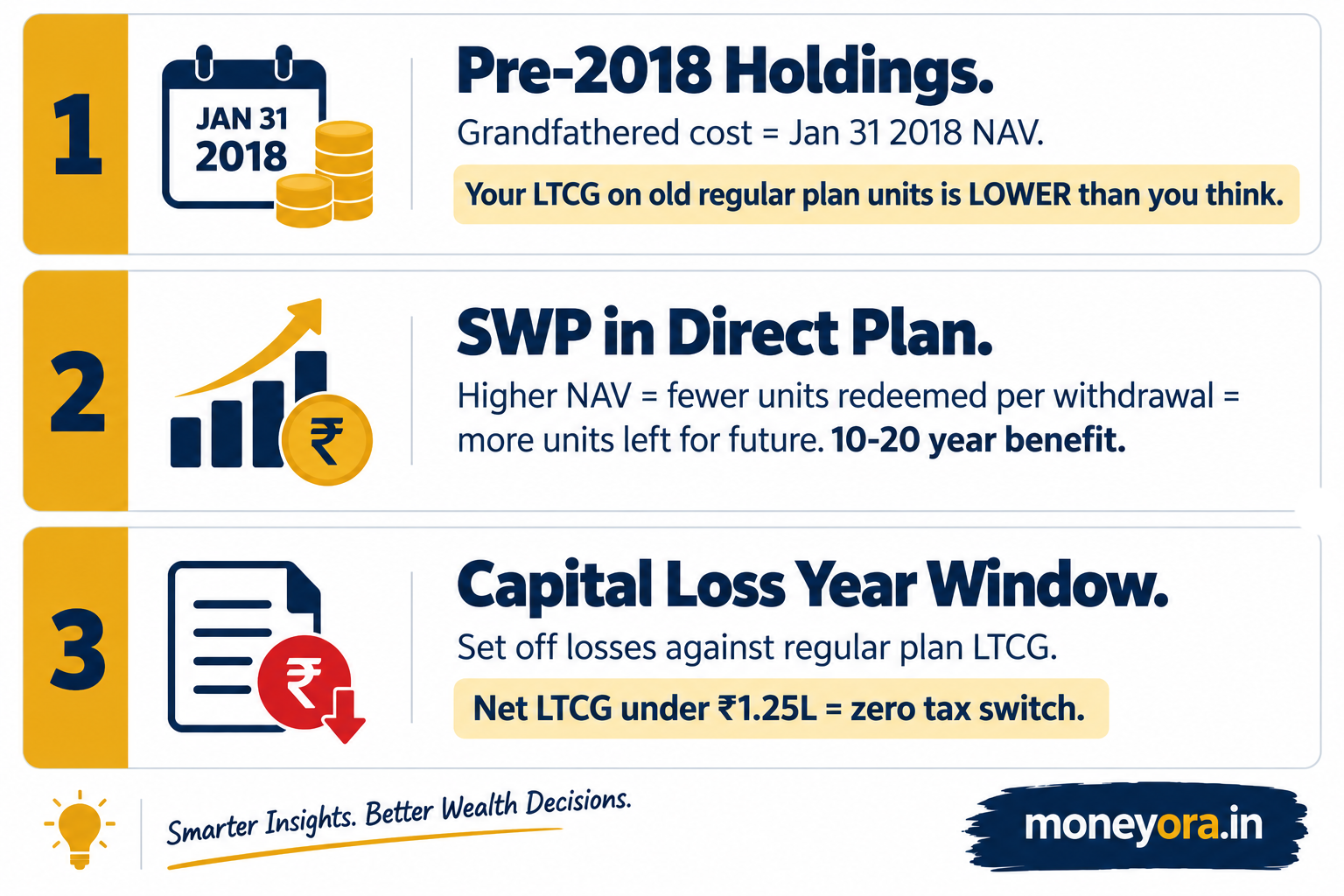
Three overlooked advantages in switching and direct plan migration. Pre-2018 grandfathering reduces old LTCG liability, SWP efficiency improves with higher direct NAV, and capital loss years create a zero-tax switching window.
The Right Order for Switching Regular to Direct Mutual Fund
Switching moving to direct is not a single decision. It is a sequence of decisions made in the right order. The wrong order costs you tax unnecessarily. The right order saves you that tax while still getting you to the same destination.
Start today with Step 1: stop all SIP investments in regular plans and restart them in direct plans. This is available to everyone at zero cost and zero tax.
Step 2 is annual LTCG harvesting of existing regular plan holdings, migrating the portion that generates Rs 1.25 lakh in gains each year and pay nothing.
Step 3 is handling the residual holdings once you have used up the convenient tax-free tranches, using the break-even calculator to decide whether to continue harvesting or accept a one-time switch.
For debt fund holdings, the analysis is separate and the conclusion is usually to hold existing positions and only move new money into direct. For ELSS, wait for lock-in expiry and redirect new contributions to direct immediately.
Use the free SIP Calculator on MoneyOra.in to model what your mutual fund corpus grows to in direct versus regular over your specific time horizon.
FAQ. Switching Regular to Direct Mutual Fund
Does switching regular to direct mutual fund attract tax?
Yes. Switching this move is treated as a redemption of regular plan units and a fresh purchase of direct plan units for tax purposes The gain on regular plan units at the time of switch is taxable as capital gains Units held more than 12 months generate LTCG at 12.5% on gains above Rs 1.25 lakh per year Units held less than 12 months generate STCG at 20%. This is the single most important fact that most articles on this topic do not state clearly.
What is the new LTCG rate for switching regular to direct mutual fund in 2026?
The current LTCG rate on equity-oriented mutual fund gains is 12.5% on gains above Rs 1.25 lakh per financial year This rate applies to all equity fund gains from transfers made on or after 23 July 2024 Budget 2025 and Budget 2026 both confirmed no changes to this rate. The old 10% rate that many articles still quote was replaced in Budget 2024.
How do I switch regular to direct mutual fund without paying tax?
Two approaches work. First stop new SIP investments in the regular plan and restart them in the direct plan This generates zero tax since no existing units are redeemed Second use annual LTCG harvesting switch the portion of your regular plan that generates exactly Rs 1.25 lakh in LTCG each financial year. Gains up to Rs 1.25 lakh are fully exempt from LTCG tax. By spreading the switch over multiple years you migrate the entire corpus to direct at zero tax cost.
Is switching regular to direct mutual fund worth it?
It depends on your corpus size unrealised gains and remaining investment horizon. For newer investments with small gains and a TER gap of 1% or more switching switching plans typically pays back the switching tax within 2 to 3 years. For older heavily appreciated holdings the annual LTCG harvesting approach is usually better than an immediate switch. For debt fund holdings the case is weaker because all gains are taxed at slab rate and TER gaps are smaller.
How do I switch regular to direct mutual fund through CAMS?
Log in to camsonline.com using your registered mobile and OTP. Go to Transact and select Switch. Choose your regular plan holding as source and the same fund’s direct plan as the destination. Enter the amount or all units. Confirm via OTP. The switch executes at the same day’s closing NAV if submitted before 3 PM on a business day. MF Central at mfcentral.com is an alternative that covers both CAMS and KFintech registered funds from one login.
Can I switch ELSS regular to direct mutual fund?
Only after the 3-year lock-in expires for each specific investment tranche. ELSS units within the lock-in period cannot be switched redeemed or transferred to any plan. Once the lock-in expires the switch works exactly like any equity fund. LTCG at 12.5% on gains above Rs 1.25 lakh applies. For new ELSS investments redirect them to the direct ELSS plan immediately. Fresh direct plan units start a new 3-year lock-in.
Does switching regular to direct mutual fund affect SIP returns?
Switching existing corpus does not directly affect ongoing SIP returns. However if you stop a regular plan SIP and restart in the direct plan your future SIP returns will be calculated on the direct plan NAV which is higher than the regular plan NAV of the same fund. This means you get slightly fewer units per SIP instalment in the direct plan but each unit is worth more because the direct plan NAV is higher due to lower expense drag. Over a 15 to 20 year SIP horizon this difference in expense ratio compounds into a significantly larger corpus.
What is the difference between regular and direct mutual fund returns over 10 years?
For a 1% TER difference on a Rs 10 lakh corpus invested for 10 years at 12% gross return the direct plan would produce approximately Rs 31.1 lakh while the regular plan would produce approximately Rs 25.9 lakh a difference of roughly Rs 5.2 lakh. The annual commission in Year 1 is Rs 10,000. Due to compounding the foregone commission grows to Rs 2.1 lakh in total compound loss over 10 years measured in terms of final value differential This is why switching the migration is one of the highest-return financial decisions available but only when executed with the right tax strategy.