

The Complete Salary Handbook for Indian Employees (2026)
What This Salary Handbook Covers
- The exact difference between CTC, Gross Salary, and Net (In-Hand) Salary
- How every line on your payslip is calculated – Basic, HRA, PF, PT, TDS
- The gratuity formula, eligibility rules, and tax exemption limits for 2026
- Leave encashment and statutory bonus – what you’re legally owed
- New tax regime vs old tax regime – which saves more at your salary level
- How to use MoneyOra calculators to verify every number on your slip
Your offer letter says ₹12 lakh CTC. Your bank account gets ₹74,000 a month which is ₹8.88 lakh annualised. The ₹3.12 lakh difference isn’t gone; it’s split across your EPF account, a gratuity provision your employer holds for you, and income tax that the government collects in advance. This salary handbook explains where every rupee goes, why it goes there, and what you can do to keep more of it.
This is not a generic salary guide. This salary handbook is built specifically for Indian salaried employees in FY 2026-27, updated for the new tax regime slabs, the Code on Wages 2019 changes that took full effect in April 2026, and the Section 87A rebate that makes salaries up to ₹12.75 lakh effectively tax-free. Whether you’re a fresher reading your first payslip or a senior employee evaluating a new offer, you’ll find every answer here.

Salary Handbook : CTC vs Gross vs Net Salary The Three Layers of Pay
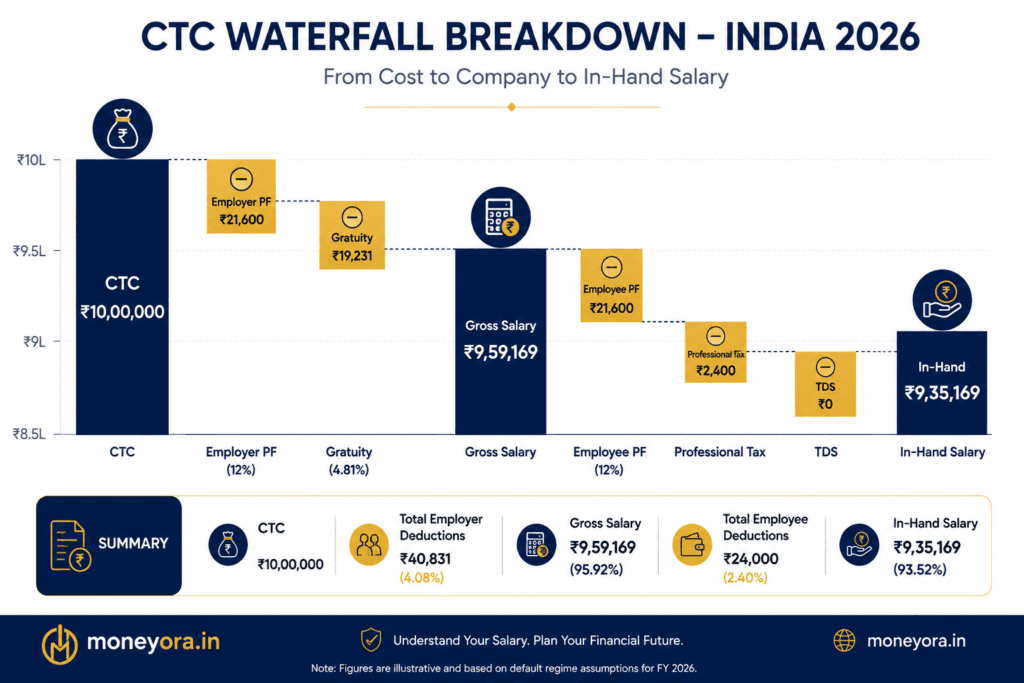
Every salary handbook must start here, because this single confusion causes more financial planning errors than anything else. CTC, Gross, and Net are three different numbers, and confusing them leads to budget disasters, poor job offer comparisons, and unnecessary tax anxiety.
Salary Handbook : CTC – Cost to Company
CTC is the total annual amount your employer spends on you. It includes money that never reaches your bank account like the employer’s 12% EPF contribution (which goes into your PF account) and a gratuity provision (held until you complete five years and leave). Think of CTC as the employer’s total bill for employing you, not your annual salary.
Salary Handbook : CTC Formula
CTC = Basic Salary + HRA + Special Allowance + Other Allowances + LTA + Employer EPF (12% of Basic) + Gratuity Provision (4.81% of Basic) + Group Insurance Premium + Any Other PerksSalary Handbook : Gross Salary
Gross salary is what the employer credits to your salary account before deductions. It excludes employer-side costs like their EPF contribution and gratuity. Gross is the number used to calculate your income tax (TDS), and it’s the base from which employee deductions are subtracted.
Salary Handbook : Gross Salary Formula
Gross Salary = CTC − Employer EPF − Gratuity Provision − Group Insurance (if any)Typically: Gross is 88–93% of CTC
Salary Handbook : Net Salary (In-Hand / Take-Home)
Net salary is what actually arrives in your bank account. It’s gross salary minus all employee-side deductions: your 12% EPF contribution, Professional Tax, and TDS on income.
Salary Handbook : Net Salary Formula
Net Salary = Gross Salary − Employee EPF − Professional Tax − TDSTypically: Net is 75–90% of Gross (depending on income level)
| Component | In CTC? | In Gross? | In Net? | Where Does It Go? |
|---|---|---|---|---|
| Basic Salary | Yes | Yes | Yes | Your bank account |
| HRA + Allowances | Yes | Yes | Yes | Your bank account |
| Employer EPF (12%) | Yes | No | No | Your EPF account |
| Gratuity Provision | Yes | No | No | Paid on exit after 5 years |
| Employee EPF (12%) | Yes | Yes | No | Your EPF account |
| Professional Tax | Yes | Yes | No | State government |
| TDS (Income Tax) | Yes | Yes | No | Central government (refundable if excess) |
Your Salary Slip Decoded Every Line Explained
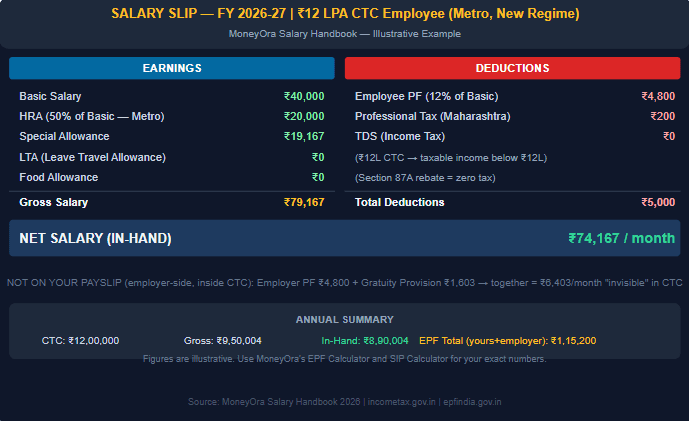
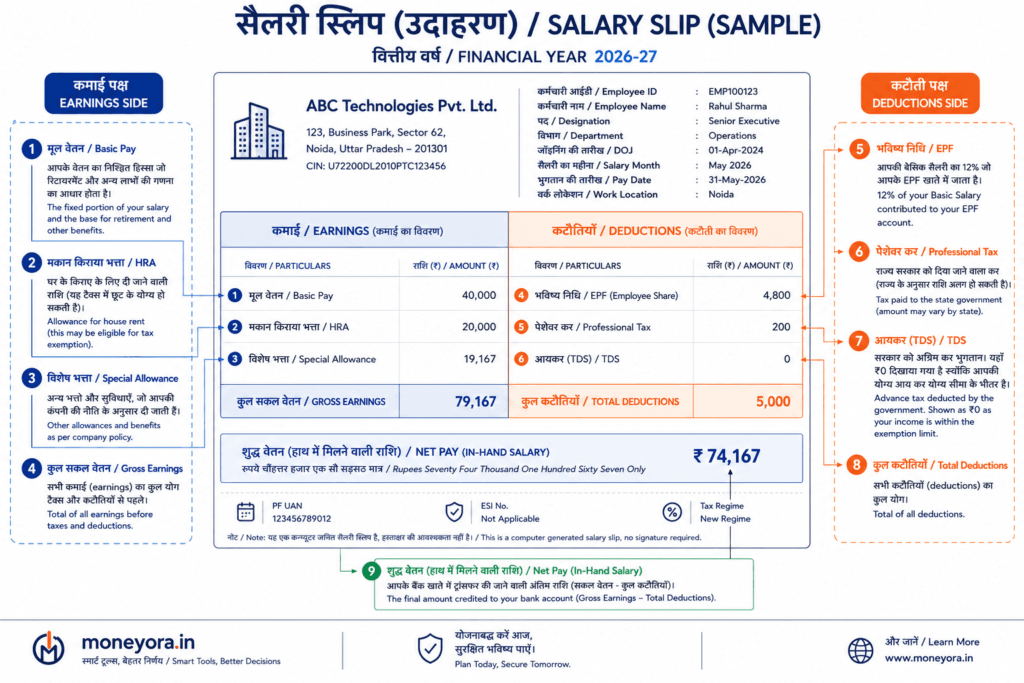
A standard Indian salary slip has two columns: Earnings on the left, Deductions on the right. Most employees scan the bottom line (Net Pay) and ignore everything above it. This salary handbook section explains what every line means so you can verify your payslip is actually correct.
Basic Salary The Foundation That Drives Everything
Basic salary is the fixed, non-negotiable core of your monthly pay and every major downstream calculation in this salary handbook flows from it. Your EPF contribution (12% of basic), your employer’s EPF contribution (12% of basic), your gratuity calculation (15/26 × basic), and your HRA (typically 40-50% of basic) are all anchored to this single number.
How Much of CTC Should Be Basic?
Most private-sector companies have historically kept basic at 40-50% of CTC. A critical change in this salary handbook’s 2026 context: the Code on Wages 2019, now fully effective from April 2026, mandates that basic salary plus Dearness Allowance (DA) must constitute at least 50% of total remuneration.
This is a structural shift. Companies that had suppressed basic to 30-35% of CTC (to minimise PF outflows) now face a compliance mandate to raise it. The knock-on effects:
- Higher PF deductions – both employee and employer contribute more
- Larger gratuity liability for the employer over time
- Higher HRA – which for old-regime taxpayers who pay rent means a bigger tax exemption
- Lower in-hand salary in the short term, but a larger retirement corpus
Basic Salary Is Fully Taxable
Unlike HRA or LTA, there is no exemption on basic salary under either the old or the new tax regime. Every rupee of basic is part of your taxable income. This is another reason the company-vs-employee interest conflict over basic salary is real: higher basic helps employees build PF and gratuity but reduces the flexibility to shield income through structured allowances.
HRA – House Rent Allowance: The Biggest Tax Saver for Renters
HRA is the allowance your employer pays to help cover rental costs. For employees paying rent, HRA offers one of the largest legal tax deductions available but only under the old tax regime. Under the new regime, HRA is fully taxable as part of your salary.
HRA Exemption Under Old Tax Regime Section 10(13A)
If you opt for the old tax regime and pay rent, you can claim an HRA exemption equal to the lowest of these three amounts:
- Actual HRA received from employer
- 50% of Basic Salary (metro cities: Delhi, Mumbai, Kolkata, Chennai) / 40% of Basic (all other cities)
- Actual rent paid minus 10% of Basic Salary
HRA Calculation Worked Example
Meera’s situation: Basic = ₹40,000/month | HRA received = ₹20,000/month | Rent paid = ₹18,000/month | City: Bengaluru (non-metro)
1. HRA received: ₹20,000
2. 40% of Basic: 40% × ₹40,000 = ₹16,000
3. Rent − 10% of Basic: ₹18,000 − ₹4,000 = ₹14,000
HRA exemption = Lowest = ₹14,000/month = ₹1,68,000/year
Tax saved at 20% slab: ₹1,68,000 × 20% = ₹33,600/year – this single exemption saves Meera ₹2,800/month in taxes.
Under the new tax regime, Meera gets none of this exemption. Her entire ₹20,000/month HRA is taxable. For employees paying significant rent in metro cities, this alone can make the old regime worth keeping.
To calculate your HRA exemption precisely, use the MoneyOra EPF Calculator alongside your tax comparison, or cross-check with the FD Calculator to see how your post-tax savings compare across instruments.
PF – Provident Fund: The 12% That Silently Builds Your Retirement
No salary handbook is complete without a thorough treatment of PF. The Employees’ Provident Fund (EPF) is a mandatory retirement savings scheme for employees in establishments with 20 or more workers, governed by the Employees’ Provident Fund and Miscellaneous Provisions Act, 1952.
How PF Works: The Three Streams
| Contribution | Rate | Where It Goes |
|---|---|---|
| Employee contribution | 12% of Basic | Your EPF account (earns 8.25% interest, FY 2025-26) |
| Employer contribution – EPF portion | 3.67% of Basic | Your EPF account |
| Employer contribution – EPS portion | 8.33% of Basic (capped at ₹1,250/month) | EPS – builds your monthly pension at retirement |
So your employer’s 12% goes two ways: 8.33% funds your eventual pension through EPS, and the remaining 3.67% grows in your EPF account alongside your own 12%. For a basic salary of ₹40,000, that means ₹4,800 from you and ₹1,468 going to EPF (from the employer), with the balance ₹3,332 funding your pension.
PF Taxability The ₹2.5 Lakh Rule
From FY 2021-22 onwards, EPF interest on employee contributions exceeding ₹2.5 lakh per year is taxable as “Income from Other Sources.” For most employees with basic salaries below ₹20,800/month, the annual EPF contribution stays under ₹2.5 lakh and is fully tax-free. Above that threshold, interest on the excess is taxed at your slab rate.
Contributions up to ₹1.5 lakh/year (employee share) also qualify for Section 80C deduction under the old tax regime reducing your taxable income by that amount. Under the new regime, this Section 80C benefit is not available.
Use MoneyOra’s free EPF Calculator to project your retirement corpus with compound interest and see exactly how much you’ll accumulate over your career. For comparison with PPF and NPS, our PPF Calculator and NPS Calculator are built for side-by-side analysis.
Professional Tax – The Small State Deduction Most Employees Ignore
Professional Tax (PT) is a state-level levy on salaried employees and working professionals. It appears in the deductions column of every payslip in applicable states typically as a small monthly deduction of ₹150-₹200 and many employees don’t know what it is or that it’s legally deductible from their taxable income (under the old regime).
Key Facts About Professional Tax in This Salary Handbook
- Maximum PT payable: ₹2,500 per year (constitutional cap under Article 276)
- Calculated on monthly gross salary, not CTC or basic
- Not all states levy it: Delhi, Haryana, Rajasthan, Uttarakhand, Himachal Pradesh, and several others have no PT
- PT is deducted based on where the employee works, not where the company is registered
| State | Monthly Gross Salary | Monthly PT | Annual PT |
|---|---|---|---|
| Maharashtra | Up to ₹10,000 | ₹0 | ₹0 |
| Above ₹10,000 | ₹200 (₹300 in Feb) | ₹2,500 | |
| Karnataka | Up to ₹24,999 | ₹0 | ₹0 |
| Above ₹25,000 | ₹200 | ₹2,400 | |
| West Bengal | Above ₹40,000 | ₹208 | ₹2,500 |
| Tamil Nadu | Above ₹75,000/half-year | ₹208 | ₹2,500 |
| Telangana / Andhra Pradesh | Above ₹20,000 | ₹200 | ₹2,400 |
| Delhi / Haryana / Rajasthan | All slabs | ₹0 | ₹0 |
Is Professional Tax Deductible from Income Tax?
Yes but with a critical caveat. Professional Tax paid during the year is deductible from gross salary under Section 16(iii) of the Income Tax Act. However, this deduction is available only under the old tax regime. Employees who have opted for the new tax regime cannot claim this deduction. For a 30% slab taxpayer paying ₹2,500/year in PT, the old-regime deduction saves ₹750/year — small, but real.
TDS on Salary – Why Your Tax Deduction Changes Every Month
TDS (Tax Deducted at Source) is your employer acting as a tax collector on the government’s behalf. Every month, your employer estimates your annual tax liability, divides it by the remaining months in the financial year, and deducts that amount from your salary. This is why TDS appears on your payslip as a monthly deduction.
New Tax Regime Slabs – FY 2026-27 (Default)
| Annual Taxable Income | Tax Rate |
|---|---|
| Up to ₹4,00,000 | Nil |
| ₹4,00,001 – ₹8,00,000 | 5% |
| ₹8,00,001 – ₹12,00,000 | 10% |
| ₹12,00,001 – ₹16,00,000 | 15% |
| ₹16,00,001 – ₹20,00,000 | 20% |
| ₹20,00,001 – ₹24,00,000 | 25% |
| Above ₹24,00,000 | 30% |
Critical 2026 update: A standard deduction of ₹75,000 is available under the new regime (for salaried employees). Plus, the Section 87A rebate of ₹60,000 eliminates tax on taxable income up to ₹12 lakh. This means a salaried employee with gross income up to ₹12.75 lakh (after standard deduction) pays zero income tax under the new regime. TDS on their salary will be ₹0.
Why TDS Changes Month to Month
Your TDS is not a fixed number it’s recalculated whenever your income changes or you submit proof of investments. Three phases to understand in every financial year:
- April–October: Low TDS – investment declarations are estimates only, and employers typically deduct conservatively
- November–January: TDS increases as employers ask for actual investment proofs (rent receipts, LIC premiums, ELSS statements). Your declared-but-unproven deductions are removed if you don’t submit proofs
- February–March: TDS can spike sharply to recover any shortfall from the preceding 10 months. This is the “March TDS shock” that surprises employees every year
Gratuity Your Loyalty Bonus: Formula, Eligibility, and the ₹20 Lakh Tax Shield
Gratuity is a statutory lump-sum payment from your employer when you leave a financial recognition for years of service. Governed by the Payment of Gratuity Act, 1972, it is not optional for covered establishments. It’s a legal right, enforceable through labour courts, with criminal penalties for non-payment.
Gratuity Eligibility Rules in 2026
| Employee Type | Minimum Service Required | Governing Rule |
|---|---|---|
| Permanent employee | 5 years continuous service | Payment of Gratuity Act, 1972 |
| Fixed-Term Employee (FTE) | 1 year (post-Labour Codes, 2026) | Code on Social Security, 2020 |
| Death or permanent disability | No minimum service | Payable immediately to nominee |
This salary handbook highlights a critical 2026 change: Fixed-Term Employees those hired on a contractual basis for a defined period are now eligible for gratuity after just one year of service, a major shift from the prior 5-year rule. If you’re on a fixed-term contract and have completed one year, gratuity is legally owed to you.
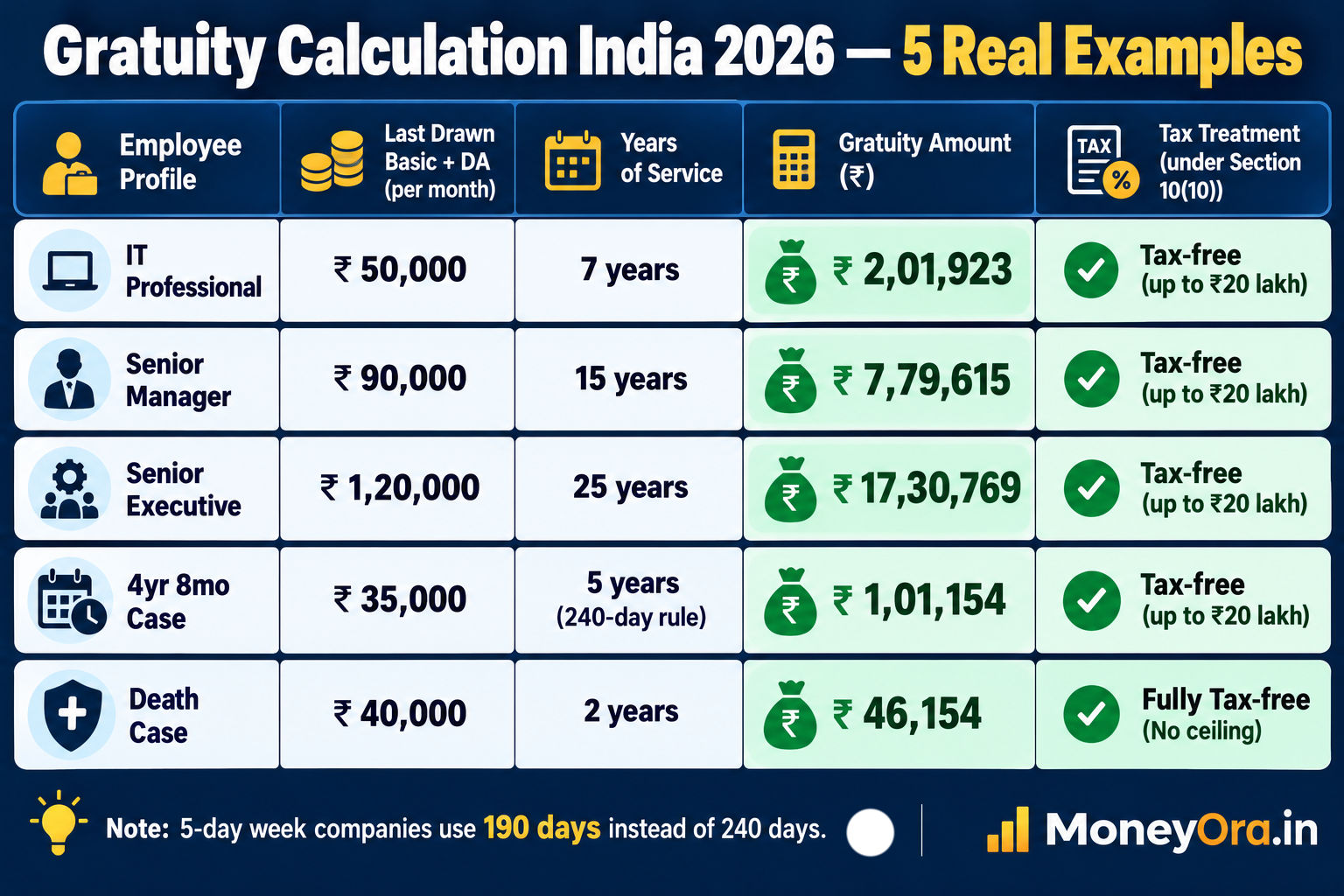
The Gratuity Formula
The number 26 represents the working days in a month (assuming 4 Sundays off). The 15 represents 15 days’ salary per completed year of service.
Gratuity Worked Example
Arjun’s gratuity: Basic salary at exit = ₹60,000/month | Service = 8 years 7 months (rounds to 9 years)
Gratuity = ₹60,000 × (15/26) × 9
= ₹60,000 × 0.5769 × 9
= ₹3,11,538
Tax implication : Fully tax-free for private-sector employees up to ₹20 lakh lifetime (all gratuities received across all employers combined). Arjun’s ₹3.11 lakh = 100% tax-free.
Leave Encashment Converting Unused Leave into Cash
Leave encashment is the payment your employer makes for earned/privileged leave that you accumulated but didn’t use during your tenure. It’s essentially your employer converting your banked leave into money and the tax rules make it one of the most underutilised financial benefits for Indian employees.
When Is Leave Encashment Paid?
- At resignation or retirement: You receive payment for all accumulated earned leave (EL/PL), up to your company’s cap
- During employment: Some companies allow encashment of surplus leave exceeding a set balance (e.g., carry-forward of 30 days maximum excess is encashed annually)
- On death of employee: Paid to the legal heir or nominee
Leave Encashment Tax Rules – Section 10(10AA)
| Employee Type | Tax Treatment at Retirement/Resignation |
|---|---|
| Central/State Government employees | 100% tax-free (no limit) at retirement |
| Private-sector employees (retirement) | Tax-free up to ₹25 lakh (updated 2023, still applicable in 2026) |
| Private-sector employees (resignation) | Tax-free up to ₹25 lakh – same limit, not restricted to retirement |
| Leave encashment during employment | Fully taxable – added to gross salary income |
Bonus – Statutory Bonus, Performance Bonus, and the Tax Rules
Bonus is one of the most misunderstood parts of Indian compensation. There are two completely different types: a statutory bonus you are legally entitled to, and a performance/discretionary bonus your employer may pay based on results. This salary handbook covers both.
Statutory Bonus – Payment of Bonus Act, 1965
Under the Payment of Bonus Act, 1965, every eligible employee must receive an annual bonus. Key rules:
- Eligibility: Employees earning up to ₹21,000/month (salary ceiling for bonus calculation)
- Minimum bonus: 8.33% of salary (or ₹100, whichever is higher) regardless of employer profit
- Maximum bonus: 20% of salary when the employer’s allocable surplus permits
- Calculation ceiling: Even if actual salary is ₹21,000, bonus is calculated on a wage ceiling of ₹7,000/month
- Timing: Within 8 months of the financial year end (by 30 November for FY 2025-26)
- Establishments covered: Factories and establishments with 20+ employees
Statutory Bonus Calculation Example
Sunita’s statutory bonus: Monthly salary = ₹18,000 | Wage ceiling = ₹7,000 | Minimum bonus rate = 8.33%
Annual bonus = ₹7,000 × 8.33% × 12 = ₹6,997.20 ≈ ₹7,000
Even though Sunita earns ₹18,000/month, the bonus is calculated on ₹7,000 (the wage ceiling). This is why statutory bonus often feels small compared to what employees expect.
Performance Bonus / Variable Pay
Performance bonuses (also called variable pay, incentives, or annual bonuses) are discretionary and not covered by the Bonus Act. They’re governed by your employment contract. From a tax perspective, all bonus income both statutory and performance is fully taxable as salary income in the year of receipt. There is no exemption for bonus under any regime.
Old Regime vs New Regime Which Should You Choose in 2026?
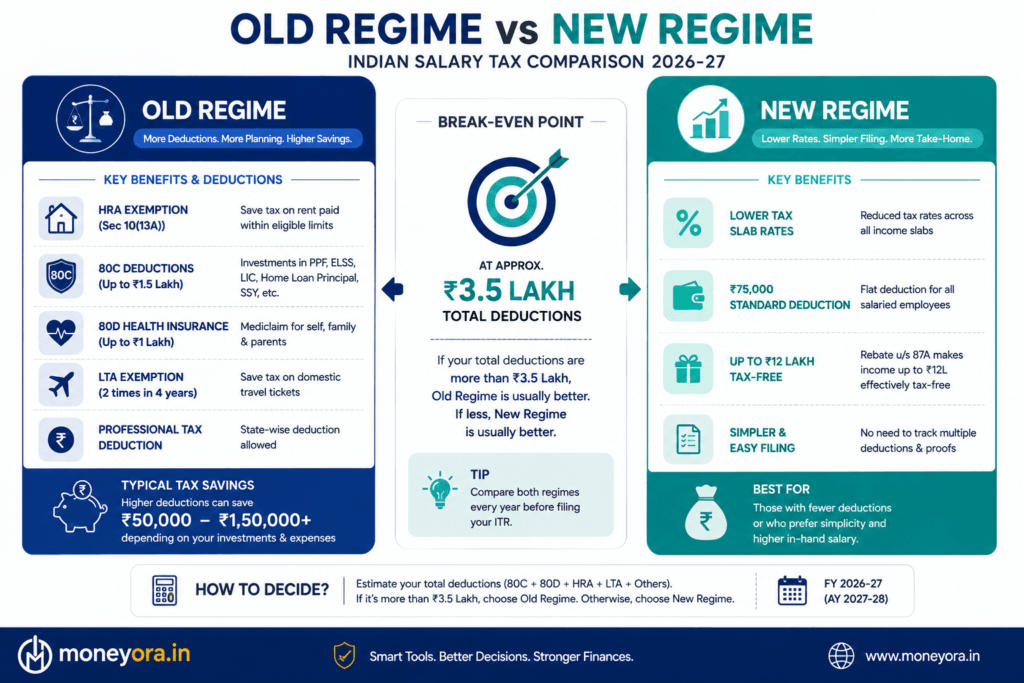
This is the most consequential decision in this salary handbook for most salaried Indians. The choice affects your monthly in-hand pay, your TDS amount, and your tax liability at filing. Here is the definitive framework for making the right choice.
The Break-Even Rule
The new regime is better if your total tax deductions (HRA + 80C + 80D + home loan interest + other) are less than a break-even threshold. The old regime wins above that threshold. Here’s the break-even guide by salary band:
| Annual Gross Salary (CTC) | Break-even Deduction Amount | Likely Better Regime |
|---|---|---|
| Up to ₹12.75L | N/A – zero tax under new regime | New regime always |
| ₹12.75L – ₹15L | ₹2.5L | Depends – calculate both |
| ₹15L – ₹20L | ₹3.5L | Old regime if HRA + home loan + 80C > ₹3.5L |
| ₹20L – ₹50L | ₹3.75L – ₹4.5L | Old regime if HRA + home loan are high |
| Above ₹50L | Surcharge differences apply | New regime often wins – surcharge capped |
What the New Regime Loses vs Old Regime
- HRA exemption (Section 10(13A)) – biggest loss for renters
- LTA exemption (leave travel)
- Section 80C deductions (PPF, ELSS, EPF, LIC, etc.)
- Section 80D (health insurance premiums)
- Home loan interest deduction (Section 24(b))
- Professional tax deduction (Section 16(iii))
What the New Regime Keeps
- Standard Deduction of ₹75,000
- Section 87A rebate (zero tax up to ₹12L taxable income)
- Employer NPS contribution deduction (Section 80CCD(2))
- Simpler calculation – no investment proofs required
Use MoneyOra’s NPS Calculator to model how employer NPS contributions affect your tax under both regimes this is the one deduction that survives under the new regime and is often overlooked. Also check our SIP Calculator to compare ELSS (which only helps under old regime) with regular mutual fund SIPs that are regime-agnostic.
Full Worked Examples: CTC to In-Hand at ₹5L, ₹10L, ₹20L, and ₹50L
Every salary handbook needs real numbers. Here are four complete CTC-to-in-hand calculations for common salary levels, all under the new tax regime, FY 2026-27, metro city (Maharashtra).
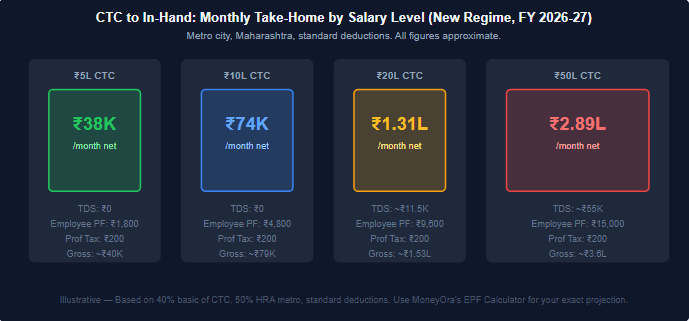
| Component | ₹5L CTC | ₹10L CTC | ₹20L CTC | ₹50L CTC |
|---|---|---|---|---|
| Monthly Gross | ₹40,000 | ₹79,167 | ₹1,53,333 | ₹3,60,000 |
| Employee EPF | ₹1,800 | ₹4,800 | ₹9,600 | ₹15,000* |
| Professional Tax | ₹200 | ₹200 | ₹200 | ₹200 |
| Monthly TDS (new regime) | ₹0 | ₹0 | ₹11,500 | ₹55,000 |
| Monthly In-Hand (Net) | ₹38,000 | ₹74,167 | ₹1,32,033 | ₹2,89,800 |
*EPF capped at ₹1,800/month for employees with basic ≤ ₹15,000 wage ceiling. Companies often contribute 12% on actual basic beyond the ceiling. | Maharashtra PT assumed. | TDS approximate, new regime, standard deduction applied.
These numbers change significantly under the old tax regime if you have substantial HRA, home loan, and 80C claims. For a precise personalised calculation, use our EPF Calculator, Home Loan EMI Calculator, and PPF Calculator in combination.
7 Salary Mistakes Most Indian Employees Make
No salary handbook is complete without a list of what not to do. These are the seven most common and most costly errors salaried Indians make every year.
Mistake 1: Comparing Offers by CTC Alone
A ₹15L CTC with no bonus and full gratuity in CTC is structurally different from ₹15L CTC with 20% variable pay and gratuity excluded. Always ask for the fixed pay breakup and whether gratuity, group insurance, or retiral benefits are bundled into the CTC headline.
Mistake 2: Not Submitting Investment Declarations in April
Every April your employer asks for investment declarations. Most employees guess or ignore this. Accurate declarations in April mean lower TDS throughout the year better cash flow and no March TDS shock.
Mistake 3: Choosing the New Tax Regime Without Checking Break-Even
The new tax regime is the default for FY 2026-27, but it’s not always optimal. If you pay significant rent in a metro city and/or have a home loan, the old regime often saves substantially more. Calculate both before your employer locks your regime for the year.
Mistake 4: Ignoring the Employer EPF Contribution
Many employees think of EPF as a deduction (₹4,800/month gone from salary). But the employer matches with their own 12% contribution. Over a 30-year career at ₹40,000 basic, that employer contribution alone at 8.25% interest becomes a corpus of over ₹28 lakh. It’s part of your total compensation treat it as such.
Mistake 5: Not Claiming Gratuity from a Previous Employer
Gratuity becomes payable within 30 days of exit. Many employees never formally apply for it, assuming the HR will initiate it. If you completed 5 years (or 1 year as an FTE), file a written application for gratuity to your employer. If unpaid, escalate to the Labour Commissioner.
Mistake 6: Forgetting to Declare Leave Encashment in ITR
Leave encashment received during service (not at exit) is fully taxable. It appears in Form 16 but employees who switch jobs mid-year sometimes miss this in their ITR. Cross-check Form 26AS for all employers you worked for in the financial year.
Mistake 7: Treating Bonus as Regular Income for Budgeting
Performance bonuses are discretionary. Building a monthly budget that depends on bonus income is a financial planning error. Build your budget on fixed salary only; treat bonus as windfall savings or debt repayment. This salary handbook recommends routing annual bonus directly into lumpsum investments use our Lumpsum Calculator to see the compounding impact.
Risks and Limitations Every Employee Should Know
- Salary structure risk: Many companies restructure CTC annually. A component shown as “special allowance” this year may be reclassified next year, changing your PF base and tax liability
- TDS under-deduction risk: If you don’t submit investment proofs on time, your employer may not deduct enough TDS. You’ll owe the balance when you file ITR – potentially with interest under Section 234B/C
- Gratuity non-payment risk: MSME employers with cash flow problems sometimes delay or dispute gratuity. Know your rights: file with the Labour Commissioner within 30 days of the employer’s failure to pay
- Variable pay risk: Performance bonuses are discretionary. Never include them in long-term financial plans (EMI, insurance commitments) unless they’re guaranteed in your employment contract
- Regime lock-in for business income: Salaried employees can switch regimes every year. But if you have business income (freelancing, consulting), switching back from the new regime to old is a one-time option choose carefully
Tools to Put This Salary Handbook into Practice
Reading this salary handbook is step one. Step two is running your actual numbers through MoneyOra’s free calculators so you can see exactly what your compensation looks like and plan every rupee going forward.
- EPF Calculator – Project your PF corpus at retirement with compound interest at the current 8.25% rate
- Home Loan EMI Calculator – See how your home loan interest deduction affects your old-regime tax liability
- PPF Calculator – Compare EPF vs PPF for your long-term savings (Section 80C under old regime)
- NPS Calculator – Model NPS corpus and the Section 80CCD(2) employer contribution deduction (valid under both regimes)
- SIP Calculator – Plan ELSS SIPs for 80C (old regime) or regular equity SIPs for long-term wealth
- FD Calculator – Estimate post-tax returns on fixed deposits to compare with EPF and PPF
- RD Calculator – Model recurring deposit returns for short-term salary savings goals
- EMI Calculator – Plan personal loan repayments against your in-hand salary budget
Take Control of Your Salary Use MoneyOra’s Free Calculators
Every number in this salary handbook is more powerful when you apply it to your own CTC. Our calculators are free, built for Indian salary structures, and updated for FY 2026-27.
Use the free calculator now on MoneyOra.in →
Official Sources and External References
- Income Tax Department India — incometax.gov.in (TDS, tax slabs, Section 87A rebate)
- EPFO — epfindia.gov.in (PF contribution rates, EPF interest rate)
- Ministry of Labour and Employment — labour.gov.in (Payment of Gratuity Act, Payment of Bonus Act, Code on Wages)
- CBDT — cbdt.gov.in (Tax notifications, Form 16/Form 130 guidelines)
- TaxGuru — Old vs New Tax Regime FY 2026-27
- ClearTax — EPF Interest Rate and Calculation 2026
- BankBazaar — Gratuity Calculation and Tax Exemption India
Frequently Asked Questions – Salary Handbook India 2026
What is the difference between CTC, gross salary, and net salary?
CTC (Cost to Company) is the total employer spend including amounts that don’t reach your bank like employer EPF and gratuity provision. Gross salary is your total earnings before deductions. Net salary (in-hand/take-home) is what arrives in your bank after employee EPF, professional tax, and TDS are deducted. Gross is typically 88-93% of CTC; net is typically 75-90% of gross, depending on income level.
How is gratuity calculated in India?
Gratuity = Last Drawn Basic Salary × (15/26) × Years of Service. The maximum statutory gratuity is ₹20 lakh for private-sector employees (lifetime), and this entire amount is tax-free. For Fixed-Term Employees under the Labour Codes (2026), gratuity eligibility starts after just 1 year of service (not 5 years). Employers must pay within 30 days; delayed payments attract 10% annual interest.
Is HRA taxable under the new tax regime 2026?
Yes entirely. Under the new tax regime (the default for FY 2026-27), HRA is fully taxable as part of your salary. The HRA exemption under Section 10(13A) is available only under the old tax regime. For employees paying significant rent in metro cities, this single difference often makes the old regime worth more than its lower slab rates suggest.
Which states have professional tax in India?
States with professional tax (PT) include Maharashtra, Karnataka, West Bengal, Tamil Nadu, Andhra Pradesh, Telangana, Gujarat, Odisha, Kerala, Madhya Pradesh, Meghalaya, Sikkim, Tripura, Jharkhand, Bihar, and Assam. States with NO professional tax include Delhi, Haryana, Rajasthan, Uttarakhand, Himachal Pradesh, J&K, Goa, and most northeastern states. PT is determined by where the employee works, not where the company is registered.
What is the leave encashment tax exemption limit for private employees in 2026?
Leave encashment received at retirement or resignation is tax-free up to ₹25 lakh for private-sector employees (updated in 2023, still applicable in 2026). This is a separate limit from the gratuity exemption of ₹20 lakh the two don’t overlap. Leave encashment received during employment (while still working) is fully taxable as salary income.
What are the latest questions people are asking about salaries in India in 2026?
- Is income up to ₹12 lakh tax-free in 2026? Yes, for salaried employees under the new regime: ₹12L taxable income × Section 87A rebate = zero tax. Add ₹75,000 standard deduction and the zero-tax gross threshold is ₹12.75L.
- What is the Code on Wages 2026 impact on my salary? Basic + DA must now be ≥ 50% of total remuneration. This raises PF contributions and gratuity provisions for employees at companies that previously kept basic low.
- How do I calculate my actual in-hand salary from CTC? Subtract employer EPF (12% of basic) and gratuity provision (4.81% of basic) from CTC to get gross. Then subtract employee EPF (12% of basic), professional tax, and TDS from gross to get net.
- Is statutory bonus taxable? Yes, fully. Both statutory and performance bonuses are taxable as salary income in the year of receipt, at your applicable slab rate under whichever regime you’ve chosen.
- What happens to my EPF if I change jobs? Your UAN (Universal Account Number) stays the same across all employers. Transfer your old EPF balance to the new employer using the EPFO member portal within 60 days of joining to continue earning interest and avoid the account going inoperative.


Been playing on jilibet777 for a while now, and the payouts are legit. Had a pretty good run last week – cashed out no problem. Give it a try, you might get lucky too!