

ITR Refund Status Check 2026: How to Track Your Income Tax Refund Online
- Check your ITR refund status on incometax.gov.in (login required) or on the NSDL/Protean portal (no login needed)
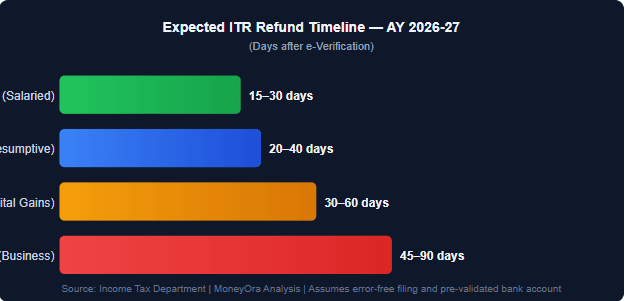
- For AY 2026-27 (FY 2025-26), most straightforward refunds arrive within 15–45 days of e-verification
- Your refund will not be released if PAN is not linked to Aadhaar or your bank account isn’t pre-validated
- Delayed refunds earn 6% annual interest (Section 244A) — but only if the delay is the department’s fault
- If your refund failed, raise a Refund Reissue Request under Services on the e-filing portal
So you filed your ITR, e-verified it, and now you’re staring at a blank bank account wondering where your money went. You’re not alone. Nearly 8.8 crore Indians filed returns for AY 2025-26, and the Central Processing Centre (CPC) in Bengaluru was still working through backlogs well into 2026. The good news: checking your ITR refund status takes about two minutes — and fixing most delays is simpler than you think.
This guide covers every method to track your income tax refund online for AY 2026-27 (FY 2025-26), explains what every status message actually means, walks you through fixing a failed or delayed refund, and tells you exactly when you’re legally owed interest from the government.
If you filed your return months ago and your ITR Refund Status Check keeps showing the exact same unchanged status, you’re one of roughly 24.64 lakh taxpayers in exactly that position as of early 2026 — a real, officially reported number, not an exaggeration. That’s a genuinely unusual scale of pending returns, and it’s worth understanding both how to actually check your status correctly and what this year’s specific backlog means for how long “too long” really is.
This guide walks through the precise steps for an ITR Refund Status Check today, decodes every status message the portal can show you, and — unlike most coverage on this topic — actually calculates the interest you’re owed under Section 244A if the delay drags on, explains exactly how a Section 245 adjustment against old dues works, and gives you a specific decision framework for what to do at each stage of waiting. Once your ITR Refund Status Check shows a confirmed refund, plan where that money goes next using MoneyOra’s SIP Calculator or FD Calculator.
What Is an ITR Refund and Who Is Eligible?
An income tax refund is the amount the government returns when you’ve paid more tax during the year than your actual liability. This happens when your employer deducts TDS at a rate higher than your actual tax bracket, or when deductions and exemptions (like Section 80C, HRA, or home loan interest) reduce your taxable income below what was already paid.
The refund is not given automatically. It’s calculated when the Income Tax Department processes your filed ITR and cross-verifies it against Form 26AS and your Annual Information Statement (AIS). If the math shows excess tax paid, the department initiates a refund — but only after your return is successfully e-verified. An unverified return is treated as never filed.
Common Reasons You Might Get a Refund
| Tax Already Paid Via | When Refund Arises | Where to Verify |
|---|---|---|
| TDS by Employer | Deductions exceed TDS slab | Form 16 / Form 26AS |
| TDS by Bank on FD Interest | Income below taxable limit | Form 26AS / AIS |
| Advance Tax Paid | Actual liability was lower | Challan records / AIS |
| Self-Assessment Tax | Paid more than needed | Form 26AS |
| TCS (Tax Collected at Source) | Final liability is lower | AIS / Form 26AS |
ITR Refund Status Check: Step-by-Step Guide (Two Methods)
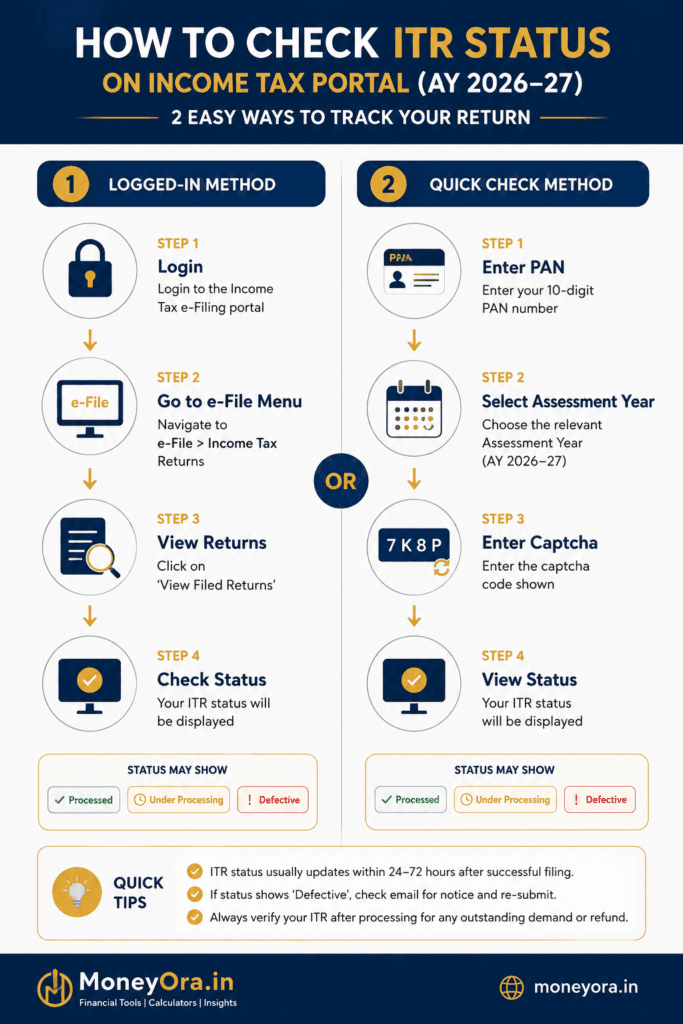
ITR Refund Status Check: Log in at incometax.gov.in, go to e-File → Income Tax Returns → View Filed Returns, and check your refund status listed against the relevant Assessment Year. A no-login option also exists under “Know Your Refund Status” on the portal homepage, requiring only your PAN and assessment year.
ITR Refund Status Check Method 1: Logged-in e-Filing Portal (Most Detailed)
The e-filing portal (incometax.gov.in) gives the most detailed and up-to-date refund status — including the exact refund amount, dispatch date, and the full lifecycle of your return. This is the method the Income Tax Department itself recommends for the most accurate picture.
Step-by-Step: Check ITR Refund Status After Login
- Go to www.incometax.gov.in
- Click Login — enter your PAN number as User ID, your password, and the captcha
- After logging in, click on e-File in the top menu
- Select Income Tax Returns → View Filed Returns
- Choose the relevant Assessment Year (select AY 2026-27 for income earned in FY 2025-26)
- Click View Details — this shows the ITR processing lifecycle
- Scroll to the Refund Status section to see current stage, amount, and dispatch date
If your PAN is inoperative (not linked to Aadhaar), the portal will display a warning message and your refund will be held. Link PAN to Aadhaar immediately via the “Link Aadhaar” option on the portal homepage before expecting any refund.
ITR Refund Status Check Method 2: No-Login Quick Check
- Go to the income tax e-filing portal homepage.
- Under Quick Links, select “Know Your Refund Status.”
- Enter your PAN, select the Assessment Year, and enter the captcha.
- The result displays instantly without needing your password.
MoneyOra Expert Tip for your ITR Refund Status Check: Bookmark the no-login option specifically — it’s faster for a quick check and doesn’t risk a login lockout from repeated password attempts if you’re checking frequently during an anxious waiting period.
Method 2: Check ITR Refund Status via NSDL/Protean (No Login Required)
If you don’t have your portal password handy, or just want a quick check without logging in, the NSDL (now Protean eGov Technologies) portal works with just your PAN and Assessment Year. It’s faster but shows less detail than the e-filing portal.
Step-by-Step: NSDL Refund Status Without Login
- Visit tin.tin.nsdl.com (official NSDL refund tracking page)
- Enter your PAN number
- Select the Assessment Year (e.g., 2026-27)
- Enter the CAPTCHA code shown on screen
- Click Proceed — your refund dispatch status appears
| Feature | e-Filing Portal | NSDL/Protean |
|---|---|---|
| Login Required | Yes | No |
| Detail Level | Full lifecycle | Dispatch status |
| Refund Amount Shown | Yes | Sometimes |
| Best For | Full audit of your return | Quick dispatch check |
| Official Source | incometax.gov.in | tin.tin.nsdl.com |
You can also view refund entries through Form 26AS on the TRACES portal, accessible from the same e-filing login under Annual Information Statement.
What Does Each ITR Refund Status Message Mean?
This is where most guides fall short. They tell you how to check, but not what to do when you see a confusing status. Here’s every status you might encounter, what it actually means, and the exact action you need to take.
| Status Message | What It Means | What You Should Do |
|---|---|---|
| Return Submitted and Pending for e-Verification | ITR filed but not verified. Processing hasn’t started. | e-Verify immediately via Aadhaar OTP, Net Banking EVC, or Demat EVC. The 30-day window applies. |
| Successfully Verified / Under Processing | Return e-verified. CPC is currently processing it. | No action needed. Wait 15–45 days for ITR-1/ITR-4. ITR-2/ITR-3 may take 30–60 days. |
| Processed with Refund Due | CPC has processed the return and confirmed a refund is owed. | Wait for the NEFT/RTGS credit. Usually 2–5 working days after this status appears. |
| Refund Issued | Amount has been sent to your bank via NEFT. Check your account. | Check bank statement. If not credited in 5 days, contact your bank’s NEFT department with the UTR number shown on the portal. |
| Refund Failed | Bank transfer was rejected — wrong IFSC, closed account, account not pre-validated, or PAN inoperative. | Raise a Refund Reissue Request immediately under Services on the portal. Fix bank details first. |
| Refund Returned | Refund was dispatched but came back — account closed, wrong number, or ECS not enabled. | Same as above — Refund Reissue Request with corrected and pre-validated bank account. |
| No Demand, No Refund | Processing complete. Tax paid exactly equals liability — nothing is owed either way. | No action needed. If you believe this is wrong, file a rectification request under e-File → Rectification. |
| Adjusted Against Outstanding Demand | Your refund was used to settle a previous year’s tax demand under Section 245. | Check your demand history. If the adjustment is wrong, respond to the Section 245 notice or raise a grievance. |
ITR Refund Status Check: Decoding Every Status Message You Might See
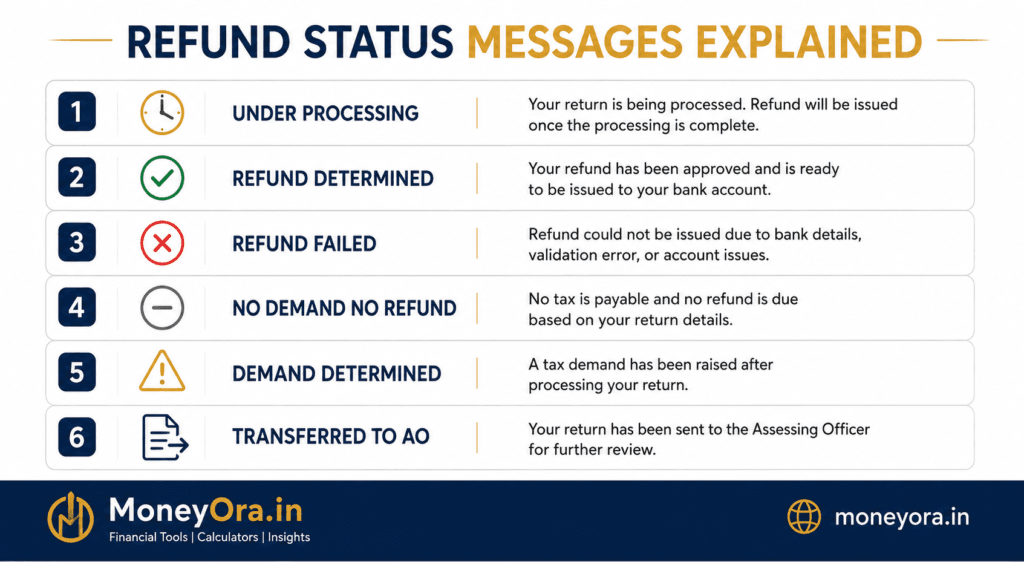
The portal displays one of several distinct status messages, each requiring a different response — “Refund Determined” means payment is processing, “Refund Failed” means a bank detail issue needs fixing, and “No Demand No Refund” means your tax paid exactly matched your liability, with nothing owed either way.
| Status Message | What It Means | What You Should Do |
|---|---|---|
| ITR Verified / Under Processing | Your return has been submitted and e-verified; CPC hasn’t finished processing yet | Wait — no action needed unless it exceeds the timeline in Section 3 |
| Refund Determined and Sent to Refund Banker | Processing complete; refund approved and handed to the banking system for transfer | Check your bank account within 5-7 working days |
| Refund Failed | The transfer attempt failed, usually due to incorrect or unvalidated bank details | Correct and re-validate your bank account, then submit a “Refund Reissue Request” |
| No Demand No Refund | Your tax paid exactly equals your calculated liability | No action needed — this is a normal, complete outcome |
| Demand Determined | The department has calculated that you owe additional tax rather than being owed a refund | Review the intimation notice carefully; pay the demand or file a rectification if you disagree |
| Case Transferred to Assessing Officer | Your return has been flagged for manual review beyond CPC’s automated processing | Expect a longer wait; respond promptly to any notice issued |
Common Mistake: Assuming an ITR Refund Status Check showing “Under Processing” for weeks means something is broken. For AY 2025-26 specifically, this status can legitimately persist far longer than in previous years due to the scale of the current backlog — it doesn’t, by itself, indicate a problem with your specific return.
ITR Refund Status Check Timeline for AY 2025-26 (Not the Textbook Version)
The textbook timeline is 4–8 weeks after e-verification. The realistic 2026 timeline, given the current backlog, is closer to 6–16 weeks for straightforward returns, and potentially several months for returns flagged under risk-based scrutiny — with a hard CPC deadline of December 31, 2026 for all AY 2025-26 processing.
| Stage | Typical Timing (Normal Year) | Realistic Timing (AY 2025-26) |
|---|---|---|
| E-verification | Within 30 days of filing | Same — this deadline hasn’t changed |
| Initial processing / intimation | 20-45 days after e-verification | Often 45-90 days given current volume |
| Refund credit after intimation | 5-7 days after “Refund Determined” | Same, once that status appears |
| Full resolution for flagged/scrutiny cases | Rare, case-specific | Can extend to several months, within the Dec 31, 2026 statutory limit |
Why this year’s ITR Refund Status Check results look genuinely different: Nearly 8.8 crore returns were filed for AY 2025-26 — a volume that has visibly stretched CPC’s processing capacity, according to the department’s own published pendency figures. This is a scale issue behind your ITR Refund Status Check result, not evidence that your specific return has a problem.
How Long Does the ITR Refund Take in 2026?
For AY 2026-27, the Income Tax Department has made the refund process almost entirely electronic. There’s no manual cheque dispatch, no physical delivery. Every refund goes directly to your pre-validated bank account via NEFT or RTGS. That means speed depends heavily on the completeness and accuracy of your filing — not on physical processes.
| Stage | Expected Timing | What’s Happening |
|---|---|---|
| ITR Filed | Day 0 | Return submitted, acknowledgement (ITR-V) generated |
| e-Verification | Within 30 days of filing | Must e-verify via Aadhaar OTP/EVC or post ITR-V to CPC Bengaluru |
| Processing Begins | Day 1–3 after e-verify | CPC cross-verifies income, TDS, bank details against AIS/Form 26AS |
| Refund Computed | 15–90 days (form-dependent) | 143(1) intimation sent via email. Check registered email inbox. |
| Refund Issued | 1–3 days after computation | NEFT/RTGS to pre-validated bank account |
| Bank Credit | 2–5 working days after dispatch | Refund credited to your bank account |
Why Is Your ITR Refund Delayed? 8 Real Reasons
A refund that hasn’t shown up isn’t necessarily stuck — it may simply be queued. But some delays are caused by specific, fixable problems. Here’s the actual list of reasons, straight from the CPC and CBDT guidance, plus what to do about each one.
1. ITR Not e-Verified
The most common mistake. If your return is not e-verified within 30 days, the department treats it as invalid and no processing begins. Go back and e-verify via Aadhaar OTP, Net Banking, or send the physical ITR-V to CPC Bengaluru.
2. PAN Not Linked to Aadhaar
Under Section 139AA, PAN-Aadhaar linking is mandatory. If your PAN is “inoperative,” the system blocks the refund entirely. Link them at the Income Tax portal and then check whether your refund gets released automatically or requires a Refund Reissue.
3. Bank Account Not Pre-Validated
Even if CPC computes your refund, it can’t be credited to an account that isn’t pre-validated on the e-filing portal. Add your bank account under “My Profile → Bank Account” and complete the validation (which involves a ₹1 micro-credit test in some cases).
4. Mismatch Between ITR and Form 26AS / AIS
This is the most common cause of delays in 2026. If the TDS your employer or bank deducted doesn’t match what’s in Form 26AS at the time of filing, CPC flags the return for manual verification. The resolution can take 30–90 additional days.
5. Return Selected for Scrutiny
High-value refund claims, unusually large deductions, or mismatches can trigger scrutiny under CASS (Computer Aided Scrutiny Selection). If your return is under scrutiny, the refund is held until the scrutiny is complete. You’ll receive a notice — respond promptly and within the deadline.
6. Outstanding Tax Demand from Previous Years
If there’s an unpaid demand from a prior assessment year, the department may adjust (deduct) your current refund against it under Section 245. You’ll receive an intimation letter before this happens — if you agree, the adjustment proceeds; if not, respond within 30 days disputing the demand.
7. Incorrect IFSC Code or Bank Account Number
Even a single digit wrong will cause the refund to fail at the bank’s end. Check your pre-validated bank account details carefully — the account number AND the IFSC code must match your actual account exactly.
8. High Filing Volume Near the Deadline
Roughly 30–40% of all ITR filers submit in the last week of July. CPC handles millions of returns simultaneously. If you filed on 30–31 July, your return is likely in a queue — not stuck, just waiting. Check again in 2–3 weeks.
Refund Failed or Returned — How to Raise a Refund Reissue Request
If the portal shows “Refund Failed” or “Refund Returned,” don’t panic. Your money hasn’t disappeared — it’s sitting with the department, waiting for you to give it the right bank account to send it to. Here’s the exact process.
Step-by-Step: Refund Reissue Request
- Fix your bank account first — Go to My Profile → Bank Account → Add or update the correct account with the right IFSC code → Complete pre-validation
- Log in to incometax.gov.in
- Go to Services → Refund Reissue
- Click Create Refund Reissue Request
- Select the Assessment Year for which the refund failed
- Choose your corrected, pre-validated bank account from the dropdown
- Click Proceed to Verification
- Complete e-Verification using Aadhaar OTP, EVC via Net Banking, or DSC
- Submit — note the request acknowledgement number
The reissued refund typically arrives within 15–30 days of the successful request submission. If it doesn’t, raise a grievance (covered below).
Section 244A: You Can Earn Interest on a Delayed Refund
Most people don’t know this: if the Income Tax Department delays your refund and it’s their fault — not a filing error on your end — you’re legally entitled to interest at 0.5% per month (6% per annum) on the delayed amount. This is governed by Section 244A of the Income Tax Act, 1961.
When Does Section 244A Interest Apply?
Interest applies when:
- The refund arises from excess TDS or advance tax
- The delay is not caused by your own default (e.g., unverified return, wrong bank details)
- The refund is not processed by the deadline
Practical Example — Section 244A Calculation
Scenario: Priya filed her ITR-1 for AY 2026-27 on 15 July 2026. The refund due is ₹80,000. CPC processes her return on 15 March 2027 — 8 months after filing. The delay was due to a processing backlog at CPC, not any error by Priya.
Section 244A interest calculation:
Refund Amount: ₹80,000
Interest Rate: 0.5% per month
Delay period: 8 months (April to November 2026 approximately)
Interest = ₹80,000 × 0.5% × 8 = ₹3,200
Tax note: This ₹3,200 interest income is fully taxable as “Income from Other Sources” in the year Priya receives it. It will also appear in her AIS for that year. She must declare it when filing her next ITR.
The interest appears as a line item in the Section 143(1) intimation that CPC emails you when processing is complete. If your refund is significantly delayed and no interest is reflected, compare the amount credited to your bank with the amount on your intimation — the difference should include the interest.
What to Do If Your Refund Was Adjusted Under Section 245
Section 245 allows the Income Tax Department to adjust your current year’s refund against a pending tax demand from a previous assessment year. Before doing this, the department is required to send you an intimation — and you have 30 days to respond. Here’s what to do in each case.
Scenario A: You Agree with the Demand
Simply respond to the intimation accepting the adjustment. The refund — after deducting the demand — will be credited to your bank account. No further action needed.
Scenario B: You Dispute the Demand
If you believe the demand is incorrect (e.g., it’s already been paid, or it’s a mistake), you must respond within 30 days of receiving the intimation and provide supporting documents. You can also raise a rectification request or file an appeal if the demand arises from an assessment order.
Scenario C: Adjustment Happened Without Prior Intimation
This shouldn’t happen — but if it does, raise a grievance on the e-filing portal immediately under the “Grievance” tab, citing the lack of prior notice. Include your PAN, AY, and the refund amount that was adjusted.
How to Raise a Grievance for a Delayed or Missing Refund
If your refund hasn’t arrived and you’ve waited beyond the normal processing window, you can file a formal grievance. This is not a complaint in the traditional sense — it’s an official escalation that the department is required to respond to within 30 days.
Step-by-Step: Filing a Grievance on the e-Filing Portal
- Log in to incometax.gov.in
- Go to e-File → Grievances → Submit Grievance
- Select the Category: “Return/Refund” and Sub-Category: “Refund not received”
- Select the relevant Assessment Year
- Enter your grievance details — include the date you e-verified, the acknowledgement number, and the expected refund amount
- Submit and note the Grievance Reference Number
You can also call the CPC helpline at 1800 103 4455 (toll-free) or 1800 419 0025. Support lines operate 24×7 during peak filing seasons. The department’s official email for refund queries is refunds@incometax.gov.in.
For internal links to related MoneyOra tools that can help with your overall tax planning:
- Use our FD Calculator to estimate TDS on fixed deposits before filing
- Our EPF Calculator helps you plan retirement contributions and their tax implications
- Understanding your CIBIL score is important if you’re also managing a home loan alongside your tax filing
- Check the PAN-Aadhaar Link Status guide on MoneyOra to verify your link status — required for any ITR refund
- Planning investments? Use our PPF Calculator to optimize Section 80C deductions for next year’s filing
- Salaried professionals can also explore our EPF vs PPF vs NPS comparison for smart tax-saving decisions
- Use the SIP Calculator to plan ELSS investments for Section 80C deductions
Pre-Refund Checklist: Ensure You Receive Your Refund on Time
Run through this checklist before filing — and again after e-verification — to avoid the most common causes of refund delays and failures.
ITR Refund Pre-Checklist
- ☐ PAN is linked to Aadhaar (check: incometax.gov.in → Link Aadhaar → Check Status)
- ☐ Bank account is added and pre-validated on the e-filing portal
- ☐ Bank account IFSC code is correct and up to date (some banks changed IFSCs post-merger)
- ☐ Return has been e-verified within 30 days of filing
- ☐ Income and TDS figures in ITR match Form 26AS and AIS
- ☐ Registered email address on the portal is active (143(1) intimation goes there)
- ☐ Registered mobile number is active (for OTP-based verifications)
- ☐ No pending response to any notice or NUDGE from the department
- ☐ No outstanding tax demands from previous years (check under Pending Actions)
- ☐ Correct Assessment Year selected while filing (AY 2026-27 for FY 2025-26 income)
ITR Refund Status Check Shows Pending? The Real 2026 Causes
The main causes are processing backlogs from record filing volume, AI-driven risk-based scrutiny of high-value or unusual claims, mismatches between your ITR and Form 26AS/AIS data, unverified returns, and outstanding tax demands from prior years being adjusted against the current refund.
- Sheer volume: With close to 8.8 crore returns filed, even a small percentage of delayed cases translates to a large absolute number — 24,64,044 returns pending beyond 90 days as of February 4, 2026, is roughly 2.8% of total filings, a genuinely small share that still represents millions of individual taxpayers.
- AI-driven risk assessment: The department has been applying automated risk-scoring to identify returns with unusual patterns — large deductions relative to income, donations to specific categories of entities, or claims inconsistent with prior years — for closer review before releasing a refund.
- AIS/Form 26AS mismatches: If the income or TDS figures in your ITR don’t match what’s reported in your Annual Information Statement or Form 26AS, the return is typically routed for additional reconciliation before a refund is released.
- Unverified returns: An ITR that hasn’t been e-verified within 30 days of filing is treated as not filed at all — no processing, no refund, regardless of how correct the return itself is.
- Bank account issues: Refunds fail when the linked bank account isn’t pre-validated, or when account/IFSC details don’t match what’s on file.
- Prior-year demand adjustment: Under Section 245, an existing tax demand from an earlier year can be adjusted against your current refund automatically (covered in detail in Section 7).
ITR Refund Status Check Flagged Under NUDGE? What It Actually Means
NUDGE refers to advisory SMS/email alerts sent by the department flagging a return for “risk management” review — these are not penalty notices, but a prompt to voluntarily re-check your return where the system has detected a possible mismatch or unusually large claim, particularly around donations and deductions.
The Central Board of Direct Taxes has specifically clarified that NUDGE communications are advisory in nature, not punitive. They’ve been triggered in particular by donations to certain registered-but-unrecognised political parties (RUPPs) and specific charitable entities that have come under scrutiny for potentially bogus donation receipts used purely for tax-refund purposes.
MoneyOra Action Checklist if you receive a NUDGE alert:
- Read the alert carefully — it will typically specify which claim or figure triggered it.
- Cross-check the flagged deduction or donation against your actual supporting documentation.
- If you find a genuine error, file a revised return correcting it (the AY 2025-26 deadline for this is March 31, 2026, following an extension from 9 months to 12 months from the end of the relevant assessment year).
- If you’re confident the original claim is accurate and legitimate, you generally don’t need to take further action beyond acknowledging the alert — but keep your supporting documents accessible in case of a formal follow-up.
- Do not ignore the alert entirely; a NUDGE that goes unaddressed can extend into a longer, more formal scrutiny process.
ITR Refund Status Check Shows a Delay? Section 244A Interest You’re Owed
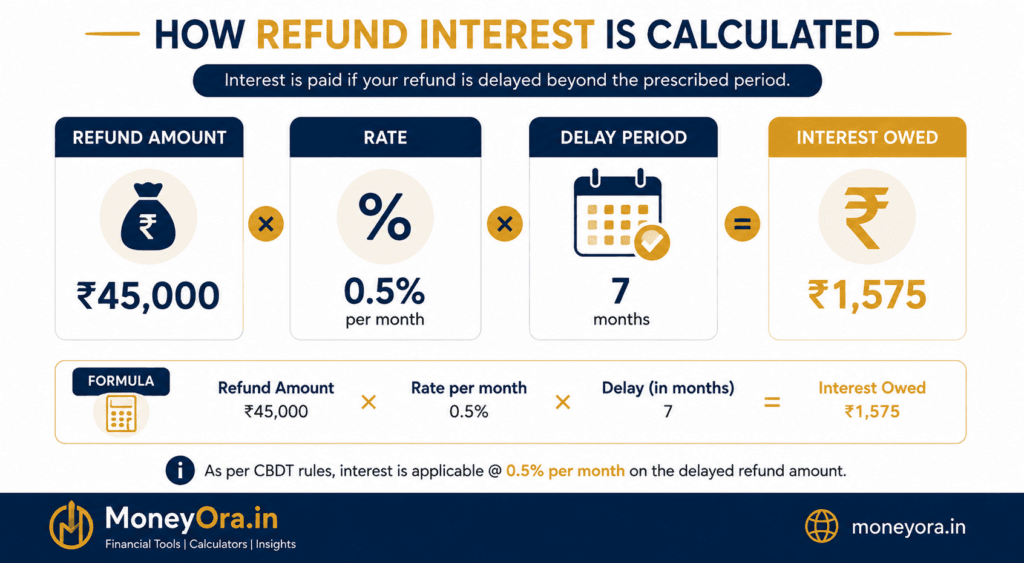
Under Section 244A, if your refund is delayed beyond the normal processing period, the Income Tax Department pays you interest at 0.5% per month (6% annually) on the refund amount, calculated from the start of the assessment year (or the filing date, if filed late) until the refund is actually issued.
Original ITR Refund Status Check calculation example: Suppose your calculated refund is ₹45,000 for AY 2025-26, and your return is finally processed and paid out 7 months after the start of the interest-accrual period (a realistic scenario given this year’s backlog). At 0.5% per month, that’s:
₹45,000 × 0.5% × 7 months = ₹1,575 in interest, credited automatically alongside your principal refund.
This interest is calculated and added by the system itself — you don’t need to separately apply for it — but it’s genuinely useful to know this number exists so a longer wait doesn’t feel like pure loss.
Note: this interest itself is taxable as “Income from Other Sources” in the year you receive it, a detail commonly overlooked.
Did You Know? If the delay in processing is found to be attributable to the taxpayer (for instance, a late e-verification), interest may not accrue for that portion of the delay — the interest specifically compensates for delay on the department’s side, not delays you caused yourself.
ITR Refund Status Check Shows an Adjustment? Section 245 Explained
Section 245 allows the Income Tax Department to adjust your current year’s refund against an outstanding tax demand from a previous assessment year, but you must first receive an intimation and are entitled to respond before the adjustment is finalized.
How an ITR Refund Status Check adjustment actually plays out, with an example: Suppose you’re owed a ₹30,000 refund for AY 2025-26, but the department’s records show an outstanding ₹18,000 demand from AY 2022-23 that you either forgot about or disputed informally without a formal resolution. Under Section 245, the department can issue you an intimation proposing to adjust the ₹18,000 against your ₹30,000 refund, leaving you a net ₹12,000 (plus any applicable interest on the remaining refund amount).
Your rights in this process:
- You must be given an opportunity to respond to the proposed adjustment before it’s finalized — it isn’t supposed to happen silently.
- If you believe the old demand is incorrect, outdated, or already paid, you can respond through the e-filing portal’s “Response to Outstanding Demand” section with supporting evidence.
- If you don’t respond within the given window, the adjustment typically proceeds as proposed.
MoneyOra Warning for your ITR Refund Status Check: Old, unresolved tax demands don’t disappear on their own — checking your “Outstanding Demand” section on the portal periodically, even years after the original assessment, avoids an unpleasant surprise showing up against a future refund you were counting on receiving in full.
ITR Refund Status Check Amount Lower Than Expected? Old vs New Regime
Your choice between the old and new tax regime doesn’t just affect your total tax liability — it directly changes your refund amount, since the old regime allows more deductions (potentially lowering liability further below what was already deducted as TDS) while the new regime offers lower slab rates but fewer deductions to claim against tax already paid.
| Factor | Old Regime | New Regime (Default) |
|---|---|---|
| Basic exemption limit | ₹2.5 lakh | ₹4 lakh |
| Deductions available | 80C, 80D, HRA, and others | Very limited |
| Best suited for | Taxpayers with significant eligible deductions (investments, insurance, home loan interest) | Taxpayers with few deductions to claim |
| Refund impact | Can produce a larger refund if TDS was deducted assuming no deductions, but you actually have substantial eligible claims | Refund reflects a simpler calculation with fewer variables that could inflate or reduce it |
Practical ITR Refund Status Check example: Suppose your employer deducted TDS assuming the new regime (the current default) throughout the year, but you actually have ₹1.5 lakh in eligible Section 80C investments and a home loan interest deduction you didn’t declare to your employer mid-year. Filing under the old regime at return time could produce a meaningfully larger refund than the new regime would, purely because your TDS was calculated on an income figure that didn’t yet reflect deductions you’re entitled to claim.
MoneyOra Expert Tip: Before assuming your ITR Refund Status Check shows a correct “small refund” outcome, actually run both regime calculations — the difference can be substantial, and once the return is filed and processed, switching becomes a revised-return exercise rather than a same-day fix.
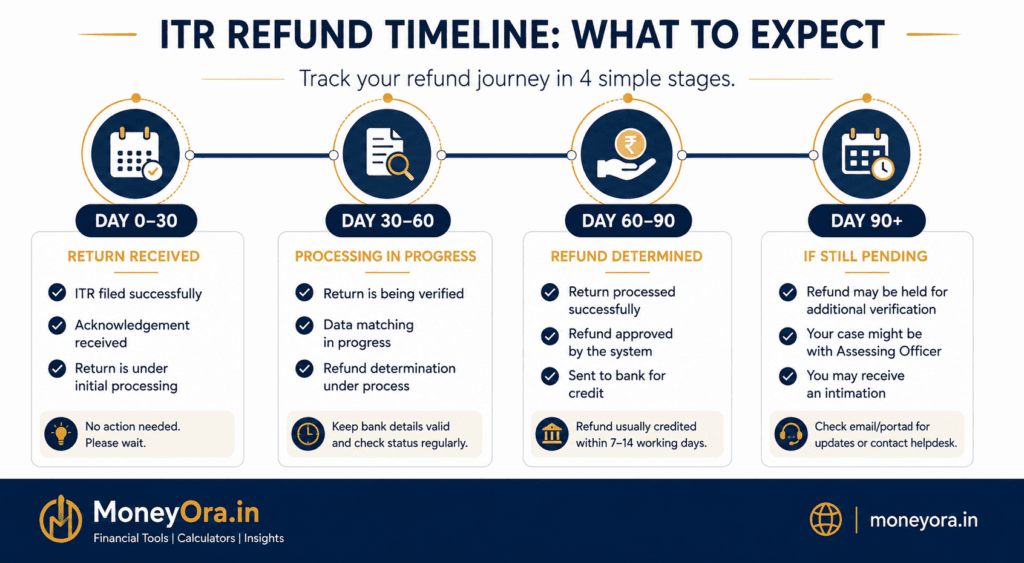
ITR Refund Status Check: The Day-30/60/90 Decision Framework
At day 30, simply confirm e-verification is complete. At day 60, cross-check your AIS/Form 26AS for mismatches and confirm bank pre-validation. At day 90+, if the status is genuinely unchanged with no notice received, it’s reasonable to raise a formal grievance rather than continue waiting indefinitely.
Day 0-30 (Just Filed):
- Confirm you’ve e-verified your return (via Aadhaar OTP, net banking, or another accepted method) — an unverified return is treated as not filed at all.
- Confirm your bank account is pre-validated on the portal.
- No action needed beyond this; processing hasn’t typically started in earnest yet.
Day 30-60 (Standard Wait Window):
- Check your ITR Refund Status Check result periodically — “Under Processing” is entirely normal here.
- Cross-check your own return against your Form 26AS and AIS for any obvious mismatch you can proactively correct via a revised return.
- If you’ve received a NUDGE alert, address it per Section 5’s checklist now rather than waiting.
Day 60-90 (Extended Wait, Still Reasonable Given 2026’s Backlog):
- Verify no “Refund Failed” status has appeared due to a bank detail issue.
- Check the “Outstanding Demand” section for any Section 245 adjustment notice you may have missed.
- Continued “Under Processing” status here is still within a realistic range for AY 2025-26 specifically, given the reported backlog scale.
Day 90+ (Time to Escalate):
- If status remains genuinely unchanged with zero communication, submit a grievance through the e-filing portal’s grievance section, or contact the CPC helpline directly.
- If your return was transferred to an Assessing Officer for manual review, respond immediately and completely to any notice — delayed responses extend the timeline further.
Common Mistakes That Delay Your ITR Refund Status Check Result
- Not e-verifying within 30 days. This single step being skipped means your return is treated as unfiled — no processing occurs at all until it’s done.
- Providing a bank account that isn’t pre-validated. Even a correctly filed return with an accurate refund calculation will show “Refund Failed” if the receiving account isn’t properly validated on the portal.
- Ignoring a NUDGE alert entirely. Treating an advisory nudge as spam or an error, rather than a genuine prompt to double-check a specific claim, can allow a resolvable issue to escalate into formal scrutiny.
- Filing based on assumed deductions without documentation. Claiming donations or deductions you can’t immediately substantiate if asked is one of the most common triggers for AI-driven risk flagging in the current system.
- Forgetting an old, unresolved demand exists. Assuming a years-old dispute has simply gone away, only to have it silently reduce a current refund under Section 245 with no advance planning on your part.
ITR Refund Status Check: Real-Life Case Study
Ananya, a salaried professional in Bengaluru, filed her ITR for AY 2025-26 in June 2025 and e-verified it the same day. By September, her repeated ITR Refund Status Check attempts still showed “Under Processing,” and by early November — nearly five months later — she began to worry something was genuinely wrong.
Rather than filing an immediate grievance, she worked through the day-90+ framework: her bank account was correctly pre-validated, her AIS matched her return, and she hadn’t received any NUDGE alert or demand notice. She raised a grievance through the portal in mid-November, referencing the specific pendency figures the department itself had published. Her return was processed three weeks later, with a “Refund Determined” status showing not just her original ₹52,000 refund but an additional ₹1,690 in Section 244A interest for the delay period — a detail she hadn’t expected but was, in fact, entitled to under the law.
The lesson: A long ITR Refund Status Check wait in 2026 specifically doesn’t automatically mean something is wrong, but it also doesn’t mean indefinite patience is the only option — a well-timed, specific grievance referencing your actual pendency duration is a reasonable and often effective step once you’ve passed the 90-day mark with no other explanation.
MoneyOra Analysis: What This Year’s ITR Refund Status Check Backlog Really Means
The 24.64 lakh pending ITR Refund Status Check figure isn’t really a story about individual taxpayer errors — it’s a capacity story. Filing volume for AY 2025-26 reached nearly 8.8 crore returns, and the Centralized Processing Centre’s infrastructure, however automated, has a practical throughput ceiling that record-year volumes can genuinely strain, independent of anything an individual filer did right or wrong.
What’s changed structurally this year, beyond raw volume, is the layering of AI-driven risk assessment onto that already-strained processing pipeline. Returns that would have cleared automatically in a lower-scrutiny environment are now being held for additional review when specific patterns — certain donation categories, unusually large deductions relative to declared income — get flagged. This is a deliberate policy choice aimed at reducing fraudulent refund claims, and it has a real, if unintended, side effect of slowing down entirely legitimate returns that happen to share surface-level characteristics with the ones the system is actually trying to catch.
There’s also a genuine transparency gap worth naming plainly: several tax-professional commentaries this year have specifically noted that portal status reporting doesn’t always clearly communicate why a return is delayed, leaving taxpayers to infer causes rather than being told directly. Proposals for a more real-time, transparent refund tracking system have reportedly been floated with the Ministry of Finance for the upcoming budget cycle — worth watching, since it would directly address the single biggest frustration underlying most of this year’s refund-related search volume: not the delay itself, but the uncertainty about its cause.
Assumptions stated: figures cited reflect officially reported pendency data as of February 2026 and general regulatory provisions in effect for AY 2025-26; specific circumstances vary by individual return, and this is not a guarantee of any particular processing timeline.
ITR Refund Status Check: Risks and Limitations to Understand
- Statutory deadline isn’t a guarantee of speed. December 31, 2026 is the outer limit for CPC to complete AY 2025-26 processing — it’s a ceiling, not a typical timeline, and most straightforward returns will clear well before it.
- Interest under Section 244A is not unlimited or automatic in every scenario. Delays attributable to the taxpayer’s own actions (late e-verification, incomplete documentation) may not accrue interest for that portion of the delay.
- A Section 245 adjustment can reduce your expected refund without prior expectation, particularly if you weren’t aware of an older, unresolved demand.
- NUDGE alerts and scrutiny flags are not the same as an audit or formal notice, but ignoring them can escalate a resolvable situation into a more formal, time-consuming process.
- Revised return deadlines are specific to each assessment year — the March 31, 2026 deadline referenced here applies to AY 2025-26 specifically, not future years, so always confirm the current deadline for whichever year you’re addressing.
This ITR Refund Status Check guide is for educational and informational purposes only and does not constitute tax or legal advice. Rules, deadlines, and portal processes can change; always verify current requirements directly on the official Income Tax e-Filing portal or consult a qualified tax professional for guidance specific to your situation.
How do I check my ITR refund status without logging in?
Visit tin.tin.nsdl.com, enter your PAN number, select the Assessment Year (2026-27 for FY 2025-26 income), type the captcha, and click Proceed. Your refund dispatch status appears immediately — no password or OTP required. This method shows whether the refund has been dispatched, but doesn’t show the full processing lifecycle that the e-filing portal provides.
How long does the ITR refund take for AY 2026-27?
For ITR-1 and ITR-4 filers with no mismatches: typically 15–30 days after e-verification. ITR-2 (capital gains) and ITR-3 (business income) filers can expect 30–60 days. Returns selected for scrutiny or with data mismatches can take longer. The department has a statutory deadline of 31 December 2026 to process all AY 2025-26 returns.
My refund status shows “Under Processing” for over 60 days. What should I do?
First, confirm your return is e-verified and your PAN is linked to Aadhaar. Check your AIS for any mismatches and your “Pending Actions” section for any notices you may have missed. If everything looks clean and it’s been over 90 days, raise a formal grievance on the e-filing portal under e-File → Grievances → Submit Grievance.
What is a Refund Reissue Request, and when do I need one?
A Refund Reissue Request is needed when your refund was dispatched but failed to credit — usually because of a wrong IFSC code, closed bank account, account number mismatch, or account not pre-validated. Go to Services → Refund Reissue on the e-filing portal, update your correct bank details, and submit with e-Verification. The reissued refund typically arrives within 15–30 days.
Is income tax refund interest taxable under Section 244A?
Yes, fully taxable. Interest under Section 244A is calculated at 0.5% per month (6% per annum) and is classified as “Income from Other Sources” under Section 56 of the Income Tax Act. It is taxable at your applicable income slab rate. There is no exemption. The interest amount should appear in your Section 143(1) intimation from CPC and may also show up in your AIS for the year it’s credited.
Can the Income Tax Department use my refund to pay old tax demands?
Yes. Under Section 245, the department can adjust your current refund against outstanding tax demands from previous assessment years. Critically, the department is required to issue an intimation before doing this, and you have 30 days to respond — either accepting the adjustment or disputing the underlying demand. If you dispute it and the demand turns out to be incorrect, your full refund will be released.
What are the latest questions people are asking about ITR refunds in 2026?
- Why is my AY 2026-27 refund not credited even though status shows “Refund Issued”? — Check your bank account for a failed NEFT entry. If the IFSC or account number was wrong, the bank returns the funds to CPC. Raise a Refund Reissue Request.
- Do I get interest if my refund is delayed by 5 months? — Yes, if the delay is attributable to CPC (not your filing error), Section 244A interest applies for the entire delayed period at 0.5% per month.
- My Form 26AS shows TDS but AIS doesn’t — whose data does the department use? — The department now places greater weight on AIS data. If there’s a conflict, raise a feedback submission on the AIS portal to correct the mismatch before your return is processed.
- I filed ITR on 31 July. How long will I wait? — Expect 30–60 days for simple returns, 60–90 for more complex ones. Last-minute filers join a larger processing queue.
- Can I check refund status via SMS? — Yes, the department sends SMS updates to your registered mobile number when the refund is processed and dispatched. No separate SMS tracking service is needed.
Refund Delay Decision Framework: What Should I Do Now?
| Your Situation | Immediate Action | Timeline to Expect |
|---|---|---|
| Return not e-verified | e-Verify immediately using Aadhaar OTP | Processing begins in 1–3 days |
| PAN not linked to Aadhaar | Link PAN-Aadhaar on the portal homepage | Refund may release in 2–4 weeks post-linking |
| Status shows “Refund Failed” | Pre-validate bank account → Refund Reissue | 15–30 days after reissue request |
| AIS/26AS mismatch notice received | Respond to the notice within the deadline | Processing resumes in 2–4 weeks post-response |
| Refund adjusted under Section 245 | Accept (if correct) or dispute within 30 days | Balance refund credited within 1–2 weeks |
| “Under Processing” for 90+ days, no notices | Raise a Grievance on the portal | Department responds in 30 days |
| Return under scrutiny | Respond to scrutiny notice with documents | Refund released after scrutiny closure |
Plan Your Taxes Better — Use MoneyOra’s Free Calculators
Smart tax planning means fewer surprises at ITR time. Use our calculators to optimise your deductions, estimate TDS, and plan investments before the next filing season.
Use the free calculators now on MoneyOra.in →
Official Sources and External References
- Income Tax Department — Refund Status User Manual
- Income Tax Department — Check Refund Status (Official Help)
- NSDL/Protean — Know Your Refund Status (No Login)
- Income Tax e-Filing Portal — incometax.gov.in
- Income Tax India — Refund Status Check
FREQUENTLY ASKED QUESTIONS
1. How do I check my ITR refund status online?
Log in at incometax.gov.in, go to e-File → Income Tax Returns → View Filed Returns, and check the refund status against your Assessment Year. Alternatively, use the no-login “Know Your Refund Status” option with just your PAN and assessment year.
2. Why is my ITR refund delayed for AY 2025-26?
Common causes include record filing volume straining CPC’s processing capacity (8.8 crore returns filed), AI-driven risk-based scrutiny of unusual claims, mismatches between your ITR and Form 26AS/AIS, an unverified return, bank pre-validation issues, or an old tax demand being adjusted under Section 245.
3. What does “Refund Failed” status mean and how do I fix it?
It typically means the transfer attempt failed due to incorrect or unvalidated bank account details. Correct and pre-validate your bank account on the portal, then submit a Refund Reissue Request to trigger a new attempt.
4. Am I owed interest if my refund is delayed?
Yes, under Section 244A, you’re generally owed interest at 0.5% per month (6% annually) on the refund amount for the delay period, calculated and credited automatically alongside your principal refund — though this interest is itself taxable in the year received.
5. What is the NUDGE campaign and should I be worried if I got an alert?
NUDGE alerts are advisory SMS/email messages flagging a possible mismatch or unusually large claim (particularly around certain donations) for voluntary review — they are not penalty notices. Cross-check the flagged item against your documentation and file a revised return if you find a genuine error.
6. Can the department adjust my refund against an old tax demand?
Yes, under Section 245, an outstanding demand from a previous assessment year can be adjusted against your current refund, but you must receive an intimation and have an opportunity to respond before the adjustment is finalized.
7. How does choosing the old vs new tax regime affect my refund amount?
The old regime allows more deductions, which can increase your refund if your employer’s TDS calculation didn’t account for those deductions during the year. The new regime offers lower slab rates but fewer deductions, generally producing a more straightforward refund calculation.
8. What should I do if my refund status hasn’t changed in over 90 days?
Verify e-verification is complete, your bank account is pre-validated, and there’s no outstanding demand notice you missed. If all of this checks out and status remains unchanged, submit a formal grievance through the e-filing portal’s grievance section.
9. Is a delayed refund a sign that something is wrong with my return?
Not necessarily. For AY 2025-26 specifically, the sheer volume of filings (nearly 8.8 crore) has genuinely stretched processing capacity, and a delay alone doesn’t indicate an error — though a “Case Transferred to Assessing Officer” status does mean your return has been flagged for manual review.
10. What is the deadline for the Income Tax Department to process AY 2025-26 refunds?
The Centralized Processing Centre has a statutory deadline of December 31, 2026 to complete processing of all AY 2025-26 returns, though most straightforward returns are expected to clear well before that outer limit.


Pingback: Tax Deductions Other Than 80C for Salaried Employees FY 2026-27 - MoneyOra