

Gold Price Today India: Record Highs — Should You Buy or Wait?
Gold Price Today India is sitting close to levels nobody was quoting even two years ago, and the instinct to either rush in or hold off entirely is completely understandable — a record-high headline does that to people. The more useful question isn’t “will it go higher,” which nobody can answer with certainty, but “does buying right now actually fit what I need this gold for.” Check PAN Aadhaar Link Status 2026: Is Your PAN Still Active?
This guide gives you today’s actual rate across major cities, an honest explanation for why prices climbed this high, and a clear framework — not a prediction — for deciding whether to buy now, wait, or buy differently than you’d originally planned. Once you’ve decided on an amount, you can model how a gold allocation fits your broader portfolio using MoneyOra’s SIP Calculator or Lumpsum Calculator.
1. Gold Price Today India: The Current Rate
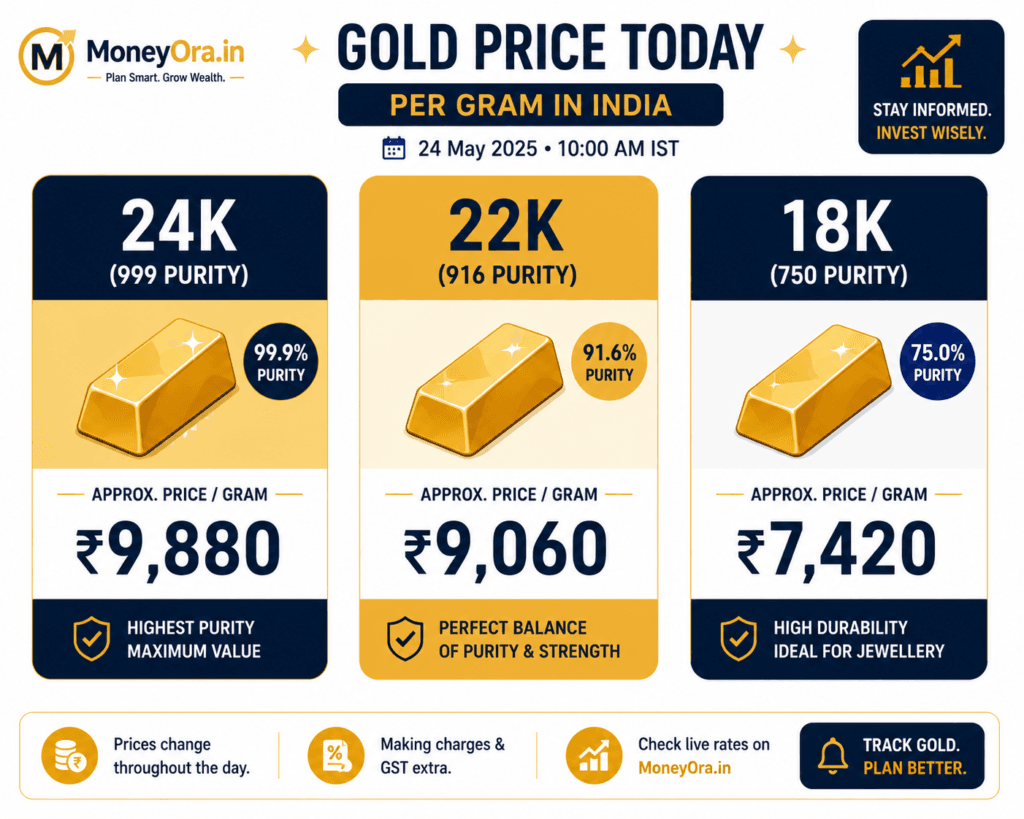
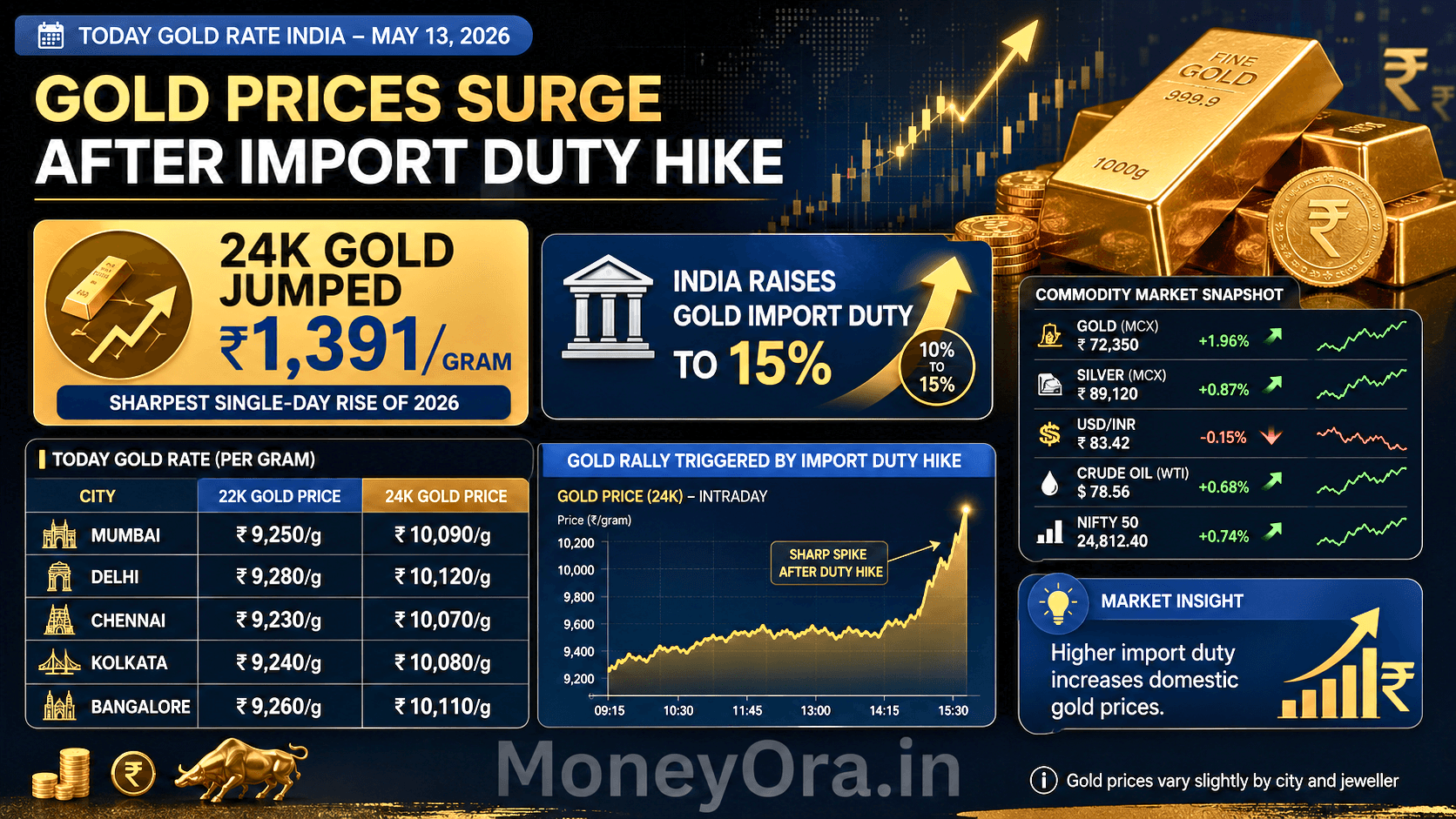
As of late July 2026, Gold Price Today India stands at approximately ₹14,400 per gram for 24K gold (₹1,44,000 per 10 grams) and around ₹13,200 per gram for 22K gold, with rates fluctuating daily based on international spot prices and the rupee-dollar exchange rate. Earlier in 2026, 24K gold briefly crossed ₹1,69,349 per 10 grams, marking an all-time high before easing back somewhat. CKYC Number: Urgent 2026 Guide to Find Yours Fast
| Purity | Price Per Gram (approx.) | Price Per 10 Grams (approx.) |
|---|---|---|
| 24K (999 purity) | ₹14,400 | ₹1,44,000 |
| 22K (916 purity) | ₹13,200 | ₹1,32,000 |
| 18K (750 purity) | ₹10,800 | ₹1,08,000 |
Rates are indicative as of late July 2026 and change daily — always check a live source like your jeweller, MCX futures data, or a financial data platform for the exact current rate before making a purchase decision “EPF passbook not showing your latest contribution? Here’s why”.

2. City-Wise Gold Price Today India
Gold Price Today India isn’t identical across the country — local taxes, transportation costs, and regional demand create small but real city-wise variations, typically within a few hundred rupees per 10 grams.
| City | 24K Gold (per 10g, approx.) | 22K Gold (per 10g, approx.) |
|---|---|---|
| Mumbai | ₹1,44,000 | ₹1,32,000 |
| Delhi | ₹1,44,200 | ₹1,32,200 |
| Chennai | ₹1,44,800 | ₹1,32,800 |
| Hyderabad | ₹1,44,300 | ₹1,32,300 |
City-wise rates are indicative and can shift daily; jewellers in the same city may also quote slightly different rates depending on their own sourcing and margin. Always confirm the live rate before a purchase.
Why the city difference exists:
State-level taxes, octroi and local levies (where applicable), and the specific bullion association a city references — the India Bullion and Jewellers Association (IBJA) rate often serves as the informal national benchmark — all contribute to these small gaps. They’re generally too small to justify traveling between cities purely to save on gold, but worth knowing so a quoted rate at your local jeweller doesn’t seem unexpectedly “off” compared to a national headline number. “Railway PSU stocks that moved the market”
3. Why Gold Hit Record Highs in 2026
Gold Price Today India reflects a combination of global and domestic forces, not a single cause — understanding these is what actually helps decide whether current levels make sense for your situation, rather than just reacting to the headline.
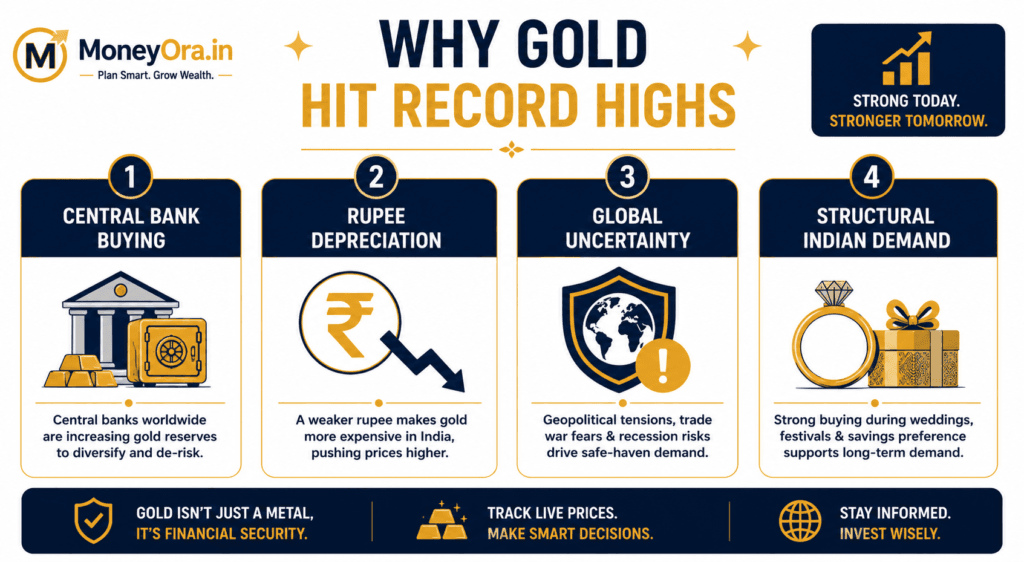
Central bank buying, including RBI:
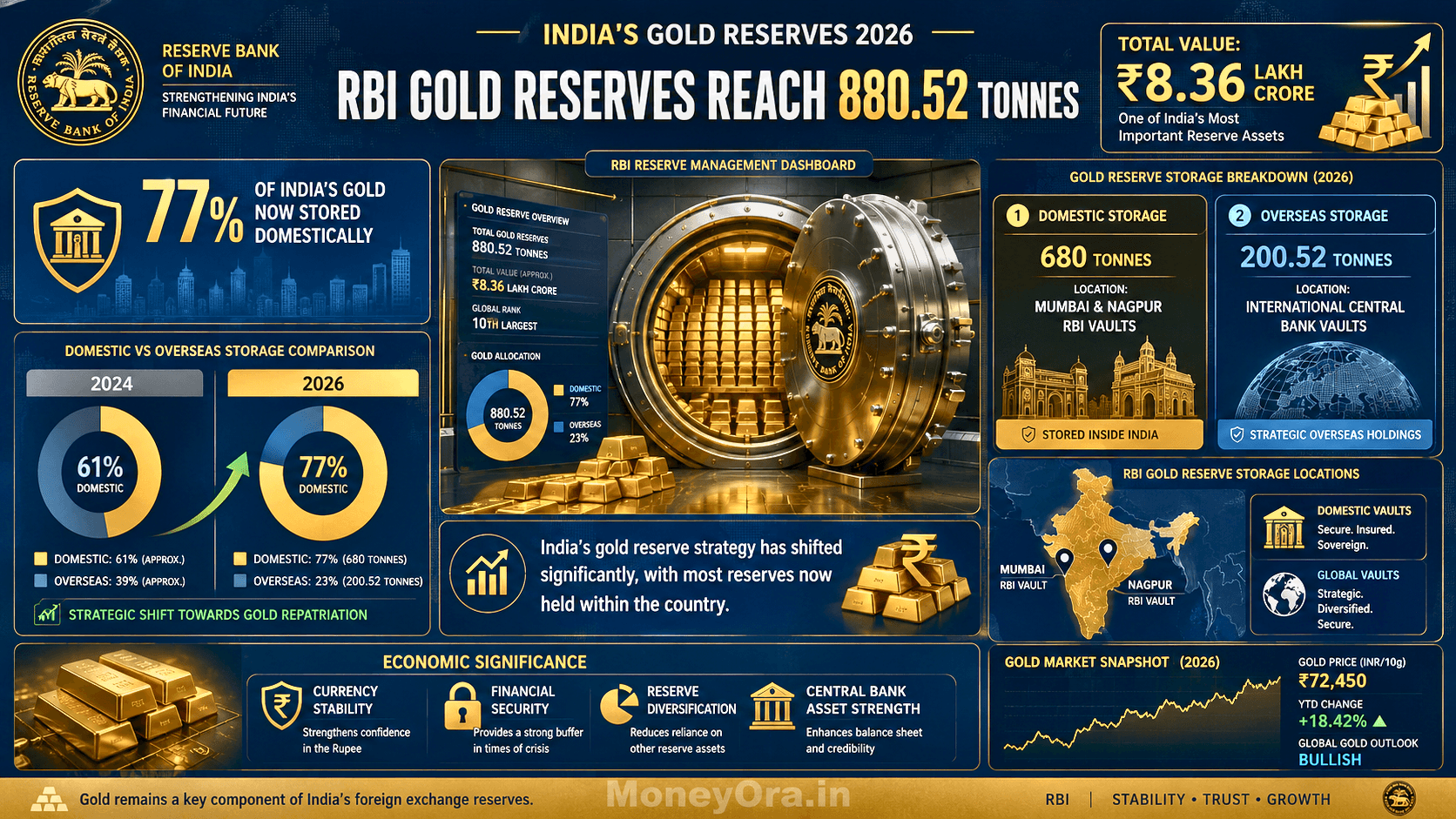
The Reserve Bank of India has been a consistent, sustained gold buyer, building its reserves to several hundred tonnes over recent years — a global pattern among central banks that has provided a steady source of demand supporting prices independent of retail or jewellery buying.
Rupee depreciation:
Gold is priced internationally in US dollars, and a weaker rupee means the same dollar-denominated gold price translates into a higher rupee price. Part of the rupee-terms rally in Gold Price Today India reflects currency movement as much as the underlying dollar gold price itself.
Global economic uncertainty:
Gold’s traditional role as a safe-haven asset during geopolitical tension and economic uncertainty has continued to drive institutional and retail demand internationally, with international spot prices themselves reaching successive records through 2025 and into 2026.
Structural Indian demand:
India remains the world’s second-largest gold consumer, and demand has stayed structurally resilient even at elevated prices — weddings, festivals, and gifting occasions continue to drive purchases regardless of the headline rate, which keeps a demand floor under the domestic price.
Consider a Chennai-based family planning a wedding for later this year. Two years ago, the same gold jewellery budget bought noticeably more grams than it does today at current Gold Price Today India levels. Rather than delaying the purchase indefinitely hoping for a pullback, many families in this position are adjusting design choices — slightly lighter pieces, or a mix of 18K and 22K items — to manage the total budget while still meeting the occasion’s timeline. This is a practical, purpose-driven response to elevated prices, distinct from trying to time an investment purchase.
4. Gold Price Today India: 24K vs 22K vs 18K Explained
A meaningful share of confusion around today’s Gold Price Today India figures comes from not knowing which purity a quoted rate refers to.
- 24K (999 purity): The purest form of gold, used mainly for investment-grade bars, coins, and Sovereign Gold Bonds. Too soft for durable jewellery on its own.
- 22K (916 purity): The standard for most Indian jewellery, alloyed with a small amount of other metals (usually copper or silver) for durability, while retaining a high gold content.
- 18K (750 purity): Increasingly common in modern, diamond-studded, or Western-style jewellery designs, offering more durability and a lower price point at the cost of lower gold content.
Comparing a “gold price today” headline (usually quoted in 24K terms) directly against a jeweller’s 22K jewellery quote and assuming a discrepancy or error. The correct comparison always requires matching purity first — a 22K rate will always run below the 24K headline figure by design, not because of a pricing error.
5. Should You Buy Gold Now or Wait?
For Gold Price Today India, there’s no universally correct answer here — it depends entirely on why you’re buying, not on trying to predict where Gold Price Today India goes next.
If you’re buying for a wedding or a fixed-date occasion:
The purchase timing is largely dictated by the event date, not the price level. Waiting for a “better” price risks missing the occasion entirely for a saving that may or may not materialize. In this case, buying closer to when you actually need it — while comparing making charges across jewellers, which can vary meaningfully — matters more than trying to time the metal price itself.
If you’re buying as a long-term investment (5+ years):
Historical patterns show gold has moved through extended periods of both rapid appreciation and multi-year stagnation. A staggered approach — investing a fixed amount periodically rather than a single lump sum at today’s Gold Price Today India level — reduces the risk of committing a large amount right before a pullback, similar to how SIP investing works for equities.
If you’re buying purely on momentum because “it keeps going up”:
This is the scenario worth pausing on. Chasing a rally without a specific purpose or time horizon is a common pattern that precedes disappointment if prices consolidate or pull back, as they did between the March 2026 high and current July levels.
If you already hold gold and are wondering whether to sell:
That’s a separate decision from “should I buy,” and depends on your original purpose for holding it (jewellery for personal use typically shouldn’t be treated as a trading position) and your tax situation on any gains.
6. Gold Price Today India: Physical vs Digital vs ETF vs SGB
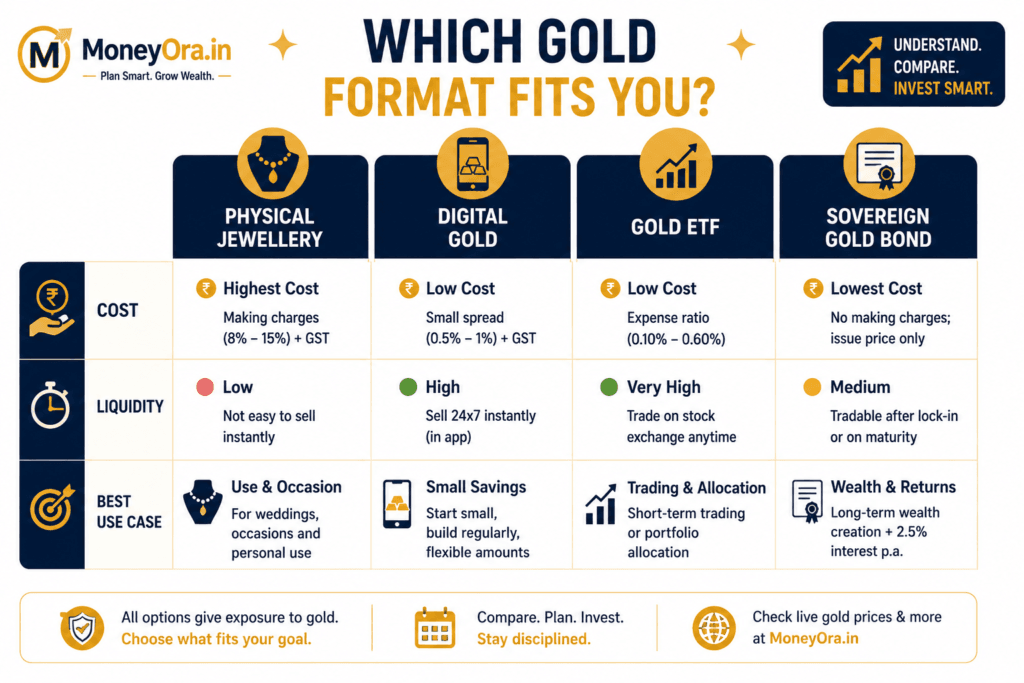
Gold Price Today India applies differently depending on which format you’re buying, and the format matters as much as the timing decision.
| Format | Making/Storage Cost | Liquidity | Best For |
|---|---|---|---|
| Physical Jewellery | High (making charges, wastage) | Lower (resale often below market rate) | Personal use, weddings, gifting |
| Physical Coins/Bars | Lower than jewellery, but storage risk | Moderate | Small investment allocations, gifting |
| Digital Gold | Low, but platform-dependent | High | Small, flexible investment amounts |
| Gold ETF | Very low (expense ratio only) | High (traded like a stock) | Investment-focused exposure without storage |
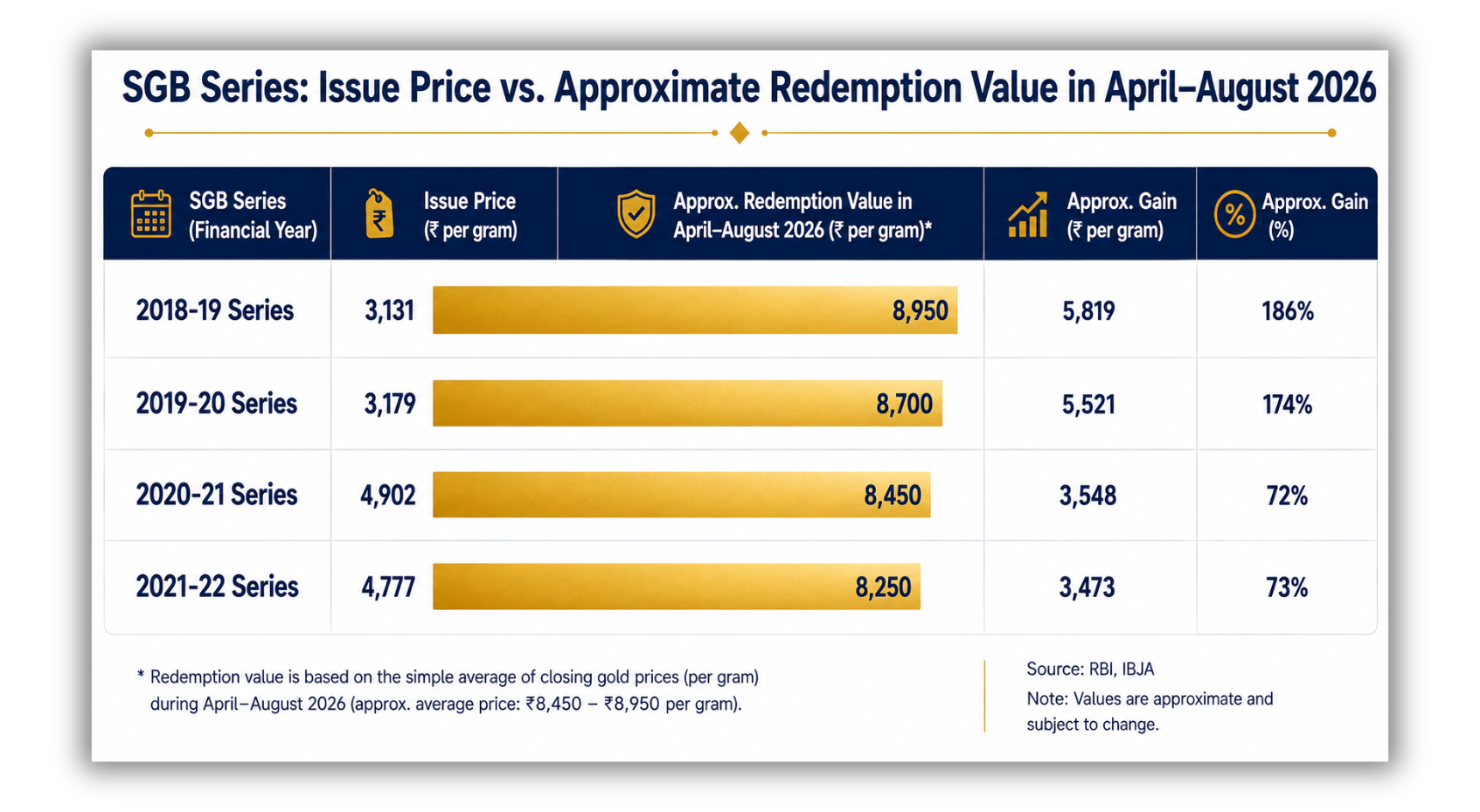
| Sovereign Gold Bond (SGB) | None; plus fixed 2.5% annual interest | Lower (fixed tenure, though tradeable) | Long-term investment with a bonus interest component |
MoneyOra view on format: For pure investment exposure to Gold Price Today India movements, formats like gold ETFs or SGBs typically make more sense than physical gold, since they avoid making charges and storage risk entirely. Physical gold remains the natural choice when the actual jewellery itself — not just the metal’s value — is the point of the purchase, such as for a wedding.
7. Common Mistakes Gold Price Today India Buyers Make
- Ignoring making charges when comparing “gold price today” against a jewellery bill. Making charges (typically 8%–25% of the gold value, depending on design complexity) sit on top of the metal price and vary significantly between jewellers — always compare making charges separately, not just the headline gold rate.
- Buying purely because of a “record high” headline, without a specific purpose. A rally is not, by itself, a reason to buy; a headline about Gold Price Today India hitting a new high is context, not a signal.
- Not accounting for GST on gold purchases. A 3% GST applies to gold value, in addition to making charges, which meaningfully affects the total out-the-door cost beyond just the quoted per-gram rate.
- Treating hallmarking as optional. Always verify BIS (Bureau of Indian Standards) hallmarking on jewellery purchases to confirm actual purity matches what’s being charged for — a mismatch between claimed and actual purity is a real, avoidable risk.
- Assuming physical gold is the only way to gain gold exposure. For pure investment purposes, ignoring lower-cost alternatives like gold ETFs or SGBs in favor of physical gold by default often means paying unnecessary making charges for value that could otherwise sit in a more liquid, lower-cost instrument.
What History Says About Buying at Record Highs
A pattern worth understanding about Gold Price Today India headlines like it: “record high” gets reported constantly during genuine multi-year bull markets, almost by definition, since a rising trend continuously sets new highs along the way. This doesn’t make the label meaningless, but it does mean “gold hit a record high” is a much weaker signal about future direction than the phrase intuitively suggests — a rally can extend through dozens of individual “record high” headlines before it eventually pauses or reverses.
The more useful historical observation is that gold, over multi-decade periods in India, has moved through both extended rallies (like 2000–2010’s roughly 320% rise) and multi-year periods of relative stagnation. Neither pattern can be reliably predicted in advance, which is precisely why a purpose-driven approach (Section 5) tends to serve buyers better than an attempt to time entry against a headline number.
For context on the current rally specifically: a combination of sustained central bank buying (including RBI), broad-based global economic uncertainty, and rupee depreciation has driven this cycle — factors that are structurally different from, say, a purely speculative retail-driven spike, which historically tends to argue for a somewhat more durable (though still not guaranteed) trend than a rally built purely on short-term momentum.
Assumptions stated: this reflects publicly available market data and reporting as of late July 2026 and is not a projection or guarantee of future gold prices.
Gold Price Today India: Key Risks to Understand Before Buying
- Price volatility risk: Gold Price Today India can move meaningfully in either direction within days based on global cues, currency movement, and central bank commentary — a purchase made at today’s rate isn’t insulated from near-term price swings.
- Making charge and resale value loss on jewellery: Physical jewellery typically can’t be resold at the full purchase price, since making charges and wastage aren’t recovered on resale — this is a structural cost, not a market risk, but it’s often underestimated.
- Currency risk embedded in the rupee price: Since gold is dollar-denominated internationally, rupee movements independent of the actual gold market can push the domestic price up or down regardless of what’s happening to gold in dollar terms.
- Storage and security risk for physical gold: Bars, coins, and jewellery held at home carry theft and loss risk that paper-gold alternatives (ETFs, SGBs, digital gold held with a regulated provider) don’t carry in the same way.
- Purity and hallmarking risk: Buying from unverified sources without checking BIS hallmarking can result in paying a 22K or 24K price for gold that doesn’t actually match that purity.
This is general educational information, not personalised financial advice — the right decision depends on your specific purpose, timeline, and risk comfort, and is worth discussing with a financial advisor for larger allocations.
Gold Price Today India
Gold Price Today India reflects a genuine, multi-factor rally — sustained central bank buying, rupee depreciation, and global economic uncertainty — rather than a speculative spike with no underlying support. That said, “record high” headlines are a weak signal about future direction on their own, since rallies generate them continuously by definition. The better question than “buy now or wait” is “what is this gold actually for” — a wedding purchase, a long-term investment allocation, or pure momentum-chasing each call for a different approach, and matching the format (physical, digital, ETF, or SGB) to that purpose matters as much as the timing itself.
This article is for educational and informational purposes only and does not constitute investment advice. Gold prices change daily; verify the current live rate through a reliable source before making any purchase decision, and consult a financial advisor for guidance on larger investment allocations.
FREQUENTLY ASKED QUESTIONS
1. What is the gold price today in India?
As of late July 2026, Gold Price Today India stands at approximately ₹14,400 per gram for 24K gold (around ₹1,44,000 per 10 grams) and about ₹13,200 per gram for 22K gold, though rates change daily based on international spot prices and the rupee-dollar exchange rate.
2. Why is gold price at a record high in 2026?
The rally reflects sustained central bank gold buying (including by the RBI), rupee depreciation against the dollar, ongoing global economic uncertainty driving safe-haven demand, and structurally resilient Indian consumer demand even at elevated prices.
3. Should I buy gold now or wait for the price to fall?
It depends on your purpose. For a wedding or fixed-date need, buying closer to the occasion matters more than timing the price. For long-term investment, a staggered buying approach reduces the risk of a single lump-sum purchase right before a pullback, rather than trying to time a single “best” entry point.
4. What’s the difference between 24K, 22K, and 18K gold price?
24K (999 purity) is the purest form, used for investment bars, coins, and bonds. 22K (916 purity) is standard for most Indian jewellery. 18K (750 purity) is common in modern or diamond-studded designs. A quoted “gold price today” headline typically refers to 24K, so 22K jewellery rates will always be somewhat lower.
5. Is it better to buy physical gold or a Sovereign Gold Bond (SGB)?
For pure investment exposure, SGBs avoid making charges and storage risk entirely, plus offer a fixed 2.5% annual interest on top of the gold price movement. Physical gold makes more sense when the jewellery itself, not just the investment value, is the actual purpose of the purchase.
6. Why does gold price vary between cities in India?
Small city-wise differences come from local taxes, transportation costs, and which city’s bullion association rate is being referenced (Mumbai’s rate often serves as an informal national benchmark), typically amounting to a few hundred rupees per 10 grams difference.
7. Does GST apply to gold purchases in India?
Yes, a 3% GST applies to the gold value, in addition to making charges on jewellery, both of which sit on top of the quoted per-gram or per-10-gram metal rate and meaningfully affect the total purchase cost.
8. What is BIS hallmarking and why does it matter for gold purchases?
BIS hallmarking is an official purity certification that verifies gold jewellery actually matches its claimed karat value. Always check for hallmarking when buying jewellery to avoid paying a 22K or 24K price for gold that doesn’t match that purity.
9. Has gold price in India always gone up over time?
No. While gold has appreciated significantly over multi-decade periods (roughly 320% between 2000 and 2010, for example), it has also moved through extended multi-year periods of relative stagnation, and short-term pullbacks after “record high” periods are common, as seen between March 2026’s peak and current levels.
10. What’s the best way to invest in gold instead of buying jewellery?
Gold ETFs, Sovereign Gold Bonds, and digital gold through regulated platforms are generally more cost-efficient for pure investment purposes than physical jewellery, since they avoid making charges and reduce storage and resale-value-loss risk.


Pingback: Gold Reserve in India Hits 880 Tonnes: Why Is RBI Bringing Gold Back Home - MoneyOra
Pingback: State Backed Bonds 2026: Is the 9.15% Return Real?