


If you opened your trading app on Monday morning and did a double-take — you weren’t imagining it.
The Sensex rally ceasefire story is real. Sensex surged over 2,300 points and Nifty 50 crossed 24,737 on May 12, 2026, after India and Pakistan announced a ceasefire over the weekend. Every sector index on NSE closed green. The BSE market cap added over ₹12 lakh crore in a single session. And millions of retail investors are now wondering the same thing: what does this mean for my portfolio?
This post breaks it all down — what actually happened, which stocks moved and why, what smart investors are doing, and the honest answer to whether you should be buying right now or waiting.
What Happened on May 12, 2026
Here is the timeline, plain and simple.
In late April 2026, a terror attack in Pahalgam, Kashmir killed 26 civilians. India responded with Operation Sindoor — a large-scale military strike targeting terror infrastructure across the border. Pakistan retaliated. Cross-border tensions ran hot for several days. Indian stock markets had a rough week — the Nifty fell, the India VIX (fear gauge) spiked, and FIIs started moving money out.
Then on Saturday, May 10, India and Pakistan agreed to a ceasefire.
Markets opened on Monday, May 12, and the reaction was immediate. Sensex was up over 1,400 points even in the pre-market session. By close, it had added 2,300+ points. Nifty 50 crossed 24,737. Every single sectoral index — IT, Realty, Power, Energy, Banking, FMCG — ended the day positive. Market breadth was exceptional: over 3,300 stocks advanced on BSE versus fewer than 600 declining.
There was a second tailwind too. US and China announced a 90-day tariff pause over the same weekend, lifting global risk appetite. But for Indian markets, the ceasefire was the main story.
Why Markets React So Sharply to Ceasefire News
It is a fair question — why does a diplomatic announcement cause a 2,300-point move in one day?
Markets price in risk constantly. When two nuclear-armed neighbouring countries escalate militarily, institutional investors do not wait to see what happens next. They reduce exposure. Foreign institutional investors move capital to safer markets. Domestic funds hold back fresh deployments. The result: selling pressure, higher volatility, a spike in the VIX.
When that risk disappears — or even partially reduces — the reverse happens. Fast. Money that was sitting on the sidelines flows back in. Short positions get covered. And retail investors who had been watching anxiously start buying again.
This pattern has played out before. After the 2019 Balakot airstrikes, markets recovered sharply within days once it was clear the situation would not escalate further. After the 2016 surgical strikes, same story. Geopolitical events cause fast, emotional market moves. The underlying Indian economy does not change overnight.
The investor who understands this cycle — and stays calm — usually ends up ahead of the one who sold at the bottom of the fear.
Sector-by-Sector Breakdown: What Moved and Why
IT Stocks Led the Entire Market
This surprised many people. Why would software companies rally on India–Pakistan ceasefire news?
Because the ceasefire coincided with the US-China trade truce. Indian IT companies earn most of their revenue in US dollars from American clients. When global trade tensions ease and US tech spending outlook improves, Indian IT names move. Nifty IT was the top sectoral performer on May 12 — up sharply, logging its best single session in years. Infosys and HCL Technologies were among the biggest Nifty 50 movers.
Realty, Power, and Energy
These three sectors moved 4–6% on the day. Infrastructure-heavy sectors benefit the most from geopolitical stability. Capital project planning, government spending, and investor confidence in long-cycle assets all improve when security concerns reduce.
Banking and Financials
Banking stocks participated but did not lead. Banks are more sensitive to interest rates and credit cycles than to geopolitical headlines. Private sector banks saw steady buying. PSU banks were mixed. The broader financial sector sentiment was positive but less explosive than IT or Realty.
Broad Market — Mid and Small Caps Joined In
The rally was not just about 10–15 Nifty heavyweights. BSE Midcap gained around 3.5–4%. Smallcap index added 4%+. When mid and small caps move together with large caps on a high-breadth day like this, it signals genuine investor confidence rather than just index manipulation by a few large stocks.
5 Stocks to Watch After the India–Pakistan Ceasefire
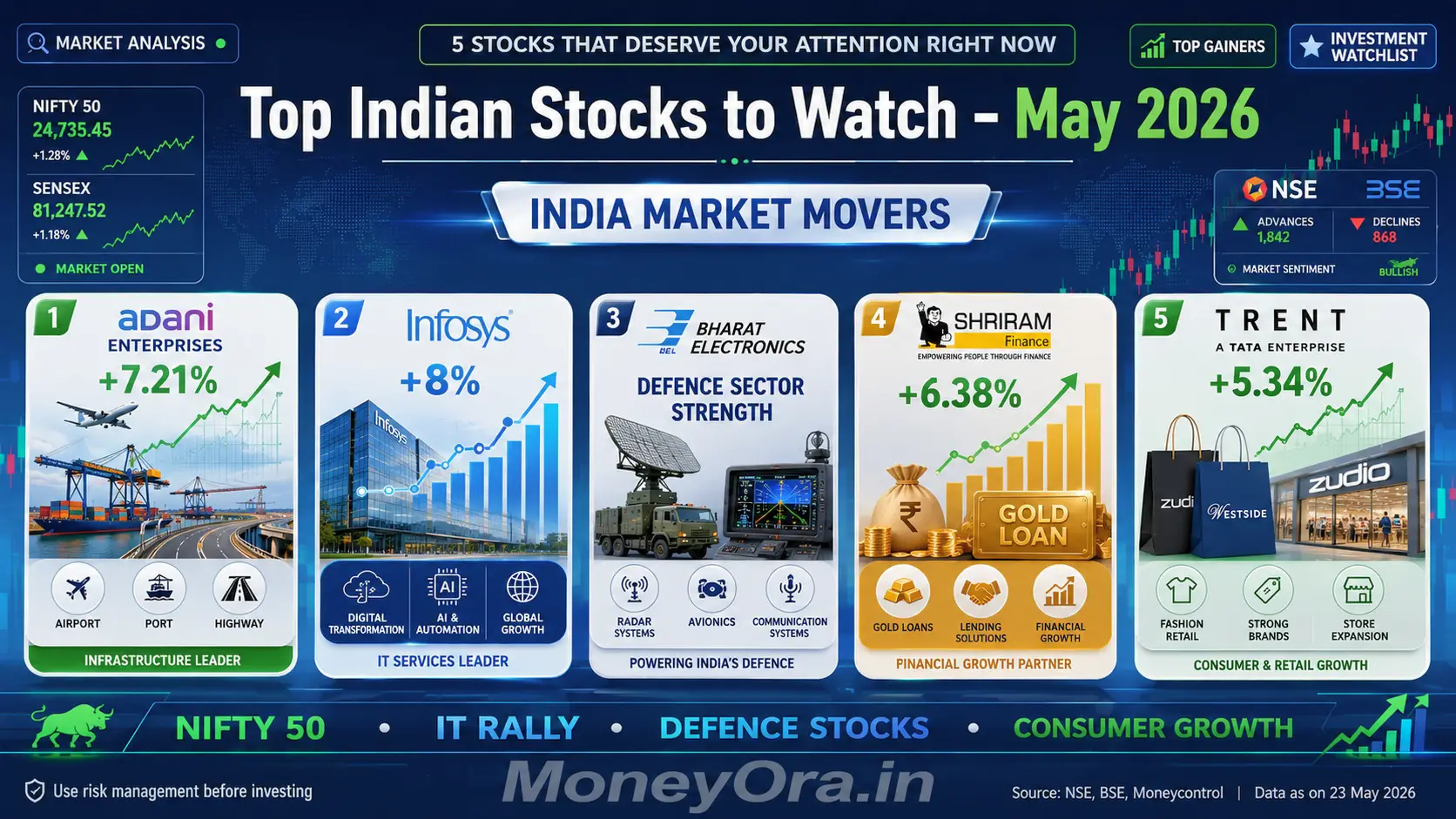
1. Adani Enterprises
Adani Enterprises was one of the best performers in Nifty 50 on May 12, gaining over 7%. The reasons are layered. Improved clarity around the conglomerate’s regulatory situation helped. Geopolitical stability directly benefits Adani’s infrastructure businesses — airports, ports, roads, power. When security risk falls, long-cycle infrastructure projects get repriced upward.
For investors watching Adani, the business fundamentals are large and tied to India’s multi-decade infrastructure story. But the stock swings hard on news — 5–8% moves in either direction are not unusual. Before entering any position, use MoneyOra’s Stop-Loss Calculator to set a clear exit level so you do not let a trade turn into a loss-holding exercise.
2. Infosys
Eight percent in one day. Infosys was one of the top Nifty 50 movers on May 12, and most retail investors were too focused on defence stocks to notice.
The IT sector rally was driven by the US-China trade pause improving global tech spending outlook. Infosys, which earns the majority of revenue from US enterprise clients, is a direct beneficiary. After the correction from 2024 highs, Infosys valuations look more reasonable against its historical earnings range.
Want to check if Infosys is fairly valued at current levels? Use MoneyOra’s P/E Ratio Calculator to compare its current P/E against sector average and 5-year historical mean. Numbers sometimes tell a different story than headlines.
3. Bharat Electronics Limited (BEL)
Defence stocks overall showed mixed behaviour on May 12 — more on that in the next section. But BEL held up better than most in the sector.
BEL supplies radars, electronic warfare systems, avionics, and communication equipment under long-term government contracts. Its order book is not driven by single conflict cycles. India’s Atmanirbhar Bharat defence indigenisation push gives BEL a decade-long revenue pipeline regardless of whether India and Pakistan are in ceasefire or tension mode.
Paras Defence fell 6% on May 12. BEL did not. That difference matters, and it is a fundamentals story.
4. Shriram Finance
Shriram Finance rose over 6% on the day — and this one had nothing to do with the ceasefire.
The company reported strong Q4 loan growth and improved asset quality independently. Commercial vehicle financing, small business lending, gold loans — Shriram’s book is in good shape. On a big macro rally day, stocks with both a market tailwind and a company-specific positive usually outperform and are less likely to give back gains in the following sessions.
If you are calculating the real return from your Shriram Finance position or any other holding through this volatile period, MoneyOra’s Stock Return Calculator gives you the exact annualised figure — not just the percentage gain since purchase.
5. Trent (Tata Retail)
Trent — the Tata Group’s retail arm behind Westside and Zudio — gained over 5% on May 12. Strong same-store sales growth and aggressive Zudio expansion are the core drivers. Zudio is quietly gaining market share in value fashion across Tier 1 and Tier 2 cities.
Geopolitical stability improves consumer sentiment and discretionary spending. Trent is a direct play on that. The P/E looks elevated on the surface, but for a high-growth retailer with genuine category disruption, the growth-adjusted valuation is more interesting than the headline multiple suggests.
What Actually Happened to Defence Stocks
This needs its own section because the narrative gets confusing.
During the week of India–Pakistan tensions — before the ceasefire — defence stocks went parabolic. HAL, BDL, Bharat Dynamics, Paras Defence, Zen Technologies all spiked 15–20% or more. The Nifty Defence Index touched multi-month highs. Every finance channel was talking about defence stocks.
Then the ceasefire happened. And some of those stocks fell sharply on May 12. Paras Defence down 6%. Astra Microwave down. HAL slightly weak.
Classic “buy the rumour, sell the news.”
Here is the thing though — the long-term defence story for India is completely intact. The Atmanirbhar Bharat defence initiative, India’s target of ₹35,000 crore in annual defence exports, HAL’s Tejas LCA export pipeline, BDL’s missile system contracts — none of that changed because of a ceasefire. Analysts at Religare Broking have called this a sector with a 5–7 year structural runway.
The short-term traders who chased defence stocks at the top of the conflict spike got hurt on May 12. Long-term investors who held BEL or HAL for their order book fundamentals were largely fine.
Before sizing any position in high-volatility sectors like defence, use MoneyOra’s Position Size Calculator to work out how much you can afford to allocate without it destroying your overall portfolio if it goes against you.
FII Activity — This Is the Number That Actually Matters
Individual stocks are one thing. But the bigger story of May 12 is what FIIs do next.
By April 2026, Foreign Institutional Investors had turned net buyers in Indian equities for the first time in months, after a period of heavy selling triggered by high valuations, a strong dollar, and global uncertainty. The rupee had recovered strongly. Domestic institutional investors (DIIs) had, for the first time ever, overtaken FIIs in shareholding of NSE-listed companies — DIIs at 17.62% versus FIIs at 17.22%.
With the ceasefire removing a major geopolitical risk premium, conditions are now favourable for FII buying to accelerate. When FIIs are net buyers for three or more consecutive sessions after a relief rally, history shows the move tends to extend.
Track this daily. NSE and BSE both publish FII/DII data every evening. It takes two minutes to check. If FIIs are consistently buying, the rally has legs. If they start selling into the bounce, be careful.
What Should Retail Investors Do Right Now
Honest answer? It depends on who you are.
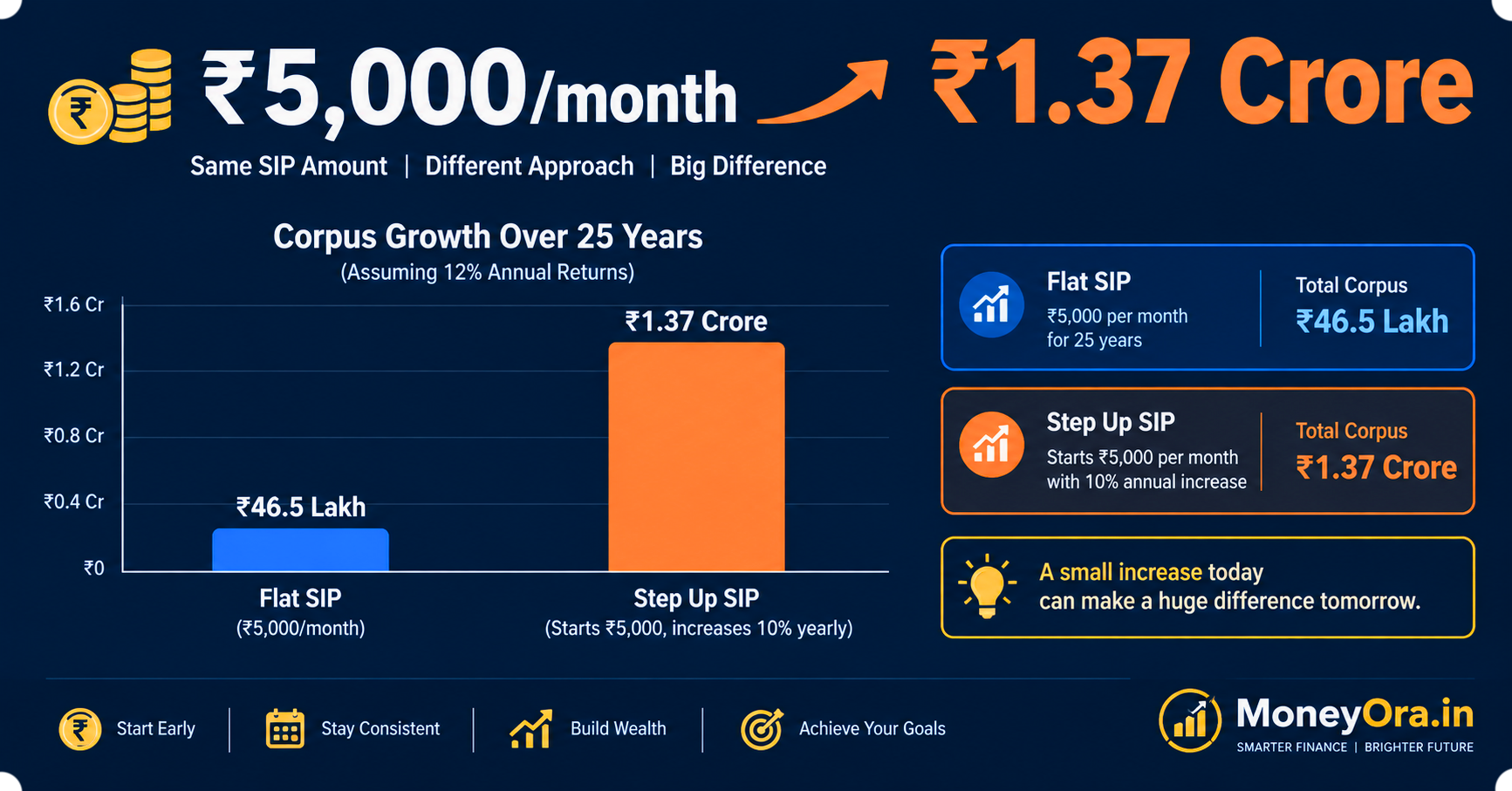
If you invest via monthly SIPs: Nothing changes. Your SIP bought units cheaper last week when markets were fearful. That is the system doing exactly what it should. Do not now add a lump sum on top of momentum just because the Sensex moved 2,300 points in a day. If you want to check how your SIP is tracking over time, MoneyOra’s SIP Calculator shows projected growth across different investment horizons.
If you are looking for fresh equity exposure: The post-ceasefire environment is constructive. But after a 2,300-point single-day move, a lot of the easy upside is already priced in. Look for stocks with both a macro tailwind and a specific fundamental reason to be higher — like Shriram Finance, not just anything that moved on May 12.
If you hold defence stocks bought during the tensions: Some profit booking is rational. The structural story is intact but riding a conflict-driven trade back down after the event passes is not a plan. Book a portion, keep the rest for the long-term.
If you are a short-term trader: India VIX likely compresses in the coming sessions. Options premium will fall. Adjust your strategy accordingly.
For anyone reinvesting gains into FDs or RDs while the market consolidates, check MoneyOra’s FD Calculator and RD Calculator to compare post-tax returns before parking money.
Pro Tips for Navigating Post-Rally Markets
1. Check your actual returns before making new decisions Your portfolio feels good after a 2,300-point Sensex day. But what is the actual annualised return from your specific holdings? Use MoneyOra’s Stock Return Calculator before you decide whether to hold, add, or trim.
2. Do not confuse a macro event with a stock-specific thesis Adani moving 7% on a relief rally and Adani being a great long-term investment are two different things. Check the P/E and fundamentals before chasing. MoneyOra’s P/E Ratio Calculator helps you do this in seconds.
3. Set stop-losses on any new position you enter after the rally Post-rally entries carry higher risk. The stock is already up. If sentiment reverses, it can give back gains faster than it built them. MoneyOra’s Stop-Loss Calculator removes the emotion from this decision.
4. Size positions based on risk, not excitement Big rally days create FOMO. FOMO creates oversized positions. Oversized positions create big losses when things reverse. Use MoneyOra’s Position Size Calculator every single time before entering a trade.
5. Watch the rupee alongside the index When FIIs buy Indian equities, they buy rupees first. A strengthening rupee alongside a rising Nifty confirms the rally has institutional backing. A rising Nifty with a weak or flat rupee suggests it is mostly domestic buying — which is thinner.
6. Keep some dry powder Not every rupee needs to be deployed on Day 1 of a rally. Markets often consolidate after large single-day moves. Having cash available to buy on a 2–3% dip after the initial pop is often a better entry than chasing the day-one surge.

Comparison Table: Defence Stocks — Short-Term Reaction vs Long-Term Story
| Stock | May 12, 2026 Move | Conflict-Week Move | Long-Term Thesis | Verdict |
|---|---|---|---|---|
| BEL | Mildly positive | +12–15% | Strong order book, indigenisation | Hold / accumulate on dips |
| HAL | Slightly weak | +18–20% | Tejas exports, ₹1.84L cr order book | Long-term hold, avoid chasing |
| BDL | Mixed | +15%+ | Missile systems, MBDA JV | Fundamentals intact |
| Paras Defence | –6% | +20%+ | Conflict-driven trade | Booked profits wisely |
| Zen Technologies | Mixed | +15%+ | Simulation/training systems | Solid niche, less liquid |
Common Mistakes to Avoid After a Big Rally Day
This section might be more useful than all the stock picks combined.
Mistake 1: Panic-buying on a FOMO high Markets moved 2,300 points. You feel like you missed it. You rush in. This is exactly how retail investors buy at the top. The rally happened. It is okay to wait for a pullback.
Mistake 2: Averaging down on stocks that fell during the tensions for the wrong reasons Some stocks fell last week because of panic selling and will recover. Others fell because their business fundamentals deteriorated. Know the difference before averaging down. A geopolitical sell-off is different from an earnings-driven decline. For averaging strategies, MoneyOra’s Stock Average Calculator helps you calculate the new average cost clearly.
Mistake 3: Treating defence stocks as a permanent theme based on a temporary event Defence sector’s structural growth is real. But if you bought HAL or Paras Defence at the top of a conflict-driven spike, you are holding a geopolitical trade, not a fundamentals-based investment. These are different risk profiles.
Mistake 4: Forgetting that markets discount events quickly By the time the ceasefire news was on every WhatsApp group, the market had already moved. The Sensex opened 1,400 points higher before most retail investors had their morning chai. Markets price in information faster than you can act on it from headlines.
Mistake 5: Ignoring your asset allocation After a big equity rally, your portfolio may now be overweight equities relative to your plan. If you had a 60/40 equity-debt allocation, it is probably 65/35 now. Rebalancing is a discipline, not a penalty. If you have EPF or PPF as your debt allocation, check MoneyOra’s EPF Calculator and PPF Calculator to understand your current fixed-income position clearly.
Bank Nifty — What to Expect Next
Bank Nifty did not lead the May 12 rally — and there is a reason for that.
Banking stocks move on interest rates, credit cycles, NPA trends, and quarterly earnings. Geopolitical relief improves general sentiment but does not directly change a bank’s loan book or net interest margin. So while all banking stocks closed green on May 12, the gains were more moderate than IT or Realty.
For Bank Nifty going forward, watch three things:
RBI’s next move: The Reserve Bank of India has been in an accommodative cycle. If rate cuts continue, bank margins and credit growth both improve. That is the medium-term driver for private banks.
FII buying specifically in banking: FIIs have historically overweight Indian private banks in their India allocations. If FII flows return strongly post-ceasefire, HDFC Bank, ICICI Bank, and Kotak Bank are likely beneficiaries.
Credit quality in Q1 FY27 results: The upcoming quarterly results (June 2026 quarter) will show whether the macro environment is translating into better credit demand and lower NPAs. That is the real Bank Nifty catalyst, not the ceasefire alone.
A Quick Note on the Bigger Picture
One thing stands out from May 12, 2026, and is worth saying directly.
India’s stock market absorbed a genuine national security event — actual cross-border military action between two nuclear states — and recovered within days. Not months. Days.
That is not normal for most emerging markets. It reflects something structural: India now has ₹25,000+ crore monthly SIP inflows providing a floor under equities, DIIs that absorb FII selling without the market collapsing, RBI macro management that has kept the rupee stable, and a corporate earnings cycle that, while patchy, is trending upward.
The “sell everything when India–Pakistan tensions rise” playbook is increasingly outdated. Selling into the panic of May 7–9, 2026 and buying back after the May 12 rally would have cost you 4–5% plus taxes and brokerage. According to SEBI’s investor education resources, staying invested through short-term volatility is one of the most important factors in long-term wealth creation.
The market is showing you — again — that the long-term India story does not break on geopolitical events. It bends. Then it comes back.
For anyone building long-term wealth through NPS, SIPs, or PPF alongside equities, tools like MoneyOra’s NPS Calculator, SIP Calculator, and Lumpsum Calculator can show you the compounding power of staying the course rather than reacting to every headline.
Conclusion
May 12, 2026 was one of those market days you will remember — 2,300+ points on the Sensex, Nifty crossing 24,737, every sector green, ₹12+ lakh crore added to BSE market cap in a single session.
The Sensex rally ceasefire story tells you something important: Indian markets have matured. Geopolitical events cause short, sharp dislocations now. The underlying economy does not change. The structural India growth story does not change. Investors who understand this — and stay calm while others panic — keep building wealth while the news cycle moves from fear to relief and back again.
The five stocks worth watching — Adani Enterprises, Infosys, BEL, Shriram Finance, and Trent — each have specific reasons to be on your radar beyond just the headline move. Not all of them are buys at current prices. That is why the work of checking valuations, setting stop-losses, and sizing positions correctly matters just as much as picking the right names.
Use MoneyOra’s calculators to make those decisions with numbers, not feelings:
- Stock Return Calculator — know your actual returns
- Stop-Loss Calculator — protect what you have
- Position Size Calculator — size every trade correctly
- P/E Ratio Calculator — check valuations before entering
The market will have more volatile weeks. More geopolitical headlines. More 1,000-point up days and 800-point down days. The investors who come out ahead are not the ones with the best news sources. They are the ones who have a clear process — and stick to it.
Disclaimer: This article is for educational and informational purposes only. It does not constitute investment advice. Please consult a SEBI-registered financial advisor before making investment decisions. Equity investments are subject to market risk.



Pingback: Defence Index 2026: Top Investment Opportunity or Overvalued Risk for Investors?