
Age Calculator
Calculate exact age in years, months, days & more. Find your next birthday, zodiac sign, life stats, and compare two dates — completely free.
| Unit | Value | Note |
|---|
| Milestone | Date | In | Day of Week |
|---|
| Anniversary | Date | Days Away | Day |
|---|
Age Calculator: 7 Best Free Tools to Know Your Exact Age Instantly
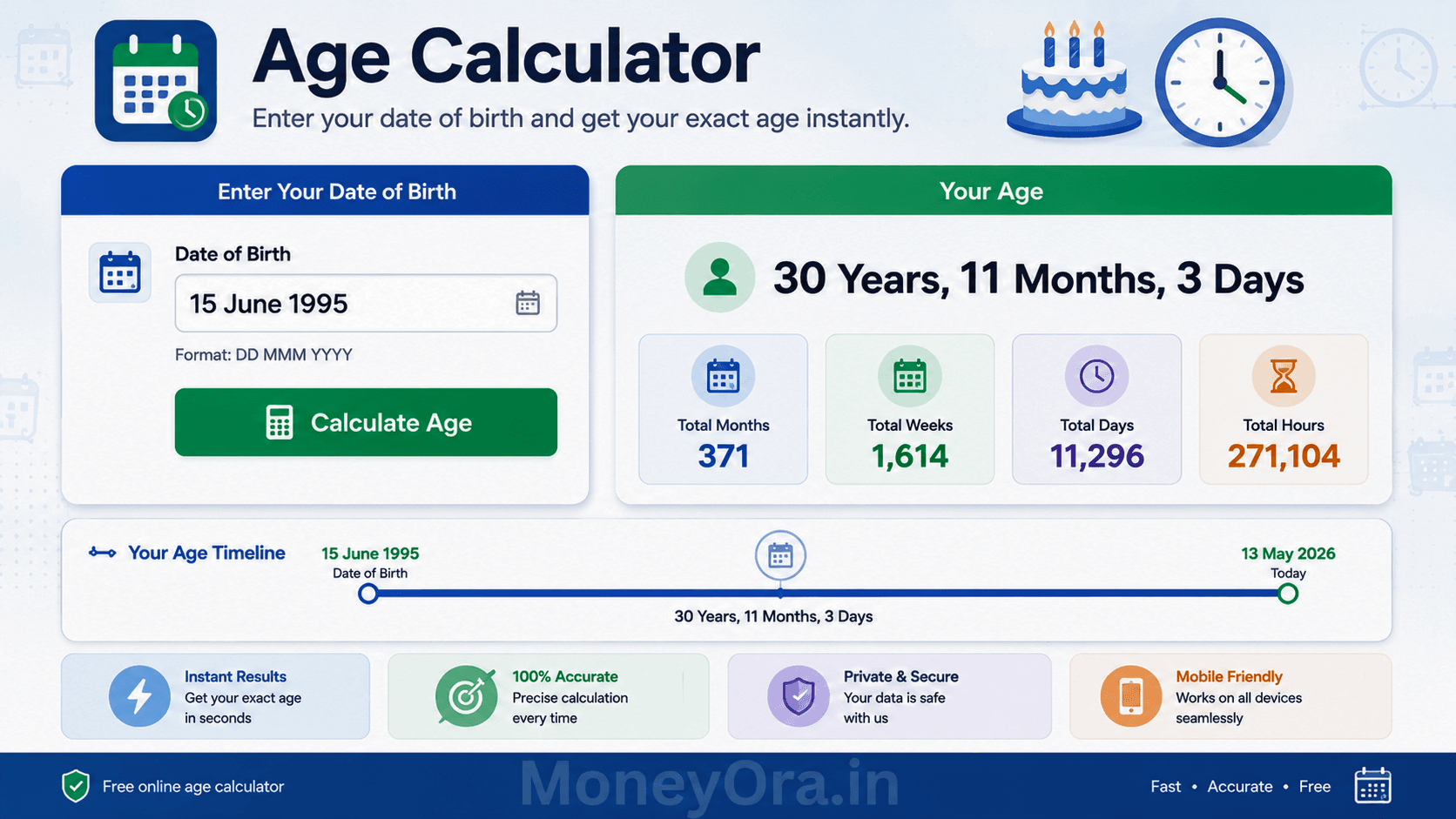
How old are you — exactly? Not just the year, but the months, weeks, and days too. Most people guess. The ones who need to know for a passport renewal, an insurance form, a school admission, or a pension calculation reach for an age calculator.
An online age calculator takes your date of birth, compares it to today’s date, and returns your precise chronological age in seconds. No manual counting, no wrestling with leap years, no arithmetic mistakes on a form that cannot be corrected after submission.
In this guide you will learn how an age calculator works, the formula behind it, how it handles leap years and different calendar systems, and seven smart ways to actually use one — beyond just answering “how old am I.” Whether you need your age in days, want to calculate an age difference between two people, or need the exact age for a government document, this covers everything.
- An age calculator uses the Gregorian calendar and accounts for leap years automatically
- Your exact age can be expressed in years, months, weeks, days, hours, and even minutes
- Age calculation is critical for insurance premiums, pension eligibility, school admissions, and legal documents
- The age difference calculator function works by using one person’s birth date as the reference date for the other
- Korea officially switched from its traditional age system to the international Gregorian method in June 2023
What Is an Age Calculator?
An age calculator is a free digital tool that computes your exact age by subtracting your date of birth from a given reference date — usually today. The result is expressed not just in years but in the full breakdown: years, months, weeks, days, hours, and sometimes minutes elapsed since you were born.
The need for this tool is more widespread than most people realize. Think of how many times per year you fill out a form that asks for your age in completed years. Insurance applications, school enrollment, senior citizen scheme eligibility, passport applications, tax filings, and medical intake forms all use your precise age at a specific date. Getting it wrong — even by one day if you are on an eligibility boundary — can invalidate a document or disqualify an application.
Why Not Just Subtract the Birth Year from the Current Year?
Because that gives you an approximate age, not your exact age. If today is March 2025 and your birthday is in November, subtracting birth year from 2025 gives you a figure that is actually one year too high — you have not yet turned that age this calendar year. A proper date of birth age calculator checks whether your birthday has passed in the current year before arriving at the final number.
Who Uses an Age Calculator?
Individuals and Families
- Checking exact age for government ID applications (Aadhaar, PAN, Passport)
- Calculating a child’s age for school or vaccination records
- Finding out how many days old a newborn is
- Settling friendly debates about who is older and by exactly how much
Finance and Insurance Professionals
- Calculating premium rates, which change on the birthday in most insurance policies
- Checking eligibility for age-linked tax benefits (senior citizen FD rates, Section 80TTB)
- Determining NPS or EPF withdrawal eligibility based on exact completed age
Legal and Government Use
- Age verification for voting registration, driving licence, and alcohol purchase eligibility
- Court filings requiring the age of parties on a specific hearing date
- HR departments verifying employee age for retirement processing
Medical and Clinical Use
- Pediatric dosage calculations that depend on exact age in months (not just years)
- Vaccine schedule tracking that counts weeks since birth for infants
- Clinical trials and research studies requiring precise participant age at enrollment
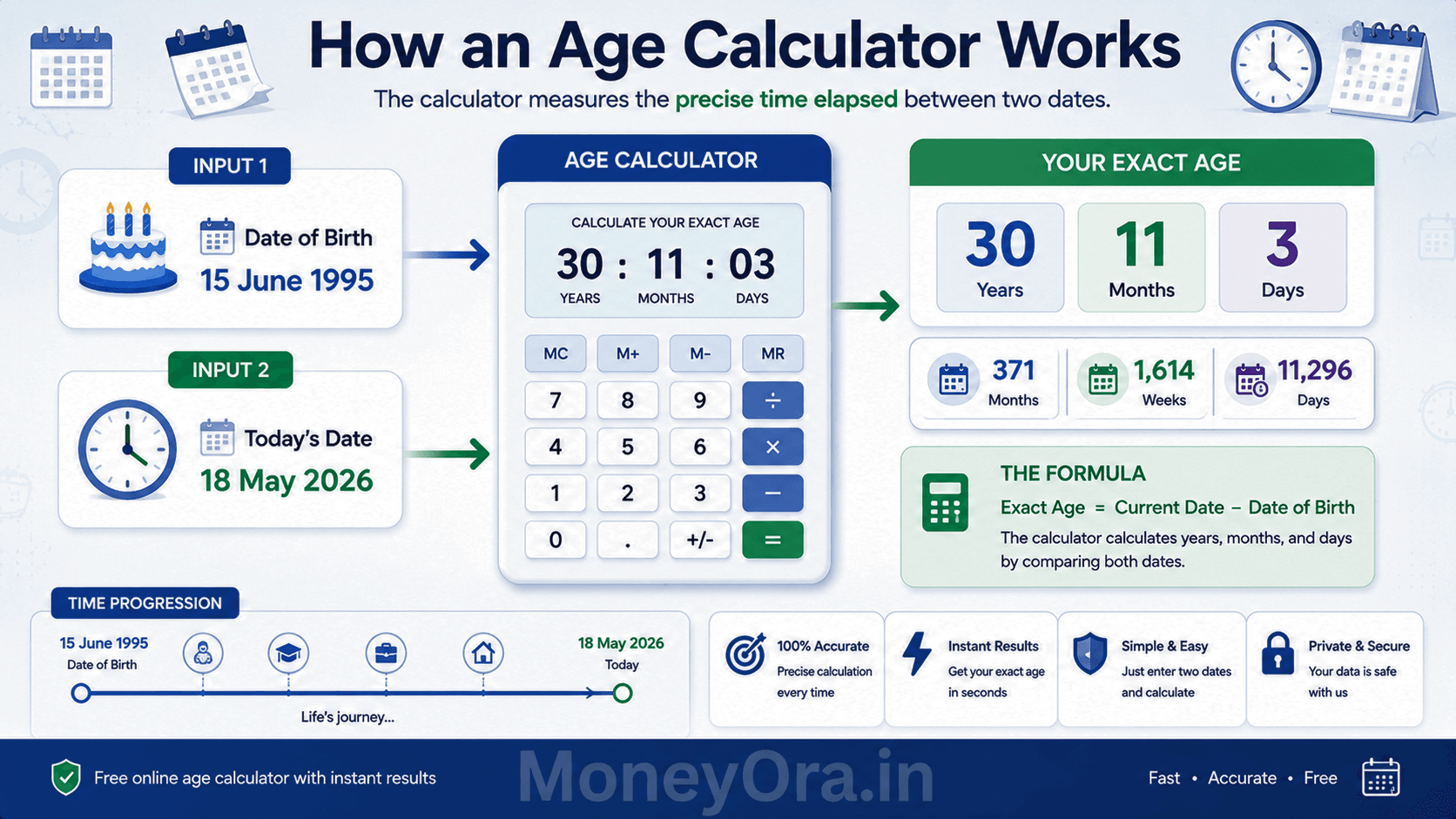
How an Age Calculator Works: The Formula Behind the Tool
The calculation looks simple on the surface — just find the difference between two dates. But dates are awkward. Months have 28, 29, 30, or 31 days. Leap years add an extra day every four years (with exceptions for century years). Any reliable exact age calculator handles all of this cleanly.
The Basic Age Calculation Formula
The standard approach is:
Age = Reference Date − Date of Birth
Expressed as: Years (Y) + Remaining Months (M) + Remaining Days (D)
Step-by-Step Breakdown
Say your date of birth is 15 August 1990 and today is 10 June 2025:
- Years: From 1990 to 2025 = 35 years. But today (June 10) is before August 15, so the birthday has not yet occurred in 2025. Completed years = 34.
- Months: Count from August 15 (last birthday) to June 10. That is 9 months and some days (Aug→Sep→Oct→Nov→Dec→Jan→Feb→Mar→Apr→May = 9 months, then 10 days into June).
- Days: 25 days remaining in August (31−15) + full months counted above + 10 days in June. The tool counts these precisely, accounting for each month’s actual day count.
- Result: 34 years, 9 months, 26 days (approximately — the exact count depends on the specific calendar months traversed).
Why Leap Years Complicate Things
A leap year (e.g., 2024) has 366 days instead of 365. When your age calculation spans one or more leap years, the total day count changes. A robust age in days calculator tracks the actual calendar rather than multiplying years by 365, which is why it produces a different (and more accurate) day count than a simple mental calculation.
The Gregorian Calendar Rule for Leap Years
- A year divisible by 4 is a leap year — except
- Years divisible by 100 are not leap years — unless
- They are also divisible by 400 (so 2000 was a leap year; 1900 was not)
According to the Gregorian calendar system on Wikipedia, this rule keeps the calendar aligned with Earth’s solar orbit to within 26 seconds per year. Every age calculator worth using applies this logic automatically.
Age Calculation in Programming: How Tools Are Built
JavaScript Date Difference Logic
Modern online age calculators use JavaScript’s Date object to get the precise millisecond difference between two dates, then convert that figure into years, months, and days. The conversion handles month-length irregularities by walking backwards through the calendar month by month rather than dividing by a fixed number of days per month.
Why This Matters for Accuracy
A naive calculation that treats every month as 30.44 days (365.25 ÷ 12) introduces errors. Over a lifetime, these compound. A well-coded age calculator avoids this by using actual calendar traversal, which is why two reputable tools given the same birth date will always produce the same day count.
How to Use the Age Calculator (Step by Step)
Using an online age calculator takes under a minute. Here is exactly what to do on MoneyOra:
Step 1 — Enter Your Date of Birth
Select or type your birth date: day, month, and year. Double-check the year — especially if you are filling this in for someone else. A one-digit error in the birth year produces a wildly wrong result.
Step 2 — Set the Reference Date
By default the tool uses today’s date. If you need to calculate how old someone was (or will be) on a specific date — a wedding date, a policy start date, a court date — change the reference date field to that date.
Step 3 — Click Calculate
The result appears instantly. A full-featured birthday age calculator shows:
- Age in completed years (e.g., 34 years)
- Age in years and months (e.g., 34 years, 9 months)
- Age in years, months, and days (e.g., 34 years, 9 months, 26 days)
- Total age in months (e.g., 417 months)
- Total age in weeks (e.g., 1,813 weeks)
- Total age in days (e.g., 12,692 days)
- Next birthday countdown (days until your next birthday)
Step 4 — Use the Result
Copy the relevant figure for your form. For insurance or pension documents, you typically need “age in completed years.” For infant medical records, “age in weeks” or “age in months” is often required. Use the output format that matches your specific need.
Pro Tip: Check Age at a Future Date
If your insurance policy starts in three months, calculate your age on that future start date — not today. Premiums and eligibility brackets often change on the birthday, so the age at policy inception date (not today) is what the insurer uses.
7 Best Ways to Use an Age Calculator
Most people use an age calculator by date of birth once and close the tab. But the tool has practical uses that go much further than satisfying curiosity.
1. Verify Age for Government Documents and Schemes
India’s senior citizen classification for income tax purposes (Section 80TTB, higher FD interest rates, senior citizen health insurance) kicks in at exactly 60 years of age on the last day of the financial year. If your 60th birthday falls on or before March 31, you qualify for that financial year. If it falls on April 1 or later, you do not. An age calculator tells you exactly which side of that line you fall on.
2. Calculate Your Child’s Age for School Admission
Most schools and state boards require a child to be a minimum age — often 5 years and 6 months, or exactly 6 years — as of a specific cut-off date (usually June 1 or July 31). Parents often miscalculate by a few days and miss the window or wrongly believe they qualify. The exact age calculator removes all ambiguity.
3. Check Insurance Premium Age Band
Health and life insurance premiums are calculated based on your age at the time of application. Most insurers use age bands (e.g., 25–30, 31–35). If you are 29 years and 11 months old, applying today places you in the lower band. Waiting another month could push you into the next higher band, raising your premium for the entire policy tenure. Knowing your exact age in months helps you time the application correctly.
4. Find How Many Days Old You Are
This is a surprisingly popular use of an age in days calculator. Some people celebrate milestone days (10,000 days old, for example). Others use the day count for fitness tracking, sobriety tracking, or celebrating years since a major life event. A 30-year-old has lived approximately 10,957 days — more than most people expect.
5. Calculate Age Difference Between Two People
Partners, siblings, co-workers comparing ages — use the age difference function (more detail in the dedicated section below). Enter one person’s birth date as the reference date and the other’s as the date of birth. The result is the exact age gap to the day.
6. Plan NPS, EPF, or Retirement Milestones
The National Pension System allows exit at 60 years of age (with options at 75). EPF allows full withdrawal after 58 years (or two months before retirement). These are not round-number approximations — they are calculated to the day based on your date of birth. Using an age calculator alongside our NPS calculator and EPF calculator gives you a complete picture of when and how much you can access.
7. Medical and Paediatric Age Tracking
Doctors — especially paediatricians — calculate age in weeks and months for infants and toddlers. A baby who is 18 months old is developmentally very different from one who is 24 months, and dosage charts for many medications reference age in months rather than years. The current age calculator with its month and week output is a practical tool for parents managing vaccination schedules and growth charts.
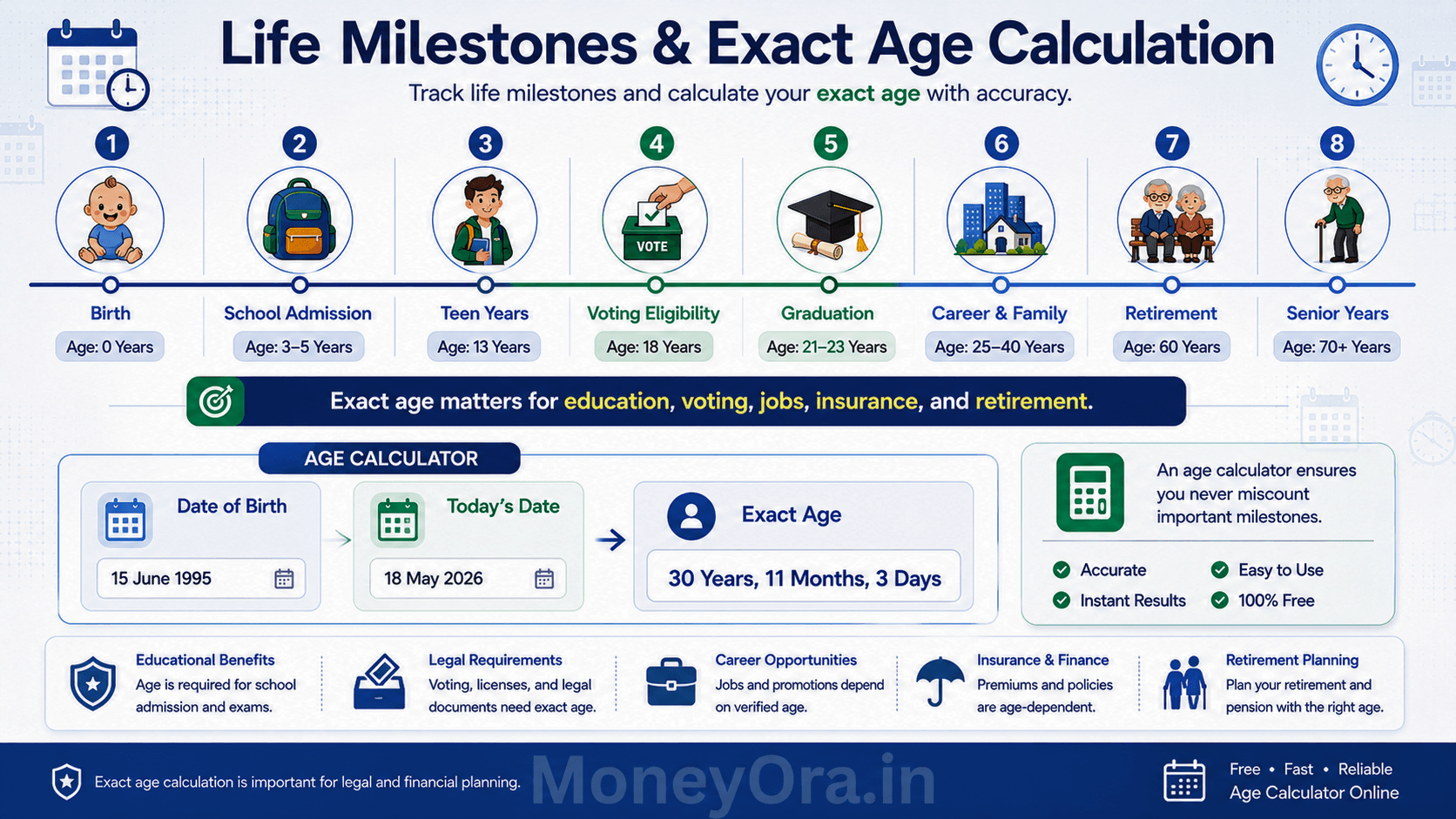
Your Age in Different Units: Years, Months, Days, Hours
When someone asks “how old are you,” the instinctive answer is in years. But age has richer expressions — and each one is useful in a different context.
Age in Completed Years (Chronological Age)
The standard for most documents. You are 34 years old on the day you complete 34 full years since birth. You do not become 35 until the exact anniversary of your birth date. This is what legal and government documents universally refer to as your age.
Age in Years and Months
Used for children’s developmental assessments, insurance underwriting, and some government schemes. A 4-year-9-month-old child and a 5-year-2-month-old are both “approximately 5” but are treated differently by pediatric charts, admission cut-offs, and vaccine schedules.
Age in Total Months
Useful for clinical calculations and paediatric growth tracking. A baby who is 14 months old has very different developmental expectations from one who is 20 months. WHO growth charts for height, weight, and head circumference all reference age in months up to 24 months, and in months and years from 2 to 5.
Age in Total Weeks
Critical for neonatal and infant care. A 36-week premature baby has different health protocols than a 40-week full-term one. Paediatric vaccination schedules in India (under the Universal Immunisation Programme) reference age in weeks for the first few doses — BCG and Hepatitis B at birth, OPV and Pentavalent at 6 weeks, 10 weeks, and 14 weeks.
Age in Total Days
The most granular common output of an age in days calculator. Interesting milestones:
| Age (Years) | Approximate Days Lived | Interesting Context |
|---|---|---|
| 1 | 365–366 | Includes leap year check |
| 10 | 3,652–3,653 | Two or three leap years in the span |
| 18 | 6,570–6,574 | Legal adulthood in India and most countries |
| 25 | 9,131–9,136 | Quarter-life milestone |
| 30 | 10,957–10,962 | ~10,000 days lived around age 27.4 |
| 40 | 14,610–14,616 | 10 leap years in a 40-year span |
| 60 | 21,915–21,925 | Senior citizen eligibility in India |
| 75 | 27,393–27,407 | Super senior citizen tax bracket (India) |
Age in Hours and Minutes
More of a novelty figure, but some age calculators offer it. A 30-year-old has lived approximately 262,980 hours. Knowing this is unlikely to change your tax filing, but it does put a vivid frame around how finite and countable time actually is.
Which Unit Should You Use?
| Purpose | Best Unit to Use |
|---|---|
| Government documents, legal filings | Completed years |
| Insurance applications | Completed years (age at last birthday) |
| School admissions | Years and months as of cut-off date |
| Paediatric check-ups (under 2 years) | Total months |
| Newborn and infant care | Total weeks |
| Milestone celebrations, sobriety tracking | Total days |
| Pregnancy tracking | Weeks of gestation |
How Age Calculators Handle Leap Years and February 29 Birthdays
Leap years are the most common source of confusion in manual age calculations. Here is how a well-built precise age calculator deals with them.
The Standard Leap Year ApproachFor
most people born outside of February 29, a leap year simply means one extra day gets counted in the total days-lived figure. No confusion about which birthday year it is.
February 29 Birthdays: The Edge Case
People born on February 29 (leaplings) only have their exact birth date available every four years. For non-leap years, age calculators use one of two conventions:
Convention 1 — March 1 (most common globally)
The birthday is treated as March 1 in non-leap years. So a person born on Feb 29, 2000 turns 25 on March 1, 2025 in this convention.
Convention 2 — February 28
Some calculators and some countries (notably parts of Europe) treat February 28 as the birthday in non-leap years. This is less common but entirely valid.
Legal Impact in India
India’s legal system does not have a specific statutory provision for leap day birthdays. In practice, the convention used in government ID systems (Aadhaar, PAN) defaults to February 28. If your documents say February 28 as the birth date (because you were born on Feb 29 and the system adjusted), use February 28 as input in any age calculator for accurate results matching your official records.
How Many Leap Years Fall in a Lifetime?
| Age (Years) | Leap Years Included (Approx.) | Extra Days Added |
|---|---|---|
| 20 | 5 | 5 extra days |
| 40 | 10 | 10 extra days |
| 60 | 15 | 14–15 extra days |
| 80 | 19–20 | 19–20 extra days (2100 is NOT a leap year) |
Note that 2100 will not be a leap year (divisible by 100 but not 400), so people living past age 75 in the 2020s will see one fewer leap year than a naive estimate would predict.
Age Systems Around the World: India, Korea, China, and the West
Not everyone in the world calculates age the same way. Understanding the differences matters if you are dealing with cross-border documents, international insurance policies, or simply understanding age references in global content.
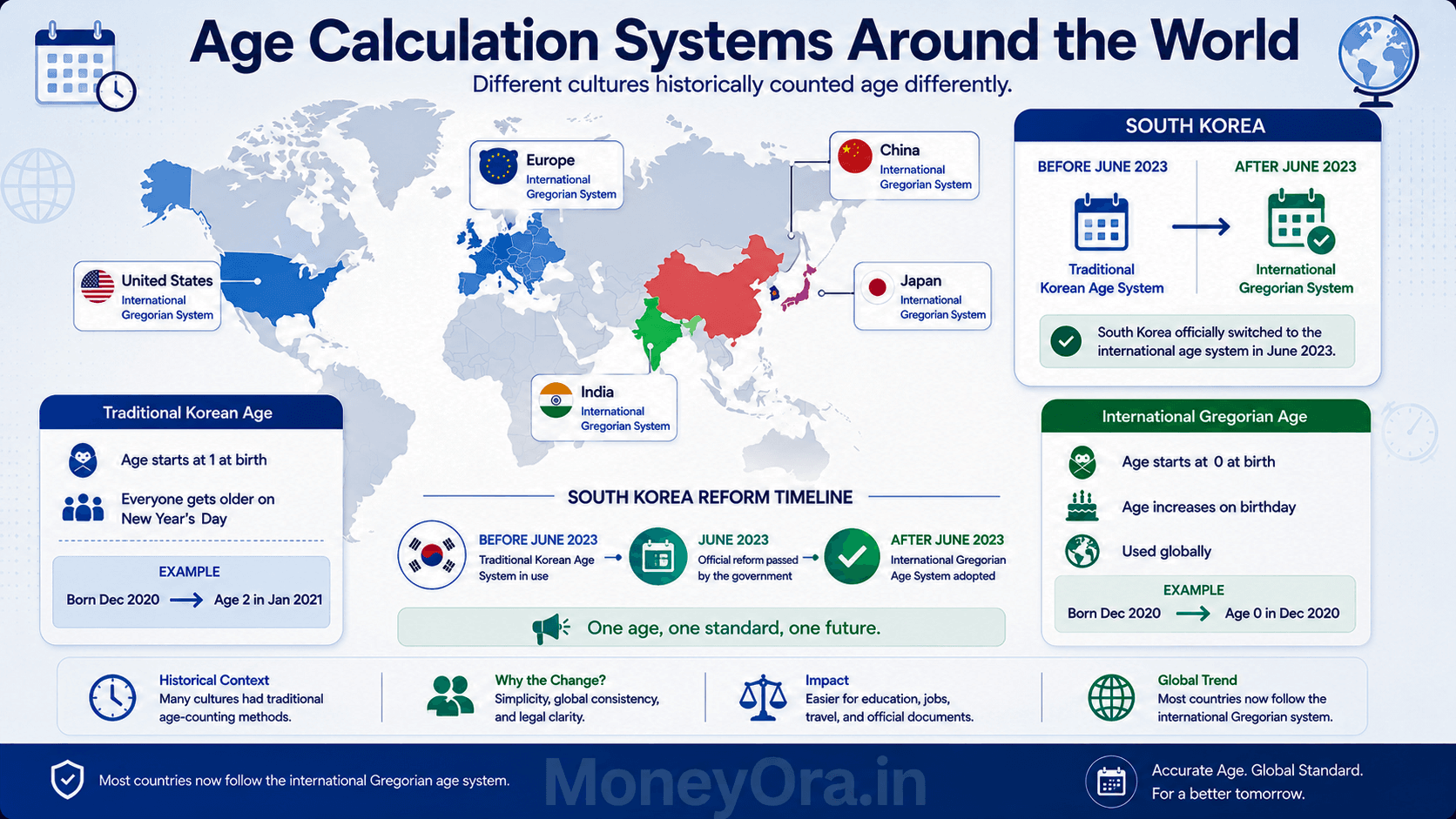
International System (Gregorian) — Used in India, US, UK, EU
You are 0 years old at birth. You turn 1 on your first birthday. Age increases by 1 exactly on your birthday each year. This is the method used by virtually all digital age calculators, including ours. It is also what all Indian government documents, tax forms, and legal agreements use.
Traditional Korean Age System
In the Korean system, everyone is considered 1 year old the moment they are born (counting the time in the womb). Everyone then gains one additional year on January 1st, not on their personal birthday. So a baby born on December 31 would be considered 2 years old the very next day.
South Korea’s 2023 Age System Change
South Korea officially abolished its traditional age system and shifted to the international Gregorian standard in June 2023. This affected identity documents, legal contracts, and administrative records for roughly 51 million people. It remains one of the largest calendar-system transitions a country has undertaken in recent history.
East Asian Traditional Age System (China, Japan — Historically)
China historically used a system where a person was considered 1 at birth and added a year at the lunar new year. Japan abandoned this system in 1902 in favor of the Western method. China transitioned officially to the international system decades ago, though the traditional concept persists in some cultural contexts (horoscopes, traditional medicine).
Gestational Age
In medical contexts, particularly for newborns and premature infants, “gestational age” counts from the first day of the mother’s last menstrual period — typically 2 weeks before conception. A “40-week” full-term baby is 40 gestational weeks. After birth, doctors sometimes use “corrected age” or “adjusted age” for premature infants, subtracting the weeks they were early from their chronological age. Online age calculators compute chronological (Gregorian) age by default — not gestational or corrected age.
Which System Does Our Age Calculator Use?
MoneyOra’s age calculator uses the international Gregorian system. You enter your birth date, we compare it to the reference date, and the result is your chronological age in completed years, months, and days. This matches what all Indian legal documents, financial institutions, and government schemes use.
Chronological Age vs Biological Age vs Mental Age
An age calculator gives you your chronological age — the time that has objectively passed since your birth. But age science recognizes at least three distinct concepts of age, and they do not always match.
Chronological Age
The number a calendar produces. Fixed, objective, and the same regardless of your health or lifestyle. This is what appears on your passport, what your bank uses, and what our DOB calculator computes. It is the legal and administrative standard worldwide.
Biological Age
How old your body actually functions compared to the average for your chronological age. Someone who exercises regularly, sleeps well, and eats a balanced diet may have a biological age 5–10 years younger than their chronological age. Conversely, chronic disease, obesity, or smoking can make biological age significantly higher than chronological age.
How Biological Age Is Measured
- Telomere length — the protective caps on chromosomes that shorten with age
- Epigenetic clocks (e.g., Horvath clock) — DNA methylation patterns that correlate with functional age
- Grip strength and VO₂ max — physical fitness markers that predict mortality risk better than chronological age in several studies
- Blood biomarkers — cholesterol, blood sugar, inflammation markers, kidney function
Biological age testing is a growing industry, with companies like Elysium Health and InsideTracker offering consumer DNA methylation tests. These are different from and far more complex than a simple age calculator by date of birth.
Mental Age
A concept from early 20th-century psychology — originally used in IQ testing to describe the level of cognitive tasks a person could handle compared to the average for their age group. The term fell out of clinical favour due to misuse, but colloquially people still use it to describe emotional maturity or cognitive function relative to age norms.
Social Age
How old someone presents or is perceived to be in a social context — influenced by appearance, communication style, lifestyle, and cultural expectations. Entirely subjective and not calculated by any tool.
Which Age Matters for Finance?
For every financial purpose — insurance, tax, pension, loan eligibility — only chronological age matters. Use our age calculator to get it right. Biological or social age, however interesting, has no legal or financial standing in India or most jurisdictions.
Age Difference Calculator: Find the Exact Gap Between Two People
The age difference calculator is one of the most searched-for features in any date-based tool. It answers: how much older (or younger) is person A than person B, in exact years, months, and days?
How to Calculate Age Difference
The method is simple:
- Enter Person A’s date of birth as the main birth date input
- Enter Person B’s date of birth as the reference date (instead of today’s date)
- Click Calculate — the result is the exact age difference
Age Difference in Relationships
People frequently look up the age difference between couples, siblings, or public figures out of curiosity. Beyond curiosity, age difference has a practical angle too — in joint insurance policies or joint home loans, the age of the older applicant typically governs the maximum tenure available. A 5-year age difference between co-borrowers on a 25-year home loan affects which of them hits the bank’s retirement-age cutoff first.
For joint home loan planning, our home loan EMI calculator and EMI calculator let you model the repayment schedule based on the older borrower’s age.
Age Difference Tables: Common Gaps in Context
| Age Gap | Common Context | Financial Implication |
|---|---|---|
| 0–2 years | Irish twins, close siblings | Minimal difference in eligibility dates |
| 3–5 years | Common sibling gap, partner gap | Joint insurance policies: small premium variation |
| 6–10 years | Larger sibling gap, many couples | Noticeable difference in home loan tenure eligibility |
| 11–15 years | Some couples, mentor–mentee | Significant: older person may retire while loan is active |
| 16–20 years | Some couples, parent–adult child | Banks may restrict joint loan tenure to older person’s retirement age |
| 20+ years | Parent–child gap | Joint financial products need careful tenure structuring |
Age Calculator and Financial Planning: Why Exact Age Matters More Than You Think
Finance in India is deeply age-linked. Dozens of products, schemes, and eligibility rules hinge not just on your birth year but on your exact age at a specific date. Here is where an online age calculator becomes a genuine financial tool, not just a novelty.
Income Tax: Senior and Super Senior Citizen Benefits
Senior Citizen (60 Years and Above)
- Higher basic exemption limit: ₹3,00,000 per year (vs ₹2,50,000 for general)
- Section 80TTB deduction up to ₹50,000 on interest income
- Higher FD interest rates at most banks (typically 25–75 bps above standard rates)
Super Senior Citizen (75 Years and Above)
- Basic exemption limit: ₹5,00,000
- Exempted from filing ITR if pension income and interest income come from the same bank (Budget 2021 provision)
The qualifying age is assessed as of March 31 of the relevant financial year. A person who turns 60 on March 31, 2025 qualifies for FY 2024–25 senior citizen benefits. One who turns 60 on April 1, 2025 does not. An age calculator eliminates any uncertainty about which side you fall on.
NPS (National Pension System) Age Rules
Under India’s NPS, the standard exit age is 60 years. You can defer withdrawal until 75. Partial withdrawals are available after 3 years of enrollment and under specific conditions (children’s education, illness, home purchase). All of these are calculated from your exact date of birth as registered with the NPS trust. Use our NPS calculator to model your corpus at exact exit ages.
EPF Withdrawal and Pension
EPF full withdrawal is permitted on retirement at 58 years of age or after two months of unemployment. The Employees’ Pension Scheme (EPS) pension starts at 58. Both are calculated from the exact date of birth in your UAN records. Knowing your exact age keeps you ahead of these milestones. Pair this with our EPF calculator to estimate your corpus at each age.
Life Insurance and Health Insurance
Life insurance premiums increase sharply at certain age bands — typically at 35, 40, 45, and 50. If you are 34 years and 10 months old, buying a term plan today saves you the higher premium associated with the 35–39 bracket for the entire policy tenure, which could be 20–30 years. The saving from buying two months early can be substantial. Use an age calculator to check your current age in months before applying.
SIP and Long-Term Investments: Time-Left Calculation
Knowing your exact age helps you calculate how many years remain until your target retirement date. If you are 32 years and 4 months old and want to retire at 60, you have 27 years and 8 months of investment runway — not simply “about 28 years.” That precision matters when you feed inputs into our SIP calculator, FD calculator, or PPF calculator. Even a few months’ difference in tenure changes the compounded outcome meaningfully.
Home Loan Maximum Tenure
Banks typically lend home loans with a maximum repayment age of 65–70 years for salaried borrowers. If you are currently 42 years old, the maximum loan tenure available to you is approximately 23–28 years, not the standard 30 years offered to younger borrowers. This affects your EMI. Model it in our home loan EMI calculator using your actual current age as the starting point.
Stock Market and Trading Age Requirements
To open a demat account and trade on NSE or BSE, you must be at least 18 years old. Minors can have accounts under a guardian, but can operate independently only on turning 18. If you are approaching 18, knowing your exact date of eligibility helps you plan account opening and start investing as early as legally possible. Once you are investing, tools like our stock return calculator, brokerage calculator, and CAGR calculator help you track wealth growth over the years ahead.
An age calculator gives you the when. The calculators below tell you the how much at every age milestone.
Loan Calculators
- EMI Calculator — Calculate monthly repayments for any loan; tenure limited by your current age
- Home Loan EMI Calculator — Model home loan repayment; max tenure tied to your exact age
- Car Loan EMI Calculator — Plan vehicle finance by current age
- Personal Loan EMI Calculator — Quick unsecured loan EMI check
Savings and Investment Calculators
- SIP Calculator — Start a SIP today and project corpus to your target retirement age
- Lumpsum Calculator — Grow a one-time investment from your current age to goal age
- FD Calculator — Compare FD rates across age brackets (senior citizen vs general)
- RD Calculator — Recurring deposit growth over the years ahead
- PPF Calculator — 15-year PPF lock-in planned from your exact current age
- NPS Calculator — Retirement corpus projection to exact NPS exit age
- EPF Calculator — Provident fund balance at age 58 retirement milestone
- SWP Calculator — Plan systematic withdrawals post-retirement
- CAGR Calculator — Measure returns over the years since you started investing
Stock Market Tools
- Stock Return Calculator — Track equity returns since your investment date
- Stock Average Calculator — Average your cost basis over time
- Dividend Calculator — Passive income from dividends at any stage of life
- Brokerage Calculator — Calculate trading costs for your equity portfolio
- Margin Calculator — Understand leverage in equity and F&O trading
- PE Ratio Calculator — Value stocks at any stage of your investing journey
- Option Price Calculator — Price options contracts accurately
- Position Size Calculator — Manage trade risk at any portfolio size
- Stop Loss Calculator — Define downside limits per trade
Banking Tools
- IFSC Code Finder — Look up any bank branch code instantly
- Bank Details Finder — Verify branch details before a transfer
Conclusion: Your Exact Age Is More Valuable Than You Think
An age calculator is one of those tools that seems trivial until you actually need it. And the truth is, you need it more often than you realize — for tax eligibility, insurance timing, school admissions, NPS exit planning, and half a dozen other situations where being off by even a month matters.
The math behind it is simple in principle but awkward to do by hand — leap years, varying month lengths, and year-end edge cases all introduce errors into manual calculation. An online age calculator removes all of that in a second. Enter your date of birth, set the reference date, and you have your exact age in every unit you could need.
More importantly, your exact age connects directly to your financial life. The difference between 59 years 11 months and 60 years 0 months can mean the difference between general and senior citizen income tax treatment, between standard and preferential FD rates, or between qualifying and not qualifying for a government scheme. That is real money. Use the tool.
Ready to Find Your Exact Age?
Use MoneyOra’s free Age Calculator right now — enter your date of birth and get your exact age in years, months, weeks, and days instantly. No signup required.
Then use our NPS Calculator and SIP Calculator to plan your financial goals from your exact age today to your target retirement date.
Frequently Asked Questions About Age Calculator
An age calculator is a free online tool.
It calculates exact age instantly.
It shows years, months, weeks, and days.
It compares date of birth with today's date.
It handles leap years automatically.
It also adjusts for different month lengths.
Useful for forms, insurance, and official records.
Subtract birth year from current year.
Check whether your birthday already passed this year.
If not, subtract one more year.
Months and days must also be counted separately.
Different month lengths make manual calculation difficult.
Leap years add extra complexity.
An online age calculator handles this instantly.
Yes, advanced calculators show total days lived.
They include leap years for accuracy.
A 30-year-old has lived around 10,957–10,962 days.
The exact figure depends on leap years.
Chronological age means time since birth.
It is used in passports and Aadhaar.
Biological age reflects body condition.
It depends on fitness and health markers.
Age calculators show chronological age only.
The calculator follows Gregorian calendar rules.
Leap years include February 29.
Years divisible by 4 are leap years.
Century years must also be divisible by 400.
For Feb 29 birthdays, calculators often use March 1 in non-leap years.
This keeps total age accurate.
Yes, it can calculate age difference.
Enter one birth date as reference date.
The tool shows years, months, and days difference.
Useful for insurance and loan applications.
India follows the Gregorian age system.
You become older on your birthday.
Some countries previously used different systems.
South Korea adopted international standard in 2023.
This calculator uses Gregorian method globally.
Insurance premiums depend on age bands.
Crossing into a higher age band increases cost.
Even a few months can matter.
Exact age helps time insurance applications better.
This can reduce long-term premium expenses.