
How Much Term Insurance Do You Actually Need? The HLV Method Explained
Most people in India buy ₹1 crore of term insurance because an agent said so Or because that is the round number in the ad. That is not a plan That is a guess.
The average sum assured per life insurance policy in India sits at roughly ₹4 to 5 lakh according to IRDAI data. Meanwhile a 35 year old earning ₹12 lakh annually needs cover closer to ₹1.8 to 2.5 crore by a proper calculation The gap is enormous And it leaves millions of Indian households financially exposed without anyone in the family knowing it. For EPF vs PPF vs NPS comparison
Figuring out how much term insurance do I need is not complicated. There is a method for it Financial planners worldwide use the Human Life Value (HLV) method to calculate it Once you understand the logic you can do it in fifteen minutes.
This guide walks through the HLV method in full with real numbers for Indian salaries It covers the DIME method as a cross check It answers how much term insurance do I need for every major income bracket from ₹6 lakh to ₹30 lakh And it tells you exactly when ₹1 crore is enough and when it is dangerously insufficient. Read New vs Old tax regime FY 2026-27
- The HLV method calculates term insurance as the present value of your future income minus personal expenses over your remaining working years
- A ₹12 lakh annual income earner aged 35 needs ₹1.8 to 2.5 crore of cover using HLV
- ₹1 crore is insufficient for most salaried Indians earning above ₹8 lakh annually
- From 22 September 2025 individual term insurance premiums in India attract 0% GST saving policyholders up to 18% on annual premium
- HDFC Life and PNB MetLife reported claim settlement ratios of 99.72% and 99.81% respectively for FY 2025-26
What Is the HLV Method and Why Does It Matter for Answering How Much Term Insurance Do I Need
The Human Life Value method is the most accurate way to answer how much term insurance do I need. Economists developed it. Financial planners use it worldwide.
The core idea is simple. If you were not there your family would lose your net income contribution specifically. Not your full salary, because your own spending disappears too. So the calculation runs on what you contribute to others, not what you earn in total.
HLV formula at its most basic:
HLV Coverage = (Annual Income minus Annual Personal Expenses) multiplied by remaining working years adjusted for inflation and discounted to present value
In practice most Indian financial planners use a simplified version. That version still gives a far better answer than any rule of thumb.
Why the 10x rule fails when you ask how much term insurance do I need:
The “10 times annual income” rule is the most quoted shorthand for how much term insurance do I need in India. An agent tells someone earning ₹15 lakh to buy ₹1.5 crore. The problem is this rule completely ignores outstanding loans your existing savings and your family’s actual living expenses. A couple with a ₹50 lakh home loan and two school age children needs far more than 10x income.
For most salaried Indians earning above ₹8 lakh annually ₹1 crore is likely insufficient. A ₹10 lakh per annum earner using the HLV method at age 32 needs approximately ₹2.5 crore. After factoring in a ₹50 lakh home loan and two dependents the Liability and Goals method pushes this figure to ₹3 to 3.5 crore.
So when you ask how much term insurance do I need the answer is almost certainly higher than what you currently have.
The HLV Method Step by Step for Indian Salaries
This guide shows how to calculate the amount of term insurance you need by using the HLV method. I will use an Indian example so you can apply your own numbers easily.
Example profile
Name: Amit
Age: 34
income: ₹15 lakh
Planned retirement age: 60
Years left to work: 26
Annual personal expenses (commute, food, personal spending): ₹4 lakh
Discount rate: 7%
Step 1. Find your annual contribution
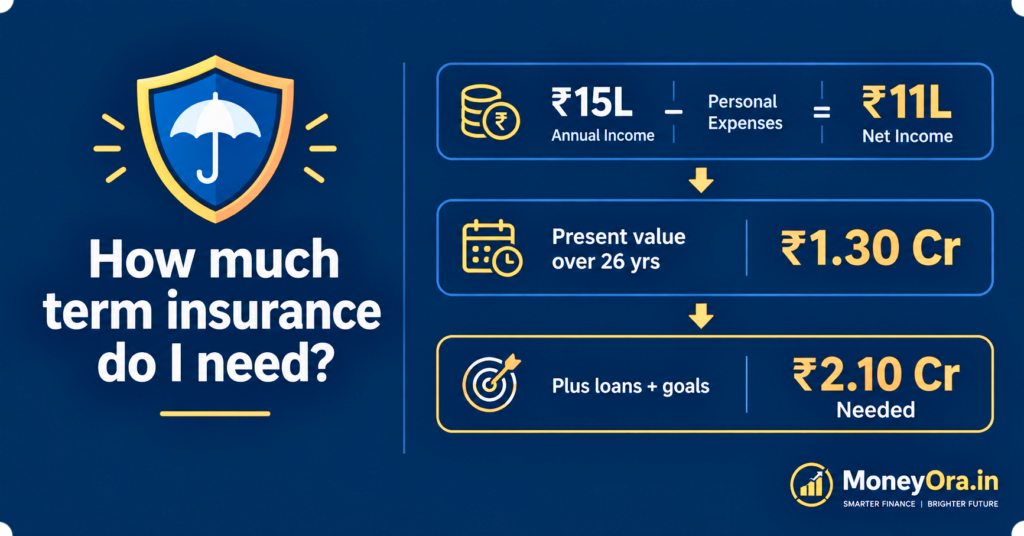
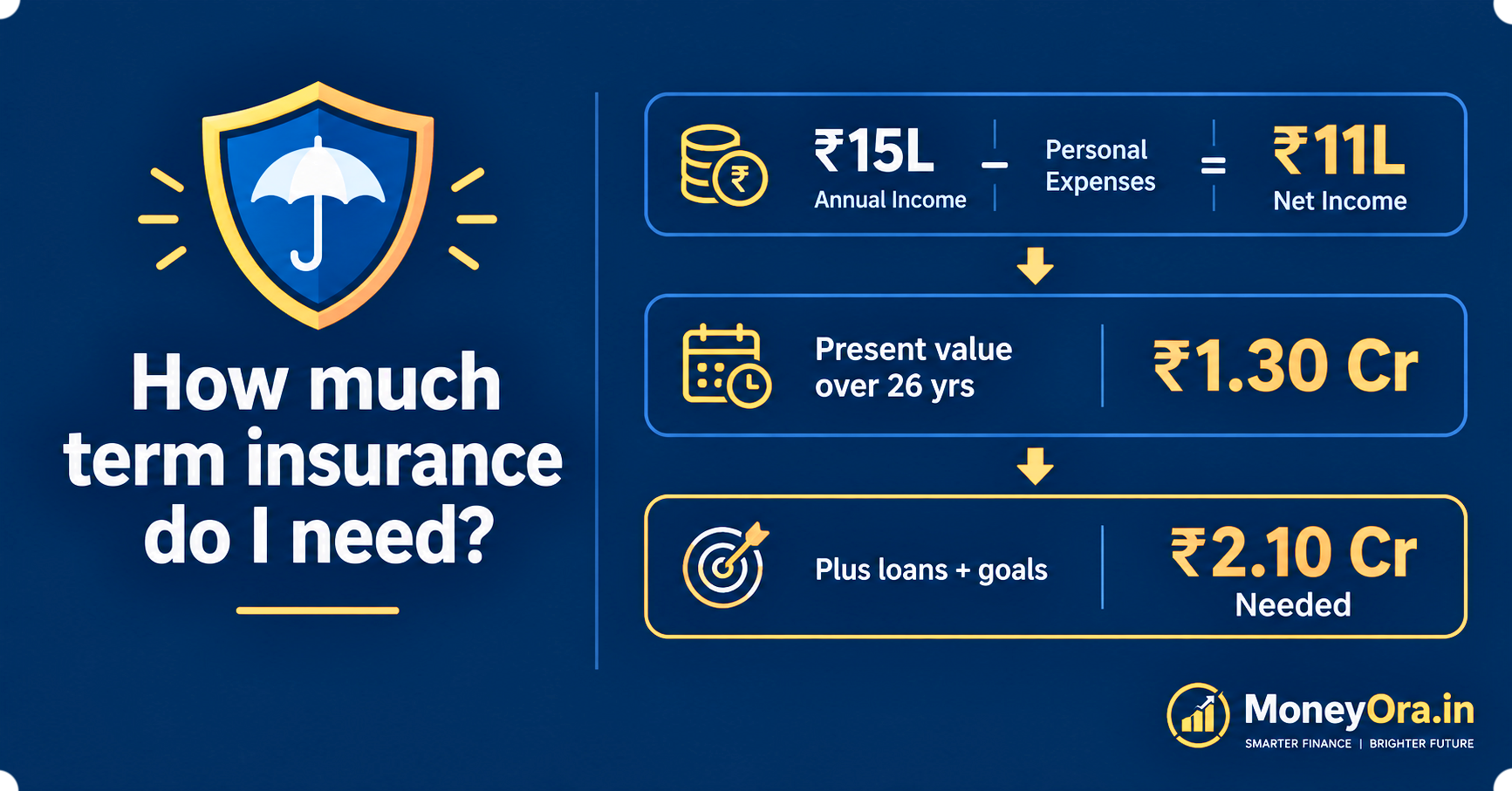
Under the HLV method the net annual contribution equals annual income minus annual personal expenses. For example ₹15 lakh minus ₹4 lakh equals ₹11 lakh per year. This ₹11 lakh is what Amit’s family would need to replace each year if he were not there.
Step 2. Calculate the value of that income stream
Rather than multiplying ₹11 lakh by 26 years which would give an inflated ₹2.86 crore the HLV method discounts future income to present value. Money received twenty years from now is worth less today. Using a discount rate of 7% over 26 years the present value factor is 11.8. Then HLV method gives HLV equal, to ₹11 lakh times 11.8 which equals ₹1.30 crore.
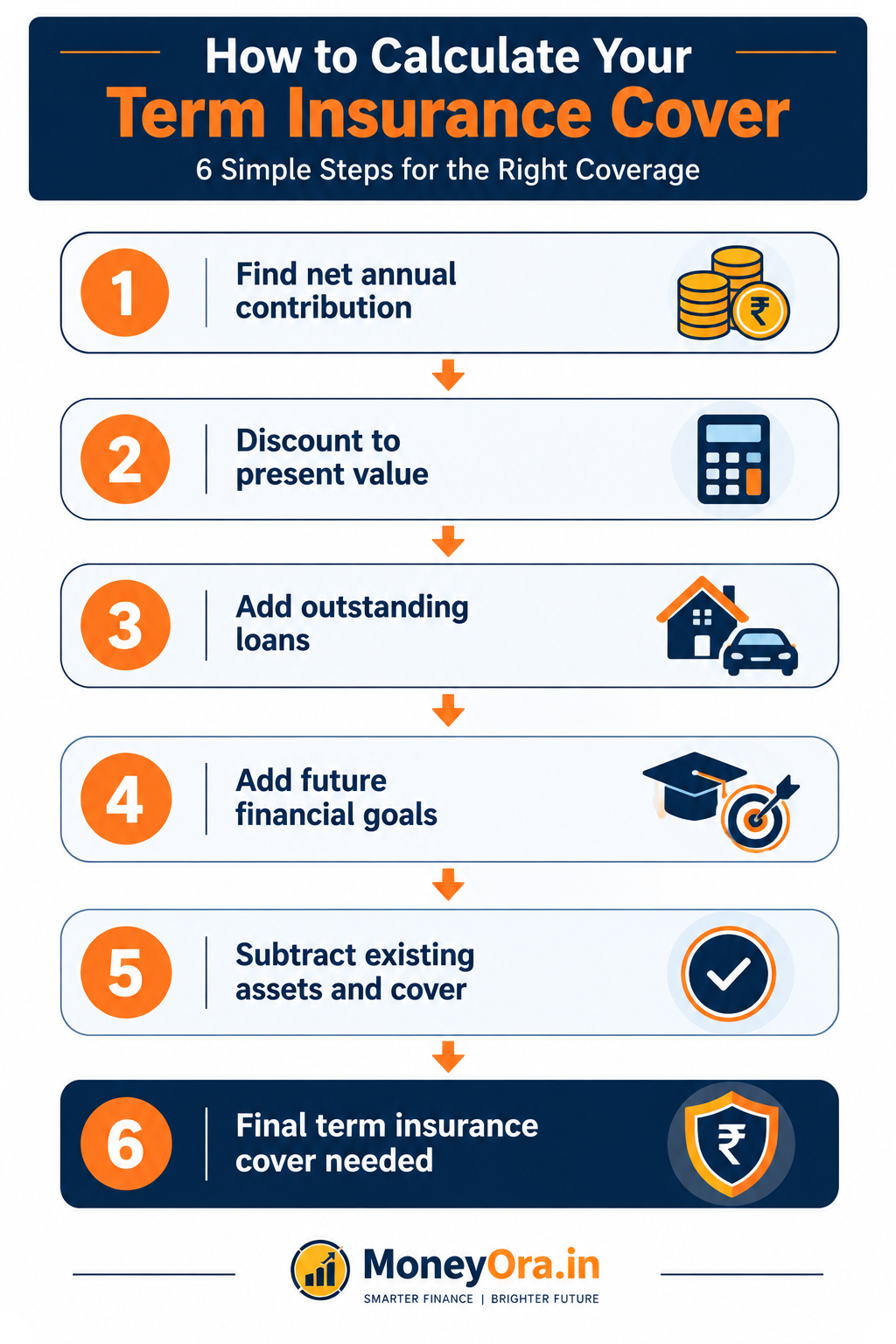
Step 3. Add outstanding liabilities
Outstanding home loan: ₹45 lakh Personal loan: ₹5 lakh Total liabilities: ₹50 lakh
Step 4. Add future financial goals
Child 1 higher education (in today’s value): ₹20 lakh Child 2 higher education (in today’s value): ₹20 lakh Spouse retirement corpus needed: ₹30 lakh Total goals: ₹70 lakh
Step 5. Subtract existing assets
EPF balance: ₹8 lakh Mutual fund investments: ₹12 lakh Existing term insurance (employer provided): ₹20 lakh Total existing assets: ₹40 lakh
Step 6. Compute final HLV coverage needed
HLV coverage = (Income replacement + Liabilities + Goals) minus Existing assets = (₹1.30 crore + ₹50 lakh + ₹70 lakh) minus ₹40 lakh = ₹2.50 crore minus ₹40 lakh = ₹2.10 crore
Amit needs roughly ₹2.1 crore of total term insurance coverage. His employer provides ₹20 lakh so he should buy at least ₹1.9 crore of personal term insurance.
This is how financial planners answer how much term insurance do I need for a ₹15 lakh income earner. Not ₹1 crore. Not even ₹1.5 crore.
How Much Term Insurance Do I Need by Salary
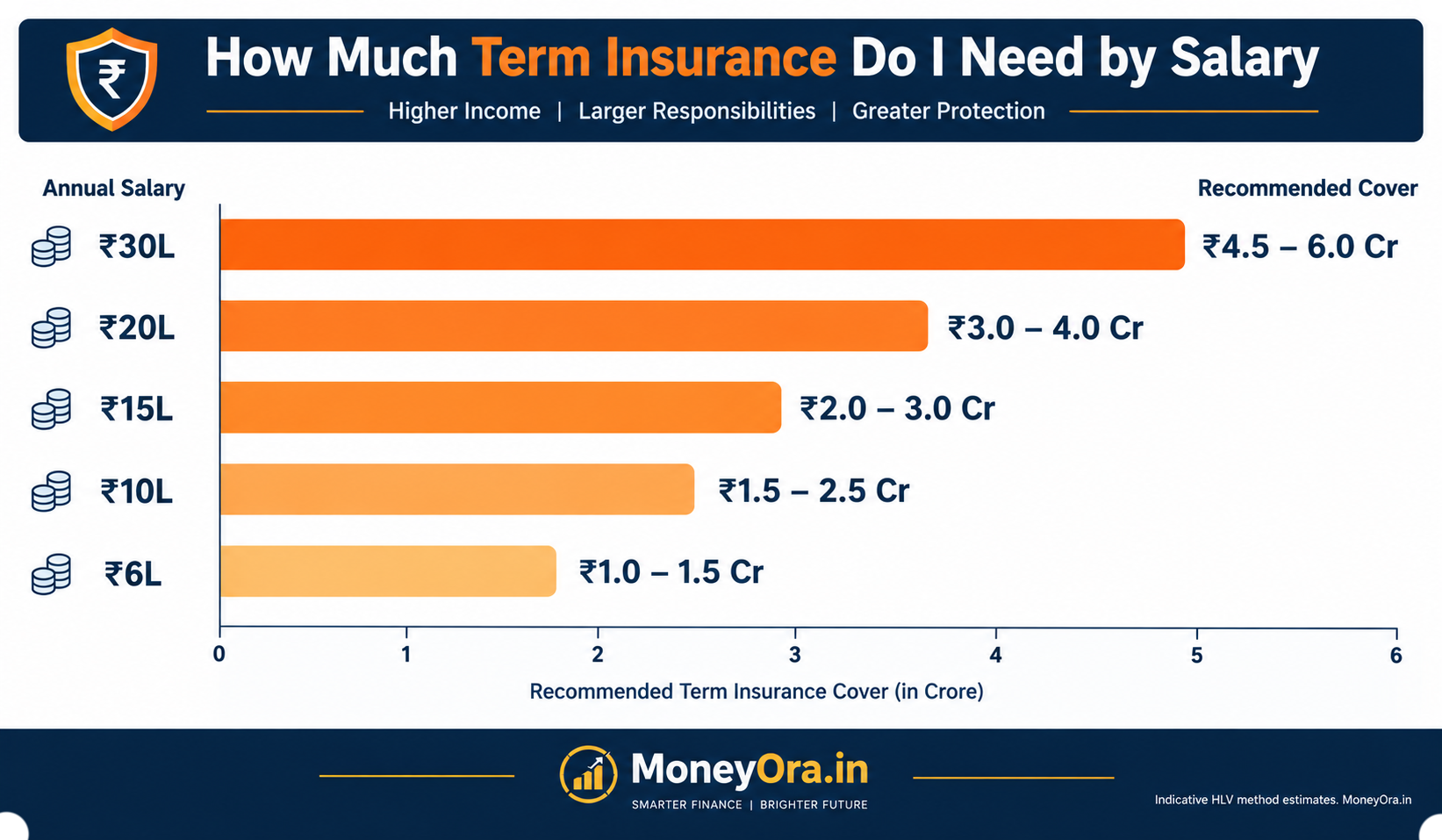
This table answers how much term insurance do I need for the most common income brackets in India. Use it as a starting point before running the full HLV calculation for your specific profile. How much term insurance do I need for your exact situation may differ based on your actual loan balance and dependents. Assumptions used are age 32 to 35 retirement at 60 and one home loan of ₹30 to 60 lakh.
| Annual Income | Basic HLV Range | With Home Loan | Total Recommended Cover |
|---|---|---|---|
| ₹6 lakh | ₹80 lakh to ₹1 crore | +₹20 to 30 lakh | ₹1 to 1.3 crore |
| ₹10 lakh | ₹1.3 to 1.8 crore | +₹30 to 40 lakh | ₹1.6 to 2.2 crore |
| ₹15 lakh | ₹2 to 2.5 crore | +₹40 to 50 lakh | ₹2.4 to 3 crore |
| ₹20 lakh | ₹2.6 to 3.2 crore | +₹50 to 60 lakh | ₹3.1 to 3.8 crore |
| ₹30 lakh | ₹4 to 5 crore | +₹60 to 80 lakh | ₹4.6 to 5.8 crore |
These are approximate ranges. Actual numbers depend on your personal expense ratio your exact outstanding loans and the goals you have set for children and spouse.
The DIME Method as a Cross Check for How Much Term Insurance Do I Need
After you finish the HLV calculation run the DIME method as a cross check. Many financial planners advise using both methods when you ask the question How Much Term Insurance Do I Need? The two methods rely on logic and often produce different figures. If the figures are close you can trust the result. If they differ a lot review the inputs closely.
DIME stands for Debt, Income, Mortgage and Education.
Debt refers to all personal loans, credit‑card balances and car loans but does not include the home loan. Income refers to your earnings multiplied by the number of years you still plan to work. Mortgage refers to the remaining balance on your home loan. Education refers to the cost of your children’s education, such as college expenses.
Debt: ₹5 lakh ( loan) Income: ₹15 lakh multiplied by 26 years equals ₹3.90 crore Mortgage: ₹45 lakh Education: ₹40 lakh for two children
DIME total equals ₹5 lakh plus ₹3.90 crore plus ₹45 lakh plus ₹40 lakh, which totals ₹4.80 crore.
The DIME method gave a figure because it does not discount income to present value and it does not deduct current assets. The HLV result was ₹2.10 crore while the DIME result was ₹4.80 crore so both figures bracket the need. Certified financial planners suggest aiming for the midpoint of the two results if your budget permits.
For Amit the midpoint is ₹3.4 crore. A ₹3 crore term plan purchased at age 34 costs ₹15,000 to ₹20,000 per year for a non‑smoker male. This works out to around ₹1,250 per month providing protection, for the whole family under the term insurance plan.
The Tax Change That Makes 2025 the Best Time to Buy
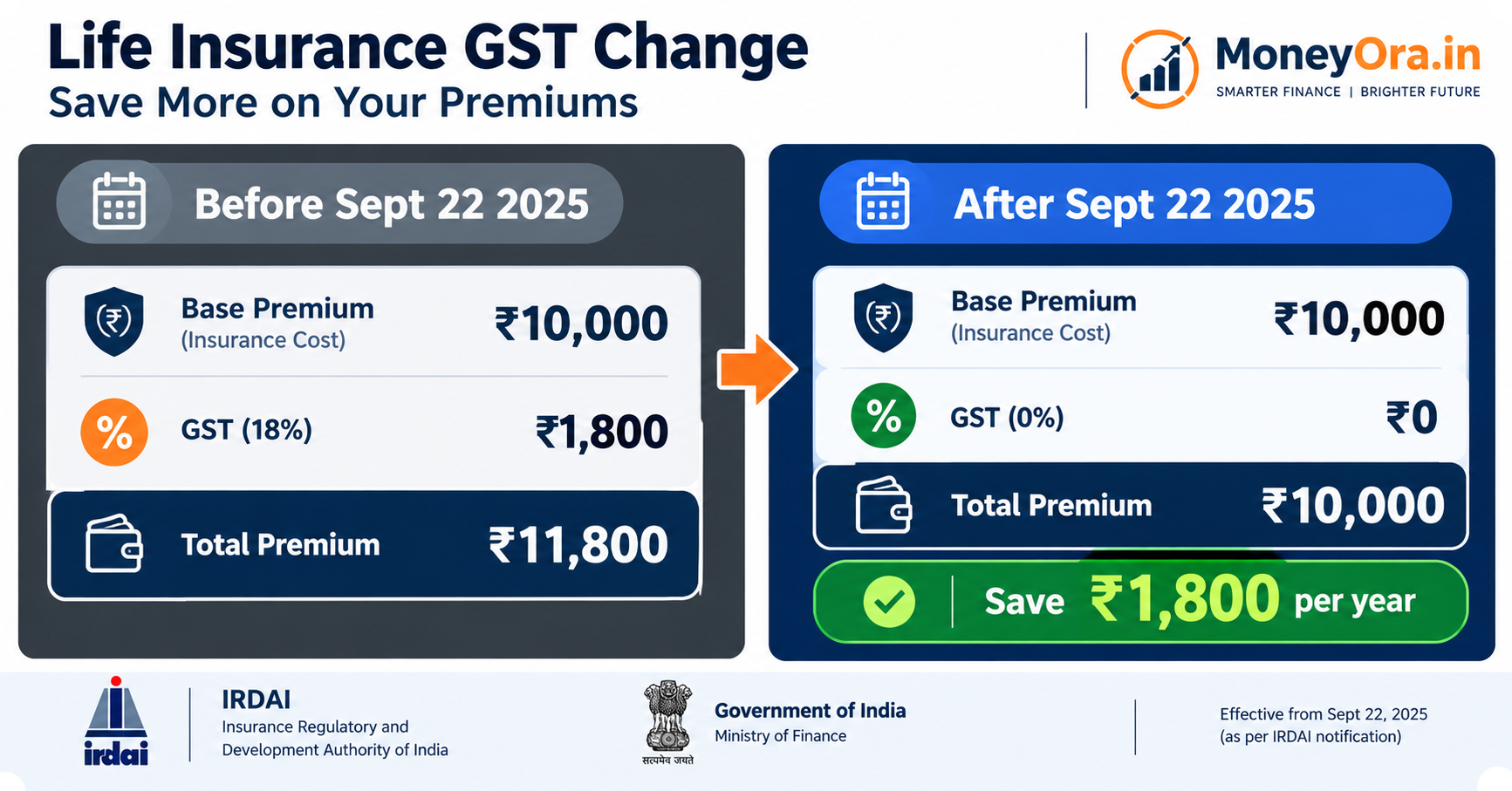
From 22 September 2025 individual term insurance premiums in India attract 0% tax. This was announced under Notification 16/2025 Central Tax. Applies to all individual life insurance policies. Group insurance policies including employer sponsored group term continue to attract 18% tax.
What this means practically is that a ₹20,000 annual premium now costs ₹20,000 instead of ₹23,600 under the old 18% tax regime. Over a 30 year policy term that saving compounds. You save ₹1,800 every year on a ₹10,000 base premium.
Before the September 2025 exemption 18% tax was applicable, on term insurance premiums. Adding 18% tax to a ₹10,000 premium brought the total to ₹11,800. Many young individuals and first time buyers remained underinsured to avoid paying a high term insurance premium that included tax.
If you have been putting off answering how much term insurance do I need because of cost that specific barrier is now genuinely lower. The tax removal alone saves ₹1,800 per year on a ₹10,000 base premium. Premiums are cheaper now than they were twelve months ago. Waiting costs you every year.
Is ₹1 Crore Enough? An Honest Answer to How Much Term Insurance Do I Need
This is the question everyone is actually searching for when they ask how much term insurance do I need. The short answer is: for most urban salaried Indians it is not enough.
₹1 crore is probably enough only if:
- Your annual income is ₹5 lakh or below
- You have no outstanding home loan
- You have at most one dependent
- You have significant existing savings and investments
- Your spouse earns independently
₹1 crore is almost certainly not enough if:
- You earn ₹8 lakh or more annually
- You have an outstanding home loan above ₹20 lakh
- You have two or more dependents including children
- Your spouse does not earn independently
- You are the primary earner in your household
IRDAI data shows the average sum assured per life insurance policy in India sits at approximately ₹4 to 5 lakh while a 35 year old earning ₹12 lakh annually needs cover closer to ₹1.8 to 2.5 crore by a proper HLV calculation. A ₹1 crore term plan for a 35 year old non smoking male costs roughly ₹595 to 700 per month online. Underbuying cover to save ₹300 per month is one of the costliest financial decisions a family can make.
Put simply Most middle income Indian families answering how much term insurance do I need should target ₹2 to 4 crore depending on their income and liability profile.
How Much Does Term Insurance Cost in India in 2025
Once you know how much term insurance do I need using the HLV method the next question is what that cover actually costs. Many people are surprised at how affordable the premiums are for the cover they actually need. Premium rates dropped meaningfully after GST removal.
Indicative annual premiums for a ₹1 crore term plan (non smoker male online purchase):
| Age | Approximate Annual Premium |
|---|---|
| 25 years | ₹6,000 to 8,000 |
| 30 years | ₹8,000 to 12,000 |
| 35 years | ₹10,000 to 16,000 |
| 40 years | ₹16,000 to 25,000 |
| 45 years | ₹28,000 to 45,000 |
For a ₹2 crore plan roughly double these figures For a ₹3 crore plan roughly triple.
The difference between buying at 28 and buying at 38 on a ₹2 crore plan can be ₹10,000 to 15,000 per year in premium savings Over a 30 year policy that is ₹3 to 4.5 lakh in total premium savings just from acting earlier.
Section 80C tax benefit:
Under the old tax regime premiums paid for term insurance are deductible under Section 80C up to ₹1.5 lakh per financial year At the 30% slab plus 4% cess the maximum annual tax saving is ₹46,800. This benefit is not available under the new tax regime which most salaried Indians are now defaulting to Choose your regime carefully before factoring this into your cost calculation.
Term Insurance Mistakes That Cost Indian Families Crores
Knowing how much term insurance do I need is only half the task Buying the right number from the wrong insurer or letting the policy lapse during a job change undoes all of it.
Mistake 1: Relying only on employer term cover
Most corporate employers provide group term insurance of one to three times annual salary That cover vanishes the day you resign or are laid off If you change jobs there is usually a gap of weeks before new employer cover kicks in. Anyone who relies entirely on employer term insurance has zero personal cover during job transitions.
Mistake 2: Buying the cheapest policy without checking claims data
An independent study supported by IRDAI regulatory data showed that count based claim settlement ratios and value based ratios can diverge significantly at the same insurer. An insurer advertising 99% count based CSR might have a meaningfully lower value based CSR where high sum assured claims face disproportionately more friction.
When buying a ₹2 to 3 crore policy always look at the value based claim settlement ratio not just the headline count based number.
Mistake 3: Not reviewing coverage after major life events
The answer to how much term insurance do I need at 28 with no dependents is very different from the answer at 35 with a home loan and two children. How much term insurance do I need is not a one time question. It is a question you should revisit every five years or whenever a major life event changes your financial obligations. Most people buy once and forget. Review your term insurance coverage whenever any of these events occur: marriage children purchase of a home major income increase or significant new liability.
Mistake 4: Choosing too short a policy term
A 35 year old buying a 20 year term plan is uncovered from age 55. If they have dependents at 55 (which most people with children do) they are exposed with no cover and will face extremely high premiums to buy new insurance at that age. Buy cover at minimum until age 60 and ideally until 65 if you have significant financial obligations expected to extend into your sixties.
Mistake 5: Selecting wrong riders without reading the fine print
Critical illness and accidental death riders can add genuine value. Waiver of premium riders protect your family if you are incapacitated. But some riders offered by agents add cost without proportional benefit. Accidental death benefit riders make more sense for someone in a high risk occupation than for a desk worker. Read what each rider actually covers before paying for it.
How to Choose a Term Insurance Provider
Once how much term insurance do I need is settled the next decision is who to buy from. The insurer you choose matters as much as the amount. A ₹3 crore policy from an insurer that struggles with large claim settlements is worth less than a ₹2 crore policy from a top rated provider. Three filters matter more than anything else.
Filter 1: Claim settlement ratio by value not just count
For FY 2025-26 PNB MetLife reported the highest individual claim settlement ratio at 99.81% closely followed by HDFC Life at 99.72% and Axis Max Life among the top private life insurers. Look for consistency across at least three financial years not just the latest number.
Always verify claim settlement data directly on the IRDAI website before finalising any insurer. IRDAI publishes annual insurance statistics with claim data for all registered insurers.
Filter 2: Financial strength and solvency ratio
IRDAI requires all insurers to maintain a minimum solvency ratio of 150%. A higher solvency ratio means a more financially stable insurer. Check this in the annual report or on the IRDAI data portal.
Filter 3: Online purchase with transparent pricing
Online term plans have significantly lower expense ratios than agent sold policies. The premium savings over a 30 year term can be ₹1 to 2 lakh or more. A good source for comparing current online premiums is the IRDAI Insurance Repository which lists all approved products.
Three Indian Earners
These three scenarios show how the HLV method answers how much term insurance do I need at different income levels ages and life stages Map your own profile to the closest scenario and adjust from there.
Scenario 1: Deepa age 28 earns ₹8 lakh annually
Deepa is single with no dependents and no loans Her parents are self sufficient She asks how much term insurance do I need and arrives at roughly ₹80 lakh using HLV She buys a ₹1 crore plan to account for future marriage and dependents that are likely but not yet certain Annual premium at 28 is approximately ₹7,000 post GST exemption She locks in this low premium for the next 32 years.
Scenario 2: Rohit age 36 earns ₹20 lakh annually
Rohit has a spouse who earns ₹6 lakh annually two children aged 8 and 5 and an outstanding home loan of ₹60 lakh When Rohit asks how much term insurance do I need the HLV calculation gives him ₹2.8 crore net need after accounting for spouse income and existing EPF of ₹15 lakh He buys ₹2.5 crore of personal term insurance His employer provides ₹20 lakh as group cover Total family protection is ₹2.7 crore which closely matches the calculated need Annual personal premium at 36 for the ₹2.5 crore plan is approximately ₹28,000.
Scenario 3: Meena age 42 earns ₹30 lakh annually
Meena is a sole earner with aging parents and one child in school She has a ₹80 lakh home loan outstanding When she calculates how much term insurance do I need her HLV gives ₹4.2 crore of cover needed She already has ₹50 lakh of existing cover bought years ago She needs an additional ₹3.7 crore At 42 this will cost approximately ₹90,000 to 1.1 lakh per year The premium is high but the need is real Buying earlier would have cost ₹25,000 to 35,000 per year at 32 That ten year delay cost her an extra ₹65,000 to 75,000 annually in premium for the rest of the policy term.
You now have the exact method to answer how much term insurance do I need.
Run the HLV calculation Add your loans and goals Subtract your existing assets Cross check with DIME How much term insurance do I need is a question with a precise answer for every income level and life stage Buy personal cover for the net amount with one of the top claim settors in the country Review it every five years or after any major life event.
The math is not complicated. What is complicated is explaining to your family why you chose to skip it.
With GST now at 0% on individual policies premiums dropped roughly 18% overnight in September 2025 There is no reason to keep waiting.
Use the free calculator now on MoneyOra.in to run your own HLV calculation in under five minutes.
Disclaimer: All calculations in this article are illustrative examples only and do not constitute financial advice Term insurance decisions involve individual health status income stability and family circumstances that vary significantly Always consult a SEBI registered investment advisor or IRDAI registered insurance intermediary before purchasing Claim settlement ratios referenced are sourced from publicly available IRDAI and insurer disclosures for FY 2025-26.
Frequently Asked Questions
How much term insurance do I need for a ₹10 lakh salary in India?
A person who earns ₹10 lakh a year is aged between 32 and 35 has a home loan of ₹30 to 40 lakh and has two dependents usually needs between ₹1.6 and 2.2 crore in term insurance cover when calculated with the HLV method. From that amount you subtract any employer group cover that you already have and any investment assets you already own. The amount that remains is usually between ₹1.4 and 2 crore. That is the amount you should consider buying a personal term insurance plan for.
Is ₹1 crore term insurance enough for a family?
If a family earns than ₹8 lakh a year still has a home loan and has more than one dependent a cover of ₹1 crore is not enough. The HLV method shows that a person who earns ₹10 lakh a year and is 32 years needs between ₹1.5 and 1.8 crore just to replace income. When you add loans and other goals the needed amount rises to ₹2 crore or more.
What is the HLV method in term insurance?
The Human Life Value method is a way to estimate How much term insurance do I need. It calculates the value of the money you will earn in the future and will provide to your family subtracts your personal expenses for the rest of your working life adds any debts and financial goals and then subtracts any assets and savings you already have. The result is the amount of term insurance you should buy.
At what age should I buy term insurance in India?
Buying term insurance early in your twenties or thirties locks in premiums for life. A ₹1 crore plan for a costs between ₹6,000 and 8,000 a year. The same plan for a 40‑year‑old costs between ₹16,000 and 25,000 a year. Buy a plan soon as you have dependents or debts that make coverage meaningful.
Does term insurance have any return if I survive the policy?
Pure term insurance is death cover. There is no survival or maturity benefit. This is intentional. The savings in premiums compared to endowment or ULIP plans are huge. A ₹1 crore term plan for a costs between ₹6,000 and 8,000 a year. An endowment plan that gives the ₹1 crore cover costs between ₹4 and 6 lakh a year. The difference of about ₹3.9 lakh a year if invested in equity funds at 12% over 30 years becomes about ₹10.6 crore. The return from term insurance is not in the premium. It is in the protection it gives to your family.
What happens to my term insurance if I change jobs?
Your personal term insurance plan is independent of your job. The policy continues long as you pay the premiums directly from your bank account. Employer‑provided group term insurance stops when you leave a job. That is why having your own personal term plan matters even if you have employer cover. If you switch jobs you need that cover on the day of the gap.
How is term insurance taxed in India in 2025?
Premiums paid for term insurance are deductible under Section 80C of the Income Tax Act up to ₹1.5 lakh per year under the tax regime. The death benefit received by the nominee is fully tax free under Section 10(10D) in circumstances. There is no GST on individual term insurance premiums from 22 September 2025 onwards as confirmed by the Department of Financial Services of the Government of India.
Can a housewife or homemaker buy term insurance in India?
Yes homemakers can buy term insurance in India. The sum assured is usually based on the spouses income or the economic value of household work. IRDAI regulations do not prohibit homemakers from buying life insurance. The economic contribution of a homemaker, in managing the household and caring for children has monetary value that would need to be replaced if they were not there.