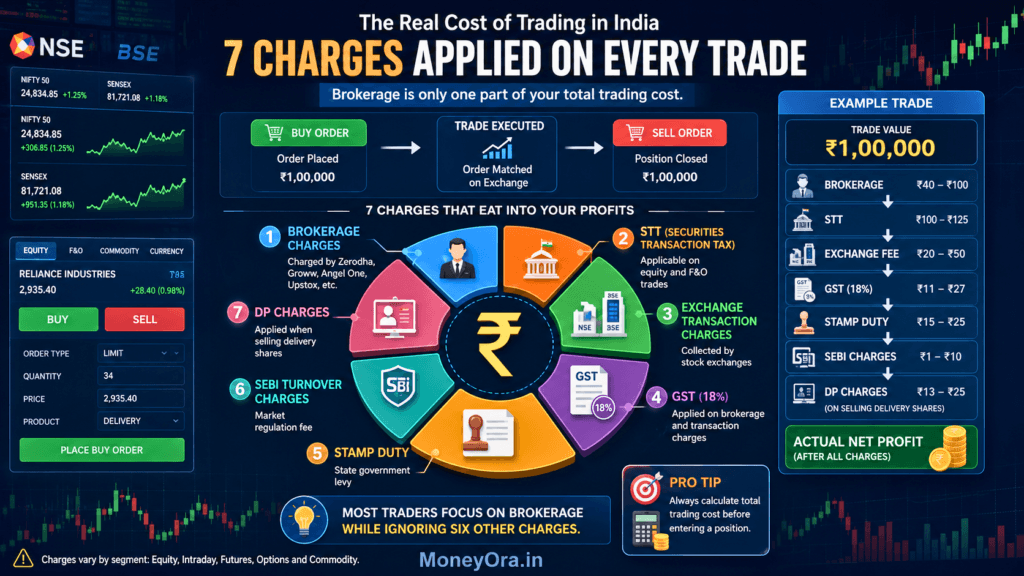
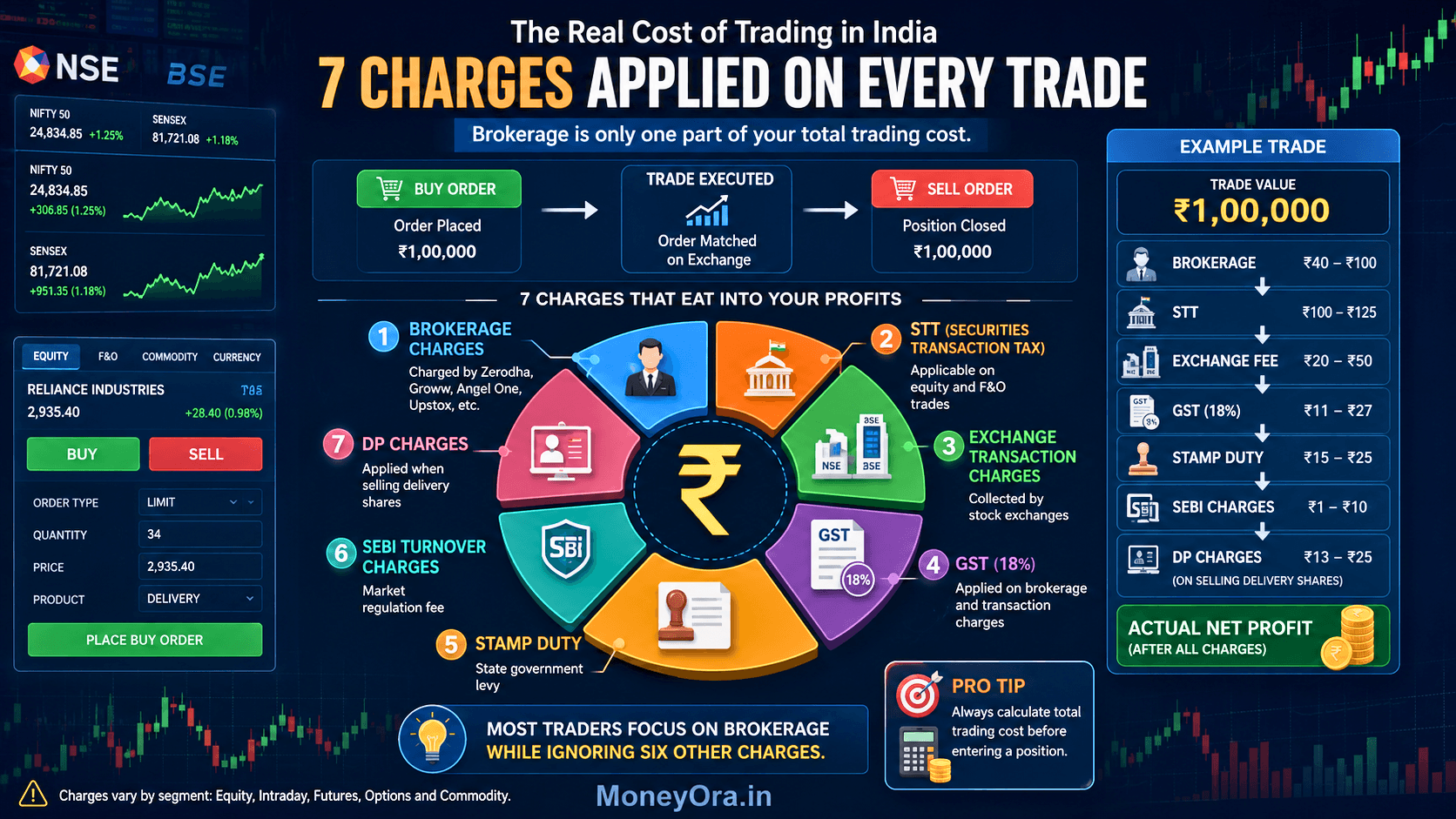
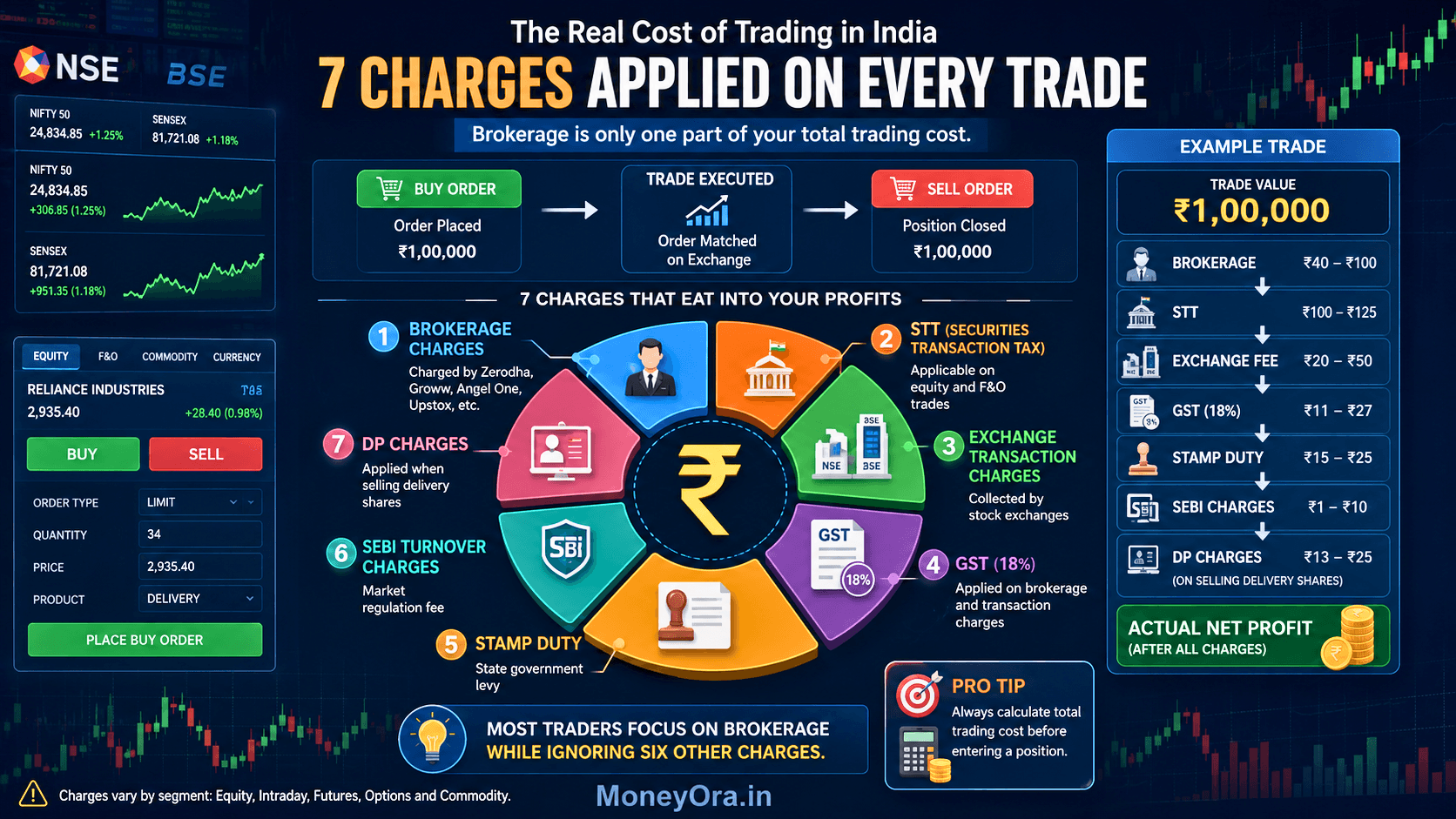
Here is something a lot of new traders discover the hard way. They open a Zerodha account, see the words “zero brokerage on delivery,” and assume their trades are basically free. Then the contract note arrives. There is a charge for STT. Another one for NSE. One from the GST department. Something called stamp duty. A DP charge they have never heard of. And somehow, the “free” trade cost them ₹400.
Brokerage charges in India are not one fee — they are seven. Your broker’s commission is just the most visible one. The other six come from the government, the exchange, and your depository, and they show up whether you make money or not.
This guide breaks down every brokerage charge you will encounter in the Indian stock market — with exact rates, worked examples for delivery, intraday, and F&O trades, and a decision framework that helps you choose the right broker for how you actually trade. At the end, you can use MoneyOra’s free brokerage calculator to run these numbers for your specific trade before you place it.
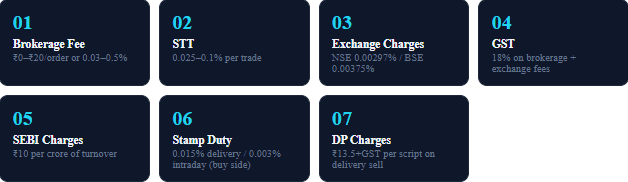
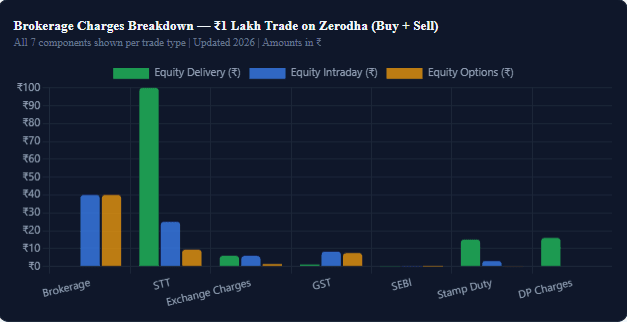
Brokerage charges are the total fees deducted from your trading account when you buy or sell securities on the stock market. In India, the total charge includes 7 components: broker commission, STT (Securities Transaction Tax), exchange transaction charges, GST, SEBI charges, stamp duty, and DP charges. Even on “zero brokerage” platforms, the remaining 6 charges can amount to ₹150–500 per ₹1 lakh trade.
Why Brokerage Charges Matter More Than Most Traders Think
A trader who does ₹10 lakh of intraday volume per day — which is fairly common — is paying ₹30,000 per month in brokerage charges at a traditional full-service broker at 0.3% per trade. The same volume at a discount broker costs roughly ₹2,000–3,000 per month. That is a ₹27,000 difference every single month. Per year: ₹3.24 lakh. Just gone.
This is not hypothetical. This is why Zerodha grew from a small firm to India’s largest retail broker in about a decade — traders doing the math realised what they were losing.
But here is the subtler point that even discount broker users miss. Even at ₹0 brokerage on delivery trades, your STT, exchange charges, and DP charges are fixed by law and by regulation. You pay them regardless. The question is whether your trade generates enough return to cover them.
If you are buying ₹10,000 worth of a stock on Zerodha delivery and selling it two days later, your total charges — even at ₹0 brokerage — are approximately ₹45–55. That means the stock needs to move at least 0.5% in your favour before you even break even. For short-term trades on slow-moving stocks, this is a meaningful hurdle.
Track your actual stock returns using our stock return calculator to factor in brokerage charges as a cost in your real CAGR calculation.
All 7 Brokerage Charges in India — Explained Simply

Brokerage Fee — The Only One You Can Actually Choose
This is the broker’s commission for executing your trade. It is the only charge on this list where you have any control — by choosing your broker. Discount brokers like Zerodha, Angel One, Upstox, and Dhan cap it at ₹20 per order or 0.03% (whichever is lower). Full-service brokers like HDFC Securities and ICICI Direct charge 0.3–0.5% per trade on both buy and sell sides.
For a ₹1 lakh trade: discount broker brokerage = ₹20. Full-service broker brokerage = ₹300–500. That is 15–25x more. And the market research provided by full-service brokers, while useful for some, is increasingly available for free through Screener.in, TradingView, and NSE’s own platform.
2 – STT — Securities Transaction Tax — Cannot Be Avoided
STT is a government tax collected under the Finance Act. It has nothing to do with your broker — every registered broker in India collects it on the government’s behalf. You cannot avoid it. You cannot negotiate it. And it can be your biggest single charge on large delivery trades.
| Trade Type | STT Rate | Applied On |
|---|---|---|
| Equity Delivery | 0.1% | Sell side only |
| Equity Intraday (MIS) | 0.025% | Sell side only |
| Equity Futures | 0.0125% | Sell side only |
| Equity Options (Exercise) | 0.125% | Strike value on exercise |
| Equity Options (Sell Premium) | 0.0625% | Premium on sell side |
For context: on a ₹1 lakh equity delivery sell, STT alone is ₹100. If you trade delivery actively — buying and selling ₹1 lakh worth of stock every week — you pay ₹400+ per month in STT alone, to the government, regardless of whether you profit.
SEBI’s official regulations on STT are available at the Securities and Exchange Board of India (SEBI) website. Always check the official source if rates change after a Union Budget.
3 – Exchange Transaction Charges — NSE and BSE Infrastructure Fees
NSE and BSE charge a small fee for using their trading platform. NSE charges approximately 0.00297% of the trade value for cash equity. BSE charges 0.00375%. These are tiny — about ₹3 per ₹1 lakh traded — but they apply to every single transaction.
4 – GST — 18% on the Broker’s Portion and Exchange Fees
GST at 18% applies on your brokerage fee plus the exchange transaction charges. Not on STT, stamp duty, or DP charges — just on those two components. For a Zerodha intraday trade with ₹20 brokerage + ₹3 exchange charges, GST = 18% × ₹23 = ₹4.14. Small but consistent.
5 – SEBI Charges — Practically Nothing But Real
₹10 per crore of turnover. For a ₹1 lakh trade, that is ₹0.10 — one paisa. You will never feel this one, but it is on every contract note.
6 – Stamp Duty — State Government’s Cut on Every Trade
Stamp duty is a state-level tax, applied only on the buy side of every trade. Rates: 0.015% for delivery trades, 0.003% for intraday, 0.002% for futures, 0.003% for options. On a ₹1 lakh delivery buy, stamp duty = ₹15. It sounds small but it adds up if you are trading frequently.
7 – DP Charges — The One That Surprises Everyone
DP (Depository Participant) charges are flat fees for transferring shares out of your demat account when you sell delivery shares. They apply per scrip per day — not per share quantity.
Zerodha: ₹13.5 + GST = ₹15.93 per scrip per sell day. If you sell 5 different stocks in a single session, you pay ₹15.93 × 5 = ₹79.65 in DP charges alone. Sell 100 shares of Infosys and 200 shares of TCS in the same session — that is two scrips, so ₹31.86 in DP charges.
DP charges do not apply on intraday trades (because you never actually hold the shares in your demat) or on futures/options (derivative contracts, not actual share ownership).
3 Worked Trade Examples — Full Brokerage Charge Breakdown


Example 1: Equity Delivery Trade on Zerodha — ₹1 Lakh
Scenario: Buy ₹1,00,000 of Reliance, sell 3 days later at the same price (no price change)
| Charge | Buy Side (₹) | Sell Side (₹) | Total (₹) |
|---|---|---|---|
| Brokerage | 0 | 0 | 0 |
| STT (0.1% on delivery sell) | 0 | 100.00 | 100.00 |
| Exchange Charges (NSE 0.00297%) | 2.97 | 2.97 | 5.94 |
| GST (18% on exchange charges only) | 0.53 | 0.53 | 1.07 |
| SEBI Charges | 0.10 | 0.10 | 0.20 |
| Stamp Duty (0.015% on buy) | 15.00 | 0 | 15.00 |
| DP Charges (₹15.93 per scrip on sell) | 0 | 15.93 | 15.93 |
| TOTAL CHARGES | 18.60 | 119.53 | 138.13 |
Even with ₹0 brokerage, a flat ₹1 lakh delivery round-trip costs ₹138. The stock needs to move 0.14% up just to break even on charges.
Example 2: Equity Intraday Trade on Zerodha — ₹1 Lakh
Scenario: Buy ₹1,00,000 of Infosys intraday, sell same day at same price
| Charge | Buy Side (₹) | Sell Side (₹) | Total (₹) |
|---|---|---|---|
| Brokerage (₹20 per order) | 20.00 | 20.00 | 40.00 |
| STT (0.025% on sell only) | 0 | 25.00 | 25.00 |
| Exchange Charges | 2.97 | 2.97 | 5.94 |
| GST (18% on brokerage + exchange) | 4.13 | 4.13 | 8.27 |
| SEBI Charges | 0.10 | 0.10 | 0.20 |
| Stamp Duty (0.003% on buy) | 3.00 | 0 | 3.00 |
| DP Charges | 0 | 0 | 0 |
| TOTAL CHARGES | 30.20 | 52.20 | 82.41 |
Intraday charges are lower than delivery for the same ₹1 lakh — mainly because STT is 4x lower intraday. Breakeven: 0.08% price move.
Example 3: NIFTY Options — 1 Lot Buy at ₹150 Premium, Sell at ₹200
Scenario: Buy 1 lot NIFTY (75 units) at ₹150 premium, sell at ₹200. Trade value = ₹11,250 buy / ₹15,000 sell
| Charge | Amount (₹) |
|---|---|
| Brokerage (₹20 flat both orders) | 40.00 |
| STT on sell premium (0.0625% × ₹15,000) | 9.38 |
| Exchange Charges | 1.35 |
| GST on brokerage + exchange | 7.44 |
| SEBI Charges | 0.03 |
| Stamp Duty | 0.34 |
| DP Charges | 0 |
| Total Charges | 58.54 |
| Gross Profit (₹50 × 75 units) | ₹3,750 |
| Net Profit | ₹3,691.46 |
Options charges are proportionally low because you trade on premium (small absolute value), not the full underlying contract value. This is why options are popular for leveraged exposure at low cost.
Discount Broker vs Full-Service Broker: Real Trade Comparison
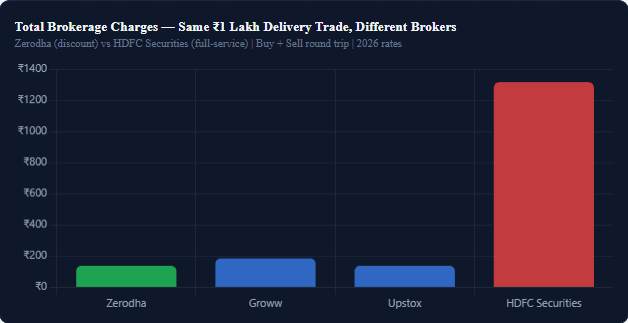
The most concrete way to understand what brokerage charges cost you is to see the same trade through two different brokers. This is the comparison most articles skip.

| Charge Component | Zerodha (₹) | Groww (₹) | Upstox (₹) | HDFC Securities (₹) |
|---|---|---|---|---|
| Brokerage | 0 | 40 | 0 | 1,000 (0.5%) |
| STT | 100 | 100 | 100 | 100 |
| Exchange Charges | 5.94 | 5.94 | 5.94 | 5.94 |
| GST | 1.07 | 8.31 | 1.07 | 180.00 |
| SEBI Charges | 0.20 | 0.20 | 0.20 | 0.20 |
| Stamp Duty | 15.00 | 15.00 | 15.00 | 15.00 |
| DP Charges | 15.93 | 15.93 | 15.93 | 15.93 |
| TOTAL | 138.14 | 185.38 | 138.14 | 1,317.07 |
The same ₹1 lakh delivery round-trip costs ₹138 on Zerodha and ₹1,317 on HDFC Securities. If you trade ₹1 lakh worth of stock every week on HDFC Securities, your annual brokerage charge bill is ₹68,484 vs ₹7,183 on Zerodha. A ₹61,301 annual gap — just from brokerage charges.
The famous example I always quote: buy Reliance at ₹2,800 (100 shares = ₹2,80,000), sell at ₹2,814 (+₹1,400 profit). With Zerodha, after charges, you take home approximately ₹1,000. With HDFC Securities, the same trade turns into a loss because brokerage charges alone exceed the ₹1,400 profit.
Brokerage Charges by Segment: Delivery, Intraday, Futures, Options
| Segment | Brokerage | STT | Exchange Charge | DP Charges | Stamp Duty | Typical Total per ₹1L |
|---|---|---|---|---|---|---|
| Equity Delivery | ₹0 | 0.1% (sell) | 0.00297% NSE | ₹15.93/scrip sell | 0.015% (buy) | ~₹140 |
| Equity Intraday | ₹20/order | 0.025% (sell) | 0.00297% NSE | Nil | 0.003% (buy) | ~₹82 |
| Equity Futures | ₹20/order | 0.0125% (sell) | 0.00174% NSE | Nil | 0.002% (buy) | ~₹55 |
| Equity Options | ₹20/order | 0.0625% premium (sell) | 0.035% NSE (on premium) | Nil | 0.003% (buy) | Varies by premium |
Why Futures and Options Have Lower Total Brokerage Charges
The key insight: for futures and options, STT is charged on a much smaller base than delivery trades. Delivery STT is 0.1% on the full trade value (on sell). Futures STT is 0.0125% on the full contract value — 8x lower. Options STT is 0.0625% on the premium — which is a fraction of the full contract’s notional value.
This is why F&O trading can make sense for cost-conscious traders who understand leverage. The total brokerage charges per rupee of market exposure are substantially lower in derivatives. However, leverage also means larger absolute losses if the trade goes wrong. Use our margin calculator to understand the capital required for F&O positions, and our option price calculator to model option premiums before entering.

The Breakeven Calculation: What Price Move Do You Need to Cover Brokerage Charges?

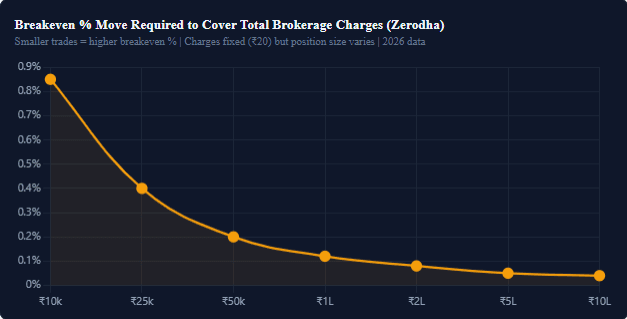
This is the calculation that changes how you think about trading. Your brokerage charges are largely fixed (₹20 per order for intraday, ₹0 for delivery brokerage). But the minimum price move you need to cover those charges depends on your position size.
| Position Size (₹) | Brokerage (₹) | All Other Charges (₹) | Total Charges (₹) | Breakeven % Move |
|---|---|---|---|---|
| ₹10,000 | 40 | ~45 | ~85 | 0.85% (Nifty needs 100+ point move) |
| ₹50,000 | 40 | ~60 | ~100 | 0.20% |
| ₹1,00,000 | 40 | ~80 | ~120 | 0.12% |
| ₹5,00,000 | 40 | ~220 | ~260 | 0.05% |
| ₹10,00,000 | 40 | ~400 | ~440 | 0.04% |
The brutal reality in the ₹10,000 row: to just break even on a ₹10,000 intraday trade, Nifty needs to move over 100 points in your favour. That happens — but not on every trade. Traders with small capital who do many small trades are fighting the brokerage charges battle on impossible odds.
This is why minimum position size matters. Most experienced intraday traders will tell you that trading less than ₹50,000 per position is fighting headwinds from brokerage charges that make consistent profitability very hard. Use our position size calculator to determine the right trade size for your capital.
7 Investor Mistakes That Waste Money on Brokerage Charges
These are the mistakes that cost traders real money. Most of them are avoidable once you know what to look for.
Mistake 1: Trading Small Positions with Flat Fees
If your broker charges ₹20 per order flat, a ₹10,000 intraday trade pays the same ₹20 brokerage as a ₹10 lakh trade. Effective cost for ₹10,000: 0.4%. Effective cost for ₹10 lakh: 0.004%. Small position sizes make the flat fee extraordinarily expensive on a percentage basis.
Mistake 2: Not Accounting for DP Charges on Long-Term Portfolios
You bought 20 different stocks for your portfolio. You decide to rebalance and sell all 20 in one session. That is ₹15.93 × 20 = ₹318.60 in DP charges alone — before any other trading cost. Many investors discover this only on the contract note, after the fact.
Mistake 3: Ignoring the STT on Delivery Trades
Many delivery traders forget that 0.1% STT on the sell side means every round-trip costs at least ₹100 per ₹1 lakh in STT alone. If you buy and sell ₹5 lakh of stocks quarterly, your annual STT bill is ₹2,000 — regardless of whether you made any profit.
Mistake 4: Using a Full-Service Broker for Self-Directed Trading
Full-service brokers make sense for investors who genuinely use their advisory services, have complex requirements, or trade through relationship managers for large portfolios. For a self-directed trader using their own analysis, paying 0.5% per trade in brokerage charges vs ₹20 flat is a structural disadvantage that compounds every day.
Mistake 5: Calculating Profit Without Deducting All Charges
A trade showing +1.2% on the screen might feel profitable. After deducting all brokerage charges — especially STT and DP charges — the actual net return could be 0.8–0.9%. Over many trades, this difference between gross and net return matters significantly. Always use the brokerage calculator to see your actual take-home number before exiting a position.
Mistake 6: Over-Trading to Recover Losses
Each additional trade adds more charges. A trader trying to recover a loss by placing three or four more trades is paying brokerage charges on each one. The psychology of trying to break even often leads to the charges compounding the original loss.
Mistake 7: Not Reviewing Contract Notes Regularly
Your contract note is the legal document that lists every charge on every trade. Most traders never read them. If you check them monthly, you will quickly see which charge is your biggest cost and can optimise accordingly. Log into your demat account, download your last 3 months of contract notes, and actually add up the columns.
How to Reduce Your Brokerage Charges Legally
You cannot avoid STT, SEBI charges, or exchange fees. But you can meaningfully reduce the total brokerage charges you pay through smarter choices.
1. Switch to a Discount Broker
If you are still using a full-service broker for self-directed trading, this single change can save you 90% of your broker commission. Zerodha, Angel One, Dhan, and Upstox all offer ₹0 delivery brokerage and ₹20 flat for intraday/F&O. There is no reason to pay 0.5% per trade for research you are not using.
2. Minimise Unnecessary Churn on Long-Term Holdings
Every time you sell a delivery stock, you pay STT (0.1%), exchange fees, and DP charges. If you are a long-term investor, holding stocks for 3–5 years rather than trading in and out quarterly eliminates years of STT accumulation. The brokerage charges saved by not trading compound the same way your investment returns do. Model the compounding effect using our CAGR calculator.
3. Use Options Instead of Delivery for Short-Term Views
For a short-term directional view on a stock, buying a near-term call or put option costs dramatically less in brokerage charges than buying the underlying shares delivery. The STT on options is on the premium (tiny), not on the full contract value. Just make sure the option’s time decay and implied volatility are factored into your expected move using our option price calculator.
4. Trade Larger Positions Less Frequently
With flat-fee pricing (₹20 per order), the breakeven % drops as position size increases. Trading ₹5 lakh twice a week is far more charge-efficient than trading ₹50,000 twenty times a week. Same rupee volume, but the larger single trades make the flat fee proportionally insignificant.
5. Check Your Stop Loss Placement
Stop losses that are too tight cause frequent small losses — each with its full charge load. A trader who gets stopped out 10 times a month on ₹50,000 trades is paying ₹800–1,000 in charges for those 10 exits alone. Calibrate stop losses using our stop loss calculator to ensure your risk/reward ratio accounts for total charges.
Track all your trades and their real net returns using our stock return calculator.
Decision Framework: Which Broker Suits Which Trader?
| Trader Type | Ideal Broker | Key Reason | Avoid |
|---|---|---|---|
| Long-term investor (buy and hold 1–5 years) | Zerodha or Angel One | ₹0 delivery brokerage; strong platform | Groww (₹20 on delivery) for large holding |
| Active intraday trader | Zerodha, Angel One, Dhan | ₹20 flat; reliable execution | Any full-service broker |
| F&O / Options trader (frequent) | Zerodha or Dhan | ₹20 flat on F&O; low slippage | Full-service brokers at 0.5% |
| Beginner investor (SIP + occasional stocks) | Groww or Angel One | Simple UI; good education resources | Full-service unless using advisory |
| HNI/large portfolio with advisory need | HDFC Securities / ICICI Direct | Dedicated RM, research, priority service | None — full-service justified here |
Note: This is a general framework. Always check the latest broker charges — they change periodically. Before opening or switching, calculate your expected monthly brokerage charges using the MoneyOra brokerage calculator with your typical trade size and frequency.
Related MoneyOra Tools for Stock Market Traders
Tools That Work Alongside Your Brokerage Calculator
- Brokerage Calculator — Calculate exact charges for any trade on Zerodha, Groww, Angel One, Upstox
- Margin Calculator — Check F&O margin requirements before placing derivatives trades
- Option Price Calculator — Model option premiums and breakeven before entry
- Stop Loss Calculator — Set stop levels that factor in total brokerage charges
- Position Size Calculator — Size trades correctly relative to your capital and risk tolerance
- Stock Return Calculator — Track net-of-charges CAGR on your investments
- PE Ratio Calculator — Evaluate stock valuation before entering long-term positions
- Stock Average Calculator — Compute cost averaging on delivery positions
- Dividend Calculator — Calculate dividend income from your equity holdings
- SIP Calculator — For long-term mutual fund SIP investing (avoids all direct brokerage charges)
Conclusion: Brokerage Charges Are the One Cost You Control
Of all the costs in trading, brokerage charges are the one area where your choices actually matter.
You cannot change STT.
You cannot negotiate SEBI fees.
But you can choose a broker that charges ₹20 flat versus one that charges ₹1,000 on the same trade.
That choice, made once, compounds across every trade you place for the rest of your investing life.
The second most powerful thing you can do is understand all 7 charges — not just the broker’s fee.
Know your STT exposure by segment. Know when DP charges apply and how many scrips you are selling in a session.
Check your breakeven before placing intraday trades, especially on small positions where the flat fee creates a high percentage hurdle.
The traders who consistently make money in the Indian stock market are not necessarily the ones with the best stock picks. They are the ones who understand their cost structure, keep their charges low, and make decisions with the full picture — not just the buy price and sell price.
Run every trade through the numbers before you place it. That is the single best habit you can build.
Use the Free Brokerage Calculator Now on MoneyOra.in
Calculate exact brokerage charges for your specific trade size, broker, and segment. See what you actually take home after every cost — not just the profit figure on screen.
Use the free calculator now on MoneyOra.in. Also explore our margin calculator, stop loss calculator, position size calculator, and SIP calculator for your full investment planning toolkit.
Frequently Asked Questions About Brokerage Charges in India
What are brokerage charges in India?
Brokerage charges in India are the total fees deducted when you trade on the stock market. There are 7 components: broker commission (₹0–₹20 at discount brokers, 0.3–0.5% at full-service brokers), Securities Transaction Tax (STT), NSE/BSE exchange charges, GST at 18% on brokerage and exchange fees, SEBI turnover charges, stamp duty, and DP charges. Even at ₹0 brokerage, the other 6 charges total ₹138–500 per ₹1 lakh round-trip trade.
How are brokerage charges calculated for Zerodha?
Zerodha brokerage charges: Delivery — ₹0 brokerage but you pay STT (0.1% on sell), exchange charges, GST, stamp duty, DP charges. Intraday — ₹20 or 0.03% per order (whichever is lower) plus STT at 0.025% on sell, exchange, GST, stamp duty. Options — flat ₹20 per order plus STT on premium on sell side. Total per ₹1 lakh: approximately ₹138 delivery, ₹82 intraday. Use MoneyOra’s brokerage calculator for exact figures.
Do I pay brokerage charges even if I make a loss?
Yes, all brokerage charges apply regardless of profit or loss. STT, exchange fees, GST, stamp duty, DP charges, and broker commission are all levied on transaction value — not on profit. If you buy and sell at the same price, you end up with a net loss equal to all charges paid. This is why traders need a sufficient expected price move before placing a trade.
What is STT (Securities Transaction Tax)?
STT is a government-mandated tax on all stock market transactions. It is regulated by SEBI and cannot be avoided. Delivery sell: 0.1%. Intraday sell: 0.025%. Futures sell: 0.0125%. Options sell (premium): 0.0625%. For a ₹1 lakh delivery sell, STT alone = ₹100. See the official SEBI website for the latest STT regulations.
What are DP charges in stock trading?
DP (Depository Participant) charges are fees charged when you sell shares from your demat account. Zerodha charges ₹13.5 + 18% GST = ₹15.93 per scrip per sell day. They only apply on delivery sell trades — not intraday or F&O. If you sell 10 different stocks in one session, you pay DP charges 10 times (₹159.30 total). These charges are often the most unexpected item on a contract note for new investors.
Which broker has lowest brokerage charges in India 2026?
For delivery trading: Zerodha, Angel One, Dhan — ₹0 brokerage. For intraday/F&O: Zerodha, Angel One, Upstox, Dhan — all charge ₹20 flat per order. Full-service brokers (HDFC, ICICI Direct, Kotak) charge 0.3–0.5% per trade, which is 10–25x more expensive. Use MoneyOra’s free brokerage calculator to compare the total charge across brokers for your specific trade.
How much does it cost to trade ₹1 lakh of stocks in India?
On Zerodha: Equity delivery buy+sell — approximately ₹138 total. Equity intraday buy+sell — approximately ₹82 total. Options 1 lot — approximately ₹50–70 depending on premium. On HDFC Securities at 0.5% delivery: approximately ₹1,317 total. The difference is why active traders overwhelmingly use discount brokers. The brokerage charges saved compound into significant capital over time.
Is there GST on brokerage charges in India?
Yes. GST at 18% applies on two components of your total brokerage charges: (1) the broker’s commission/brokerage fee, and (2) the exchange transaction charges. GST does not apply on STT, stamp duty, or DP charges. For a Zerodha intraday trade with ₹20 brokerage, the GST component is approximately ₹4–5. Verified by the NSE India transaction charge schedule.