
IDCW vs Growth Plan Mutual Fund 2026 and the Hidden Tax Cost Explained
You picked a mutual fund and you invested. The IDCW vs growth plan mutual fund 2026 question is one of the most financially consequential choices you will make as an Indian investor Now your statement says IDCW and you are not sure which side of the IDCW vs growth plan mutual fund 2026 choice you are on. You get a payout every quarter and it feels like your fund is working. Except it probably is not working as hard as you think.
This article on IDCW vs growth plan mutual fund 2026 covers the thing most comparison articles skip which is the actual rupee numbers. Not just “Growth is better for wealth.” We show you exactly how much better in the IDCW vs growth plan mutual fund 2026 context using a 10-year table built for Indian investors in the current tax regime We also cover the name confusion trap that is tripping up millions of investors right now and the LTCG switch strategy that lets you move out of IDCW at zero tax cost.
First thing to know about the name confusion trap nobody is talking about
SEBI renamed the “Dividend Plan” to “IDCW” (Income Distribution cum Capital Withdrawal) in April 2021. IDCW vs growth plan mutual fund 2026 is therefore the same question as dividend vs growth mutual fund that people were asking five years ago. Same product with a new label
Here is where it gets messy. If you bought a Dividend Plan before 2021 and never changed anything your statement now reads IDCW. Many investors assume they moved to a new plan. They did not switch to anything new If you opened an account with a distributor who recommended “dividend reinvestment” you are in IDCW Reinvestment today. The money is being reinvested but the payout is still taxed as income at your slab rate before reinvestment.
The IDCW vs growth plan mutual fund 2026 check starts with your statement right now. The plan name appears next to the fund name. If it says IDCW that is your Dividend Plan and you are already in the IDCW vs growth plan mutual fund 2026 comparison whether you chose to be or not Nothing changed in your account and nothing was upgraded
What actually happens when IDCW pays you
The single most important thing about IDCW is that there is no extra money.
When a fund declares IDCW of Rs 2 per unit and your NAV is Rs 30 the NAV drops to Rs 28 on the ex-dividend date. You receive Rs 2 per unit in your bank account. Your total holding (Rs 28 NAV plus Rs 2 cash) equals exactly Rs 30. Nothing was added and your own capital was simply returned to you
SEBI chose the name “Income Distribution cum Capital Withdrawal” specifically to make this clear. Understanding this is step one in answering the IDCW vs growth plan mutual fund 2026 question properly The “cum Capital Withdrawal” part is doing real work here. You are withdrawing your own capital and this is the mechanical reality behind the IDCW vs growth plan mutual fund 2026 wealth gap The only question is whether that withdrawal is tax-efficient.
The answer is that it is not
The tax that decides the IDCW vs growth plan mutual fund 2026 debate
Every IDCW payout is treated as income from other sources under Section 56(2) of the Income Tax Act. It is added to your gross income and taxed at your slab rate in the year you receive it.
Tax rates in FY 2026-27 under the new tax regime are as follows
| Income Slab | Tax Rate | Tax on Rs 10000 IDCW payout |
|---|---|---|
| Up to Rs 7 lakh | 0% (with rebate) | Rs 0 |
| Rs 7 lakh to Rs 10 lakh | 10% | Rs 1000 |
| Rs 10 lakh to Rs 12 lakh | 15% | Rs 1500 |
| Rs 12 lakh to Rs 15 lakh | 20% | Rs 2000 |
| Above Rs 15 lakh | 30% | Rs 3000 |
Compare this to the Growth plan. When you redeem after holding for more than one year you pay Long Term Capital Gains tax at 12.5% on gains above Rs 1.25 lakh per year (Section 112A). Below Rs 1.25 lakh of annual LTCG the tax is zero.
For anyone in the 20% or 30% slab the IDCW vs growth plan mutual fund 2026 decision is not close. The IDCW vs growth plan mutual fund 2026 tax difference is simply too large to ignore.
The TDS angle most investors miss
Fund houses are required to deduct TDS under Section 194K at 10% on IDCW payments if the total from a single scheme exceeds Rs 5000 in a financial year. Note that some platforms show this threshold as Rs 5000 per fund scheme not per AMC.
This means if you are in the 30% bracket you receive the payout with 10% TDS already deducted. Then you declare it as income and pay the remaining 20% when filing your ITR. If you are in the 5% bracket you get a TDS refund but that requires filing ITR and waiting months for the refund to hit your account.
TDS is not the full tax but an advance deduction The final tax depends on your slab. Most investors who think IDCW is a bonus discover the real cost only when they calculate the IDCW vs growth plan mutual fund 2026 wealth difference after a decade
If you want to understand how the Growth plan compounds your money over time without tax drag the free SIP calculator on MoneyOra lets you model any corpus and return rate.
The 10-year wealth comparison for Rs 10 lakh invested at 12 percent
This is the original calculation you will not find on any competitor page. We built it specifically for Indian investors at different tax brackets to show the actual rupee cost of choosing IDCW vs growth plan mutual fund 2026.
Assumptions for this calculation are a Rs 10 lakh lumpsum investment. 12% annual return for both plans IDCW pays out 8% of corpus annually (a generous IDCW yield for illustration). IDCW payout taxed at investor’s slab rate in year received. Growth plan taxed at LTCG 12.5% only at redemption with Rs 1.25 lakh exemption applied. Holding period of 10 years All figures are approximate and for illustration only
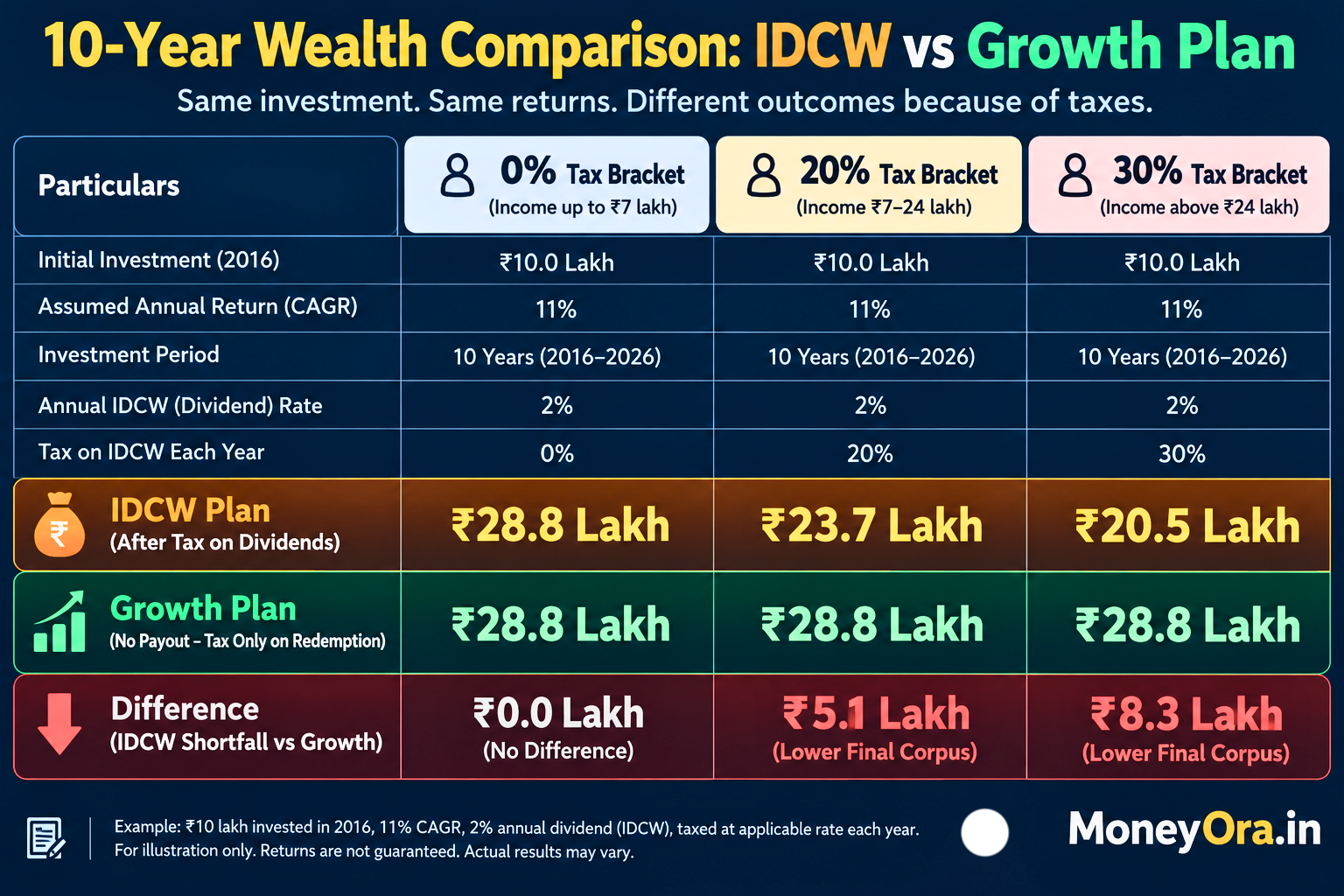
| Scenario | 0% bracket (below Rs 7L income) | 20% bracket | 30% bracket |
|---|---|---|---|
| Growth Plan 10-year corpus before LTCG tax | Rs 31.1 lakh | Rs 31.1 lakh | Rs 31.1 lakh |
| Growth Plan Tax at redemption approx | Rs 0 | Rs 2.5 lakh | Rs 2.5 lakh |
| Growth Plan Net corpus after tax | Rs 31.1 lakh | Rs 28.6 lakh | Rs 28.6 lakh |
| IDCW Plan 10-year corpus after annual tax drag | Rs 30.4 lakh | Rs 24.9 lakh | Rs 20.3 lakh |
| Advantage of Growth plan over IDCW | Rs 0.7 lakh | Rs 3.7 lakh | Rs 8.3 lakh |
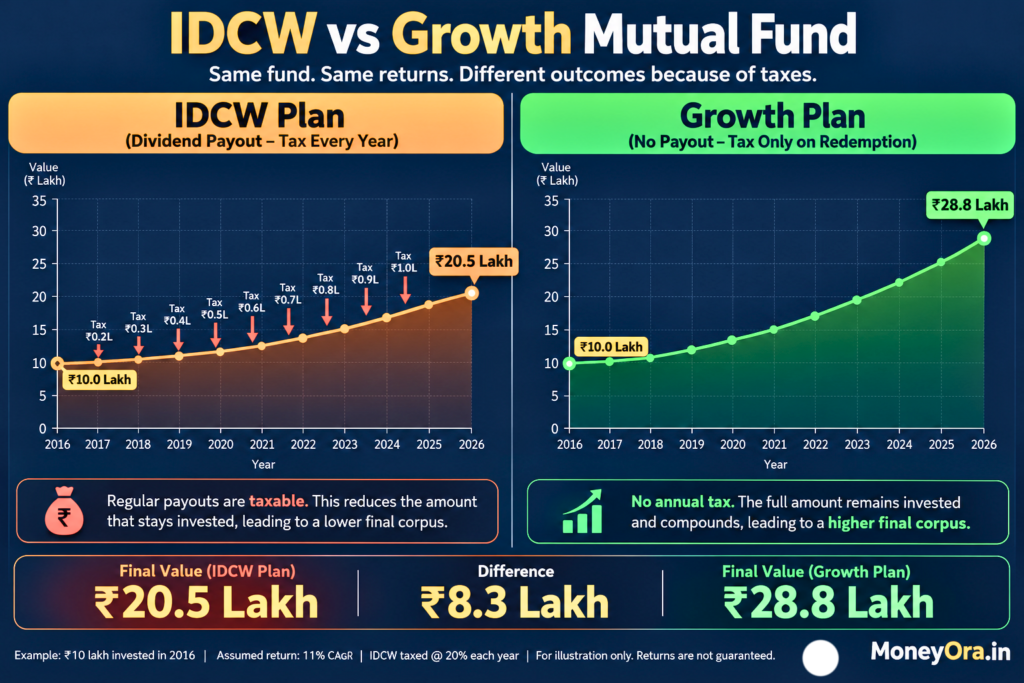
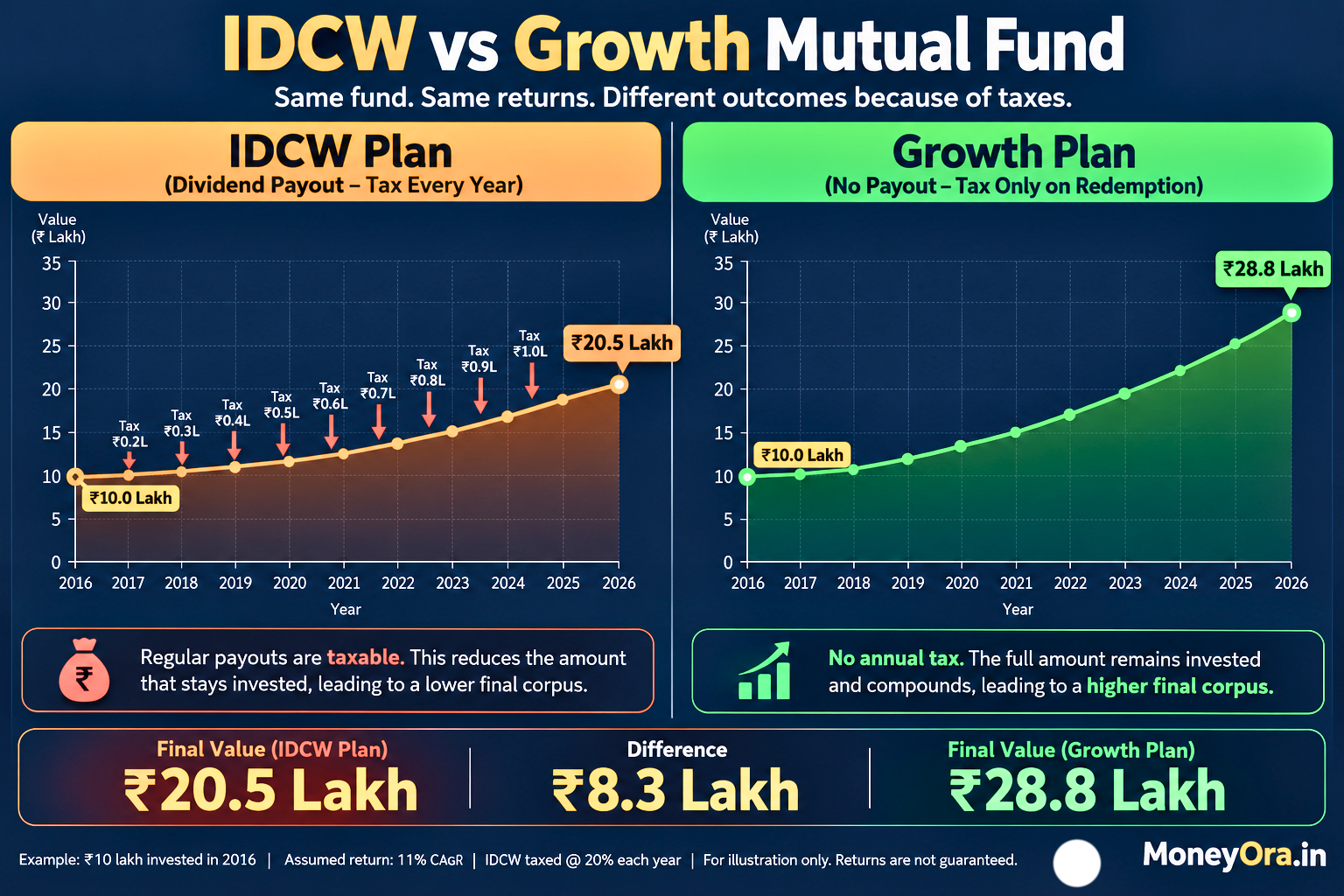
The Rs 8.3 lakh gap for the 30% bracket investor is not a rounding error. It is what annual slab-rate taxation does to a corpus over a decade. Each year Rs 80000 of IDCW is paid out. Rs 24960 leaves as tax (31.2% including cess). That Rs 24960 never compounds again in the fund
The compounding cost nobody calculates
Every Rs 1000 of IDCW payout is removed from the fund on the ex-date. It stops compounding permanently inside the fund At 12% annual return Rs 1000 today is worth Rs 3105 in 10 years. When your fund pays out Rs 1000 as IDCW you are not just losing Rs 1000. You are losing Rs 3105 of future corpus.
Now multiply that across monthly IDCW payouts over 20 years. A fund paying Rs 1000 per month in IDCW at 12% growth gives up roughly Rs 9.6 lakh in compounding value over 20 years compared to a Growth plan that keeps those Rs 1000 working inside the fund each month. This compounding loss is the invisible cost at the centre of every IDCW vs growth plan mutual fund 2026 comparison
This is why the IDCW vs growth plan mutual fund 2026 question matters so much for long-term investors. The IDCW vs growth plan mutual fund 2026 math is unforgiving over 20 years. The payouts feel like income at first glance The math says they are forfeited compounding.
To see exactly how compounding works on a lumpsum investment over any time period use the free lumpsum calculator on MoneyOra and compare the ending corpus with and without annual withdrawals.
When IDCW actually wins in 2026
There is one situation where IDCW vs growth plan mutual fund 2026 tips in IDCW’s favor.
If your total taxable income is below the Rs 7 lakh threshold under the new tax regime your effective slab rate is 0% after the rebate under Section 87A. In that case IDCW payouts are tax-free in your hands. The 12.5% LTCG you would pay on Growth plan redemptions actually makes the Growth plan more expensive at exit.
Who this applies to in the IDCW vs growth plan mutual fund 2026 context
- Retirees with no other income source whose total income including IDCW stays below Rs 7 lakh
- Homemakers or dependents with very low or no other income
- Students who inherited or received a gift of mutual fund units
If you fall into this group IDCW can genuinely be the better choice. The key number is your total income including the IDCW payout itself. If that combined figure crosses Rs 7 lakh you start paying slab tax on the portion above the threshold and the math shifts back toward Growth.
Everyone else in the 20% or 30% bracket should be in the Growth plan for the IDCW vs growth plan mutual fund 2026 question.
Debt fund special case where IDCW vs growth plan mutual fund 2026 is different
This nuance is completely absent from competitor articles and it matters for the IDCW vs growth plan mutual fund 2026 choice. Every article comparing IDCW vs growth plan mutual fund 2026 for equity funds needs a separate section for debt funds because the rules changed in 2023
For equity mutual funds Growth wins on tax because of the 12.5% LTCG rate after one year. For debt mutual funds the tax picture changed completely after April 1 2023.
Under Finance Act 2023 all gains from debt mutual funds bought on or after April 1 2023 are taxed at your income slab rate regardless of holding period. There is no LTCG benefit for debt funds anymore.
This means for debt funds
- IDCW payouts are taxed at slab rate as income (same as always)
- Growth plan redemption gains are also taxed at slab rate (new rule from 2023)
- The tax treatment is identical for both plans
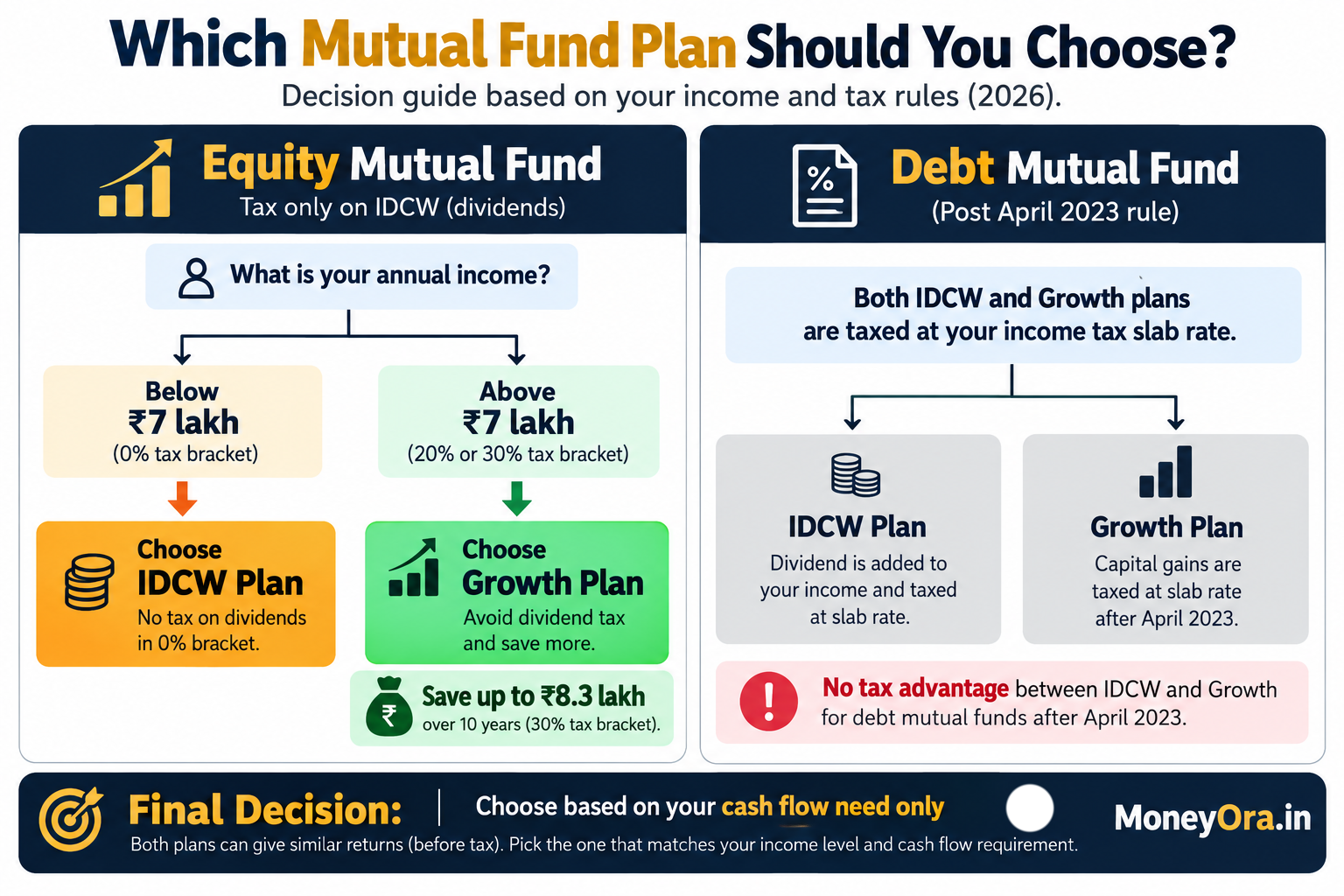
So for debt mutual funds the IDCW vs growth plan mutual fund 2026 decision is purely about whether you need regular cash flow. In the IDCW vs growth plan mutual fund 2026 comparison for debt the tax angle is now identical for both plans. There is no tax advantage to either plan. If you need income the IDCW plan delivers it without forcing you to redeem units. If you do not need income the Growth plan keeps your corpus intact and growing without the hassle of receiving (and accounting for) regular payouts.
This is a completely different decision framework from equity funds and no competing article explains it.
The LTCG harvest switch strategy to move from IDCW to Growth at zero tax
You are in IDCW. You want to switch to Growth but need a plan If you switch all your units at once you will likely trigger a large capital gains tax event. Here is how to do it gradually at zero cost.
Every financial year you can redeem (or switch) equity mutual fund units and pay zero LTCG tax on gains up to Rs 1.25 lakh under Section 112A (provided you have held those units for more than one year). This is the annual LTCG exemption that most investors underuse
You can use this exemption specifically to switch units from IDCW to Growth each year. The switch is treated as a redemption followed by a fresh purchase.
Year-by-year schedule for a Rs 10 lakh IDCW corpus switching to Growth (assuming 12% growth and Rs 1.25 lakh LTCG exemption used fully each year)
| Year | Units switched to Growth | LTCG tax paid | Remaining in IDCW |
|---|---|---|---|
| Year 1 | Rs 1.25 lakh of gains | Rs 0 | Rs 8.75 lakh |
| Year 2 | Rs 1.25 lakh of gains | Rs 0 | Rs 7.5 lakh |
| Year 3 | Rs 1.25 lakh of gains | Rs 0 | Rs 6.25 lakh |
| Year 4 | Rs 1.25 lakh of gains | Rs 0 | Rs 5 lakh |
| Year 5 | Rs 1.25 lakh of gains | Rs 0 | Rs 3.75 lakh |
| Year 6 | Rs 1.25 lakh of gains | Rs 0 | Rs 2.5 lakh |
| Year 7 | Rs 1.25 lakh of gains | Rs 0 | Rs 1.25 lakh |
| Year 8 | Remaining balance | Rs 0 | Rs 0 (fully switched) |
Total LTCG tax paid over 8 years to complete the full switch from IDCW to Growth is Rs 0.
A few practical notes worth keeping in mind before you switch The switch happens within the same AMC. You redeem IDCW plan units of Fund X and purchase Growth plan units of the same Fund X. Each switch resets the holding period for LTCG purposes on the new Growth units. So plan the timing to avoid short-term redemptions from the newly purchased Growth units.
This strategy for IDCW vs growth plan mutual fund 2026 switching is genuinely underused. If you have been in IDCW for three or more years the IDCW vs growth plan mutual fund 2026 switch via LTCG harvest is almost always the right move for a 20% or 30% bracket investor and no competitor article has laid it out with a year-by-year schedule.
How to check if you are in IDCW or Growth right now
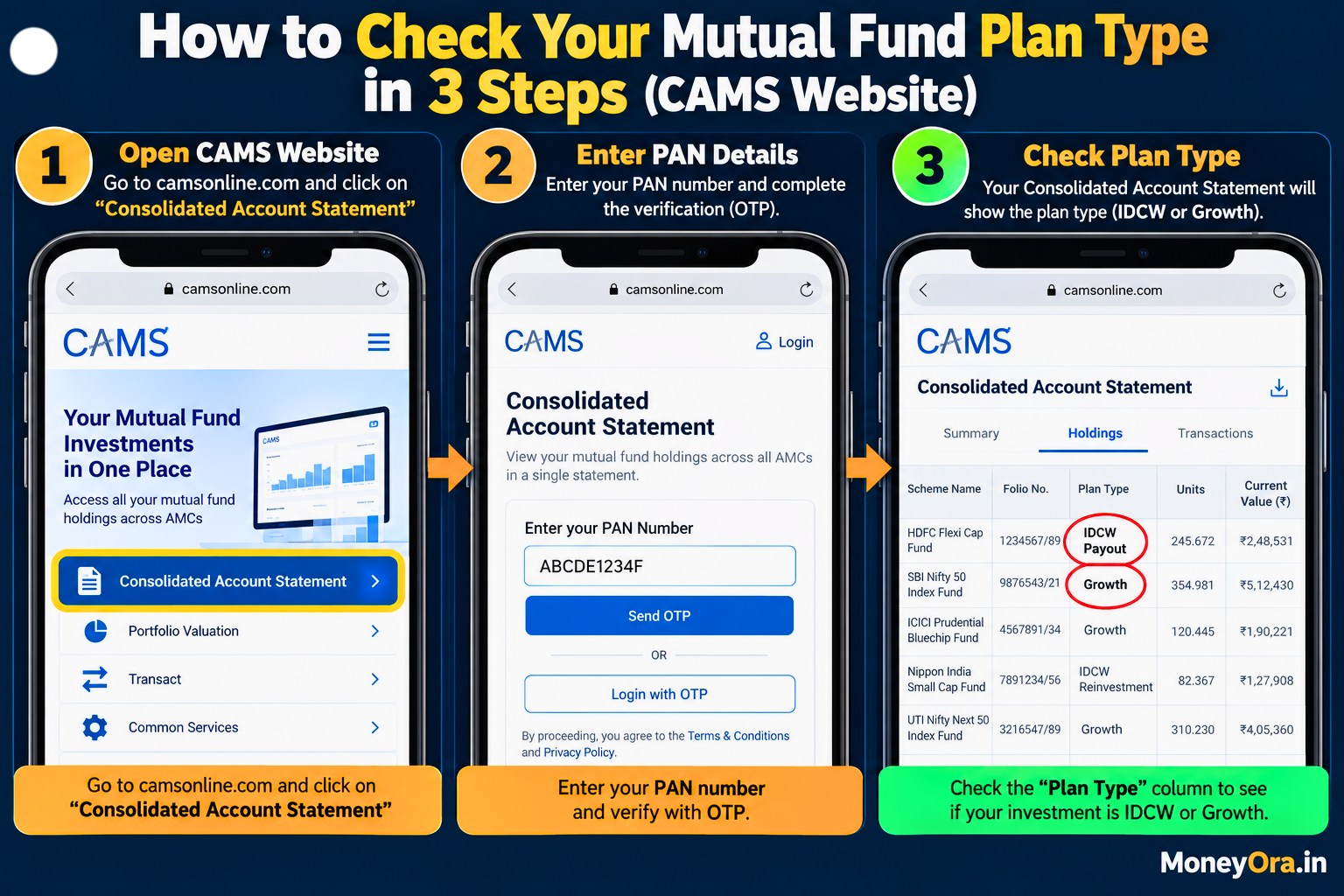
Millions of investors do not know which plan they hold and this is one of the most common starting points for anyone researching IDCW vs growth plan mutual fund 2026 Here are the exact steps.
Check on CAMS (for most fund houses)
- Go to camsonline.com
- Click on Investor Services then Consolidated Account Statement
- Enter your PAN and registered email or mobile number
- Select the date range (last 6 months works)
- Download the PDF statement
- Look for each fund entry. After the scheme name you will see either “Growth” or “IDCW Payout” or “IDCW Reinvestment”
Check on KFintech (for Kotak and other KFintech-serviced AMCs)
- Go to mfs.kfintech.com
- Select Investor Login
- Log in with your PAN and registered details
- Download your Consolidated Account Statement
- The plan type is listed alongside each scheme name
If you see IDCW Reinvestment that means your payouts are being reinvested as new units but the payout is still taxed at slab rate before reinvestment. You are not in Growth. The Growth plan and IDCW Reinvestment are not the same thing and confusing them is one of the costliest mistakes in the IDCW vs growth plan mutual fund 2026 decision
After you confirm your plan use the mutual fund calculator on MoneyOra to model the difference in wealth at your target retirement date under IDCW vs Growth.
IDCW vs growth plan mutual fund 2026
Is IDCW income or capital gain?
IDCW is treated as income from other sources under Section 56(2)(i) of the Income Tax Act. It is not capital gain and this single distinction is what creates the IDCW vs growth plan mutual fund 2026 tax gap This means it is added to your total income and taxed at your applicable slab rate. There is no indexation benefit or flat LTCG rate for IDCW payouts.
What is the TDS rate on IDCW payouts in 2026?
Under Section 194K the AMC deducts 10% TDS if your total IDCW from a single mutual fund scheme in a financial year exceeds Rs 5000. If you are in the 30% bracket you will still owe the additional tax when you file your ITR. If you are below the taxable threshold you file for a TDS refund.
Can NRIs choose between IDCW and Growth plan?
Yes. NRIs can invest in both plans. The TDS rate is different at 20% TDS for NRIs under Section 196A on IDCW payouts (not 10% as for resident Indians). For NRIs the Growth plan is usually even more clearly the better choice in the IDCW vs growth plan mutual fund 2026 comparison.
Does IDCW affect my ELSS tax benefit?
ELSS funds (Equity Linked Savings Schemes) also come in both IDCW and Growth options. The Section 80C deduction of Rs 1.5 lakh applies to both. However the IDCW payout from ELSS is fully taxable. For ELSS the Growth option is the standard recommendation since ELSS is designed for long-term wealth building inside the 80C basket. In the IDCW vs growth plan mutual fund 2026 framework ELSS is one of the clearest cases where Growth wins
What happens to IDCW if the fund has a bad year?
IDCW is not guaranteed. The fund distributes IDCW only from distributable surplus meaning realised gains. In a year where the fund makes losses or does not realise gains the IDCW can be zero. Unlike a fixed deposit or a bond coupon IDCW can stop or fall without notice and this uncertainty adds another layer to the IDCW vs growth plan mutual fund 2026 analysis This is why IDCW vs growth plan mutual fund 2026 comparisons based on “regular income” need to be read carefully because the income is not guaranteed.
The official SEBI circular that mandated the rename from Dividend to IDCW in 2021 is available on the SEBI website for investors who want to read the regulation directly.
The Association of Mutual Funds in India (AMFI) maintains a tax corner at amfiindia.com where you can verify the current tax treatment of mutual fund payouts for both resident Indians and NRIs.
Risks and important caveats
- All tax calculations in this article are based on current law as of FY 2026-27. Tax rules can change in future Budgets.
- The return projections at 12% are illustrative. Actual mutual fund returns vary based on market conditions and fund performance.
- LTCG exemption of Rs 1.25 lakh per year may be revised by the government. The switch strategy should be reviewed annually.
- Switching from IDCW to Growth within the same scheme is allowed without exit load only if you are past the exit load period (typically 1 year for equity funds). Check your fund’s specific exit load schedule.
- Consult a qualified tax advisor or SEBI-registered investment advisor before making any switch decision based on your specific income situation. The IDCW vs growth plan mutual fund 2026 tax rules summarised here are current as of FY 2026-27 but should be reverified before acting
For tax planning related to your full investment portfolio the income tax calculator on MoneyOra can help you estimate your total tax liability before and after the switch.
Summary and what to do with this information
The IDCW vs growth plan mutual fund 2026 decision comes down to your tax bracket and whether you genuinely need periodic income.
If your income is below Rs 7 lakh and IDCW payouts keep you below that threshold IDCW can be tax-efficient. If you are in the 20% or 30% slab the Growth plan builds substantially more wealth over time. The Rs 8.3 lakh gap over 10 years for a Rs 10 lakh investment in the 30% bracket is not theoretical. It is the cost of annual slab-rate taxation versus deferred LTCG tax.
If you are stuck in IDCW today and want to move to Growth the annual Rs 1.25 lakh LTCG harvest strategy gets you there in 6 to 8 years at zero tax cost. It takes patience but there is no rush-and-pay alternative.
Check your plan type on CAMS or KFintech today. Every month you stay in the wrong plan is another IDCW vs growth plan mutual fund 2026 tax cost you are paying unnecessarily If it says IDCW and you are in the 20% or 30% bracket start planning the switch.
Use the free calculator now on MoneyOra.in to model your own IDCW vs Growth corpus at retirement.
Frequently asked questions on IDCW vs growth plan mutual fund 2026
What is the difference between IDCW and Growth plan in mutual fund 2026?
In the Growth plan profits stay inside the fund and compound. In IDCW the fund pays profits out periodically and the NAV falls by the same amount. The key difference in 2026 is tax where IDCW payouts are taxed at your income slab rate (up to 30%) while Growth gains are taxed at LTCG 12.5% only when you redeem after one year.
Is IDCW the same as Dividend plan?
Yes. SEBI renamed the Dividend Plan to IDCW in April 2021. If you are still in a Dividend Plan your account statement now shows IDCW. It is the exact same plan under a new name.
Is IDCW taxable in 2026?
Yes. Every IDCW payout is added to your taxable income and taxed at your slab rate. For someone in the 30% bracket that means 31.2% (including cess) on every payout. This is the core tax problem at the heart of the IDCW vs growth plan mutual fund 2026 debate. The fund also deducts 10% TDS under Section 194K if your total IDCW from a single fund scheme exceeds Rs 5000 in a financial year.
When does IDCW make more sense than Growth?
IDCW makes sense when your total taxable income puts you in the 0% or 5% slab (approximately below Rs 7 lakh under the new regime). In that case your slab rate is lower than the 12.5% LTCG on Growth plan redemptions. For everyone in the 20% or 30% bracket Growth is almost always better.
How do I switch from IDCW to Growth without paying tax?
Switch Rs 1.25 lakh of IDCW units to Growth each financial year using the annual LTCG exemption under Section 112A. At this pace a Rs 10 lakh corpus is fully switched over 6 to 8 years at zero tax cost.
How do I check if I am in IDCW or Growth plan?
Log in to CAMS at camsonline.com or KFintech at mfs.kfintech.com and download your Consolidated Account Statement. The plan type is listed next to each fund name as either Growth or IDCW.
Is IDCW better than Growth for debt mutual funds in 2026?
For debt mutual funds bought on or after April 1 2023 both IDCW and Growth are taxed at your income slab rate. There is no LTCG benefit on debt funds anymore. The choice between IDCW and Growth for debt funds is therefore about cash flow needs rather than tax savings.
IDCW vs growth plan mutual fund 2026
The IDCW vs growth plan mutual fund 2026 debate generates thousands of searches every month in India. Here are the questions real investors are asking and direct answers.
Which is better IDCW or Growth for SIP in 2026?
For SIP investors in the 20% or 30% tax bracket the Growth plan is better in the IDCW vs growth plan mutual fund 2026 comparison. The IDCW vs growth plan mutual fund 2026 tax gap is especially large when you are running a SIP because each instalment is a separate holding period. Your SIP contributions grow without annual tax leakage. You pay LTCG at 12.5% only when you redeem after one year of holding each instalment. With IDCW each payout is taxed at slab rate in the year you receive it.
What happens to NAV in IDCW plan?
The NAV of an IDCW plan falls by the exact amount of the payout on the ex-dividend date. This NAV drop is one of the most misunderstood parts of the IDCW vs growth plan mutual fund 2026 comparison If NAV is Rs 40 and IDCW declared is Rs 4 per unit the NAV drops to Rs 36. You now have Rs 4 cash and Rs 36 NAV. The IDCW vs growth plan mutual fund 2026 comparison shows that the Growth plan NAV keeps compounding at the full Rs 40 without this interruption.
Is IDCW plan good for retirement income?
For retirement the IDCW vs growth plan mutual fund 2026 answer depends on your income level. If your retirement income (including IDCW) stays below Rs 7 lakh under the new regime IDCW can be tax-free. If your total income including pension and other sources pushes you above Rs 7 lakh the IDCW will be taxed and the Growth plan with a Systematic Withdrawal Plan (SWP) becomes more tax-efficient for retirement income.
Can I switch from IDCW to Growth in the same mutual fund?
Yes. In the IDCW vs growth plan mutual fund 2026 switch scenario you can switch within the same scheme (from IDCW option to Growth option of the same fund) at the same AMC. A switch is treated as a redemption and fresh purchase. It triggers LTCG (or STCG if held less than 12 months) on the gains. This is why the annual Rs 1.25 lakh LTCG harvest strategy described above is more tax-efficient than switching everything at once.
What is the IDCW vs growth plan mutual fund 2026 tax rate?
IDCW plan payouts are taxed at your income slab rate (0% to 30% plus cess). Growth plan gains on equity funds held more than 12 months are taxed at 12.5% LTCG above Rs 1.25 lakh exemption. Growth plan gains on equity funds held less than 12 months attract 20% STCG. For debt funds both plans are taxed at slab rate post April 2023.