

State-Backed Bonds 2026: Should You Chase the 9.15% Return?
A headline promising 9.15% from State Backed Bonds 2026, something described as state-backed, is the kind of number that makes people stop scrolling — it sounds too good for something wearing a government label, and too specific to be pure marketing. Both instincts are worth taking seriously, because the real answer sits in between: the yield is genuine, but it isn’t free money, and understanding why it moved this high tells you more about the actual risk than the headline number ever will. “gold vs government bonds — comparing two safe-haven assets”
This guide breaks down what State Backed Bonds 2026 (formally called State Development Loans, or SDLs) actually are, why yields on longer-tenure state paper have climbed toward and, in some recent auctions, above the 9% mark, and what the real trade-offs are before you consider one for your own portfolio. Nothing here is investment advice — it’s the factual landscape you need before making that call with a financial advisor. Check PAN Aadhaar Link Status 2026: Is Your PAN Still Active?
Before allocating anything to State Backed Bonds 2026 or any new fixed-income instrument, it’s worth checking how it fits your existing plan using MoneyOra’s FD Calculator or RD Calculator for a like-for-like comparison.
1. What State Backed Bonds 2026 Actually Means
State Backed Bonds 2026, formally State Development Loans (SDLs), are government securities issued by individual Indian state governments — not the central government — to fund their own spending and cover fiscal deficits. They’re a specific sub-category within the broader “G-Sec” (government securities) universe, auctioned through the Reserve Bank of India on behalf of each state.
For State Backed Bonds 2026, the distinction matters because government bond in casual conversation often gets used as shorthand for central government securities, when SDLs are a genuinely separate instrument issued by 28 different states and union territories, each with its own fiscal position, credit profile, and borrowing calendar. When a Karnataka SDL and a Bihar SDL both get called “state-backed bonds,” they’re structurally similar — same auction mechanism, same G-Sec categorization — but not identical in underlying state finances, even though both carry the same zero-risk-weight treatment under banking capital rules.
Why this isn’t the same as a corporate retail bond:
Recent high-profile retail bond issuances from private companies — coupons in the 9.25%–9.9% range have appeared on some corporate retail bonds — sit in a completely different risk category from state government paper, backed by a company’s own credit rating rather than a state government’s taxing and borrowing authority. If a “state-backed bonds” headline is describing SDLs specifically, that’s a meaningfully different risk profile than a company’s retail NCD, even when the advertised yields land in a similar range.
2. State Backed Bonds 2026: Where the 9.15% Number Comes From
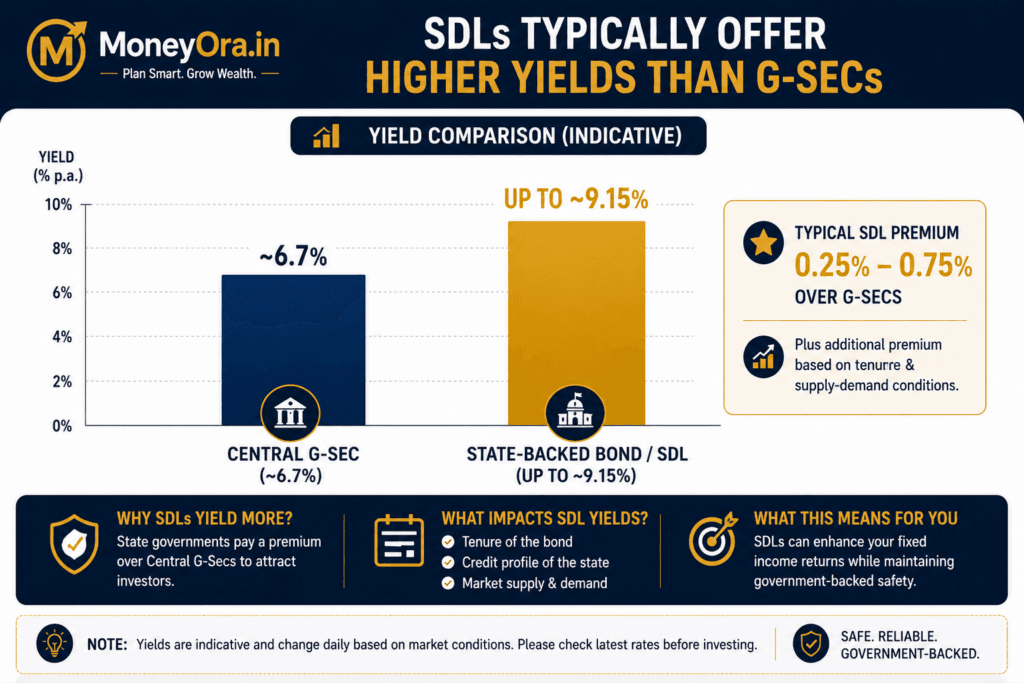
State Backed Bonds 2026 yields are typically quoted at a premium of roughly 25–75 basis points (0.25%–0.75%) over comparable-tenure central government securities, a spread that widens or narrows depending on how much states are borrowing at any given time and how the market is pricing that supply.
For State Backed Bonds 2026, with India’s 10-year benchmark G-Sec yield trading in the 6.6%–6.75% range through late 2025 and into 2026, a longer-tenure SDL carrying the higher end of its typical spread — plus additional premium for tenure and state-specific supply pressure — can land meaningfully higher than the benchmark, and specific auction cut-offs on longer-dated state paper have been reported approaching or exceeding the 9% mark during periods of unusually heavy state borrowing. A figure like 9.15% is plausible as a specific auction cut-off yield on a longer-tenure SDL from a particular state, at a particular point in a heavy-supply period — not a blanket rate every SDL offers.
The important caveat about State Backed Bonds 2026:
SDL yields move with every auction. A number reported in one week’s auction — even a genuine, RBI-published cut-off yield — is not a standing offer available indefinitely. Anyone acting on a specific headline yield should verify the current, live rate through RBI’s Retail Direct platform or a registered bond platform before assuming that number is still on the table.
3. Why State Backed Bonds 2026 Yields Rose
This is the part most State Backed Bonds 2026 headline coverage skips, and it’s the single most useful piece of context for judging whether the yield reflects opportunity or risk.
Heavy borrowing supply driving State Backed Bonds 2026 yields:
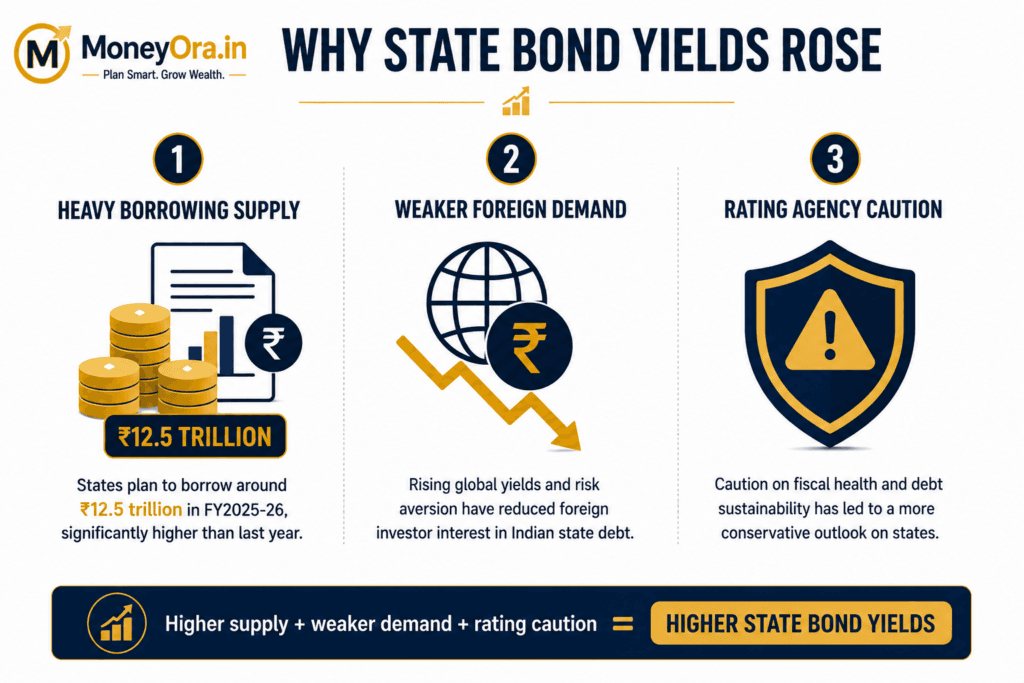
Indian states were expected to raise nearly ₹12.5 trillion through SDL issuances in FY 2025-26, and gross state borrowings reportedly rose almost 20% this fiscal year compared to the prior year, as tax revenue growth slowed while spending increased. More supply hitting the market at once generally requires higher yields to clear each auction — simple supply-and-demand, not a signal of imminent default risk on any specific state.
Rating agency caution on aggregate finances:
Fitch Ratings has flagged that while India’s growth outlook remains robust, government finances (including the state layer) continue to represent a credit weakness area worth monitoring, even as S&P separately upgraded India’s sovereign rating. This is commentary on the broader fiscal picture, not a specific default warning on any individual state’s SDL.
Currency and foreign flow dynamics:
A weaker rupee through parts of this period reportedly prompted foreign investors to reduce Indian bond holdings, removing a source of demand that would otherwise have absorbed some of the heavy new supply, adding further upward pressure on yields across the board, including SDLs.
What this combination means practically:
Higher SDL yields right now reflect a market pricing in heavy near-term supply and a genuinely more cautious fixed-income environment — not a specific, isolated red flag on the state-bond asset class itself. That’s a meaningfully different story than “yields are high because something is wrong with state government credit,” and it’s the distinction most “9.15%!” headlines skip entirely.
4. State Backed Bonds 2026 vs G-Secs vs Corporate Bonds: The Real Differences
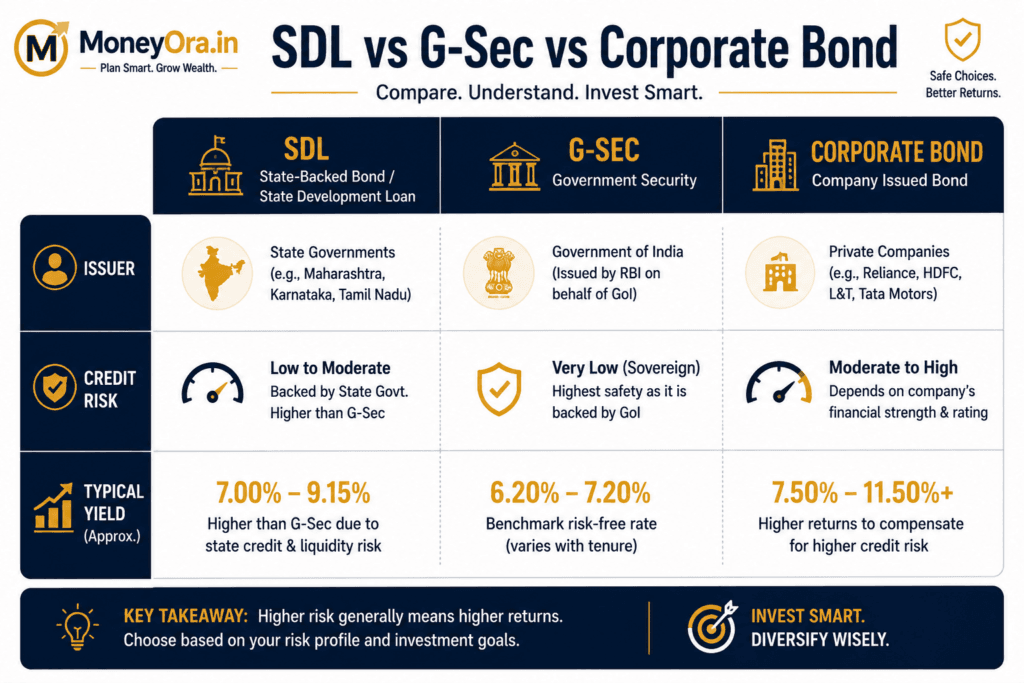
| Feature | SDL (State-Backed Bond) | Central G-Sec | Corporate Retail Bond |
|---|---|---|---|
| Issuer | Individual state governments | Central government | Private companies |
| Typical yield vs G-Sec | +0.25% to +0.75% premium | Benchmark | Varies widely, often higher, tied to company credit rating |
| Credit risk weight (for banks) | Zero, same as central G-Sec | Zero | Non-zero, varies by rating |
| Auction mechanism | RBI e-Kuber, on behalf of states | RBI, on behalf of central govt | Company-managed issuance, various platforms |
| Underlying risk | Individual state’s fiscal position | Sovereign (central govt) | Individual company’s business and credit health |
| Typical retail accessibility | RBI Retail Direct, bond platforms | RBI Retail Direct, bond platforms | Company-specific retail bond windows |
Assuming all three rows carry comparable safety just because “bond” appears in each description. Reserve Bank of India — official site (for SDL auction calendars and notifications) SDLs and central G-Secs share the zero-risk-weight treatment because both represent government borrowing; a corporate retail bond, however attractively yielding, carries the issuing company’s own credit risk and is not interchangeable with either government-backed category. Reserve Bank of India — RBI Retail Direct platform (for actual SDL auction participation)
5. Are State Backed Bonds 2026 Actually Safe?
State Backed Bonds 2026 are treated as carrying no credit risk in the same regulatory sense as central government securities — banks aren’t required to hold capital against them under prudential rules, reflecting the assumption that a state government backing the bond effectively won’t default in the way a company might.
That said, “no credit risk in a regulatory sense” isn’t the same as “no risk of any kind” for an individual investor. Two risk categories matter more than default risk here:
Interest rate risk: If you buy a longer-tenure SDL and market yields rise further afterward, the market value of your existing bond (if you needed to sell before maturity) would fall, since new bonds would offer a more attractive rate. This doesn’t affect you if you hold to maturity, but it matters if there’s any chance you’d need to exit early.
Liquidity risk: SDLs, especially from smaller states or less-traded issuances, don’t always have deep secondary market liquidity. Selling before maturity might mean accepting a less favorable price than the bond’s theoretical value, simply because there aren’t many buyers actively quoting that specific issuance at any given moment.
State-specific fiscal health still matters at the margin:
While the regulatory framework treats all SDLs similarly, an individual state’s specific fiscal position — its debt-to-GSDP ratio, revenue trends, and spending commitments — is still worth a glance before committing a large sum to a single state’s paper, even though outright default risk is considered very low across the category.
6. How to Buy State Backed Bonds 2026 as a Retail Investor
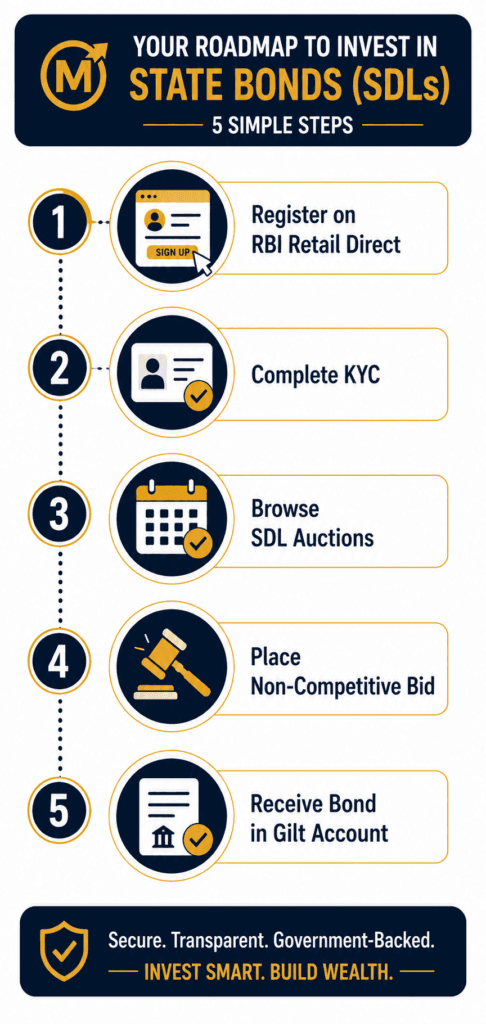
Method 1 — RBI Retail Direct (for State Backed Bonds 2026):
- Register for a free Retail Direct Gilt (RDG) account directly with the RBI at rbiretaildirect.org.in.
- Complete KYC using PAN, a bank account, and standard identity documents.
- Browse upcoming SDL auctions listed on the platform, which shows the issuing state, tenure, and auction date in advance.
- Place a non-competitive bid for the SDL you want — retail investors typically participate in the non-competitive segment, receiving the yield determined by the auction’s cut-off.
- Funds are debited and the bond is credited to your RDG account upon successful allotment.
Method 2 — Registered Online Bond Platforms:
Several SEBI-registered Online Bond Platform Providers (OBPPs) list SDLs and other government securities for retail purchase, often with a more familiar app-based interface than RBI’s direct platform, sometimes allowing purchase of bonds already trading in the secondary market rather than only new auctions.
Minimum investment:
SDLs are typically available in relatively small denominations through the retail-focused platforms and RBI Retail Direct, making them accessible without requiring a large lump sum, though the exact minimum varies by specific issuance and platform.
Once you’ve identified a specific SDL and its yield, compare the actual take-home return against other fixed-income options using MoneyOra’s FD Calculator or RD Calculator before deciding where your money is best placed.
7. State Backed Bonds 2026 vs FD vs Debt Mutual Funds: Return Comparison
| Instrument | Typical Current Yield Range | Credit Risk | Liquidity | Taxation |
|---|---|---|---|---|
| State-Backed Bonds (SDL) | ~7%–9%+ depending on tenure and auction | Effectively zero (state-govt backed) | Low to moderate secondary market liquidity | Interest taxed annually at slab rate |
| Bank Fixed Deposit | ~6.25%–7% | Very low (DICGC-insured to ₹5 lakh) | Low if broken early (penalty); otherwise fixed term | Interest taxed annually at slab rate |
| Liquid Mutual Fund | ~6.5%–7.5% | Low, market-linked | High (T+1 or instant redemption) | Taxed only on redemption, at slab rate |
| Corporate Retail Bonds | ~8%–11%+ depending on rating | Varies with issuer credit rating | Often lower than government paper | Interest taxed annually at slab rate |
What this table means in practice:
State Backed Bonds 2026 can offer a genuine yield edge over a bank FD for a similar “government-adjacent” risk comfort level, but that edge comes with materially lower liquidity than a liquid fund and, depending on tenure, real interest rate risk if you might need to exit early. Securities and Exchange Board of India (SEBI) — for guidance on registered investment advisors and Online Bond Platform Providers The comparison isn’t “SDL beats FD, case closed” — it’s a trade-off between yield, liquidity, and holding-period certainty that depends on what the money is actually for.
8. State Backed Bonds 2026: Key Risks Every Investor Should Understand
- State Backed Bonds 2026 are not a same-day liquid instrument: Unlike a liquid mutual fund or savings account, exiting an SDL before maturity depends on finding a secondary market buyer, which isn’t guaranteed to happen quickly or at a favorable price.
- Interest rate risk on longer tenures: A 10-year or longer SDL locks in today’s yield; if rates rise further, the bond’s mark-to-market value falls, which only matters if you need to sell before maturity, but is worth understanding regardless.
- Yields can move down as fast as they moved up: The current elevated yield environment reflects heavy borrowing supply and cautious market sentiment — if that supply-demand balance shifts (a rate-cut cycle, lower state borrowing calendars), future SDL auctions could offer meaningfully lower yields than what’s available today.
- Taxation reduces the headline number: Interest income from SDLs is taxed annually at your income slab rate, meaning the actual after-tax return for a higher-bracket investor is noticeably below the advertised coupon.
- State-specific fiscal variation, however small: While default risk is treated as very low across the category, states do vary in debt burden and fiscal discipline; concentrating a large sum in a single state’s paper isn’t identical to diversifying across several.
- Headline yields are auction-specific and time-sensitive: The exact number driving a “state-backed bonds offering 9.15%” headline reflects one auction at one moment — always verify the current live rate before treating a reported figure as a standing offer.
Should You Actually Chase State Backed Bonds 2026?
The honest answer is that a 9%-plus yield on State Backed Bonds 2026 is real, achievable, and meaningfully better than a bank FD for an investor comfortable with the trade-offs — but it’s not a free upgrade over an FD with no cost attached. The cost shows up as lower liquidity, real (if generally low-probability) mark-to-market volatility if you need to exit early, and the same annual-taxation drag that applies to FD interest.
The more useful framing than “should I chase this yield” is “what is this specific money for.” Money you’re confident you won’t need before the bond’s maturity date, and where you’re comfortable holding a government-backed instrument for a fixed multi-year term, is a reasonable fit for an SDL at today’s elevated yields. Money that might need to come out early — an emergency fund, a near-term goal — is a poor fit regardless of how attractive the headline number looks, precisely because SDLs aren’t built for that kind of flexibility.
It’s also worth remembering that today’s elevated SDL yields exist because of a specific, identifiable set of 2025-26 conditions — heavy state borrowing supply, cautious foreign investor flows, a weaker rupee — not because SDLs as an asset class permanently repriced higher. If those conditions ease, future auctions may not offer the same yield, which is a reasonable argument for locking in a longer tenure now if the money genuinely fits that time horizon, but not a reason to assume this yield is the new normal indefinitely.
Assumptions stated: this reflects publicly available market data and reporting as of early-to-mid 2026 and is not a projection or guarantee of future yields, state fiscal performance, or investment returns.
State Backed Bonds 2026
State Backed Bonds 2026 offering yields near or above 9% reflect a genuine, RBI-auctioned instrument with a strong regulatory safety profile, elevated right now by heavy state borrowing supply and a cautious broader bond market — not a hidden catch or a mislabeled risky product. The real considerations are liquidity, tenure fit, and taxation, not credit risk in the way that phrase usually gets used. Whether it’s right for you depends entirely on whether the specific money you’d commit can genuinely sit locked up for the bond’s full term, and that’s a decision worth making with a clear-eyed comparison against FDs, liquid funds, and your own cash-flow needs — ideally with input from a SEBI-registered financial advisor. Ministry of Finance, Government of India — for state fiscal and borrowing policy context
This article is for educational and informational purposes only and does not constitute investment advice or a recommendation to buy, sell, or hold any security. Bond yields, auction results, and state fiscal data change frequently; verify current figures directly through RBI Retail Direct or a registered bond platform before making any investment decision.
FREQUENTLY ASKED QUESTIONS
1. What are state-backed bonds in India?
State-backed bonds, formally called State Development Loans (SDLs), are government securities issued by individual Indian state governments through RBI auctions to fund state spending and cover fiscal deficits. They’re a sub-category of the broader G-Sec (government securities) market, distinct from central government bonds.
2. Is the 9.15% return on state-backed bonds guaranteed?
The yield reflects a specific auction’s cut-off rate at a specific point in time, generally on a longer-tenure state bond during a period of heavy state borrowing supply. It’s a genuine, real yield when reported, but it’s not a standing offer — SDL yields move with every new auction, so always verify the current live rate before assuming a headline figure is still available.
3. Are state government bonds (SDLs) safe to invest in?
SDLs carry a zero risk-weight under banking capital rules, similar to central government securities, reflecting very low default risk. However, “safe from default” doesn’t mean “zero risk” for an individual investor — liquidity risk and interest rate risk if selling before maturity are real considerations.
4. How is an SDL different from a regular government bond (G-Sec)?
G-Secs broadly include both central government bonds and SDLs. The key difference is the issuer: central G-Secs are issued by the Government of India, while SDLs are issued by individual state governments, typically at a yield premium of 0.25%–0.75% over comparable central G-Secs.
5. Why did state bond yields rise so much in 2025-26?
Primarily due to heavy state borrowing supply (nearly ₹12.5 trillion planned for FY 2025-26), reduced foreign investor demand amid rupee weakness, and rating agency caution on aggregate government finances — not a specific default risk signal on any individual state.
6. How can I buy state-backed bonds as a retail investor in India?
The two main routes are RBI’s Retail Direct platform (rbiretaildirect.org.in), which lets you participate directly in SDL auctions via a free Gilt account, or SEBI-registered Online Bond Platform Providers that list SDLs for retail purchase, sometimes including secondary market issuances.
7. Are state-backed bonds better than a fixed deposit?
SDLs can offer a meaningfully higher yield than a typical bank FD, but with lower liquidity if you need to exit before maturity, and the same annual-taxation treatment on interest. Whether it’s “better” depends on whether the money can genuinely stay locked up for the bond’s full term.
8. Is interest from state-backed bonds taxable?
Yes. Interest income from SDLs is taxed annually at your income slab rate, similar to FD interest, which reduces the effective after-tax return compared to the advertised coupon rate, particularly for investors in higher tax brackets.
9. Can I sell a state-backed bond before it matures?
In principle, yes, through the secondary market, but liquidity varies and isn’t guaranteed to be deep, especially for smaller or less-traded state issuances. Selling early may mean accepting a price different from the bond’s theoretical value depending on prevailing market conditions.
10. Which state’s bonds are the safest to invest in?
All SDLs carry the same zero-risk-weight regulatory treatment, but individual states do vary in debt-to-GSDP ratio and fiscal discipline. Investors who want to account for this can review a state’s fiscal indicators before a large allocation, though outright default risk is considered very low across the category as a whole.
A high headline yield is only worth chasing once you understand what’s actually driving it and whether the trade-offs fit your money’s timeline. Compare state-backed bond returns against your other fixed-income options before deciding. Use the free FD Calculator now on MoneyOra.in.
This article is for educational and informational purposes only and does not constitute investment advice. Please consult a SEBI-registered financial advisor before making any investment decisions.


Pingback: Gold Reserve in India Hits 880 Tonnes: Why Is RBI Bringing Gold Back Home - MoneyOra